Part 1: Songs of the Lincoln Brigade performed by Pete
Seeger, Tom Glazer, Baldwin (Butch) Hawes, Bess Hawes
1. Jarama Valley 2:47
(lyrics adapted from Alec McDade)
2. Cookhouse / The Young Man from Alcalá 2:37
(Cookhouse: Leonard P. Breedlove–Andrew Young)
3. Quartermaster Song 2:02
(Lewis E. Jones)
4. Viva la Quince Brigada (Long Live the 15th
Brigade) 2:45
5. El Quinto Regimiento (The Fifth Regiment) 2:18
6. Si Me Quieres Escribir (If You Want to Write
to Me) 2:36
Volume
one
Part 2: Six Songs for Democracy sung by Ernst Busch
and chorus
7. Los Cuatro Generales (The Four Generals) 2:37
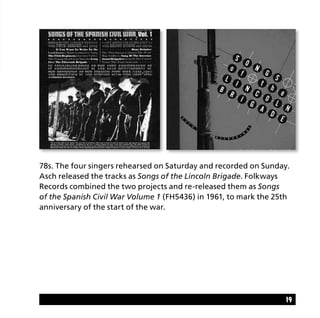
(Federico García Lorca)
8. Die Thälmann-Kolonne (The Thaelmann
Column) 2:57
(Peter Daniel–Karl Ernst)
9. Hans Beimler 2:21
(Friedrich Silcher–Ernst Busch)
10. Das Lied von der Einheitsfront (Song of the
United Front) 2:42
(Hanns Eisler–Bertolt Brecht/Deutscher Verlag fuer Musik)
11. Lied der Internationalen Brigaden (Song of the
International Brigades) 2:32
(Carlos Palacio–Rafael Espinosa–Erich Weinert)
12. Die Moorsoldaten (The Peat-Bog Soldiers) 2:58
(Rudi Goguel –Johann Esser–Wolfgang Langhoff)
Songs of the Spanish Civil War, Volumes 1 & 2
SFW CD 40188
p© 2014 Smithsonian Folkways Recordings
4
Part 1: Woody Guthrie; Ernst Busch accompanied
by chorus and orchestra
13. Jarama 2:52
(Adapted by Woody Guthrie / Bug Music, BMI–Pete
Seeger / Stormking Music, BMI–Lee Hays, BMI )
14. On the Jarama Front 2:43
(David Martin)
15. Ballad of the XI Brigade 3:07
(Grigori M. Schneerson–Ernst Busch)
16. Hans Beimler, Comrade 2:51
(Friedrich Silcher–Ernst Busch)
17. Die Thälmann-Kolonne (The Thaelmann
Column) 2:42
(Peter Daniel–Karl Ernst)
Volume
two
5
Part 2: “Songs We Remember” sung by the people of
Catalonia, Seville, and Asturias, Spain
18. Santa Espina 2:22
(Enric Morera–Angel Guimerà)
19. Sevillanos 2:24
20. The Road to Avilés 2:40
Part 3: From “Behind the Barbed Wire” sung by Bart van der
Schelling and the Exiles Chorus, directed by Earl Robinson
21. La Guardia Rossa (The Red Guard) 2:30
(Raffaele Offidani)
22. Wie Hinterm Draht (Behind the
Barbed Wire) 2:51
(Eberhard Schmitt)
23. La Joven Guardia (The Youthful
Guardsmen) 2:19
(Gaston Mardochée Brunswick–Saint-Gilles)
24. Au Devant de la Vie (Toward the New Life) 2:45
(Jeanne Perret / SACEM–Dmitri Shostakovitch /
G. Schirmer, Inc., ASCAP)
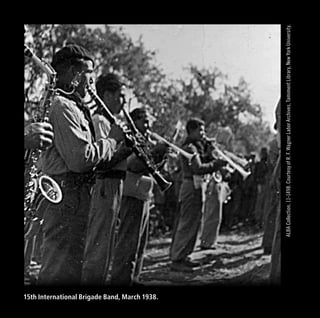
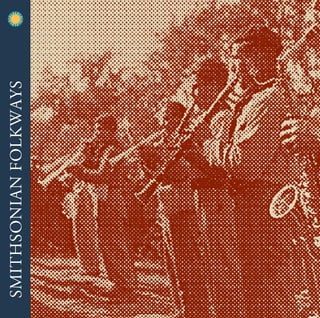
ALBACollection,11-1498.CourtesyofR.F.WagnerLaborArchives,TamimentLibrary,NewYorkUniversity.
15th International Brigade Band, March 1938.
7
T
he Spanish Civil War was sung to me long before I knew
what it was about. I grew up in the 1960s. When my
parents would invite friends over for a dinner party, the
conversations inevitably turned to the war in Vietnam.
After dinner, my father, folk singer Tom Glazer, would get
out his guitar and play. Often, someone would ask him to
perform songs from another very different war, the Span-
ish conflict of the 1930s. “Do the one about the four generals” was a
common request. “Los cuatro generales, los cuatro generales . . .” my
father would sing, and a reverent hush would fall over the room. Eyes
would close; people would hum or sing along. This music created an
emotional atmosphere I could neither fathom nor ignore. Years later,
the songs led me to the history. I found out who the four generals
were, the nature of their betrayal of the Spanish people, and why, a
few verses later, the song called for their hanging on Christmas Eve.
I also came to understand why this music had such an effect.
introduction
peter glazer
8
For so many on the Left,
the cause of the Spanish
Republic in its fight against
fascism between 1936 and
1939 was almost sacred,
and these songs were their
hymnal.
	 The war in Spain moved
and inspired a generation
of liberal and left-leaning
people around the globe.
Franco had no idea what
passions his coup against
the democratically elected
government of Spain
would unleash. He thought
he would control Spain
in weeks. It took three
bloody years, and he only
succeeded thanks to the
military assistance of Hitler and Mussolini, and, of course, the other
three insurgent Spanish generals of Franco’s cadre: Varela, Mola,
and Queipo de Llano. To support the Spanish Republic, roughly 2,750
Americans went to Spain and joined the fight against Franco, along
with 30,000 other volunteers from 52 countries. “I sit down to have
9
RobertMunsonTaylorCollection.CourtesyofR.F.WagnerLaborArchives,TamimentLibrary,NewYorkUniversity.
Veterans of the Abraham Lincoln Brigade parade in New York City: Vaughn Love,
Bill Van Felix (banner), unknown, Hy Wallach (sunglasses), Leonard Lamb
(foreground), Len Levenson (beret), Moe Fishman (banner). June 1984.
my breakfast,” American volunteer Peter Frye recalled of a morning
in 1936, “open the paper . . . . I don’t want to romanticize this, but I
said, ‘I can’t live in this world if I don’t fight against this kind of thing.
I can’t accept it‘” (The Good Fight 1983). The actions of the Abraham
Lincoln Brigade—the name taken on by the American volunteers—
quickly developed into an icon of radical activism: doing the right
thing for the right reasons against all odds, whatever the risk. The
fight against Franco became known as “the good fight.”
	 Thousands of books have been written about the Spanish Civil
War and the historical events that set the stage for 32 months of
vicious struggle. To offer a brief overview: Spain had been a monar-
chy for centuries, with the exception of its failed first Republic, 1873
to 1874. The power had rested firmly with the king, the army, the
Catholic Church, and the wealthy landowners. In 1931, though, elec-
tions in Spain heavily favored Republican parties interested in more
egalitarian leadership. Two days after the voting, on April 14, the king
abdicated and the second Spanish Republic was proclaimed. Suddenly,
those traditionally in power were legally subject to the will of the peo-
ple. The new government introduced reforms separating church and
state, redistributing land, and de-militarizing the government. Seeing
their well-being and long-standing control threatened, the traditional
powers resisted the changes, and parties on the Right successfully
gained control of the government in the elections of 1933. But many
on the Left were dissatisfied with the new reforms as well. The anar-
chists were particularly unruly, and factions on both sides struggled
10
11
for dominance. The Right, led by Gil Robles, dismantled many of the
progressive reforms begun in 1931, which led to a series of uprisings.
The most significant of them occurred in the province of Asturias,
where the miners struck and were brutally put down by troops under
the command of one Francisco Franco, already recognized as a ruth-
less and efficient military leader. But the working people were under
attack, and they were fighting back, and many thousands of union
workers and their kith and kin across Europe and in the United States
took notice.
	 Other fascist dictators were consolidating power and expanding
their influence during the same period. In 1931, Japan’s Kwangtung
army attacked Manchuria. Hitler became chancellor of Germany early
in 1933. Mussolini offered to support the Spanish monarchists in
1934 if they rebelled against the standing government. In October of
1935, Italy invaded Abyssinia, now Ethiopia, with bombings that were
among the first to purposely attack civilian populations from the air.
In the United States, blacks in Harlem began to organize to defend
Abyssinia, but the Italians took power too quickly. Hitler began legal
persecution of the Jews with the Nuremberg Laws in 1935, and
occupied the Rhineland in 1936.
	 That same year, the Spanish government changed hands again,
when the Popular Front, a coalition of left, liberal, and centrist parties,
won convincingly. Violence, unrest, and assassinations continued on
both sides, but the Popular Front victory seems to have been the last
straw for the forces of reaction, already plotting rebellion. Franco
announced his war on the Republic from Morocco on July 17, 1936, and
street battles began throughout Spain. Franco and his army of Moorish
conscripts and Foreign Legionnaires crossed the Mediterranean ten
days later in transport planes provided by Hitler and Hermann Goering.
Many of the military units across Spain followed Franco’s lead to wrest
control of the country from the popularly elected government—but
not all of them. Some soldiers remained loyal to the Republic. The most
impressive response in Spain came from the people themselves. In city
after city, citizens resisted. They took to the streets in large numbers to
challenge the military’s actions, and eventually gained control in major
cities such as Madrid, Barcelona, and Valencia.
	 The civil war in Spain was international news. With Hitler in power,
and threatening or annexing neighboring lands, democratic Spain
was a powerful symbol. By responding in such numbers to put down
Franco’s rebellion, the Republicans proved that resistance to fascism
was possible, that capitulation could not be assumed. When Franco
initiated his coup and it soon became clear that he had Hitler and Mus-
solini’s backing, the bravery of the Spanish people in holding off this
fascist onslaught was all the more compelling. “Madrid, qué bien re-
sistes / mamita mía / los bombardeos,” a verse of “Los cuatro generales”
proclaims. And then: “De las bombas se ríen / mamita mía, / los madrile-
ños.” “Madrid,” it cheers, “little mother, how well you withstand the
bombing. The people of Madrid laugh at the bombs.” In the words of
veteran Ed Bender, Spain represented “one glimmer of hope in a world
rushing toward fascist domination” (quoted in Carroll 1994, 10).
12
Yet none of the Western democracies came to the aid of the
Republic, only the Soviet Union and Mexico. With the communists in
Spain a significant force in the Republican government, and the Soviet
Union fearing the loss of one of the last holdouts against fascism, the
Communist Party recruited volunteers through cells around the world
for an International Brigade. This became a multinational army of anti-
fascists organized to help defend Spain against Franco and his insur-
gent generals, the Italian troops and their hardware, and the German
air force. Twenty-six hundred Americans took up arms, supported by
an additional 150 doctors, nurses, drivers, and technicians. “It was an
army unprecedented in American history, based on ideology, moti-
vated by principles,” Peter N. Carroll states in his definitive history of
the Abraham Lincoln Brigade (1994, 14). Others had already mobilized;
in early November 1936, fascist troops attempted to take Madrid but
were stopped by a combination of local militias, Republican forces, and
the first anti-fascist volunteers from nearby France and Germany.
	 From the doctrinaire and well-organized communists to the
intractable anarchists, the liberals and pacifists to the socialists, almost
everyone on the Left agreed that the loss of Spain to Franco and the
fascists would be a disaster, and most believed that the Republic could
be saved.
	 “History was going our way,” literary critic Alfred Kazin wrote,
optimistically. “Everything in the outside world seemed to be moving
toward some final decision, for by now the Spanish Civil War had
begun, and every day felt choked with struggle” (quoted in Carroll
13
14
1994, 14). By July 31, just two weeks after the war began, the communist
paper the Daily Worker ran a photograph of a huge rally in New York
City in support of the Republic. Thousands of fists were raised in the
Republican salute.
	 Less than two months later, however, the leaders of the Western
democracies formed the Non-Intervention Committee. Germany and
Italy were members but supplied Franco with troops, arms, and planes
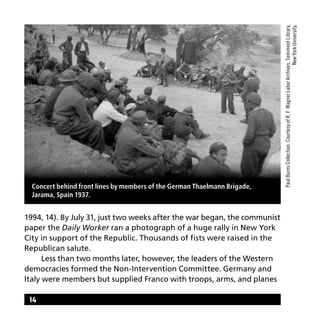
PaulBurnsCollection.CourtesyofR.F.WagnerLaborArchives,TamimentLibrary,
NewYorkUniversity.
Concert behind front lines by members of the German Thaelmann Brigade,
Jarama, Spain 1937.
15
nonetheless. The U.S. government established an arms embargo on
Spain on January 8, 1936, and three days afterward made it illegal for
citizens to travel there. That did not stop American volunteers from
participating in the struggle. The first group departed New York City
on the day after Christmas, 1936, and volunteers continued to travel
overseas for months, mostly through the efforts of the CPUSA, the U.S.
Communist Party. “The resistance of the Spanish people and their allies
to international fascism represented the last opportunity to avert the
global calamity of World War II,” according to historian and American
volunteer Arthur H. Landis (1989, xv). Spain became the first battle-
ground for the most significant and deadly ideological conflict of the
century, a model for Popular Fronters and their supporters in many
countries, and a source of hope amidst a world gone awry.
Ill-equipped and, in the early going, ill trained, Americans fought in
the battles of Jarama and Brunete, at Teruel in 1937, and on the Aragon
front in 1938. They had many triumphs and gained the respect of hard-
ened anti-fascists, but history in the end did not go their way. Most
students of the war agree that Franco could not have won on his own,
but Hitler and Mussolini simply tipped the scales too far, and eventually
had the advantage. The Lincolns were part of the “Great Retreats” as
Franco and the fascists gradually took more of the country, and then
they participated in the Ebro offensive, the last major Republican
advance in which the Internationals served. Late in 1938 Spanish Prime
Minister Negrín ordered the International volunteers out of Spain in
the hope that, by removing them, the Non-Intervention Committee
would be forced to address the illegal support Franco was receiving
from Germany and Italy, but his effort was to no avail. By March of
1939, Franco had finally triumphed; his army entered Madrid. Hitler
invaded Poland six months later, beginning World War II.
	 In his poem, “Spain,” W. H. Auden wrote, “Our thoughts have
bodies” (Auden 1980, 99). Of the 2,750 U.S. volunteers in Spain, one-
third lost their lives, but for many of those who returned, the struggle
continued. “The war in Spain is over in the field of action,” Republican
General Vincente Rojo said in 1939, “but not in the field of thought”
(Landis 1967, xv). And this “field of thought,” so aptly credited by
Rojo, produced its own kind of action on the home front. Among
other things, it began and drove a vigorous commemorative process
now 75 years old, in which the musical legacy of the war continues to
be a centerpiece. To this day, songs of the Spanish Civil War are sung
at annual gatherings in New York City and San Francisco. The songs
bring this activist history forward at a time when the causes are no
less urgent, and the enemies of freedom no less dangerous.
16
17Soldiers Monument: “To Our Fallen Comrades—Our Victory Is Your Vengeance June 1937.” ALBACollection36.CourtesyofR.F.WagnerLaborArchives,TamimentLibrary,NewYorkUniversity.
18
Volume 1
Songs of the Lincoln Brigade and
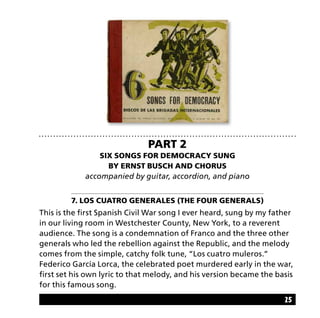
Six Songs for Democracy
S
ix Songs for Democracy was originally recorded in Spain in
June 1938 during an air raid on Barcelona. One of the records
bore a sticker reading: “The defective impression of this
record is due to interruptions of electric current during an
air raid.” The soloist and organizer of this recording is the
great German working-class tenor Ernst Busch, backed by a
chorus of members of the Thaelmann Battalion (11th I.B.).
It was released in the United States by Keynote Recordings in 1940,
to great success. Moses Asch believed that an American recording of
Spanish Civil War songs could do as well. He contacted Pete Seeger
and asked him to put a group together. On furlough from the army
one weekend in 1943 or 1944, Seeger gathered fellow folk singers Tom
Glazer, Baldwin (Butch) Hawes, and Bess Lomax Hawes to record three
track
nOtes
19
78s. The four singers rehearsed on Saturday and recorded on Sunday.
Asch released the tracks as Songs of the Lincoln Brigade. Folkways
Records combined the two projects and re-released them as Songs
of the Spanish Civil War Volume 1 (FH5436) in 1961, to mark the 25th
anniversary of the start of the war.
20
ALBACollection.CourtesyofR.F.WagnerLaborArchives,TamimentLibrary,NewYorkUniversity.
Camp kitchen: Man holding ladle over a pot of soup, undated.
21
Part 1
Songs of the Lincoln Brigade
Pete Seeger, banjo, vocals; Tom Glazer, guitar, vocals;
Baldwin (Butch) Hawes, guitar, vocals; Bess Hawes, vocals
1. Jarama Valley
Tom Glazer, lead vocals
The melody is the familiar “Red River Valley,” which is usually
associated with the Red River in Texas but had much earlier origins
in Canada, where a Red River flows through Manitoba, and possibly
even before that in the United States, referring to the Mohawk River
Valley. The Spanish Civil War version is often credited to Alec McDade,
a Scottish volunteer who wrote a wonderfully pointed satire criticizing
the ill treatment of the International Brigaders (IBs) by their own
leadership during the battle. The popular version Tom Glazer sings here
is a far cry from McDade’s, as the last two lines of the first verse make
clear: “It was there that we wasted our manhood,” McDade wrote,
“And most of our old age as well.”
2. Cookhouse / The Young Man from Alcalá
Butch Hawes, Tom Glazer, and Pete Seeger, lead vocals
The melody for the satirical complaint about the lack of food for the
soldiers in “Cookhouse” was taken from Leonard P. Breedlove’s popular
22
Unknown International Brigade Soldiers
FromlinernotestoFH5436.CourtesyoftheMosesandFrancisAschCollection,RalphRinzlerFolklifeArchivesandCollections,
SmithsonianInstitution.
23
1850 hymn “There Is a Happy Land,” and based on a poem by Andrew
Young. The cadence of the lyric “There is a happy land” matches
“There is a sweet cookhouse. . . .” Five verses of “The Young Man from
Alcalá” humorously chronicle the Lincolns’ time in Spain, with corny
rhymes, questionable Spanish, and a melody taken from a 19th century
song called “Yip-Ay-Addie-i-Ay.”.
3. Quartermaster Song
Pete Seeger, lead vocals
When Lewis E. Jones wrote the hymn “There Is Power in the Blood” in
1899, he could never have imagined that it would end up as the melody
for this funny and briefly scatological attack, once again on the quality
of the food made available to the soldiers.
4. Viva la Quince Brigada (Long Live the 15th Brigade)
Pete Seeger, lead vocals
A rousing Spanish folk melody was used as the basis for two songs
during the war: this famous anthem, and another, “El ejército del
Ebro.” The infectious chorus, with the refrain “Rumbala, rumbala,
rumba-la,” is one of the most recognizable and singable signatures
of the songs of the Spanish Civil War.
5. El Quinto Regimiento (The Fifth Regiment)
Pete Seeger, lead vocals
This song, also set to a traditional melody, celebrates the heroics
of the Fifth Regiment of the Spanish Army, and names Republican
heroes in the struggle against Franco: General Enrique Líster, who
played a vital role in the early defense of Madrid; Juan Modesto;
“El Campesino” (The Peasant), born Valentín González; and “Paco”
Galán. The chorus roughly translates to “Come on be happy, be happy
/ Hear the avenging machine guns / It will be the end of Franco / It will
be the end of Franco.” I sang it for years in a jolly manner before
I learned what it meant.
6. Si me quieres escribir (If You Want to Write to Me)
Ensemble, vocals
One of the more ironic songs to come out of the war, and very popular
with the soldiers, it tells the story of fighting on the Gandesa front
where there’s an inn with a Moor standing at the door touting the
good food—a first course of hand grenades followed by shrapnel—
“a meal you’ll never forget.”
24
25
Part 2
Six Songs for Democracy sung
by Ernst Busch and chorus
accompanied by guitar, accordion, and piano
7. Los cuatro generales (The Four Generals)
This is the first Spanish Civil War song I ever heard, sung by my father
in our living room in Westchester County, New York, to a reverent
audience. The song is a condemnation of Franco and the three other
generals who led the rebellion against the Republic, and the melody
comes from the simple, catchy folk tune, “Los cuatro muleros.”
Federico García Lorca, the celebrated poet murdered early in the war,
first set his own lyric to that melody, and his version became the basis
for this famous song.
26
8. Die Thälmann-Kolonne (The Thaelmann Column)
This is the song of the Thaelmann Battalion of German anti-fascists,
the first unit of the International Brigades to arrive in Spain to defend
Madrid against Franco’s early onslaught. “At dawn on the morning
of November 7, 1936,” earlier liner notes state, “the inhabitants
of Madrid were awakened by the firm tramp of disciplined troops
marching through the city. They rushed to their windows, thinking
that Franco’s army had captured the city. What they saw was the first
body of highly trained troops marching behind the purple, gold, and
red banner of Republican Spain. . . . It was largely the heroism of the
Thaelmann Battalion that saved Madrid, when Franco was at the city’s
gates.” The ferocious defense of Madrid early in the war is the subject
of many songs. The words are by Karl Ernst, the music by Peter Daniel.
9. Hans Beimler
Beimler, a deputy in the Bavarian Diet and a communist,
was one of the very few prisoners to escape from the
concentration camp at Dachau. He went to Spain in
November 1936 as a leader of the first contingent of
volunteers, the German Thaelmann Battalion, who
helped save Madrid. Chief political commissar of the
International Brigades, Beimler was killed in action one
month later. The lyric is by Ernst Busch, and celebrates the life and death of
this brave German anti-Nazi, one of the war’s first heroes.
27
10. Das Lied von der Einheitsfront
(Song of the United Front)
Renowned German playwright Bertolt Brecht wrote the pointed lyric,
and his friend and collaborator Hanns Eisler wrote the driving minor-
key melody while the two of them were living in exile in London in
1934. Sung by Busch in Spanish, English, French, and German, the song
packs a dramatic punch typical of these writers.
11. Lied der Internationalen Brigaden
(Song of the International Brigades)
The lyric is by poet Erich Weinert, a German communist who left
Germany for France as an exile and joined the International Brigades.
Ernst Busch asked him to write the song to an existing melody by Carlos
Palacio and Rafael Espinosa. No single person had more influence on
songs from the war than Busch, who published a comprehensive pocket
anthology, Canciones de las Brigades Internationales.
12. Die Moorsoldaten (The Peat Bog Soldiers)
Barred from singing existing songs of protest, prisoners in the
Börgermoor concentration camp in Nazi Germany wrote this one
themselves. Its third stanza became a rallying cry for the prisoners, and
the song was eventually banned as well. It was smuggled out of the
camp in a shoe and quickly made its way to Spain, where Busch heard it
and recorded it.
28
	 In his introduction to the first American release of Six Songs for
Democracy in 1940, Paul Robeson wrote: “I was there in the course of
that struggle and my faith in man—in the eventual attainment of his
freedom—was strengthened a thousand fold. This album helps sustain
that faith.”
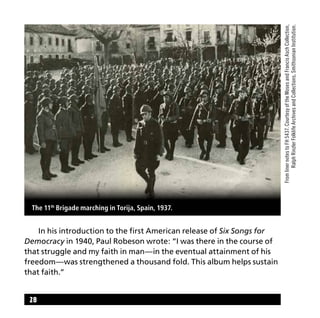
The 11th
Brigade marching in Torija, Spain, 1937.
FromlinernotestoFH5437.CourtesyoftheMosesandFrancisAschCollection,
RalphRinzlerFolklifeArchivesandCollections,SmithsonianInstitution.
29
Volume 2
T
his collection of songs, compiled and released in 1962 as
Folkways FH5437, was divided into three sections, each
with very different origins. According to the original liner
notes to this album, written by veteran Moe Fishman,
the first group of five songs was compiled and pressed
as a souvenir for members of the International Brigades
attending the commemoration of the 25th anniversary of
the war in Berlin in 1961, which Fishman attended. Fishman wrote:
“[A]nd from the original recordings these songs of the past magically
re-created an atmosphere of readiness for combat, hatred for the
fascists, and love and longing for the distant homeland.”
30
Part 1
13. Jarama
Woody Guthrie, vocals and guitar
The battle of Jarama took place early in the war and was a long, drawn
out, but ultimately successful defense of Madrid by the International
Brigades in which the American volunteers played a vital role. Many
died. This is Woody Guthrie’s take on the most popular American song
that came back with the vets, due in part to the tribute it pays to dead
comrades. Another version appears on Volume 1.
14. On the Jarama Front
Ernst Busch and chorus
The song was written in German in 1938, and then translated into
other languages as it became popular around Europe. The final verse
reads: “And one day then, when the hour has come / That all the
spectres are banished from the earth; / Then the world will be our
Jarama front, / As in the February days!”
15. Ballad of the XI Brigade
Ernst Busch, chorus, and orchestra
“For us in Spain, everything got worse / And we fell back step by step,
/ So all the fascists cried aloud / Ah! Madrid will be ours! / Then they
came to us from all the world, / Those with red stars on their hats. / In
Manzanares they put an end / To Franco’s overbearing pride.”
31
16. Hans Beimler, Comrade
Ernst Busch, vocals and accordion, and chorus
Busch revised this 19th-century German military
tribute to soldiers lost in battle to serve more
revolutionary ends, and celebrate the life of Hans
Beimler. The song carries in its melody a long history
of memorialization, and in Busch’s lyric a celebration
of a soldier in a new kind of war.
17. Die Thälmann-Kolonne (The Thaelmann Column)
Ernst Busch, chorus, and orchestra
A stirring and inspiring song, also known as “Freiheit!” (Freedom!), the
chorus shouts: “We’re far from our land / Yet ready we stand / We’re
fighting and singing for you / Freedom!”
Part 2
“Songs We Remember”
This second set of three songs evokes the American volunteers’ love for
Spain, its people and its culture. From their time in Spain the volunteers
were familiar with the Songs We Remember, each of which was recorded
in the 1930s in a different Spanish province and sung by Spaniards. The
recording was issued on a 78 in 1947 in a limited edition. “We remember
a land where the hope of freedom mingled with the soft fragrance of
the orange blossoms and the smell of gunpowder,” Moe Fishman wrote
in 1961 liner notes, while Spain was still under Franco’s rule. “Listen . . .
and you will hear the songs of a free Spain.”
18. Santa Espina
Performed by people of Catalonia; instrumental version with orchestra
“Santa Espina,” recorded in Catalonia, chronicles the history of the
Basque province and its long struggle for autonomy from the Spanish
government, and was banned by Franco. It premiered in Barcelona in 1907.
19. Sevillanos
Performed by people of Seville; singer unknown, accompanied
by flamenco guitar, dancing, and castanets
“Sevillanos” (those who live in Seville) is subtitled “Cruz de Mayo”
(May Cross). It describes a dance of peasant girls who bring flowers to
bedeck the crosses around the city of Seville in May. Flamenco guitar,
castanets, and the stomping feet of a dancer drive the song.
20. The Road to Avilés
Performed by people of Asturias; sung by male chorus with soloist
This Asturian song, sung a cappella, tells of a muleteer and his friends
singing while tending the herd. A mountain answers back to them that
the night will be calm and peaceful.
32
33
Part 3
From “Behind the Barbed Wire”
Sung by Bart van der Schelling and the Exiles Chorus
The third group of songs, Behind the Barbed Wire, was recorded in
New York City in 1938 and originally released in the United States by
the League of American Writers. Four of the six songs are included
here. The title of the collection, a translation of the German song,
“Wie Hinterm Draht,” refers to the concentration camps in France,
where French, Spanish, Italian, and German anti-Fascists were held
and where these songs were sung. The singer is Bart van der Schelling,
backed by the Exiles Chorus directed by American Earl Robinson, one
of the leading left wing composers of the era. Van der Schelling was
born in Holland in 1892. He fought at Jarama, was seriously wounded
34
at the battle of Brunete, spent six months in the hospital only to fight
and be wounded again at Teruel, then continued his efforts, when the
war was turning Franco’s way, on the Aragón front and the battle of
the Ebro River. He eventually became physically unable to fight, but he
didn’t stop singing. He was called the official singer for the returning
American volunteers.
21. La Guardia Rossa (The Red Guard)
Song of the Garibaldi Battalion
chorus, accompanied by marching feet
This song, both music and lyrics, was written in Italy in 1919 by Raffaele
Offidani, under the pseudonym Spartacus Picenus, to honor the
proletarian Red Guards formed to defend workers from aggressive
actions by industrialists and the Italian state. It was taken up by the
Garibaldis, the Italian anti-fascist volunteers in Spain. The first chorus
reads: “’Tis the Red Guard Brave / That marches wave on wave / And
rescues from its grave / Enslaved humanity.”
22. Wie Hinterm Draht (Behind the Barbed Wire)
Song of the Gurs Camp
Bart van der Schelling, lead vocals, with chorus and piano
This song was written by a member of the Thaelmann Battalion,
Eberhard Schmitt, who was imprisoned in Gurs, one of the largest
detention camps in France, located in Basque country.
35
23. La Joven Guardia (The Youthful Guardsmen)
French song for the Spanish youth
Bart van der Schelling, lead vocals, with chorus and piano
Many thousands of young people suffered or died during the war;
this song was sung for them. “Give us victory, or give us death. / The
cause we’re fighting for is noble: / To free all men from slavery’s chains.
/ Maybe the streets will run with your life blood, / With the blood of
youth on the march.” This is yet another revolutionary song written
under a pseudonym. Gaston Mardochée Brunswick, a.k.a. Montéhus,
wrote the music, and adapted lyrics by Saint-Gilles.
Bart Van Der Schelling
36
24. Au Devant de la Vie (Toward the New Life)
Bart van der Schelling, lead vocals, with piano
A very popular melody in Russia by Dmitri Shostakovitch, this lyric was
adapted for use in Spain. As was the case with so much of the music
sung during the war, familiar melodies became the foundation for new
songs, put to a new purpose.
The entirety of Volume 2 was dedicated to the fight against the
1950 McCarran Act, also known as the Subversive Activities Control
Act, which required suspected communist organizations to register
with the United States Attorney General. The McCarran Act forced
the Veterans of the Abraham Lincoln Brigade to suspend most of its
activities for a number of years. But the music, as always, lived on.
Works Cited
Auden, W. H. 1980. “Spain 1937.” The Penguin Book of Spanish Civil 	
	WarVerse. Edited by Valentine Cunningham. Harmondsworth, UK: 	
	Penguin.
Carroll, Peter N. 1994. The Odyssey of the Abraham Lincoln Brigade: 	
	 Americans in the Spanish Civil War. Redwood City, CA: Stanford 	
	 University Press.
The Good Fight: The Abraham Lincoln Brigade in the Spanish Civil War. 	
	 1983. Directed by Noel Buchner, Mary Dore, and Sam Sills.
	 Distributed by First Run Features, videocassette.
37
Landis, Arthur. 1967. The Abraham Lincoln Brigade. New York:
	 Citadel Press.
_____. 1989. Death in the Olive Groves: American Volunteers in the 	
	 Spanish Civil War, 1936–1939. New York: Paragon House Publishers.
Other Sources:
Glazer, Peter. 2005. Radical Nostalgia: Spanish Civil War
	 Commemoration in America. Rochester: Rochester University Press.
http://www.altavozdelfrente.org
Silverman, Jerry. 2002. The Undying Flame: Ballads and Songs of the 	
	Holocaust. Syracuse: Syracuse University Press.
For more information about the U.S. volunteers in the Spanish Civil
War, please visit the Abraham Lincoln Brigade Archives (ALBA) website:
www.alba-valb.org
Credits
Originally issued by Moses Asch for Folkways Records in 1961 as FH5436,
	 and in 1962 as FH5437
Reissue sound restoration and mastering by Pete Reiniger
Annotated by Peter Glazer
Executive producers: Daniel E. Sheehy and D. A. Sonneborn
Production manager: Mary Monseur
Production Assistance by Emily Hilliard
Photo research by Adam Schutzman and Emily Hilliard
Editorial assistance by Carla Borden
Design and layout by Jackson Foster, The I.D. Entity®
	www.theID-entity.com
38
Smithsonian Folkways Staff: Richard James Burgess, associate director for
business strategies; Cecille Chen, royalties manager; Laura Dion, sales and
marketing; Toby Dodds, technology director; Claudia Foronda, customer
service; Henri Goodson, financial assistant; Will Griffin, marketing and
sales; Emily Hilliard, fulfillment; Meredith Holmgren, web production
and education; David Horgan, online marketing; Helen Lindsay, customer
service; Keisha Martin, manufacturing coordinator; Jeff Place, archivist;
Sayem Sharif, director of financial operations; Ronnie Simpkins, audio
specialist; John Smith, sales and marketing; Stephanie Smith, archivist;
Atesh Sonneborn, associate director for programs and acquisitions;
Sandy Wang, web designer; Jonathan Wright, fulfillment.
Special thanks to: the Abraham Lincoln Brigade Archives (ALBA) for
preserving the history of the men and women of the Lincoln Brigade
and making it available through its educational and cultural programs.
www.alba-valb.org; for ALBA: Sebastiaan Faber, Peter N. Carroll, and
Marina Garde; Bruce Barthol; Kate Donovan, Sarah Leila Moazeni, and
Chela Scott Weber of Tamiment Library, New York University.
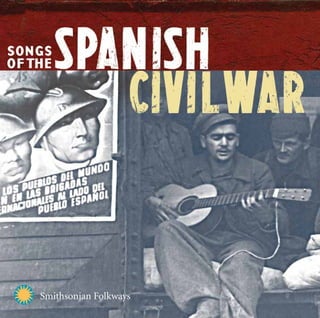
Cover photo: L to R: Fred Matterdayer, Einiv Junkala (playing guitar)
seated in boxcar door with poster on exterior of car, November 1937.
ALBA Collection 11-1345. Courtesy of R. F. Wagner Labor Archives,
Tamiment Library, New York University.
Unless otherwise noted, all graphics and images are from FH5436 and
FH5437. Courtesy of the Moses and Francis Asch Collection, Ralph Rinzler
Folklife Archives and Collections, Smithsonian Institution.
39
About Smithsonian Folkways
Smithsonian Folkways Recordings is the nonprofit record label of the
Smithsonian Institution, the national museum of the United States. Our
mission is the legacy of Moses Asch, who founded Folkways Records in
1948 to document music, spoken word, instruction, and sounds from
around the world. The Smithsonian acquired Folkways from the Asch
estate in 1987, and Smithsonian Folkways Recordings has continued
the Folkways tradition by supporting the work of traditional artists
and expressing a commitment to cultural diversity, education, and
increased understanding among peoples through the documentation,
preservation, and dissemination of sound.
Smithsonian Folkways Recordings, Folkways, Collector, Cook,
Dyer-Bennet, Fast Folk, Mickey Hart Collection, Monitor, M.O.R.E.,
and Paredon recordings are all available through:
Smithsonian Folkways Recordings Mail Order
Washington, DC 20560-0520				
Phone: (800) 410-9815 or 888-FOLKWAYS (orders only)
Fax: (800) 853-9511 (orders only)
To purchase online, or for further information about Smithsonian
Folkways Recordings go to: www.folkways.si.edu. Please send
comments, questions, and catalogue requests to
smithsonianfolkways@si.edu.
SFW CD 40188 p© 2014 Smithsonian Folkways Recordings
SmithsonianFolkways
S
ongs of the Spanish Civil War rekindles the hymnal of the Abraham Lincoln
Brigade, more than 2600 American volunteers who fought General Francisco
Franco and his fellow fascists from Italy and Nazi Germany to defend the
popularlyelectedSpanishRepublicduringthe1936-1939conflict.Thesesongs,recorded
around the time of the war’s end and later reissued in the 1960s by Folkways Records,
still inspire supporters of democratic causes around the world. Singers include Pete
Seeger, Tom Glazer, Butch and Bess Hawes, Woody Guthrie, Ernst Busch, and Bart
van der Schelling. Notes by Peter Glazer. 63 minutes (1 CD), 40-page booklet.
Songs of the Spanish Civil War, Volumes 1 & 2
Volume 1
Part 1: Songs of the Lincoln Brigade
performed by Pete Seeger, Tom Glazer,
Baldwin (Butch) Hawes, Bess Hawes
1. Jarama Valley
2. Cookhouse / The Young Man from Alcalá
3. Quartermaster Song
4.	Viva la Quince Brigada (Long Live
the 15th Brigade)
5. El Quinto Regimiento (The Fifth Regiment)
6. Si Me Quieres Escribir (If You Want to
Write to Me)
Part 2: Six Songs for Democracy
sung by Ernst Busch and chorus
7. Los Cuatro Generales (The Four Generals)
8. Die Thälmann-Kolonne (The Thaelmann
Column)
9. Hans Beimler
10.		Das Lied von der Einheitsfront (Song of the
United Front)
11.		Lied der Internationalen Brigaden (Song of
the International Brigades)
12. Die Moorsoldaten (The Peat Bog Soldiers)
Both volumes on a single CD
Volume 2
Part 1: Woody Guthrie; Ernst
Busch accompanied by chorus
and orchestra
13. Jarama
14. On the Jarama Front
15. Ballad of the XI Brigade
16. Hans Beimler, Comrade
17. Die Thälmann-Kolonne
(The Thaelmann Column)
Part 2: Songs We Remember sung by
the people of Catalonia, Seville, and
Asturias, Spain
18. Santa Espina
19. Sevillanos
20. The Road to Avilés
Part 3: From Behind the Barbed Wire
sung by Bart van der Schelling and
the Exiles Chorus
21. La Guardia Rossa (The Red Guard)
22. Wie Hinterm Draht (Behind the Barbed Wire),
23. La Joven Guardia (The Youthful Guardsmen),
24. Au Devant de la Vie (Toward the New Life)
Washington,DC20560www.folkways.si.edu
SFWCD40188p©2014SmithsonianFolkwaysRecordings

SFW40188

  • 2.
    Part 1: Songsof the Lincoln Brigade performed by Pete Seeger, Tom Glazer, Baldwin (Butch) Hawes, Bess Hawes 1. Jarama Valley 2:47 (lyrics adapted from Alec McDade) 2. Cookhouse / The Young Man from Alcalá 2:37 (Cookhouse: Leonard P. Breedlove–Andrew Young) 3. Quartermaster Song 2:02 (Lewis E. Jones) 4. Viva la Quince Brigada (Long Live the 15th Brigade) 2:45 5. El Quinto Regimiento (The Fifth Regiment) 2:18 6. Si Me Quieres Escribir (If You Want to Write to Me) 2:36 Volume one
  • 3.
    Part 2: SixSongs for Democracy sung by Ernst Busch and chorus 7. Los Cuatro Generales (The Four Generals) 2:37 (Federico García Lorca) 8. Die Thälmann-Kolonne (The Thaelmann Column) 2:57 (Peter Daniel–Karl Ernst) 9. Hans Beimler 2:21 (Friedrich Silcher–Ernst Busch) 10. Das Lied von der Einheitsfront (Song of the United Front) 2:42 (Hanns Eisler–Bertolt Brecht/Deutscher Verlag fuer Musik) 11. Lied der Internationalen Brigaden (Song of the International Brigades) 2:32 (Carlos Palacio–Rafael Espinosa–Erich Weinert) 12. Die Moorsoldaten (The Peat-Bog Soldiers) 2:58 (Rudi Goguel –Johann Esser–Wolfgang Langhoff) Songs of the Spanish Civil War, Volumes 1 & 2 SFW CD 40188 p© 2014 Smithsonian Folkways Recordings
  • 4.
    4 Part 1: WoodyGuthrie; Ernst Busch accompanied by chorus and orchestra 13. Jarama 2:52 (Adapted by Woody Guthrie / Bug Music, BMI–Pete Seeger / Stormking Music, BMI–Lee Hays, BMI ) 14. On the Jarama Front 2:43 (David Martin) 15. Ballad of the XI Brigade 3:07 (Grigori M. Schneerson–Ernst Busch) 16. Hans Beimler, Comrade 2:51 (Friedrich Silcher–Ernst Busch) 17. Die Thälmann-Kolonne (The Thaelmann Column) 2:42 (Peter Daniel–Karl Ernst) Volume two
  • 5.
    5 Part 2: “SongsWe Remember” sung by the people of Catalonia, Seville, and Asturias, Spain 18. Santa Espina 2:22 (Enric Morera–Angel Guimerà) 19. Sevillanos 2:24 20. The Road to Avilés 2:40 Part 3: From “Behind the Barbed Wire” sung by Bart van der Schelling and the Exiles Chorus, directed by Earl Robinson 21. La Guardia Rossa (The Red Guard) 2:30 (Raffaele Offidani) 22. Wie Hinterm Draht (Behind the Barbed Wire) 2:51 (Eberhard Schmitt) 23. La Joven Guardia (The Youthful Guardsmen) 2:19 (Gaston Mardochée Brunswick–Saint-Gilles) 24. Au Devant de la Vie (Toward the New Life) 2:45 (Jeanne Perret / SACEM–Dmitri Shostakovitch / G. Schirmer, Inc., ASCAP)
  • 6.
  • 7.
    7 T he Spanish CivilWar was sung to me long before I knew what it was about. I grew up in the 1960s. When my parents would invite friends over for a dinner party, the conversations inevitably turned to the war in Vietnam. After dinner, my father, folk singer Tom Glazer, would get out his guitar and play. Often, someone would ask him to perform songs from another very different war, the Span- ish conflict of the 1930s. “Do the one about the four generals” was a common request. “Los cuatro generales, los cuatro generales . . .” my father would sing, and a reverent hush would fall over the room. Eyes would close; people would hum or sing along. This music created an emotional atmosphere I could neither fathom nor ignore. Years later, the songs led me to the history. I found out who the four generals were, the nature of their betrayal of the Spanish people, and why, a few verses later, the song called for their hanging on Christmas Eve. I also came to understand why this music had such an effect. introduction peter glazer
  • 8.
    8 For so manyon the Left, the cause of the Spanish Republic in its fight against fascism between 1936 and 1939 was almost sacred, and these songs were their hymnal. The war in Spain moved and inspired a generation of liberal and left-leaning people around the globe. Franco had no idea what passions his coup against the democratically elected government of Spain would unleash. He thought he would control Spain in weeks. It took three bloody years, and he only succeeded thanks to the military assistance of Hitler and Mussolini, and, of course, the other three insurgent Spanish generals of Franco’s cadre: Varela, Mola, and Queipo de Llano. To support the Spanish Republic, roughly 2,750 Americans went to Spain and joined the fight against Franco, along with 30,000 other volunteers from 52 countries. “I sit down to have
  • 9.
    9 RobertMunsonTaylorCollection.CourtesyofR.F.WagnerLaborArchives,TamimentLibrary,NewYorkUniversity. Veterans of theAbraham Lincoln Brigade parade in New York City: Vaughn Love, Bill Van Felix (banner), unknown, Hy Wallach (sunglasses), Leonard Lamb (foreground), Len Levenson (beret), Moe Fishman (banner). June 1984.
  • 10.
    my breakfast,” Americanvolunteer Peter Frye recalled of a morning in 1936, “open the paper . . . . I don’t want to romanticize this, but I said, ‘I can’t live in this world if I don’t fight against this kind of thing. I can’t accept it‘” (The Good Fight 1983). The actions of the Abraham Lincoln Brigade—the name taken on by the American volunteers— quickly developed into an icon of radical activism: doing the right thing for the right reasons against all odds, whatever the risk. The fight against Franco became known as “the good fight.” Thousands of books have been written about the Spanish Civil War and the historical events that set the stage for 32 months of vicious struggle. To offer a brief overview: Spain had been a monar- chy for centuries, with the exception of its failed first Republic, 1873 to 1874. The power had rested firmly with the king, the army, the Catholic Church, and the wealthy landowners. In 1931, though, elec- tions in Spain heavily favored Republican parties interested in more egalitarian leadership. Two days after the voting, on April 14, the king abdicated and the second Spanish Republic was proclaimed. Suddenly, those traditionally in power were legally subject to the will of the peo- ple. The new government introduced reforms separating church and state, redistributing land, and de-militarizing the government. Seeing their well-being and long-standing control threatened, the traditional powers resisted the changes, and parties on the Right successfully gained control of the government in the elections of 1933. But many on the Left were dissatisfied with the new reforms as well. The anar- chists were particularly unruly, and factions on both sides struggled 10
  • 11.
    11 for dominance. TheRight, led by Gil Robles, dismantled many of the progressive reforms begun in 1931, which led to a series of uprisings. The most significant of them occurred in the province of Asturias, where the miners struck and were brutally put down by troops under the command of one Francisco Franco, already recognized as a ruth- less and efficient military leader. But the working people were under attack, and they were fighting back, and many thousands of union workers and their kith and kin across Europe and in the United States took notice. Other fascist dictators were consolidating power and expanding their influence during the same period. In 1931, Japan’s Kwangtung army attacked Manchuria. Hitler became chancellor of Germany early in 1933. Mussolini offered to support the Spanish monarchists in 1934 if they rebelled against the standing government. In October of 1935, Italy invaded Abyssinia, now Ethiopia, with bombings that were among the first to purposely attack civilian populations from the air. In the United States, blacks in Harlem began to organize to defend Abyssinia, but the Italians took power too quickly. Hitler began legal persecution of the Jews with the Nuremberg Laws in 1935, and occupied the Rhineland in 1936. That same year, the Spanish government changed hands again, when the Popular Front, a coalition of left, liberal, and centrist parties, won convincingly. Violence, unrest, and assassinations continued on both sides, but the Popular Front victory seems to have been the last straw for the forces of reaction, already plotting rebellion. Franco
  • 12.
    announced his waron the Republic from Morocco on July 17, 1936, and street battles began throughout Spain. Franco and his army of Moorish conscripts and Foreign Legionnaires crossed the Mediterranean ten days later in transport planes provided by Hitler and Hermann Goering. Many of the military units across Spain followed Franco’s lead to wrest control of the country from the popularly elected government—but not all of them. Some soldiers remained loyal to the Republic. The most impressive response in Spain came from the people themselves. In city after city, citizens resisted. They took to the streets in large numbers to challenge the military’s actions, and eventually gained control in major cities such as Madrid, Barcelona, and Valencia. The civil war in Spain was international news. With Hitler in power, and threatening or annexing neighboring lands, democratic Spain was a powerful symbol. By responding in such numbers to put down Franco’s rebellion, the Republicans proved that resistance to fascism was possible, that capitulation could not be assumed. When Franco initiated his coup and it soon became clear that he had Hitler and Mus- solini’s backing, the bravery of the Spanish people in holding off this fascist onslaught was all the more compelling. “Madrid, qué bien re- sistes / mamita mía / los bombardeos,” a verse of “Los cuatro generales” proclaims. And then: “De las bombas se ríen / mamita mía, / los madrile- ños.” “Madrid,” it cheers, “little mother, how well you withstand the bombing. The people of Madrid laugh at the bombs.” In the words of veteran Ed Bender, Spain represented “one glimmer of hope in a world rushing toward fascist domination” (quoted in Carroll 1994, 10). 12
  • 13.
    Yet none ofthe Western democracies came to the aid of the Republic, only the Soviet Union and Mexico. With the communists in Spain a significant force in the Republican government, and the Soviet Union fearing the loss of one of the last holdouts against fascism, the Communist Party recruited volunteers through cells around the world for an International Brigade. This became a multinational army of anti- fascists organized to help defend Spain against Franco and his insur- gent generals, the Italian troops and their hardware, and the German air force. Twenty-six hundred Americans took up arms, supported by an additional 150 doctors, nurses, drivers, and technicians. “It was an army unprecedented in American history, based on ideology, moti- vated by principles,” Peter N. Carroll states in his definitive history of the Abraham Lincoln Brigade (1994, 14). Others had already mobilized; in early November 1936, fascist troops attempted to take Madrid but were stopped by a combination of local militias, Republican forces, and the first anti-fascist volunteers from nearby France and Germany. From the doctrinaire and well-organized communists to the intractable anarchists, the liberals and pacifists to the socialists, almost everyone on the Left agreed that the loss of Spain to Franco and the fascists would be a disaster, and most believed that the Republic could be saved. “History was going our way,” literary critic Alfred Kazin wrote, optimistically. “Everything in the outside world seemed to be moving toward some final decision, for by now the Spanish Civil War had begun, and every day felt choked with struggle” (quoted in Carroll 13
  • 14.
    14 1994, 14). ByJuly 31, just two weeks after the war began, the communist paper the Daily Worker ran a photograph of a huge rally in New York City in support of the Republic. Thousands of fists were raised in the Republican salute. Less than two months later, however, the leaders of the Western democracies formed the Non-Intervention Committee. Germany and Italy were members but supplied Franco with troops, arms, and planes PaulBurnsCollection.CourtesyofR.F.WagnerLaborArchives,TamimentLibrary, NewYorkUniversity. Concert behind front lines by members of the German Thaelmann Brigade, Jarama, Spain 1937.
  • 15.
    15 nonetheless. The U.S.government established an arms embargo on Spain on January 8, 1936, and three days afterward made it illegal for citizens to travel there. That did not stop American volunteers from participating in the struggle. The first group departed New York City on the day after Christmas, 1936, and volunteers continued to travel overseas for months, mostly through the efforts of the CPUSA, the U.S. Communist Party. “The resistance of the Spanish people and their allies to international fascism represented the last opportunity to avert the global calamity of World War II,” according to historian and American volunteer Arthur H. Landis (1989, xv). Spain became the first battle- ground for the most significant and deadly ideological conflict of the century, a model for Popular Fronters and their supporters in many countries, and a source of hope amidst a world gone awry. Ill-equipped and, in the early going, ill trained, Americans fought in the battles of Jarama and Brunete, at Teruel in 1937, and on the Aragon front in 1938. They had many triumphs and gained the respect of hard- ened anti-fascists, but history in the end did not go their way. Most students of the war agree that Franco could not have won on his own, but Hitler and Mussolini simply tipped the scales too far, and eventually had the advantage. The Lincolns were part of the “Great Retreats” as Franco and the fascists gradually took more of the country, and then they participated in the Ebro offensive, the last major Republican advance in which the Internationals served. Late in 1938 Spanish Prime Minister Negrín ordered the International volunteers out of Spain in the hope that, by removing them, the Non-Intervention Committee
  • 16.
    would be forcedto address the illegal support Franco was receiving from Germany and Italy, but his effort was to no avail. By March of 1939, Franco had finally triumphed; his army entered Madrid. Hitler invaded Poland six months later, beginning World War II. In his poem, “Spain,” W. H. Auden wrote, “Our thoughts have bodies” (Auden 1980, 99). Of the 2,750 U.S. volunteers in Spain, one- third lost their lives, but for many of those who returned, the struggle continued. “The war in Spain is over in the field of action,” Republican General Vincente Rojo said in 1939, “but not in the field of thought” (Landis 1967, xv). And this “field of thought,” so aptly credited by Rojo, produced its own kind of action on the home front. Among other things, it began and drove a vigorous commemorative process now 75 years old, in which the musical legacy of the war continues to be a centerpiece. To this day, songs of the Spanish Civil War are sung at annual gatherings in New York City and San Francisco. The songs bring this activist history forward at a time when the causes are no less urgent, and the enemies of freedom no less dangerous. 16
  • 17.
    17Soldiers Monument: “ToOur Fallen Comrades—Our Victory Is Your Vengeance June 1937.” ALBACollection36.CourtesyofR.F.WagnerLaborArchives,TamimentLibrary,NewYorkUniversity.
  • 18.
    18 Volume 1 Songs ofthe Lincoln Brigade and Six Songs for Democracy S ix Songs for Democracy was originally recorded in Spain in June 1938 during an air raid on Barcelona. One of the records bore a sticker reading: “The defective impression of this record is due to interruptions of electric current during an air raid.” The soloist and organizer of this recording is the great German working-class tenor Ernst Busch, backed by a chorus of members of the Thaelmann Battalion (11th I.B.). It was released in the United States by Keynote Recordings in 1940, to great success. Moses Asch believed that an American recording of Spanish Civil War songs could do as well. He contacted Pete Seeger and asked him to put a group together. On furlough from the army one weekend in 1943 or 1944, Seeger gathered fellow folk singers Tom Glazer, Baldwin (Butch) Hawes, and Bess Lomax Hawes to record three track nOtes
  • 19.
    19 78s. The foursingers rehearsed on Saturday and recorded on Sunday. Asch released the tracks as Songs of the Lincoln Brigade. Folkways Records combined the two projects and re-released them as Songs of the Spanish Civil War Volume 1 (FH5436) in 1961, to mark the 25th anniversary of the start of the war.
  • 20.
  • 21.
    21 Part 1 Songs ofthe Lincoln Brigade Pete Seeger, banjo, vocals; Tom Glazer, guitar, vocals; Baldwin (Butch) Hawes, guitar, vocals; Bess Hawes, vocals 1. Jarama Valley Tom Glazer, lead vocals The melody is the familiar “Red River Valley,” which is usually associated with the Red River in Texas but had much earlier origins in Canada, where a Red River flows through Manitoba, and possibly even before that in the United States, referring to the Mohawk River Valley. The Spanish Civil War version is often credited to Alec McDade, a Scottish volunteer who wrote a wonderfully pointed satire criticizing the ill treatment of the International Brigaders (IBs) by their own leadership during the battle. The popular version Tom Glazer sings here is a far cry from McDade’s, as the last two lines of the first verse make clear: “It was there that we wasted our manhood,” McDade wrote, “And most of our old age as well.” 2. Cookhouse / The Young Man from Alcalá Butch Hawes, Tom Glazer, and Pete Seeger, lead vocals The melody for the satirical complaint about the lack of food for the soldiers in “Cookhouse” was taken from Leonard P. Breedlove’s popular
  • 22.
    22 Unknown International BrigadeSoldiers FromlinernotestoFH5436.CourtesyoftheMosesandFrancisAschCollection,RalphRinzlerFolklifeArchivesandCollections, SmithsonianInstitution.
  • 23.
    23 1850 hymn “ThereIs a Happy Land,” and based on a poem by Andrew Young. The cadence of the lyric “There is a happy land” matches “There is a sweet cookhouse. . . .” Five verses of “The Young Man from Alcalá” humorously chronicle the Lincolns’ time in Spain, with corny rhymes, questionable Spanish, and a melody taken from a 19th century song called “Yip-Ay-Addie-i-Ay.”. 3. Quartermaster Song Pete Seeger, lead vocals When Lewis E. Jones wrote the hymn “There Is Power in the Blood” in 1899, he could never have imagined that it would end up as the melody for this funny and briefly scatological attack, once again on the quality of the food made available to the soldiers. 4. Viva la Quince Brigada (Long Live the 15th Brigade) Pete Seeger, lead vocals A rousing Spanish folk melody was used as the basis for two songs during the war: this famous anthem, and another, “El ejército del Ebro.” The infectious chorus, with the refrain “Rumbala, rumbala, rumba-la,” is one of the most recognizable and singable signatures of the songs of the Spanish Civil War.
  • 24.
    5. El QuintoRegimiento (The Fifth Regiment) Pete Seeger, lead vocals This song, also set to a traditional melody, celebrates the heroics of the Fifth Regiment of the Spanish Army, and names Republican heroes in the struggle against Franco: General Enrique Líster, who played a vital role in the early defense of Madrid; Juan Modesto; “El Campesino” (The Peasant), born Valentín González; and “Paco” Galán. The chorus roughly translates to “Come on be happy, be happy / Hear the avenging machine guns / It will be the end of Franco / It will be the end of Franco.” I sang it for years in a jolly manner before I learned what it meant. 6. Si me quieres escribir (If You Want to Write to Me) Ensemble, vocals One of the more ironic songs to come out of the war, and very popular with the soldiers, it tells the story of fighting on the Gandesa front where there’s an inn with a Moor standing at the door touting the good food—a first course of hand grenades followed by shrapnel— “a meal you’ll never forget.” 24
  • 25.
    25 Part 2 Six Songsfor Democracy sung by Ernst Busch and chorus accompanied by guitar, accordion, and piano 7. Los cuatro generales (The Four Generals) This is the first Spanish Civil War song I ever heard, sung by my father in our living room in Westchester County, New York, to a reverent audience. The song is a condemnation of Franco and the three other generals who led the rebellion against the Republic, and the melody comes from the simple, catchy folk tune, “Los cuatro muleros.” Federico García Lorca, the celebrated poet murdered early in the war, first set his own lyric to that melody, and his version became the basis for this famous song.
  • 26.
    26 8. Die Thälmann-Kolonne(The Thaelmann Column) This is the song of the Thaelmann Battalion of German anti-fascists, the first unit of the International Brigades to arrive in Spain to defend Madrid against Franco’s early onslaught. “At dawn on the morning of November 7, 1936,” earlier liner notes state, “the inhabitants of Madrid were awakened by the firm tramp of disciplined troops marching through the city. They rushed to their windows, thinking that Franco’s army had captured the city. What they saw was the first body of highly trained troops marching behind the purple, gold, and red banner of Republican Spain. . . . It was largely the heroism of the Thaelmann Battalion that saved Madrid, when Franco was at the city’s gates.” The ferocious defense of Madrid early in the war is the subject of many songs. The words are by Karl Ernst, the music by Peter Daniel. 9. Hans Beimler Beimler, a deputy in the Bavarian Diet and a communist, was one of the very few prisoners to escape from the concentration camp at Dachau. He went to Spain in November 1936 as a leader of the first contingent of volunteers, the German Thaelmann Battalion, who helped save Madrid. Chief political commissar of the International Brigades, Beimler was killed in action one month later. The lyric is by Ernst Busch, and celebrates the life and death of this brave German anti-Nazi, one of the war’s first heroes.
  • 27.
    27 10. Das Liedvon der Einheitsfront (Song of the United Front) Renowned German playwright Bertolt Brecht wrote the pointed lyric, and his friend and collaborator Hanns Eisler wrote the driving minor- key melody while the two of them were living in exile in London in 1934. Sung by Busch in Spanish, English, French, and German, the song packs a dramatic punch typical of these writers. 11. Lied der Internationalen Brigaden (Song of the International Brigades) The lyric is by poet Erich Weinert, a German communist who left Germany for France as an exile and joined the International Brigades. Ernst Busch asked him to write the song to an existing melody by Carlos Palacio and Rafael Espinosa. No single person had more influence on songs from the war than Busch, who published a comprehensive pocket anthology, Canciones de las Brigades Internationales. 12. Die Moorsoldaten (The Peat Bog Soldiers) Barred from singing existing songs of protest, prisoners in the Börgermoor concentration camp in Nazi Germany wrote this one themselves. Its third stanza became a rallying cry for the prisoners, and the song was eventually banned as well. It was smuggled out of the camp in a shoe and quickly made its way to Spain, where Busch heard it and recorded it.
  • 28.
    28 In hisintroduction to the first American release of Six Songs for Democracy in 1940, Paul Robeson wrote: “I was there in the course of that struggle and my faith in man—in the eventual attainment of his freedom—was strengthened a thousand fold. This album helps sustain that faith.” The 11th Brigade marching in Torija, Spain, 1937. FromlinernotestoFH5437.CourtesyoftheMosesandFrancisAschCollection, RalphRinzlerFolklifeArchivesandCollections,SmithsonianInstitution.
  • 29.
    29 Volume 2 T his collectionof songs, compiled and released in 1962 as Folkways FH5437, was divided into three sections, each with very different origins. According to the original liner notes to this album, written by veteran Moe Fishman, the first group of five songs was compiled and pressed as a souvenir for members of the International Brigades attending the commemoration of the 25th anniversary of the war in Berlin in 1961, which Fishman attended. Fishman wrote: “[A]nd from the original recordings these songs of the past magically re-created an atmosphere of readiness for combat, hatred for the fascists, and love and longing for the distant homeland.”
  • 30.
    30 Part 1 13. Jarama WoodyGuthrie, vocals and guitar The battle of Jarama took place early in the war and was a long, drawn out, but ultimately successful defense of Madrid by the International Brigades in which the American volunteers played a vital role. Many died. This is Woody Guthrie’s take on the most popular American song that came back with the vets, due in part to the tribute it pays to dead comrades. Another version appears on Volume 1. 14. On the Jarama Front Ernst Busch and chorus The song was written in German in 1938, and then translated into other languages as it became popular around Europe. The final verse reads: “And one day then, when the hour has come / That all the spectres are banished from the earth; / Then the world will be our Jarama front, / As in the February days!” 15. Ballad of the XI Brigade Ernst Busch, chorus, and orchestra “For us in Spain, everything got worse / And we fell back step by step, / So all the fascists cried aloud / Ah! Madrid will be ours! / Then they came to us from all the world, / Those with red stars on their hats. / In Manzanares they put an end / To Franco’s overbearing pride.”
  • 31.
    31 16. Hans Beimler,Comrade Ernst Busch, vocals and accordion, and chorus Busch revised this 19th-century German military tribute to soldiers lost in battle to serve more revolutionary ends, and celebrate the life of Hans Beimler. The song carries in its melody a long history of memorialization, and in Busch’s lyric a celebration of a soldier in a new kind of war. 17. Die Thälmann-Kolonne (The Thaelmann Column) Ernst Busch, chorus, and orchestra A stirring and inspiring song, also known as “Freiheit!” (Freedom!), the chorus shouts: “We’re far from our land / Yet ready we stand / We’re fighting and singing for you / Freedom!” Part 2 “Songs We Remember” This second set of three songs evokes the American volunteers’ love for Spain, its people and its culture. From their time in Spain the volunteers were familiar with the Songs We Remember, each of which was recorded in the 1930s in a different Spanish province and sung by Spaniards. The recording was issued on a 78 in 1947 in a limited edition. “We remember a land where the hope of freedom mingled with the soft fragrance of
  • 32.
    the orange blossomsand the smell of gunpowder,” Moe Fishman wrote in 1961 liner notes, while Spain was still under Franco’s rule. “Listen . . . and you will hear the songs of a free Spain.” 18. Santa Espina Performed by people of Catalonia; instrumental version with orchestra “Santa Espina,” recorded in Catalonia, chronicles the history of the Basque province and its long struggle for autonomy from the Spanish government, and was banned by Franco. It premiered in Barcelona in 1907. 19. Sevillanos Performed by people of Seville; singer unknown, accompanied by flamenco guitar, dancing, and castanets “Sevillanos” (those who live in Seville) is subtitled “Cruz de Mayo” (May Cross). It describes a dance of peasant girls who bring flowers to bedeck the crosses around the city of Seville in May. Flamenco guitar, castanets, and the stomping feet of a dancer drive the song. 20. The Road to Avilés Performed by people of Asturias; sung by male chorus with soloist This Asturian song, sung a cappella, tells of a muleteer and his friends singing while tending the herd. A mountain answers back to them that the night will be calm and peaceful. 32
  • 33.
    33 Part 3 From “Behindthe Barbed Wire” Sung by Bart van der Schelling and the Exiles Chorus The third group of songs, Behind the Barbed Wire, was recorded in New York City in 1938 and originally released in the United States by the League of American Writers. Four of the six songs are included here. The title of the collection, a translation of the German song, “Wie Hinterm Draht,” refers to the concentration camps in France, where French, Spanish, Italian, and German anti-Fascists were held and where these songs were sung. The singer is Bart van der Schelling, backed by the Exiles Chorus directed by American Earl Robinson, one of the leading left wing composers of the era. Van der Schelling was born in Holland in 1892. He fought at Jarama, was seriously wounded
  • 34.
    34 at the battleof Brunete, spent six months in the hospital only to fight and be wounded again at Teruel, then continued his efforts, when the war was turning Franco’s way, on the Aragón front and the battle of the Ebro River. He eventually became physically unable to fight, but he didn’t stop singing. He was called the official singer for the returning American volunteers. 21. La Guardia Rossa (The Red Guard) Song of the Garibaldi Battalion chorus, accompanied by marching feet This song, both music and lyrics, was written in Italy in 1919 by Raffaele Offidani, under the pseudonym Spartacus Picenus, to honor the proletarian Red Guards formed to defend workers from aggressive actions by industrialists and the Italian state. It was taken up by the Garibaldis, the Italian anti-fascist volunteers in Spain. The first chorus reads: “’Tis the Red Guard Brave / That marches wave on wave / And rescues from its grave / Enslaved humanity.” 22. Wie Hinterm Draht (Behind the Barbed Wire) Song of the Gurs Camp Bart van der Schelling, lead vocals, with chorus and piano This song was written by a member of the Thaelmann Battalion, Eberhard Schmitt, who was imprisoned in Gurs, one of the largest detention camps in France, located in Basque country.
  • 35.
    35 23. La JovenGuardia (The Youthful Guardsmen) French song for the Spanish youth Bart van der Schelling, lead vocals, with chorus and piano Many thousands of young people suffered or died during the war; this song was sung for them. “Give us victory, or give us death. / The cause we’re fighting for is noble: / To free all men from slavery’s chains. / Maybe the streets will run with your life blood, / With the blood of youth on the march.” This is yet another revolutionary song written under a pseudonym. Gaston Mardochée Brunswick, a.k.a. Montéhus, wrote the music, and adapted lyrics by Saint-Gilles. Bart Van Der Schelling
  • 36.
    36 24. Au Devantde la Vie (Toward the New Life) Bart van der Schelling, lead vocals, with piano A very popular melody in Russia by Dmitri Shostakovitch, this lyric was adapted for use in Spain. As was the case with so much of the music sung during the war, familiar melodies became the foundation for new songs, put to a new purpose. The entirety of Volume 2 was dedicated to the fight against the 1950 McCarran Act, also known as the Subversive Activities Control Act, which required suspected communist organizations to register with the United States Attorney General. The McCarran Act forced the Veterans of the Abraham Lincoln Brigade to suspend most of its activities for a number of years. But the music, as always, lived on. Works Cited Auden, W. H. 1980. “Spain 1937.” The Penguin Book of Spanish Civil WarVerse. Edited by Valentine Cunningham. Harmondsworth, UK: Penguin. Carroll, Peter N. 1994. The Odyssey of the Abraham Lincoln Brigade: Americans in the Spanish Civil War. Redwood City, CA: Stanford University Press. The Good Fight: The Abraham Lincoln Brigade in the Spanish Civil War. 1983. Directed by Noel Buchner, Mary Dore, and Sam Sills. Distributed by First Run Features, videocassette.
  • 37.
    37 Landis, Arthur. 1967.The Abraham Lincoln Brigade. New York: Citadel Press. _____. 1989. Death in the Olive Groves: American Volunteers in the Spanish Civil War, 1936–1939. New York: Paragon House Publishers. Other Sources: Glazer, Peter. 2005. Radical Nostalgia: Spanish Civil War Commemoration in America. Rochester: Rochester University Press. http://www.altavozdelfrente.org Silverman, Jerry. 2002. The Undying Flame: Ballads and Songs of the Holocaust. Syracuse: Syracuse University Press. For more information about the U.S. volunteers in the Spanish Civil War, please visit the Abraham Lincoln Brigade Archives (ALBA) website: www.alba-valb.org Credits Originally issued by Moses Asch for Folkways Records in 1961 as FH5436, and in 1962 as FH5437 Reissue sound restoration and mastering by Pete Reiniger Annotated by Peter Glazer Executive producers: Daniel E. Sheehy and D. A. Sonneborn Production manager: Mary Monseur Production Assistance by Emily Hilliard Photo research by Adam Schutzman and Emily Hilliard Editorial assistance by Carla Borden Design and layout by Jackson Foster, The I.D. Entity® www.theID-entity.com
  • 38.
    38 Smithsonian Folkways Staff:Richard James Burgess, associate director for business strategies; Cecille Chen, royalties manager; Laura Dion, sales and marketing; Toby Dodds, technology director; Claudia Foronda, customer service; Henri Goodson, financial assistant; Will Griffin, marketing and sales; Emily Hilliard, fulfillment; Meredith Holmgren, web production and education; David Horgan, online marketing; Helen Lindsay, customer service; Keisha Martin, manufacturing coordinator; Jeff Place, archivist; Sayem Sharif, director of financial operations; Ronnie Simpkins, audio specialist; John Smith, sales and marketing; Stephanie Smith, archivist; Atesh Sonneborn, associate director for programs and acquisitions; Sandy Wang, web designer; Jonathan Wright, fulfillment. Special thanks to: the Abraham Lincoln Brigade Archives (ALBA) for preserving the history of the men and women of the Lincoln Brigade and making it available through its educational and cultural programs. www.alba-valb.org; for ALBA: Sebastiaan Faber, Peter N. Carroll, and Marina Garde; Bruce Barthol; Kate Donovan, Sarah Leila Moazeni, and Chela Scott Weber of Tamiment Library, New York University. Cover photo: L to R: Fred Matterdayer, Einiv Junkala (playing guitar) seated in boxcar door with poster on exterior of car, November 1937. ALBA Collection 11-1345. Courtesy of R. F. Wagner Labor Archives, Tamiment Library, New York University. Unless otherwise noted, all graphics and images are from FH5436 and FH5437. Courtesy of the Moses and Francis Asch Collection, Ralph Rinzler Folklife Archives and Collections, Smithsonian Institution.
  • 39.
    39 About Smithsonian Folkways SmithsonianFolkways Recordings is the nonprofit record label of the Smithsonian Institution, the national museum of the United States. Our mission is the legacy of Moses Asch, who founded Folkways Records in 1948 to document music, spoken word, instruction, and sounds from around the world. The Smithsonian acquired Folkways from the Asch estate in 1987, and Smithsonian Folkways Recordings has continued the Folkways tradition by supporting the work of traditional artists and expressing a commitment to cultural diversity, education, and increased understanding among peoples through the documentation, preservation, and dissemination of sound. Smithsonian Folkways Recordings, Folkways, Collector, Cook, Dyer-Bennet, Fast Folk, Mickey Hart Collection, Monitor, M.O.R.E., and Paredon recordings are all available through: Smithsonian Folkways Recordings Mail Order Washington, DC 20560-0520 Phone: (800) 410-9815 or 888-FOLKWAYS (orders only) Fax: (800) 853-9511 (orders only) To purchase online, or for further information about Smithsonian Folkways Recordings go to: www.folkways.si.edu. Please send comments, questions, and catalogue requests to smithsonianfolkways@si.edu.
  • 40.
    SFW CD 40188p© 2014 Smithsonian Folkways Recordings
  • 41.
  • 42.
    S ongs of theSpanish Civil War rekindles the hymnal of the Abraham Lincoln Brigade, more than 2600 American volunteers who fought General Francisco Franco and his fellow fascists from Italy and Nazi Germany to defend the popularlyelectedSpanishRepublicduringthe1936-1939conflict.Thesesongs,recorded around the time of the war’s end and later reissued in the 1960s by Folkways Records, still inspire supporters of democratic causes around the world. Singers include Pete Seeger, Tom Glazer, Butch and Bess Hawes, Woody Guthrie, Ernst Busch, and Bart van der Schelling. Notes by Peter Glazer. 63 minutes (1 CD), 40-page booklet. Songs of the Spanish Civil War, Volumes 1 & 2 Volume 1 Part 1: Songs of the Lincoln Brigade performed by Pete Seeger, Tom Glazer, Baldwin (Butch) Hawes, Bess Hawes 1. Jarama Valley 2. Cookhouse / The Young Man from Alcalá 3. Quartermaster Song 4. Viva la Quince Brigada (Long Live the 15th Brigade) 5. El Quinto Regimiento (The Fifth Regiment) 6. Si Me Quieres Escribir (If You Want to Write to Me) Part 2: Six Songs for Democracy sung by Ernst Busch and chorus 7. Los Cuatro Generales (The Four Generals) 8. Die Thälmann-Kolonne (The Thaelmann Column) 9. Hans Beimler 10. Das Lied von der Einheitsfront (Song of the United Front) 11. Lied der Internationalen Brigaden (Song of the International Brigades) 12. Die Moorsoldaten (The Peat Bog Soldiers) Both volumes on a single CD Volume 2 Part 1: Woody Guthrie; Ernst Busch accompanied by chorus and orchestra 13. Jarama 14. On the Jarama Front 15. Ballad of the XI Brigade 16. Hans Beimler, Comrade 17. Die Thälmann-Kolonne (The Thaelmann Column) Part 2: Songs We Remember sung by the people of Catalonia, Seville, and Asturias, Spain 18. Santa Espina 19. Sevillanos 20. The Road to Avilés Part 3: From Behind the Barbed Wire sung by Bart van der Schelling and the Exiles Chorus 21. La Guardia Rossa (The Red Guard) 22. Wie Hinterm Draht (Behind the Barbed Wire), 23. La Joven Guardia (The Youthful Guardsmen), 24. Au Devant de la Vie (Toward the New Life) Washington,DC20560www.folkways.si.edu SFWCD40188p©2014SmithsonianFolkwaysRecordings