


Business Models
Ppayne@sfu.ca
For NVBC Round 2.0, April 2015
The Magic Wand!
No magic wands
Agenda
Business Model Canvas: WHO? WHAT? WHY?
HOW?
Business Model Generation via “Canvas”
1. Value Proposition + Customer Segments
3. Channels
4. Customer Relationships
5. Revenue Streams
6. Cost Structures
7. Key Resources
8. Key Partnerships
9. Key Activities
10. Weaknesses of the BMC
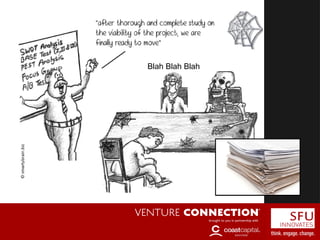
Blah Blah Blah
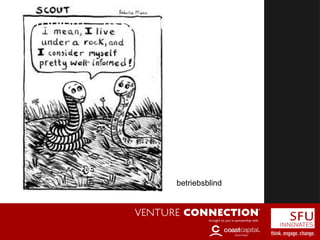
Problem = Assumptions
betriebsblind
Solution = ask
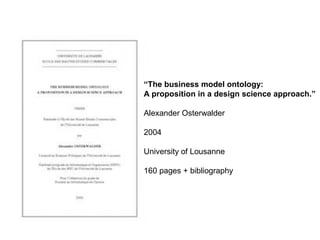
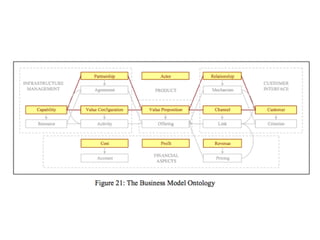
“The business model ontology:
A proposition in a design science approach.”
Alexander Osterwalder
2004
University of Lousanne
160 pages + bibliography
BMC Genesis
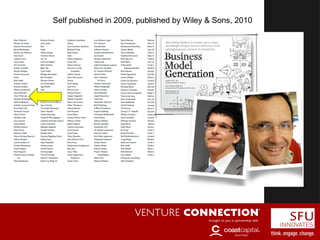
Self published in 2009, published by Wiley & Sons, 2010
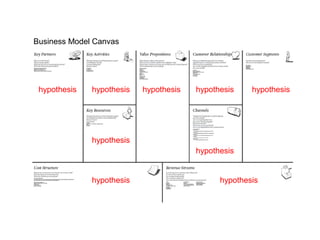
hypothesishypothesishypothesis hypothesis hypothesis
hypothesis
hypothesis
hypothesis hypothesis
Solution = scientific method
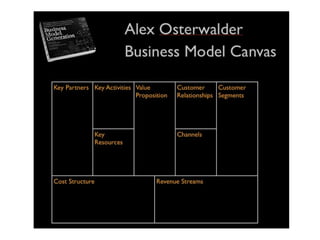
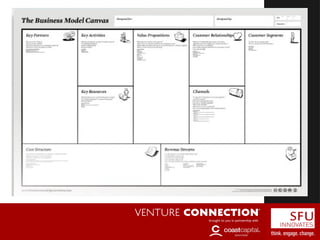
Business Model Canvas
Evidence
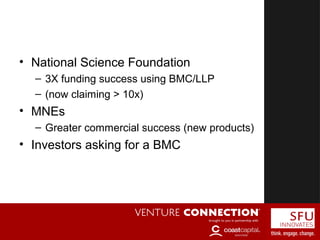
• National Science Foundation
– 3X funding success using BMC/LLP
– (now claiming > 10x)
• MNEs
– Greater commercial success (new products)
• Investors asking for a BMC
Used by companies from start-ups to Fortune 500s, business schools
Half a Million Books + 26 Languages + over 5,000,000 Canvas users
Traction: Wide adoption
VP&CS: Product-Market Fit
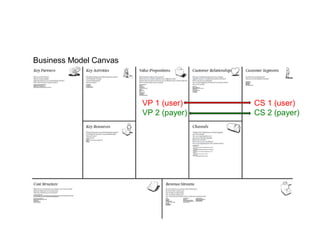
VP & CS
Business Model Canvas
VP 1 (user)
VP 2 (payer)
CS 1 (user)
CS 2 (payer)
e.g. Game for kids
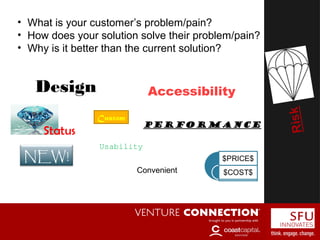
Value Proposition• What is your customer’s problem/pain?
• How does your solution solve their problem/pain?
• Why is it better than the current solution?
NEW!
Convenient
Performance
Custom
Design
Usability
Accessibility
Status
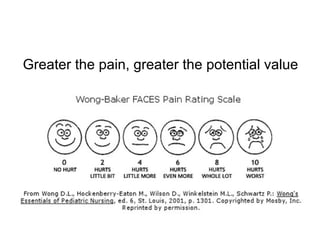
Greater the pain, greater the potential value
Value Proposition
GPS Accuracy
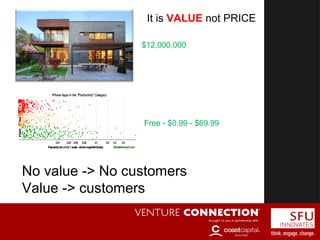
No value -> No customers
Value -> customers
$12,000,000
Free - $0.99 - $69.99
It is VALUE not PRICE
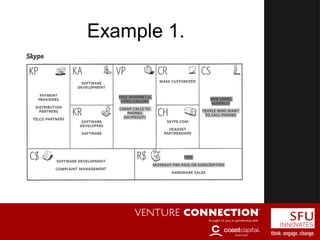
Example 1.
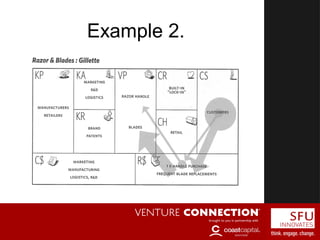
Example 2.
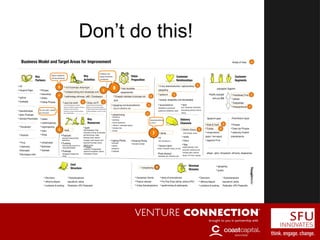
Don’t do this!
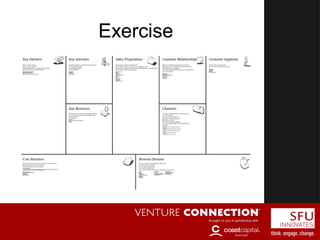
Exercise
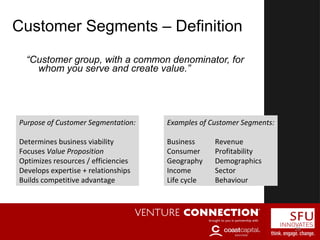
“Customer group, with a common denominator, for
whom you serve and create value.”
28
Customer Segments – Definition
Purpose of Customer Segmentation:
Determines business viability
Focuses Value Proposition
Optimizes resources / efficiencies
Develops expertise + relationships
Builds competitive advantage
Examples of Customer Segments:
Business Revenue
Consumer Profitability
Geography Demographics
Income Sector
Life cycle Behaviour
Customer Segments
30
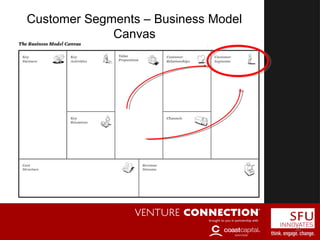
Customer Segments – Business Model
Canvas
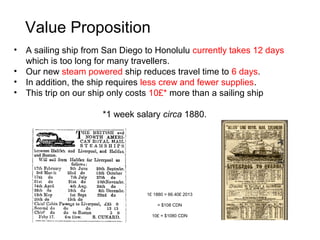
Value Proposition: Timeless Example
• A sailing ship from San Diego to Honolulu currently takes 12 days
which is too long for many travellers.
• Our new steam powered ship reduces travel time to 6 days.
• In addition, the ship requires less crew and fewer supplies.
• This trip on our ship only costs 10£* more than a sailing ship
*1 week salary circa 1880.
1£ 1880 = 66.40£ 2013
= $108 CDN
10£ = $1080 CDN
Value Proposition
• Exercise: Your value proposition:
– What is your customer’s pain?
– What is your solution?
– Why is it better than your customer’s
current (or alternative) solution?
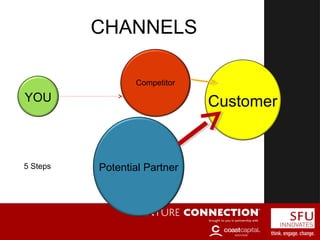
CHANNELS
Customer
Potential Partner
YOU
Competitor
5 Steps
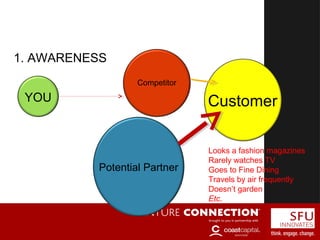
CHANNELS
Customer
Potential Partner
YOU
Competitor
1. AWARENESS
Looks a fashion magazines
Rarely watches TV
Goes to Fine Dining
Travels by air frequently
Doesn’t garden
Etc.
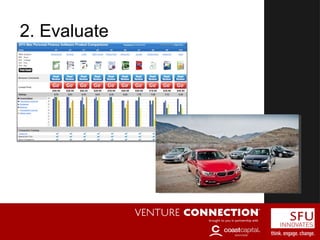
CHANNELS2. Evaluate
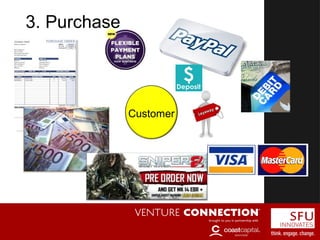
3. Purchase
Customer
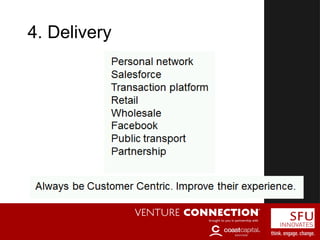
CHANNELS4. Delivery
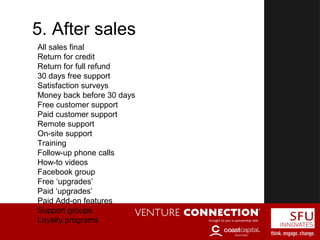
CHANNELS5. After sales
All sales final
Return for credit
Return for full refund
30 days free support
Satisfaction surveys
Money back before 30 days
Free customer support
Paid customer support
Remote support
On-site support
Training
Follow-up phone calls
How-to videos
Facebook group
Free ‘upgrades’
Paid ‘upgrades’
Paid Add-on features
Support groups
Loyalty programs
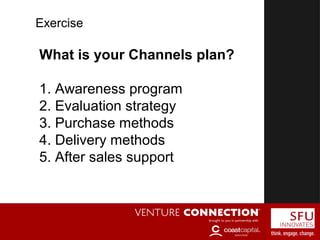
What is your Channels plan?
1. Awareness program
2. Evaluation strategy
3. Purchase methods
4. Delivery methods
5. After sales support
Exercise
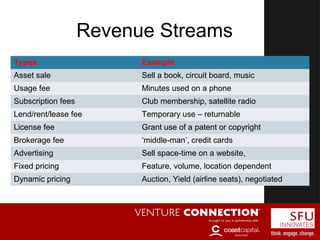
Revenue Streams
Types Example
Asset sale Sell a book, circuit board, music
Usage fee Minutes used on a phone
Subscription fees Club membership, satellite radio
Lend/rent/lease fee Temporary use – returnable
License fee Grant use of a patent or copyright
Brokerage fee ‘middle-man’, credit cards
Advertising Sell space-time on a website,
Fixed pricing Feature, volume, location dependent
Dynamic pricing Auction, Yield (airline seats), negotiated
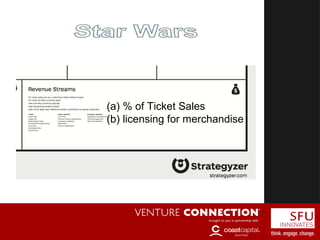
(a) % of Ticket Sales
(b) licensing for merchandise
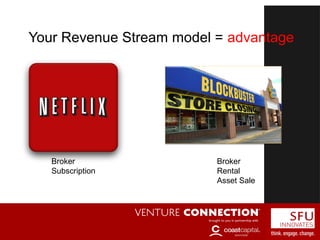
Your Revenue Stream model = advantage
Broker
Subscription
Broker
Rental
Asset Sale
How does your customer pay for their current
solution?
How much does your customer pay for their current
solution? (do they have a limit?)
How would your customer prefer to pay? (Club
Penguin example)
How much will they pay?
How do you prove it?
Exercise
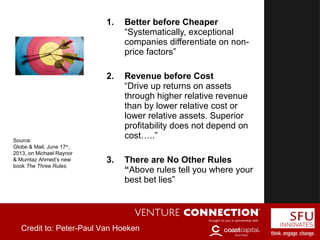
1. Better before Cheaper
“Systematically, exceptional
companies differentiate on non-
price factors”
2. Revenue before Cost
“Drive up returns on assets
through higher relative revenue
than by lower relative cost or
lower relative assets. Superior
profitability does not depend on
cost…..”
3. There are No Other Rules
“Above rules tell you where your
best bet lies”
Source:
Globe & Mail, June 17th
,
2013, on Michael Raynor
& Mumtaz Ahmed’s new
book The Three Rules.
Credit to: Peter-Paul Van Hoeken
Cost-Driven Business Model
• Focus on minimizing costs wherever
possible
• Creating and maintaining the leanest
possible Cost Structure, using:
– Low price Value Propositions
– Maximum automation, and extensive
outsourcing.
• Examples: No frills airlines, such as
Southwest
Value-Driven Business Model• Some companies are less concerned
with the cost implications of a particular
business model design, instead focus
on Value Creation
• Premium Value Propositions and a high
degree of personalized service usually
characterize value-driven business
models
• Examples: Luxury hotels
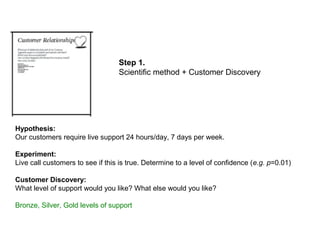
Hypothesis:
Our customers require live support 24 hours/day, 7 days per week.
Experiment:
Live call customers to see if this is true. Determine to a level of confidence (e.g. p=0.01)
Customer Discovery:
What level of support would you like? What else would you like?
Bronze, Silver, Gold levels of support
Step 1.
Scientific method + Customer Discovery
EXAMPLEHow to …
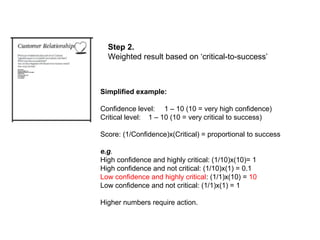
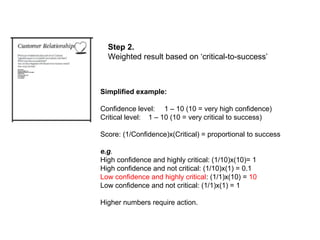
Simplified example:
Confidence level: 1 – 10 (10 = very high confidence)
Critical level: 1 – 10 (10 = very critical to success)
Score: (1/Confidence)x(Critical) = proportional to success
e.g.
High confidence and highly critical: (1/10)x(10)= 1
High confidence and not critical: (1/10)x(1) = 0.1
Low confidence and highly critical: (1/1)x(10) = 10
Low confidence and not critical: (1/1)x(1) = 1
Higher numbers require action.
Step 2.
Weighted result based on ‘critical-to-success’
EXAMPLEHow to …
Keys
• Key Resources
• Key Partners
• Key Activities
Key PartnershipsPartnerships
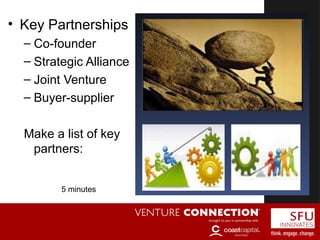
Key Partnerships• Key Partnerships
– Co-founder
– Strategic Alliance
– Joint Venture
– Buyer-supplier
Make a list of key
partners:
5 minutes
Key Resources
• Key Resources: required your business to
succeed
– Physical: building, equipment, servers, etc.
– Intellectual: Customer databases, ‘brand
awareness’, patents, trademarks, secrets, etc.
– Human: certifications, experience, connections
– Financial: LOC, cash, share-pool
– Create your list (5 minutes)
Key Activities
• Key Activities
– Production: Physical product, virtual, software,
delivery. What MUST happen?
– Problem solving: e.g. confirm price point by
customer discovery.
What activities MUST you do in next:
– 30 days. 3-4 activities
– 90 days. 3-4 activities that can only happen
after the 30 day activities are completed.
20 minutes
Weaknesses
• Analysis of the customer
• Analysis of the competition
Solutions
• Customer
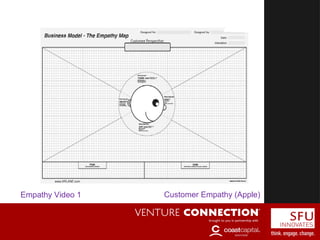
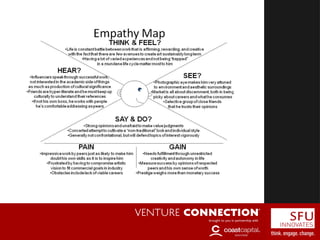
– Empathy Maps
– Day in the life of (customer segment X)
– Decision map
Customer Empathy
Empathy Video 1 Customer Empathy (Apple)
Customer Empathy
Competition
• Customer Discovery
– Interviews
• Old fashioned research
– Internet search
– Reports
– User groups
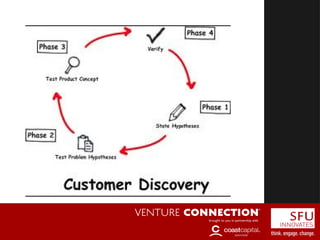
Customer Discovery
Create a list of 10 people you believe are your
users and/or paying customers and talk to them
(face-to-face).
You are seeking (a) insights, (b) new actions.
Healthy Eating Interview
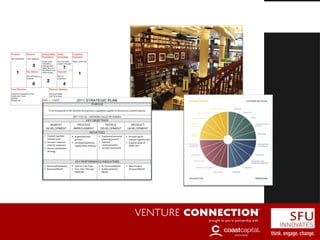
Death by Powerpoint
Customer Discovery
Example questions (DO NOT SELL!):
•Is ‘X’ a problem for you?
•How do you solve ‘X’ now?
•What is your cost of the current solution?
•If someone provided new Value Proposition ‘Y’,
would you use it?
•Who else should I talk to?
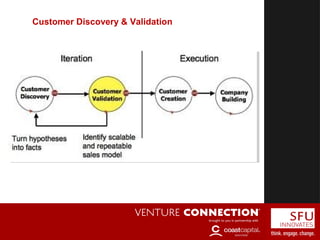
Customer DiscoveryCustomer Discovery & Validation
Thank you!
• Appendix
Simplified example:
Confidence level: 1 – 10 (10 = very high confidence)
Critical level: 1 – 10 (10 = very critical to success)
Score: (1/Confidence)x(Critical) = proportional to success
e.g.
High confidence and highly critical: (1/10)x(10)= 1
High confidence and not critical: (1/10)x(1) = 0.1
Low confidence and highly critical: (1/1)x(10) = 10
Low confidence and not critical: (1/1)x(1) = 1
Higher numbers require action.
Step 2.
Weighted result based on ‘critical-to-success’
EXAMPLEHow to …
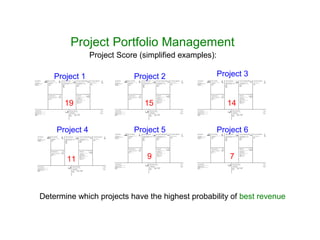
Project Portfolio Management
Project Score (simplified examples):
911
141519
7
Determine which projects have the highest probability of best revenue
Project 1 Project 2 Project 3
Project 4 Project 5 Project 6
How to …

SFU Business models sfu vc 2017

  • 1.
  • 2.
    For NVBC Round2.0, April 2015
  • 3.
  • 4.
  • 5.
    Agenda Business Model Canvas:WHO? WHAT? WHY? HOW? Business Model Generation via “Canvas” 1. Value Proposition + Customer Segments 3. Channels 4. Customer Relationships 5. Revenue Streams 6. Cost Structures 7. Key Resources 8. Key Partnerships 9. Key Activities 10. Weaknesses of the BMC
  • 6.
  • 8.
  • 9.
  • 10.
    “The business modelontology: A proposition in a design science approach.” Alexander Osterwalder 2004 University of Lousanne 160 pages + bibliography BMC Genesis
  • 12.
    Self published in2009, published by Wiley & Sons, 2010
  • 16.
    hypothesishypothesishypothesis hypothesis hypothesis hypothesis hypothesis hypothesishypothesis Solution = scientific method Business Model Canvas
  • 17.
    Evidence • National ScienceFoundation – 3X funding success using BMC/LLP – (now claiming > 10x) • MNEs – Greater commercial success (new products) • Investors asking for a BMC
  • 18.
    Used by companiesfrom start-ups to Fortune 500s, business schools Half a Million Books + 26 Languages + over 5,000,000 Canvas users Traction: Wide adoption
  • 19.
  • 20.
    VP & CS BusinessModel Canvas VP 1 (user) VP 2 (payer) CS 1 (user) CS 2 (payer) e.g. Game for kids
  • 21.
    Value Proposition• Whatis your customer’s problem/pain? • How does your solution solve their problem/pain? • Why is it better than the current solution? NEW! Convenient Performance Custom Design Usability Accessibility Status
  • 22.
    Greater the pain,greater the potential value Value Proposition GPS Accuracy
  • 23.
    No value ->No customers Value -> customers $12,000,000 Free - $0.99 - $69.99 It is VALUE not PRICE
  • 24.
  • 25.
  • 26.
  • 27.
  • 28.
    “Customer group, witha common denominator, for whom you serve and create value.” 28 Customer Segments – Definition Purpose of Customer Segmentation: Determines business viability Focuses Value Proposition Optimizes resources / efficiencies Develops expertise + relationships Builds competitive advantage Examples of Customer Segments: Business Revenue Consumer Profitability Geography Demographics Income Sector Life cycle Behaviour
  • 29.
  • 30.
    30 Customer Segments –Business Model Canvas
  • 31.
    Value Proposition: TimelessExample • A sailing ship from San Diego to Honolulu currently takes 12 days which is too long for many travellers. • Our new steam powered ship reduces travel time to 6 days. • In addition, the ship requires less crew and fewer supplies. • This trip on our ship only costs 10£* more than a sailing ship *1 week salary circa 1880. 1£ 1880 = 66.40£ 2013 = $108 CDN 10£ = $1080 CDN Value Proposition
  • 32.
    • Exercise: Yourvalue proposition: – What is your customer’s pain? – What is your solution? – Why is it better than your customer’s current (or alternative) solution?
  • 33.
  • 34.
    CHANNELS Customer Potential Partner YOU Competitor 1. AWARENESS Looksa fashion magazines Rarely watches TV Goes to Fine Dining Travels by air frequently Doesn’t garden Etc.
  • 35.
  • 36.
  • 37.
  • 38.
    CHANNELS5. After sales Allsales final Return for credit Return for full refund 30 days free support Satisfaction surveys Money back before 30 days Free customer support Paid customer support Remote support On-site support Training Follow-up phone calls How-to videos Facebook group Free ‘upgrades’ Paid ‘upgrades’ Paid Add-on features Support groups Loyalty programs
  • 39.
    What is yourChannels plan? 1. Awareness program 2. Evaluation strategy 3. Purchase methods 4. Delivery methods 5. After sales support Exercise
  • 40.
    Revenue Streams Types Example Assetsale Sell a book, circuit board, music Usage fee Minutes used on a phone Subscription fees Club membership, satellite radio Lend/rent/lease fee Temporary use – returnable License fee Grant use of a patent or copyright Brokerage fee ‘middle-man’, credit cards Advertising Sell space-time on a website, Fixed pricing Feature, volume, location dependent Dynamic pricing Auction, Yield (airline seats), negotiated
  • 41.
    (a) % ofTicket Sales (b) licensing for merchandise
  • 42.
    Your Revenue Streammodel = advantage Broker Subscription Broker Rental Asset Sale
  • 43.
    How does yourcustomer pay for their current solution? How much does your customer pay for their current solution? (do they have a limit?) How would your customer prefer to pay? (Club Penguin example) How much will they pay? How do you prove it? Exercise
  • 44.
    1. Better beforeCheaper “Systematically, exceptional companies differentiate on non- price factors” 2. Revenue before Cost “Drive up returns on assets through higher relative revenue than by lower relative cost or lower relative assets. Superior profitability does not depend on cost…..” 3. There are No Other Rules “Above rules tell you where your best bet lies” Source: Globe & Mail, June 17th , 2013, on Michael Raynor & Mumtaz Ahmed’s new book The Three Rules. Credit to: Peter-Paul Van Hoeken
  • 45.
    Cost-Driven Business Model •Focus on minimizing costs wherever possible • Creating and maintaining the leanest possible Cost Structure, using: – Low price Value Propositions – Maximum automation, and extensive outsourcing. • Examples: No frills airlines, such as Southwest
  • 46.
    Value-Driven Business Model•Some companies are less concerned with the cost implications of a particular business model design, instead focus on Value Creation • Premium Value Propositions and a high degree of personalized service usually characterize value-driven business models • Examples: Luxury hotels
  • 48.
    Hypothesis: Our customers requirelive support 24 hours/day, 7 days per week. Experiment: Live call customers to see if this is true. Determine to a level of confidence (e.g. p=0.01) Customer Discovery: What level of support would you like? What else would you like? Bronze, Silver, Gold levels of support Step 1. Scientific method + Customer Discovery EXAMPLEHow to …
  • 49.
    Simplified example: Confidence level:1 – 10 (10 = very high confidence) Critical level: 1 – 10 (10 = very critical to success) Score: (1/Confidence)x(Critical) = proportional to success e.g. High confidence and highly critical: (1/10)x(10)= 1 High confidence and not critical: (1/10)x(1) = 0.1 Low confidence and highly critical: (1/1)x(10) = 10 Low confidence and not critical: (1/1)x(1) = 1 Higher numbers require action. Step 2. Weighted result based on ‘critical-to-success’ EXAMPLEHow to …
  • 50.
    Keys • Key Resources •Key Partners • Key Activities
  • 51.
  • 52.
    Key Partnerships• KeyPartnerships – Co-founder – Strategic Alliance – Joint Venture – Buyer-supplier Make a list of key partners: 5 minutes
  • 53.
    Key Resources • KeyResources: required your business to succeed – Physical: building, equipment, servers, etc. – Intellectual: Customer databases, ‘brand awareness’, patents, trademarks, secrets, etc. – Human: certifications, experience, connections – Financial: LOC, cash, share-pool – Create your list (5 minutes)
  • 54.
    Key Activities • KeyActivities – Production: Physical product, virtual, software, delivery. What MUST happen? – Problem solving: e.g. confirm price point by customer discovery. What activities MUST you do in next: – 30 days. 3-4 activities – 90 days. 3-4 activities that can only happen after the 30 day activities are completed. 20 minutes
  • 55.
    Weaknesses • Analysis ofthe customer • Analysis of the competition
  • 56.
    Solutions • Customer – EmpathyMaps – Day in the life of (customer segment X) – Decision map
  • 57.
    Customer Empathy Empathy Video1 Customer Empathy (Apple)
  • 58.
  • 59.
    Competition • Customer Discovery –Interviews • Old fashioned research – Internet search – Reports – User groups
  • 60.
    Customer Discovery Create alist of 10 people you believe are your users and/or paying customers and talk to them (face-to-face). You are seeking (a) insights, (b) new actions. Healthy Eating Interview Death by Powerpoint
  • 61.
    Customer Discovery Example questions(DO NOT SELL!): •Is ‘X’ a problem for you? •How do you solve ‘X’ now? •What is your cost of the current solution? •If someone provided new Value Proposition ‘Y’, would you use it? •Who else should I talk to?
  • 62.
  • 63.
  • 64.
  • 65.
    Simplified example: Confidence level:1 – 10 (10 = very high confidence) Critical level: 1 – 10 (10 = very critical to success) Score: (1/Confidence)x(Critical) = proportional to success e.g. High confidence and highly critical: (1/10)x(10)= 1 High confidence and not critical: (1/10)x(1) = 0.1 Low confidence and highly critical: (1/1)x(10) = 10 Low confidence and not critical: (1/1)x(1) = 1 Higher numbers require action. Step 2. Weighted result based on ‘critical-to-success’ EXAMPLEHow to …
  • 66.
    Project Portfolio Management ProjectScore (simplified examples): 911 141519 7 Determine which projects have the highest probability of best revenue Project 1 Project 2 Project 3 Project 4 Project 5 Project 6 How to …

Editor's Notes

  • #8 There are a lot of business books to choose from. Which one is best?
  • #10 There are a lot of business books to choose from. Which one is best?
  • #11 In the begininning The business model ontology:
  • #16 Where to start? Valid reasons to start at different places. Due to the variety of companies in C4G, we will start in the middle.
  • #17 Ask Bosch attendees what their current ‘pain’ is (Customer Discovery) What are the critical issues at Bosch? How does this benefit me (Bosch). Expanding your market base of CURRENT products : test this now internally. No risk, Test against your current challenging projects. Open process with your teams; may increase their focus. Next steps = What is your feedback. Timeline.
  • #20 Can change the product AND the customer. Customer are more challenging because they change and don’t tell you about it. You need to maintain constant contact with your customers. Never stop. Do not be surprized if they change their requirement WITHOUT YOUR PERMISSION. They do not answer to you. You answer to them.
  • #21 Ask Bosch attendees what their current ‘pain’ is (Customer Discovery) What are the critical issues at Bosch? How does this benefit me (Bosch). Expanding your market base of CURRENT products : test this now internally. No risk, Test against your current challenging projects. Open process with your teams; may increase their focus. Next steps = What is your feedback. Timeline.
  • #22 1) Identify who your customer is. 2) Can often be quantitated: may express quantitatively internally but may be expressed qualitatively to a customer Newness Performance Custom Turn-key or “Get the job done” e.g. Rolls Royce jet engines Brand/Status Price Cost reduction Risk reduction/increase Accessibility Convenience Entertainment
  • #23 The greater the pain, the more valuable the solution.
  • #24 Any other reasons? How many of you have heard your potential customer say that it was THEIR fault that they did not buy your product? Why do they not buy? There is not enough VALUE to them. People take out loans for large sums of money for things that they see value in (house, car), but will not pay $0.99 for something that has less value than $0.99. Customers buy because of the right combination of factors that create VALUE. Price, features, usability, reliability… etc. Would you eat a rancid meal if it was $1.00? How about free?
  • #30 Product Market fit. Was the product wrong, or was the market wrong, or both?
  • #32 Ask the group: What is the customer pain? What is the solution? Why is it better is it than the competition? Do you think a user-customer would understand? Do you think a ship-buyer would understand? Do you think an investor would understand? Your audience will decide in 30 seconds whether or not they want to know more.
  • #33 1) Clients will now develop their VP for approximately 30 minutes using BMC Poster-Notes on the wall. 2) Clients will then, in turn, present their value proposition to the group for feedback. Exact time will depend on number of client companies. e.g. @45 minutes and 15 companies: Presentation 1 minute, feedback for 2 minutes total of 3 minutes per company.
  • #34 Well studied: 5 identified phases. Awareness Evaluation Purchase Delivery After sales/support
  • #35 Well studied: 5 identified phases. Awareness Evaluation Purchase Delivery After sales/support
  • #36 Well studied: 5 identified phases. Awareness Evaluation Purchase Delivery After sales/support
  • #37 Well studied: 5 identified phases. Make it easy for the customer to give you money. I hate web-sites that make it difficult, I give up and move on. Awareness Evaluation Purchase Delivery After sales/support
  • #38 Well studied: 5 identified phases. Make it easy for the customer to give you money. I hate web-sites that make it difficult, I give up and move on. Awareness Evaluation Purchase Delivery After sales/support
  • #39 Well studied: 5 identified phases. Make it easy for the customer to give you money. I hate web-sites that make it difficult, I give up and move on. Awareness Evaluation Purchase Delivery After sales/support: How do you track results?
  • #40 Well studied: 5 identified phases. Make it easy for the customer to give you money. I hate web-sites that make it difficult, I give up and move on. Awareness Evaluation Purchase Delivery After sales/support: How do you track results?
  • #41 Provide overview. Combinations are possible. Review Xerox example: Inventing new methods are possible. e.g. Xerox (Haloid Photographic) credited with inventing lease plus usage combination to overcome high initial cost. Customers did not believe the product would be used or save money. After day 2, all usage fee; Value Proposition became obvious to customers. Would you sell to the user when it is the user you are putting out of a job? Rooms of 50 typists reduced to 2 people. Options = they way people are used to paying, OR a new method that captures another market. Need to do the math.
  • #43 Provide overview. Combinations are possible. Review Xerox example: Inventing new methods are possible. e.g. Xerox (Haloid Photographic) credited with inventing lease plus usage combination to overcome high initial cost. Customers did not believe the product would be used or save money. After day 2, all usage fee; Value Proposition became obvious to customers. Would you sell to the user when it is the user you are putting out of a job? Rooms of 50 typists reduced to 2 people. Options = they way people are used to paying, OR a new method that captures another market. Need to do the math. NetFlix vs. Blockbuster (in Canada) Netflix has less selection, few or no new releases and has latency issues. Opening for Shaw-On-Demand and Apple Movies.
  • #44 You can add sales cycle information here also.
  • #49 Live call allows for Customer Discovery, while a paper/on-line survey will only allow the answer to the specific question: Less insight.
  • #50 Live call allows for Customer Discovery, while a paper/on-line survey will only allow the answer to the specific question: Less insight.
  • #51 Physical: that you must control (e.g. does owning your server add value, or can you use a service). Intellectual: Patents, copyright, trademarks, trade secrets, customer database (can be very valuable e.g. Rich’s Data, brand awareness (NIKE, Sony, Microsoft, SAP just the name is valuable). Human: knowledge, experience, certifications (engineering firms, accounting, law), connections Financial: Cash, Lines-of-credit, share-option pool available,
  • #52 Partnerships
  • #53 Start-ups typically try to push a big rock up a big hill. Options 1) pick a smaller rock, 2) pick a less steep hill, 3) get help moving the rock. Co-founder Strategic alliance: competitor, or a non-competitor Joint Venture e.g. two companies form a third company for mutual benefit Buyer-supplier for reliable supply (you can be on either side).
  • #54 Physical: that you must control (e.g. does owning your server add value, or can you use a service). Intellectual: Patents, copyright, trademarks, trade secrets, customer database (can be very valuable e.g. Rich’s Data, brand awareness (NIKE, Sony, Microsoft, SAP just the name is valuable). Human: knowledge, experience, certifications (engineering firms, accounting, law), connections Financial: Cash, Lines-of-credit, share-option pool available,
  • #55 Production: Product oriented companies, physical product, software Problem solving: Service based companies, but often includes product based companies/new product. Network/Platform (middle-man): e.g., E-bay, VISA, POS, etc.
  • #58 Why? Play the videos. Explain as: A day in the life of your users/buyers. IDEA: Create a “Product Empathy Map”. A day in the life of your product; e.g. who comes into contact with your product, who is affected by it.
  • #59 Create Your Customer Map. If you have a multisided market, you will need to create more than one. Think in terms of “a day in the life of my customer”. Right from, do they have a coffee in the morning, do they have kids, where do they get their NEWS (on line, newspaper, magazine, Pinterest, Facebook, LinkedIN, scientific journals). What are their hobbies? Golf, sailing, driving, gardening. What is the most frustrating part of their day? What are their political beliefs, religious. How do they dress? What do they listen too? What do they do to make their day better? Who reports to them? Who do they report to?
  • #61 Call to Action. Is it possible to talk to too many customers? Never stop revisiting you plan or model. You customers keep moving and you have to keep discovering where they are going or where they went. Note the biomedical company that did not track customers that left, therefore they could not adjust. They had to keep finding new customers, rather than keeping their existing customers.. Which is easier, less costly and more valuable in terms of lifetime value? Ask attendees how they will conduct their interviews.
  • #62 Call to Action. Is it possible to talk to too many customers? Never stop revisiting you plan or model. You customers keep moving and you have to keep discovering where they are going or where they went. Note the biomedical company that did not track customers that left, therefore they could not adjust. They had to keep finding new customers, rather than keeping their existing customers.. Which is easier, less costly and more valuable in terms of lifetime value? Does Nike still talk to customers? McDonalds?
  • #63 Besides all the other awesome things you will do for your company in the next week, We would like you to add just two things. Have a 30 second value proposition ready Call 25 people that you believe are your customer in the next week, before our next meeting (can you talk to 6 people a day for 5 days in a row?) State your value proposition and ask them (example) What do they use now? how much the would be willing to pay for your solution How would they prefer to pay
  • #66 Live call allows for Customer Discovery, while a paper/on-line survey will only allow the answer to the specific question: Less insight.