Sustainable food and food security
Session 2 – Alternative and community-led projects
FCH, Thursday 6th March 2014
Dan Keech, CCRI
dkeech@glos.ac.uk
Field trip 13th March
9.15 Meet at main entrance Bristol Temple Meads
10.00 Fareshare South West, St Jude’s
11.30 Bristol Pound, Corn Street
12.15 St Nicholas Market
c. 12.45 lunch and free time
2.00 Recap at Bristol Castle or Bordeaux Quay.
Need to bring – comfortable shoes and rain coats, note
taking materials, money and/or lunch
Should be finished by 3pm, return to Cheltenham under
your own steam
Session 2
This morning we will :
• Review the emergence of local food initiatives (as a
response to national food security concerns)
• Go through CSA models
• Go through FM case study, film, analysis method
Later, Matt will talk about:
• Personal, household, social food insecurity
• Different UK responses to economic food insecurity
(poverty) with film clips
But first – how is it going?
Alternative and community-led projects as
responses to concerns about food security
Matt will cover issues of personal and social food insecurity
this afternoon
In this session we will begin looking at food security from a
national policy perspective.
• How has policy on food security developed in the UK?
• Why did food security concerns spur alternative
responses?
• How is local/community food perceived as improving food
security?
Emergence of alternatives
In session 1 we heard how some of the consequences of the
modern food system stimulate concern among citizens:
• Concern about the disconnection between consumers and
producers
• Concern about who controls the food chain
• Concern about health and environment linked to the
industrial food system (‘externalities’ – Lang & Pretty 2004)
• The idea that some of these challenges are ‘locked in’ to
the places and the ways that we live and work
In this session we will hear about a two civil society responses to
these concerns – CSA and Farmers’ Markets.
Food security policy in the UK
• Increasing reliance on imports since Industrial Revolution
• Colonial trading networks
• Interruptions of food supply during Second World War
• Consequently policy of state intervention in agriculture
• Reduction in local diversity (standardisation)
• Increase in output productivity (green revolution)
• Increased dependence on imported agricultural resources
(oil and fertilisers) – 1973 oil supply crisis
• From 1970s EEC/EC/EU membership – 90% self-sufficient
• Global trade liberalisation during 1980s – we can buy our
way out of trouble
• New interest in national food security in 2000s as input
costs rise dramatically and food price spikes occur.
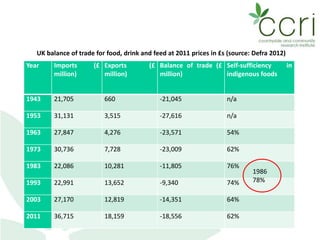
Year Imports (£
million)
Exports (£
million)
Balance of trade (£
million)
Self-sufficiency in
indigenous foods
1943 21,705 660 -21,045 n/a
1953 31,131 3,515 -27,616 n/a
1963 27,847 4,276 -23,571 54%
1973 30,736 7,728 -23,009 62%
1983 22,086 10,281 -11,805 76%
1993 22,991 13,652 -9,340 74%
2003 27,170 12,819 -14,351 64%
2011 36,715 18,159 -18,556 62%
UK balance of trade for food, drink and feed at 2011 prices in £s (source: Defra 2012)
1986
78%
Local food movement
Soil Association Food Futures programme
Sustain and food links federation
Foot and mouth/Curry Commission – local and regional
food as rural development
Lottery support:
• Food for Life
• Making Local Food Work
• Local Food programme (urban)
• Negligible contribution in terms of food output but
social innovation and new enterprise models.
• http://www.localfoodgrants.org/foodetube
Local food projects presented as:
• Innovative
• Convivial
• Educational
• Therapeutic
• Green/healthy
• Building relationships
• Successful
• Alternatives
1. CSA - What is it?
CSA has a number of characteristics which may include:
• Shared risk between farmer and consumer (member)
• Advanced, or regular payment for food
• Co-operative/democratic management
• Contribution by members to labour
• Access to the farm for education, relaxation… etc.
Essentially, it is a way of planning cash-flow and cropping; and
may renegotiate the distinction between farmer, landholder,
customer – this is a political/conceptual challenge in the EU.
Current models include:
•Share in the harvest (a proportion of the harvest)
•Committed market (a minimum, or informal commitment)
•Support group around a farm (events, festivals, markets)
•Rent a tree (for fruit – can be non-local)
•Do the work yourself (labour for food)
•Shares or gifts in the farm capital (cf. Polanyi?)
•Community owned enterprise (see shares above and later)
We’ll discus some of these. Main point is to think about breadth
– one size will not fit all, all schemes are different.
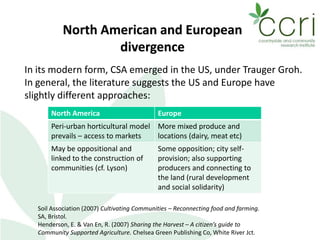
North American and European
divergence
In its modern form, CSA emerged in the US, under Trauger Groh.
In general, the literature suggests the US and Europe have
slightly different approaches:
North America Europe
Peri-urban horticultural model
prevails – access to markets
More mixed produce and
locations (dairy, meat etc)
May be oppositional and
linked to the construction of
communities (cf. Lyson)
Some opposition; city self-
provision; also supporting
producers and connecting to
the land (rural development
and social solidarity)
Soil Association (2007) Cultivating Communities – Reconnecting food and farming.
SA, Bristol.
Henderson, E. & Van En, R. (2007) Sharing the Harvest – A citizen’s guide to
Community Supported Agriculture. Chelsea Green Publishing Co, White River Jct.
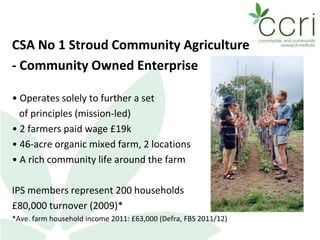
CSA No 1 Stroud Community Agriculture
- Community Owned Enterprise
• Operates solely to further a set
of principles (mission-led)
• 2 farmers paid wage £19k
• 46-acre organic mixed farm, 2 locations
• A rich community life around the farm
IPS members represent 200 households
£80,000 turnover (2009)*
*Ave. farm household income 2011: £63,000 (Defra, FBS 2011/12)
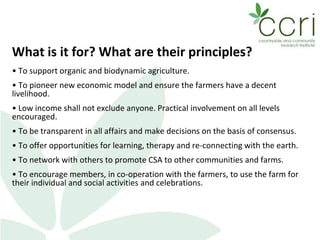
What is it for? What are their principles?
• To support organic and biodynamic agriculture.
• To pioneer new economic model and ensure the farmers have a decent
livelihood.
• Low income shall not exclude anyone. Practical involvement on all levels
encouraged.
• To be transparent in all affairs and make decisions on the basis of consensus.
• To offer opportunities for learning, therapy and re-connecting with the earth.
• To network with others to promote CSA to other communities and farms.
• To encourage members, in co-operation with the farmers, to use the farm for
their individual and social activities and celebrations.
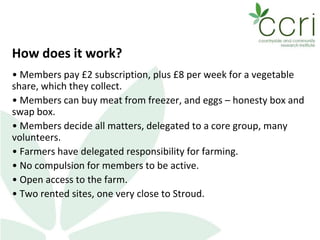
How does it work?
• Members pay £2 subscription, plus £8 per week for a vegetable
share, which they collect.
• Members can buy meat from freezer, and eggs – honesty box and
swap box.
• Members decide all matters, delegated to a core group, many
volunteers.
• Farmers have delegated responsibility for farming.
• No compulsion for members to be active.
• Open access to the farm.
• Two rented sites, one very close to Stroud.
No 2: Tablehurst & Plaw Hatch CSA
• Tablehurst (125 ha.) is arable and stock, Plaw Hatch (50 ha.
acres) is dairy and horticulture
• Both are biodynamic. T’hurst was a loss-making college farm
put up for sale in 1994. Local people raised capital to buy it.
• A co-op (IPS) owns both farms, with shares held by local
members. Membership does not give entitlement to food.
• Together employ 20 f/t and 40 p/t and voluntary staff –
inefficient or rural job creation? Several staff live on the farm –
community inside the farm & links to social care.
• Annual turnover £1.3 million
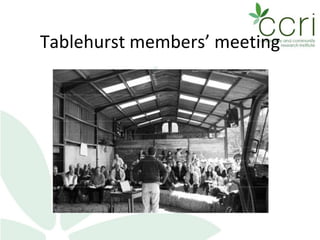
Tablehurst members’ meeting
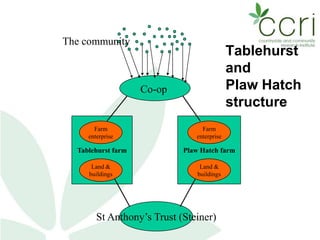
Tablehurst
and
Plaw Hatch
structure
The community
Co-op
Tablehurst farm Plaw Hatch farm
St Anthony’s Trust (Steiner)
Farm
enterprise
Land &
buildings
Farm
enterprise
Land &
buildings
Tablehurst & Plaw Hatch - Farming for farmers?
• Shares cost £100 and there are 600 members. No yield or trade.
• 1,000 customers a week in farm shop and bakery.
• Occasionally members are asked to provide loan capital – for
buildings (incl. homes) or loans equipment (over 5 years)
• Total capital stock is c.£250k
• In exchange for that capital and that goodwill, farmers
undertake to farm well. They do.
• Farmers appreciate the strong sense of community, faith in
their professionalism and freedom from burden of inheritance.
They farm for the future, not for their own wealth (it’s fixed) or
for their children.
Short film
• http://www.youtube.com/watch?v=dqLUa
saHLuA
• Growing Communities in London
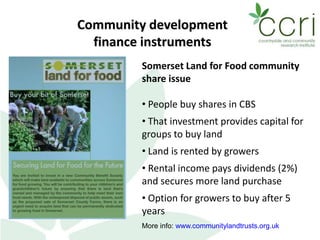
Community development
finance instruments
Somerset Land for Food community
share issue
• People buy shares in CBS
• That investment provides capital for
groups to buy land
• Land is rented by growers
• Rental income pays dividends (2%)
and secures more land purchase
• Option for growers to buy after 5
years
More info: www.communitylandtrusts.org.uk
Group exercise: CSA critique
Divide into 2 groups. Think about the CSA story.
Group 1 – Consider three key general strengths of the CSA
models we have described as you see them.
Group 2 – CSAs are a good idea but they are not the
mainstream of farming. Please provide 3-5 critical points
about the difficulties or weaknesses of CSA.
10 mins and 5 mins feedback per group.
Some critiques of CSA
• CSAs are marginal do not really change the food ‘landscape’
• Their pricing policies may be exclusive for some citizens – often
educated and wealthy
• They can be complex and hard work – relies on high degree of
farmer and business skills
• Land is very hard and expensive to find
• Farmers may appreciate the support of their communities but
find the limited sales volumes hard to accommodate
• Potentially risky; have to eat what grows – choice?
Summary
• CSA takes many forms but most expect consumers to
share production risks with farmers
• CSAs may be ideologically led but are businesses
• CSAs have made successful links with other
alternative food projects – farmers’ markets, organic
box schemes and have produced innovative methods
and financial models
• Potentially transferable? – housing and energy
generation
• Community supported agriculture or agriculture
supporting the community?
Some reading
Butler Flora, C. and Bregendahl, C. (2012) Collaborative Community-
supported Agriculture: Balancing Community Capitals for Producers and
Consumers. International Journal of Sociology of Agriculture and Food Vol
19 No 3 pp. 329-346.
DeLind, M. (1999) Is This a Women’s Movement? The Relationship to
Gender of Community Supported Agriculture in Michigan. Human
Organisation Vol 58 No 2 pp. 190-200
Guthman, J., Morris, A. and Allen, P (2006) Squaring Farm Security in Two
Types of Alternative Food Institutions. Rural Sociology Vol 71, No 4, pp.
662-684
Keech, D., Alldred, S. and Snow, R (2009) An analysis of seven CSA
enterprises. Making Local Food Work Discussion Paper. Soil
Association, Bristol.
Schnell, S (2007) Food with a farmer’s face: CSA in the United States.
Geographical Review Vol 97 Iss 4, pp.550-564.
10 mins break

SF&FS Session 6th March

  • 1.
    Sustainable food andfood security Session 2 – Alternative and community-led projects FCH, Thursday 6th March 2014 Dan Keech, CCRI dkeech@glos.ac.uk
  • 2.
    Field trip 13thMarch 9.15 Meet at main entrance Bristol Temple Meads 10.00 Fareshare South West, St Jude’s 11.30 Bristol Pound, Corn Street 12.15 St Nicholas Market c. 12.45 lunch and free time 2.00 Recap at Bristol Castle or Bordeaux Quay. Need to bring – comfortable shoes and rain coats, note taking materials, money and/or lunch Should be finished by 3pm, return to Cheltenham under your own steam
  • 3.
    Session 2 This morningwe will : • Review the emergence of local food initiatives (as a response to national food security concerns) • Go through CSA models • Go through FM case study, film, analysis method Later, Matt will talk about: • Personal, household, social food insecurity • Different UK responses to economic food insecurity (poverty) with film clips But first – how is it going?
  • 4.
    Alternative and community-ledprojects as responses to concerns about food security Matt will cover issues of personal and social food insecurity this afternoon In this session we will begin looking at food security from a national policy perspective. • How has policy on food security developed in the UK? • Why did food security concerns spur alternative responses? • How is local/community food perceived as improving food security?
  • 5.
    Emergence of alternatives Insession 1 we heard how some of the consequences of the modern food system stimulate concern among citizens: • Concern about the disconnection between consumers and producers • Concern about who controls the food chain • Concern about health and environment linked to the industrial food system (‘externalities’ – Lang & Pretty 2004) • The idea that some of these challenges are ‘locked in’ to the places and the ways that we live and work In this session we will hear about a two civil society responses to these concerns – CSA and Farmers’ Markets.
  • 6.
    Food security policyin the UK • Increasing reliance on imports since Industrial Revolution • Colonial trading networks • Interruptions of food supply during Second World War • Consequently policy of state intervention in agriculture • Reduction in local diversity (standardisation) • Increase in output productivity (green revolution) • Increased dependence on imported agricultural resources (oil and fertilisers) – 1973 oil supply crisis • From 1970s EEC/EC/EU membership – 90% self-sufficient • Global trade liberalisation during 1980s – we can buy our way out of trouble • New interest in national food security in 2000s as input costs rise dramatically and food price spikes occur.
  • 7.
    Year Imports (£ million) Exports(£ million) Balance of trade (£ million) Self-sufficiency in indigenous foods 1943 21,705 660 -21,045 n/a 1953 31,131 3,515 -27,616 n/a 1963 27,847 4,276 -23,571 54% 1973 30,736 7,728 -23,009 62% 1983 22,086 10,281 -11,805 76% 1993 22,991 13,652 -9,340 74% 2003 27,170 12,819 -14,351 64% 2011 36,715 18,159 -18,556 62% UK balance of trade for food, drink and feed at 2011 prices in £s (source: Defra 2012) 1986 78%
  • 8.
    Local food movement SoilAssociation Food Futures programme Sustain and food links federation Foot and mouth/Curry Commission – local and regional food as rural development Lottery support: • Food for Life • Making Local Food Work • Local Food programme (urban) • Negligible contribution in terms of food output but social innovation and new enterprise models. • http://www.localfoodgrants.org/foodetube
  • 9.
    Local food projectspresented as: • Innovative • Convivial • Educational • Therapeutic • Green/healthy • Building relationships • Successful • Alternatives
  • 10.
    1. CSA -What is it? CSA has a number of characteristics which may include: • Shared risk between farmer and consumer (member) • Advanced, or regular payment for food • Co-operative/democratic management • Contribution by members to labour • Access to the farm for education, relaxation… etc. Essentially, it is a way of planning cash-flow and cropping; and may renegotiate the distinction between farmer, landholder, customer – this is a political/conceptual challenge in the EU.
  • 11.
    Current models include: •Sharein the harvest (a proportion of the harvest) •Committed market (a minimum, or informal commitment) •Support group around a farm (events, festivals, markets) •Rent a tree (for fruit – can be non-local) •Do the work yourself (labour for food) •Shares or gifts in the farm capital (cf. Polanyi?) •Community owned enterprise (see shares above and later) We’ll discus some of these. Main point is to think about breadth – one size will not fit all, all schemes are different.
  • 12.
    North American andEuropean divergence In its modern form, CSA emerged in the US, under Trauger Groh. In general, the literature suggests the US and Europe have slightly different approaches: North America Europe Peri-urban horticultural model prevails – access to markets More mixed produce and locations (dairy, meat etc) May be oppositional and linked to the construction of communities (cf. Lyson) Some opposition; city self- provision; also supporting producers and connecting to the land (rural development and social solidarity) Soil Association (2007) Cultivating Communities – Reconnecting food and farming. SA, Bristol. Henderson, E. & Van En, R. (2007) Sharing the Harvest – A citizen’s guide to Community Supported Agriculture. Chelsea Green Publishing Co, White River Jct.
  • 13.
    CSA No 1Stroud Community Agriculture - Community Owned Enterprise • Operates solely to further a set of principles (mission-led) • 2 farmers paid wage £19k • 46-acre organic mixed farm, 2 locations • A rich community life around the farm IPS members represent 200 households £80,000 turnover (2009)* *Ave. farm household income 2011: £63,000 (Defra, FBS 2011/12)
  • 14.
    What is itfor? What are their principles? • To support organic and biodynamic agriculture. • To pioneer new economic model and ensure the farmers have a decent livelihood. • Low income shall not exclude anyone. Practical involvement on all levels encouraged. • To be transparent in all affairs and make decisions on the basis of consensus. • To offer opportunities for learning, therapy and re-connecting with the earth. • To network with others to promote CSA to other communities and farms. • To encourage members, in co-operation with the farmers, to use the farm for their individual and social activities and celebrations.
  • 15.
    How does itwork? • Members pay £2 subscription, plus £8 per week for a vegetable share, which they collect. • Members can buy meat from freezer, and eggs – honesty box and swap box. • Members decide all matters, delegated to a core group, many volunteers. • Farmers have delegated responsibility for farming. • No compulsion for members to be active. • Open access to the farm. • Two rented sites, one very close to Stroud.
  • 16.
    No 2: Tablehurst& Plaw Hatch CSA • Tablehurst (125 ha.) is arable and stock, Plaw Hatch (50 ha. acres) is dairy and horticulture • Both are biodynamic. T’hurst was a loss-making college farm put up for sale in 1994. Local people raised capital to buy it. • A co-op (IPS) owns both farms, with shares held by local members. Membership does not give entitlement to food. • Together employ 20 f/t and 40 p/t and voluntary staff – inefficient or rural job creation? Several staff live on the farm – community inside the farm & links to social care. • Annual turnover £1.3 million
  • 17.
  • 18.
    Tablehurst and Plaw Hatch structure The community Co-op Tablehurstfarm Plaw Hatch farm St Anthony’s Trust (Steiner) Farm enterprise Land & buildings Farm enterprise Land & buildings
  • 19.
    Tablehurst & PlawHatch - Farming for farmers? • Shares cost £100 and there are 600 members. No yield or trade. • 1,000 customers a week in farm shop and bakery. • Occasionally members are asked to provide loan capital – for buildings (incl. homes) or loans equipment (over 5 years) • Total capital stock is c.£250k • In exchange for that capital and that goodwill, farmers undertake to farm well. They do. • Farmers appreciate the strong sense of community, faith in their professionalism and freedom from burden of inheritance. They farm for the future, not for their own wealth (it’s fixed) or for their children.
  • 20.
  • 21.
    Community development finance instruments SomersetLand for Food community share issue • People buy shares in CBS • That investment provides capital for groups to buy land • Land is rented by growers • Rental income pays dividends (2%) and secures more land purchase • Option for growers to buy after 5 years More info: www.communitylandtrusts.org.uk
  • 22.
    Group exercise: CSAcritique Divide into 2 groups. Think about the CSA story. Group 1 – Consider three key general strengths of the CSA models we have described as you see them. Group 2 – CSAs are a good idea but they are not the mainstream of farming. Please provide 3-5 critical points about the difficulties or weaknesses of CSA. 10 mins and 5 mins feedback per group.
  • 23.
    Some critiques ofCSA • CSAs are marginal do not really change the food ‘landscape’ • Their pricing policies may be exclusive for some citizens – often educated and wealthy • They can be complex and hard work – relies on high degree of farmer and business skills • Land is very hard and expensive to find • Farmers may appreciate the support of their communities but find the limited sales volumes hard to accommodate • Potentially risky; have to eat what grows – choice?
  • 24.
    Summary • CSA takesmany forms but most expect consumers to share production risks with farmers • CSAs may be ideologically led but are businesses • CSAs have made successful links with other alternative food projects – farmers’ markets, organic box schemes and have produced innovative methods and financial models • Potentially transferable? – housing and energy generation • Community supported agriculture or agriculture supporting the community?
  • 25.
    Some reading Butler Flora,C. and Bregendahl, C. (2012) Collaborative Community- supported Agriculture: Balancing Community Capitals for Producers and Consumers. International Journal of Sociology of Agriculture and Food Vol 19 No 3 pp. 329-346. DeLind, M. (1999) Is This a Women’s Movement? The Relationship to Gender of Community Supported Agriculture in Michigan. Human Organisation Vol 58 No 2 pp. 190-200 Guthman, J., Morris, A. and Allen, P (2006) Squaring Farm Security in Two Types of Alternative Food Institutions. Rural Sociology Vol 71, No 4, pp. 662-684 Keech, D., Alldred, S. and Snow, R (2009) An analysis of seven CSA enterprises. Making Local Food Work Discussion Paper. Soil Association, Bristol. Schnell, S (2007) Food with a farmer’s face: CSA in the United States. Geographical Review Vol 97 Iss 4, pp.550-564.
  • 26.