Scaling up Urban
Agriculture in
Toronto               !


Building the Infrastructure

Metcalf Food Solutions


Joseph Nasr, Rod MacRae & James Kuhns


with Martin Danyluk, Penny Kaill-Vinish,
Marc Michalak & Abra Snider


June 2010
Metcalf Foundation


  The Metcalf Foundation helps Canadians imagine and build a just, healthy,
and creative society by supporting dynamic leaders who are strengthening their
communities, nurturing innovative approaches to persistent problems, and
encouraging dialogue and learning to inform action.


Authors


  Joseph Nasr is an independent scholar, lecturer, and consultant based in
Toronto. He is co-coordinator of MetroAg – Alliance for Urban Agriculture and
president of the Urban Agriculture Network. Recently, he co-curated the
travelling exhibit Carrot City: Designing for Urban Agriculture. He has taught
at universities in several countries, including courses on urban food security and
urban agriculture through Ryerson University, where he is an Associate at the
Centre for Studies in Food Security. He is co-author or co-editor of three books
(including Urban Agriculture: Food, Jobs and Sustainable Cities) and author of
dozens of articles. He holds a doctorate from the University of Pennsylvania.
 Rod MacRae is an assistant professor at York University’s Faculty of
Environmental Studies. A food policy analyst, over the past 25 years, he has
worked for governments, businesses, and NGOs on the transition to sustainable
and health-promoting food systems. He was the first coordinator of the Toronto
Food Policy Council. Rod holds a doctorate from McGill University.
  James Kuhns works in urban agriculture and food security–related
activities. He is the president of James Kuhns Urban Issues, co-coordinator of
the MetroAg – Alliance for Urban Agriculture, and an Associate at the Ryerson
Centre for Food Studies in Food Security, where he teaches online courses
concerning urban agriculture. He is the immediate past president of the
American Community Gardening Association and a member of the Toronto
Food Policy Council. He holds a M.Sc. in agricultural development from the
University of London.


Scaling up Urban Agriculture in Toronto: Building the Infrastructure             2
Acknowledgements


  We owe considerable thanks to some people who reviewed the paper or
offered valuable insights: Jodi Callan, Russ Christianson, Elbert van
Donkersgoed, Peter Dorfman, Wayne Roberts, Wally Seccombe, and Rhonda
Teitel-Payne. We especially thank Philippa Campsie for her hard work editing
this report.


Additional Reports


  Additional reports based on studies that served as background research for
this paper can be found at http://urbangrowers.wordpress.com.


Scaling up Urban Agriculture in Toronto: Building the Infrastructure           3
Contents


Foreword .................................................................................................................. 5!
Executive Summary ..................................................................................................7!
Introduction ............................................................................................................10!
Overview of Urban Agriculture in the City of Toronto...........................................12!
Infrastructure for Accessing Spaces for Production ..............................................14!
    Official Plan and Zoning Bylaws ......................................................................... 15!
    Agricultural Land Taxation .................................................................................18!
    Lease Arrangements........................................................................................... 20!
    Infrastructure for Rooftop Agriculture Development ........................................21!
Resources, Services, and Physical Infrastructure ................................................. 24!
  The Greatest Needs ............................................................................................ 24!
    Soil and Amendments ........................................................................................ 25!
    Water and Wastewater....................................................................................... 28!
    Power and Lighting ............................................................................................ 29!
    Seeds and Seedlings ........................................................................................... 30!
    Equipment and Facilities ....................................................................................31!
    Season Extension ............................................................................................... 32!
    Fencing ............................................................................................................... 33!
  Support Facilities ............................................................................................... 33!
Food-Chain Infrastructure .................................................................................... 34!
    Analysis of Supply Chains .................................................................................. 34!
    City of Toronto Initiatives .................................................................................. 36!
    Post-harvest Handling and Distribution of Local Food .................................... 38!
    The Potential of Co-operatives........................................................................... 39!
Knowledge Infrastructure...................................................................................... 40!
  Urban Agriculture Virtual Clearinghouse...........................................................41!
    Urban Food and Agriculture Learning Centres................................................. 43!
  Training Initiatives............................................................................................. 43!
Governance, Coordination, and Financial Support Infrastructure ...................... 46!
    Grounds for Choosing a Governance Model...................................................... 46!
    Potential Governance Models ............................................................................ 47!
  Financial and Other Support ............................................................................. 50!
Conclusion: A Vision for a Potential Urban Agriculture in Toronto .................... 55!
Appendix: Summary of Solutions...........................................................................57!
References .............................................................................................................. 63!


Scaling up Urban Agriculture in Toronto: Building the Infrastructure                                                       4
Foreword


  Food — how and where we grow, process, distribute, sell, and eat it — is a
fundamental human concern and central to the health of our communities,
economy, environment, and bodies. Food is elemental, yet the system we have
built around it is complex, rigid, and opaque.
   There is growing concern that our current food system is not working well —
some would say it is broken. In Ontario, many farmers are facing an income
crisis. Too many people lack access to healthy food. And, despite growing
demand for local food, our centralized, large-scale food processors, distributors,
and retailers are unable to provide it.
  Efforts to rebuild the local food supply chain and restructure Ontario’s food
and agriculture system have been building momentum in the last few years.
Ontario’s residents are expressing a burgeoning desire to create a food system
that is more sustainable, equitable, and economically viable.
  For the past eight years, the Metcalf Foundation has been seeding and
supporting food- and agriculture-related initiatives across the province, from
agricultural land trusts to sustainable food certification, from new farm
incubators to low-income neighbourhood farmers’ markets, from diversified
forms of street food to new models for community food hubs.
  Starting in 2007, we convened our funding partners who were working on the
supply and equitable distribution of local, sustainable food. We wanted to
explore the possibilities for cooperative, integrated efforts to transform Ontario’s
food and agriculture system. These gatherings led to the creation of Sustain
Ontario – the Alliance for Healthy Food and Farming which, after only one year
of operation, is already playing a central role in supporting the efforts of its
growing membership. The discussions also led to our publishing the paper Food
Connects Us All: Sustainable Local Food in Southern Ontario in February 2008,
which identified some of the barriers to a local, sustainable food system and the
many roads to change.
 Building on that first paper, in 2009 we decided to focus on solutions, rather
than just the obstacles to progress. We have learned about innovators and
activists, academics and growers who are engaged in new ways of understanding
and engaging with food systems. Yet too little of this experimentation and
innovation has been entering the policy conversation. We issued a call for
proposals seeking tangible ways to advance a local, sustainable food system
agenda in Ontario over the next five to ten years.


Scaling up Urban Agriculture in Toronto: Building the Infrastructure                5
The call inspired a strong response — and difficult choices for the Foundation.
We commissioned five papers, each authored collaboratively by NGOs,
academics, practitioners, and others representing a range of sectors and
perspectives. The papers are intended to be at once pragmatic and inspiring —
looking to craft responses that more meaningfully connect food to critical societal
issues such as health, urban sprawl, poverty and hunger, declining farm incomes,
and communities at risk.
  We hope these papers will provide a platform for a more robust discussion of
the possibilities for food system reform in Ontario. But we also want to move
beyond discussion. Public interest, civil society engagement, academic focus, and
government awareness has never been higher on this issue. We want to stimulate
multi-sectoral cooperation in advancing credible, grounded solutions that can be
brought into action.
  We recognize that there are multiple paths to change, and that innovation often
comes from bridging issues and sharing visions for the future. The Foundation
thanks the innovators whose ideas and actions are sowing a new vision for food
and farming in Ontario.


Sandy Houston, President
Metcalf Foundation


Scaling up Urban Agriculture in Toronto: Building the Infrastructure             6
Executive Summary


  Urban agriculture in Toronto is almost invisible, mostly confined to gardening
in backyards, in containers on rooftops, in community gardens, and on farms at
the boundaries of the city, which produce largely for other markets. Yet the
potential exists to develop urban agriculture to the point at which it supplies a
sizable proportion of the city’s demand for fresh vegetables and herbs. How do
we scale up urban agriculture so that it contributes to the city’s environmental,
social, and economic development and sustainability?
  Scaling up means two things. First, it means spreading simple growing
approaches throughout the city, involving more people in more places. Second,
it means enhancing the sophistication and productivity of urban agriculture
practices, that is, the development of commercial-scale agriculture capable of
becoming part of the mainstream food supply system. We propose that the City
pursue both approaches in tandem, and we present ideas for both.
  This report describes the current state of urban agriculture in the city and
offers suggestions for action in five areas:
       1.     increasing urban growers’ access to spaces for production
       2.     putting in place the physical infrastructure and resources for agriculture
       3.     strengthening the food-supply chain
       4.     sharing knowledge
       5.     creating new models for governance, coordination, and attracting
              financial support
 These suggestions build on many important initiatives that are already under
way. The body of academic research on urban agriculture is expanding rapidly,
and we have benefited from examples of good practices in other cities.
Furthermore, urban growers are beginning to mobilize to promote their
interests; the recently created Toronto Urban Growers network is an example.
Part of our research, which focuses on the production of vegetables and herbs
within the city, is based on a survey of their needs and priorities.
  Our findings indicate that the supply of land is not an insurmountable barrier
to urban agriculture in Toronto. A number of less-evident barriers also impact
this supply — taxation systems and government structures based on the
assumption that agriculture is a rural activity only; the need for knowledge
sharing among those involved in urban agriculture; the dearth of incentives to
attract landowners and foundations to provide financial or in-kind support. Our
recommendations address these barriers, along with the more obvious
requirements of urban agriculture, such as access to soil, water, and seeds.


Scaling up Urban Agriculture in Toronto: Building the Infrastructure                  7
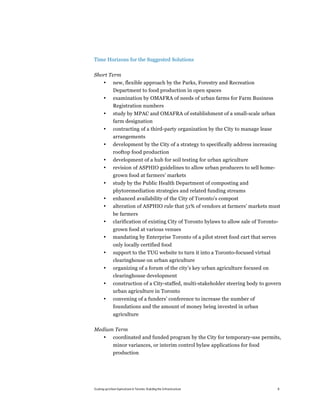
Time Horizons for the Suggested Solutions

Short Term
       •      new, flexible approach by the Parks, Forestry and Recreation
              Department to food production in open spaces
       •      examination by OMAFRA of needs of urban farms for Farm Business
              Registration numbers
       •      study by MPAC and OMAFRA of establishment of a small-scale urban
              farm designation
       •      contracting of a third-party organization by the City to manage lease
              arrangements
       •      development by the City of a strategy to specifically address increasing
              rooftop food production
       •      development of a hub for soil testing for urban agriculture
       •      revision of ASPHIO guidelines to allow urban producers to sell home-
              grown food at farmers’ markets
       •      study by the Public Health Department of composting and
              phytoremediation strategies and related funding streams
       •      enhanced availability of the City of Toronto’s compost
       •      alteration of ASPHIO rule that 51% of vendors at farmers’ markets must
              be farmers
       •      clarification of existing City of Toronto bylaws to allow sale of Toronto-
              grown food at various venues
       •      mandating by Enterprise Toronto of a pilot street food cart that serves
              only locally certified food
       •      support to the TUG website to turn it into a Toronto-focused virtual
              clearinghouse on urban agriculture
       •      organizing of a forum of the city’s key urban agriculture focused on
              clearinghouse development
       •      construction of a City-staffed, multi-stakeholder steering body to govern
              urban agriculture in Toronto
       •      convening of a funders’ conference to increase the number of
              foundations and the amount of money being invested in urban
              agriculture

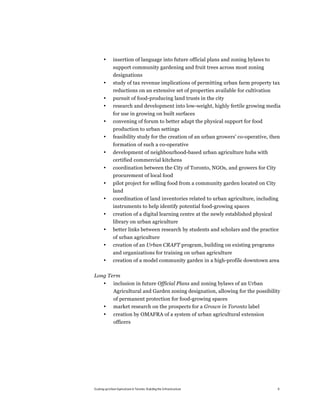
Medium Term
       •      coordinated and funded program by the City for temporary-use permits,
              minor variances, or interim control bylaw applications for food
              production


Scaling up Urban Agriculture in Toronto: Building the Infrastructure                     8
•      insertion of language into future official plans and zoning bylaws to
              support community gardening and fruit trees across most zoning
              designations
       •      study of tax revenue implications of permitting urban farm property tax
              reductions on an extensive set of properties available for cultivation
       •      pursuit of food-producing land trusts in the city
       •      research and development into low-weight, highly fertile growing media
              for use in growing on built surfaces
       •      convening of forum to better adapt the physical support for food
              production to urban settings
       •      feasibility study for the creation of an urban growers’ co-operative, then
              formation of such a co-operative
       •      development of neighbourhood-based urban agriculture hubs with
              certified commercial kitchens
       •      coordination between the City of Toronto, NGOs, and growers for City
              procurement of local food
       •      pilot project for selling food from a community garden located on City
              land
       •      coordination of land inventories related to urban agriculture, including
              instruments to help identify potential food-growing spaces
       •      creation of a digital learning centre at the newly established physical
              library on urban agriculture
       •      better links between research by students and scholars and the practice
              of urban agriculture
       •      creation of an Urban CRAFT program, building on existing programs
              and organizations for training on urban agriculture
       •      creation of a model community garden in a high-profile downtown area

Long Term
       •       inclusion in future Official Plans and zoning bylaws of an Urban
               Agricultural and Garden zoning designation, allowing for the possibility
               of permanent protection for food-growing spaces
       •       market research on the prospects for a Grown in Toronto label
       •       creation by OMAFRA of a system of urban agricultural extension
               officers


Scaling up Urban Agriculture in Toronto: Building the Infrastructure                    9
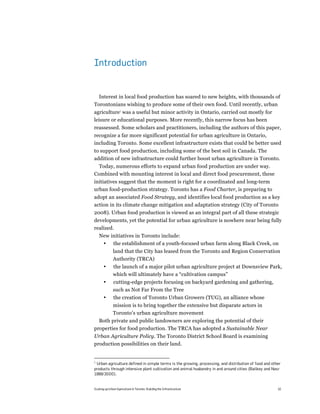
Introduction


  Interest in local food production has soared to new heights, with thousands of
Torontonians wishing to produce some of their own food. Until recently, urban
agriculture1 was a useful but minor activity in Ontario, carried out mostly for
leisure or educational purposes. More recently, this narrow focus has been
reassessed. Some scholars and practitioners, including the authors of this paper,
recognize a far more significant potential for urban agriculture in Ontario,
including Toronto. Some excellent infrastructure exists that could be better used
to support food production, including some of the best soil in Canada. The
addition of new infrastructure could further boost urban agriculture in Toronto.
  Today, numerous efforts to expand urban food production are under way.
Combined with mounting interest in local and direct food procurement, these
initiatives suggest that the moment is right for a coordinated and long-term
urban food-production strategy. Toronto has a Food Charter, is preparing to
adopt an associated Food Strategy, and identifies local food production as a key
action in its climate change mitigation and adaptation strategy (City of Toronto
2008). Urban food production is viewed as an integral part of all these strategic
developments, yet the potential for urban agriculture is nowhere near being fully
realized.
    New initiatives in Toronto include:
     • the establishment of a youth-focused urban farm along Black Creek, on
              land that the City has leased from the Toronto and Region Conservation
              Authority (TRCA)
       •      the launch of a major pilot urban agriculture project at Downsview Park,
              which will ultimately have a “cultivation campus”
       •      cutting-edge projects focusing on backyard gardening and gathering,
              such as Not Far From the Tree
       •       the creation of Toronto Urban Growers (TUG), an alliance whose
              mission is to bring together the extensive but disparate actors in
              Toronto’s urban agriculture movement
  Both private and public landowners are exploring the potential of their
properties for food production. The TRCA has adopted a Sustainable Near
Urban Agriculture Policy. The Toronto District School Board is examining
production possibilities on their land.


1
 Urban agriculture defined in simple terms is the growing, processing, and distribution of food and other
products through intensive plant cultivation and animal husbandry in and around cities (Bailkey and Nasr
1999/2000).


Scaling up Urban Agriculture in Toronto: Building the Infrastructure                                   10
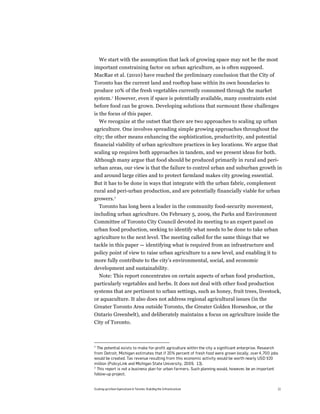
We start with the assumption that lack of growing space may not be the most
important constraining factor on urban agriculture, as is often supposed.
MacRae et al. (2010) have reached the preliminary conclusion that the City of
Toronto has the current land and rooftop base within its own boundaries to
produce 10% of the fresh vegetables currently consumed through the market
system.2 However, even if space is potentially available, many constraints exist
before food can be grown. Developing solutions that surmount these challenges
is the focus of this paper.
   We recognize at the outset that there are two approaches to scaling up urban
agriculture. One involves spreading simple growing approaches throughout the
city; the other means enhancing the sophistication, productivity, and potential
financial viability of urban agriculture practices in key locations. We argue that
scaling up requires both approaches in tandem, and we present ideas for both.
Although many argue that food should be produced primarily in rural and peri-
urban areas, our view is that the failure to control urban and suburban growth in
and around large cities and to protect farmland makes city growing essential.
But it has to be done in ways that integrate with the urban fabric, complement
rural and peri-urban production, and are potentially financially viable for urban
growers.3
  Toronto has long been a leader in the community food-security movement,
including urban agriculture. On February 5, 2009, the Parks and Environment
Committee of Toronto City Council devoted its meeting to an expert panel on
urban food production, seeking to identify what needs to be done to take urban
agriculture to the next level. The meeting called for the same things that we
tackle in this paper — identifying what is required from an infrastructure and
policy point of view to raise urban agriculture to a new level, and enabling it to
more fully contribute to the city’s environmental, social, and economic
development and sustainability.
  Note: This report concentrates on certain aspects of urban food production,
particularly vegetables and herbs. It does not deal with other food production
systems that are pertinent to urban settings, such as honey, fruit trees, livestock,
or aquaculture. It also does not address regional agricultural issues (in the
Greater Toronto Area outside Toronto, the Greater Golden Horseshoe, or the
Ontario Greenbelt), and deliberately maintains a focus on agriculture inside the
City of Toronto.


2
  The potential exists to make for-profit agriculture within the city a significant enterprise. Research
from Detroit, Michigan estimates that if 20% percent of fresh food were grown locally, over 4,700 jobs
would be created. Tax revenue resulting from this economic activity would be worth nearly USD $20
million (PolicyLink and Michigan State University, 2009, 13).
3
  This report is not a business plan for urban farmers. Such planning would, however, be an important
follow-up project.


Scaling up Urban Agriculture in Toronto: Building the Infrastructure                                   11
Overview of Urban Agriculture in the City of
Toronto


  Food production in Toronto is primarily an informal provisioning and
recreational activity. Urban agriculture is currently limited in its ability to
address the inadequacies of the dominant commercial food system. We believe
that action is needed in two areas: strengthening the informal sector, and jump-
starting a profit-oriented food production that addresses multiple food-system
problems.
    The key outcomes of such a food production strategy would include
     • health benefits of people growing and consuming their own food
       •       enhanced city greening
       •       increased employment opportunities for new farmers
       •       increased local food distribution, with attendant reductions in
              greenhouse gases
       •      more efficient use of municipal organic wastes
       •       new small-scale food entrepreneurship opportunities
       •       heightened awareness amongst Toronto residents of the source of their
              food
       •      greater import substitution, which offers regional economic benefits and
              addresses the food needs of Toronto's increasingly multicultural
              population
       •       environmental improvements associated with largely organic cultivation
          (to meet City objectives for pesticide reduction)
    The infrastructure requirements proposed in the paper build on three areas of
knowledge. First, Toronto practitioners and researchers have developed an
extensive understanding of barriers to urban food production and of the
infrastructure needed to overcome them. Discussion of these barriers was
central to the formation of TUG.4 Second, some researchers have started to
prepare feasibility studies, planning reports, GIS analyses, and project proposals
related to urban food production infrastructure issues. However, these elements
remain fragmented, as exchanges among researchers have been limited until
recently. Third, much knowledge, albeit scattered, exists about attempts in other


4
 At the inaugural meeting on November 17, 2008, participants identified the following main barriers to
urban farming in Toronto: safety and quality of soil and compost; land access; land zoning; funding,
resources, and infrastructure; diversity and equity in access; marketing and infrastructure; training;
networks and communication.


Scaling up Urban Agriculture in Toronto: Building the Infrastructure                                 12
municipal jurisdictions to implement comparable elements. We have attempted
to draw together some of this scattered knowledge.
  Infrastructure here is understood in its broadest sense as the structural
elements that underpin urban food production and either hinder or enable its
development.
   We offer proposals in five areas:
       1.     infrastructure for accessing spaces for production
       2.     resources, services, and physical infrastructure
       3.     food-chain infrastructure
       4.     knowledge infrastructure
    5. governance, coordination, and financial support infrastructure
   The initiatives proposed here cross many infrastructure areas, so the
discussion will overlap in some areas. As well, the knowledge and practice of
urban agriculture is constantly changing. Although recommendations on
infrastructure and how to provide for it will need to be implemented over a
number of years, we have not addressed in detail the phasing of these solutions.


Scaling up Urban Agriculture in Toronto: Building the Infrastructure            13
Infrastructure for Accessing Spaces for
Production


  Using high-cost urban land for food production is a challenge, given dominant
urban planning and real estate practices. Ideally, land used for food cultivation
should be fertile and free of contaminants, should be close to both input supplies
and markets, and should not reduce biodiversity. Food production should fit
sufficiently well into the neighbouring fabric to sustain positive relations with
neighbours, while including elements that will minimize theft and vandalism.
  Despite the challenges, interest in urban agriculture is increasing, as reflected
in several studies under way. Researchers at Ryerson University are researching
green spaces in the city. The City of Toronto Environment Office is examining
underutilized and oddly shaped land parcels that could be used for community
gardens. Several governmental and paragovernmental agencies have expressed
interest in conducting internal assessments of underused or surplus land
holdings, including the Toronto District School Board. The Ontario Realty
Corporation is currently studying provincially owned land in the Greater
Toronto Area that can be placed in agriculture.
  Researchers at York University (MacRae et al. 2010) completed an analysis of
growing spaces available to permit the city to produce 10% of its fresh vegetable
requirements from within its own boundary. The study concluded that Toronto
required 2,317 hectares of food production area to meet current consumption
requirements (based on market purchases).5 Of this, 1,073 hectares would be
available on:
    • existing Toronto Census farms and lands currently zoned for food
              production
       •      areas zoned for industrial uses
       •      about 200 small plots (between 0.5 and 2 hectares) dotted throughout
              the northern reaches of the city
    These 1,073 hectares could be supplemented with:
     • land within hydro corridors (potentially problematic because of public
               health concerns about electromagnetic fields, as well high rental costs)
       •       institutional lands


5
 Note that this study does not include self-provisioning, since there are no good data on consumption and
gardening on which to base an analysis.


Scaling up Urban Agriculture in Toronto: Building the Infrastructure                                  14
•       rooftop production — the maximum rooftop area required would be
               about 1,243 hectares, approximately 25% of the rooftop area identified
               as more generally suitable for rooftop greening in the City of Toronto
          (Banting et al. 2005)6
    Given the existing demand for vegetables, a combination of areas cropped
more extensively (e.g., potatoes, sweet corn, squash, cabbage) and those grown
more intensively (e.g., lettuce, bok choy) would be required. The land and
rooftop space available suggests, however, that there would be difficulties
matching parcel sizes with key crops, including sweet corn, squash, potatoes,
cabbage, carrots, and asparagus.
  Urban farmers and gardeners need long-term and stable access to land, to
warrant the investments in soil building required for sustainable production.
Ensuring long-term access will involve changes to official plans, zoning bylaws,
and land taxation on the part of government, and ownership or lease
arrangements on the part of landowners. For current and potential urban
farmers, this is a difficult maze to navigate on a case-by-case basis. Moreover,
extensive education about these challenges and assistance in navigating this
maze will be essential to help those who are excited by the idea of urban
agriculture get ready to deal with the challenges. Systemic changes will be
needed to address these issues.

Official Plan and Zoning Bylaws

Official Plan
  Despite the presence of several hundred hectares of agricultural land within
the Rouge River Park (see MacRae et al. 2010), the City of Toronto’s 2007
Official Plan has only two policies that deal with agriculture.
    • Policy 2.1.1(k) states that the City of Toronto will work with its
               neighbouring municipalities to develop a framework for dealing with
               growth across the Greater Toronto Area that, among a number of other
               priorities, protects the region’s prime agricultural land.
       •       Policy 4.4.2 notes that agriculture is an acceptable secondary use within
               utility corridors.
  The Official Plan also contains policies dealing with community and rooftop
gardens, including references to gardens in parks and rooftop gardens in multi-
unit residential developments.
  These policies are bolstered through repeated reference to rooftop and
community gardens in the non-policy text of the Official Plan. They are referred
to as part of what creates beautiful cities (1.2), as an ingredient in the creation of

6
 Additional surfaces, such as building facades, balconies, and south-facing walls, can supplement
rooftops as growing areas.


Scaling up Urban Agriculture in Toronto: Building the Infrastructure                                15
a high-quality public realm (2.2.2), as opportunity providers for passive and
active recreation (2.3.2), as an important community facility through which the
City and local agencies deliver services (3.2.2), and as part of the diverse and
complex system of open spaces and natural areas (2.2.3).
  At the same time, although the Official Plan contains eight land-use
designations — neighbourhoods, apartment neighbourhoods, parks and open
space, mixed use areas, employment areas, regeneration areas, institutional
areas, and utility corridors — only the utility corridors designation contains any
policy related to agriculture or gardens.
  The official plan is reviewed every five years. To further urban agriculture, the
community supporting this activity needs to understand the review process,
mobilize, and speak with one voice to keep existing policies and extend them
across the city.

Zoning Bylaws
    Official Plan land-use designations set broad categories of permitted and
intended uses on private and public City lands. Zoning bylaws implement these
objectives at the site level. They contain site-specific regulations pertaining to
land use, and to the size, height, density, and location of buildings. The Planning
Act requires that zoning bylaws conform to the Official Plan.
  The City of Toronto is currently in the process of updating its zoning bylaws to
conform to its new Official Plan. One comprehensive zoning bylaw will be
created from the 41 that the City inherited from the six former municipalities.
This project began in 2003 and is not yet finished. The project has distilled over
1,550 land-use definitions into 180 in nine categories: residence, public,
commerce, performance, industry, parking, institution, administrative, and
accessory.
  Agriculture is not identified as a category. However, two of the 180 land-use
definitions, both of which are in the industry category, are agriculture-related.
       •      Agricultural Uses: “Premises used for growing and harvesting plants or
              raising animals, fowl, fish or insects, and may include aquaculture… The
              definition of agricultural use should be broad enough to capture the
              range of uses anticipated. An agricultural use is the cultivation of plants
              and the raising of animals primarily for food.”
       •      Market Garden: “A market garden is an area that is used for the growing
              of plants. A market garden is not on a residential property. Lands such
              as Hydro corridors or roof tops could also be used for growing food and
              plants.”7


7
 The new zoning code can be found at http://www.toronto.ca/zoning/. As of spring 2010, however, the
zoning codes of the former municipalities were still in effect. Note that a market garden designation
would appear to be applicable to both commercial and non-commercial gardens.


Scaling up Urban Agriculture in Toronto: Building the Infrastructure                                    16
Could sites recommended for food production be rezoned to one of these two
new designations? There appear to be several options, if a permanent food
production designation is not approved in the short term.
       •      A minor variance application may be brought to a municipal Committee
              of Adjustment. This process can take up to three months to complete
              and costs at least $500. Approval is arbitrary and permission given is
              not specific to the use of the land, but more to the structures on and
              configuration of the land. The duration of the land use can be specified
              in the application.
       •      A temporary-use bylaw, permitted under the Toronto Official Plan, may
              be used to zone land or buildings for specific uses for a maximum of
              three years, with possible extensions. A temporary-use bylaw is initiated
              by the City and includes public consultation; it can take up to one year to
              complete. It is more specific to the land use of the property in question.
         The cost is considerably more than for a minor variance.
   For both approaches, a consultation process with the community is required.
The documentation required includes a survey of the property, a map of existing
structures, as well as information on the size of the property, the type of
activities to be carried out, the percentage of land to be used for what purposes,
and an authorization from the property owner to initiate the consultation
process.

How could the Official Plan and zoning bylaws better support urban
agriculture?
   Many informal elements of urban food production do not depend on official
plan and zoning changes to expand. Backyard gardening does not require zoning
changes. Backyard-sharing programs require organization, but not regulatory
changes. Rooftop gardens constructed by building owners or lessees are usually
permitted under existing legislation. Planting urban fruit trees is permitted,
provided that the affected community agrees — securing agreement is more
likely to require changes to residents’ ideas about how common land should be
used than changes to planning documents.
  Even limited commercial activities associated with small-scale urban
agriculture may not be problematic, given current rules regarding yard sales,
park designations in many zones that can be interpreted to permit food
production, and the absence of clear rules on rooftop production.
  However, larger-scale collective and commercial endeavours will require
significant adjustments. The key challenge is to permit food-growing on lands
not covered by current categories. The MacRae et al. (2010) report identifies 80
potential sites in the industrial category. The two proposed land-use definitions


Scaling up Urban Agriculture in Toronto: Building the Infrastructure                     17
(Agricultural Uses and Market Garden) will need to be widely permitted across
industrial zones to allow for cultivation at this scale.
  The MacRae et al. study also identifies 75 sites that are currently designated as
parks. Agriculture would be a permitted use in open spaces zones under the new
draft zoning bylaws, and discussion continues about the potential sale of food
produced in parks. The department should be encouraged to develop a more
flexible approach to food production in open spaces. Because urban agriculture
can fulfil numerous municipal objectives, an argument can be made that private
gains will achieve public purposes and therefore should be permitted.
  Forty sites identified in the MacRae et al. study have commercial,
institutional, and residential designations. Temporary use permits, minor
variances, or interim control bylaws are possible tools to use for these sites,
although time and expense may prevent their use for agriculture. A coordinated
and funded program by the City to lighten the burden on urban farmers and
community organizations would make this a more useful approach. In the longer
term, language to support community gardening and the planting of fruit trees
across most zoning designations could be included in future official plans and
zoning amendments.8
  If the proposed urban agriculture program is successful, changes to the
Official Plan and zoning designations should include an Urban Agricultural and
Garden zoning designation, as it does in several U.S. cities, including
Philadelphia (Caggiano et al. 2009) and Cleveland.9 The ideal would be
permanent protection of the agricultural status of certain lands. Montreal’s
Permanent Agricultural Zones (PAZ) are an example of this approach. Four
percent of the city’s lands are zoned under this category, including an
experimental farm, an agricultural park, an eco-museum, and an arboretum
(True Consulting Group 2007). Though the PAZ does not extend into the urban
core, its existence on the urban fringe keeps speculators at bay and by its
permanence “permits farmers to risk investment” (McCallum 2001, 3).

Agricultural Land Taxation
  Land taxation is a key issue for urban agriculture on private land. Wekerle
(2002) has argued that shifting tax burdens could encourage “urban agriculture
instead of empty lots which pay reduced property taxes. Allowing small lots in
the city used for food production to be taxed at an agricultural rate might
encourage such uses.”
  The implications for land owned or controlled by the government or its
agencies are more problematic. For example, establishing community gardens in


8
  Conditional use permits allow agriculture in most land-use designations in Oakland, California
(McClintock and Cooper 2009).
9
  http://www.mayorsinnovation.org/pdf/Cleveland_CG_zoning_ord.pdf


Scaling up Urban Agriculture in Toronto: Building the Infrastructure                               18
hydro corridors has tax revenue implications for the City of Toronto, since it
results in a lower tax rate.
  To obtain a reduced property tax rate, a property must be taxed at agricultural
rates. Although zoning is largely a City issue as it relates to land use, and
although it is the City that collects and uses the property taxes, farm designation
for property tax purposes is in provincial hands. The Farm Property Class Tax
Rate (FPCTR) is offered through the Ontario Ministry of Agriculture, Food and
Rural Affairs (OMAFRA), and the Municipal Property Assessment Corporation
(MPAC) is responsible for determining the property classification. Currently, to
obtain a farm designation, the property must be assessed as farmland. A
landowner must complete a Request for Reconsideration form for submission to
MPAC and request from OMAFRA an eligibility determination and approval for
the Farm Property Class Tax Rate. The owner must have a Farm Business
Registration number and the farm must generate at least $7,000 in gross annual
income. The person who owns the land10 must apply for the Farm Property Class
Tax Rate. The owner is responsible for ensuring that any tenant who farms the
land has a valid Farm Business Registration number.
  If the site gets this designation, its tax rates are reduced to 25% of residential
property tax rates. This discount would amount to about $6,500 (2008) on a
property zoned MR6 and valued at $1 million. The farm rate applies to only the
part of the land under cultivation. For example, if a property covers six acres, of
which four acres are farmed and two are forested and used for a learning centre,
the farm tax rate will apply only to the four acres. The regular tax rate will apply
to the remaining two acres. This provision raises a potential problem. It is
important to ensure that land with tree cover and other natural features is not
converted to farmland solely to take advantage of the property tax reduction.
  There are farms within Toronto with Farm Business Registration numbers,
taxed at the agricultural rate. An urban location may not then, per se, be an
obstacle to reduced tax rates. But small-scale urban farms may have more
difficulty obtaining a Farm Business Registration number. Exemptions from the
normal requirements may be needed. OMAFRA should examine whether small-
scale urban farms might need a different minimum gross annual income for
eligibility11 for a Farm Business Registration number, and MPAC and OMAFRA
should also study the implications of establishing a small-scale urban farm
designation.
  Flowing from the MacRae et al. (2010) analysis, we recommend that the City
Finance Department study the tax revenue implications of permitting urban
farm property tax reductions on the properties identified in the report. This


10
   If the property is owned by a business that is a sole proprietorship, the owner must be a Canadian
citizen or permanent resident.
11
   The FoodShare production site grosses $6,000 / 0.1 hectare of land (Danyluk 2009).


Scaling up Urban Agriculture in Toronto: Building the Infrastructure                                    19
might be accomplished through a coordinating and facilitating body to help with
the processing of applications for zoning changes and for land taxation
reconsideration. Such provisions could make urban farmland and community
gardens more affordable for participating landowners.

Lease Arrangements
     With the important exception of backyard gardeners, urban farmers and
growers often do not own the land or rooftop spaces they cultivate. Urban
farming scenarios require effective land and rooftop tenure stewardship
arrangements that provide security of tenure and suitable financial
arrangements (if required) for all parties, cover any insurance and liability
issues, and include conditions of use that support the City’s multiple
environmental and socio-cultural objectives.
     For commercial production or the locating of community gardens on private
lands, lease arrangements will be critical. Depending on the nature of the food
production, leases could be with individuals or organizations. For smaller farms
or gardens, support from community organizations may be helpful. For example,
backyard-sharing projects could benefit from access to a lease template that the
parties could adapt to their own needs, with the support of a coordinating
community organization (see the section on financial and other support for
proposals on how to fund this work).
  Setting lease rates has already proven to be a challenge in some instances in
Toronto. Because of the lack of experience with such arrangements, and the
limited information available on revenues, there is no standard leasing template,
though such a template is as vital for commercial farming situations as it is for
backyard-sharing ones. How to determine “fair market value” when the land has
a limited set of private uses (e.g., hydro corridors) or could potentially be used
for housing development, makes rate-setting complex.
  The owners of much of the land that could be available for food production
may have motives other than profit maximizing for offering land at reduced rate
or even for free. They may want to see a garden next to their residence, support
the local food movement, gain environmental benefits (birds, bees, etc.), or get a
tax break on estate by giving land to the City. If the City creates incentives for
developers to install gardens, and disincentives if they fail to, it can shift market
incentives towards allocating more land for gardens.12
     Among the over 300 parcels identified in the MacRae et al. (2010) analysis are
a wide range of likely landowners and food production options. Given the need
to coordinate production, distribution, and community access, and the expertise
required to manage a complex set of arrangements, a coordinated leasing
arrangement will be needed.

12
     Personal communication, Wally Seccombe, 2010.


Scaling up Urban Agriculture in Toronto: Building the Infrastructure                20
Here is how it could work. Interested landowners, including the municipal
government, would contract with a third-party organization to manage lease
arrangements, based on templates established by the municipality. The third
party would set up the lease arrangements with interested farmers, taking a
small percentage of rents supplemented with revenues from the municipality
and foundations to finance its coordination activities. If a third party is
managing leases, there is some opportunity for blending leasing rates through a
pooled leasing price for farmers and community organizations, with the leasing
agency pooling revenue and then dispersing differentially to land owners.
  The use of such third-party arrangements is increasingly common among
government departments. NGOs such as FarmStart and Everdale Environmental
Learning Centre are experimenting with such kinds of arrangements. The
partnership between FarmStart and the Toronto Region Conservation Authority
(TRCA) is built upon such an arrangement at the McVean Farm, although on a
site that is not in Toronto.
   In addition to setting out the rental and stewardship conditions for the land
(e.g., organic production to respect pesticide use restrictions and greenhouse gas
mitigation objectives, respecting biodiversity enhancements), the leases would
establish the requirements to distribute food in an environmentally aware
manner and to markets within the municipality as part of the strategy to support
other City endeavours.
  Landowners interested in more long-term contributions to the bank of food-
producing land could donate to a land trust (see also the discussion of
permanent urban agriculture zoning designations above). Owing to some unique
legislation, the Ontario Heritage Trust (OHT) offers a program whereby
participants do not pay property tax on the land that they contribute to the OHT.
Environment Canada also offers an Eco-Gifts program, for which a market
appraisal is required and a tax receipt may be obtained. Such approaches have
been used successfully to establish security of tenure for many urban garden
locations in U.S. cities (Kaufman and Bailkey 2000). The same is possible for
Toronto and surrounding areas.

Infrastructure for Rooftop Agriculture Development
  Many Toronto rooftops are already food-growing spaces. Individual
homeowners or the managers of apartment or commercial facilities may arrange
for container gardens on the roofs of buildings. Such arrangements do not
require direct support from the state, though community organizations could
benefit from grant programs to support their promotional work in this area (see
the section on financial infrastructure).
  Above-ground food production (including on roofs) will likely continue to
expand, but on a very small-scale, non-commercial basis, in the near future.


Scaling up Urban Agriculture in Toronto: Building the Infrastructure               21
Large-scale commercial rooftop agriculture is probably still years away from
being a mainstream practice. While individual examples of commercial rooftop
farms, such as the Eagle Street Rooftop Farm in Brooklyn, New York, do exist,
they remain exceptional. No cities have specifically targeted rooftop production
as part of an agricultural or development strategy, but given the scarcity of land
and competing uses, it is likely only a matter of time before rooftops are put to
more intensive use.
  MacRae et al. (2010) identified the need for 1,243 hectares of rooftop growing
space to meet the target of providing 10% of Toronto’s fresh vegetable supply, or
about 25% of the rooftop space theoretically identified earlier by Ryerson
researchers (Banting et al. 2005). Peck and Kuhn (2003) note that the City of
Toronto owns approximately 1,700 buildings, and proposed that the City green
20% of all City-owned rooftops or walls in three to five years. Assuming a
modest average food garden surface of 465 m2 (5,000 ft2), this requirement
would make approximately 16 hectares of area available for food-growing and
for absorbing moisture.
  Toronto is moving to take greater advantage of its rooftops with a new green
roof bylaw. As of January 31, 2010, new residential, commercial, and
institutional buildings will be required to have a certain percentage of green roof
coverage.13 This provision applies to all construction with a gross floor area
(GFA) of 2,000m2 and over (and, for residential buildings, a height of 20m and
over). The coverage required begins at 20% for smaller buildings, and increases
to a maximum of 60% as the gross floor area increases to 20,000m2 and over.
Industrial buildings are exempt until 2011, at which time they will be required to
have approximately 10% coverage.
  However, substantial changes will be required to the current bylaw to support
food production. The purpose of the bylaw is to reduce the urban heat island
effect (the higher temperatures found in urban areas caused by the sun
reflecting off hard surfaces) and improve stormwater management (rainwater
runoff from buildings). Encouraging food production would require the
following types of changes, some of which could be part of an amended bylaw:
       •      design elements: food production usually requires deeper soil than that
              required under the bylaw
       •       access to the roof: growers need daily access to the roof during the
              growing season and the capacity to readily move material up and down
       •      insurance: coverage for growers using the rooftop will be needed
       •      wider applicability: the bylaw should encourage retrofitting existing
              roofs rather than apply to new construction only (Kaill-Vinish 2009)
       •      zoning: questions about zoning the land for commercial food production
              will need to be settled

13
     The bylaw was enacted May 27, 2009. See http://www.toronto.ca/legdocs/bylaws/2009/law0583.pdf


Scaling up Urban Agriculture in Toronto: Building the Infrastructure                            22
Various policy tools that have been used in other jurisdictions to encourage
green roofs could be adapted to promote food production. These include bylaws,
density bonuses, incentive programs, grants, fees, and levies (usually related to
stormwater runoff from buildings). Given Toronto’s current policy and program
infrastructure, the next challenge is to study how to modify existing instruments
to promote food production. If modifying existing policies and programs proves
too difficult, a specific food-production bylaw might have to be introduced.


Scaling up Urban Agriculture in Toronto: Building the Infrastructure              23
Resources, Services, and Physical
Infrastructure


  This section includes the most tangible forms of infrastructure for producing
food and other crops. We have used the term “physical infrastructure” to cover
all that is necessary (or at least useful) for the production, processing, and
distribution of food in urban areas, grouped into two broad areas. The first
refers to the basic resources for urban agriculture (land, water, soil) and services
that support agricultural activity, such as electricity and security. The second
includes equipment and facilities — whether held individually or collectively.
  To identify what is needed to scale up urban agriculture in Toronto, we
undertook a survey of those on the mailing list of the Toronto Urban Growers
network (Snider 2009) and received more than 30 responses. We will refer to
these results throughout this section.14

The Greatest Needs
  When we asked urban growers about the resources on which they rely most to
produce food in the city, the top three were (1) seeds, (2) land or space, and (3)
compost. Ranked somewhat lower were water, soil, funding, and seedlings.
When asked what resources they most lacked, the top five responses were (1)
compost, (2) funding or capital, (3) land, (4) staff or volunteers, and (5) soil.
Finally, when we asked growers to explain why they identified their “most
needed” tool and their “most needed” resource as particularly lacking, the
responses were (1) accessibility, (2) organic matter, (3) affordability and
funding, (4) knowledge, and (5) tools.
  From these lists, some categories emerge clearly as resources and as needs.
These include:
       •       soil and the means to enrich it (particularly compost)
       •       funding and help in securing it
       •       land and help in accessing it
       •       knowledge
       •       tools


14
   The total for each response does not generally equal 100 percent, as most questions in the survey
allowed respondents to select multiple choices; moreover, only responses that several people selected
are included with the results in this report.


Scaling up Urban Agriculture in Toronto: Building the Infrastructure                                24
Funding, land, and knowledge will be all treated in separate sections. Tools are
dealt with later in this section. Here, we will consider solutions related to soil
and compost, as well as some additional resources of importance to the scaling
up of urban agriculture.

Soil and Amendments
     Toronto sits upon some of the most productive soil in Canada, so for some
growers, soil quality is not much of an issue, provided there has been no
extensive disturbance from urban processes. Yet access to soil and ways to
improve its quality show up among the top issues for those involved in food-
growing. Depending on the context, several causes help explain this need — and
consequently, several approaches exist to making land with usable soil available
for cultivation.

Soil
  Most new sites where urban agriculture is feasible require testing and some
transformation in a coordinated and environmentally sensitive way. Even where
high-quality soil is available, it may be difficult to access or use that soil. The
main reason is soil contamination, real or perceived. Part of the solution to soil
contamination is technical (developing appropriate means for soil
decontamination), but large-scale technical intervention goes beyond the
capacity of many individual gardeners and producers.
  A better approach is to find effective and inexpensive ways to clarify the status
of land through knowledge sharing and organization. Toronto Public Health's
Environmental Protection Office is currently developing a soil-contaminant
protocol to assess the potential risks in various uses of soil, a protocol that will
be used in future for lands considered for urban agriculture.15
  A larger question is who will pay for soil remediation. Given the costs, urban
agriculture is likely to occur only on sites with contamination moderate enough
to be remediated with composting and phytoremediation (using plants
themselves to absorb pollutants).
  An entirely different approach to enhancing soil quality is to save the soil
being removed from lands that are being prepared for construction projects.
When areas are graded for development, good soil may be buried under new
buildings or shipped to distant landfills. No system exists for recuperating such
soils and moving them to sites being cultivated in urbanized areas. Soil-saving
systems could be created that either match those removing good soil with those
who need it, or that allow for “soil banking.”


15
  Personal communication, Peter Dorfman, 2010. The current process begins with the completion of a
technical report (currently pending) to be followed by public consultation.


Scaling up Urban Agriculture in Toronto: Building the Infrastructure                             25
Even where fertile soil exists, it may be highly compacted. Compacted soil can
be made useful again, but the process requires money, effort, and time. In other
areas, soil may be infertile and require improvements to make it productive.
Improving soils that are not contaminated but are still not readily cultivable
calls for processes such as breaking up the sod, applying soil amendments, and
planting an initial cover crop. Such soil improvements require organization,
knowledge sharing, and access to appropriate equipment.
  Soil is also needed for container or rooftop gardening.16 The development and
dissemination of appropriate, affordable, lightweight techniques for both soil-
based and soil-less cultivation are needed. Groups such as Alternatives and
EarthBox have developed appropriate growing media and containers, yet such
approaches are rarely applied. A strategy is needed to promote the development
and adoption of such growing approaches, perhaps through a forum that brings
together various partners to develop and implement it.
  In urban areas, just as in rural ones, amendments are constantly applied to
improve the soil, from fertilizers to pesticides. In Toronto, however, restrictions
are increasingly placed on what can be applied in gardens, notably the provincial
ban of the sale and use of chemical pesticides for cosmetic purposes, which
supplanted the earlier ban by the City of Toronto.17 At the same time, obtaining
organic alternatives for fertilization and natural pest management is a challenge.
For urban agriculture to be practised by larger numbers of people, such
materials must be readily accessible in every corner of the city. This approach
has been used in Cuba, with its system of neighbourhood urban agriculture
supply stores. Other less ambitious ways to make soil amendments will also be
needed. This question is considered further in the discussion on organizing the
physical infrastructure.

Compost
     Toronto has plenty of organic materials at its disposal for composting, as do
all cities that have green bin and yard waste collection programs. Adequate
supply should not be a problem. Yet in our survey, compost topped the list of
resources needed to expand urban agriculture.
  Our survey included two questions intended to shed light on composting.
First, we asked about the sources of compost. Most respondents made some of
their own compost, about half of them bought it, and a smaller number received
donated compost. Second, we asked about the best way to help growers obtain
compost. Most respondents recommended an improved distribution system,
involving an expansion in local producers and the setting up of numerous pick-


16
   Many examples of alternative forms of containers and stands for off-soil cultivation were featured in
the Carrot City exhibit. See www.ryerson.ca/carrotcity, in particular the Products section.
17
   www.toronto.ca/health/pesticides/faq.htm


Scaling up Urban Agriculture in Toronto: Building the Infrastructure                                   26
up locations in the city. Other respondents suggested better information,
including workshops, a public list of suppliers, and the streamlining of
municipal assistance.
   Respondents identified the quality of what goes into Toronto’s green bin and
its processing as problems. The City promotes landfill diversion, without
coupling this goal with nutrient recycling. So the Solid Waste department
subcontracts the latter stages of the curing process to the companies that haul it
away. Solid Waste is not required to ensure that the organics it collects are safely
recycled onto food-growing soils in Toronto.18
  Moreover, current rules dictate that compost prepared by the City of Toronto
as part of its yard and leaf composting program is available only to residents, not
sold to businesses (City of Toronto 2009). Given the limited supply, reserving
this compost for non-commercial food-growing makes sense — yet this product
has acquired a bad reputation in terms of quality, so many potential users avoid
it.
      Since most urban farms are plant-based operations (without access to the
sources of nitrogen needed for better-quality compost), and many occupy a
limited area, it is not feasible to make compost using only organic matter
generated on site. But acquiring the materials for composting on an urban farm
is difficult. Currently, importing materials for on-site composting requires
approval by the Ministry of the Environment to permit the operation of a waste
disposal site — a difficult and expensive process. The Ministry needs to develop
a simplified and less expensive process, while continuing to control, through
built-in safeguards, the content and process of imported materials for on-site
composting. Composting is even more challenging (though far from absent) on
rooftops, because of the difficulty of getting materials to and from the roof.
  Some co-operative group could take on the role of coordinating the purchase
and distribution of the inputs for composting (and handle the associated
approvals). Such an organization could be a bulk purchaser of compost materials
and other inputs (see discussion in the section on the potential of co-operatives).
  Medium-scale composting is the mission of FoodCycles, a new organization
working to develop a network of sites that combine composting from and for the
neighbourhood with production, marketing, and education relating to food.
FoodCycles’s first operation is part of the Downsview Park pilot project.
  The medium-sized approach is new in Toronto, and for now, sufficient quality
compost for an expanding urban agriculture will need to be generated through
large-scale composting based on improvements in the green bin program
(especially since the program is expected to be extended to include apartment
buildings). The City’s progressive adoption of anaerobic digestion represents one
way to enhance large-scale urban composting. This approach has two major

18
     Personal communication, Wally Seccombe, 2010.


Scaling up Urban Agriculture in Toronto: Building the Infrastructure              27
advantages: (1) it contains odour and eliminates pests, which is critical in an
urban area and (2) it captures methane-laden biogas while generating modest
amounts of heat and electricity, so it is a good strategy in relation to climate
change.19

Water and Wastewater
     The lack of adequate access to water and sanitation clearly can limit or even
preclude urban agriculture. Solutions that enhance the water collection and
supply infrastructure are essential.

Water
  The priority is to encourage the design of gardens and cropping systems with a
reduced demand for water. This means mulching, using soils with good
moisture-holding capacity, cultivating drought-resistant plant varieties, and
incorporating plants that offer shade. The need for water will depend on the type
of operation.
  If City hook-up is required, a crucial question is whether the farm operation
must be connected to a drip irrigation system and metered. Most growers prefer
drip irrigation systems with full coverage. Portland, Oregon reported installation
costs of $20,000 to $30,000 to meter sites for urban agriculture (Mendes et al.
2008), so these are significant costs to avoid. Hence, policy questions will need
to be addressed regarding how to service urban farm sites with water, and who
will bear those costs.
  Of course, not all water for irrigation must be brought from off site. Over half
of the respondents in the survey reused water, mostly from rain barrels. More
advanced water-reuse systems such as cisterns and greywater recycling
arrangements are almost non-existent in Toronto.20 For those who do not reuse
water for irrigation, we asked what would encourage them to start reusing water.
This question yielded two main responses: (1) guidance (through workshops and
other forms of education) to navigate the process of getting a rain barrel or other
system for using recycled water and (2) financing.
  These responses indicate a readiness to use alternative approaches for water
use, to avoid reliance on domestic, treated municipal water sources. Solutions lie
primarily in making users more comfortable with such alternatives through
knowledge-sharing efforts and through funding to make such alternatives more
affordable, particularly for areas such as floodplains and rooftops, which do not
have ready access to domestic water sources.


19
  Personal communication, Wally Seccombe, 2010.
20
  One exception is The Stop’s Green Barn, where a greywater capture system was included as part of the
retrofitting of a historic building.


Scaling up Urban Agriculture in Toronto: Building the Infrastructure                               28
Increasing access to water for urban agricultural projects without relying on
hook-ups to City pipes depends on expanding water-catchment facilities. Other
cities already have well-established programs that do so. The Water Resources
Group in New York City has rain-barrel systems at over 50 community
gardens.21 The expansion of urban agriculture in Toronto will need to be tied in
closely to the City’s existing rain-barrel initiative. Since the City has been
promoting residential rain barrels for some time, a program to encourage
rainwater harvesting for irrigation of larger (non-domestic) sites is needed.

Sanitation
     Washroom facilities are not a problem for backyard gardens or farming
operations adjacent to fixed facilities that are accessible to the growers (such as
a community garden next to a community centre). But otherwise, the lack of
washroom facilities can be a real obstacle to creating small plots. Porta-potties
represent an ongoing cost and can detract from the appearance of a growing
operation. They are also not a viable option in rooftop operations. Alternatives
include developing good relations with neighbours or integrating washrooms
into larger support structures.
  Another option is to consider reuse of the effluent on site. Greywater and even
blackwater reuse is common practice in many poorer countries, however, it
remains rare and frowned upon in richer countries. Many regulatory obstacles
prevent this from becoming a common practice, as do the costs associated with
safely developing such systems. The one exception is the use of composting
toilets. These exist already in some instances, especially where connection to
sewage systems is not possible, but their use remains rare. A program to support
the expansion of the availability of composting toilets is worth exploring,
including training in their proper set-up and use.

Power and Lighting
 Power supply is an often-forgotten part of modern urban agriculture.
Cultivation itself may not require electricity, but many support functions do,
from refrigeration to lighting for processing spaces, to ventilation of
greenhouses in the summer, to record keeping. Lighting may also be important
for safety and for harvesting at dawn or at dusk.
  In urban farming, a power supply may already be close to the site of
production. For backyard production, simple power cords are sufficient.
Bringing power to rooftops is usually straightforward. Many community gardens
in parks also have electrical service. However, a number of sites around Toronto
do not have ready access to power. Paradoxically, electric transmission corridors
seldom have a supply of electricity on the ground.

21
     www.waterresourcesgroup.org


Scaling up Urban Agriculture in Toronto: Building the Infrastructure                 29
Where power needs to be brought in from outside, one question is whether
permanent or temporary service is appropriate. The latter might seem to make
sense if there is no off-season production between November and April.
However, temporary hook-ups can cost more than regular city rates, and as
many growers move towards season extension, temporary connections would
not be advisable.
  As inexpensive, small-scale solar panels become increasingly common, solar
energy may become a perfect fit for urban agriculture. Collaboration between
Toronto Hydro, local researchers in design and engineering, and growers could
support better energy provision for food production and processing. This can
include:
       •       power generation “on the urban farm” through solar and other means,
               such as the integration of compost and fish farming into greenhouses to
               catch the heat released, as practised by Growing Power in Milwaukee
       •       the capture of wasted energy from buildings — a particular asset of
               agriculture in an urban context
       •       the avoidance of lost energy from urban agriculture by improving the
               energy efficiency of greenhouses or using natural cold storage
   More research is needed, but many solutions would use existing knowledge.

Seeds and Seedlings
   Relative to that of many other cities, the production system for seeds and
seedlings is relatively well developed in Toronto. The responses to our survey
confirmed that there are many sources for obtaining seeds and seedlings,
including seed saving, retail stores, seed exchanges, and the Internet. For
example, Urban Harvest, a small commercial producer of seeds and seedlings,
serves the local market, growing most of its seeds and seedlings inside the city.
Seed exchange is also commonly practised, notably in the Seedy Saturday event
in late winter.
  For those in the urban agriculture movement, obtaining seeds and seedlings is
not an overwhelming challenge. However, the availability of seeds and seedlings
to the general population is an obstacle to the expansion of urban agriculture.
Although small garden stores can be found across the city, they generally do not
stock a range of seeds and seedlings for food crops. Herbs may be the only
category that is easily found, and usually in an extremely narrow range. Young
fruit trees, seedlings for vegetables consumed by immigrant communities, seeds
for medicinal crops — all these are difficult to find.
  Moreover, the space for producing seeds and seedlings within the city remains
inadequate. Many growers cited a shortage of greenhouse space in the city,
which is crucial for getting seedlings ready for planting season. Even established
producers like Urban Harvest have to shift production sites frequently, as tenure


Scaling up Urban Agriculture in Toronto: Building the Infrastructure                  30
insecurity and shortage of reliable growing space force them to move constantly
and, in many cases, necessitate their settling outside the city.
  A systematic enhancement of the production and distribution of seeds and
seedlings across the city will be necessary if we wish to scale up urban
agriculture. Support for the producers of seeds and seedlings will range from
enterprise development support, to greenhouse provision or long-term leases on
institutional land. In parallel, the sites where seeds and seedlings for fruits and
vegetables can be found will need to be expanded. We propose two main
approaches. First, neighbourhood agricultural hubs, as found in Cuba, could
provide specialized seeds and seedlings, along with other equipment and
services. Second, if such hubs cannot be instituted in the short term, a program
to make seeds and seedlings more available at small neighbourhood garden
stores could be effective. Such a program could be modelled on existing North
American programs to reinvent the corner store22 and the food cart23 as conduits
for healthy food rather than junk food.

Equipment and Facilities
     Two survey questions dealt with production and processing equipment and
facilities. First, we asked which tools growers rely on to produce food in the city;
second, we asked about the tools that are needed but particularly lacking. The
top responses were largely very basic tools: hoses, wheelbarrows, pitchforks,
shovels, composters, stakes, trellises, shovels, and rain barrels. The most
sophisticated item was automated/drip irrigation.
  Clearly, the need for basic tools cannot be underestimated in the spread of
urban agriculture. Food cultivation involves many different tools, and their cost
can add up. At the same time, not all tools are needed simultaneously.
Suggestions from the survey for tool-sharing arrangements make particular
sense.
  At the same time, the emphasis on basic tools shows the small-scale, low-tech
approach that remains dominant in urban agriculture in Toronto. Despite
proposals for more elaborate approaches to food production,24 larger-scale, more
elaborate operations remain rare. Such operations do not imply strictly for-
profit or high-tech enterprises. Organizations such as Growing Power in
Milwaukee combine simple materials and approaches to growing with complex,


22
   www.healthycornerstores.org
23
   Toronto City Council has been working on several levels at modifying its own standards for food carts,
which have in effect precluded the possibility of food carts selling anything but hot dogs. New York City
has also developed its Green Cart program, which is aimed at promoting the presence of food carts
selling only fresh produce in some of the city’s “food deserts.” See www.nyc.gov/greencart
24
   The recent exhibition Carrot City: Designing for Urban Agriculture features many examples of more
complex approaches to urban agriculture, in which production spaces as well as the components of those
spaces are designed for the urban context.


Scaling up Urban Agriculture in Toronto: Building the Infrastructure                                  31
integrated food-resource cycling systems that require increasingly complex
equipment and facilities.
  Improving widespread access to basic tools will need to be combined with
increasing the sophistication of equipment and facilities whenever possible.
Other practices fall between the commercial and collective approaches to urban
agriculture. For instance, expanding the yard-sharing approach will rely on
access to sophisticated manual and power hand tools. Co-operative sharing
arrangements could buy such equipment in bulk and make it available through
travelling tool-lending libraries, including hand tools, rain barrels, fencing,
protective meshing, irrigation lines, and packaging. Such sources need to
include tools that are designed for people with disabilities. Sophisticated hand
tools are also appropriate on rooftops, where moving larger equipment can be
quite difficult.

Season Extension
     In colder climates such as Toronto’s, season extension has emerged as the next
frontier for ensuring the viability of many urban farming operations. Season
extension can take many forms. Some favour adapting the choice of crops to late
fall or winter crops. Others prefer to use simple, inexpensive covers such as low
tunnels to shelter their crops from cold and wind, enabling the crops to last a
few weeks longer. Other approaches range from capture of waste energy to year-
round, controlled environment agricultural operations that require high capital
investments but can yield high returns.25
  In the future, all these approaches are expected to increase in significance,
based on the ingenuity of making best use of the urban environment. For
instance, greenhouse space could be built onto south-facing office and
apartment buildings, enabling heated buildings to exchange air with the
greenhouses instead of wasting heat by venting it to the outside — thus
enhancing indoor air quality and growing greens through the winter months.
This is one of a number of creative ideas that could be explored in pilot projects
before scaling them up across the built parts of Toronto.26 Such creative thinking
will necessitate innovation by many different actors, particularly in universities.


25
   A good example of the latter is Gotham Greens, a large enterprise that will open in summer 2010,
using advanced hydroponic systems operating year-round on the roof of an old industrial building in
Greenpoint, Brooklyn and requiring a start-up investment of over US$1 million. Such operations can
generate more than 10 times the yield of field-based cultivation, using one-tenth the water. See
www.gothamgreens.com
26
   Personal communication, Wally Seccombe, 2010.


Scaling up Urban Agriculture in Toronto: Building the Infrastructure                                  32
Fencing
     Kaufman and Bailkey (2000) reported that urban farmers view the theft of
food as primarily an irritant rather than a deterrent. While theft may not be an
issue on most sites, it does come up regularly as a top concern at gatherings of
community gardeners.27 This is easily addressed by fencing (along with other
measures such as communication), though the expenses associated with it,
along with the image it conveys, may deter gardeners from investing in fencing.
Moreover, urban farmers have occasional concerns about personal security that
are more serious. A security survey would need to be carried out for many
parcels and a prevention plan developed as appropriate. Fencing and alarms
may be required in some cases; such measures should be considered part of the
municipal investment in infrastructure.
     Fencing is also needed for rooftop food production as a matter of liability.
Regulations govern the type, placement, and height requirements related to
fencing, as well as who would use the area and when, how close to the edge of
the roof a garden may extend, and what materials may be used. Lack of
knowledge of these requirements and the fear that they may be too burdensome
hold back rooftop production in Toronto.

Support Facilities
     Survey respondents indicated an interest in having tools and resources
available within support facilities for food production. Respondents proposed
many features for such a facility, including a station for washing and preparing
produce, a canning station and canning supplies, dehydrators, and a tool-
lending facility. They also wanted meeting spaces; experts who could provide
advice on pest management, organics, and technical matters; educational
workshops; and a library. This illustrates how knowledge and facilities for
processing the harvest are as important as help for the production process itself.


27
     Personal communication, Rhonda Teitel-Payne, 2010.


Scaling up Urban Agriculture in Toronto: Building the Infrastructure                33
Food-Chain Infrastructure


  Growing produce for sale or for non-profit purposes such as community
building and social inclusion requires interventions in the supply chain. What
happens to the crops after they are harvested will depend on the scale of
production and its purpose. For small-scale, non-commercial growers,
processing, cooking, and storing products can generally take place in a home or
community kitchen. The principal demands in these cases are for training in
domestic techniques for handling food after it is harvested.
  For larger-scale commercial growing operations, more sophisticated post-
harvest facilities and distribution mechanisms are needed. High-quality, safe,
appealing produce grown locally will foster market interest in Toronto
production. At the same time, the potential environmental benefits of local
production will be realized only with careful attention to minimizing transport
with small vehicles, which emit more kilograms of carbon dioxide per tonne-km
than large trucks, trains, or ships (Edwards-Jones et al. 2008).
  A related issue is where commercial producers sell. There is little advantage,
in terms of reducing greenhouse gas emissions, in taking markets away from
existing producers just outside urban areas. Established farmers have
traditionally opposed commercial urban agriculture because of worries that it
will cut into their markets. It makes more sense for urban production to
supplant vegetables shipped long distance by truck. Toronto is a major
destination for California and Florida vegetables, and most of it arrives by truck.
  Most of the land identified in the MacRae et al. (2010) study is located some
distance from food retailers, restaurants, and farmers’ markets, largely in
pockets identified by Lister (2007) as “food deserts” (areas in which very few
retail outlets sell fresh food). Most commercial rooftop production would take
place in industrial areas, often equally removed from retail sites outside the
downtown core, as the City’s survey (Banting et al. 2005) identified primarily
industrial and commercial rooftops as suitable locations.
  The larger farms in northeastern Scarborough, likely growing mainly late-
season crops, offer opportunities to coordinate collection and distribution.
Similarly, many of the small parcels and rooftops in Etobicoke would also lend
themselves to clustering for distribution purposes.

Analysis of Supply Chains
   Most commercial production will likely be targeted to fresh-food markets,
given the growing popularity of local and fresh food. This approach will help


Scaling up Urban Agriculture in Toronto: Building the Infrastructure               34
maximize market returns for producers. Mainstream retailers or food service
operations are not likely to buy Toronto produce. The main sales opportunities
include farm stands, farmers’ markets, Good Food Markets, produce auctions,
mobile produce carts, home-delivery box schemes, and Community Shared
Agriculture (CSA).28 Some independent and co-operative retailers with flexible
vendor protocols and no requirements for central warehousing are also possible
retail outlets.
  Independent restaurants may be interested in direct delivery, especially those
that design their menus around seasonal food. Institutional procurement may be
possible for City-run or -overseen operations. There may be opportunities for
micro-processors working in small batch operations (including incubator
kitchens). We will discuss the opportunities and challenges of these supply-
chain options in the remainder of this section.

Farmers’ markets and Good Food Markets
     These markets have experienced a huge increase in popularity recently, and
more than 30 now operate in Toronto. However, rules about who can sell at
farmers’ markets affect the percentage of brokers versus farmers. Many vendors
are rural farmers, and an urban agriculture program should not displace them.
However, where markets lack a diversity of vendors, it may be feasible for urban
farmers to occupy new vending spaces without competing with rural producers.
  Toronto’s Public Health Department bears responsibility for monitoring food
safety at farmers’ markets. The Association of Supervisors of Public Health
Inspectors Ontario (ASPHIO) has created guidelines under which a farmer from
a recognized commercial urban farm could be eligible to sell at a farmers’
market, but a homeowner selling produce from his or her backyard garden could
not (City of Toronto 2009).
  The provincial Food Premises Regulation currently exempts farmers’ markets
from the requirement of obtaining onerous special-event permits, provided that
51% of vendors at any given market are “farmers.” This regulation brings up the
issue of who is considered a “farmer.” As rules stand now, urban growers do not
fit the bill. This provision could change, however, if our recommendations on
creating urban farm land-use designations are followed.

Community shared agriculture (CSA)
 MacRae et al. (2010) note that pooling production from small packages of land
might be needed in Toronto. Several examples of this form of marketing
currently operate, including the proposed CSA program to be offered by the
Matchbox Garden and Seed Company, using produce grown on the McVean

28
  This is an arrangement whereby consumers pre-purchase a share of a farm’s produce, which comes in
the form of a weekly delivery.


Scaling up Urban Agriculture in Toronto: Building the Infrastructure                             35
Farm in Brampton and at various sites in Toronto. Patel (2010) also highlighted
many of the potential locations and challenges of establishing CSAs in Toronto.
 The status of potential CSAs featuring produce grown in Toronto is not clear,
however; normally, food can be sold only on sites zoned to allow merchandise
sales (City of Toronto 2009). However, a bylaw from the old City of Toronto
(pre-amalgamation in 1998) appears to permit farmers and market gardeners to
sell food adjacent to a road, sidewalk, or boulevard under certain
circumstances.29 A modified version of this bylaw extended across the new City
of Toronto could permit on-farm CSA distribution and farm stands.

Produce auctions
  Toronto can learn from examples elsewhere on how to sell produce and
processed food. The Elmira Produce Auction Co-operative was established in
2004 as a new market for local produce, to encourage farmers to diversify into
higher-value, seasonal crops. The idea has caught on, with 2006 sales of more
than $900,000. This novel way of selling produce has had an unintended
benefit. According to agricultural consultant Elbert van Donkersgoed, the
auction has encouraged growers to expand production, because they are
confident that the auction will reward them with adequate prices.
  Could such a scheme work in Toronto? It would give smaller producers —
including growers using small parcels of land or rooftops — a place to market
what they grow. If the auction were part of a local growers’ co-operative, some
producers could specialize in niche crops and increase their chance of returning
a profit.
     At the same time, the presence of a different marketing model, the Ontario
Food Terminal, which focuses on the wholesale trade, could be an impediment
to this approach. Resolving this issue would require some collaboration.

City of Toronto Initiatives

Institutional procurement of local food
  Toronto City Council adopted a Local Food Procurement Policy in 2008, in an
attempt to reduce greenhouse gases caused by importing food from afar. To
date, however, standards are not in place to describe precisely what “local”
means, and shifting supply chains is proving challenging because of existing

29
  Former City of Toronto Municipal Code § 315-2: Vending restricted. [Amended 1996-04-29 by By-law
No. 1996-0228] “Subject to §§ 315-5, 315-19 and 315-20, no person shall at any time in, over or upon the
road, sidewalk or boulevard of any public highway vend or otherwise stop, park, place, store, stand or
leave any object, vehicle or thing on the road, sidewalk or boulevard for the purposes of vending unless
the use of the road, sidewalk or boulevard is by a farmer or market gardener selling or delivering goods to
any place of business or residence adjacent to the road, sidewalk or boulevard, if the farmer or market
gardener is not selling or delivering from a vehicle parked, stopped or standing in a designated area
established under this chapter.”


Scaling up Urban Agriculture in Toronto: Building the Infrastructure                                    36
relations with distributors and the particular food requirements that exist in
many cafeterias. In addition, linkages with potential urban growers are needed,
and establishing these requires partnerships among NGOs, the City, and
growers. Careful planning should produce a listing of what the City could use in
its food purchasing.

Street food
  Improvements to the confusing regulatory world of street food in Toronto
offer another market for locally grown and produced food. Enterprise Toronto,
the new governing body for the street food program, could initiate a pilot
project, whereby some local content is included in the newly approved cart
system; perhaps one cart could even serve locally certified food only (see the
discussion on branding below).

Community gardens as commercial production sites
  To date, sales of produce from community gardens are prohibited, except as
part of “yard sales.” In other parts of Canada and in the United States,
community gardens with a built-in entrepreneurial program are commonplace.
We suggest that a pilot project be formed to test how a community garden on
City land could sell produce as a means of cost recovery and skills development.
It is likely that the benefits to the community at large would outweigh any
drawbacks. The Parks, Forestry and Recreation Division should examine this
possibility as it reconsiders its policies for gardens in parks.

Neighbourhood food hubs
   Neighbourhood hubs for urban agriculture would make food processing, at a
scale at which a return could be generated, a real possibility. Links need to be
made between growers and certified commercial kitchens where food can be
processed according to Public Health requirements. Processed food could be
sold directly at farmers’ markets, ensuring some cost recovery while
simultaneously teaching valuable skills.
  In addition to neighbourhood hubs, larger facilities for processing locally
grown food are vital for a rejuvenated and expanded urban agriculture sector in
Toronto. A well-capitalized and spacious Toronto Business Incubator could
stimulate local agricultural production and keep money in the Toronto economy.
And existing infrastructure in schools, community centres, and churches could
also be used in a more systematic manner to boost food processing.


Scaling up Urban Agriculture in Toronto: Building the Infrastructure               37
Post-harvest Handling and Distribution of Local Food

Post-harvest handling
  It is now well recognized that the “middle” of the food chain (processing,
storage, and distribution) represents the most significant bottleneck in the
development of alternative food systems. Developing an array of such facilities is
vital for supporting commercial-scale urban agriculture in Toronto. Yet the
expansion of the “middle” in an urban context poses particular challenges.
  Currently there are few post-harvest facilities in Toronto. Post-harvest
facilities include cooling units to take the field heat out of produce, space and
materials for packaging, and, in some cases, refrigerated transport. Creating
fixed or mobile small- or medium-scale post-harvest handling facilities would
save the costs of creating large centralized ones, unless existing partners provide
access to them.

Distribution challenges
  About 25% of U.S. food transport greenhouse gas emissions are associated
with the delivery of food to consumers, and the situation may be more acute in
Canada. These emissions are particularly problematic in the produce sector
because of its reliance on trucks (Weber and Matthews 2008). If small producers
move their produce to market in small vehicles, which produce more emissions
on a tonne-km basis, the polluting effects will be dramatically higher than those
that result from importing goods — effects that will all be felt in Toronto. Other
distribution models are needed.
  The 100-Mile Market is a distributor and “food service concept” that acts as an
intermediary between local producers and institutional purchasers. It collects
produce from supplier hubs outside the city and distributes them on a set route
within Toronto. Currently under development, this initiative could eventually
result in a 100-Mile “brand,” offering growers another important outlet for
produce and value-added products.
  A related distribution model is 100km Foods, which follows a relatively set
route around the edge of the city, collecting small batches from different
producers and selling to restaurants on different delivery days. When compared
to traditional methods of trucking, both of these models appear to reduce
emissions.
 Transport by bicycle may be an option for some growers. In the coming
months, a graduate student in York University’s Faculty of Environmental
Studies plans to explore the feasibility of bicycle transport for certain kinds of
distribution.


Scaling up Urban Agriculture in Toronto: Building the Infrastructure                 38
The Potential of Co-operatives
 Kaufman and Bailkey (2000) identified the critical need for collaboration
among urban farmers. Scaling up urban agriculture in a financially sustainable
manner means increasing supply in a coordinated way to keep prices stable and
build market confidence in urban suppliers. Although some individuals and
organizations may successfully grow food for profit, working together in a co-
operative manner is a more likely path to success in Toronto. Land
requirements, the dispersion of small parcels across wide areas of the city, and
market specialization are all factors that necessitate people working together. An
urban growers’ co-operative would be a step forward. Although a full feasibility
study, including what co-op model to employ, will be required,30 we suggest that
a co-op needs to fulfil some of the functions outlined here.
  A co-op could facilitate collaboration for purchasing inputs and equipment
and also for distributing products. The challenges of post-harvest handling
might also be addressed by a co-op, including the provision of field-chilling
facilities (permanent or mobile), supports for packaging, and scheduling of
transport.
  Market research is also needed to identify opportunities for import
substitution or new markets not currently served by existing Ontario producers.
Coordinating supply to serve these markets is also critical, given the small scale
of many of the production sites.
  The co-op might even engage in certain retail functions. For example, it could
employ the approach used by the Niagara Food Co-operative, a self-described
“virtual farmers’ market” where members order and pay for food online, picking
up their purchases at a central location.
  Finally, co-operatives are well suited to educating consumers about the value
of local products. Education in conjunction with marketing infrastructure, such
as a Grown in Toronto label, could be part of the development process. Such a
label could capitalize on consumers’ growing desire to eat locally produced food
and support the City of Toronto’s efforts to source a percentage of their food
locally.
  Clearly, detailed market research would be needed before any label could be
developed. Buy-in from growers, institutional purchasers, and retail outlets
would also be required. However, a co-op could learn from the example of Local
Food Plus (LFP), a certifying body for sustainably produced local food.


30
  This should be co-financed by co-operative development funds available at the provincial and federal
levels.


Scaling up Urban Agriculture in Toronto: Building the Infrastructure                                     39
Knowledge Infrastructure


  Individuals and organizations who grow food in Toronto demonstrate
tremendous know-how and knowledge sharing about local food production. The
learning goes beyond the acquisition of specific techniques for producing food in
tight urban spaces. Many are figuring out innovative ways to turn land and
buildings (especially rooftops) into food-production sites, and gaining an
understanding of what it takes to make food production in urban areas a
commercial enterprise (whether negotiating a lease or preparing a business
plan). Beyond the researchers, advocates, and practitioners who are already
committed to the cause of urban agriculture, urban planners, real estate
developers, landlords, environmentalists, and others will need to be informed
about the opportunites and challenges of urban agriculture.
 The question of learning raises the issue of urban agriculture knowledge —
where it lies, how it is transmitted, and who is acquiring it, developing it, and
sharing it. Some of the knowledge-related activities over the past decade in
Toronto highlight the range of learning needed for local food production to
blossom fully:
       •      Organizations such as FoodShare and The Stop Community Food Centre
              have long had urban agriculture coordinators, whose mandate has been
              information sharing as much as food production. This pattern has been
              continued by newer organizations such as Greenest City and
              FoodCycles. Training and other forms of spreading knowledge are
              central to the mandate of most urban agriculture–focused organizations
              in Toronto.
       •      Awareness of urban agriculture is also now entrenched among Toronto
              university students and researchers, as reflected in the growing numbers
              of students who choose to focus on urban food production in their
              schooling and undertake research on the subject for course papers,
              theses, and doctoral dissertations.
       •      Ryerson University’s Chang School offers a range of online courses on
              urban agriculture. These courses, part of Ryerson’s Certificate in Food
              Security, are proving very popular, enabling many in the Toronto area to
              learn alongside students from around the world.


Scaling up Urban Agriculture in Toronto: Building the Infrastructure                  40
•       At Ryerson’s Department of Architectural Science, a few students who
              were preparing architectural thesis projects dealing with food issues
              developed an array of activities, including a symposium in 2008 on “The
              Role of Food and Agriculture in the Planning and Design of Buildings
              and Cities” and the 2009 exhibition, Carrot City: Designing for Urban
           Agriculture.31
     As these examples show, knowledge of urban agriculture is expanding in and
around Toronto. However, the capacity for scaling up food production in
Toronto has been constrained by several factors, including:
       •      the limited capacity of only a handful of experienced people to spread
              their know-how to many interested participants
       •       the scattering of this expertise across organizations and locations
       •       the difficulty in learning how to access spaces for food production
       •       insufficient integration of emerging knowledge into practice and into
           other spheres of knowledge
     This section considers various approaches that can be developed further to
move knowledge of urban agriculture to higher levels and to spread this
knowledge more effectively and efficiently.

Urban Agriculture Virtual Clearinghouse
  Toronto Urban Growers (TUG) was formed as an alliance that brings together
local actors in urban farming. Participants in TUG meetings identified the
development of knowledge about urban agriculture (such as zoning regulations,
availability of land, technical know-how, or who’s doing what) and the
enhancement of access to this information as central to the promotion of urban
food production. They identified the creation of a clearinghouse as a pressing
need.32
   MetroAg: Alliance for Urban Agriculture, a new North American organization,
is currently constructing a clearinghouse on urban agriculture information
across Canada and the United States.33 Sustain Ontario, fast emerging as a key
node for improving the province’s food and farming systems, recently launched
its website as a knowledge platform for the local food movement across


31
   See www.ryerson.ca/carrotcity
32
   Such a clearinghouse would support the following goals:
     • avoiding duplication and overlap of projects by better knowledge of existing projects
     • identifying gaps
     • sharing resources and information
     • bringing interested people together to identify and take action on creating policies that support
        urban agriculture and removing barriers to urban agriculture initiatives
     • connecting people with land to potential urban farmers
     • identifying training opportunities for people wanting to learn how to farm.
These goals match ones identified through focus groups undertaken by MetroAg in 2008 and 2009.
33
   The address for the new site will be www.metroagalliance.org


Scaling up Urban Agriculture in Toronto: Building the Infrastructure                                       41
Ontario.34 Toronto is well positioned to develop a Toronto-focused clearinghouse
on urban agriculture that would partly interact with MetroAg’s and Sustain
Ontario’s websites. Such a clearinghouse would seek to facilitate knowledge
sharing among Torontonians and with other urban growers across Ontario and
North America.
  The proposed Toronto clearinghouse would have several components,
including learning centres, discussed below. Here we focus on two other
important components.
  First, the clearinghouse would be a systematic source of information on who is
doing what in urban agriculture in and around Toronto, and will include a
directory of urban agriculture projects, organizations and actors. MetroAg is in
the process of creating a directory that will be a keystone of its clearinghouse,
using an electronic form to be completed by organizations and individuals with
descriptions of their organizations and relevant projects, and information such
as internships and volunteer opportunities. These forms will be used as the
template for a Toronto directory, which will be integrated into the MetroAg
directory. The directory will also enable contributors to update information on
their activities, projects and organizations. Thus the directory will be not just an
inventory, but a living document, useful to organizations and individuals
working in urban agriculture.
  Second, the directory will be the centrepiece of a recently created website
about urban agriculture in Toronto.35 This website is right now no more than a
shell, and the skills of a trained web designer will be needed to ensure that this
website functions well as a resource. Much of the content can be expected to
come from the rich local urban agriculture movement, and links to key websites
already in existence in Toronto, such as those of the Toronto Community
Gardening Network and Ryerson’s Centre for Studies in Food Security (CSFS)
will be needed.
  Although the directory will be at the core of the clearinghouse, other
important information sources will also be integrated. Many of the existing
resources are scattered across a number of digital locations, so that many urban
growers may not be aware of all that is available; other resources are currently in
development. One existing initiative that will be integrated with the
clearinghouse is an inventory of available lands potentially usable for food
production in Toronto (see MacRae et al. 2010). Several other inventories are in
the works, including one by the City of Toronto. City regulations as they pertain
to local food production and related activities such as composting will form


34
  sustainontario.com
35
  It is currently housed at urbangrowers.wordpress.com. A Google Group
(http://groups.google.com/group/toronto-urban-growers) also exists, providing a channel for
communication among interested members.


Scaling up Urban Agriculture in Toronto: Building the Infrastructure                          42
another information set expected to be housed on this site. It will also offer
space for posting employment and volunteer positions in urban agriculture.

Urban Food and Agriculture Learning Centres
     Urban growers have recently started to propose the creation of a physical hub
within the city to provide a space for developing and disseminating knowledge
about urban agriculture. MetroAg and FoodShare are developing an urban
agriculture and food security learning centre that can serve researchers,
practitioners, advocates, and others. The objective is to establish a knowledge-
development and -dissemination hub that would include both a physical and a
digital library, as well as meeting spaces, and work space.
  A physical hub would necessitate the development of partnerships with urban
agriculture experts based in universities and training centres. It could serve
university students, seasoned practitioners (including immigrant farmers),
newcomers to urban agriculture (notably youth), and people seeking innovative
approaches to urban food production, community building, and other associated
activities. The plan also includes the development of a digital library that builds
on the collections of The Urban Agriculture Network (TUAN)36 and FoodShare.
This digital library would be part of the Internet-based clearinghouse that
MetroAg is currently setting up.
  In addition to a central focal point for knowledge storage and sharing, a series
of smaller-scale neighbourhood hubs for urban agriculture are needed. Such a
centre would offer a place to hold meetings and training sessions on urban
agriculture, a small library for students to deepen their knowledge and connect
with others, and a forum for innovation and dissemination of advances. The
intention would be to combine such urban agriculture hubs of learning with
other features that support urban agriculture, such as tool lending and material
storage (see section on resources, services, and physical infrastructure).
Neighbourhood hubs could be linked to emerging neighbourhood food centre
proposals, which are part of the City’s Food Strategy discussions.

Training Initiatives
     Physical spaces for knowledge should be complemented by mechanisms for
disseminating knowledge through training. Many training initiatives are already
in place, but they can be significantly expanded and strengthened. These should
target highly diverse population groups, using varied approaches that are
adapted to the needs of each group. These range from children to the elderly,


36
  MetroAg has secured control of the library that was assembled by TUAN, a non-profit organization
based in Washington, DC, and has shipped it to Toronto. This collection contains publications, books,
articles, papers, computer files, photos, and recordings.


Scaling up Urban Agriculture in Toronto: Building the Infrastructure                                    43
and from university students to practitioners seeking advanced learning in
particular skills in urban farming.
  Toronto has a growing number of students and researchers focusing on urban
agriculture, and there are strong links among individuals in its postsecondary
institutions. However, dissemination of the knowledge generated by researchers
to practitioners is much weaker. Dozens of studies have been undertaken, but
most urban farmers are either not aware of them or do not know how to find
them. A greater effort at presenting the results of new research to the public, and
at sharing existing research more widely, is crucial. Better links to organizations
in the field — through internships, sponsored research, and other means — can
also strengthen the ties between researchers and growers.
   Much knowledge diffusion takes place through training provided by the civic
sector. Still, training of potential urban growers can be enhanced through
various means. For example, the successful Community Food Animators
program can be expanded to new parts of the city and animators could be
catalysts to build the community urban agriculture hubs we call for in this
report.
  Another way to provide training could be through an adaptation of the
successful Collaborative Regional Alliance for Farmer Training (CRAFT)
program for training new farmers, which is going strong in the near-urban parts
of the Greater Toronto Area, including such established non-profits as Everdale
and FarmStart. An “urban CRAFT” program could go a long way towards
strengthening the ranks of new urban farmers — which include young,
Canadian-born, usually urban-bred, individuals, as well as recent immigrants
who are seeking to make use of their roots in farming but require knowledge to
adapt to their new agricultural conditions. Better coordination between trainers
based in the civil sector and post-secondary educators can also help integrate the
different approaches to building and sharing knowledge — a new initiative
seeking coordination of this type may soon achieve such a goal.
  The creation of positions for urban agricultural extension specialists, as in the
departments of agriculture in several U.S. states, is worth considering in
Ontario. Toronto City officials would need to explore with the Ministry of
Agriculture, Food and Rural Affairs its long-term interest in developing this
capacity.
  In many countries, teaching school-age children about food production is
increasingly recognized as an important area of school-based education. Many
educators and nutritionists now consider this an essential component in the
knowledge infrastructure of urban agriculture, particularly as a contributor to
“food literacy.”


Scaling up Urban Agriculture in Toronto: Building the Infrastructure              44
School gardens are, of course, not new to cities, including Toronto. What may
be different at present is the variety of forms that school gardens are now taking,
as well as the increase in scale of school gardens. The former is well illustrated in
the multiple forms that have emerged recently in New York City. Some schools
there use gardens to teach about food (e.g., the Edible Schoolyard at PS216 in
Brooklyn). For others, the goal is “environmental literacy” (PS41 in Manhattan).
Sometimes, food production is seen as a way to engage students’ interest in
science, as can be seen in the case of a new organization, Boswyck Farms, that is
specializing in the use of hydroponics as an approach to science teaching.37
Other programs, such as those that use gardening and cooking skills to reach
youth emerging from foster care, target vulnerable groups. Clearly the concept of
“school garden” has evolved greatly in the past few years.
  As for the increase in scale, it can be seen in the proliferation of youth-focused
programs across Toronto schools, such as PACT Urban Peace Program’s urban
agriculture training program.38 It can also be seen in ambitious initiatives to
place a garden in every school in order to integrate food literacy across the
curriculum, from the first to the final grade. FoodShare’s wide-ranging new
initiative, Recipe for Change, has such an objective.39
  A multitude of approaches to teaching about food production need to be tested
in Toronto schools and phased in over time. These approaches offer multiple
forms of training, target multiple groups, and should be seen as part of a
continuum of learning about urban agriculture — as an aim in itself as well as a
means to achieve other learning objectives.


37
    www.boswyckfarms.org
38
    www.pactprogram.ca
39
    "FoodShare believes that all children and youth should learn to grow, cook and know good, healthy food
... Recipe for Change will build on our Field to Table Schools program to take our vision for students to
new heights: a Good Food Cafe in every school, and all students being taught to cook, garden and compost
throughout all the subject areas.” http://www.foodshare.ca/school-recipeforchange.htm


Scaling up Urban Agriculture in Toronto: Building the Infrastructure                                   45
Governance, Coordination, and Financial
Support Infrastructure


  Complex policy and program environments, such as those related to urban
agriculture, are challenging to govern. Urban agriculture is shaped by federal
and provincial rules and regulations, in addition to local ordinances and bylaws.
The regulatory environment is not easy to navigate. Governments have
traditionally focused on managing rural agricultural development and have
generally failed to manage urban areas for such purposes. And, given
government restructuring and financial restrictions, agricultural departments
are not likely to have the budgets or resources to offer significant support to
urban producers, even if they were to take an interest. At the same time, non-
governmental organizations, which have played a significant role in promoting
urban agriculture, do not have the broad-scale resources and expertise to
effectively implement such programming.
  In this environment, governments and civil society actors are increasingly
prepared to collaborate in new ways. The processes of globalization have
diminished the role of the state (Koc et al. 2008), and to compensate, many of
those in government are looking for expertise outside their walls to assist with
implementation of new agendas. Since those in civil society are less willing to
trust the state to act alone on matters in which they have been involved, they
may participate in more formalized shared arrangements to set policy and
regulation and implement programs.

Grounds for Choosing a Governance Model
  A governance structure needs to accomplish a number of things. It must
express and refine a shared vision and enhance long-term plans for
implementation. It must agregate resources for implementing urban agriculture
across numerous complementary and competing actions and actors.
  Since urban agriculture, especially its commercial expression, is not
particularly common in Canadian cities, many of the rules potentially governing
its behaviour have yet to be determined. Gaps in the jurisdictional and
regulatory frameworks can create governance challenges. Whether food
production is for commercial or non-commercial purposes is another factor that
needs to be taken into consideration. The range of landowners and building
owners and the geographic dispersion of production and distribution further
complicate the governance environment.


Scaling up Urban Agriculture in Toronto: Building the Infrastructure               46
Ontario’s Ministry of Agriculture, Food and Rural Affairs (OMAFRA) has not
typically considered urban food production part of its mission, but that could
change if urban agriculture becomes significant. Indeed, the urban agriculture
movement must work to make it a provincial priority. Many public health
questions related to urban agriculture generally fall between provincial and
municipal jurisdictions. Issues of municipal zoning and commercial regulation
have yet to be resolved, and the solutions could determine which City
departments are responsible for what.
  The fact that legal jurisdiction, expertise, and resources are distributed among
different levels of government and different government ministries raises issues
that must be resolved for an effective program and governance model to be put
in place. For example, it cannot be assumed that the City will agree to lease City
land directly to farmers for urban farming purposes, nor that it will agree to
coordinate an urban agriculture program, as it may not be able to commit to
acquiring the infrastructure to manage such a program, or to deal with the
insurance issues. However, the City could provide oversight to the initiative and
engage a third-party operator to run part or all of the program. This approach is
common in agricultural circles, a well-known example in Ontario being the
third-party operation of the federal-provincial Environmental Farm Plan
program.

Potential Governance Models
  Several models for governing this kind of work are possible. We briefly outline
some of the key features, potentials, and limitations of each.

Political level coordination – Mayor’s Office, council advocate, champion
   Homegrown Minneapolis is an initiative that emanated directly from the
city’s mayor in 2009. In its initial phase, four committees were formed to advise
the Mayor’s Office on different aspects of urban agriculture development and
promotion. A wide range of stakeholders participated in the committees,
including staff from some City departments. This approach successfully
produced an implementation plan, which was approved by Minneapolis City
Council.40 Implementation committees are now at work to act on the
recommendations, although the implementation process is primarily geared to
municipal departments and City Council. Currently in phase II, the process is
designed to consider establishing a permanent food advisory structure by mid-
2011.


40
     http://www.ci.minneapolis.mn.us/dhfs/hgfinalrec.pdf


Scaling up Urban Agriculture in Toronto: Building the Infrastructure             47
This approach is unlikely to be successful in Toronto in the short term, as the
2010 municipal election would interfere with political-level coordination of
food-related initiatives and is dependent on strong support from the Mayor’s
Office.

Interdepartmental committee of municipal government
     Philadelphia adopted a food charter in 2008, empowering the Mayor’s Office
of Sustainability to advance urban agriculture in the city. The Office has a
mandate to “coordinate among multiple city agencies to facilitate and promote
access to healthy food and foster the growth of urban agriculture.”41
  The City of Toronto also has a food charter and an interdepartmental
committee on urban agriculture.42 This committee will have a central role in
coordinating government action on urban agriculture, but given the history of
interdepartmental committees at the City, it will not be able to play an effective
role in integrating initiatives external to the City with internal initiatives. In
other words, the interdepartmental committee will be part of a wider
implementation network, but will not likely be able to take the lead and integrate
non-governmental initiatives with City efforts.

Leading NGO acting as focal point
   In Providence, Rhode Island, an NGO, the South Side Community Land Trust
is the central player in urban agriculture development in the city, and leading
project manager for urban and peri-urban farms and community gardens.43 Its
Urban Edge Farm feeds CSA shareholders, farmers’ market customers, and
diners at local restaurants, soup kitchens, and food pantries. It has an extensive
educational program in local schools, including youth gardening initiatives. The
organization has been a leading actor in the Providence Urban Agriculture Policy
Task Force, which reported on baseline conditions and new potentials for urban
agriculture in 2006. A similar role is played by the Kansas City Center for Urban
Agriculture.
  Conditions in Toronto are different from those in Providence and Kansas City.
No large, well-resourced NGOs have urban agriculture as their central and only
mission. Although several large community food NGOs in Toronto have
extensive and successful involvement with urban agriculture, it is only one of
several program areas they manage. Consequently, this approach would not
appear to be an appropriate option in Toronto.


41
   http://www.leadershipforhealthycommunities.org/images/stories/philadelphia_food_charter1.pdf
42
   The committee includes representatives from: City Planning; Economic Development, Culture and
Tourism; Parks, Forestry and Recreation; Social Development, Finance and Administration; Toronto
Community Housing Corporation; and the Toronto Environment Office.
43
   http://southsideclt.org/


Scaling up Urban Agriculture in Toronto: Building the Infrastructure                               48
Coalitions of NGOs and other partners
  The Milwaukee Urban Agriculture Network44 brings together the main NGOs
and other public and institutional partners active in urban agriculture in the
city, along with dedicated individuals. The network runs projects, sponsors
educational events, and carries out advocacy to advance urban agriculture. The
City’s office of sustainability, connected to the Mayor’s Office, is the main
connection to the municipal government machinery.
  Toronto has the emerging Toronto Urban Growers. Such coalitions can
effectively carry out certain aspects of governance but not others, because they
lack the resources and authority to implement solutions to many of the types of
barriers reported here.

Multi-stakeholder steering body with staffing from a funded agency
     From our survey of urban agriculture development in North American cities,
no other jurisdiction has completely pursued this model, although a Toronto
food-related initiative, Student Nutrition, has used this approach for more than
10 years. The Toronto Partners for Student Nutrition coordinate the
implementation of student nutrition programs for 125,000 children daily in
Toronto schools. The partnership involves all the major funders and
implementers of student nutrition programs, with staff support provided by the
Toronto District School Board.
  This may represent the most promising governance approach for urban
agriculture in Toronto. In this model, overall governance and policy
development is provided by a steering body representing all the main
governmental and non-governmental actors engaged in the sector and the
proposed urban growers’ marketing co-operative, with staffing support from the
City of Toronto (likely by staff that sit on the existing urban agriculture
interdepartmental committee). The steering body has an allocations committee
that aggregates resources — land, finances, inputs, expertise — and allocates
them to projects based on integrated funding applications. Its members would
include representatives from government, funding agencies, private donors, and
programme delivery agencies who would advise particularly on successful
programme delivery.
  We assume that commercial and non-commercial urban agriculture projects
will need start-up support and suggest that this allocations committee can
effectively distribute resources. Both the steering body and allocations
committee would need to develop connections to existing networks involved in
on-the-ground delivery of urban agriculture programming.


44
     http://www.mkeurbanag.org/Main/AboutMUAN


Scaling up Urban Agriculture in Toronto: Building the Infrastructure               49
Emerging groups, including Toronto Urban Growers and the City’s
interdepartmental committee would be key members of the governance system,
and would be strengthened by its existence. The steering body would work with
these existing groups to complement their strengths and fill gaps.

Financial and Other Support
   Finally, we must confront the enduring question: how to pay for it? Currently,
funding for urban agriculture in Toronto comes largely from three sources:
foundations (funding NGOs), corporations, and the City of Toronto. There is
also support in the form of in-kind contributions, which save NGOs and urban
agriculturalists from having to purchase goods and services, such as compost
and water connections.
  To scale up urban agriculture, innovative and reliable financing initiatives will
be required. Partnerships will be vital. As Food Connects Us All stated, “there is
a need to connect the dots between the key actors and to capitalize on the pool of
energy available in Southern Ontario to bring about system-wide change”
(Metcalf 2008, 5). This is the challenge for urban agriculture in Toronto.

Foundations and associations
   Public interest in urban agriculture and sustainable food have greatly
increased in the last decade. Many foundations have been quick to pick up on
this trend. Many NGOs that operate urban agriculture programs depend heavily
on these foundations for funding. Foundation staff have sound and sophisticated
knowledge of urban agriculture issues. But for urban agriculture to scale up,
more needs to be done.
 This report is intended to inform organizations that could be enablers of urban
agriculture and get them thinking about how urban agriculture could be used to
meet their goals.
   Currently, professions and vocations typically not aligned with urban
agriculture are looking at it with new interest. In October 2009, the Canadian
Institute of Planners held a workshop on the planning of food systems, including
urban agriculture, and published a special issue of its journal, Plan Canada,
devoted to this subject. Though this example represents a good start, many
professions are in the dark about how urban agriculture could support their
mandates. Funding is urgently needed to educate relevant constituencies in real
estate development, architecture, landscape architecture, and other professions,
about the important role they can play in shaping the development of urban
agriculture.
  A conference on urban agriculture for potential funders is urgently needed.
The movement has a compelling story to tell. More funders need to hear it. The
aim of such a conference is simple — to increase the number of foundations


Scaling up Urban Agriculture in Toronto: Building the Infrastructure             50
involved and the amount of money being invested in urban agriculture.
Foundations could also play an instrumental role in funding outreach activities
to other organizations.

The private sector
  Efforts are urgently needed to portray urban agriculture in a way that appeals
to both the charitable and business objectives of private companies.
  Actions by government can make urban agriculture more appealing to the
private sector. For example, property tax breaks for commercially zoned land
can get the attention of private landowners with land suitable for cultivation.
Private-sector players might also be interested in donating more goods and
services for non-commercial production activities, and many already support
NGOs in this way. One of the tasks of a governance structure could be to market
such opportunities to potential private-sector donors.
  On the commercial side, the private sector will be buying the products of
commercial urban agriculture. Although most production will probably be
allocated to fresh markets — restaurants, independent retailers, farmers’
markets, CSAs — some may end up in the processing sector.
 One of the city’s most successful public-private initiatives is the Toronto Food
Business Incubator. Demand for its services is so high that in 2010 it will move
to a new, larger facility, which will include three accelerator units. Given the
relatively small scale of urban agriculture, expansion of this successful
partnership between the private sector and government is vital if locally grown
produce is to tap into the value-added market.
   Private-sector actors interested in supporting local agriculture may also
donate goods and services, or directly support their supply base (such as
providing resources to meet food safety and quality specifications). Such efforts
should be coordinated by the governing structure for urban agriculture.

City of Toronto
   Visionary leadership from the City of Toronto is a major reason why Toronto
could be viewed as a leader in urban agriculture in North America. Although the
City offers both financial and non-financial support, its investment in this area
could have an even bigger payback.

Financial support
   Currently, grants for urban agriculture come from two sources. The first is
Live Green Toronto Community Investment Program, which funds projects that
will reduce greenhouse gas and smog-causing emissions. Urban agriculture can
fit the criteria if the production is organic and distribution emissions are
minimized with innovative transport approaches; two granting opportunities are


Scaling up Urban Agriculture in Toronto: Building the Infrastructure               51
available each year. The second source of grant funding is the Food Security
Investment Program (FSIP), which continues to play a major role in enabling
community-based urban agriculture in Toronto’s priority neighbourhoods
through the community food animators program. Urban agriculture is one focus
of activities for the animators.
  One absence in Toronto funding is a stream dedicated solely to urban
agriculture. Other jurisdictions around the world have dedicated streams — on a
permanent or one-time basis — for grants to jump-start the sector. For example,
the Borough of Islington in London, United Kingdom, has instituted an
ambitious project related to the 2012 Olympic Games: 2,012 new food-growing
spaces are to be created by 2012, supported with small grants of $300 to
$5,000. The Edible Islington program includes funding for commercial projects
that will “provide a community benefit.” This one-time investment stream will
change forever urban agriculture in Islington.
  Many presenters at Toronto’s Parks and Environment committee hearing on
February 6, 2009, gave important guidance to the City concerning what they
should be funding in the urban agriculture realm. Investment in infrastructure-
related items with hard capital costs is vital for initiating many urban agriculture
projects. However for many NGOs, the cost of people to bring the infrastructure
to life is also key.

Non-financial support
  The City makes a valuable contribution to community gardens by providing
goods and services such as site identification, garden design, water hook-ups,
and compost. The availability of these services removes a financial barrier to
garden start-ups that might otherwise prevent community members from
gardening.
  Still, the City could do more to raise the profile of community gardens and
urban agriculture. Other cities, such as Vancouver and San Francisco, have
community gardens on the grounds of their city halls. Vancouver is a trailblazer
in devising guidelines on the provision of edible landscaping in new residential
and mixed-use buildings.
  In Toronto, the Department of Parks, Forestry and Recreation, in partnership
with community groups or dedicated individuals, should plan for a community
garden in a high-profile downtown area.
   Awards can also raise the profile of urban agriculture and attract new sources
of funds. The recent decision by the Toronto Environment Office to add a new
category for local food is welcomed.


Scaling up Urban Agriculture in Toronto: Building the Infrastructure              52
Government of Ontario
  Many provincial policy initiatives could boost urban agriculture. Support at
the moment is disjointed, but helping the province “connect the dots” could lead
to an improved financial infrastructure for urban agriculture.
  For many urban growers, the disconnect with the province begins with the
unfortunately named Ontario Ministry of Agriculture, Food and Rural Affairs
(OMAFRA). This name implies that agriculture does not happen in cities. For-
profit growers and the not-for-profit sector tend not to look to OMAFRA for
funding. Yet some of their programs could be relevant for urban growers and,
with some tweaking, could make an important contribution.
  One example is the Ontario Market Investment Fund (OMIF). This program
supports local food marketing efforts with the aim of improving customer access
to locally produced foods. Target areas for investment include market research,
development of market opportunities, communications initiatives, and
consumer or trade events. There is no reason why funds couldn’t support
projects and initiatives in Toronto.
  The Ontario Realty Corporation (ORC) — Ontario’s largest landowner — has
included an urban agriculture feasibility study as part of its Queen’s Park Block
renewal project. The interest in urban agriculture expressed by the ORC suggests
the potential for engagement, beyond the ORC itself, with the numerous
departments that interact regularly with it on land-holding issues.

Government of Canada
   Urban agriculture is far removed from the agenda of the federal government.
Canada has no national food policy that would include urban agriculture
(MacRae et al. 1999). Canada’s Action Plan for Food Security (1998) made only
brief mention of urban agriculture in an international context. Since then, no
significant reports have been released on the subject.
  In the past, several departments and crown corporations have shown modest
interest in urban agriculture. Internationally, the Canadian International
Development Agency (CIDA) and the International Development Research
Centre (IDRC) have made significant contributions. The Canada Mortgage and
Housing Corporation (CMHC) might support urban agriculture. CMHC is
committed to supporting Canadians’ access to good-quality, affordable homes,
while encouraging the development of vibrant, healthy communities and cities.
CMHC has shown sporadic interest in the subject.
  In Toronto, the federally owned and managed Downsview Park includes a
proposed cultivation campus. In 2009, a pilot urban agriculture project was
started on roughly 1.5 hectares in the park.


Scaling up Urban Agriculture in Toronto: Building the Infrastructure            53
The Federal Economic Development Agency for Southern Ontario (FedDev
Ontario) is the agency responsible for allocating infrastructure funds. Given the
importance of the food sector to the GTA region, we hope that FedDev would
look favourably on applications to strengthen the locally grown food and
processing sector.


Scaling up Urban Agriculture in Toronto: Building the Infrastructure            54
Conclusion: A Vision for a Potential Urban
Agriculture in Toronto


   Let us imagine what urban agriculture could be like in 2020.
    An urban grower named Zoe works full time producing a mix of herbs and
  vegetables in response to local demand. She uses both a large roof on an old industrial
  building as well as ground-level land along one of Toronto’s creeks on long-term lease
  from the TRCA. This lease was a standard one, negotiated by the TRCA and the
  growers’ co-operative to which Zoe belongs. The co-operative also provides some of
  the tools and equipment that she does not own, including a rototiller for her field and
  the covered shelters she uses to extend her growing season on her rooftop site. The co-
  operative helped Zoe buy wire mesh at a bulk rate to protect her seeds (most of which
  were produced inside Toronto), as well as fencing for her rooftop site.
    She is particularly happy with the fence — designed in a joint venture between a
  local NGO, an interdepartmental team at one of the local universities, and a plastic
  manufacturer from the GTA, specifically to be easily transported onto a roof, attached
  securely to meet local codes, and removed as needed without damaging the structure,
  all at an affordable price. The cost of the fence was funded through the small loan she
  obtained through the micro-credit arm of the co-operative. This has made cultivation
  on the roof feasible for her — a vital asset considering the fierce competition these
  days for leased ground-level land.
    Zoe regularly uses the community food and agriculture centre (often referred to
  simply as “the hub”) near where she lives and works. This is where she borrows or
  buys supplies from her growers’ co-operative, and where she delivers her produce to
  the marketing co-operative to which she also belongs (the twin companion to the
  growers’ co-operative). She also goes to the centre to discuss growing techniques and
  problems with other young growers who also belong to the urban CRAFT group, to
  consult with the provincial agricultural extension specialist who has regular hours
  there twice a week, and to consult the mini-library at the local urban agricultural
  learning centre.
    The Hub is also where Zoe acts as a mentor to a range of growers who cultivate in
  their yards or on their balconies. These include Yves, whose minor hobby of planting a
  tomato patch has blossomed after retirement into a complete transformation of his
  whole yard into an “edible landscape” — which he learned about through the national
  campaign developed by the federal Ministry of Food and Agriculture. Zoe also mentors
  Zelda, who had struggled for years after migrating to Toronto, but now finds respite
  and fresh food for her household at the allotment plot that she secured a few years ago
  through a new program that opened up TDSB-owned lands to parents with young
  children.


Scaling up Urban Agriculture in Toronto: Building the Infrastructure                        55
This is a sketch of the vision for a potential urban agriculture in Toronto. The
existing initiatives and directives from the City and the desires of residents
frame this statement and indicate some of the many solutions that we think will
be necessary to achieve such a vision (summarized in the Appendix). The
possibilities shown in this story also imply a number of challenges that would
need to be overcome to realize this potential and explain why many of the
options presented in this paper are required (additional details can be found in
the supplemental reports that are part of this research, soon to be available
online45 ).
  This is a vision of an urban agriculture that is diverse in scale, location, and
orientation (including both commercial and non-commercial operations), with
multiple purposes (job creation, recreation, social cohesion) and based on low-
input, productive, non-capital-intensive, and organic production.


45
  These reports, including the survey, will be placed on the Toronto Urban Growers website, currently at
urbangrowers.wordpress.com


Scaling up Urban Agriculture in Toronto: Building the Infrastructure                                  56
Appendix: Summary of Solutions


  The following recommendations are offered to support a comprehensive urban
agriculture program and build on existing initiatives currently under way. Each
solution is placed according to the term (short, medium, long) that we anticipate
is most realistic for getting it under way. Thus, this framework expresses the
likeliest time horizon for each solution, rather than its order of priority.

Infrastructure for Accessing Spaces for Production

Official plan and zoning bylaws

Short term
       •      The Parks, Forestry and Recreation Department should develop a
              flexible approach to food production in open spaces, acknowledging that
              broad public objectives can be served by private production in public
              spaces.

Medium term
       •      The City of Toronto should develop a coordinated and funded program
              to lighten the burden on urban farmers and community organizations
              seeking temporary-use permits, minor variances, or interim control
              bylaw applications.
       •      The City of Toronto should add language in future Official Plans and
              zoning bylaws to permit community gardening and fruit trees in most
              zoning designations.

Long term
       •      Future Official Plans and zoning bylaws should include an Urban
              Agricultural and Garden zoning designation, allowing for the possibility
              of permanent protection for food-growing spaces.

Agricultural land taxation

Short term
       •      OMAFRA should examine whether small-scale urban farms need a
              different minimum gross annual income to be eligible for a Farm
              Business Registration number.


Scaling up Urban Agriculture in Toronto: Building the Infrastructure                  57
•      MPAC and OMAFRA should study the implications of establishing a
              small-scale urban farm designation.

Medium term
       •      The City Finance Department should study the tax revenue implications
              of permitting urban farm property tax reductions on an extensive set of
              properties available for cultivation. As part of these studies, the City
              should explore the potential of engaging a coordinating and facilitating
              body to help with processing applications for zoning changes and for
              land taxation reconsideration.

Lease arrangements

Short term
       •      The City should contract with a third-party organization to manage lease
              arrangements, based on templates established by the City to facilitate
              the program. If a third party manages the leases, there is an opportunity
              to blend leasing rates, through a pooled leasing price for farmers, with
              the leasing agency pooling revenue and then dispersing it differentially
              to landowners. In addition to setting out the rental and stewardship
              conditions (e.g., organic production, respect for biodiversity
              enhancements), the leases would establish requirements for distributing
              food in an environmentally aware manner and for marketing as part of
              the strategy to optimize other City endeavours.

Medium term
       •      The City should explore the potential for establishing food-producing
              land trusts in the City, based on existing provincial and federal
              legislation and programming.

Infrastructure for rooftop agriculture development

Short term
       •       The City should develop a strategy specifically addressing the need to
              increase rooftop food production, potentially by modifying the existing
              green roof bylaw or the use of other policy and program instruments.


Scaling up Urban Agriculture in Toronto: Building the Infrastructure                     58
Resources, Services, and Physical Infrastructure

Short term
       •      The City of Toronto’s Environment Office, the Board of Health,
              university research facilities, and the private sector should develop and
              build a hub for soil testing for urban agriculture, offering different
              approaches for commercial and non-commercial growers.
       •      As part of consultations on a soil quality protocol for urban agriculture,
              the Public Health Department should examine where composting and
              phytoremediation are viable strategies, and whether funding streams to
              support remediation of various kinds will be required to facilitate soil
              improvement.

Medium term
       •      Local universities, with support from leading civil-sector organizations
              and from the City of Toronto, should develop a coordinated strategy for
              researching and developing low-weight, highly fertile growing media for
              use in growing on built surfaces. A similar strategy will be needed for
              promoting various approaches to season extension within the urban
              environment, based on the use of this environment as a resource.
       •      Toronto Urban Growers should convene a forum to better adapt the
              physical support for food production (such as containers, greenhouses,
              or temporary fencing) to urban settings, bringing together businesses
              that construct such structures, interested government officials, NGOs,
              landlords, farmers, and growers.
       •      To maximize scarce resources, the leading organizations in the local
              urban agriculture movement should join together to put in place a
              growers’ co-operative, to buy in bulk inputs such as sophisticated hand
              tools, rain barrels, fencing, protective meshing, irrigation lines, and
              packaging.
       •      The City of Toronto should adapt its yard and leaf-composting program
              to make the availability of compost for non-commercial food- growing
              (rather than diversion from the waste stream) its first priority; any
              surplus should be marketed to for-profit agriculture in Toronto.

Food-Chain Infrastructure

Short term
       •       The Association of Supervisors of Public Health Inspectors Ontario
              (ASPHIO) should revise its guidelines to allow urban producers to sell
              food grown in their backyards at farmers’ markets.


Scaling up Urban Agriculture in Toronto: Building the Infrastructure                     59
•       In the near term, and in order to accommodate urban growers who
              might not be designated as farmers in tax terms, ASPHIO should alter
              the rule that 51% of vendors at farmers’ markets must be farmers. In the
              longer term, proposals for urban farmer designation will hopefully be
              accepted.
       •      The City of Toronto should examine changing existing bylaws that
              prevent the sale of Toronto-grown food through CSAs, at farmers’
              markets, and at the place of production (farm gate).

Medium term
       •       Enterprise Toronto should run a pilot project with one street food cart,
              serving only locally certified food, to support its existing street food
              initiative.
       •       The Ontario Co-operative Association, which has a history of support for
              food co-operatives, should consider conducting a full feasibility study on
              the creation of an urban growers’ cooperative — including identifying
              what co-op model to employ — financed by co-operative development
              funds available at the provincial and federal levels.
       •      Established food-security organizations in Toronto, supported by
              government and foundations, should lead the formation of
              neighbourhood-based urban agriculture hubs where food can be
              processed in certified commercial kitchens.
       •      As the City of Toronto local procurement policy evolves, City staff
              should partner with NGOs and urban growers to coordinate the
              purchase of Toronto food by the City.
       •      Parks and Recreation should run a pilot project selling food from a
              community garden located on City land, in order to identify and resolve
              challenges associated with such activities, which are widely permitted in
              other jurisdictions.

Long term
       •      Toronto’s business schools, working with Toronto’s main urban
              agriculture advocates, should carry out detailed market research on the
              creation of a Grown in Toronto label, with the aim of stimulating
              agricultural production and processing.


Scaling up Urban Agriculture in Toronto: Building the Infrastructure                     60
Knowledge Infrastructure

Short term
       •      Local foundations, the City of Toronto, and potentially provincial
              contribution agreements should support the Toronto Urban Growers
              website to turn it into a Toronto-focused virtual clearinghouse on urban
              agriculture.
       •      The key entities that are already strongly involved in urban agriculture
              (from non-profits to research and teaching institutions) should organize
              a forum to examine what each can contribute to the development of such
              a clearinghouse, including which existing knowledge should be brought
              into it.
       •      Local universities should join MetroAg and FoodShare in a concentrated
              effort to create a digital learning centre based on the newly established
              physical library on urban agriculture.

Medium term
       •       All groups undertaking inventories related to land availability for urban
              agriculture should coordinate them and create instruments to help
              identify potential food-growing spaces, working in conjunction with
              Toronto Urban Growers to make this information readily accessible.
       •      Local universities should examine individually and collectively how they
              can better link the current or completed research by students and
              scholars to the practice of urban agriculture in Toronto.
       •      Organizations already providing training in urban agriculture should
              join the existing Ontario CRAFT program to institute an Urban CRAFT
              program to coordinate the training of new urban farmers. This Urban
              CRAFT should also coordinate its training activities with the relevant
              programs offered at local universities.
       •      The Toronto District School Board should develop pilot school gardens
              to test different approaches to learning about urban agriculture.

Long term
       •      OMAFRA should institute a system of urban agricultural extension
              officers.
       •      TDSB should adopt a long-term goal of “a garden in every school” in the
              Toronto school system, to be developed in partnership with many local
              training organizations.


Scaling up Urban Agriculture in Toronto: Building the Infrastructure                      61
Governance, Coordination, and Financial Support Infrastructure

Short term
       •       The City of Toronto should form a multi-stakeholder steering body, with
               staffing from a City department, modelled on the successful Toronto
               Partners for Student Nutrition, to govern urban agriculture in Toronto.
       •       Foundations that are leading change in agriculture in Ontario, working
               with key organizations and supporters of urban agriculture, should
               convene a conference about urban agriculture, specifically geared to
               funders. The aim of such a conference would be to increase the number
               of foundations and the amount of money being invested in urban
               agriculture.

Medium term
       •       Parks and Recreation, in partnership with community groups or
              dedicated individuals, should plan for a community garden in a high-
              profile downtown area. The idea of this being a part of a newly designed
              Nathan Phillips Square should be explored.
       •      The City of Toronto should develop edible landscaping guidelines for
              Toronto.


Scaling up Urban Agriculture in Toronto: Building the Infrastructure                  62
References


  Bailkey, M. and J. Nasr, 1999/2000. “From Brownfields to Greenfields: Producing
Food in North American Cities.” Community Food Security News Fall/Winter: 6–8.
  Banting, D. et al. 2005. “Report on the Environmental Benefits and Costs of Green
Roof Technology for the City of Toronto.” Report to the City of Toronto and Ontario
Centres of Excellence – Earth and Environmental Technologies (OCE-ETech).
Toronto: Ryerson University.
  Baxter, M. 2007. “The Elmira Auction: A Win-Win Producers and Sellers of Local
Produce.” Better Farming November.
http://www.betterfarming.com/2007/november/cover.html (date accessed: Sept. 1,
2009)
   Caggiano, C. et al. 2009. “Farming in Philadelphia? A Proposal for a Sustainable
Urban Farm Incubator.” Panorama 2009: 27–31.
http://www.design.upenn.edu/files/Panorama09_08_FarmIncubator_Caggianoeta
l.pdf
  City of Toronto. 2001. The Growing Season, Phase II Report. Toronto: Food and
Hunger Action Committee.
http://www.toronto.ca/food_hunger/pdf/growing_season.pdf (date accessed: May
2010)
  ———. 2007. Toronto Official Plan. Toronto: Toronto City Planning.
http://www.toronto.ca/planning/official_plan/pdf_chapter1-
5/chapters1_5_aug2007.pdf (date acccessed: November 20, 2007)
  ———. 2008. “Ahead of the Storm: Preparing Toronto for Climate Change –
Highlights.” http://www.toronto.ca/teo/pdf/ahead_of_the_storm_highlights.pdf
(date accessed: May 2010)
  ———. 2009. “Identifying Urban Agriculture Opportunities in the City of Toronto.”
Staff Report to Parks and Environment Committee.
  City Farmer. 2002. “44% of Vancouver Households Grow Food.” City Farmer
September. http://www.cityfarmer.org/44percent.html#44percent.
  ———. 2002. “City Dwellers are Growing Food in Surprising Numbers!” City
Farmer November. http://www.cityfarmer.org/40percent.html.
  Danyluk, M. 2009. “Cultivating Potential: Planning for Urban Agriculture in
Toronto’s Hydro Corridors.” Current Issues Paper. Toronto: University of Toronto
(Department of Geography).
  Department for Communities and Local Government (United Kingdom). 2002.
“Planning Policy Guidance 17: Planning for Open Space, Sport and Recreation.”
http://www.communities.gov.uk/documents/planningandbuilding/pdf/ppg17.pdf
(date accessed: May 2010)


Scaling up Urban Agriculture in Toronto: Building the Infrastructure               63
Edwards-Jones, G. et al. 2008. “Testing the Assertion that ‘Local Food is Best’:
The Challenges of an Evidence-Based Approach.” Trends in Food Science &
Technology 19 (5): 265–274.
  Hamm, M.J., C. Litjens, and S. Treuhaft. 2009. “Healthy Food For All: Building
Equitable and Sustainable Food Systems in Detroit and Oakland.” PolicyLink and
Michigan State University. http://www.policylink.org/atf/cf/%7B97C6D565-BB43-
406D-A6D5-ECA3BBF35AF0%7D/Healthy%20Food%20For%20All-8-19-09-
FINAL.pdf
  Kaill-Vinish , P. 2009. “Toronto’s Green Roof Policy and Rooftop Food
Production.” Plan Canada 49 (2): 39–41.
  Kaufman, J. and M. Bailkey. 2000. “Farming Inside Cities: Entrepreneurial Urban
Agriculture in the United States.” Working paper. Cambridge, MA: Lincoln Institute
of Land Policy. http://queencityfarm.org/FarmingInsideCities.pdf (date accessed:
October 16, 2007)
  Koc, M., R. MacRae, E. Desjardins, and W. Roberts. 2008. “Getting Civil About
Food: The Interactions Between Civil Society and the State to Advance Sustainable
Food Systems in Canada,” Journal of Hunger & Environmental Nutrition 3 (2/3):
122–144.
  Kortright, R. 2007. “Edible Backyards: Residential Land Use for Food Production
in Toronto.” MA Thesis. Toronto: University of Toronto (Department of Geography).
  Lister, N.M. 2007. “Placing Food: Toronto’s Edible Landscape.” in Knechtel, J.,
ed., Food. Boston: MIT Press.
http://www.ryerson.ca/foodsecurity/projects/urbandesign/Nina%20Marie%20Liste
r%20paper.pdf
  MacRae, R. 1999. “Policy Failure in the Canadian Food System,” in Koc, M. et al.,
eds., For Hunger-proof Cities: Sustainable Urban Food Systems. Ottawa:
International Development Research Centre (in association with the Centre for
Studies in Food Security, Ryerson Polytechnic University).
  MacRae, R. et al. 2010. “Could Toronto Provide 10% of its Fresh Vegetable
Requirements from within its Own Boundary? Part I, Matching Consumption
Requirements with Growing Spaces.” Unpublished report. Toronto: York University
(Faculty of Environmental Studies).
  MacRae, R.et al. “Improving Energy Efficiency and GHG Mitigation Potentials in
Canadian Organic Farming Systems.” Journal of Sustainable Agriculture (in press)
  MacRae, R., R.C. Martin, M. Juhasz, and J. Langer. 2009. “Ten Percent Organic
within 15 Years: Policy and Programme Initiatives to Advance Organic Food and
Farming in Ontario, Canada.” Renewable Agriculture and Food Systems 24 (2):
120–136. DOI:10.1017/S1742170509002531
  McCallum C. 2001. “Code, Custom, or Collaboration: Mechanisms of Farmland
Protection in the GTA and near Montreal.” GTA Forum on Agricultural Land Policy:
Debating the Alternatives, June 2001, Toronto, ON.


Scaling up Urban Agriculture in Toronto: Building the Infrastructure                 64
McClintock, N. and J. Cooper. 2009. “Cultivating the Commons: An Assessment of
the Potential for Urban Agriculture on Oakland’s Public Lands.” Berkeley, CA:
University of California (Department of Geography).
http://www.oaklandfood.org/media/AA/AD/oaklandfood-
org/downloads/27621/Cultivating_the_Commons_COMPLETE.pdf
  Mendes, W. et al. 2008. “Using Land Inventories to Plan for Urban Agriculture:
Experiences from Portland and Vancouver,” Journal of the American Planning
Association 74 (4): 435–449.
  Metcalf Foundation, 2008. Food Connects Us All: Sustainable Local Food in
Southern Ontario. Toronto: Metcalf Foundation.
  NPLAN, 2009. “Establishing Land Use Protections for Community Gardens.”
Public Health Law & Policy report. http://nplanonline.org/products/establishing-
land-use-protections-community-gardens
  Patel, S. 2010. “The Potential of Community Supported Agriculture (CSA) in the
City of Toronto,” MES Major Paper. Toronto: York University (Faculty of
Environmental Studies).
  Peck, S. and M. Kuhn, 2003. “Design Guidelines for Green Roofs.” Ontario
Association of Architects and CMHC report. http://www.cmhc-
schl.gc.ca/en/inpr/bude/himu/coedar/upload/Design-Guidelines-for-Green-
Roofs.pdf
  Porter, C. 2008. “Sprout Business Shooting Up.” Toronto Star. April 8.
http://www.thestar.com/article/411212
  Quon, S. 1999. “Planning for Urban Agriculture: A Review of Tools and Strategies
for Urban Planners.” Report 28 in Cities Feeding People Series. Ottawa:
International Development Research Centre.
  Snider, A. 2009. “Urban Agriculture Tools and Resource Survey Summary
Report.” http://urbangrowers.wordpress.com.
   Statistics Canada. 2006. 2006 Census of Agriculture. Ottawa: Statistics Canada.
  Toronto Food Policy Council. 1999. “Feeding the City from the Back 40: A
Commercial Food Production Plan for the City of Toronto.” Report submitted for
Toronto Official Plan. Toronto: Toronto Food Policy Council.
http://www.toronto.ca/health/tfpc_feeding.pdf
  True Consulting Group. 2007. “Best Practices in Urban Agriculture: A Background
Report for the City of Kamloops to Support Development of a Urban Agriculture
Strategy.” Kamloops: City of Kamloops.
http://www.fooddemocracy.org/docs/BestPractices_Urban%20Agriculture.pdf (date
accessed: February 2008)
  Weber, C.L. and H.S. Matthews. 2008. “Food-Miles and the Relative Climate
Impacts of Food Choices in the United States.” Environmental Science &
Technology 42 (10): 3508–3513.
 Wekerle, G. 2002. “Toronto’s Official Plan from the Perspective of Community
Gardening and Urban Agriculture.” Ontario Planning Journal 17 (4): 25–26.


Scaling up Urban Agriculture in Toronto: Building the Infrastructure                 65
Scaling up Urban Agriculture in Toronto: Building the Infrastructure
Toronto: June 2010

This report was prepared by: Joseph Nasr, Rod MacRae & James Kuhns

Published by:
George Cedric Metcalf Charitable Foundation
174 Avenue Road
Toronto, Ontario M5R 2J1

Phone: (416) 926-0366
Fax: (416) 926-0370
E-mail: info@metcalffoundation.com
Website: www.metcalffoundation.com

Copyright (c) 2010 by the Metcalf Foundation.

This work is made available under the Creative Commons Attribution-Non-
Commercial-No Derivative Works 2.5 Canada License. To view a copy of this
license, visit http://creativecommons.org/licenses/by-nc-nd/2.5/ca/

Copies of this report can be downloaded from our website.

Scaling up Urban Agriculture in Toronto - Building the Infrastructure

  • 1.
    Scaling up Urban Agriculturein Toronto ! Building the Infrastructure Metcalf Food Solutions Joseph Nasr, Rod MacRae & James Kuhns with Martin Danyluk, Penny Kaill-Vinish, Marc Michalak & Abra Snider June 2010
  • 2.
    Metcalf Foundation The Metcalf Foundation helps Canadians imagine and build a just, healthy, and creative society by supporting dynamic leaders who are strengthening their communities, nurturing innovative approaches to persistent problems, and encouraging dialogue and learning to inform action. Authors Joseph Nasr is an independent scholar, lecturer, and consultant based in Toronto. He is co-coordinator of MetroAg – Alliance for Urban Agriculture and president of the Urban Agriculture Network. Recently, he co-curated the travelling exhibit Carrot City: Designing for Urban Agriculture. He has taught at universities in several countries, including courses on urban food security and urban agriculture through Ryerson University, where he is an Associate at the Centre for Studies in Food Security. He is co-author or co-editor of three books (including Urban Agriculture: Food, Jobs and Sustainable Cities) and author of dozens of articles. He holds a doctorate from the University of Pennsylvania. Rod MacRae is an assistant professor at York University’s Faculty of Environmental Studies. A food policy analyst, over the past 25 years, he has worked for governments, businesses, and NGOs on the transition to sustainable and health-promoting food systems. He was the first coordinator of the Toronto Food Policy Council. Rod holds a doctorate from McGill University. James Kuhns works in urban agriculture and food security–related activities. He is the president of James Kuhns Urban Issues, co-coordinator of the MetroAg – Alliance for Urban Agriculture, and an Associate at the Ryerson Centre for Food Studies in Food Security, where he teaches online courses concerning urban agriculture. He is the immediate past president of the American Community Gardening Association and a member of the Toronto Food Policy Council. He holds a M.Sc. in agricultural development from the University of London. Scaling up Urban Agriculture in Toronto: Building the Infrastructure 2
  • 3.
    Acknowledgements Weowe considerable thanks to some people who reviewed the paper or offered valuable insights: Jodi Callan, Russ Christianson, Elbert van Donkersgoed, Peter Dorfman, Wayne Roberts, Wally Seccombe, and Rhonda Teitel-Payne. We especially thank Philippa Campsie for her hard work editing this report. Additional Reports Additional reports based on studies that served as background research for this paper can be found at http://urbangrowers.wordpress.com. Scaling up Urban Agriculture in Toronto: Building the Infrastructure 3
  • 4.
    Contents Foreword .................................................................................................................. 5! ExecutiveSummary ..................................................................................................7! Introduction ............................................................................................................10! Overview of Urban Agriculture in the City of Toronto...........................................12! Infrastructure for Accessing Spaces for Production ..............................................14! Official Plan and Zoning Bylaws ......................................................................... 15! Agricultural Land Taxation .................................................................................18! Lease Arrangements........................................................................................... 20! Infrastructure for Rooftop Agriculture Development ........................................21! Resources, Services, and Physical Infrastructure ................................................. 24! The Greatest Needs ............................................................................................ 24! Soil and Amendments ........................................................................................ 25! Water and Wastewater....................................................................................... 28! Power and Lighting ............................................................................................ 29! Seeds and Seedlings ........................................................................................... 30! Equipment and Facilities ....................................................................................31! Season Extension ............................................................................................... 32! Fencing ............................................................................................................... 33! Support Facilities ............................................................................................... 33! Food-Chain Infrastructure .................................................................................... 34! Analysis of Supply Chains .................................................................................. 34! City of Toronto Initiatives .................................................................................. 36! Post-harvest Handling and Distribution of Local Food .................................... 38! The Potential of Co-operatives........................................................................... 39! Knowledge Infrastructure...................................................................................... 40! Urban Agriculture Virtual Clearinghouse...........................................................41! Urban Food and Agriculture Learning Centres................................................. 43! Training Initiatives............................................................................................. 43! Governance, Coordination, and Financial Support Infrastructure ...................... 46! Grounds for Choosing a Governance Model...................................................... 46! Potential Governance Models ............................................................................ 47! Financial and Other Support ............................................................................. 50! Conclusion: A Vision for a Potential Urban Agriculture in Toronto .................... 55! Appendix: Summary of Solutions...........................................................................57! References .............................................................................................................. 63! Scaling up Urban Agriculture in Toronto: Building the Infrastructure 4
  • 5.
    Foreword Food— how and where we grow, process, distribute, sell, and eat it — is a fundamental human concern and central to the health of our communities, economy, environment, and bodies. Food is elemental, yet the system we have built around it is complex, rigid, and opaque. There is growing concern that our current food system is not working well — some would say it is broken. In Ontario, many farmers are facing an income crisis. Too many people lack access to healthy food. And, despite growing demand for local food, our centralized, large-scale food processors, distributors, and retailers are unable to provide it. Efforts to rebuild the local food supply chain and restructure Ontario’s food and agriculture system have been building momentum in the last few years. Ontario’s residents are expressing a burgeoning desire to create a food system that is more sustainable, equitable, and economically viable. For the past eight years, the Metcalf Foundation has been seeding and supporting food- and agriculture-related initiatives across the province, from agricultural land trusts to sustainable food certification, from new farm incubators to low-income neighbourhood farmers’ markets, from diversified forms of street food to new models for community food hubs. Starting in 2007, we convened our funding partners who were working on the supply and equitable distribution of local, sustainable food. We wanted to explore the possibilities for cooperative, integrated efforts to transform Ontario’s food and agriculture system. These gatherings led to the creation of Sustain Ontario – the Alliance for Healthy Food and Farming which, after only one year of operation, is already playing a central role in supporting the efforts of its growing membership. The discussions also led to our publishing the paper Food Connects Us All: Sustainable Local Food in Southern Ontario in February 2008, which identified some of the barriers to a local, sustainable food system and the many roads to change. Building on that first paper, in 2009 we decided to focus on solutions, rather than just the obstacles to progress. We have learned about innovators and activists, academics and growers who are engaged in new ways of understanding and engaging with food systems. Yet too little of this experimentation and innovation has been entering the policy conversation. We issued a call for proposals seeking tangible ways to advance a local, sustainable food system agenda in Ontario over the next five to ten years. Scaling up Urban Agriculture in Toronto: Building the Infrastructure 5
  • 6.
    The call inspireda strong response — and difficult choices for the Foundation. We commissioned five papers, each authored collaboratively by NGOs, academics, practitioners, and others representing a range of sectors and perspectives. The papers are intended to be at once pragmatic and inspiring — looking to craft responses that more meaningfully connect food to critical societal issues such as health, urban sprawl, poverty and hunger, declining farm incomes, and communities at risk. We hope these papers will provide a platform for a more robust discussion of the possibilities for food system reform in Ontario. But we also want to move beyond discussion. Public interest, civil society engagement, academic focus, and government awareness has never been higher on this issue. We want to stimulate multi-sectoral cooperation in advancing credible, grounded solutions that can be brought into action. We recognize that there are multiple paths to change, and that innovation often comes from bridging issues and sharing visions for the future. The Foundation thanks the innovators whose ideas and actions are sowing a new vision for food and farming in Ontario. Sandy Houston, President Metcalf Foundation Scaling up Urban Agriculture in Toronto: Building the Infrastructure 6
  • 7.
    Executive Summary Urban agriculture in Toronto is almost invisible, mostly confined to gardening in backyards, in containers on rooftops, in community gardens, and on farms at the boundaries of the city, which produce largely for other markets. Yet the potential exists to develop urban agriculture to the point at which it supplies a sizable proportion of the city’s demand for fresh vegetables and herbs. How do we scale up urban agriculture so that it contributes to the city’s environmental, social, and economic development and sustainability? Scaling up means two things. First, it means spreading simple growing approaches throughout the city, involving more people in more places. Second, it means enhancing the sophistication and productivity of urban agriculture practices, that is, the development of commercial-scale agriculture capable of becoming part of the mainstream food supply system. We propose that the City pursue both approaches in tandem, and we present ideas for both. This report describes the current state of urban agriculture in the city and offers suggestions for action in five areas: 1. increasing urban growers’ access to spaces for production 2. putting in place the physical infrastructure and resources for agriculture 3. strengthening the food-supply chain 4. sharing knowledge 5. creating new models for governance, coordination, and attracting financial support These suggestions build on many important initiatives that are already under way. The body of academic research on urban agriculture is expanding rapidly, and we have benefited from examples of good practices in other cities. Furthermore, urban growers are beginning to mobilize to promote their interests; the recently created Toronto Urban Growers network is an example. Part of our research, which focuses on the production of vegetables and herbs within the city, is based on a survey of their needs and priorities. Our findings indicate that the supply of land is not an insurmountable barrier to urban agriculture in Toronto. A number of less-evident barriers also impact this supply — taxation systems and government structures based on the assumption that agriculture is a rural activity only; the need for knowledge sharing among those involved in urban agriculture; the dearth of incentives to attract landowners and foundations to provide financial or in-kind support. Our recommendations address these barriers, along with the more obvious requirements of urban agriculture, such as access to soil, water, and seeds. Scaling up Urban Agriculture in Toronto: Building the Infrastructure 7
  • 8.
    Time Horizons forthe Suggested Solutions Short Term • new, flexible approach by the Parks, Forestry and Recreation Department to food production in open spaces • examination by OMAFRA of needs of urban farms for Farm Business Registration numbers • study by MPAC and OMAFRA of establishment of a small-scale urban farm designation • contracting of a third-party organization by the City to manage lease arrangements • development by the City of a strategy to specifically address increasing rooftop food production • development of a hub for soil testing for urban agriculture • revision of ASPHIO guidelines to allow urban producers to sell home- grown food at farmers’ markets • study by the Public Health Department of composting and phytoremediation strategies and related funding streams • enhanced availability of the City of Toronto’s compost • alteration of ASPHIO rule that 51% of vendors at farmers’ markets must be farmers • clarification of existing City of Toronto bylaws to allow sale of Toronto- grown food at various venues • mandating by Enterprise Toronto of a pilot street food cart that serves only locally certified food • support to the TUG website to turn it into a Toronto-focused virtual clearinghouse on urban agriculture • organizing of a forum of the city’s key urban agriculture focused on clearinghouse development • construction of a City-staffed, multi-stakeholder steering body to govern urban agriculture in Toronto • convening of a funders’ conference to increase the number of foundations and the amount of money being invested in urban agriculture Medium Term • coordinated and funded program by the City for temporary-use permits, minor variances, or interim control bylaw applications for food production Scaling up Urban Agriculture in Toronto: Building the Infrastructure 8
  • 9.
    insertion of language into future official plans and zoning bylaws to support community gardening and fruit trees across most zoning designations • study of tax revenue implications of permitting urban farm property tax reductions on an extensive set of properties available for cultivation • pursuit of food-producing land trusts in the city • research and development into low-weight, highly fertile growing media for use in growing on built surfaces • convening of forum to better adapt the physical support for food production to urban settings • feasibility study for the creation of an urban growers’ co-operative, then formation of such a co-operative • development of neighbourhood-based urban agriculture hubs with certified commercial kitchens • coordination between the City of Toronto, NGOs, and growers for City procurement of local food • pilot project for selling food from a community garden located on City land • coordination of land inventories related to urban agriculture, including instruments to help identify potential food-growing spaces • creation of a digital learning centre at the newly established physical library on urban agriculture • better links between research by students and scholars and the practice of urban agriculture • creation of an Urban CRAFT program, building on existing programs and organizations for training on urban agriculture • creation of a model community garden in a high-profile downtown area Long Term • inclusion in future Official Plans and zoning bylaws of an Urban Agricultural and Garden zoning designation, allowing for the possibility of permanent protection for food-growing spaces • market research on the prospects for a Grown in Toronto label • creation by OMAFRA of a system of urban agricultural extension officers Scaling up Urban Agriculture in Toronto: Building the Infrastructure 9
  • 10.
    Introduction Interestin local food production has soared to new heights, with thousands of Torontonians wishing to produce some of their own food. Until recently, urban agriculture1 was a useful but minor activity in Ontario, carried out mostly for leisure or educational purposes. More recently, this narrow focus has been reassessed. Some scholars and practitioners, including the authors of this paper, recognize a far more significant potential for urban agriculture in Ontario, including Toronto. Some excellent infrastructure exists that could be better used to support food production, including some of the best soil in Canada. The addition of new infrastructure could further boost urban agriculture in Toronto. Today, numerous efforts to expand urban food production are under way. Combined with mounting interest in local and direct food procurement, these initiatives suggest that the moment is right for a coordinated and long-term urban food-production strategy. Toronto has a Food Charter, is preparing to adopt an associated Food Strategy, and identifies local food production as a key action in its climate change mitigation and adaptation strategy (City of Toronto 2008). Urban food production is viewed as an integral part of all these strategic developments, yet the potential for urban agriculture is nowhere near being fully realized. New initiatives in Toronto include: • the establishment of a youth-focused urban farm along Black Creek, on land that the City has leased from the Toronto and Region Conservation Authority (TRCA) • the launch of a major pilot urban agriculture project at Downsview Park, which will ultimately have a “cultivation campus” • cutting-edge projects focusing on backyard gardening and gathering, such as Not Far From the Tree • the creation of Toronto Urban Growers (TUG), an alliance whose mission is to bring together the extensive but disparate actors in Toronto’s urban agriculture movement Both private and public landowners are exploring the potential of their properties for food production. The TRCA has adopted a Sustainable Near Urban Agriculture Policy. The Toronto District School Board is examining production possibilities on their land. 1 Urban agriculture defined in simple terms is the growing, processing, and distribution of food and other products through intensive plant cultivation and animal husbandry in and around cities (Bailkey and Nasr 1999/2000). Scaling up Urban Agriculture in Toronto: Building the Infrastructure 10
  • 11.
    We start withthe assumption that lack of growing space may not be the most important constraining factor on urban agriculture, as is often supposed. MacRae et al. (2010) have reached the preliminary conclusion that the City of Toronto has the current land and rooftop base within its own boundaries to produce 10% of the fresh vegetables currently consumed through the market system.2 However, even if space is potentially available, many constraints exist before food can be grown. Developing solutions that surmount these challenges is the focus of this paper. We recognize at the outset that there are two approaches to scaling up urban agriculture. One involves spreading simple growing approaches throughout the city; the other means enhancing the sophistication, productivity, and potential financial viability of urban agriculture practices in key locations. We argue that scaling up requires both approaches in tandem, and we present ideas for both. Although many argue that food should be produced primarily in rural and peri- urban areas, our view is that the failure to control urban and suburban growth in and around large cities and to protect farmland makes city growing essential. But it has to be done in ways that integrate with the urban fabric, complement rural and peri-urban production, and are potentially financially viable for urban growers.3 Toronto has long been a leader in the community food-security movement, including urban agriculture. On February 5, 2009, the Parks and Environment Committee of Toronto City Council devoted its meeting to an expert panel on urban food production, seeking to identify what needs to be done to take urban agriculture to the next level. The meeting called for the same things that we tackle in this paper — identifying what is required from an infrastructure and policy point of view to raise urban agriculture to a new level, and enabling it to more fully contribute to the city’s environmental, social, and economic development and sustainability. Note: This report concentrates on certain aspects of urban food production, particularly vegetables and herbs. It does not deal with other food production systems that are pertinent to urban settings, such as honey, fruit trees, livestock, or aquaculture. It also does not address regional agricultural issues (in the Greater Toronto Area outside Toronto, the Greater Golden Horseshoe, or the Ontario Greenbelt), and deliberately maintains a focus on agriculture inside the City of Toronto. 2 The potential exists to make for-profit agriculture within the city a significant enterprise. Research from Detroit, Michigan estimates that if 20% percent of fresh food were grown locally, over 4,700 jobs would be created. Tax revenue resulting from this economic activity would be worth nearly USD $20 million (PolicyLink and Michigan State University, 2009, 13). 3 This report is not a business plan for urban farmers. Such planning would, however, be an important follow-up project. Scaling up Urban Agriculture in Toronto: Building the Infrastructure 11
  • 12.
    Overview of UrbanAgriculture in the City of Toronto Food production in Toronto is primarily an informal provisioning and recreational activity. Urban agriculture is currently limited in its ability to address the inadequacies of the dominant commercial food system. We believe that action is needed in two areas: strengthening the informal sector, and jump- starting a profit-oriented food production that addresses multiple food-system problems. The key outcomes of such a food production strategy would include • health benefits of people growing and consuming their own food • enhanced city greening • increased employment opportunities for new farmers • increased local food distribution, with attendant reductions in greenhouse gases • more efficient use of municipal organic wastes • new small-scale food entrepreneurship opportunities • heightened awareness amongst Toronto residents of the source of their food • greater import substitution, which offers regional economic benefits and addresses the food needs of Toronto's increasingly multicultural population • environmental improvements associated with largely organic cultivation (to meet City objectives for pesticide reduction) The infrastructure requirements proposed in the paper build on three areas of knowledge. First, Toronto practitioners and researchers have developed an extensive understanding of barriers to urban food production and of the infrastructure needed to overcome them. Discussion of these barriers was central to the formation of TUG.4 Second, some researchers have started to prepare feasibility studies, planning reports, GIS analyses, and project proposals related to urban food production infrastructure issues. However, these elements remain fragmented, as exchanges among researchers have been limited until recently. Third, much knowledge, albeit scattered, exists about attempts in other 4 At the inaugural meeting on November 17, 2008, participants identified the following main barriers to urban farming in Toronto: safety and quality of soil and compost; land access; land zoning; funding, resources, and infrastructure; diversity and equity in access; marketing and infrastructure; training; networks and communication. Scaling up Urban Agriculture in Toronto: Building the Infrastructure 12
  • 13.
    municipal jurisdictions toimplement comparable elements. We have attempted to draw together some of this scattered knowledge. Infrastructure here is understood in its broadest sense as the structural elements that underpin urban food production and either hinder or enable its development. We offer proposals in five areas: 1. infrastructure for accessing spaces for production 2. resources, services, and physical infrastructure 3. food-chain infrastructure 4. knowledge infrastructure 5. governance, coordination, and financial support infrastructure The initiatives proposed here cross many infrastructure areas, so the discussion will overlap in some areas. As well, the knowledge and practice of urban agriculture is constantly changing. Although recommendations on infrastructure and how to provide for it will need to be implemented over a number of years, we have not addressed in detail the phasing of these solutions. Scaling up Urban Agriculture in Toronto: Building the Infrastructure 13
  • 14.
    Infrastructure for AccessingSpaces for Production Using high-cost urban land for food production is a challenge, given dominant urban planning and real estate practices. Ideally, land used for food cultivation should be fertile and free of contaminants, should be close to both input supplies and markets, and should not reduce biodiversity. Food production should fit sufficiently well into the neighbouring fabric to sustain positive relations with neighbours, while including elements that will minimize theft and vandalism. Despite the challenges, interest in urban agriculture is increasing, as reflected in several studies under way. Researchers at Ryerson University are researching green spaces in the city. The City of Toronto Environment Office is examining underutilized and oddly shaped land parcels that could be used for community gardens. Several governmental and paragovernmental agencies have expressed interest in conducting internal assessments of underused or surplus land holdings, including the Toronto District School Board. The Ontario Realty Corporation is currently studying provincially owned land in the Greater Toronto Area that can be placed in agriculture. Researchers at York University (MacRae et al. 2010) completed an analysis of growing spaces available to permit the city to produce 10% of its fresh vegetable requirements from within its own boundary. The study concluded that Toronto required 2,317 hectares of food production area to meet current consumption requirements (based on market purchases).5 Of this, 1,073 hectares would be available on: • existing Toronto Census farms and lands currently zoned for food production • areas zoned for industrial uses • about 200 small plots (between 0.5 and 2 hectares) dotted throughout the northern reaches of the city These 1,073 hectares could be supplemented with: • land within hydro corridors (potentially problematic because of public health concerns about electromagnetic fields, as well high rental costs) • institutional lands 5 Note that this study does not include self-provisioning, since there are no good data on consumption and gardening on which to base an analysis. Scaling up Urban Agriculture in Toronto: Building the Infrastructure 14
  • 15.
    rooftop production — the maximum rooftop area required would be about 1,243 hectares, approximately 25% of the rooftop area identified as more generally suitable for rooftop greening in the City of Toronto (Banting et al. 2005)6 Given the existing demand for vegetables, a combination of areas cropped more extensively (e.g., potatoes, sweet corn, squash, cabbage) and those grown more intensively (e.g., lettuce, bok choy) would be required. The land and rooftop space available suggests, however, that there would be difficulties matching parcel sizes with key crops, including sweet corn, squash, potatoes, cabbage, carrots, and asparagus. Urban farmers and gardeners need long-term and stable access to land, to warrant the investments in soil building required for sustainable production. Ensuring long-term access will involve changes to official plans, zoning bylaws, and land taxation on the part of government, and ownership or lease arrangements on the part of landowners. For current and potential urban farmers, this is a difficult maze to navigate on a case-by-case basis. Moreover, extensive education about these challenges and assistance in navigating this maze will be essential to help those who are excited by the idea of urban agriculture get ready to deal with the challenges. Systemic changes will be needed to address these issues. Official Plan and Zoning Bylaws Official Plan Despite the presence of several hundred hectares of agricultural land within the Rouge River Park (see MacRae et al. 2010), the City of Toronto’s 2007 Official Plan has only two policies that deal with agriculture. • Policy 2.1.1(k) states that the City of Toronto will work with its neighbouring municipalities to develop a framework for dealing with growth across the Greater Toronto Area that, among a number of other priorities, protects the region’s prime agricultural land. • Policy 4.4.2 notes that agriculture is an acceptable secondary use within utility corridors. The Official Plan also contains policies dealing with community and rooftop gardens, including references to gardens in parks and rooftop gardens in multi- unit residential developments. These policies are bolstered through repeated reference to rooftop and community gardens in the non-policy text of the Official Plan. They are referred to as part of what creates beautiful cities (1.2), as an ingredient in the creation of 6 Additional surfaces, such as building facades, balconies, and south-facing walls, can supplement rooftops as growing areas. Scaling up Urban Agriculture in Toronto: Building the Infrastructure 15
  • 16.
    a high-quality publicrealm (2.2.2), as opportunity providers for passive and active recreation (2.3.2), as an important community facility through which the City and local agencies deliver services (3.2.2), and as part of the diverse and complex system of open spaces and natural areas (2.2.3). At the same time, although the Official Plan contains eight land-use designations — neighbourhoods, apartment neighbourhoods, parks and open space, mixed use areas, employment areas, regeneration areas, institutional areas, and utility corridors — only the utility corridors designation contains any policy related to agriculture or gardens. The official plan is reviewed every five years. To further urban agriculture, the community supporting this activity needs to understand the review process, mobilize, and speak with one voice to keep existing policies and extend them across the city. Zoning Bylaws Official Plan land-use designations set broad categories of permitted and intended uses on private and public City lands. Zoning bylaws implement these objectives at the site level. They contain site-specific regulations pertaining to land use, and to the size, height, density, and location of buildings. The Planning Act requires that zoning bylaws conform to the Official Plan. The City of Toronto is currently in the process of updating its zoning bylaws to conform to its new Official Plan. One comprehensive zoning bylaw will be created from the 41 that the City inherited from the six former municipalities. This project began in 2003 and is not yet finished. The project has distilled over 1,550 land-use definitions into 180 in nine categories: residence, public, commerce, performance, industry, parking, institution, administrative, and accessory. Agriculture is not identified as a category. However, two of the 180 land-use definitions, both of which are in the industry category, are agriculture-related. • Agricultural Uses: “Premises used for growing and harvesting plants or raising animals, fowl, fish or insects, and may include aquaculture… The definition of agricultural use should be broad enough to capture the range of uses anticipated. An agricultural use is the cultivation of plants and the raising of animals primarily for food.” • Market Garden: “A market garden is an area that is used for the growing of plants. A market garden is not on a residential property. Lands such as Hydro corridors or roof tops could also be used for growing food and plants.”7 7 The new zoning code can be found at http://www.toronto.ca/zoning/. As of spring 2010, however, the zoning codes of the former municipalities were still in effect. Note that a market garden designation would appear to be applicable to both commercial and non-commercial gardens. Scaling up Urban Agriculture in Toronto: Building the Infrastructure 16
  • 17.
    Could sites recommendedfor food production be rezoned to one of these two new designations? There appear to be several options, if a permanent food production designation is not approved in the short term. • A minor variance application may be brought to a municipal Committee of Adjustment. This process can take up to three months to complete and costs at least $500. Approval is arbitrary and permission given is not specific to the use of the land, but more to the structures on and configuration of the land. The duration of the land use can be specified in the application. • A temporary-use bylaw, permitted under the Toronto Official Plan, may be used to zone land or buildings for specific uses for a maximum of three years, with possible extensions. A temporary-use bylaw is initiated by the City and includes public consultation; it can take up to one year to complete. It is more specific to the land use of the property in question. The cost is considerably more than for a minor variance. For both approaches, a consultation process with the community is required. The documentation required includes a survey of the property, a map of existing structures, as well as information on the size of the property, the type of activities to be carried out, the percentage of land to be used for what purposes, and an authorization from the property owner to initiate the consultation process. How could the Official Plan and zoning bylaws better support urban agriculture? Many informal elements of urban food production do not depend on official plan and zoning changes to expand. Backyard gardening does not require zoning changes. Backyard-sharing programs require organization, but not regulatory changes. Rooftop gardens constructed by building owners or lessees are usually permitted under existing legislation. Planting urban fruit trees is permitted, provided that the affected community agrees — securing agreement is more likely to require changes to residents’ ideas about how common land should be used than changes to planning documents. Even limited commercial activities associated with small-scale urban agriculture may not be problematic, given current rules regarding yard sales, park designations in many zones that can be interpreted to permit food production, and the absence of clear rules on rooftop production. However, larger-scale collective and commercial endeavours will require significant adjustments. The key challenge is to permit food-growing on lands not covered by current categories. The MacRae et al. (2010) report identifies 80 potential sites in the industrial category. The two proposed land-use definitions Scaling up Urban Agriculture in Toronto: Building the Infrastructure 17
  • 18.
    (Agricultural Uses andMarket Garden) will need to be widely permitted across industrial zones to allow for cultivation at this scale. The MacRae et al. study also identifies 75 sites that are currently designated as parks. Agriculture would be a permitted use in open spaces zones under the new draft zoning bylaws, and discussion continues about the potential sale of food produced in parks. The department should be encouraged to develop a more flexible approach to food production in open spaces. Because urban agriculture can fulfil numerous municipal objectives, an argument can be made that private gains will achieve public purposes and therefore should be permitted. Forty sites identified in the MacRae et al. study have commercial, institutional, and residential designations. Temporary use permits, minor variances, or interim control bylaws are possible tools to use for these sites, although time and expense may prevent their use for agriculture. A coordinated and funded program by the City to lighten the burden on urban farmers and community organizations would make this a more useful approach. In the longer term, language to support community gardening and the planting of fruit trees across most zoning designations could be included in future official plans and zoning amendments.8 If the proposed urban agriculture program is successful, changes to the Official Plan and zoning designations should include an Urban Agricultural and Garden zoning designation, as it does in several U.S. cities, including Philadelphia (Caggiano et al. 2009) and Cleveland.9 The ideal would be permanent protection of the agricultural status of certain lands. Montreal’s Permanent Agricultural Zones (PAZ) are an example of this approach. Four percent of the city’s lands are zoned under this category, including an experimental farm, an agricultural park, an eco-museum, and an arboretum (True Consulting Group 2007). Though the PAZ does not extend into the urban core, its existence on the urban fringe keeps speculators at bay and by its permanence “permits farmers to risk investment” (McCallum 2001, 3). Agricultural Land Taxation Land taxation is a key issue for urban agriculture on private land. Wekerle (2002) has argued that shifting tax burdens could encourage “urban agriculture instead of empty lots which pay reduced property taxes. Allowing small lots in the city used for food production to be taxed at an agricultural rate might encourage such uses.” The implications for land owned or controlled by the government or its agencies are more problematic. For example, establishing community gardens in 8 Conditional use permits allow agriculture in most land-use designations in Oakland, California (McClintock and Cooper 2009). 9 http://www.mayorsinnovation.org/pdf/Cleveland_CG_zoning_ord.pdf Scaling up Urban Agriculture in Toronto: Building the Infrastructure 18
  • 19.
    hydro corridors hastax revenue implications for the City of Toronto, since it results in a lower tax rate. To obtain a reduced property tax rate, a property must be taxed at agricultural rates. Although zoning is largely a City issue as it relates to land use, and although it is the City that collects and uses the property taxes, farm designation for property tax purposes is in provincial hands. The Farm Property Class Tax Rate (FPCTR) is offered through the Ontario Ministry of Agriculture, Food and Rural Affairs (OMAFRA), and the Municipal Property Assessment Corporation (MPAC) is responsible for determining the property classification. Currently, to obtain a farm designation, the property must be assessed as farmland. A landowner must complete a Request for Reconsideration form for submission to MPAC and request from OMAFRA an eligibility determination and approval for the Farm Property Class Tax Rate. The owner must have a Farm Business Registration number and the farm must generate at least $7,000 in gross annual income. The person who owns the land10 must apply for the Farm Property Class Tax Rate. The owner is responsible for ensuring that any tenant who farms the land has a valid Farm Business Registration number. If the site gets this designation, its tax rates are reduced to 25% of residential property tax rates. This discount would amount to about $6,500 (2008) on a property zoned MR6 and valued at $1 million. The farm rate applies to only the part of the land under cultivation. For example, if a property covers six acres, of which four acres are farmed and two are forested and used for a learning centre, the farm tax rate will apply only to the four acres. The regular tax rate will apply to the remaining two acres. This provision raises a potential problem. It is important to ensure that land with tree cover and other natural features is not converted to farmland solely to take advantage of the property tax reduction. There are farms within Toronto with Farm Business Registration numbers, taxed at the agricultural rate. An urban location may not then, per se, be an obstacle to reduced tax rates. But small-scale urban farms may have more difficulty obtaining a Farm Business Registration number. Exemptions from the normal requirements may be needed. OMAFRA should examine whether small- scale urban farms might need a different minimum gross annual income for eligibility11 for a Farm Business Registration number, and MPAC and OMAFRA should also study the implications of establishing a small-scale urban farm designation. Flowing from the MacRae et al. (2010) analysis, we recommend that the City Finance Department study the tax revenue implications of permitting urban farm property tax reductions on the properties identified in the report. This 10 If the property is owned by a business that is a sole proprietorship, the owner must be a Canadian citizen or permanent resident. 11 The FoodShare production site grosses $6,000 / 0.1 hectare of land (Danyluk 2009). Scaling up Urban Agriculture in Toronto: Building the Infrastructure 19
  • 20.
    might be accomplishedthrough a coordinating and facilitating body to help with the processing of applications for zoning changes and for land taxation reconsideration. Such provisions could make urban farmland and community gardens more affordable for participating landowners. Lease Arrangements With the important exception of backyard gardeners, urban farmers and growers often do not own the land or rooftop spaces they cultivate. Urban farming scenarios require effective land and rooftop tenure stewardship arrangements that provide security of tenure and suitable financial arrangements (if required) for all parties, cover any insurance and liability issues, and include conditions of use that support the City’s multiple environmental and socio-cultural objectives. For commercial production or the locating of community gardens on private lands, lease arrangements will be critical. Depending on the nature of the food production, leases could be with individuals or organizations. For smaller farms or gardens, support from community organizations may be helpful. For example, backyard-sharing projects could benefit from access to a lease template that the parties could adapt to their own needs, with the support of a coordinating community organization (see the section on financial and other support for proposals on how to fund this work). Setting lease rates has already proven to be a challenge in some instances in Toronto. Because of the lack of experience with such arrangements, and the limited information available on revenues, there is no standard leasing template, though such a template is as vital for commercial farming situations as it is for backyard-sharing ones. How to determine “fair market value” when the land has a limited set of private uses (e.g., hydro corridors) or could potentially be used for housing development, makes rate-setting complex. The owners of much of the land that could be available for food production may have motives other than profit maximizing for offering land at reduced rate or even for free. They may want to see a garden next to their residence, support the local food movement, gain environmental benefits (birds, bees, etc.), or get a tax break on estate by giving land to the City. If the City creates incentives for developers to install gardens, and disincentives if they fail to, it can shift market incentives towards allocating more land for gardens.12 Among the over 300 parcels identified in the MacRae et al. (2010) analysis are a wide range of likely landowners and food production options. Given the need to coordinate production, distribution, and community access, and the expertise required to manage a complex set of arrangements, a coordinated leasing arrangement will be needed. 12 Personal communication, Wally Seccombe, 2010. Scaling up Urban Agriculture in Toronto: Building the Infrastructure 20
  • 21.
    Here is howit could work. Interested landowners, including the municipal government, would contract with a third-party organization to manage lease arrangements, based on templates established by the municipality. The third party would set up the lease arrangements with interested farmers, taking a small percentage of rents supplemented with revenues from the municipality and foundations to finance its coordination activities. If a third party is managing leases, there is some opportunity for blending leasing rates through a pooled leasing price for farmers and community organizations, with the leasing agency pooling revenue and then dispersing differentially to land owners. The use of such third-party arrangements is increasingly common among government departments. NGOs such as FarmStart and Everdale Environmental Learning Centre are experimenting with such kinds of arrangements. The partnership between FarmStart and the Toronto Region Conservation Authority (TRCA) is built upon such an arrangement at the McVean Farm, although on a site that is not in Toronto. In addition to setting out the rental and stewardship conditions for the land (e.g., organic production to respect pesticide use restrictions and greenhouse gas mitigation objectives, respecting biodiversity enhancements), the leases would establish the requirements to distribute food in an environmentally aware manner and to markets within the municipality as part of the strategy to support other City endeavours. Landowners interested in more long-term contributions to the bank of food- producing land could donate to a land trust (see also the discussion of permanent urban agriculture zoning designations above). Owing to some unique legislation, the Ontario Heritage Trust (OHT) offers a program whereby participants do not pay property tax on the land that they contribute to the OHT. Environment Canada also offers an Eco-Gifts program, for which a market appraisal is required and a tax receipt may be obtained. Such approaches have been used successfully to establish security of tenure for many urban garden locations in U.S. cities (Kaufman and Bailkey 2000). The same is possible for Toronto and surrounding areas. Infrastructure for Rooftop Agriculture Development Many Toronto rooftops are already food-growing spaces. Individual homeowners or the managers of apartment or commercial facilities may arrange for container gardens on the roofs of buildings. Such arrangements do not require direct support from the state, though community organizations could benefit from grant programs to support their promotional work in this area (see the section on financial infrastructure). Above-ground food production (including on roofs) will likely continue to expand, but on a very small-scale, non-commercial basis, in the near future. Scaling up Urban Agriculture in Toronto: Building the Infrastructure 21
  • 22.
    Large-scale commercial rooftopagriculture is probably still years away from being a mainstream practice. While individual examples of commercial rooftop farms, such as the Eagle Street Rooftop Farm in Brooklyn, New York, do exist, they remain exceptional. No cities have specifically targeted rooftop production as part of an agricultural or development strategy, but given the scarcity of land and competing uses, it is likely only a matter of time before rooftops are put to more intensive use. MacRae et al. (2010) identified the need for 1,243 hectares of rooftop growing space to meet the target of providing 10% of Toronto’s fresh vegetable supply, or about 25% of the rooftop space theoretically identified earlier by Ryerson researchers (Banting et al. 2005). Peck and Kuhn (2003) note that the City of Toronto owns approximately 1,700 buildings, and proposed that the City green 20% of all City-owned rooftops or walls in three to five years. Assuming a modest average food garden surface of 465 m2 (5,000 ft2), this requirement would make approximately 16 hectares of area available for food-growing and for absorbing moisture. Toronto is moving to take greater advantage of its rooftops with a new green roof bylaw. As of January 31, 2010, new residential, commercial, and institutional buildings will be required to have a certain percentage of green roof coverage.13 This provision applies to all construction with a gross floor area (GFA) of 2,000m2 and over (and, for residential buildings, a height of 20m and over). The coverage required begins at 20% for smaller buildings, and increases to a maximum of 60% as the gross floor area increases to 20,000m2 and over. Industrial buildings are exempt until 2011, at which time they will be required to have approximately 10% coverage. However, substantial changes will be required to the current bylaw to support food production. The purpose of the bylaw is to reduce the urban heat island effect (the higher temperatures found in urban areas caused by the sun reflecting off hard surfaces) and improve stormwater management (rainwater runoff from buildings). Encouraging food production would require the following types of changes, some of which could be part of an amended bylaw: • design elements: food production usually requires deeper soil than that required under the bylaw • access to the roof: growers need daily access to the roof during the growing season and the capacity to readily move material up and down • insurance: coverage for growers using the rooftop will be needed • wider applicability: the bylaw should encourage retrofitting existing roofs rather than apply to new construction only (Kaill-Vinish 2009) • zoning: questions about zoning the land for commercial food production will need to be settled 13 The bylaw was enacted May 27, 2009. See http://www.toronto.ca/legdocs/bylaws/2009/law0583.pdf Scaling up Urban Agriculture in Toronto: Building the Infrastructure 22
  • 23.
    Various policy toolsthat have been used in other jurisdictions to encourage green roofs could be adapted to promote food production. These include bylaws, density bonuses, incentive programs, grants, fees, and levies (usually related to stormwater runoff from buildings). Given Toronto’s current policy and program infrastructure, the next challenge is to study how to modify existing instruments to promote food production. If modifying existing policies and programs proves too difficult, a specific food-production bylaw might have to be introduced. Scaling up Urban Agriculture in Toronto: Building the Infrastructure 23
  • 24.
    Resources, Services, andPhysical Infrastructure This section includes the most tangible forms of infrastructure for producing food and other crops. We have used the term “physical infrastructure” to cover all that is necessary (or at least useful) for the production, processing, and distribution of food in urban areas, grouped into two broad areas. The first refers to the basic resources for urban agriculture (land, water, soil) and services that support agricultural activity, such as electricity and security. The second includes equipment and facilities — whether held individually or collectively. To identify what is needed to scale up urban agriculture in Toronto, we undertook a survey of those on the mailing list of the Toronto Urban Growers network (Snider 2009) and received more than 30 responses. We will refer to these results throughout this section.14 The Greatest Needs When we asked urban growers about the resources on which they rely most to produce food in the city, the top three were (1) seeds, (2) land or space, and (3) compost. Ranked somewhat lower were water, soil, funding, and seedlings. When asked what resources they most lacked, the top five responses were (1) compost, (2) funding or capital, (3) land, (4) staff or volunteers, and (5) soil. Finally, when we asked growers to explain why they identified their “most needed” tool and their “most needed” resource as particularly lacking, the responses were (1) accessibility, (2) organic matter, (3) affordability and funding, (4) knowledge, and (5) tools. From these lists, some categories emerge clearly as resources and as needs. These include: • soil and the means to enrich it (particularly compost) • funding and help in securing it • land and help in accessing it • knowledge • tools 14 The total for each response does not generally equal 100 percent, as most questions in the survey allowed respondents to select multiple choices; moreover, only responses that several people selected are included with the results in this report. Scaling up Urban Agriculture in Toronto: Building the Infrastructure 24
  • 25.
    Funding, land, andknowledge will be all treated in separate sections. Tools are dealt with later in this section. Here, we will consider solutions related to soil and compost, as well as some additional resources of importance to the scaling up of urban agriculture. Soil and Amendments Toronto sits upon some of the most productive soil in Canada, so for some growers, soil quality is not much of an issue, provided there has been no extensive disturbance from urban processes. Yet access to soil and ways to improve its quality show up among the top issues for those involved in food- growing. Depending on the context, several causes help explain this need — and consequently, several approaches exist to making land with usable soil available for cultivation. Soil Most new sites where urban agriculture is feasible require testing and some transformation in a coordinated and environmentally sensitive way. Even where high-quality soil is available, it may be difficult to access or use that soil. The main reason is soil contamination, real or perceived. Part of the solution to soil contamination is technical (developing appropriate means for soil decontamination), but large-scale technical intervention goes beyond the capacity of many individual gardeners and producers. A better approach is to find effective and inexpensive ways to clarify the status of land through knowledge sharing and organization. Toronto Public Health's Environmental Protection Office is currently developing a soil-contaminant protocol to assess the potential risks in various uses of soil, a protocol that will be used in future for lands considered for urban agriculture.15 A larger question is who will pay for soil remediation. Given the costs, urban agriculture is likely to occur only on sites with contamination moderate enough to be remediated with composting and phytoremediation (using plants themselves to absorb pollutants). An entirely different approach to enhancing soil quality is to save the soil being removed from lands that are being prepared for construction projects. When areas are graded for development, good soil may be buried under new buildings or shipped to distant landfills. No system exists for recuperating such soils and moving them to sites being cultivated in urbanized areas. Soil-saving systems could be created that either match those removing good soil with those who need it, or that allow for “soil banking.” 15 Personal communication, Peter Dorfman, 2010. The current process begins with the completion of a technical report (currently pending) to be followed by public consultation. Scaling up Urban Agriculture in Toronto: Building the Infrastructure 25
  • 26.
    Even where fertilesoil exists, it may be highly compacted. Compacted soil can be made useful again, but the process requires money, effort, and time. In other areas, soil may be infertile and require improvements to make it productive. Improving soils that are not contaminated but are still not readily cultivable calls for processes such as breaking up the sod, applying soil amendments, and planting an initial cover crop. Such soil improvements require organization, knowledge sharing, and access to appropriate equipment. Soil is also needed for container or rooftop gardening.16 The development and dissemination of appropriate, affordable, lightweight techniques for both soil- based and soil-less cultivation are needed. Groups such as Alternatives and EarthBox have developed appropriate growing media and containers, yet such approaches are rarely applied. A strategy is needed to promote the development and adoption of such growing approaches, perhaps through a forum that brings together various partners to develop and implement it. In urban areas, just as in rural ones, amendments are constantly applied to improve the soil, from fertilizers to pesticides. In Toronto, however, restrictions are increasingly placed on what can be applied in gardens, notably the provincial ban of the sale and use of chemical pesticides for cosmetic purposes, which supplanted the earlier ban by the City of Toronto.17 At the same time, obtaining organic alternatives for fertilization and natural pest management is a challenge. For urban agriculture to be practised by larger numbers of people, such materials must be readily accessible in every corner of the city. This approach has been used in Cuba, with its system of neighbourhood urban agriculture supply stores. Other less ambitious ways to make soil amendments will also be needed. This question is considered further in the discussion on organizing the physical infrastructure. Compost Toronto has plenty of organic materials at its disposal for composting, as do all cities that have green bin and yard waste collection programs. Adequate supply should not be a problem. Yet in our survey, compost topped the list of resources needed to expand urban agriculture. Our survey included two questions intended to shed light on composting. First, we asked about the sources of compost. Most respondents made some of their own compost, about half of them bought it, and a smaller number received donated compost. Second, we asked about the best way to help growers obtain compost. Most respondents recommended an improved distribution system, involving an expansion in local producers and the setting up of numerous pick- 16 Many examples of alternative forms of containers and stands for off-soil cultivation were featured in the Carrot City exhibit. See www.ryerson.ca/carrotcity, in particular the Products section. 17 www.toronto.ca/health/pesticides/faq.htm Scaling up Urban Agriculture in Toronto: Building the Infrastructure 26
  • 27.
    up locations inthe city. Other respondents suggested better information, including workshops, a public list of suppliers, and the streamlining of municipal assistance. Respondents identified the quality of what goes into Toronto’s green bin and its processing as problems. The City promotes landfill diversion, without coupling this goal with nutrient recycling. So the Solid Waste department subcontracts the latter stages of the curing process to the companies that haul it away. Solid Waste is not required to ensure that the organics it collects are safely recycled onto food-growing soils in Toronto.18 Moreover, current rules dictate that compost prepared by the City of Toronto as part of its yard and leaf composting program is available only to residents, not sold to businesses (City of Toronto 2009). Given the limited supply, reserving this compost for non-commercial food-growing makes sense — yet this product has acquired a bad reputation in terms of quality, so many potential users avoid it. Since most urban farms are plant-based operations (without access to the sources of nitrogen needed for better-quality compost), and many occupy a limited area, it is not feasible to make compost using only organic matter generated on site. But acquiring the materials for composting on an urban farm is difficult. Currently, importing materials for on-site composting requires approval by the Ministry of the Environment to permit the operation of a waste disposal site — a difficult and expensive process. The Ministry needs to develop a simplified and less expensive process, while continuing to control, through built-in safeguards, the content and process of imported materials for on-site composting. Composting is even more challenging (though far from absent) on rooftops, because of the difficulty of getting materials to and from the roof. Some co-operative group could take on the role of coordinating the purchase and distribution of the inputs for composting (and handle the associated approvals). Such an organization could be a bulk purchaser of compost materials and other inputs (see discussion in the section on the potential of co-operatives). Medium-scale composting is the mission of FoodCycles, a new organization working to develop a network of sites that combine composting from and for the neighbourhood with production, marketing, and education relating to food. FoodCycles’s first operation is part of the Downsview Park pilot project. The medium-sized approach is new in Toronto, and for now, sufficient quality compost for an expanding urban agriculture will need to be generated through large-scale composting based on improvements in the green bin program (especially since the program is expected to be extended to include apartment buildings). The City’s progressive adoption of anaerobic digestion represents one way to enhance large-scale urban composting. This approach has two major 18 Personal communication, Wally Seccombe, 2010. Scaling up Urban Agriculture in Toronto: Building the Infrastructure 27
  • 28.
    advantages: (1) itcontains odour and eliminates pests, which is critical in an urban area and (2) it captures methane-laden biogas while generating modest amounts of heat and electricity, so it is a good strategy in relation to climate change.19 Water and Wastewater The lack of adequate access to water and sanitation clearly can limit or even preclude urban agriculture. Solutions that enhance the water collection and supply infrastructure are essential. Water The priority is to encourage the design of gardens and cropping systems with a reduced demand for water. This means mulching, using soils with good moisture-holding capacity, cultivating drought-resistant plant varieties, and incorporating plants that offer shade. The need for water will depend on the type of operation. If City hook-up is required, a crucial question is whether the farm operation must be connected to a drip irrigation system and metered. Most growers prefer drip irrigation systems with full coverage. Portland, Oregon reported installation costs of $20,000 to $30,000 to meter sites for urban agriculture (Mendes et al. 2008), so these are significant costs to avoid. Hence, policy questions will need to be addressed regarding how to service urban farm sites with water, and who will bear those costs. Of course, not all water for irrigation must be brought from off site. Over half of the respondents in the survey reused water, mostly from rain barrels. More advanced water-reuse systems such as cisterns and greywater recycling arrangements are almost non-existent in Toronto.20 For those who do not reuse water for irrigation, we asked what would encourage them to start reusing water. This question yielded two main responses: (1) guidance (through workshops and other forms of education) to navigate the process of getting a rain barrel or other system for using recycled water and (2) financing. These responses indicate a readiness to use alternative approaches for water use, to avoid reliance on domestic, treated municipal water sources. Solutions lie primarily in making users more comfortable with such alternatives through knowledge-sharing efforts and through funding to make such alternatives more affordable, particularly for areas such as floodplains and rooftops, which do not have ready access to domestic water sources. 19 Personal communication, Wally Seccombe, 2010. 20 One exception is The Stop’s Green Barn, where a greywater capture system was included as part of the retrofitting of a historic building. Scaling up Urban Agriculture in Toronto: Building the Infrastructure 28
  • 29.
    Increasing access towater for urban agricultural projects without relying on hook-ups to City pipes depends on expanding water-catchment facilities. Other cities already have well-established programs that do so. The Water Resources Group in New York City has rain-barrel systems at over 50 community gardens.21 The expansion of urban agriculture in Toronto will need to be tied in closely to the City’s existing rain-barrel initiative. Since the City has been promoting residential rain barrels for some time, a program to encourage rainwater harvesting for irrigation of larger (non-domestic) sites is needed. Sanitation Washroom facilities are not a problem for backyard gardens or farming operations adjacent to fixed facilities that are accessible to the growers (such as a community garden next to a community centre). But otherwise, the lack of washroom facilities can be a real obstacle to creating small plots. Porta-potties represent an ongoing cost and can detract from the appearance of a growing operation. They are also not a viable option in rooftop operations. Alternatives include developing good relations with neighbours or integrating washrooms into larger support structures. Another option is to consider reuse of the effluent on site. Greywater and even blackwater reuse is common practice in many poorer countries, however, it remains rare and frowned upon in richer countries. Many regulatory obstacles prevent this from becoming a common practice, as do the costs associated with safely developing such systems. The one exception is the use of composting toilets. These exist already in some instances, especially where connection to sewage systems is not possible, but their use remains rare. A program to support the expansion of the availability of composting toilets is worth exploring, including training in their proper set-up and use. Power and Lighting Power supply is an often-forgotten part of modern urban agriculture. Cultivation itself may not require electricity, but many support functions do, from refrigeration to lighting for processing spaces, to ventilation of greenhouses in the summer, to record keeping. Lighting may also be important for safety and for harvesting at dawn or at dusk. In urban farming, a power supply may already be close to the site of production. For backyard production, simple power cords are sufficient. Bringing power to rooftops is usually straightforward. Many community gardens in parks also have electrical service. However, a number of sites around Toronto do not have ready access to power. Paradoxically, electric transmission corridors seldom have a supply of electricity on the ground. 21 www.waterresourcesgroup.org Scaling up Urban Agriculture in Toronto: Building the Infrastructure 29
  • 30.
    Where power needsto be brought in from outside, one question is whether permanent or temporary service is appropriate. The latter might seem to make sense if there is no off-season production between November and April. However, temporary hook-ups can cost more than regular city rates, and as many growers move towards season extension, temporary connections would not be advisable. As inexpensive, small-scale solar panels become increasingly common, solar energy may become a perfect fit for urban agriculture. Collaboration between Toronto Hydro, local researchers in design and engineering, and growers could support better energy provision for food production and processing. This can include: • power generation “on the urban farm” through solar and other means, such as the integration of compost and fish farming into greenhouses to catch the heat released, as practised by Growing Power in Milwaukee • the capture of wasted energy from buildings — a particular asset of agriculture in an urban context • the avoidance of lost energy from urban agriculture by improving the energy efficiency of greenhouses or using natural cold storage More research is needed, but many solutions would use existing knowledge. Seeds and Seedlings Relative to that of many other cities, the production system for seeds and seedlings is relatively well developed in Toronto. The responses to our survey confirmed that there are many sources for obtaining seeds and seedlings, including seed saving, retail stores, seed exchanges, and the Internet. For example, Urban Harvest, a small commercial producer of seeds and seedlings, serves the local market, growing most of its seeds and seedlings inside the city. Seed exchange is also commonly practised, notably in the Seedy Saturday event in late winter. For those in the urban agriculture movement, obtaining seeds and seedlings is not an overwhelming challenge. However, the availability of seeds and seedlings to the general population is an obstacle to the expansion of urban agriculture. Although small garden stores can be found across the city, they generally do not stock a range of seeds and seedlings for food crops. Herbs may be the only category that is easily found, and usually in an extremely narrow range. Young fruit trees, seedlings for vegetables consumed by immigrant communities, seeds for medicinal crops — all these are difficult to find. Moreover, the space for producing seeds and seedlings within the city remains inadequate. Many growers cited a shortage of greenhouse space in the city, which is crucial for getting seedlings ready for planting season. Even established producers like Urban Harvest have to shift production sites frequently, as tenure Scaling up Urban Agriculture in Toronto: Building the Infrastructure 30
  • 31.
    insecurity and shortageof reliable growing space force them to move constantly and, in many cases, necessitate their settling outside the city. A systematic enhancement of the production and distribution of seeds and seedlings across the city will be necessary if we wish to scale up urban agriculture. Support for the producers of seeds and seedlings will range from enterprise development support, to greenhouse provision or long-term leases on institutional land. In parallel, the sites where seeds and seedlings for fruits and vegetables can be found will need to be expanded. We propose two main approaches. First, neighbourhood agricultural hubs, as found in Cuba, could provide specialized seeds and seedlings, along with other equipment and services. Second, if such hubs cannot be instituted in the short term, a program to make seeds and seedlings more available at small neighbourhood garden stores could be effective. Such a program could be modelled on existing North American programs to reinvent the corner store22 and the food cart23 as conduits for healthy food rather than junk food. Equipment and Facilities Two survey questions dealt with production and processing equipment and facilities. First, we asked which tools growers rely on to produce food in the city; second, we asked about the tools that are needed but particularly lacking. The top responses were largely very basic tools: hoses, wheelbarrows, pitchforks, shovels, composters, stakes, trellises, shovels, and rain barrels. The most sophisticated item was automated/drip irrigation. Clearly, the need for basic tools cannot be underestimated in the spread of urban agriculture. Food cultivation involves many different tools, and their cost can add up. At the same time, not all tools are needed simultaneously. Suggestions from the survey for tool-sharing arrangements make particular sense. At the same time, the emphasis on basic tools shows the small-scale, low-tech approach that remains dominant in urban agriculture in Toronto. Despite proposals for more elaborate approaches to food production,24 larger-scale, more elaborate operations remain rare. Such operations do not imply strictly for- profit or high-tech enterprises. Organizations such as Growing Power in Milwaukee combine simple materials and approaches to growing with complex, 22 www.healthycornerstores.org 23 Toronto City Council has been working on several levels at modifying its own standards for food carts, which have in effect precluded the possibility of food carts selling anything but hot dogs. New York City has also developed its Green Cart program, which is aimed at promoting the presence of food carts selling only fresh produce in some of the city’s “food deserts.” See www.nyc.gov/greencart 24 The recent exhibition Carrot City: Designing for Urban Agriculture features many examples of more complex approaches to urban agriculture, in which production spaces as well as the components of those spaces are designed for the urban context. Scaling up Urban Agriculture in Toronto: Building the Infrastructure 31
  • 32.
    integrated food-resource cyclingsystems that require increasingly complex equipment and facilities. Improving widespread access to basic tools will need to be combined with increasing the sophistication of equipment and facilities whenever possible. Other practices fall between the commercial and collective approaches to urban agriculture. For instance, expanding the yard-sharing approach will rely on access to sophisticated manual and power hand tools. Co-operative sharing arrangements could buy such equipment in bulk and make it available through travelling tool-lending libraries, including hand tools, rain barrels, fencing, protective meshing, irrigation lines, and packaging. Such sources need to include tools that are designed for people with disabilities. Sophisticated hand tools are also appropriate on rooftops, where moving larger equipment can be quite difficult. Season Extension In colder climates such as Toronto’s, season extension has emerged as the next frontier for ensuring the viability of many urban farming operations. Season extension can take many forms. Some favour adapting the choice of crops to late fall or winter crops. Others prefer to use simple, inexpensive covers such as low tunnels to shelter their crops from cold and wind, enabling the crops to last a few weeks longer. Other approaches range from capture of waste energy to year- round, controlled environment agricultural operations that require high capital investments but can yield high returns.25 In the future, all these approaches are expected to increase in significance, based on the ingenuity of making best use of the urban environment. For instance, greenhouse space could be built onto south-facing office and apartment buildings, enabling heated buildings to exchange air with the greenhouses instead of wasting heat by venting it to the outside — thus enhancing indoor air quality and growing greens through the winter months. This is one of a number of creative ideas that could be explored in pilot projects before scaling them up across the built parts of Toronto.26 Such creative thinking will necessitate innovation by many different actors, particularly in universities. 25 A good example of the latter is Gotham Greens, a large enterprise that will open in summer 2010, using advanced hydroponic systems operating year-round on the roof of an old industrial building in Greenpoint, Brooklyn and requiring a start-up investment of over US$1 million. Such operations can generate more than 10 times the yield of field-based cultivation, using one-tenth the water. See www.gothamgreens.com 26 Personal communication, Wally Seccombe, 2010. Scaling up Urban Agriculture in Toronto: Building the Infrastructure 32
  • 33.
    Fencing Kaufman and Bailkey (2000) reported that urban farmers view the theft of food as primarily an irritant rather than a deterrent. While theft may not be an issue on most sites, it does come up regularly as a top concern at gatherings of community gardeners.27 This is easily addressed by fencing (along with other measures such as communication), though the expenses associated with it, along with the image it conveys, may deter gardeners from investing in fencing. Moreover, urban farmers have occasional concerns about personal security that are more serious. A security survey would need to be carried out for many parcels and a prevention plan developed as appropriate. Fencing and alarms may be required in some cases; such measures should be considered part of the municipal investment in infrastructure. Fencing is also needed for rooftop food production as a matter of liability. Regulations govern the type, placement, and height requirements related to fencing, as well as who would use the area and when, how close to the edge of the roof a garden may extend, and what materials may be used. Lack of knowledge of these requirements and the fear that they may be too burdensome hold back rooftop production in Toronto. Support Facilities Survey respondents indicated an interest in having tools and resources available within support facilities for food production. Respondents proposed many features for such a facility, including a station for washing and preparing produce, a canning station and canning supplies, dehydrators, and a tool- lending facility. They also wanted meeting spaces; experts who could provide advice on pest management, organics, and technical matters; educational workshops; and a library. This illustrates how knowledge and facilities for processing the harvest are as important as help for the production process itself. 27 Personal communication, Rhonda Teitel-Payne, 2010. Scaling up Urban Agriculture in Toronto: Building the Infrastructure 33
  • 34.
    Food-Chain Infrastructure Growing produce for sale or for non-profit purposes such as community building and social inclusion requires interventions in the supply chain. What happens to the crops after they are harvested will depend on the scale of production and its purpose. For small-scale, non-commercial growers, processing, cooking, and storing products can generally take place in a home or community kitchen. The principal demands in these cases are for training in domestic techniques for handling food after it is harvested. For larger-scale commercial growing operations, more sophisticated post- harvest facilities and distribution mechanisms are needed. High-quality, safe, appealing produce grown locally will foster market interest in Toronto production. At the same time, the potential environmental benefits of local production will be realized only with careful attention to minimizing transport with small vehicles, which emit more kilograms of carbon dioxide per tonne-km than large trucks, trains, or ships (Edwards-Jones et al. 2008). A related issue is where commercial producers sell. There is little advantage, in terms of reducing greenhouse gas emissions, in taking markets away from existing producers just outside urban areas. Established farmers have traditionally opposed commercial urban agriculture because of worries that it will cut into their markets. It makes more sense for urban production to supplant vegetables shipped long distance by truck. Toronto is a major destination for California and Florida vegetables, and most of it arrives by truck. Most of the land identified in the MacRae et al. (2010) study is located some distance from food retailers, restaurants, and farmers’ markets, largely in pockets identified by Lister (2007) as “food deserts” (areas in which very few retail outlets sell fresh food). Most commercial rooftop production would take place in industrial areas, often equally removed from retail sites outside the downtown core, as the City’s survey (Banting et al. 2005) identified primarily industrial and commercial rooftops as suitable locations. The larger farms in northeastern Scarborough, likely growing mainly late- season crops, offer opportunities to coordinate collection and distribution. Similarly, many of the small parcels and rooftops in Etobicoke would also lend themselves to clustering for distribution purposes. Analysis of Supply Chains Most commercial production will likely be targeted to fresh-food markets, given the growing popularity of local and fresh food. This approach will help Scaling up Urban Agriculture in Toronto: Building the Infrastructure 34
  • 35.
    maximize market returnsfor producers. Mainstream retailers or food service operations are not likely to buy Toronto produce. The main sales opportunities include farm stands, farmers’ markets, Good Food Markets, produce auctions, mobile produce carts, home-delivery box schemes, and Community Shared Agriculture (CSA).28 Some independent and co-operative retailers with flexible vendor protocols and no requirements for central warehousing are also possible retail outlets. Independent restaurants may be interested in direct delivery, especially those that design their menus around seasonal food. Institutional procurement may be possible for City-run or -overseen operations. There may be opportunities for micro-processors working in small batch operations (including incubator kitchens). We will discuss the opportunities and challenges of these supply- chain options in the remainder of this section. Farmers’ markets and Good Food Markets These markets have experienced a huge increase in popularity recently, and more than 30 now operate in Toronto. However, rules about who can sell at farmers’ markets affect the percentage of brokers versus farmers. Many vendors are rural farmers, and an urban agriculture program should not displace them. However, where markets lack a diversity of vendors, it may be feasible for urban farmers to occupy new vending spaces without competing with rural producers. Toronto’s Public Health Department bears responsibility for monitoring food safety at farmers’ markets. The Association of Supervisors of Public Health Inspectors Ontario (ASPHIO) has created guidelines under which a farmer from a recognized commercial urban farm could be eligible to sell at a farmers’ market, but a homeowner selling produce from his or her backyard garden could not (City of Toronto 2009). The provincial Food Premises Regulation currently exempts farmers’ markets from the requirement of obtaining onerous special-event permits, provided that 51% of vendors at any given market are “farmers.” This regulation brings up the issue of who is considered a “farmer.” As rules stand now, urban growers do not fit the bill. This provision could change, however, if our recommendations on creating urban farm land-use designations are followed. Community shared agriculture (CSA) MacRae et al. (2010) note that pooling production from small packages of land might be needed in Toronto. Several examples of this form of marketing currently operate, including the proposed CSA program to be offered by the Matchbox Garden and Seed Company, using produce grown on the McVean 28 This is an arrangement whereby consumers pre-purchase a share of a farm’s produce, which comes in the form of a weekly delivery. Scaling up Urban Agriculture in Toronto: Building the Infrastructure 35
  • 36.
    Farm in Bramptonand at various sites in Toronto. Patel (2010) also highlighted many of the potential locations and challenges of establishing CSAs in Toronto. The status of potential CSAs featuring produce grown in Toronto is not clear, however; normally, food can be sold only on sites zoned to allow merchandise sales (City of Toronto 2009). However, a bylaw from the old City of Toronto (pre-amalgamation in 1998) appears to permit farmers and market gardeners to sell food adjacent to a road, sidewalk, or boulevard under certain circumstances.29 A modified version of this bylaw extended across the new City of Toronto could permit on-farm CSA distribution and farm stands. Produce auctions Toronto can learn from examples elsewhere on how to sell produce and processed food. The Elmira Produce Auction Co-operative was established in 2004 as a new market for local produce, to encourage farmers to diversify into higher-value, seasonal crops. The idea has caught on, with 2006 sales of more than $900,000. This novel way of selling produce has had an unintended benefit. According to agricultural consultant Elbert van Donkersgoed, the auction has encouraged growers to expand production, because they are confident that the auction will reward them with adequate prices. Could such a scheme work in Toronto? It would give smaller producers — including growers using small parcels of land or rooftops — a place to market what they grow. If the auction were part of a local growers’ co-operative, some producers could specialize in niche crops and increase their chance of returning a profit. At the same time, the presence of a different marketing model, the Ontario Food Terminal, which focuses on the wholesale trade, could be an impediment to this approach. Resolving this issue would require some collaboration. City of Toronto Initiatives Institutional procurement of local food Toronto City Council adopted a Local Food Procurement Policy in 2008, in an attempt to reduce greenhouse gases caused by importing food from afar. To date, however, standards are not in place to describe precisely what “local” means, and shifting supply chains is proving challenging because of existing 29 Former City of Toronto Municipal Code § 315-2: Vending restricted. [Amended 1996-04-29 by By-law No. 1996-0228] “Subject to §§ 315-5, 315-19 and 315-20, no person shall at any time in, over or upon the road, sidewalk or boulevard of any public highway vend or otherwise stop, park, place, store, stand or leave any object, vehicle or thing on the road, sidewalk or boulevard for the purposes of vending unless the use of the road, sidewalk or boulevard is by a farmer or market gardener selling or delivering goods to any place of business or residence adjacent to the road, sidewalk or boulevard, if the farmer or market gardener is not selling or delivering from a vehicle parked, stopped or standing in a designated area established under this chapter.” Scaling up Urban Agriculture in Toronto: Building the Infrastructure 36
  • 37.
    relations with distributorsand the particular food requirements that exist in many cafeterias. In addition, linkages with potential urban growers are needed, and establishing these requires partnerships among NGOs, the City, and growers. Careful planning should produce a listing of what the City could use in its food purchasing. Street food Improvements to the confusing regulatory world of street food in Toronto offer another market for locally grown and produced food. Enterprise Toronto, the new governing body for the street food program, could initiate a pilot project, whereby some local content is included in the newly approved cart system; perhaps one cart could even serve locally certified food only (see the discussion on branding below). Community gardens as commercial production sites To date, sales of produce from community gardens are prohibited, except as part of “yard sales.” In other parts of Canada and in the United States, community gardens with a built-in entrepreneurial program are commonplace. We suggest that a pilot project be formed to test how a community garden on City land could sell produce as a means of cost recovery and skills development. It is likely that the benefits to the community at large would outweigh any drawbacks. The Parks, Forestry and Recreation Division should examine this possibility as it reconsiders its policies for gardens in parks. Neighbourhood food hubs Neighbourhood hubs for urban agriculture would make food processing, at a scale at which a return could be generated, a real possibility. Links need to be made between growers and certified commercial kitchens where food can be processed according to Public Health requirements. Processed food could be sold directly at farmers’ markets, ensuring some cost recovery while simultaneously teaching valuable skills. In addition to neighbourhood hubs, larger facilities for processing locally grown food are vital for a rejuvenated and expanded urban agriculture sector in Toronto. A well-capitalized and spacious Toronto Business Incubator could stimulate local agricultural production and keep money in the Toronto economy. And existing infrastructure in schools, community centres, and churches could also be used in a more systematic manner to boost food processing. Scaling up Urban Agriculture in Toronto: Building the Infrastructure 37
  • 38.
    Post-harvest Handling andDistribution of Local Food Post-harvest handling It is now well recognized that the “middle” of the food chain (processing, storage, and distribution) represents the most significant bottleneck in the development of alternative food systems. Developing an array of such facilities is vital for supporting commercial-scale urban agriculture in Toronto. Yet the expansion of the “middle” in an urban context poses particular challenges. Currently there are few post-harvest facilities in Toronto. Post-harvest facilities include cooling units to take the field heat out of produce, space and materials for packaging, and, in some cases, refrigerated transport. Creating fixed or mobile small- or medium-scale post-harvest handling facilities would save the costs of creating large centralized ones, unless existing partners provide access to them. Distribution challenges About 25% of U.S. food transport greenhouse gas emissions are associated with the delivery of food to consumers, and the situation may be more acute in Canada. These emissions are particularly problematic in the produce sector because of its reliance on trucks (Weber and Matthews 2008). If small producers move their produce to market in small vehicles, which produce more emissions on a tonne-km basis, the polluting effects will be dramatically higher than those that result from importing goods — effects that will all be felt in Toronto. Other distribution models are needed. The 100-Mile Market is a distributor and “food service concept” that acts as an intermediary between local producers and institutional purchasers. It collects produce from supplier hubs outside the city and distributes them on a set route within Toronto. Currently under development, this initiative could eventually result in a 100-Mile “brand,” offering growers another important outlet for produce and value-added products. A related distribution model is 100km Foods, which follows a relatively set route around the edge of the city, collecting small batches from different producers and selling to restaurants on different delivery days. When compared to traditional methods of trucking, both of these models appear to reduce emissions. Transport by bicycle may be an option for some growers. In the coming months, a graduate student in York University’s Faculty of Environmental Studies plans to explore the feasibility of bicycle transport for certain kinds of distribution. Scaling up Urban Agriculture in Toronto: Building the Infrastructure 38
  • 39.
    The Potential ofCo-operatives Kaufman and Bailkey (2000) identified the critical need for collaboration among urban farmers. Scaling up urban agriculture in a financially sustainable manner means increasing supply in a coordinated way to keep prices stable and build market confidence in urban suppliers. Although some individuals and organizations may successfully grow food for profit, working together in a co- operative manner is a more likely path to success in Toronto. Land requirements, the dispersion of small parcels across wide areas of the city, and market specialization are all factors that necessitate people working together. An urban growers’ co-operative would be a step forward. Although a full feasibility study, including what co-op model to employ, will be required,30 we suggest that a co-op needs to fulfil some of the functions outlined here. A co-op could facilitate collaboration for purchasing inputs and equipment and also for distributing products. The challenges of post-harvest handling might also be addressed by a co-op, including the provision of field-chilling facilities (permanent or mobile), supports for packaging, and scheduling of transport. Market research is also needed to identify opportunities for import substitution or new markets not currently served by existing Ontario producers. Coordinating supply to serve these markets is also critical, given the small scale of many of the production sites. The co-op might even engage in certain retail functions. For example, it could employ the approach used by the Niagara Food Co-operative, a self-described “virtual farmers’ market” where members order and pay for food online, picking up their purchases at a central location. Finally, co-operatives are well suited to educating consumers about the value of local products. Education in conjunction with marketing infrastructure, such as a Grown in Toronto label, could be part of the development process. Such a label could capitalize on consumers’ growing desire to eat locally produced food and support the City of Toronto’s efforts to source a percentage of their food locally. Clearly, detailed market research would be needed before any label could be developed. Buy-in from growers, institutional purchasers, and retail outlets would also be required. However, a co-op could learn from the example of Local Food Plus (LFP), a certifying body for sustainably produced local food. 30 This should be co-financed by co-operative development funds available at the provincial and federal levels. Scaling up Urban Agriculture in Toronto: Building the Infrastructure 39
  • 40.
    Knowledge Infrastructure Individuals and organizations who grow food in Toronto demonstrate tremendous know-how and knowledge sharing about local food production. The learning goes beyond the acquisition of specific techniques for producing food in tight urban spaces. Many are figuring out innovative ways to turn land and buildings (especially rooftops) into food-production sites, and gaining an understanding of what it takes to make food production in urban areas a commercial enterprise (whether negotiating a lease or preparing a business plan). Beyond the researchers, advocates, and practitioners who are already committed to the cause of urban agriculture, urban planners, real estate developers, landlords, environmentalists, and others will need to be informed about the opportunites and challenges of urban agriculture. The question of learning raises the issue of urban agriculture knowledge — where it lies, how it is transmitted, and who is acquiring it, developing it, and sharing it. Some of the knowledge-related activities over the past decade in Toronto highlight the range of learning needed for local food production to blossom fully: • Organizations such as FoodShare and The Stop Community Food Centre have long had urban agriculture coordinators, whose mandate has been information sharing as much as food production. This pattern has been continued by newer organizations such as Greenest City and FoodCycles. Training and other forms of spreading knowledge are central to the mandate of most urban agriculture–focused organizations in Toronto. • Awareness of urban agriculture is also now entrenched among Toronto university students and researchers, as reflected in the growing numbers of students who choose to focus on urban food production in their schooling and undertake research on the subject for course papers, theses, and doctoral dissertations. • Ryerson University’s Chang School offers a range of online courses on urban agriculture. These courses, part of Ryerson’s Certificate in Food Security, are proving very popular, enabling many in the Toronto area to learn alongside students from around the world. Scaling up Urban Agriculture in Toronto: Building the Infrastructure 40
  • 41.
    At Ryerson’s Department of Architectural Science, a few students who were preparing architectural thesis projects dealing with food issues developed an array of activities, including a symposium in 2008 on “The Role of Food and Agriculture in the Planning and Design of Buildings and Cities” and the 2009 exhibition, Carrot City: Designing for Urban Agriculture.31 As these examples show, knowledge of urban agriculture is expanding in and around Toronto. However, the capacity for scaling up food production in Toronto has been constrained by several factors, including: • the limited capacity of only a handful of experienced people to spread their know-how to many interested participants • the scattering of this expertise across organizations and locations • the difficulty in learning how to access spaces for food production • insufficient integration of emerging knowledge into practice and into other spheres of knowledge This section considers various approaches that can be developed further to move knowledge of urban agriculture to higher levels and to spread this knowledge more effectively and efficiently. Urban Agriculture Virtual Clearinghouse Toronto Urban Growers (TUG) was formed as an alliance that brings together local actors in urban farming. Participants in TUG meetings identified the development of knowledge about urban agriculture (such as zoning regulations, availability of land, technical know-how, or who’s doing what) and the enhancement of access to this information as central to the promotion of urban food production. They identified the creation of a clearinghouse as a pressing need.32 MetroAg: Alliance for Urban Agriculture, a new North American organization, is currently constructing a clearinghouse on urban agriculture information across Canada and the United States.33 Sustain Ontario, fast emerging as a key node for improving the province’s food and farming systems, recently launched its website as a knowledge platform for the local food movement across 31 See www.ryerson.ca/carrotcity 32 Such a clearinghouse would support the following goals: • avoiding duplication and overlap of projects by better knowledge of existing projects • identifying gaps • sharing resources and information • bringing interested people together to identify and take action on creating policies that support urban agriculture and removing barriers to urban agriculture initiatives • connecting people with land to potential urban farmers • identifying training opportunities for people wanting to learn how to farm. These goals match ones identified through focus groups undertaken by MetroAg in 2008 and 2009. 33 The address for the new site will be www.metroagalliance.org Scaling up Urban Agriculture in Toronto: Building the Infrastructure 41
  • 42.
    Ontario.34 Toronto iswell positioned to develop a Toronto-focused clearinghouse on urban agriculture that would partly interact with MetroAg’s and Sustain Ontario’s websites. Such a clearinghouse would seek to facilitate knowledge sharing among Torontonians and with other urban growers across Ontario and North America. The proposed Toronto clearinghouse would have several components, including learning centres, discussed below. Here we focus on two other important components. First, the clearinghouse would be a systematic source of information on who is doing what in urban agriculture in and around Toronto, and will include a directory of urban agriculture projects, organizations and actors. MetroAg is in the process of creating a directory that will be a keystone of its clearinghouse, using an electronic form to be completed by organizations and individuals with descriptions of their organizations and relevant projects, and information such as internships and volunteer opportunities. These forms will be used as the template for a Toronto directory, which will be integrated into the MetroAg directory. The directory will also enable contributors to update information on their activities, projects and organizations. Thus the directory will be not just an inventory, but a living document, useful to organizations and individuals working in urban agriculture. Second, the directory will be the centrepiece of a recently created website about urban agriculture in Toronto.35 This website is right now no more than a shell, and the skills of a trained web designer will be needed to ensure that this website functions well as a resource. Much of the content can be expected to come from the rich local urban agriculture movement, and links to key websites already in existence in Toronto, such as those of the Toronto Community Gardening Network and Ryerson’s Centre for Studies in Food Security (CSFS) will be needed. Although the directory will be at the core of the clearinghouse, other important information sources will also be integrated. Many of the existing resources are scattered across a number of digital locations, so that many urban growers may not be aware of all that is available; other resources are currently in development. One existing initiative that will be integrated with the clearinghouse is an inventory of available lands potentially usable for food production in Toronto (see MacRae et al. 2010). Several other inventories are in the works, including one by the City of Toronto. City regulations as they pertain to local food production and related activities such as composting will form 34 sustainontario.com 35 It is currently housed at urbangrowers.wordpress.com. A Google Group (http://groups.google.com/group/toronto-urban-growers) also exists, providing a channel for communication among interested members. Scaling up Urban Agriculture in Toronto: Building the Infrastructure 42
  • 43.
    another information setexpected to be housed on this site. It will also offer space for posting employment and volunteer positions in urban agriculture. Urban Food and Agriculture Learning Centres Urban growers have recently started to propose the creation of a physical hub within the city to provide a space for developing and disseminating knowledge about urban agriculture. MetroAg and FoodShare are developing an urban agriculture and food security learning centre that can serve researchers, practitioners, advocates, and others. The objective is to establish a knowledge- development and -dissemination hub that would include both a physical and a digital library, as well as meeting spaces, and work space. A physical hub would necessitate the development of partnerships with urban agriculture experts based in universities and training centres. It could serve university students, seasoned practitioners (including immigrant farmers), newcomers to urban agriculture (notably youth), and people seeking innovative approaches to urban food production, community building, and other associated activities. The plan also includes the development of a digital library that builds on the collections of The Urban Agriculture Network (TUAN)36 and FoodShare. This digital library would be part of the Internet-based clearinghouse that MetroAg is currently setting up. In addition to a central focal point for knowledge storage and sharing, a series of smaller-scale neighbourhood hubs for urban agriculture are needed. Such a centre would offer a place to hold meetings and training sessions on urban agriculture, a small library for students to deepen their knowledge and connect with others, and a forum for innovation and dissemination of advances. The intention would be to combine such urban agriculture hubs of learning with other features that support urban agriculture, such as tool lending and material storage (see section on resources, services, and physical infrastructure). Neighbourhood hubs could be linked to emerging neighbourhood food centre proposals, which are part of the City’s Food Strategy discussions. Training Initiatives Physical spaces for knowledge should be complemented by mechanisms for disseminating knowledge through training. Many training initiatives are already in place, but they can be significantly expanded and strengthened. These should target highly diverse population groups, using varied approaches that are adapted to the needs of each group. These range from children to the elderly, 36 MetroAg has secured control of the library that was assembled by TUAN, a non-profit organization based in Washington, DC, and has shipped it to Toronto. This collection contains publications, books, articles, papers, computer files, photos, and recordings. Scaling up Urban Agriculture in Toronto: Building the Infrastructure 43
  • 44.
    and from universitystudents to practitioners seeking advanced learning in particular skills in urban farming. Toronto has a growing number of students and researchers focusing on urban agriculture, and there are strong links among individuals in its postsecondary institutions. However, dissemination of the knowledge generated by researchers to practitioners is much weaker. Dozens of studies have been undertaken, but most urban farmers are either not aware of them or do not know how to find them. A greater effort at presenting the results of new research to the public, and at sharing existing research more widely, is crucial. Better links to organizations in the field — through internships, sponsored research, and other means — can also strengthen the ties between researchers and growers. Much knowledge diffusion takes place through training provided by the civic sector. Still, training of potential urban growers can be enhanced through various means. For example, the successful Community Food Animators program can be expanded to new parts of the city and animators could be catalysts to build the community urban agriculture hubs we call for in this report. Another way to provide training could be through an adaptation of the successful Collaborative Regional Alliance for Farmer Training (CRAFT) program for training new farmers, which is going strong in the near-urban parts of the Greater Toronto Area, including such established non-profits as Everdale and FarmStart. An “urban CRAFT” program could go a long way towards strengthening the ranks of new urban farmers — which include young, Canadian-born, usually urban-bred, individuals, as well as recent immigrants who are seeking to make use of their roots in farming but require knowledge to adapt to their new agricultural conditions. Better coordination between trainers based in the civil sector and post-secondary educators can also help integrate the different approaches to building and sharing knowledge — a new initiative seeking coordination of this type may soon achieve such a goal. The creation of positions for urban agricultural extension specialists, as in the departments of agriculture in several U.S. states, is worth considering in Ontario. Toronto City officials would need to explore with the Ministry of Agriculture, Food and Rural Affairs its long-term interest in developing this capacity. In many countries, teaching school-age children about food production is increasingly recognized as an important area of school-based education. Many educators and nutritionists now consider this an essential component in the knowledge infrastructure of urban agriculture, particularly as a contributor to “food literacy.” Scaling up Urban Agriculture in Toronto: Building the Infrastructure 44
  • 45.
    School gardens are,of course, not new to cities, including Toronto. What may be different at present is the variety of forms that school gardens are now taking, as well as the increase in scale of school gardens. The former is well illustrated in the multiple forms that have emerged recently in New York City. Some schools there use gardens to teach about food (e.g., the Edible Schoolyard at PS216 in Brooklyn). For others, the goal is “environmental literacy” (PS41 in Manhattan). Sometimes, food production is seen as a way to engage students’ interest in science, as can be seen in the case of a new organization, Boswyck Farms, that is specializing in the use of hydroponics as an approach to science teaching.37 Other programs, such as those that use gardening and cooking skills to reach youth emerging from foster care, target vulnerable groups. Clearly the concept of “school garden” has evolved greatly in the past few years. As for the increase in scale, it can be seen in the proliferation of youth-focused programs across Toronto schools, such as PACT Urban Peace Program’s urban agriculture training program.38 It can also be seen in ambitious initiatives to place a garden in every school in order to integrate food literacy across the curriculum, from the first to the final grade. FoodShare’s wide-ranging new initiative, Recipe for Change, has such an objective.39 A multitude of approaches to teaching about food production need to be tested in Toronto schools and phased in over time. These approaches offer multiple forms of training, target multiple groups, and should be seen as part of a continuum of learning about urban agriculture — as an aim in itself as well as a means to achieve other learning objectives. 37 www.boswyckfarms.org 38 www.pactprogram.ca 39 "FoodShare believes that all children and youth should learn to grow, cook and know good, healthy food ... Recipe for Change will build on our Field to Table Schools program to take our vision for students to new heights: a Good Food Cafe in every school, and all students being taught to cook, garden and compost throughout all the subject areas.” http://www.foodshare.ca/school-recipeforchange.htm Scaling up Urban Agriculture in Toronto: Building the Infrastructure 45
  • 46.
    Governance, Coordination, andFinancial Support Infrastructure Complex policy and program environments, such as those related to urban agriculture, are challenging to govern. Urban agriculture is shaped by federal and provincial rules and regulations, in addition to local ordinances and bylaws. The regulatory environment is not easy to navigate. Governments have traditionally focused on managing rural agricultural development and have generally failed to manage urban areas for such purposes. And, given government restructuring and financial restrictions, agricultural departments are not likely to have the budgets or resources to offer significant support to urban producers, even if they were to take an interest. At the same time, non- governmental organizations, which have played a significant role in promoting urban agriculture, do not have the broad-scale resources and expertise to effectively implement such programming. In this environment, governments and civil society actors are increasingly prepared to collaborate in new ways. The processes of globalization have diminished the role of the state (Koc et al. 2008), and to compensate, many of those in government are looking for expertise outside their walls to assist with implementation of new agendas. Since those in civil society are less willing to trust the state to act alone on matters in which they have been involved, they may participate in more formalized shared arrangements to set policy and regulation and implement programs. Grounds for Choosing a Governance Model A governance structure needs to accomplish a number of things. It must express and refine a shared vision and enhance long-term plans for implementation. It must agregate resources for implementing urban agriculture across numerous complementary and competing actions and actors. Since urban agriculture, especially its commercial expression, is not particularly common in Canadian cities, many of the rules potentially governing its behaviour have yet to be determined. Gaps in the jurisdictional and regulatory frameworks can create governance challenges. Whether food production is for commercial or non-commercial purposes is another factor that needs to be taken into consideration. The range of landowners and building owners and the geographic dispersion of production and distribution further complicate the governance environment. Scaling up Urban Agriculture in Toronto: Building the Infrastructure 46
  • 47.
    Ontario’s Ministry ofAgriculture, Food and Rural Affairs (OMAFRA) has not typically considered urban food production part of its mission, but that could change if urban agriculture becomes significant. Indeed, the urban agriculture movement must work to make it a provincial priority. Many public health questions related to urban agriculture generally fall between provincial and municipal jurisdictions. Issues of municipal zoning and commercial regulation have yet to be resolved, and the solutions could determine which City departments are responsible for what. The fact that legal jurisdiction, expertise, and resources are distributed among different levels of government and different government ministries raises issues that must be resolved for an effective program and governance model to be put in place. For example, it cannot be assumed that the City will agree to lease City land directly to farmers for urban farming purposes, nor that it will agree to coordinate an urban agriculture program, as it may not be able to commit to acquiring the infrastructure to manage such a program, or to deal with the insurance issues. However, the City could provide oversight to the initiative and engage a third-party operator to run part or all of the program. This approach is common in agricultural circles, a well-known example in Ontario being the third-party operation of the federal-provincial Environmental Farm Plan program. Potential Governance Models Several models for governing this kind of work are possible. We briefly outline some of the key features, potentials, and limitations of each. Political level coordination – Mayor’s Office, council advocate, champion Homegrown Minneapolis is an initiative that emanated directly from the city’s mayor in 2009. In its initial phase, four committees were formed to advise the Mayor’s Office on different aspects of urban agriculture development and promotion. A wide range of stakeholders participated in the committees, including staff from some City departments. This approach successfully produced an implementation plan, which was approved by Minneapolis City Council.40 Implementation committees are now at work to act on the recommendations, although the implementation process is primarily geared to municipal departments and City Council. Currently in phase II, the process is designed to consider establishing a permanent food advisory structure by mid- 2011. 40 http://www.ci.minneapolis.mn.us/dhfs/hgfinalrec.pdf Scaling up Urban Agriculture in Toronto: Building the Infrastructure 47
  • 48.
    This approach isunlikely to be successful in Toronto in the short term, as the 2010 municipal election would interfere with political-level coordination of food-related initiatives and is dependent on strong support from the Mayor’s Office. Interdepartmental committee of municipal government Philadelphia adopted a food charter in 2008, empowering the Mayor’s Office of Sustainability to advance urban agriculture in the city. The Office has a mandate to “coordinate among multiple city agencies to facilitate and promote access to healthy food and foster the growth of urban agriculture.”41 The City of Toronto also has a food charter and an interdepartmental committee on urban agriculture.42 This committee will have a central role in coordinating government action on urban agriculture, but given the history of interdepartmental committees at the City, it will not be able to play an effective role in integrating initiatives external to the City with internal initiatives. In other words, the interdepartmental committee will be part of a wider implementation network, but will not likely be able to take the lead and integrate non-governmental initiatives with City efforts. Leading NGO acting as focal point In Providence, Rhode Island, an NGO, the South Side Community Land Trust is the central player in urban agriculture development in the city, and leading project manager for urban and peri-urban farms and community gardens.43 Its Urban Edge Farm feeds CSA shareholders, farmers’ market customers, and diners at local restaurants, soup kitchens, and food pantries. It has an extensive educational program in local schools, including youth gardening initiatives. The organization has been a leading actor in the Providence Urban Agriculture Policy Task Force, which reported on baseline conditions and new potentials for urban agriculture in 2006. A similar role is played by the Kansas City Center for Urban Agriculture. Conditions in Toronto are different from those in Providence and Kansas City. No large, well-resourced NGOs have urban agriculture as their central and only mission. Although several large community food NGOs in Toronto have extensive and successful involvement with urban agriculture, it is only one of several program areas they manage. Consequently, this approach would not appear to be an appropriate option in Toronto. 41 http://www.leadershipforhealthycommunities.org/images/stories/philadelphia_food_charter1.pdf 42 The committee includes representatives from: City Planning; Economic Development, Culture and Tourism; Parks, Forestry and Recreation; Social Development, Finance and Administration; Toronto Community Housing Corporation; and the Toronto Environment Office. 43 http://southsideclt.org/ Scaling up Urban Agriculture in Toronto: Building the Infrastructure 48
  • 49.
    Coalitions of NGOsand other partners The Milwaukee Urban Agriculture Network44 brings together the main NGOs and other public and institutional partners active in urban agriculture in the city, along with dedicated individuals. The network runs projects, sponsors educational events, and carries out advocacy to advance urban agriculture. The City’s office of sustainability, connected to the Mayor’s Office, is the main connection to the municipal government machinery. Toronto has the emerging Toronto Urban Growers. Such coalitions can effectively carry out certain aspects of governance but not others, because they lack the resources and authority to implement solutions to many of the types of barriers reported here. Multi-stakeholder steering body with staffing from a funded agency From our survey of urban agriculture development in North American cities, no other jurisdiction has completely pursued this model, although a Toronto food-related initiative, Student Nutrition, has used this approach for more than 10 years. The Toronto Partners for Student Nutrition coordinate the implementation of student nutrition programs for 125,000 children daily in Toronto schools. The partnership involves all the major funders and implementers of student nutrition programs, with staff support provided by the Toronto District School Board. This may represent the most promising governance approach for urban agriculture in Toronto. In this model, overall governance and policy development is provided by a steering body representing all the main governmental and non-governmental actors engaged in the sector and the proposed urban growers’ marketing co-operative, with staffing support from the City of Toronto (likely by staff that sit on the existing urban agriculture interdepartmental committee). The steering body has an allocations committee that aggregates resources — land, finances, inputs, expertise — and allocates them to projects based on integrated funding applications. Its members would include representatives from government, funding agencies, private donors, and programme delivery agencies who would advise particularly on successful programme delivery. We assume that commercial and non-commercial urban agriculture projects will need start-up support and suggest that this allocations committee can effectively distribute resources. Both the steering body and allocations committee would need to develop connections to existing networks involved in on-the-ground delivery of urban agriculture programming. 44 http://www.mkeurbanag.org/Main/AboutMUAN Scaling up Urban Agriculture in Toronto: Building the Infrastructure 49
  • 50.
    Emerging groups, includingToronto Urban Growers and the City’s interdepartmental committee would be key members of the governance system, and would be strengthened by its existence. The steering body would work with these existing groups to complement their strengths and fill gaps. Financial and Other Support Finally, we must confront the enduring question: how to pay for it? Currently, funding for urban agriculture in Toronto comes largely from three sources: foundations (funding NGOs), corporations, and the City of Toronto. There is also support in the form of in-kind contributions, which save NGOs and urban agriculturalists from having to purchase goods and services, such as compost and water connections. To scale up urban agriculture, innovative and reliable financing initiatives will be required. Partnerships will be vital. As Food Connects Us All stated, “there is a need to connect the dots between the key actors and to capitalize on the pool of energy available in Southern Ontario to bring about system-wide change” (Metcalf 2008, 5). This is the challenge for urban agriculture in Toronto. Foundations and associations Public interest in urban agriculture and sustainable food have greatly increased in the last decade. Many foundations have been quick to pick up on this trend. Many NGOs that operate urban agriculture programs depend heavily on these foundations for funding. Foundation staff have sound and sophisticated knowledge of urban agriculture issues. But for urban agriculture to scale up, more needs to be done. This report is intended to inform organizations that could be enablers of urban agriculture and get them thinking about how urban agriculture could be used to meet their goals. Currently, professions and vocations typically not aligned with urban agriculture are looking at it with new interest. In October 2009, the Canadian Institute of Planners held a workshop on the planning of food systems, including urban agriculture, and published a special issue of its journal, Plan Canada, devoted to this subject. Though this example represents a good start, many professions are in the dark about how urban agriculture could support their mandates. Funding is urgently needed to educate relevant constituencies in real estate development, architecture, landscape architecture, and other professions, about the important role they can play in shaping the development of urban agriculture. A conference on urban agriculture for potential funders is urgently needed. The movement has a compelling story to tell. More funders need to hear it. The aim of such a conference is simple — to increase the number of foundations Scaling up Urban Agriculture in Toronto: Building the Infrastructure 50
  • 51.
    involved and theamount of money being invested in urban agriculture. Foundations could also play an instrumental role in funding outreach activities to other organizations. The private sector Efforts are urgently needed to portray urban agriculture in a way that appeals to both the charitable and business objectives of private companies. Actions by government can make urban agriculture more appealing to the private sector. For example, property tax breaks for commercially zoned land can get the attention of private landowners with land suitable for cultivation. Private-sector players might also be interested in donating more goods and services for non-commercial production activities, and many already support NGOs in this way. One of the tasks of a governance structure could be to market such opportunities to potential private-sector donors. On the commercial side, the private sector will be buying the products of commercial urban agriculture. Although most production will probably be allocated to fresh markets — restaurants, independent retailers, farmers’ markets, CSAs — some may end up in the processing sector. One of the city’s most successful public-private initiatives is the Toronto Food Business Incubator. Demand for its services is so high that in 2010 it will move to a new, larger facility, which will include three accelerator units. Given the relatively small scale of urban agriculture, expansion of this successful partnership between the private sector and government is vital if locally grown produce is to tap into the value-added market. Private-sector actors interested in supporting local agriculture may also donate goods and services, or directly support their supply base (such as providing resources to meet food safety and quality specifications). Such efforts should be coordinated by the governing structure for urban agriculture. City of Toronto Visionary leadership from the City of Toronto is a major reason why Toronto could be viewed as a leader in urban agriculture in North America. Although the City offers both financial and non-financial support, its investment in this area could have an even bigger payback. Financial support Currently, grants for urban agriculture come from two sources. The first is Live Green Toronto Community Investment Program, which funds projects that will reduce greenhouse gas and smog-causing emissions. Urban agriculture can fit the criteria if the production is organic and distribution emissions are minimized with innovative transport approaches; two granting opportunities are Scaling up Urban Agriculture in Toronto: Building the Infrastructure 51
  • 52.
    available each year.The second source of grant funding is the Food Security Investment Program (FSIP), which continues to play a major role in enabling community-based urban agriculture in Toronto’s priority neighbourhoods through the community food animators program. Urban agriculture is one focus of activities for the animators. One absence in Toronto funding is a stream dedicated solely to urban agriculture. Other jurisdictions around the world have dedicated streams — on a permanent or one-time basis — for grants to jump-start the sector. For example, the Borough of Islington in London, United Kingdom, has instituted an ambitious project related to the 2012 Olympic Games: 2,012 new food-growing spaces are to be created by 2012, supported with small grants of $300 to $5,000. The Edible Islington program includes funding for commercial projects that will “provide a community benefit.” This one-time investment stream will change forever urban agriculture in Islington. Many presenters at Toronto’s Parks and Environment committee hearing on February 6, 2009, gave important guidance to the City concerning what they should be funding in the urban agriculture realm. Investment in infrastructure- related items with hard capital costs is vital for initiating many urban agriculture projects. However for many NGOs, the cost of people to bring the infrastructure to life is also key. Non-financial support The City makes a valuable contribution to community gardens by providing goods and services such as site identification, garden design, water hook-ups, and compost. The availability of these services removes a financial barrier to garden start-ups that might otherwise prevent community members from gardening. Still, the City could do more to raise the profile of community gardens and urban agriculture. Other cities, such as Vancouver and San Francisco, have community gardens on the grounds of their city halls. Vancouver is a trailblazer in devising guidelines on the provision of edible landscaping in new residential and mixed-use buildings. In Toronto, the Department of Parks, Forestry and Recreation, in partnership with community groups or dedicated individuals, should plan for a community garden in a high-profile downtown area. Awards can also raise the profile of urban agriculture and attract new sources of funds. The recent decision by the Toronto Environment Office to add a new category for local food is welcomed. Scaling up Urban Agriculture in Toronto: Building the Infrastructure 52
  • 53.
    Government of Ontario Many provincial policy initiatives could boost urban agriculture. Support at the moment is disjointed, but helping the province “connect the dots” could lead to an improved financial infrastructure for urban agriculture. For many urban growers, the disconnect with the province begins with the unfortunately named Ontario Ministry of Agriculture, Food and Rural Affairs (OMAFRA). This name implies that agriculture does not happen in cities. For- profit growers and the not-for-profit sector tend not to look to OMAFRA for funding. Yet some of their programs could be relevant for urban growers and, with some tweaking, could make an important contribution. One example is the Ontario Market Investment Fund (OMIF). This program supports local food marketing efforts with the aim of improving customer access to locally produced foods. Target areas for investment include market research, development of market opportunities, communications initiatives, and consumer or trade events. There is no reason why funds couldn’t support projects and initiatives in Toronto. The Ontario Realty Corporation (ORC) — Ontario’s largest landowner — has included an urban agriculture feasibility study as part of its Queen’s Park Block renewal project. The interest in urban agriculture expressed by the ORC suggests the potential for engagement, beyond the ORC itself, with the numerous departments that interact regularly with it on land-holding issues. Government of Canada Urban agriculture is far removed from the agenda of the federal government. Canada has no national food policy that would include urban agriculture (MacRae et al. 1999). Canada’s Action Plan for Food Security (1998) made only brief mention of urban agriculture in an international context. Since then, no significant reports have been released on the subject. In the past, several departments and crown corporations have shown modest interest in urban agriculture. Internationally, the Canadian International Development Agency (CIDA) and the International Development Research Centre (IDRC) have made significant contributions. The Canada Mortgage and Housing Corporation (CMHC) might support urban agriculture. CMHC is committed to supporting Canadians’ access to good-quality, affordable homes, while encouraging the development of vibrant, healthy communities and cities. CMHC has shown sporadic interest in the subject. In Toronto, the federally owned and managed Downsview Park includes a proposed cultivation campus. In 2009, a pilot urban agriculture project was started on roughly 1.5 hectares in the park. Scaling up Urban Agriculture in Toronto: Building the Infrastructure 53
  • 54.
    The Federal EconomicDevelopment Agency for Southern Ontario (FedDev Ontario) is the agency responsible for allocating infrastructure funds. Given the importance of the food sector to the GTA region, we hope that FedDev would look favourably on applications to strengthen the locally grown food and processing sector. Scaling up Urban Agriculture in Toronto: Building the Infrastructure 54
  • 55.
    Conclusion: A Visionfor a Potential Urban Agriculture in Toronto Let us imagine what urban agriculture could be like in 2020. An urban grower named Zoe works full time producing a mix of herbs and vegetables in response to local demand. She uses both a large roof on an old industrial building as well as ground-level land along one of Toronto’s creeks on long-term lease from the TRCA. This lease was a standard one, negotiated by the TRCA and the growers’ co-operative to which Zoe belongs. The co-operative also provides some of the tools and equipment that she does not own, including a rototiller for her field and the covered shelters she uses to extend her growing season on her rooftop site. The co- operative helped Zoe buy wire mesh at a bulk rate to protect her seeds (most of which were produced inside Toronto), as well as fencing for her rooftop site. She is particularly happy with the fence — designed in a joint venture between a local NGO, an interdepartmental team at one of the local universities, and a plastic manufacturer from the GTA, specifically to be easily transported onto a roof, attached securely to meet local codes, and removed as needed without damaging the structure, all at an affordable price. The cost of the fence was funded through the small loan she obtained through the micro-credit arm of the co-operative. This has made cultivation on the roof feasible for her — a vital asset considering the fierce competition these days for leased ground-level land. Zoe regularly uses the community food and agriculture centre (often referred to simply as “the hub”) near where she lives and works. This is where she borrows or buys supplies from her growers’ co-operative, and where she delivers her produce to the marketing co-operative to which she also belongs (the twin companion to the growers’ co-operative). She also goes to the centre to discuss growing techniques and problems with other young growers who also belong to the urban CRAFT group, to consult with the provincial agricultural extension specialist who has regular hours there twice a week, and to consult the mini-library at the local urban agricultural learning centre. The Hub is also where Zoe acts as a mentor to a range of growers who cultivate in their yards or on their balconies. These include Yves, whose minor hobby of planting a tomato patch has blossomed after retirement into a complete transformation of his whole yard into an “edible landscape” — which he learned about through the national campaign developed by the federal Ministry of Food and Agriculture. Zoe also mentors Zelda, who had struggled for years after migrating to Toronto, but now finds respite and fresh food for her household at the allotment plot that she secured a few years ago through a new program that opened up TDSB-owned lands to parents with young children. Scaling up Urban Agriculture in Toronto: Building the Infrastructure 55
  • 56.
    This is asketch of the vision for a potential urban agriculture in Toronto. The existing initiatives and directives from the City and the desires of residents frame this statement and indicate some of the many solutions that we think will be necessary to achieve such a vision (summarized in the Appendix). The possibilities shown in this story also imply a number of challenges that would need to be overcome to realize this potential and explain why many of the options presented in this paper are required (additional details can be found in the supplemental reports that are part of this research, soon to be available online45 ). This is a vision of an urban agriculture that is diverse in scale, location, and orientation (including both commercial and non-commercial operations), with multiple purposes (job creation, recreation, social cohesion) and based on low- input, productive, non-capital-intensive, and organic production. 45 These reports, including the survey, will be placed on the Toronto Urban Growers website, currently at urbangrowers.wordpress.com Scaling up Urban Agriculture in Toronto: Building the Infrastructure 56
  • 57.
    Appendix: Summary ofSolutions The following recommendations are offered to support a comprehensive urban agriculture program and build on existing initiatives currently under way. Each solution is placed according to the term (short, medium, long) that we anticipate is most realistic for getting it under way. Thus, this framework expresses the likeliest time horizon for each solution, rather than its order of priority. Infrastructure for Accessing Spaces for Production Official plan and zoning bylaws Short term • The Parks, Forestry and Recreation Department should develop a flexible approach to food production in open spaces, acknowledging that broad public objectives can be served by private production in public spaces. Medium term • The City of Toronto should develop a coordinated and funded program to lighten the burden on urban farmers and community organizations seeking temporary-use permits, minor variances, or interim control bylaw applications. • The City of Toronto should add language in future Official Plans and zoning bylaws to permit community gardening and fruit trees in most zoning designations. Long term • Future Official Plans and zoning bylaws should include an Urban Agricultural and Garden zoning designation, allowing for the possibility of permanent protection for food-growing spaces. Agricultural land taxation Short term • OMAFRA should examine whether small-scale urban farms need a different minimum gross annual income to be eligible for a Farm Business Registration number. Scaling up Urban Agriculture in Toronto: Building the Infrastructure 57
  • 58.
    MPAC and OMAFRA should study the implications of establishing a small-scale urban farm designation. Medium term • The City Finance Department should study the tax revenue implications of permitting urban farm property tax reductions on an extensive set of properties available for cultivation. As part of these studies, the City should explore the potential of engaging a coordinating and facilitating body to help with processing applications for zoning changes and for land taxation reconsideration. Lease arrangements Short term • The City should contract with a third-party organization to manage lease arrangements, based on templates established by the City to facilitate the program. If a third party manages the leases, there is an opportunity to blend leasing rates, through a pooled leasing price for farmers, with the leasing agency pooling revenue and then dispersing it differentially to landowners. In addition to setting out the rental and stewardship conditions (e.g., organic production, respect for biodiversity enhancements), the leases would establish requirements for distributing food in an environmentally aware manner and for marketing as part of the strategy to optimize other City endeavours. Medium term • The City should explore the potential for establishing food-producing land trusts in the City, based on existing provincial and federal legislation and programming. Infrastructure for rooftop agriculture development Short term • The City should develop a strategy specifically addressing the need to increase rooftop food production, potentially by modifying the existing green roof bylaw or the use of other policy and program instruments. Scaling up Urban Agriculture in Toronto: Building the Infrastructure 58
  • 59.
    Resources, Services, andPhysical Infrastructure Short term • The City of Toronto’s Environment Office, the Board of Health, university research facilities, and the private sector should develop and build a hub for soil testing for urban agriculture, offering different approaches for commercial and non-commercial growers. • As part of consultations on a soil quality protocol for urban agriculture, the Public Health Department should examine where composting and phytoremediation are viable strategies, and whether funding streams to support remediation of various kinds will be required to facilitate soil improvement. Medium term • Local universities, with support from leading civil-sector organizations and from the City of Toronto, should develop a coordinated strategy for researching and developing low-weight, highly fertile growing media for use in growing on built surfaces. A similar strategy will be needed for promoting various approaches to season extension within the urban environment, based on the use of this environment as a resource. • Toronto Urban Growers should convene a forum to better adapt the physical support for food production (such as containers, greenhouses, or temporary fencing) to urban settings, bringing together businesses that construct such structures, interested government officials, NGOs, landlords, farmers, and growers. • To maximize scarce resources, the leading organizations in the local urban agriculture movement should join together to put in place a growers’ co-operative, to buy in bulk inputs such as sophisticated hand tools, rain barrels, fencing, protective meshing, irrigation lines, and packaging. • The City of Toronto should adapt its yard and leaf-composting program to make the availability of compost for non-commercial food- growing (rather than diversion from the waste stream) its first priority; any surplus should be marketed to for-profit agriculture in Toronto. Food-Chain Infrastructure Short term • The Association of Supervisors of Public Health Inspectors Ontario (ASPHIO) should revise its guidelines to allow urban producers to sell food grown in their backyards at farmers’ markets. Scaling up Urban Agriculture in Toronto: Building the Infrastructure 59
  • 60.
    In the near term, and in order to accommodate urban growers who might not be designated as farmers in tax terms, ASPHIO should alter the rule that 51% of vendors at farmers’ markets must be farmers. In the longer term, proposals for urban farmer designation will hopefully be accepted. • The City of Toronto should examine changing existing bylaws that prevent the sale of Toronto-grown food through CSAs, at farmers’ markets, and at the place of production (farm gate). Medium term • Enterprise Toronto should run a pilot project with one street food cart, serving only locally certified food, to support its existing street food initiative. • The Ontario Co-operative Association, which has a history of support for food co-operatives, should consider conducting a full feasibility study on the creation of an urban growers’ cooperative — including identifying what co-op model to employ — financed by co-operative development funds available at the provincial and federal levels. • Established food-security organizations in Toronto, supported by government and foundations, should lead the formation of neighbourhood-based urban agriculture hubs where food can be processed in certified commercial kitchens. • As the City of Toronto local procurement policy evolves, City staff should partner with NGOs and urban growers to coordinate the purchase of Toronto food by the City. • Parks and Recreation should run a pilot project selling food from a community garden located on City land, in order to identify and resolve challenges associated with such activities, which are widely permitted in other jurisdictions. Long term • Toronto’s business schools, working with Toronto’s main urban agriculture advocates, should carry out detailed market research on the creation of a Grown in Toronto label, with the aim of stimulating agricultural production and processing. Scaling up Urban Agriculture in Toronto: Building the Infrastructure 60
  • 61.
    Knowledge Infrastructure Short term • Local foundations, the City of Toronto, and potentially provincial contribution agreements should support the Toronto Urban Growers website to turn it into a Toronto-focused virtual clearinghouse on urban agriculture. • The key entities that are already strongly involved in urban agriculture (from non-profits to research and teaching institutions) should organize a forum to examine what each can contribute to the development of such a clearinghouse, including which existing knowledge should be brought into it. • Local universities should join MetroAg and FoodShare in a concentrated effort to create a digital learning centre based on the newly established physical library on urban agriculture. Medium term • All groups undertaking inventories related to land availability for urban agriculture should coordinate them and create instruments to help identify potential food-growing spaces, working in conjunction with Toronto Urban Growers to make this information readily accessible. • Local universities should examine individually and collectively how they can better link the current or completed research by students and scholars to the practice of urban agriculture in Toronto. • Organizations already providing training in urban agriculture should join the existing Ontario CRAFT program to institute an Urban CRAFT program to coordinate the training of new urban farmers. This Urban CRAFT should also coordinate its training activities with the relevant programs offered at local universities. • The Toronto District School Board should develop pilot school gardens to test different approaches to learning about urban agriculture. Long term • OMAFRA should institute a system of urban agricultural extension officers. • TDSB should adopt a long-term goal of “a garden in every school” in the Toronto school system, to be developed in partnership with many local training organizations. Scaling up Urban Agriculture in Toronto: Building the Infrastructure 61
  • 62.
    Governance, Coordination, andFinancial Support Infrastructure Short term • The City of Toronto should form a multi-stakeholder steering body, with staffing from a City department, modelled on the successful Toronto Partners for Student Nutrition, to govern urban agriculture in Toronto. • Foundations that are leading change in agriculture in Ontario, working with key organizations and supporters of urban agriculture, should convene a conference about urban agriculture, specifically geared to funders. The aim of such a conference would be to increase the number of foundations and the amount of money being invested in urban agriculture. Medium term • Parks and Recreation, in partnership with community groups or dedicated individuals, should plan for a community garden in a high- profile downtown area. The idea of this being a part of a newly designed Nathan Phillips Square should be explored. • The City of Toronto should develop edible landscaping guidelines for Toronto. Scaling up Urban Agriculture in Toronto: Building the Infrastructure 62
  • 63.
    References Bailkey,M. and J. Nasr, 1999/2000. “From Brownfields to Greenfields: Producing Food in North American Cities.” Community Food Security News Fall/Winter: 6–8. Banting, D. et al. 2005. “Report on the Environmental Benefits and Costs of Green Roof Technology for the City of Toronto.” Report to the City of Toronto and Ontario Centres of Excellence – Earth and Environmental Technologies (OCE-ETech). Toronto: Ryerson University. Baxter, M. 2007. “The Elmira Auction: A Win-Win Producers and Sellers of Local Produce.” Better Farming November. http://www.betterfarming.com/2007/november/cover.html (date accessed: Sept. 1, 2009) Caggiano, C. et al. 2009. “Farming in Philadelphia? A Proposal for a Sustainable Urban Farm Incubator.” Panorama 2009: 27–31. http://www.design.upenn.edu/files/Panorama09_08_FarmIncubator_Caggianoeta l.pdf City of Toronto. 2001. The Growing Season, Phase II Report. Toronto: Food and Hunger Action Committee. http://www.toronto.ca/food_hunger/pdf/growing_season.pdf (date accessed: May 2010) ———. 2007. Toronto Official Plan. Toronto: Toronto City Planning. http://www.toronto.ca/planning/official_plan/pdf_chapter1- 5/chapters1_5_aug2007.pdf (date acccessed: November 20, 2007) ———. 2008. “Ahead of the Storm: Preparing Toronto for Climate Change – Highlights.” http://www.toronto.ca/teo/pdf/ahead_of_the_storm_highlights.pdf (date accessed: May 2010) ———. 2009. “Identifying Urban Agriculture Opportunities in the City of Toronto.” Staff Report to Parks and Environment Committee. City Farmer. 2002. “44% of Vancouver Households Grow Food.” City Farmer September. http://www.cityfarmer.org/44percent.html#44percent. ———. 2002. “City Dwellers are Growing Food in Surprising Numbers!” City Farmer November. http://www.cityfarmer.org/40percent.html. Danyluk, M. 2009. “Cultivating Potential: Planning for Urban Agriculture in Toronto’s Hydro Corridors.” Current Issues Paper. Toronto: University of Toronto (Department of Geography). Department for Communities and Local Government (United Kingdom). 2002. “Planning Policy Guidance 17: Planning for Open Space, Sport and Recreation.” http://www.communities.gov.uk/documents/planningandbuilding/pdf/ppg17.pdf (date accessed: May 2010) Scaling up Urban Agriculture in Toronto: Building the Infrastructure 63
  • 64.
    Edwards-Jones, G. etal. 2008. “Testing the Assertion that ‘Local Food is Best’: The Challenges of an Evidence-Based Approach.” Trends in Food Science & Technology 19 (5): 265–274. Hamm, M.J., C. Litjens, and S. Treuhaft. 2009. “Healthy Food For All: Building Equitable and Sustainable Food Systems in Detroit and Oakland.” PolicyLink and Michigan State University. http://www.policylink.org/atf/cf/%7B97C6D565-BB43- 406D-A6D5-ECA3BBF35AF0%7D/Healthy%20Food%20For%20All-8-19-09- FINAL.pdf Kaill-Vinish , P. 2009. “Toronto’s Green Roof Policy and Rooftop Food Production.” Plan Canada 49 (2): 39–41. Kaufman, J. and M. Bailkey. 2000. “Farming Inside Cities: Entrepreneurial Urban Agriculture in the United States.” Working paper. Cambridge, MA: Lincoln Institute of Land Policy. http://queencityfarm.org/FarmingInsideCities.pdf (date accessed: October 16, 2007) Koc, M., R. MacRae, E. Desjardins, and W. Roberts. 2008. “Getting Civil About Food: The Interactions Between Civil Society and the State to Advance Sustainable Food Systems in Canada,” Journal of Hunger & Environmental Nutrition 3 (2/3): 122–144. Kortright, R. 2007. “Edible Backyards: Residential Land Use for Food Production in Toronto.” MA Thesis. Toronto: University of Toronto (Department of Geography). Lister, N.M. 2007. “Placing Food: Toronto’s Edible Landscape.” in Knechtel, J., ed., Food. Boston: MIT Press. http://www.ryerson.ca/foodsecurity/projects/urbandesign/Nina%20Marie%20Liste r%20paper.pdf MacRae, R. 1999. “Policy Failure in the Canadian Food System,” in Koc, M. et al., eds., For Hunger-proof Cities: Sustainable Urban Food Systems. Ottawa: International Development Research Centre (in association with the Centre for Studies in Food Security, Ryerson Polytechnic University). MacRae, R. et al. 2010. “Could Toronto Provide 10% of its Fresh Vegetable Requirements from within its Own Boundary? Part I, Matching Consumption Requirements with Growing Spaces.” Unpublished report. Toronto: York University (Faculty of Environmental Studies). MacRae, R.et al. “Improving Energy Efficiency and GHG Mitigation Potentials in Canadian Organic Farming Systems.” Journal of Sustainable Agriculture (in press) MacRae, R., R.C. Martin, M. Juhasz, and J. Langer. 2009. “Ten Percent Organic within 15 Years: Policy and Programme Initiatives to Advance Organic Food and Farming in Ontario, Canada.” Renewable Agriculture and Food Systems 24 (2): 120–136. DOI:10.1017/S1742170509002531 McCallum C. 2001. “Code, Custom, or Collaboration: Mechanisms of Farmland Protection in the GTA and near Montreal.” GTA Forum on Agricultural Land Policy: Debating the Alternatives, June 2001, Toronto, ON. Scaling up Urban Agriculture in Toronto: Building the Infrastructure 64
  • 65.
    McClintock, N. andJ. Cooper. 2009. “Cultivating the Commons: An Assessment of the Potential for Urban Agriculture on Oakland’s Public Lands.” Berkeley, CA: University of California (Department of Geography). http://www.oaklandfood.org/media/AA/AD/oaklandfood- org/downloads/27621/Cultivating_the_Commons_COMPLETE.pdf Mendes, W. et al. 2008. “Using Land Inventories to Plan for Urban Agriculture: Experiences from Portland and Vancouver,” Journal of the American Planning Association 74 (4): 435–449. Metcalf Foundation, 2008. Food Connects Us All: Sustainable Local Food in Southern Ontario. Toronto: Metcalf Foundation. NPLAN, 2009. “Establishing Land Use Protections for Community Gardens.” Public Health Law & Policy report. http://nplanonline.org/products/establishing- land-use-protections-community-gardens Patel, S. 2010. “The Potential of Community Supported Agriculture (CSA) in the City of Toronto,” MES Major Paper. Toronto: York University (Faculty of Environmental Studies). Peck, S. and M. Kuhn, 2003. “Design Guidelines for Green Roofs.” Ontario Association of Architects and CMHC report. http://www.cmhc- schl.gc.ca/en/inpr/bude/himu/coedar/upload/Design-Guidelines-for-Green- Roofs.pdf Porter, C. 2008. “Sprout Business Shooting Up.” Toronto Star. April 8. http://www.thestar.com/article/411212 Quon, S. 1999. “Planning for Urban Agriculture: A Review of Tools and Strategies for Urban Planners.” Report 28 in Cities Feeding People Series. Ottawa: International Development Research Centre. Snider, A. 2009. “Urban Agriculture Tools and Resource Survey Summary Report.” http://urbangrowers.wordpress.com. Statistics Canada. 2006. 2006 Census of Agriculture. Ottawa: Statistics Canada. Toronto Food Policy Council. 1999. “Feeding the City from the Back 40: A Commercial Food Production Plan for the City of Toronto.” Report submitted for Toronto Official Plan. Toronto: Toronto Food Policy Council. http://www.toronto.ca/health/tfpc_feeding.pdf True Consulting Group. 2007. “Best Practices in Urban Agriculture: A Background Report for the City of Kamloops to Support Development of a Urban Agriculture Strategy.” Kamloops: City of Kamloops. http://www.fooddemocracy.org/docs/BestPractices_Urban%20Agriculture.pdf (date accessed: February 2008) Weber, C.L. and H.S. Matthews. 2008. “Food-Miles and the Relative Climate Impacts of Food Choices in the United States.” Environmental Science & Technology 42 (10): 3508–3513. Wekerle, G. 2002. “Toronto’s Official Plan from the Perspective of Community Gardening and Urban Agriculture.” Ontario Planning Journal 17 (4): 25–26. Scaling up Urban Agriculture in Toronto: Building the Infrastructure 65
  • 66.
    Scaling up UrbanAgriculture in Toronto: Building the Infrastructure Toronto: June 2010 This report was prepared by: Joseph Nasr, Rod MacRae & James Kuhns Published by: George Cedric Metcalf Charitable Foundation 174 Avenue Road Toronto, Ontario M5R 2J1 Phone: (416) 926-0366 Fax: (416) 926-0370 E-mail: info@metcalffoundation.com Website: www.metcalffoundation.com Copyright (c) 2010 by the Metcalf Foundation. This work is made available under the Creative Commons Attribution-Non- Commercial-No Derivative Works 2.5 Canada License. To view a copy of this license, visit http://creativecommons.org/licenses/by-nc-nd/2.5/ca/ Copies of this report can be downloaded from our website.