Eat Green
  Save Green


Good for your budget
Good for your health
 Good for the planet
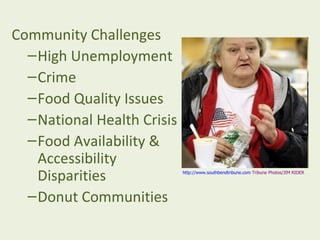
Community Challenges
  – High Unemployment
  – Crime
  – Food Quality Issues
  – National Health Crisis
  – Food Availability &
    Accessibility
    Disparities              http://www.southbendtribune.com Tribune Photos/JIM RIDER


  – Donut Communities
Reconsidering the Notion Of “Cheap” Food


“The food system is now a significant contributor to
     climate change. Reducing the carbon dioxide
   emissions from food production, processing and
   distribution by minimizing the distance between
  producer and consumer should be a critical part of
       any strategy to mitigate global warming.”
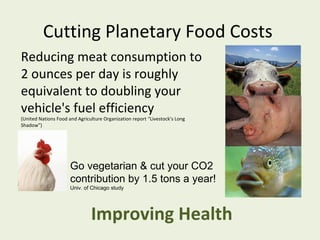
Cutting Planetary Food Costs
Reducing meat consumption to
2 ounces per day is roughly
equivalent to doubling your
vehicle's fuel efficiency
(United Nations Food and Agriculture Organization report “Livestock’s Long
Shadow”)


                      Go vegetarian & cut your CO2
                      contribution by 1.5 tons a year!
                      Univ. of Chicago study


                               Improving Health
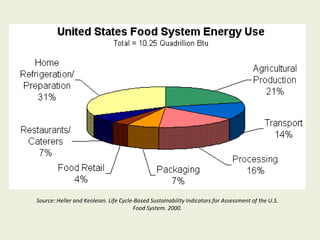
Source: Heller and Keoleian. Life Cycle-Based Sustainability Indicators for Assessment of the U.S.
                                       Food System. 2000.
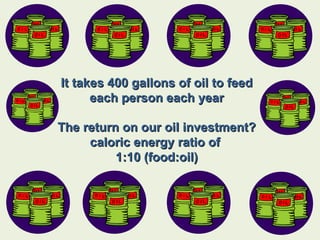
It takes 400 gallons of oil to feed
      each person each year

The return on our oil investment?
     caloric energy ratio of
          1:10 (food:oil)
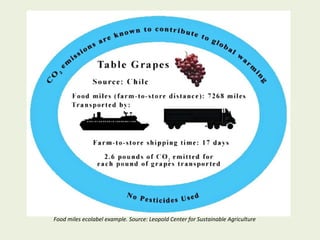
Food miles ecolabel example. Source: Leopold Center for Sustainable Agriculture
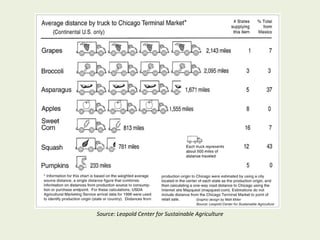
Source: Leopold Center for Sustainable Agriculture
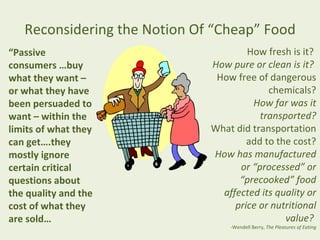
Reconsidering the Notion Of “Cheap” Food
“Passive                              How fresh is it?
consumers …buy                How pure or clean is it?
what they want –               How free of dangerous
or what they have                          chemicals?
been persuaded to                      How far was it
want – within the                        transported?
limits of what they           What did transportation
can get….they                         add to the cost?
mostly ignore                 How has manufactured
certain critical                    or “processed” or
questions about                     “precooked” food
the quality and the             affected its quality or
cost of what they                  price or nutritional
are sold…                                      value?
                                  -Wendell Berry, The Pleasures of Eating
Organic or Not – Does it Matter?
• Less fossil fuel consumption (for the manufacture
  and supply of pesticides, feedstuffs, fertilizers, and
  machinery) and greenhouse gas emissions than
  conventional systems.

     • Chemical additives used in the growing process
   account for half of the energy input in conventional
       potato production and up to 80 per cent of the
           energy consumed in some vegetable crops.
               •   From Why Our Food is So Dependent on Oil by Norman Church , available at
                                                 http://www.energybulletin.net/5045.html
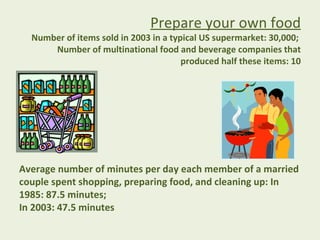
Prepare your own food
  Number of items sold in 2003 in a typical US supermarket: 30,000;
      Number of multinational food and beverage companies that
                                       produced half these items: 10


Average number of minutes per day each member of a married
couple spent shopping, preparing food, and cleaning up: In
1985: 87.5 minutes;
In 2003: 47.5 minutes
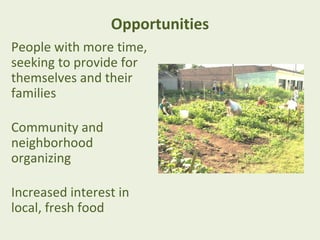
Opportunities
People with more time,
seeking to provide for
themselves and their
families

Community and
neighborhood
organizing

Increased interest in
local, fresh food
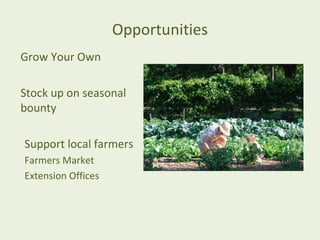
Opportunities
Grow Your Own

Stock up on seasonal
bounty

Support local farmers
Farmers Market
Extension Offices
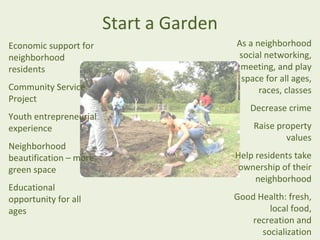
Start a Garden
Economic support for                     As a neighborhood
neighborhood                             social networking,
residents                                 meeting, and play
                                          space for all ages,
Community Service                              races, classes
Project
                                            Decrease crime
Youth entrepreneurial
experience                                   Raise property
                                                     values
Neighborhood
beautification – more                    Help residents take
green space                               ownership of their
                                              neighborhood
Educational
opportunity for all                      Good Health: fresh,
ages                                             local food,
                                             recreation and
                                               socialization
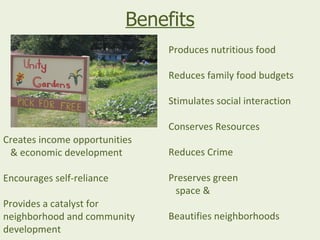
Benefits
                               Produces nutritious food

                               Reduces family food budgets

                               Stimulates social interaction

                               Conserves Resources
Creates income opportunities
 & economic development        Reduces Crime

Encourages self-reliance       Preserves green
                                space &
Provides a catalyst for
neighborhood and community     Beautifies neighborhoods
development
The vision for the Unity
Gardens is to have a
community with an
abundance of healthy,
locally grown produce.

Mission ~ To improve community health:
• Physically by increasing accessibility of fruits and vegetables
  as well as providing education on nutrition and food
  preparation.
• Socially by providing access to healthy food and opportunities
  for the disadvantaged
• Economically: by developing a sustainable local food system,
  recapturing food waste, creating new jobs, and increasing per-
  capita productivity
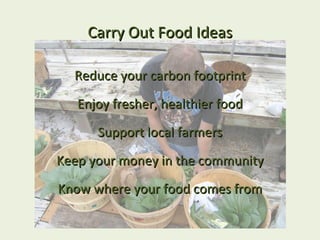
Carry Out Food Ideas

  Reduce your carbon footprint
   Enjoy fresher, healthier food
      Support local farmers
Keep your money in the community
Know where your food comes from
We each have the
      ability to bring
        change to
the system through our
      food choices.
  We can change the
  world with every bite.
Local Resources


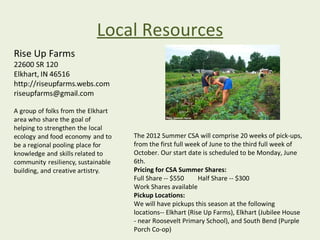
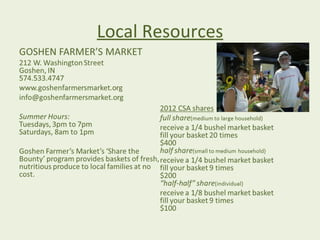
    The 2012 Summer CSA will comprise 20 weeks of pick-ups,
    from the first full week of June to the third full week of
    October. Our start date is scheduled to be Monday, June
    6th.
    Pricing for CSA Summer Shares:
    Full Share -- $550      Half Share -- $300
    Work Shares available
    Pickup Locations:
    We will have pickups this season at the following
    locations-- Elkhart (Rise Up Farms), Elkhart (Jubilee House
    - near Roosevelt Primary School), and South Bend (Purple
    Porch Co-op)
Local Resources
CLAY BOTTOM FARM
11434 CR 34
Goshen, IN 46528
www.claybottomfarm.com
claybottomfarm@gmail.com

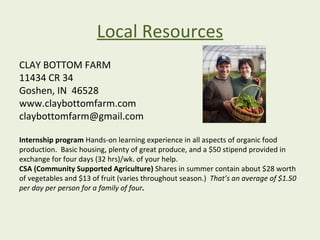
Internship program Hands-on learning experience in all aspects of organic food
production. Basic housing, plenty of great produce, and a $50 stipend provided in
exchange for four days (32 hrs)/wk. of your help.
CSA (Community Supported Agriculture) Shares in summer contain about $28 worth
of vegetables and $13 of fruit (varies throughout season.) That’s an average of $1.50
per day per person for a family of four.
Local Resources
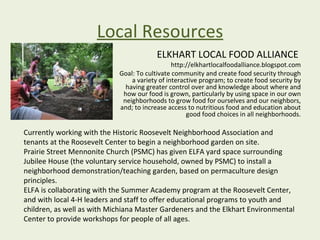
                                         ELKHART LOCAL FOOD ALLIANCE
                                               http://elkhartlocalfoodalliance.blogspot.com
                            Goal: To cultivate community and create food security through
                                a variety of interactive program; to create food security by
                              having greater control over and knowledge about where and
                             how our food is grown, particularly by using space in our own
                             neighborhoods to grow food for ourselves and our neighbors,
                            and; to increase access to nutritious food and education about
                                                    good food choices in all neighborhoods.

Currently working with the Historic Roosevelt Neighborhood Association and
tenants at the Roosevelt Center to begin a neighborhood garden on site.
Prairie Street Mennonite Church (PSMC) has given ELFA yard space surrounding
Jubilee House (the voluntary service household, owned by PSMC) to install a
neighborhood demonstration/teaching garden, based on permaculture design
principles.
ELFA is collaborating with the Summer Academy program at the Roosevelt Center,
and with local 4-H leaders and staff to offer educational programs to youth and
children, as well as with Michiana Master Gardeners and the Elkhart Environmental
Center to provide workshops for people of all ages.
Local Resources
Local Resources
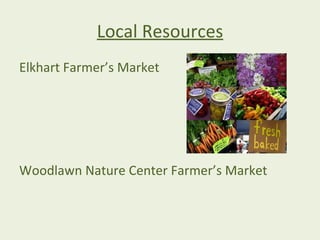
Elkhart Farmer’s Market


Woodlawn Nature Center Farmer’s Market
Local Resources
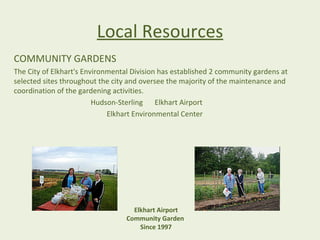
COMMUNITY GARDENS
The City of Elkhart's Environmental Division has established 2 community gardens at
selected sites throughout the city and oversee the majority of the maintenance and
coordination of the gardening activities.
                         Hudson-Sterling Elkhart Airport
                             Elkhart Environmental Center


                                    Elkhart Airport
                                  Community Garden
                                      Since 1997
Reading & Resources
BOOKS
Food Not Lawns
        -H.K. Flores
The SUV in the Pantry                        Purdue Extension
        -Thomas Starrs        Elkhart County Master Gardeners
The Pleasures of Eating                          Buying Clubs
        -Wendell Berry
Animal, Vegetable, Miracle
        -Barbara Kingsolver           Your Ideas/Suggestions?
In Defense of Food/Food
Rules/Omnivore’s Dilemma
        -Michael Pollan
FILMS
Fresh
Dirt!
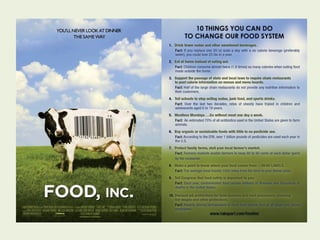
Food, Inc.
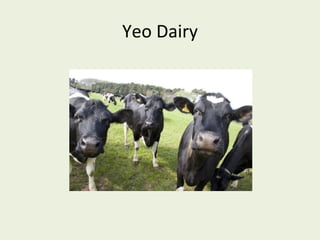
Yeo Dairy
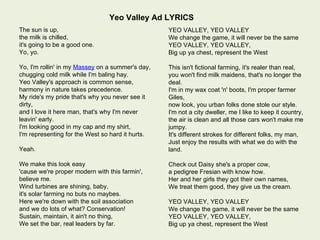
Yeo Valley Ad LYRICS
The sun is up,                                    YEO VALLEY, YEO VALLEY
the milk is chilled,                              We change the game, it will never be the same
it's going to be a good one.                      YEO VALLEY, YEO VALLEY,
Yo, yo.                                           Big up ya chest, represent the West

Yo, I'm rollin' in my Massey on a summer's day,   This isn't fictional farming, it's realer than real,
chugging cold milk while I'm baling hay.          you won't find milk maidens, that's no longer the
Yeo Valley's approach is common sense,            deal.
harmony in nature takes precedence.               I'm in my wax coat 'n' boots, I'm proper farmer
My ride's my pride that's why you never see it    Giles,
dirty,                                            now look, you urban folks done stole our style.
and I love it here man, that's why I'm never      I'm not a city dweller, me I like to keep it country,
leavin' early.                                    the air is clean and all those cars won't make me
I'm looking good in my cap and my shirt,          jumpy.
I'm representing for the West so hard it hurts.   It's different strokes for different folks, my man,
                                                  Just enjoy the results with what we do with the
Yeah.                                             land.

We make this look easy                            Check out Daisy she's a proper cow,
'cause we're proper modern with this farmin',     a pedigree Fresian with know how.
believe me.                                       Her and her girls they got their own names,
Wind turbines are shining, baby,                  We treat them good, they give us the cream.
it's solar farming no buts no maybes.
Here we're down with the soil association         YEO VALLEY, YEO VALLEY
and we do lots of what? Conservation!             We change the game, it will never be the same
Sustain, maintain, it ain't no thing,             YEO VALLEY, YEO VALLEY,
We set the bar, real leaders by far.              Big up ya chest, represent the West

Eat Green Save Green

  • 1.
    Eat Green Save Green Good for your budget Good for your health Good for the planet
  • 2.
    Community Challenges – High Unemployment – Crime – Food Quality Issues – National Health Crisis – Food Availability & Accessibility Disparities http://www.southbendtribune.com Tribune Photos/JIM RIDER – Donut Communities
  • 3.
    Reconsidering the NotionOf “Cheap” Food “The food system is now a significant contributor to climate change. Reducing the carbon dioxide emissions from food production, processing and distribution by minimizing the distance between producer and consumer should be a critical part of any strategy to mitigate global warming.”
  • 4.
    Cutting Planetary FoodCosts Reducing meat consumption to 2 ounces per day is roughly equivalent to doubling your vehicle's fuel efficiency (United Nations Food and Agriculture Organization report “Livestock’s Long Shadow”) Go vegetarian & cut your CO2 contribution by 1.5 tons a year! Univ. of Chicago study Improving Health
  • 5.
    Source: Heller andKeoleian. Life Cycle-Based Sustainability Indicators for Assessment of the U.S. Food System. 2000.
  • 6.
    It takes 400gallons of oil to feed each person each year The return on our oil investment? caloric energy ratio of 1:10 (food:oil)
  • 7.
    Food miles ecolabelexample. Source: Leopold Center for Sustainable Agriculture
  • 8.
    Source: Leopold Centerfor Sustainable Agriculture
  • 9.
    Reconsidering the NotionOf “Cheap” Food “Passive How fresh is it? consumers …buy How pure or clean is it? what they want – How free of dangerous or what they have chemicals? been persuaded to How far was it want – within the transported? limits of what they What did transportation can get….they add to the cost? mostly ignore How has manufactured certain critical or “processed” or questions about “precooked” food the quality and the affected its quality or cost of what they price or nutritional are sold… value? -Wendell Berry, The Pleasures of Eating
  • 10.
    Organic or Not– Does it Matter? • Less fossil fuel consumption (for the manufacture and supply of pesticides, feedstuffs, fertilizers, and machinery) and greenhouse gas emissions than conventional systems. • Chemical additives used in the growing process account for half of the energy input in conventional potato production and up to 80 per cent of the energy consumed in some vegetable crops. • From Why Our Food is So Dependent on Oil by Norman Church , available at http://www.energybulletin.net/5045.html
  • 11.
    Prepare your ownfood Number of items sold in 2003 in a typical US supermarket: 30,000; Number of multinational food and beverage companies that produced half these items: 10 Average number of minutes per day each member of a married couple spent shopping, preparing food, and cleaning up: In 1985: 87.5 minutes; In 2003: 47.5 minutes
  • 12.
    Opportunities People with moretime, seeking to provide for themselves and their families Community and neighborhood organizing Increased interest in local, fresh food
  • 13.
    Opportunities Grow Your Own Stockup on seasonal bounty Support local farmers Farmers Market Extension Offices
  • 14.
    Start a Garden Economicsupport for As a neighborhood neighborhood social networking, residents meeting, and play space for all ages, Community Service races, classes Project Decrease crime Youth entrepreneurial experience Raise property values Neighborhood beautification – more Help residents take green space ownership of their neighborhood Educational opportunity for all Good Health: fresh, ages local food, recreation and socialization
  • 15.
    Benefits Produces nutritious food Reduces family food budgets Stimulates social interaction Conserves Resources Creates income opportunities & economic development Reduces Crime Encourages self-reliance Preserves green space & Provides a catalyst for neighborhood and community Beautifies neighborhoods development
  • 17.
    The vision forthe Unity Gardens is to have a community with an abundance of healthy, locally grown produce. Mission ~ To improve community health: • Physically by increasing accessibility of fruits and vegetables as well as providing education on nutrition and food preparation. • Socially by providing access to healthy food and opportunities for the disadvantaged • Economically: by developing a sustainable local food system, recapturing food waste, creating new jobs, and increasing per- capita productivity
  • 19.
    Carry Out FoodIdeas Reduce your carbon footprint Enjoy fresher, healthier food Support local farmers Keep your money in the community Know where your food comes from
  • 21.
    We each havethe ability to bring change to the system through our food choices. We can change the world with every bite.
  • 22.
    Local Resources The 2012 Summer CSA will comprise 20 weeks of pick-ups, from the first full week of June to the third full week of October. Our start date is scheduled to be Monday, June 6th. Pricing for CSA Summer Shares: Full Share -- $550 Half Share -- $300 Work Shares available Pickup Locations: We will have pickups this season at the following locations-- Elkhart (Rise Up Farms), Elkhart (Jubilee House - near Roosevelt Primary School), and South Bend (Purple Porch Co-op)
  • 23.
    Local Resources CLAY BOTTOMFARM 11434 CR 34 Goshen, IN 46528 www.claybottomfarm.com claybottomfarm@gmail.com Internship program Hands-on learning experience in all aspects of organic food production. Basic housing, plenty of great produce, and a $50 stipend provided in exchange for four days (32 hrs)/wk. of your help. CSA (Community Supported Agriculture) Shares in summer contain about $28 worth of vegetables and $13 of fruit (varies throughout season.) That’s an average of $1.50 per day per person for a family of four.
  • 24.
    Local Resources ELKHART LOCAL FOOD ALLIANCE http://elkhartlocalfoodalliance.blogspot.com Goal: To cultivate community and create food security through a variety of interactive program; to create food security by having greater control over and knowledge about where and how our food is grown, particularly by using space in our own neighborhoods to grow food for ourselves and our neighbors, and; to increase access to nutritious food and education about good food choices in all neighborhoods. Currently working with the Historic Roosevelt Neighborhood Association and tenants at the Roosevelt Center to begin a neighborhood garden on site. Prairie Street Mennonite Church (PSMC) has given ELFA yard space surrounding Jubilee House (the voluntary service household, owned by PSMC) to install a neighborhood demonstration/teaching garden, based on permaculture design principles. ELFA is collaborating with the Summer Academy program at the Roosevelt Center, and with local 4-H leaders and staff to offer educational programs to youth and children, as well as with Michiana Master Gardeners and the Elkhart Environmental Center to provide workshops for people of all ages.
  • 25.
  • 26.
    Local Resources Elkhart Farmer’sMarket Woodlawn Nature Center Farmer’s Market
  • 27.
    Local Resources COMMUNITY GARDENS TheCity of Elkhart's Environmental Division has established 2 community gardens at selected sites throughout the city and oversee the majority of the maintenance and coordination of the gardening activities. Hudson-Sterling Elkhart Airport Elkhart Environmental Center Elkhart Airport Community Garden Since 1997
  • 28.
    Reading & Resources BOOKS FoodNot Lawns -H.K. Flores The SUV in the Pantry Purdue Extension -Thomas Starrs Elkhart County Master Gardeners The Pleasures of Eating Buying Clubs -Wendell Berry Animal, Vegetable, Miracle -Barbara Kingsolver Your Ideas/Suggestions? In Defense of Food/Food Rules/Omnivore’s Dilemma -Michael Pollan FILMS Fresh Dirt! Food, Inc.
  • 29.
  • 30.
    Yeo Valley AdLYRICS The sun is up, YEO VALLEY, YEO VALLEY the milk is chilled, We change the game, it will never be the same it's going to be a good one. YEO VALLEY, YEO VALLEY, Yo, yo. Big up ya chest, represent the West Yo, I'm rollin' in my Massey on a summer's day, This isn't fictional farming, it's realer than real, chugging cold milk while I'm baling hay. you won't find milk maidens, that's no longer the Yeo Valley's approach is common sense, deal. harmony in nature takes precedence. I'm in my wax coat 'n' boots, I'm proper farmer My ride's my pride that's why you never see it Giles, dirty, now look, you urban folks done stole our style. and I love it here man, that's why I'm never I'm not a city dweller, me I like to keep it country, leavin' early. the air is clean and all those cars won't make me I'm looking good in my cap and my shirt, jumpy. I'm representing for the West so hard it hurts. It's different strokes for different folks, my man, Just enjoy the results with what we do with the Yeah. land. We make this look easy Check out Daisy she's a proper cow, 'cause we're proper modern with this farmin', a pedigree Fresian with know how. believe me. Her and her girls they got their own names, Wind turbines are shining, baby, We treat them good, they give us the cream. it's solar farming no buts no maybes. Here we're down with the soil association YEO VALLEY, YEO VALLEY and we do lots of what? Conservation! We change the game, it will never be the same Sustain, maintain, it ain't no thing, YEO VALLEY, YEO VALLEY, We set the bar, real leaders by far. Big up ya chest, represent the West

Editor's Notes

  • #6 YOUR DIET IMPACTS ENVIRONMENT MORE THAN YOUR CAR  13 PERCENT = The percentage of greenhouse gases created by all trucks, SUVs, cars, airplanes, trains and other transportation. 18 PERCENT = The amount of greenhouse gases created by livestock production. (Source: United Nations Food and Agriculture Organization report “Livestock’s Long Shadow “) Food system account for almost 16% of total U.S. energy consumption 400 gallons of oil to feed each person (not incl. pkg., refridg., transport) “ oily food” - 1:10 ratio (food:oil caloric energy) FOOD SECURITY Despite the appearance of an endless bounty of food, it is a fragile bounty, dependent upon the integrity of the global oil production, refining and delivery system. …There are precious little reserves of either food or seeds to sustain any protracted interruption.
  • #11 While reduced fossil fuel energy consumption and greenhouse gas emissions are benefits to organic farming, these are often overshadowed by the environmental damage of long distance transport. Organic products that are transported long distances, particularly when distribution is by plane, are almost as damaging as their conventional air freighted counterparts. Highly processed and packaged organic foodstuffs have an added adverse environmental impact.
  • #12 -Food Counts – compiled by Lena Rotenburg