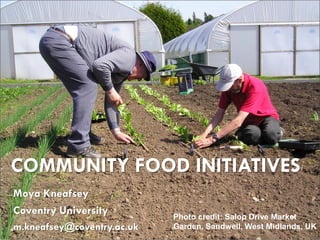
COMMUNITY FOOD INITIATIVES
Moya Kneafsey
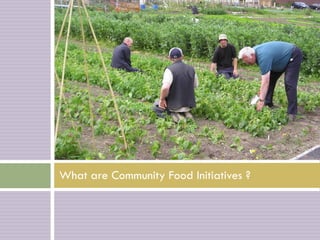
Coventry University         Photo credit: Salop Drive Market
m.kneafsey@coventry.ac.uk   Garden, Sandwell, West Midlands, UK
Outline of Presentation

1.   Context : health inequalities; food
     poverty; food security
2.   What are Community Food
     Initiatives? What can they achieve?
3.   Inspiring Stories 1: EarthShare
4.   Inspiring Stories 2: Salop Drive
5.   Conclusions
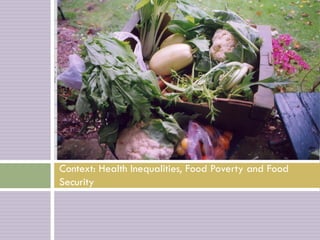
Context: Health Inequalities, Food Poverty and Food
Security
Context: Health Inequalities and Food
Poverty
 Large and growing literature on impact of
  inequalities in income, and of social
  deprivation, on food consumption and nutrition
  (Dowler et al 2001)
 Food Poverty = “the inability to acquire or

  consume an adequate or sufficient quantity of
  food in socially acceptable ways, or the
  uncertainty that one will be able to do so”
 Governments increasingly recognising food

  poverty as a serious issue
What are the food impacts of living in
  poverty?
Compared to richer people, those living on low income or in
  deprived circumstances:
   Eat less nutrient dense and less diverse diet

   Often have to pay more for basic food items

   Have to spend a greater proportion of their income on
    food – even more for healthy food
   Often have worse geographic access to food

   May go without food to pay other bills / debts

   Suffer more food related ill-health e.g. obesity, diabetes,
    (some) cancers and coronary heart disease
Food intake follows income rather than
health needs….
   Families living in poverty prioritise immediate
    satisfaction of hunger, rather than longer term health:
     “It is not that families in poverty are unaware of the
      health benefits of eating certain types of foods; just
      that these assume a lower priority than the immediate
      concern of filling stomachs” (Lang et al 2009: 260)
   Food intake is also culturally and socially contingent –
    food poverty includes lack of access to valued or
    preferred foods.
Food Security
 Since WWII, a key policy concern
 Increased significance recently due to raised
  awareness of climate change and recent food
  price rises
 Defra: „food security is when all consumers

  have access at all times to sufficient, safe and
  nutritious food for an active and healthy life at
  affordable prices‟
 Some argue for increased local self-sufficiency
  as a response….
What are Community Food Initiatives ?
What are Community Food Initiatives?

   They are diverse! But        Activities include:
    usually have these             Cookery sessions
    common elements:               Slimming clubs
     Food                         Food buying co-
     Local Involvement             operatives
     State or Charitable          Transport schemes
      Support, with some           City farms
      moving towards Social        Gardening schemes;
      Enterprise models             community allotments
                                   School breakfast clubs
                                   Community Cafes
What can CFIs achieve?
   Evaluation can be difficult, as objectives of CFIs are
    often wide-ranging
   Success means different things to different people
   Research shows that impact can be achieved when :
     CFIs are based on sound principles of community
      involvement and needs assessment
     Have clear aims and objectives

     Have time to establish themselves
The 5 Capital Assets Framework
(Dowler and Caraher 2004)

 Financial Capital: the amount of money
  circulating in a local economy
 Social Capital: human interaction around food;
  social relationships, networks
 Human Capital: capacity building; skills;
  personal development; improved health
 Natural Capital: the landscape and
  biodiversity supported by local food systems
 Physical Capital: local infrastructure available
  to or owned by local sector e.g. shops,
  transport, processing facilities
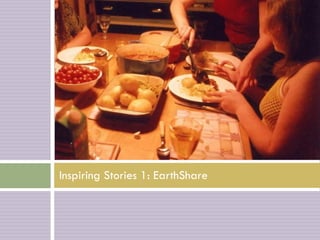
Inspiring Stories 1: EarthShare
EarthShare CSA: Scotland

Community Supported
Agriculture
   Founded 1994
170 subscribers in
2008
   Organic food
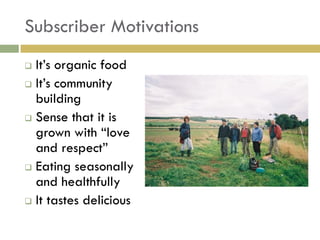
Subscriber Motivations
 It‟s organic food
 It‟s community
  building
 Sense that it is
  grown with “love
  and respect”
 Eating seasonally
  and healthfully
 It tastes delicious
The many benefits of EarthShare:
“It‟s just great that we have EarthShare and
 we haven‟t even talked about the
 advantages of EarthShare being local,
 seasonal food and I don‟t even think
 anymore about what to cook, as I just look
 in the box and whatever needs to be
 cooked is cooked . But also the relationships
 and involvement with the people growing
 the food.”              [Consumer workshop]
Reconnecting with food, and with
   people
“if you think about where your food came from and
  who‟s work has gone into getting that, the growing
  of it, the planting of it and getting it to you, and
  now when I‟m doing the vegetables I think well
  somebody‟s been out in that field and you do feel
  better having those kind of thoughts and its not just
  an anonymous carrot (laughter). It has come from
  that field and somebody had to plant it, somebody
  had to pick it then box it, and you think well a lot of
  people have gone to a lot of effort.”
                             (EarthShare subscriber)
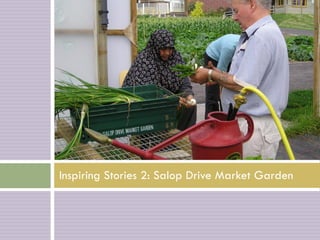
Inspiring Stories 2: Salop Drive Market Garden
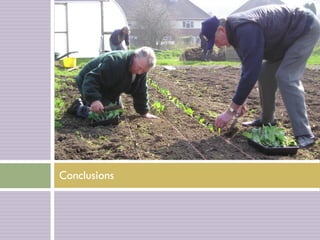
Activities at Salop Drive Market
Garden
   Therapeutic and active gardening sessions
    (supervised by horticultural therapist)
   'Ready, Steady, Grow„ programme for schools run in
    partnership with the Primary Care Trust, plus one
    off school visits with curriculum support.
   'Bag Your Share„ vegetable delivery scheme
   After school parent child gardening group
   'Grow your own veg' short course
   Monthly Health Walks
   Work Experience placements from schools and
    colleges
http://www.sandwellfoodnetwork.org/viewProject.php?id=1
New foods, new skills, healthier diets

“And there was another [vegetable we didn‟t
  recognise]… now I think it was a salad
  green, I don‟t know, I haven‟t got a clue
  what it was when we opened the bag. So
  the wife steamed it …and it was beautiful,
  and apparently it‟s supposed to be like a
  lettuce, a salad leaf, and … I don‟t know,
  but I‟ve never steamed a lettuce, but this
  was beautiful steamed.”
                         (Salop Drive Consumer)
Conclusions
CFIs can deliver many benefits…

CFIs are promoted as a way of addressing
food poverty and health inequalities, but
their contribution is wider than health:
  Dowler and Caraher (2004): found benefits
  in all 5 Capital Asset categories (in UK West
  Midlands)
  CFIs contributed ‘significantly’ to human
  capital e.g. training, skills
  CFIs were effective tools for community
  regeneration
  Some evidence of land reclamation
But they need support too…
   Secure long-term funding (currently project workers
    spend much time and energy trying to secure
    funding)
   Recognition of „soft outcomes‟ e.g. well-being, self-
    worth
   Co-ordination of policies – health, environmental
    sustainability, education etc.
   Longer term policies to remove structural barriers to
    food equality e.g. Integration of planning, retail,
    business, farming policies to promote health-giving
    food systems
Small changes….great changes
„…if you can do a little thing in some little
 way that does help either the environment
 or your community then you know…you‟re
 making a small contribution. It doesn‟t
 mean you‟re going to change the world or
 social policy, but your little bit and if a lot
 of people adopted that attitude then social
 policy and community welfare would
 change.‟            (EarthShare subscriber)
Thank you for listening!

                Dowler, E. and Caraher, M (2004) The value
References       and potential of local food initiatives in the
                 West Midlands region: Report to Advantage
                 West Midlands
                Dowler, E., Turner, S. and Dobson, B. (2001)
                 Poverty bites: food health and poor families,
                 London: Child Poverty Action Group.
                Kneafsey, M., Cox, R., Holloway, L., Dowler,
                 E., Venn, L., Tuomainen, H. (2008)
                 Reconnecting Consumers, Producers and Food:
                 Exploring Alternatives
                Lang, T., Barling, D., Caraher, M (2009) Food
                 Policy: Integrating Health, Environment and
                 Society

Moya Kneafsey Uc New

  • 1.
    COMMUNITY FOOD INITIATIVES MoyaKneafsey Coventry University Photo credit: Salop Drive Market m.kneafsey@coventry.ac.uk Garden, Sandwell, West Midlands, UK
  • 2.
    Outline of Presentation 1. Context : health inequalities; food poverty; food security 2. What are Community Food Initiatives? What can they achieve? 3. Inspiring Stories 1: EarthShare 4. Inspiring Stories 2: Salop Drive 5. Conclusions
  • 3.
    Context: Health Inequalities,Food Poverty and Food Security
  • 4.
    Context: Health Inequalitiesand Food Poverty  Large and growing literature on impact of inequalities in income, and of social deprivation, on food consumption and nutrition (Dowler et al 2001)  Food Poverty = “the inability to acquire or consume an adequate or sufficient quantity of food in socially acceptable ways, or the uncertainty that one will be able to do so”  Governments increasingly recognising food poverty as a serious issue
  • 5.
    What are thefood impacts of living in poverty? Compared to richer people, those living on low income or in deprived circumstances:  Eat less nutrient dense and less diverse diet  Often have to pay more for basic food items  Have to spend a greater proportion of their income on food – even more for healthy food  Often have worse geographic access to food  May go without food to pay other bills / debts  Suffer more food related ill-health e.g. obesity, diabetes, (some) cancers and coronary heart disease
  • 6.
    Food intake followsincome rather than health needs….  Families living in poverty prioritise immediate satisfaction of hunger, rather than longer term health:  “It is not that families in poverty are unaware of the health benefits of eating certain types of foods; just that these assume a lower priority than the immediate concern of filling stomachs” (Lang et al 2009: 260)  Food intake is also culturally and socially contingent – food poverty includes lack of access to valued or preferred foods.
  • 7.
    Food Security  SinceWWII, a key policy concern  Increased significance recently due to raised awareness of climate change and recent food price rises  Defra: „food security is when all consumers have access at all times to sufficient, safe and nutritious food for an active and healthy life at affordable prices‟  Some argue for increased local self-sufficiency as a response….
  • 8.
    What are CommunityFood Initiatives ?
  • 9.
    What are CommunityFood Initiatives?  They are diverse! But  Activities include: usually have these  Cookery sessions common elements:  Slimming clubs  Food  Food buying co-  Local Involvement operatives  State or Charitable  Transport schemes Support, with some  City farms moving towards Social  Gardening schemes; Enterprise models community allotments  School breakfast clubs  Community Cafes
  • 10.
    What can CFIsachieve?  Evaluation can be difficult, as objectives of CFIs are often wide-ranging  Success means different things to different people  Research shows that impact can be achieved when :  CFIs are based on sound principles of community involvement and needs assessment  Have clear aims and objectives  Have time to establish themselves
  • 11.
    The 5 CapitalAssets Framework (Dowler and Caraher 2004)  Financial Capital: the amount of money circulating in a local economy  Social Capital: human interaction around food; social relationships, networks  Human Capital: capacity building; skills; personal development; improved health  Natural Capital: the landscape and biodiversity supported by local food systems  Physical Capital: local infrastructure available to or owned by local sector e.g. shops, transport, processing facilities
  • 12.
  • 13.
    EarthShare CSA: Scotland CommunitySupported Agriculture  Founded 1994 170 subscribers in 2008  Organic food
  • 14.
    Subscriber Motivations  It‟sorganic food  It‟s community building  Sense that it is grown with “love and respect”  Eating seasonally and healthfully  It tastes delicious
  • 15.
    The many benefitsof EarthShare: “It‟s just great that we have EarthShare and we haven‟t even talked about the advantages of EarthShare being local, seasonal food and I don‟t even think anymore about what to cook, as I just look in the box and whatever needs to be cooked is cooked . But also the relationships and involvement with the people growing the food.” [Consumer workshop]
  • 16.
    Reconnecting with food,and with people “if you think about where your food came from and who‟s work has gone into getting that, the growing of it, the planting of it and getting it to you, and now when I‟m doing the vegetables I think well somebody‟s been out in that field and you do feel better having those kind of thoughts and its not just an anonymous carrot (laughter). It has come from that field and somebody had to plant it, somebody had to pick it then box it, and you think well a lot of people have gone to a lot of effort.” (EarthShare subscriber)
  • 17.
    Inspiring Stories 2:Salop Drive Market Garden
  • 18.
    Activities at SalopDrive Market Garden  Therapeutic and active gardening sessions (supervised by horticultural therapist)  'Ready, Steady, Grow„ programme for schools run in partnership with the Primary Care Trust, plus one off school visits with curriculum support.  'Bag Your Share„ vegetable delivery scheme  After school parent child gardening group  'Grow your own veg' short course  Monthly Health Walks  Work Experience placements from schools and colleges http://www.sandwellfoodnetwork.org/viewProject.php?id=1
  • 19.
    New foods, newskills, healthier diets “And there was another [vegetable we didn‟t recognise]… now I think it was a salad green, I don‟t know, I haven‟t got a clue what it was when we opened the bag. So the wife steamed it …and it was beautiful, and apparently it‟s supposed to be like a lettuce, a salad leaf, and … I don‟t know, but I‟ve never steamed a lettuce, but this was beautiful steamed.” (Salop Drive Consumer)
  • 20.
  • 21.
    CFIs can delivermany benefits… CFIs are promoted as a way of addressing food poverty and health inequalities, but their contribution is wider than health: Dowler and Caraher (2004): found benefits in all 5 Capital Asset categories (in UK West Midlands) CFIs contributed ‘significantly’ to human capital e.g. training, skills CFIs were effective tools for community regeneration Some evidence of land reclamation
  • 22.
    But they needsupport too…  Secure long-term funding (currently project workers spend much time and energy trying to secure funding)  Recognition of „soft outcomes‟ e.g. well-being, self- worth  Co-ordination of policies – health, environmental sustainability, education etc.  Longer term policies to remove structural barriers to food equality e.g. Integration of planning, retail, business, farming policies to promote health-giving food systems
  • 23.
    Small changes….great changes „…ifyou can do a little thing in some little way that does help either the environment or your community then you know…you‟re making a small contribution. It doesn‟t mean you‟re going to change the world or social policy, but your little bit and if a lot of people adopted that attitude then social policy and community welfare would change.‟ (EarthShare subscriber)
  • 24.
    Thank you forlistening!  Dowler, E. and Caraher, M (2004) The value References and potential of local food initiatives in the West Midlands region: Report to Advantage West Midlands  Dowler, E., Turner, S. and Dobson, B. (2001) Poverty bites: food health and poor families, London: Child Poverty Action Group.  Kneafsey, M., Cox, R., Holloway, L., Dowler, E., Venn, L., Tuomainen, H. (2008) Reconnecting Consumers, Producers and Food: Exploring Alternatives  Lang, T., Barling, D., Caraher, M (2009) Food Policy: Integrating Health, Environment and Society