I. Introduction:
• RepublicAct No. 7877
Anti-Sexual Harassment Law
Lapsed into law on February 14, 1995 by President Fidel
Ramos
Prohibits ALL forms of sexual harassment in W.E.T
• W-orkplaces
• E-ducational Institutions
• T-raining Environments
5.
II. SEXUAL HARASSMENTIN W.E.T
•Sexual harassment in Work, Education or
Training-related sexual harassment is
committed when an employer, teacher, or any
person who has authority, influence or
moral ascendancy over another (a)
demands, (b) requests or (c) otherwise
requires any sexual favor from the latter,
regardless of whether the demand, request or
requirement for submission is accepted by the
object of said act.
6.
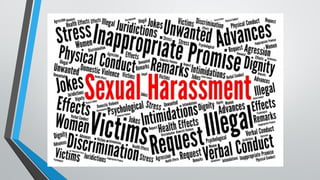
WORKPLACE SEXUAL HARASSMENT
•Sexualharassment in the
workplace is committed when
the sexual favor is made as a
condition for employment,
promotion, continued
employment and other
privileges.
7.
SEXUAL HARASSMENT INEDUCATION OR TRAINING ENVIRONMENT
• The sexual harassment is committed against one who
is under the care, custody or supervision of the
offender;
• The sexual harassment is committed against one
whose education, training, apprenticeship or
tutorship is entrusted to the offender;
• When the sexual favor is made a condition to the
giving of a passing grade, or the granting of honors
and scholarships, or the payment of a stipend,
allowance or other benefits, privileges, or
considerations; or
• When the sexual advances result in an intimidating,
8.
III. GRAVAMEN
• Thegravamen of the offense in sexual harassment is
not the violation of the employee’s sexuality but
the abuse of power by the employer. (Phil. Aeolus
Auto-Motive United Corp. v. National Labor Relations
Commission (2000))
• Workplace sexual harassment occurs when a
supervisor, or agent of an employer, or any other
person who has authority over another in a work
environment, imposes sexual favors on another,
which creates in an intimidating, hostile, or offensive
environment for the latter (LBC Express v. Palco, G.R.
No. 217101, February 12, 2020).
9.
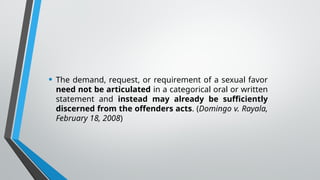
• The demand,request, or requirement of a sexual favor
need not be articulated in a categorical oral or written
statement and instead may already be sufficiently
discerned from the offenders acts. (Domingo v. Rayala,
February 18, 2008)
10.
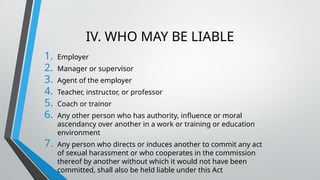
IV. WHO MAYBE LIABLE
1. Employer
2. Manager or supervisor
3. Agent of the employer
4. Teacher, instructor, or professor
5. Coach or trainor
6. Any other person who has authority, influence or moral
ascendancy over another in a work or training or education
environment
7. Any person who directs or induces another to commit any act
of sexual harassment or who cooperates in the commission
thereof by another without which it would not have been
committed, shall also be held liable under this Act
11.
V. DUTIES OFEMPLOYER
RA 7877 mandates that the employer or the head of the work-related,
educational or training environment or institution duties in ensuring the
enforcement of this Act, to wit:
• They must provide the procedures for the resolution, settlement or
prosecution of acts of sexual harassment.
• The employer must create a committee on decorum and investigation
of cases on sexual harassment.
• In the case of a work-related environment, the committee shall be
composed of at least one (1) representative each from the
management, the union, if any, the employees from the supervisory
rank, and from the rank-and-file employees.
• In the case of the educational or training institution, the committee
shall be composed of at least one (1) representative from the
administration, the trainors, instructors, professors or coaches and
students or trainees, as the case may be.
• The employer or head of office, educational or training institution shall
disseminate or post a copy of this Act for the information of all
12.
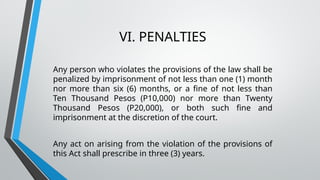
VI. PENALTIES
Any personwho violates the provisions of the law shall be
penalized by imprisonment of not less than one (1) month
nor more than six (6) months, or a fine of not less than
Ten Thousand Pesos (P10,000) nor more than Twenty
Thousand Pesos (P20,000), or both such fine and
imprisonment at the discretion of the court.
Any act on arising from the violation of the provisions of
this Act shall prescribe in three (3) years.





![Republic act 7877] presentation](https://cdn.slidesharecdn.com/ss_thumbnails/republicact7877presentation-140629083639-phpapp02-thumbnail.jpg?width=640&height=640&fit=bounds)


