Supervisor Training
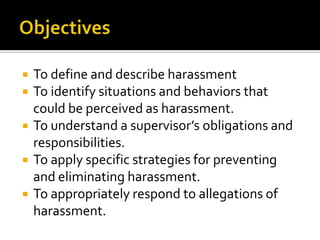
   To define and describe harassment
   To identify situations and behaviors that
    could be perceived as harassment.
   To understand a supervisor’s obligations and
    responsibilities.
   To apply specific strategies for preventing
    and eliminating harassment.
   To appropriately respond to allegations of
    harassment.
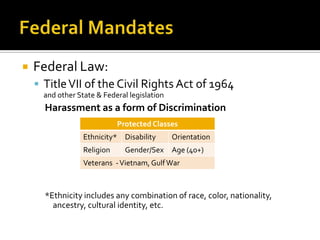
   Federal Law:
     Title VII of the Civil Rights Act of 1964
      and other State & Federal legislation
      Harassment as a form of Discrimination
                             Protected Classes
                  Ethnicity* Disability       Orientation
                  Religion     Gender/Sex     Age (40+)
                  Veterans - Vietnam, Gulf War


      *Ethnicity includes any combination of race, color, nationality,
        ancestry, cultural identity, etc.
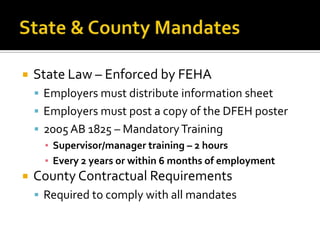
   State Law – Enforced by FEHA
     Employers must distribute information sheet
     Employers must post a copy of the DFEH poster
     2005 AB 1825 – Mandatory Training
      ▪ Supervisor/manager training – 2 hours
      ▪ Every 2 years or within 6 months of employment
   County Contractual Requirements
     Required to comply with all mandates
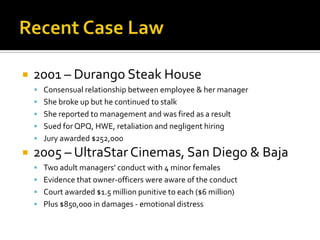
   2001 – Durango Steak House
     Consensual relationship between employee & her manager
     She broke up but he continued to stalk
     She reported to management and was fired as a result
     Sued for QPQ, HWE, retaliation and negligent hiring
     Jury awarded $252,000

   2005 – UltraStar Cinemas, San Diego & Baja
     Two adult managers’ conduct with 4 minor females
     Evidence that owner-officers were aware of the conduct
     Court awarded $1.5 million punitive to each ($6 million)
     Plus $850,000 in damages - emotional distress
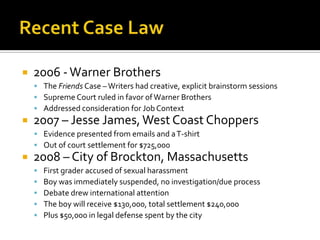
   2006 - Warner Brothers
     The Friends Case – Writers had creative, explicit brainstorm sessions
     Supreme Court ruled in favor of Warner Brothers
     Addressed consideration for Job Context
   2007 – Jesse James, West Coast Choppers
     Evidence presented from emails and a T-shirt
     Out of court settlement for $725,000
   2008 – City of Brockton, Massachusetts
       First grader accused of sexual harassment
       Boy was immediately suspended, no investigation/due process
       Debate drew international attention
       The boy will receive $130,000, total settlement $240,000
       Plus $50,000 in legal defense spent by the city
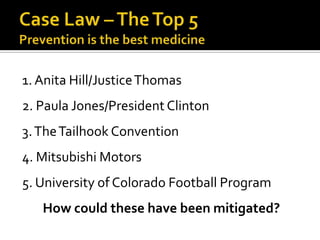
1. Anita Hill/Justice Thomas
2. Paula Jones/President Clinton
3. The Tailhook Convention
4. Mitsubishi Motors
5. University of Colorado Football Program
   How could these have been mitigated?
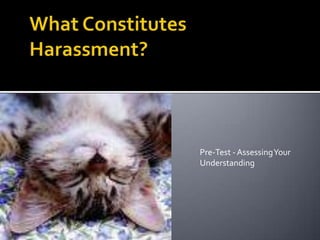
Pre-Test - Assessing Your
Understanding
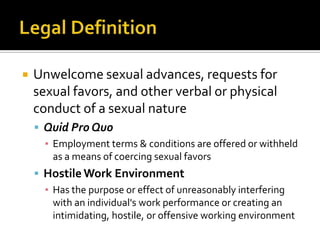
   Unwelcome sexual advances, requests for
    sexual favors, and other verbal or physical
    conduct of a sexual nature
     Quid Pro Quo
      ▪ Employment terms & conditions are offered or withheld
        as a means of coercing sexual favors
     Hostile Work Environment
      ▪ Has the purpose or effect of unreasonably interfering
        with an individual's work performance or creating an
        intimidating, hostile, or offensive working environment
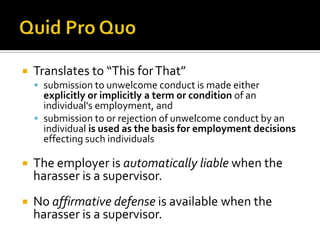
   Translates to “This for That”
     submission to unwelcome conduct is made either
      explicitly or implicitly a term or condition of an
      individual's employment, and
     submission to or rejection of unwelcome conduct by an
      individual is used as the basis for employment decisions
      effecting such individuals

   The employer is automatically liable when the
    harasser is a supervisor.
   No affirmative defense is available when the
    harasser is a supervisor.
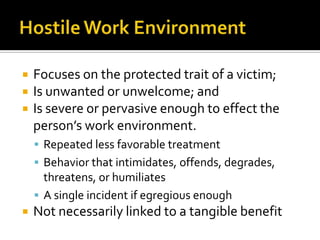
   Focuses on the protected trait of a victim;
   Is unwanted or unwelcome; and
   Is severe or pervasive enough to effect the
    person’s work environment.
     Repeated less favorable treatment
     Behavior that intimidates, offends, degrades,
      threatens, or humiliates
     A single incident if egregious enough
   Not necessarily linked to a tangible benefit
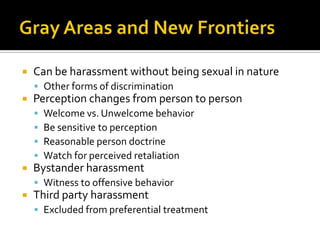
   Can be harassment without being sexual in nature
     Other forms of discrimination
   Perception changes from person to person
       Welcome vs. Unwelcome behavior
       Be sensitive to perception
       Reasonable person doctrine
       Watch for perceived retaliation
   Bystander harassment
     Witness to offensive behavior
   Third party harassment
     Excluded from preferential treatment
Group
Discussion
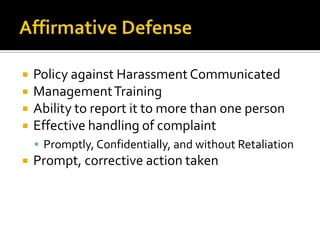
   Policy against Harassment Communicated
   Management Training
   Ability to report it to more than one person
   Effective handling of complaint
     Promptly, Confidentially, and without Retaliation
   Prompt, corrective action taken
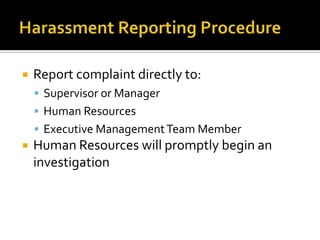
   Report complaint directly to:
     Supervisor or Manager
     Human Resources
     Executive Management Team Member
   Human Resources will promptly begin an
    investigation
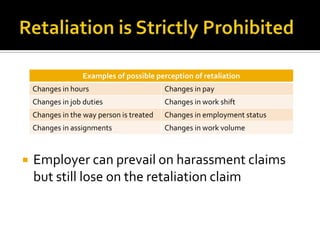
Examples of possible perception of retaliation
    Changes in hours                       Changes in pay
    Changes in job duties                  Changes in work shift
    Changes in the way person is treated   Changes in employment status
    Changes in assignments                 Changes in work volume


   Employer can prevail on harassment claims
    but still lose on the retaliation claim
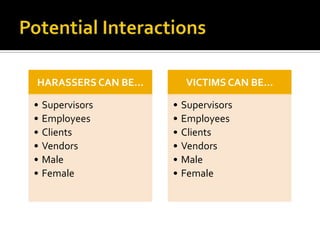
HARASSERS CAN BE…        VICTIMS CAN BE…

•   Supervisors     •   Supervisors
•   Employees       •   Employees
•   Clients         •   Clients
•   Vendors         •   Vendors
•   Male            •   Male
•   Female          •   Female
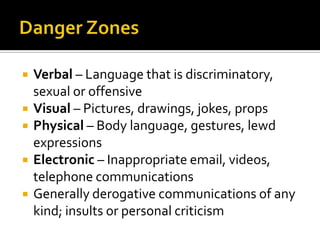
   Verbal – Language that is discriminatory,
    sexual or offensive
   Visual – Pictures, drawings, jokes, props
   Physical – Body language, gestures, lewd
    expressions
   Electronic – Inappropriate email, videos,
    telephone communications
   Generally derogative communications of any
    kind; insults or personal criticism
Memory Check
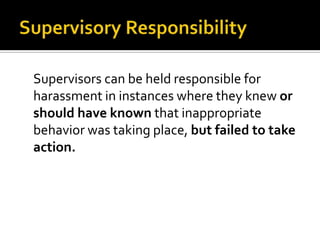
Supervisors can be held responsible for
harassment in instances where they knew or
should have known that inappropriate
behavior was taking place, but failed to take
action.
   Supervisors may be held personally and legally
    liable in circumstances where they were a
    contributor, either through action or inaction.
           when they engage in behavior that is harassing, or
           when they delay or fail to take action in the
            following circumstances:
        ▪    a complaint is made to them
        ▪    they see or hear about behavior that may be offensive
        ▪    they see or hear about behavior they know is harassment
   These styles if directed at one group of
    people could be perceived as harassing:
     Dictator – overwork, unnecessary pressure, and
      unreasonable deadlines
     Passive Aggressive – Belittling, critical, sarcastic,
      sabotaging
     Micromanager – over-detailed supervision,
      unwarranted checking and lack of trust
     Isolationist – Exclusionary or laissez-faire,
      withholding information or resources
   Employees depend on their supervisors to provide a safe
    and respectful work environment.
   Supervisors can follow six steps to eliminate existing
    sexual harassment and set the stage for preventing it in
    the future:
    1.   Know our sexual harassment policy.
    2.   Be a role model for your staff.
    3.   Identify potential problems and report them to HR.
    4.   Practice our open door policy where people feel comfortable
         confiding in you.
    5.   Maintain strict confidentiality.
    6.   Take action on all complaints even if recipient asks you not to.
Supervisory
Responsibility
Exercise
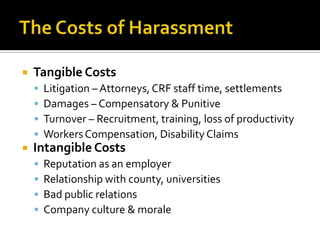
   Tangible Costs
       Litigation – Attorneys, CRF staff time, settlements
       Damages – Compensatory & Punitive
       Turnover – Recruitment, training, loss of productivity
       Workers Compensation, Disability Claims
   Intangible Costs
       Reputation as an employer
       Relationship with county, universities
       Bad public relations
       Company culture & morale
 Communication
 Awareness
 Leadership
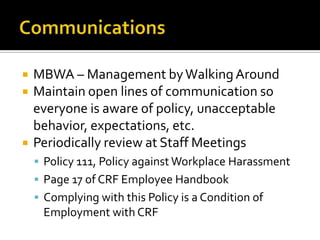
   MBWA – Management by Walking Around
   Maintain open lines of communication so
    everyone is aware of policy, unacceptable
    behavior, expectations, etc.
   Periodically review at Staff Meetings
     Policy 111, Policy against Workplace Harassment
     Page 17 of CRF Employee Handbook
     Complying with this Policy is a Condition of
     Employment with CRF
   Be aware of the following:
     It is your responsibility to take action if you know, or
      should have known, about questionable behavior in
      your workplace - even if an employee does not
      complain to you about harassment.
     The more severe the behavior is, the fewer times it
      needs to be repeated before it is considered
      harassment.
     The more severe and obvious the behavior is, the less
      responsibility the receiver has to speak up.
     Supervisors may be held personally liable for acts of
      harassment they commit against another individual.
   If you become aware of questionable behavior,
    even if there is no complaint, you should:
     Call Human Resources immediately.
     Take prompt and corrective action.
     Document action taken.
     Communicate actions taken to the affected employee
      and explain what he or she should do if the problem
      should occur again.
     Maintain strict confidentiality; information about the
      incident should be shared on a need to know basis.
In-box Scenarios

Sexual Harassment Prevention

  • 1.
  • 2.
    To define and describe harassment  To identify situations and behaviors that could be perceived as harassment.  To understand a supervisor’s obligations and responsibilities.  To apply specific strategies for preventing and eliminating harassment.  To appropriately respond to allegations of harassment.
  • 3.
    Federal Law:  Title VII of the Civil Rights Act of 1964 and other State & Federal legislation Harassment as a form of Discrimination Protected Classes Ethnicity* Disability Orientation Religion Gender/Sex Age (40+) Veterans - Vietnam, Gulf War *Ethnicity includes any combination of race, color, nationality, ancestry, cultural identity, etc.
  • 4.
    State Law – Enforced by FEHA  Employers must distribute information sheet  Employers must post a copy of the DFEH poster  2005 AB 1825 – Mandatory Training ▪ Supervisor/manager training – 2 hours ▪ Every 2 years or within 6 months of employment  County Contractual Requirements  Required to comply with all mandates
  • 5.
    2001 – Durango Steak House  Consensual relationship between employee & her manager  She broke up but he continued to stalk  She reported to management and was fired as a result  Sued for QPQ, HWE, retaliation and negligent hiring  Jury awarded $252,000  2005 – UltraStar Cinemas, San Diego & Baja  Two adult managers’ conduct with 4 minor females  Evidence that owner-officers were aware of the conduct  Court awarded $1.5 million punitive to each ($6 million)  Plus $850,000 in damages - emotional distress
  • 6.
    2006 - Warner Brothers  The Friends Case – Writers had creative, explicit brainstorm sessions  Supreme Court ruled in favor of Warner Brothers  Addressed consideration for Job Context  2007 – Jesse James, West Coast Choppers  Evidence presented from emails and a T-shirt  Out of court settlement for $725,000  2008 – City of Brockton, Massachusetts  First grader accused of sexual harassment  Boy was immediately suspended, no investigation/due process  Debate drew international attention  The boy will receive $130,000, total settlement $240,000  Plus $50,000 in legal defense spent by the city
  • 7.
    1. Anita Hill/JusticeThomas 2. Paula Jones/President Clinton 3. The Tailhook Convention 4. Mitsubishi Motors 5. University of Colorado Football Program How could these have been mitigated?
  • 8.
    Pre-Test - AssessingYour Understanding
  • 9.
    Unwelcome sexual advances, requests for sexual favors, and other verbal or physical conduct of a sexual nature  Quid Pro Quo ▪ Employment terms & conditions are offered or withheld as a means of coercing sexual favors  Hostile Work Environment ▪ Has the purpose or effect of unreasonably interfering with an individual's work performance or creating an intimidating, hostile, or offensive working environment
  • 10.
    Translates to “This for That”  submission to unwelcome conduct is made either explicitly or implicitly a term or condition of an individual's employment, and  submission to or rejection of unwelcome conduct by an individual is used as the basis for employment decisions effecting such individuals  The employer is automatically liable when the harasser is a supervisor.  No affirmative defense is available when the harasser is a supervisor.
  • 11.
    Focuses on the protected trait of a victim;  Is unwanted or unwelcome; and  Is severe or pervasive enough to effect the person’s work environment.  Repeated less favorable treatment  Behavior that intimidates, offends, degrades, threatens, or humiliates  A single incident if egregious enough  Not necessarily linked to a tangible benefit
  • 12.
    Can be harassment without being sexual in nature  Other forms of discrimination  Perception changes from person to person  Welcome vs. Unwelcome behavior  Be sensitive to perception  Reasonable person doctrine  Watch for perceived retaliation  Bystander harassment  Witness to offensive behavior  Third party harassment  Excluded from preferential treatment
  • 13.
  • 14.
    Policy against Harassment Communicated  Management Training  Ability to report it to more than one person  Effective handling of complaint  Promptly, Confidentially, and without Retaliation  Prompt, corrective action taken
  • 15.
    Report complaint directly to:  Supervisor or Manager  Human Resources  Executive Management Team Member  Human Resources will promptly begin an investigation
  • 16.
    Examples of possibleperception of retaliation Changes in hours Changes in pay Changes in job duties Changes in work shift Changes in the way person is treated Changes in employment status Changes in assignments Changes in work volume  Employer can prevail on harassment claims but still lose on the retaliation claim
  • 17.
    HARASSERS CAN BE… VICTIMS CAN BE… • Supervisors • Supervisors • Employees • Employees • Clients • Clients • Vendors • Vendors • Male • Male • Female • Female
  • 18.
    Verbal – Language that is discriminatory, sexual or offensive  Visual – Pictures, drawings, jokes, props  Physical – Body language, gestures, lewd expressions  Electronic – Inappropriate email, videos, telephone communications  Generally derogative communications of any kind; insults or personal criticism
  • 19.
  • 20.
    Supervisors can beheld responsible for harassment in instances where they knew or should have known that inappropriate behavior was taking place, but failed to take action.
  • 21.
    Supervisors may be held personally and legally liable in circumstances where they were a contributor, either through action or inaction.  when they engage in behavior that is harassing, or  when they delay or fail to take action in the following circumstances: ▪ a complaint is made to them ▪ they see or hear about behavior that may be offensive ▪ they see or hear about behavior they know is harassment
  • 22.
    These styles if directed at one group of people could be perceived as harassing:  Dictator – overwork, unnecessary pressure, and unreasonable deadlines  Passive Aggressive – Belittling, critical, sarcastic, sabotaging  Micromanager – over-detailed supervision, unwarranted checking and lack of trust  Isolationist – Exclusionary or laissez-faire, withholding information or resources
  • 23.
    Employees depend on their supervisors to provide a safe and respectful work environment.  Supervisors can follow six steps to eliminate existing sexual harassment and set the stage for preventing it in the future: 1. Know our sexual harassment policy. 2. Be a role model for your staff. 3. Identify potential problems and report them to HR. 4. Practice our open door policy where people feel comfortable confiding in you. 5. Maintain strict confidentiality. 6. Take action on all complaints even if recipient asks you not to.
  • 24.
  • 25.
    Tangible Costs  Litigation – Attorneys, CRF staff time, settlements  Damages – Compensatory & Punitive  Turnover – Recruitment, training, loss of productivity  Workers Compensation, Disability Claims  Intangible Costs  Reputation as an employer  Relationship with county, universities  Bad public relations  Company culture & morale
  • 27.
  • 28.
    MBWA – Management by Walking Around  Maintain open lines of communication so everyone is aware of policy, unacceptable behavior, expectations, etc.  Periodically review at Staff Meetings  Policy 111, Policy against Workplace Harassment  Page 17 of CRF Employee Handbook  Complying with this Policy is a Condition of Employment with CRF
  • 29.
    Be aware of the following:  It is your responsibility to take action if you know, or should have known, about questionable behavior in your workplace - even if an employee does not complain to you about harassment.  The more severe the behavior is, the fewer times it needs to be repeated before it is considered harassment.  The more severe and obvious the behavior is, the less responsibility the receiver has to speak up.  Supervisors may be held personally liable for acts of harassment they commit against another individual.
  • 30.
    If you become aware of questionable behavior, even if there is no complaint, you should:  Call Human Resources immediately.  Take prompt and corrective action.  Document action taken.  Communicate actions taken to the affected employee and explain what he or she should do if the problem should occur again.  Maintain strict confidentiality; information about the incident should be shared on a need to know basis.
  • 31.

Editor's Notes

  • #11 Affirmative Defense – a legal defense the employer can use to mitigate liability.