•Complex!

•Only 1 in 20,000 chemicals goes to the farm from the lab

• Only 1 in 200 makes it through pre-clinical testing and approval

• It can take 4 years to license an animal drug

• It can take 10+ years to take an animal drug from discovery to
approval

• In the past few years, the industry has spent over $400 million,
double what was spent 10 years ago
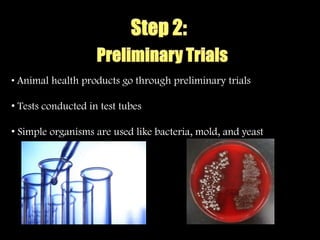
• Animal health products go through preliminary trials

• Tests conducted in test tubes

• Simple organisms are used like bacteria, mold, and yeast
• Tests are performed on animals to estimate dosage and check for
adverse effects

• If the trial is a success, the FDA is notified

• The FDA then approves further trials on drugs and food additives

• The USDA reviews plans for vaccines or other animal biologicals

• The EPA issues permits for some experiments
• Ensures the safety and effectiveness of the product

• Scientists work closely with manufacturers to make sure that all
necessary tests are being conducted

• Researchers conduct field trials to demonstrate how the product
works under normal conditions

• The manufacturer has to prove that it has produced a quality
product
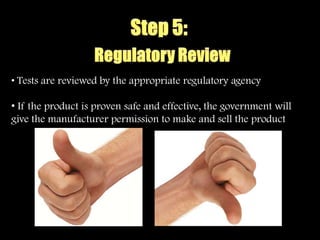
• Tests are reviewed by the appropriate regulatory agency

• If the product is proven safe and effective, the government will
give the manufacturer permission to make and sell the product
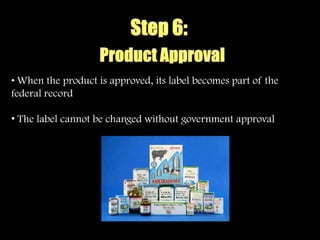
• When the product is approved, its label becomes part of the
federal record

• The label cannot be changed without government approval
• As a final check, the government monitors the food supply for
illegal drug residues

• Random tests are conducted by the FDA, USDA, and FSIS

• The rate of violation has declined in the last 10 years

• Only 0.3% of samples have tested at illegal levels in the last few
years

Seven Steps to Product Approval

  • 2.
    •Complex! •Only 1 in20,000 chemicals goes to the farm from the lab • Only 1 in 200 makes it through pre-clinical testing and approval • It can take 4 years to license an animal drug • It can take 10+ years to take an animal drug from discovery to approval • In the past few years, the industry has spent over $400 million, double what was spent 10 years ago
  • 3.
    • Animal healthproducts go through preliminary trials • Tests conducted in test tubes • Simple organisms are used like bacteria, mold, and yeast
  • 4.
    • Tests areperformed on animals to estimate dosage and check for adverse effects • If the trial is a success, the FDA is notified • The FDA then approves further trials on drugs and food additives • The USDA reviews plans for vaccines or other animal biologicals • The EPA issues permits for some experiments
  • 5.
    • Ensures thesafety and effectiveness of the product • Scientists work closely with manufacturers to make sure that all necessary tests are being conducted • Researchers conduct field trials to demonstrate how the product works under normal conditions • The manufacturer has to prove that it has produced a quality product
  • 6.
    • Tests arereviewed by the appropriate regulatory agency • If the product is proven safe and effective, the government will give the manufacturer permission to make and sell the product
  • 7.
    • When theproduct is approved, its label becomes part of the federal record • The label cannot be changed without government approval
  • 8.
    • As afinal check, the government monitors the food supply for illegal drug residues • Random tests are conducted by the FDA, USDA, and FSIS • The rate of violation has declined in the last 10 years • Only 0.3% of samples have tested at illegal levels in the last few years