Welcome
To
our
PresenTaTion
Presented To
simin shabnam loPa
b. Pharm & m. Pharm (r.u.)
lacTurer DeParTmenT of
Pharmacy,VarenDra uniVersiTy
Presented By
Group:
Revenue
Group Members
Saima Akter
ID No.: 151211046
Md. Jebon Mia
ID No.: 151211050
Sadi Md. Jubaeer
ID No: 151211047
Priyanka Rani
ID No : 151211038
Most.Khadija Akter Riva
ID No: 151211051
Md. Ifta Khairul Islam
ID No: 151211058
Al Asma Hawa
ID No: 151211066
A Pharmaceutical
Industry
Presentation
On
What is Quality
• The ability to make the same thing the same way,
over and over again
• Customer buys today is same as what they bought
last week or will buy next week
• Product meets customer’s expectations 100% of
the time
Quality Assurance
• Covers everything from raw materials and GMP
verification through finished-product release
• HACCP is part of QA
• Quality Control
• Actual manufacturing process
Quality Assurance Operation
• Reviewing the daily lab and production reports is a
part of the QA responsibilities. This is to determine
that the procedures are being followed and the tests
are being made. QA can spot trends by conducting
consistent record reviews. If record reviews don’t
stay current, no one will get timely feedback before
a real problem crops up.
The Pharmaceutical Quality Assurance & Quality
Control program combines theoretical knowledge
with hands-on skills in all areas that impact drug
quality.
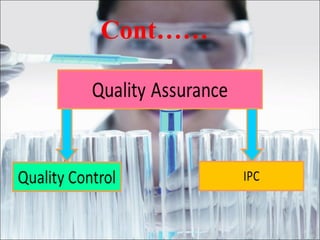
Cont……
Quality control
• Quality control is an essential operation of the
pharmaceutical industry. Drugs must be marketed
as safe and therapeutically active formulations
whose performance is consistent and predictable..
Quality control
IPC
• In-process methods are key components of quality
control in a chemical manufacturing plant. These
methods ensure that a production reaction step
conducted by trained operators It ensures the best
API.
Production
• Production involves the propagation, conversion, or
processing of a drug or device, either directly or
indirectly, by extraction of the drug from
substances of natural origin or by means of
chemical or biological synthesis.
Production also includes
• 1.Any packaging or repackaging of the
substance(s) or labeling or relabeling of containers
for the promotion and marketing of such drugs or
devices.
Production
2.Any preparation of a drug or device that is given or
sold for resale by pharmaciest , practitioners, or other
persons.
3.The distribution of inordinate amounts of
compounded preparations or the copying of
commercially available drug products.
4.The preparation of any quantity of a drug product
without a licensed prescriber/patient/licensed
pharmacist/compounder relationship.
Unit Operations of Production
1.Formulation and Pre-Formulation Development:
Before a drug can be Produced at any scale, much work
goes into the actual formulation of the drug. Formulation
development scientists must evaluate a compound for
uniformity, stability and many other factors. After the
evaluation phase, a solution must be developed to deliver the
drug in its required form such as solid, semi-solid, immediate
or controlled release, tablet, capsule, and many other
Variations
2.Powder Blending
In the pharmaceutical industry, a wide range of excipients
may be blended together to create the final blend used to
manufacture the solid dosage form.
Unit Operations of Production
3.Milling
During the drug Producing process, milling is often
required in order to reduce the average particle size
in a drug powder.
4.Granulation
Granulation can be thought of as the opposite of milling; it
is the process by which small particles are bound together to
form larger particles, called granules. Granulation is used for
several reasons.
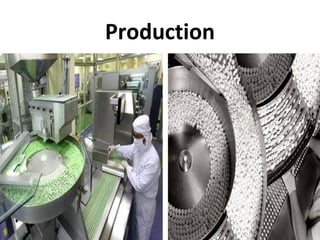
Production
Research and Development Sector in
Pharmaceutical Industry
• During the discovery research phase of development
of a medicine pharmacists will work with other
scientists to develop and select drug compounds that
may be valuable as medicines. They will also help the
project team, which might include medicinal
chemists,bioscientists,toxicologists,pharmacokinetici
sts and others, to understand the biopharmaceutical
properties of the compound, the dosage form and
how the route of administration might affect the rate
and extent of absorption. In this area a post-graduate
qualification is a particular asset.
Role of Research and Development Sector
in Pharmaceutical Industry
• New Product Research
• New Product development
• Existing Product Updates
• Quality Checking
• Innovation
• Formulation and packaging development
• Clinical research
R&D Status in Pharmaceutical Sector
Modern Medicine :
• It is mandatory to all the local and foreign
companies to follow good manufacturing practices
(GMP) as per WHO recommended guide line
• Although, top and medium level companies
strictly follow GMP and possess all high-tech
facilities in their premises, but they do not have
R&D facilities in real sense
• The top 30 local companies have well-equipped
product development (PD) department instead of
full-fledged R&D
R&D Status in Pharmaceutical Sector
• Recently some top pharmaceutical industries are
producing high-tech biopharmaceutical products
have started real R&D activities in a limited scale
• Only few of the APIs producers have full-fledge
R&D facilities. Most of them are manufacturing
under technology transfer from India and China
Storage House/ Warehouse
The storing of pharmaceutical products and materials up to
their point of use is called the storage house of a
pharmaceutical
Storage areas
1. Precautions must be taken to prevent unauthorized persons
from entering storage areas.
2. Storage areas should be of sufficient capacity to allow the
orderly storage of the various categories of materials and
products, namely starting and packaging materials,
intermediates, bulk and finished products, products in
quarantine, and released, rejected, returned or recalled
products.
Monitoring of storage conditions
1.Recorded temperature monitoring data should be available
for review. The equipment used for monitoring should be
checked at suitable predetermined intervals and the results of
such checks should be recorded and retained. All monitoring
records should be kept for at least the shelf-life of the stored
material or product plus 1 year, or as required by national
legislation. Temperature mapping should show uniformity of
the temperature across the storage facility. It is recommended
that temperature monitors be located in areas that are most
likely to show fluctuations.
2.Equipment used for monitoring should also be calibrated at
defined intervals.
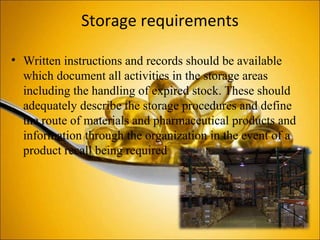
Storage requirements
• Written instructions and records should be available
which document all activities in the storage areas
including the handling of expired stock. These should
adequately describe the storage procedures and define
the route of materials and pharmaceutical products and
information through the organization in the event of a
product recall being required
Pharmaceutical Technical Services
Pharmaceutical Technical Services (PTS) is a
focused consulting organization, specializing in
serving the GMP production and facilities'
operations activities of the pharmaceutical,
biopharmaceutical, diagnostic, and related
regulated industries
Pharmaceutical Technical Services
• The pharmaceutical industry discovers, develops,
produces, and markets drugs or pharmaceuticals for
use as medications. Pharmaceutical companies may
deal in generic or brand medications and medical
devices. They are subject to a variety of laws and
regulations that govern the patenting, testing, safety,
efficacy and marketing of drugs.
Technology transfer checklist
• It consists of…
• .Production master formula
• .Manufacturing instruction
• .Analytical methods
• .Previous process validation
• .Previous analytical validation
• .Cleaning instruction and previous cleaning validation
• .Stability reports
• .Packaging instruction
• .Specimen manufacturing batch record
Master Formula
• Master Formula is a full spectrum, multinutrient
complex, providing premium vitamins, minerals,
and food-based nutriment to support general
health and well-being. By utilizing a Synergistic
Suspension Isolation process – SSI Technology –
ingredients are delivered in three distinct delivery
forms. Collectively, these ingredients provide a
premium, synergistic complex to support your
body.
Analytical Method
• Analytical Methods welcomes early applied
demonstrations of new analytical methods with
clear societal impact. Developments are encouraged
within the fields of healthcare, pharmaceuticals and
biomedical diagnostics, environmental and forensic
analysis, heritage science, agricultural science and
food products, industrial process development and
product validation
Concept of Supply Chain Management
• Supply chain is a network of facilities &
distribution options that performs the function of
procurement of raw materials, transformation of
these materials into intermediate & finished
products and distribution of these products to the
customers.
• Simply stated
• The supply chain encompasses all of those
activities associated with moving goods from the
raw-materials stage through to the end user.
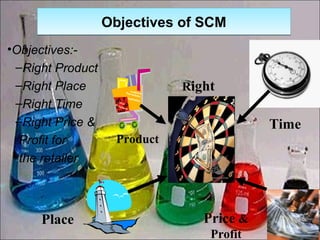
Product
Time
Price &
Profit
Place
Right
Objectives of SCMObjectives of SCM
•Objectives:-
–Right Product
–Right Place
–Right Time
–Right Price &
Profit for
the retailer
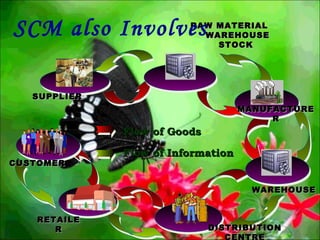
RAW MATERIALRAW MATERIAL
WAREHOUSEWAREHOUSE
STOCKSTOCK
MANUFACTUREMANUFACTURE
RR
WAREHOUSEWAREHOUSE
DISTRIBUTIONDISTRIBUTION
CENTRE
RETAILERETAILE
RR
CUSTOMERCUSTOMER
Flow of GoodsFlow of Goods
Flow of InformationFlow of Information
SCM also Involves
SUPPLIERSUPPLIER
Role of SCM
Proper implementation of SCM helps to use the
following strategic areas to their full advantage:
•1.Fulfillment:
a. Ensure the right quantity at the right time.
b. It makes sure that the right quantities are ordered.
•2.Logistics:
a. Keep the cost of transporting materials as low as
possible consistent with safe and reliable delivery.
b. Constant contact with its distribution team.
Role of SCM
• 3. Production:
Ensure production lines function smoothly.
• 4.Reduced Cost of
a. Inventory carrying cost
b. Internal and external failure cost
c. Purchase cost
• 5. Revenue & Profit
No Sales are lost and flexible to respond
unforeseen changes
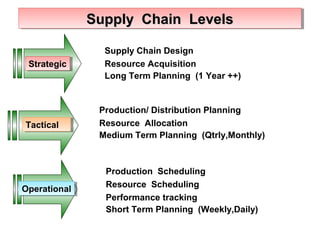
Supply Chain LevelsSupply Chain LevelsSupply Chain LevelsSupply Chain Levels
• Supply Chain Design
• Resource Acquisition
• Long Term Planning (1 Year ++)
StrategicStrategic
• Production/ Distribution Planning
• Resource Allocation
• Medium Term Planning (Qtrly,Monthly)
TacticalTactical
• Production Scheduling
• Resource Scheduling
• Performance tracking
• Short Term Planning (Weekly,Daily)
OperationalOperational
Seven Principle of SCM
• 1. Segment customers based on service needs.
• 2. Customize the logistics network.
• 3. Listen to signals of market demand and plan
accordingly.
• 4. Differentiate product closer to the customer.
• 5. Source strategically.
• 6. Develop a supply chain-wide technology
strategy.
• 7. Adopt channel-spanning performance measures
Information Technology Sector
• The Information Technology Sector is central to the
nation's security, economy, and public health and
safety as businesses, governments, academia, and
private citizens are increasingly dependent upon
Information Technology Sector functions. These
virtual and distributed functions produce and
provide hardware, software, and information
technology systems and services, and in
collaboration with the Communications Sector—
the Internet
Operation of IT Sector
• Information Technology Sector functions are
operated by a combination of entities—often
owners and operators and their respective
associations—that maintain and reconstitute the
network, including the Internet. Although
information technology infrastructure has a certain
level of inherent resilience, its interdependent and
interconnected structure presents challenges as well
as opportunities for coordinating public and private
sector preparedness and protection activities.
Role of Pharmacist in a Pharmaceutical
Industry
• Research and development
Pharmacists contribute to research, and their expertise
in formulation development is of particular relevance to
the biological availability of active ingredients.
• Manufacture and quality assurance
The pharmacist’s broad knowledge of the
pharmaceutical sciences ensures an integrated approach
to quality assurance (including good manufacturing
practice) through the validation of the various stages of
production and the testing of products before release
Role of Pharmacist in a Pharmaceutical
Industry
• Drug information
The pharmacist has the knowledge and expertise to
provide detailed information on medicines to
members of the health professions and the public.
Also, pharmacists provide an information service
within the company.
• Patent applications and drug registration
The pharmacist is ideally qualified to understand
and collate the diverse information required for
patent and authorization submissions.
Role of Pharmacist in a Pharmaceutical
Industry
• Clinical trials and post-marketing surveillance
The pharmacist has the knowledge of drugs and
health care provision required to facilitate
collaboration between companies, health
professionals and governments in relation to
clinical trials and surveillance.
• Sales and marketing
The pharmacist, whose professional ethics demand
a concern for the interest of patients, can make a
contribution to proper marketing practices related
to health care and to the provision of appropriate
information to health professionals and the public.
Thank You

Bristy

  • 2.
  • 3.
    Presented To simin shabnamloPa b. Pharm & m. Pharm (r.u.) lacTurer DeParTmenT of Pharmacy,VarenDra uniVersiTy
  • 4.
  • 5.
    Group Members Saima Akter IDNo.: 151211046 Md. Jebon Mia ID No.: 151211050
  • 6.
    Sadi Md. Jubaeer IDNo: 151211047 Priyanka Rani ID No : 151211038 Most.Khadija Akter Riva ID No: 151211051
  • 7.
    Md. Ifta KhairulIslam ID No: 151211058 Al Asma Hawa ID No: 151211066
  • 8.
  • 10.
    What is Quality •The ability to make the same thing the same way, over and over again • Customer buys today is same as what they bought last week or will buy next week • Product meets customer’s expectations 100% of the time
  • 11.
    Quality Assurance • Coverseverything from raw materials and GMP verification through finished-product release • HACCP is part of QA • Quality Control • Actual manufacturing process
  • 12.
    Quality Assurance Operation •Reviewing the daily lab and production reports is a part of the QA responsibilities. This is to determine that the procedures are being followed and the tests are being made. QA can spot trends by conducting consistent record reviews. If record reviews don’t stay current, no one will get timely feedback before a real problem crops up.
  • 13.
    The Pharmaceutical QualityAssurance & Quality Control program combines theoretical knowledge with hands-on skills in all areas that impact drug quality.
  • 14.
  • 15.
    Quality control • Qualitycontrol is an essential operation of the pharmaceutical industry. Drugs must be marketed as safe and therapeutically active formulations whose performance is consistent and predictable..
  • 16.
  • 17.
    IPC • In-process methodsare key components of quality control in a chemical manufacturing plant. These methods ensure that a production reaction step conducted by trained operators It ensures the best API.
  • 18.
    Production • Production involvesthe propagation, conversion, or processing of a drug or device, either directly or indirectly, by extraction of the drug from substances of natural origin or by means of chemical or biological synthesis. Production also includes • 1.Any packaging or repackaging of the substance(s) or labeling or relabeling of containers for the promotion and marketing of such drugs or devices.
  • 19.
    Production 2.Any preparation ofa drug or device that is given or sold for resale by pharmaciest , practitioners, or other persons. 3.The distribution of inordinate amounts of compounded preparations or the copying of commercially available drug products. 4.The preparation of any quantity of a drug product without a licensed prescriber/patient/licensed pharmacist/compounder relationship.
  • 20.
    Unit Operations ofProduction 1.Formulation and Pre-Formulation Development: Before a drug can be Produced at any scale, much work goes into the actual formulation of the drug. Formulation development scientists must evaluate a compound for uniformity, stability and many other factors. After the evaluation phase, a solution must be developed to deliver the drug in its required form such as solid, semi-solid, immediate or controlled release, tablet, capsule, and many other Variations 2.Powder Blending In the pharmaceutical industry, a wide range of excipients may be blended together to create the final blend used to manufacture the solid dosage form.
  • 21.
    Unit Operations ofProduction 3.Milling During the drug Producing process, milling is often required in order to reduce the average particle size in a drug powder. 4.Granulation Granulation can be thought of as the opposite of milling; it is the process by which small particles are bound together to form larger particles, called granules. Granulation is used for several reasons.
  • 22.
  • 23.
    Research and DevelopmentSector in Pharmaceutical Industry • During the discovery research phase of development of a medicine pharmacists will work with other scientists to develop and select drug compounds that may be valuable as medicines. They will also help the project team, which might include medicinal chemists,bioscientists,toxicologists,pharmacokinetici sts and others, to understand the biopharmaceutical properties of the compound, the dosage form and how the route of administration might affect the rate and extent of absorption. In this area a post-graduate qualification is a particular asset.
  • 24.
    Role of Researchand Development Sector in Pharmaceutical Industry • New Product Research • New Product development • Existing Product Updates • Quality Checking • Innovation • Formulation and packaging development • Clinical research
  • 25.
    R&D Status inPharmaceutical Sector Modern Medicine : • It is mandatory to all the local and foreign companies to follow good manufacturing practices (GMP) as per WHO recommended guide line • Although, top and medium level companies strictly follow GMP and possess all high-tech facilities in their premises, but they do not have R&D facilities in real sense • The top 30 local companies have well-equipped product development (PD) department instead of full-fledged R&D
  • 26.
    R&D Status inPharmaceutical Sector • Recently some top pharmaceutical industries are producing high-tech biopharmaceutical products have started real R&D activities in a limited scale • Only few of the APIs producers have full-fledge R&D facilities. Most of them are manufacturing under technology transfer from India and China
  • 27.
    Storage House/ Warehouse Thestoring of pharmaceutical products and materials up to their point of use is called the storage house of a pharmaceutical Storage areas 1. Precautions must be taken to prevent unauthorized persons from entering storage areas. 2. Storage areas should be of sufficient capacity to allow the orderly storage of the various categories of materials and products, namely starting and packaging materials, intermediates, bulk and finished products, products in quarantine, and released, rejected, returned or recalled products.
  • 28.
    Monitoring of storageconditions 1.Recorded temperature monitoring data should be available for review. The equipment used for monitoring should be checked at suitable predetermined intervals and the results of such checks should be recorded and retained. All monitoring records should be kept for at least the shelf-life of the stored material or product plus 1 year, or as required by national legislation. Temperature mapping should show uniformity of the temperature across the storage facility. It is recommended that temperature monitors be located in areas that are most likely to show fluctuations. 2.Equipment used for monitoring should also be calibrated at defined intervals.
  • 29.
    Storage requirements • Writteninstructions and records should be available which document all activities in the storage areas including the handling of expired stock. These should adequately describe the storage procedures and define the route of materials and pharmaceutical products and information through the organization in the event of a product recall being required
  • 30.
    Pharmaceutical Technical Services PharmaceuticalTechnical Services (PTS) is a focused consulting organization, specializing in serving the GMP production and facilities' operations activities of the pharmaceutical, biopharmaceutical, diagnostic, and related regulated industries
  • 31.
    Pharmaceutical Technical Services •The pharmaceutical industry discovers, develops, produces, and markets drugs or pharmaceuticals for use as medications. Pharmaceutical companies may deal in generic or brand medications and medical devices. They are subject to a variety of laws and regulations that govern the patenting, testing, safety, efficacy and marketing of drugs.
  • 32.
    Technology transfer checklist •It consists of… • .Production master formula • .Manufacturing instruction • .Analytical methods • .Previous process validation • .Previous analytical validation • .Cleaning instruction and previous cleaning validation • .Stability reports • .Packaging instruction • .Specimen manufacturing batch record
  • 33.
    Master Formula • MasterFormula is a full spectrum, multinutrient complex, providing premium vitamins, minerals, and food-based nutriment to support general health and well-being. By utilizing a Synergistic Suspension Isolation process – SSI Technology – ingredients are delivered in three distinct delivery forms. Collectively, these ingredients provide a premium, synergistic complex to support your body.
  • 34.
    Analytical Method • AnalyticalMethods welcomes early applied demonstrations of new analytical methods with clear societal impact. Developments are encouraged within the fields of healthcare, pharmaceuticals and biomedical diagnostics, environmental and forensic analysis, heritage science, agricultural science and food products, industrial process development and product validation
  • 36.
    Concept of SupplyChain Management • Supply chain is a network of facilities & distribution options that performs the function of procurement of raw materials, transformation of these materials into intermediate & finished products and distribution of these products to the customers. • Simply stated • The supply chain encompasses all of those activities associated with moving goods from the raw-materials stage through to the end user.
  • 37.
    Product Time Price & Profit Place Right Objectives ofSCMObjectives of SCM •Objectives:- –Right Product –Right Place –Right Time –Right Price & Profit for the retailer
  • 38.
  • 39.
    Role of SCM Properimplementation of SCM helps to use the following strategic areas to their full advantage: •1.Fulfillment: a. Ensure the right quantity at the right time. b. It makes sure that the right quantities are ordered. •2.Logistics: a. Keep the cost of transporting materials as low as possible consistent with safe and reliable delivery. b. Constant contact with its distribution team.
  • 40.
    Role of SCM •3. Production: Ensure production lines function smoothly. • 4.Reduced Cost of a. Inventory carrying cost b. Internal and external failure cost c. Purchase cost • 5. Revenue & Profit No Sales are lost and flexible to respond unforeseen changes
  • 41.
    Supply Chain LevelsSupplyChain LevelsSupply Chain LevelsSupply Chain Levels • Supply Chain Design • Resource Acquisition • Long Term Planning (1 Year ++) StrategicStrategic • Production/ Distribution Planning • Resource Allocation • Medium Term Planning (Qtrly,Monthly) TacticalTactical • Production Scheduling • Resource Scheduling • Performance tracking • Short Term Planning (Weekly,Daily) OperationalOperational
  • 42.
    Seven Principle ofSCM • 1. Segment customers based on service needs. • 2. Customize the logistics network. • 3. Listen to signals of market demand and plan accordingly. • 4. Differentiate product closer to the customer. • 5. Source strategically. • 6. Develop a supply chain-wide technology strategy. • 7. Adopt channel-spanning performance measures
  • 43.
    Information Technology Sector •The Information Technology Sector is central to the nation's security, economy, and public health and safety as businesses, governments, academia, and private citizens are increasingly dependent upon Information Technology Sector functions. These virtual and distributed functions produce and provide hardware, software, and information technology systems and services, and in collaboration with the Communications Sector— the Internet
  • 44.
    Operation of ITSector • Information Technology Sector functions are operated by a combination of entities—often owners and operators and their respective associations—that maintain and reconstitute the network, including the Internet. Although information technology infrastructure has a certain level of inherent resilience, its interdependent and interconnected structure presents challenges as well as opportunities for coordinating public and private sector preparedness and protection activities.
  • 46.
    Role of Pharmacistin a Pharmaceutical Industry • Research and development Pharmacists contribute to research, and their expertise in formulation development is of particular relevance to the biological availability of active ingredients. • Manufacture and quality assurance The pharmacist’s broad knowledge of the pharmaceutical sciences ensures an integrated approach to quality assurance (including good manufacturing practice) through the validation of the various stages of production and the testing of products before release
  • 47.
    Role of Pharmacistin a Pharmaceutical Industry • Drug information The pharmacist has the knowledge and expertise to provide detailed information on medicines to members of the health professions and the public. Also, pharmacists provide an information service within the company. • Patent applications and drug registration The pharmacist is ideally qualified to understand and collate the diverse information required for patent and authorization submissions.
  • 48.
    Role of Pharmacistin a Pharmaceutical Industry • Clinical trials and post-marketing surveillance The pharmacist has the knowledge of drugs and health care provision required to facilitate collaboration between companies, health professionals and governments in relation to clinical trials and surveillance. • Sales and marketing The pharmacist, whose professional ethics demand a concern for the interest of patients, can make a contribution to proper marketing practices related to health care and to the provision of appropriate information to health professionals and the public.
  • 49.