Past, Present and Future of RPAGROW FOR TOMORROW
March 2017
© 2017 Mindfields. All rights reserved.
§ About Mindfields
§ Key capability and Service offerings
§ Mindfields Automation Advisory Services
§ Statement of Work
§ Our Value Proposition
§ Our approach methodology – Phase 1
§ Our approach methodology – Phase 2
§ Engagement Schedule
§ Deliverables - Deep Dive / Process Enhancement
§ Deep Dive / Process Enhancement – Resources
§ Information required
§ Access to key decision makers
§ Pricing and Timelines
§ Our Clients
Content
2
© 2017 Mindfields. All rights reserved.
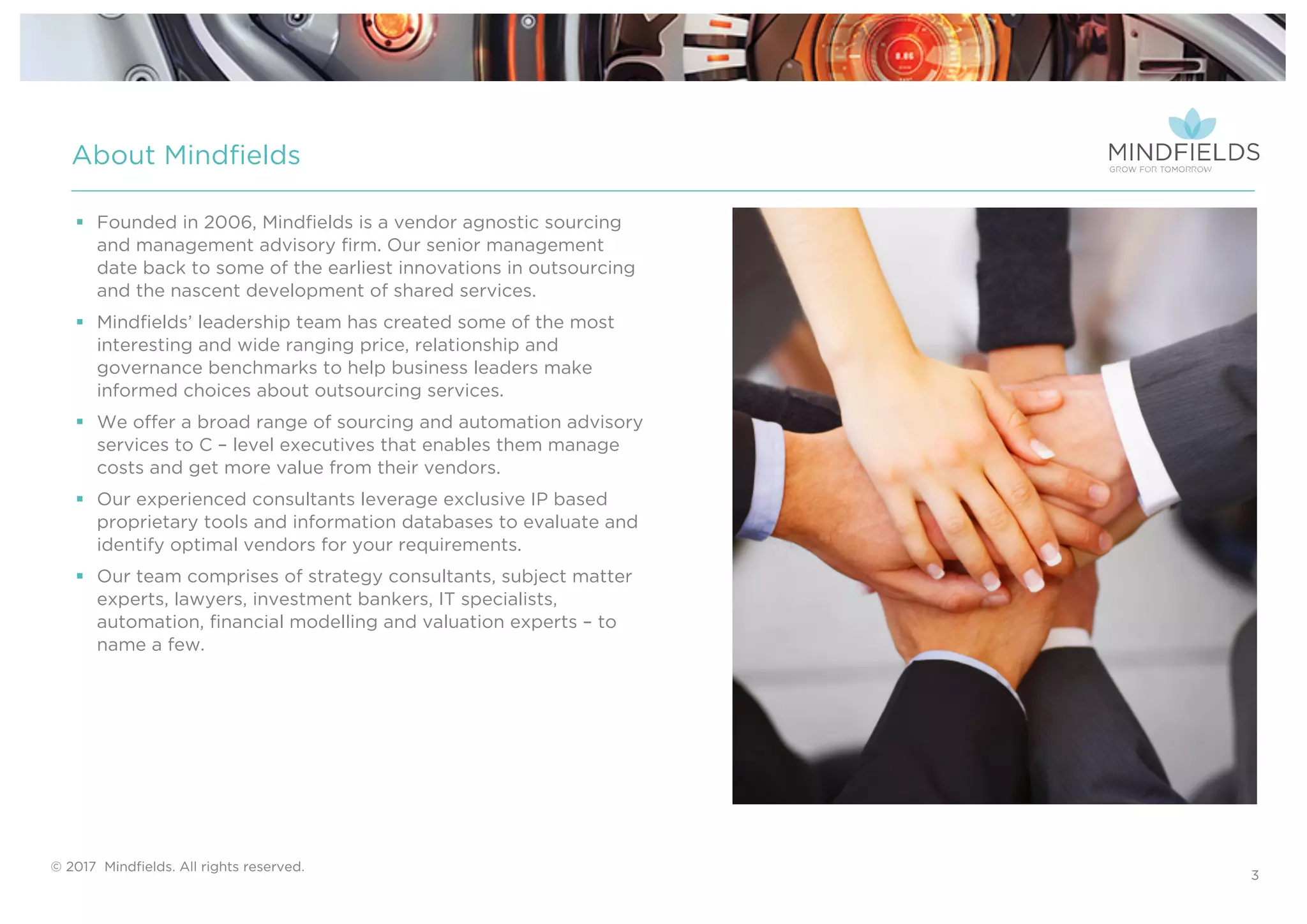
§ Founded in 2006, Mindfields is a vendor agnostic sourcing
and management advisory firm. Our senior management
date back to some of the earliest innovations in outsourcing
and the nascent development of shared services.
§ Mindfields’ leadership team has created some of the most
interesting and wide ranging price, relationship and
governance benchmarks to help business leaders make
informed choices about outsourcing services.
§ We offer a broad range of sourcing and automation advisory
services to C – level executives that enables them manage
costs and get more value from their vendors.
§ Our experienced consultants leverage exclusive IP based
proprietary tools and information databases to evaluate and
identify optimal vendors for your requirements.
§ Our team comprises of strategy consultants, subject matter
experts, lawyers, investment bankers, IT specialists,
automation, financial modelling and valuation experts – to
name a few.
About Mindfields
3
© 2017 Mindfields. All rights reserved.
Strategy
Sourcing
Vendor	Management
Private	Equity
Third	Party	Advisory
Cloud	Advisory
Automation	Advisory	(RPA)
RFP	Management
Business	Transformation
Strategic	Research	&	Analysis
Detailed	Company	Analysis
News	letters
Competitive	Intelligence
White	Papers
Research	based	Market	Studies
MindFind
MindPrice
§ Web/mobile based tools for clients
to screen IT/BPO companies as
well as gain insights on FTE
pricing rates
§ Research based insights on market
opportunities and emerging trends
in the IT/BPO sector
§ Broad portfolio of IT/BPO
outsourcing advisory services
4
Key Capabilities / Service Offerings
Advisory Research Services Products
MindHire
© 2017 Mindfields. All rights reserved.
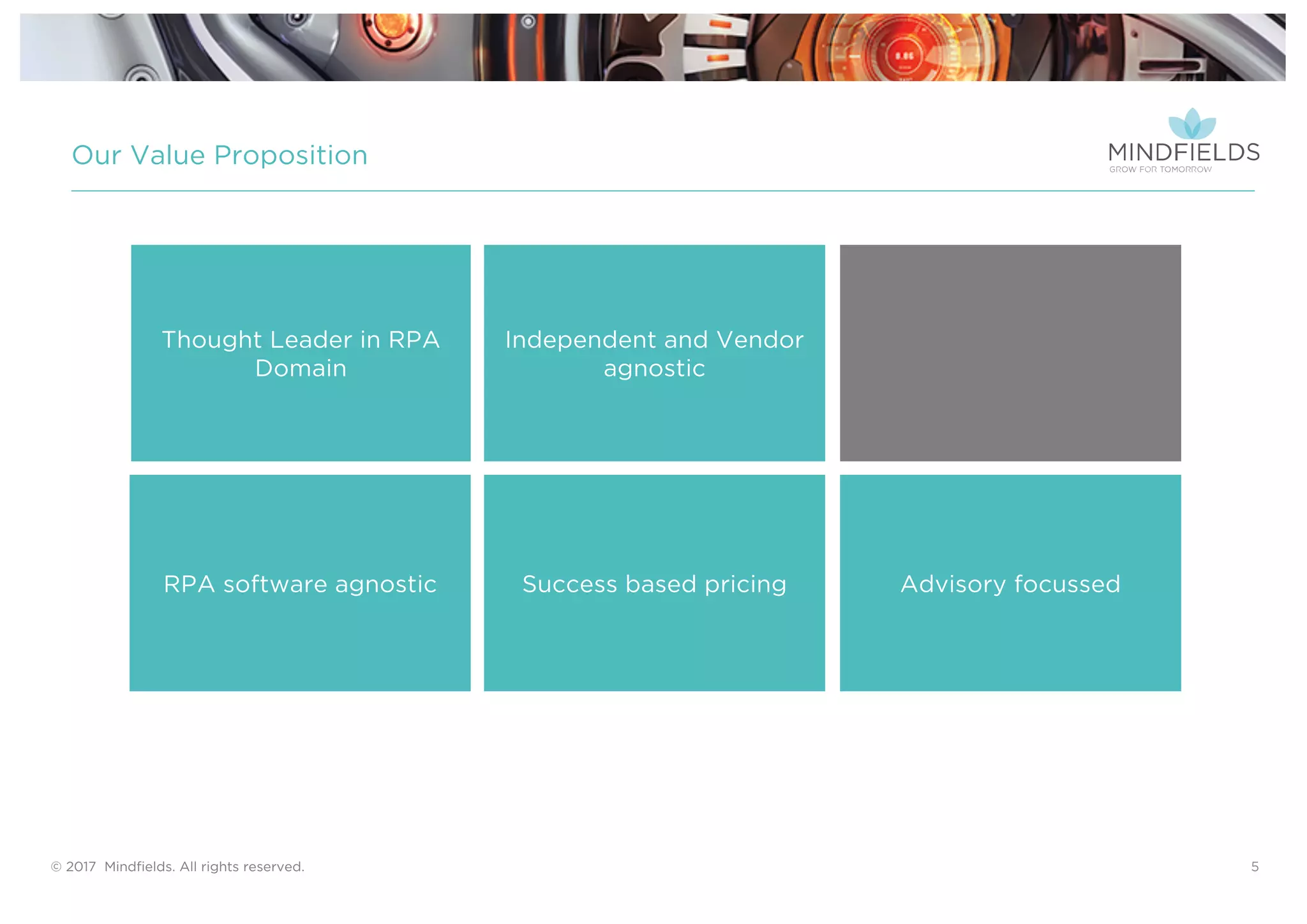
Our Value Proposition
Thought Leader in RPA
Domain
Independent and Vendor
agnostic
RPA software agnostic Advisory focussedSuccess based pricing
5
© 2017 Mindfields. All rights reserved.
Global RPA Market Forecast (2013-2020)
6
RPA – Key Insights from the Study
© 2017 Mindfields. All rights reserved.
Our approach is to provide research-based advisory services to the clients on
Automation. We focus to provide end-to-end offerings in Automation and AI.
§ Research: We have conducted an independent and intensive research on
Automation. What, how and why of Automation and market landscape. It is
ongoing research. We are constantly updating the “Lessons learnt” after each
engagement. We have sold more than 100 copies of Research Report on
global basis. It also gives the buyer access to the latest development and
“lessons learnt” in the Automation and Artificial Intelligence domain.
§ Education: We conduct workshops with CXO and Stakeholders to educate
them on how automation can impact their business models and increase
operational efficiencies. We have conducted more than 50 workshops
globally.
§ Consulting: We provide advice on RPA Assessment and roadmap to our
clients. It covers what process can be automated, How it can be automated
(It includes advice on RPA Software/tool selection, Set up of CoE, Target
Operating Model, Security, Governance model) and Why it should be
automated (Business case, What should be considered in Business case). Our
consulting services are fixed price depending on the scope of engagement.
We are also automating our consulting process and passing the benefits to
the client.
§ Execution: We implement and automate the process. It includes scripting, IT
architecture, Security standards, mitigating risks and What can Go wrong?
We charge our clients on fixed price per process, depending on various
technical factors. We charge only when the process is successfully
automated. We are also moving our execution of automation process to IBM
Watson to enhance our execution offering with Artificial Intelligence. We
would be passing the benefits to the clients at no additional costs.
Artificial	Intelligence
Robotic	Process	Automation
Machine	Learning	
Research
Educate
Consult
Execute
Our Process Framework
7
© 2017 Mindfields. All rights reserved.
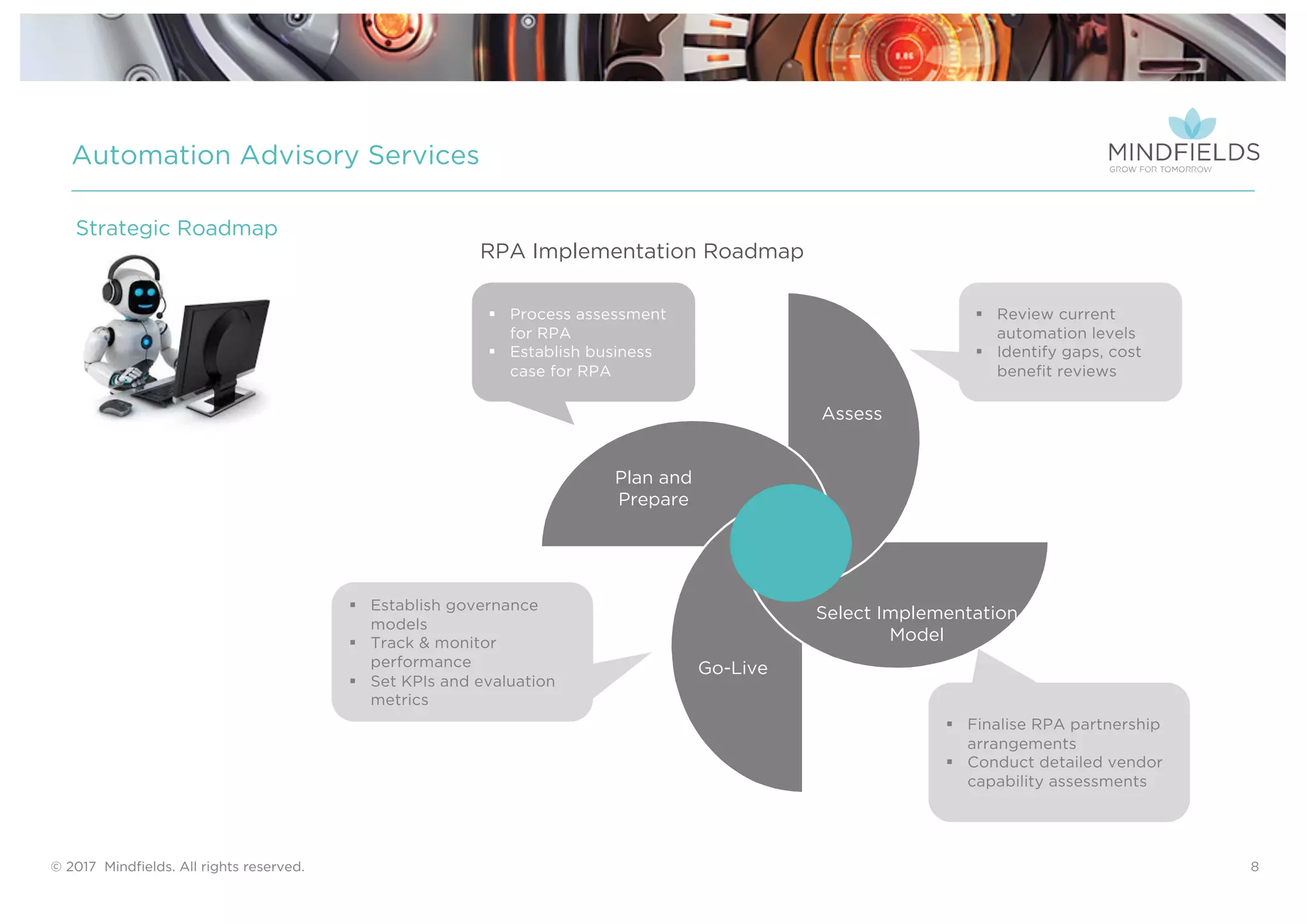
Plan and
Prepare
Assess
Select Implementation
Model
Go-Live
RPA Implementation Roadmap
§ Process assessment
for RPA
§ Establish business
case for RPA
Automation Advisory Services
Strategic Roadmap
§ Establish governance
models
§ Track & monitor
performance
§ Set KPIs and evaluation
metrics
§ Finalise RPA partnership
arrangements
§ Conduct detailed vendor
capability assessments
§ Review current
automation levels
§ Identify gaps, cost
benefit reviews
8
© 2017 Mindfields. All rights reserved. 9
RPA – Key Insights from the Study
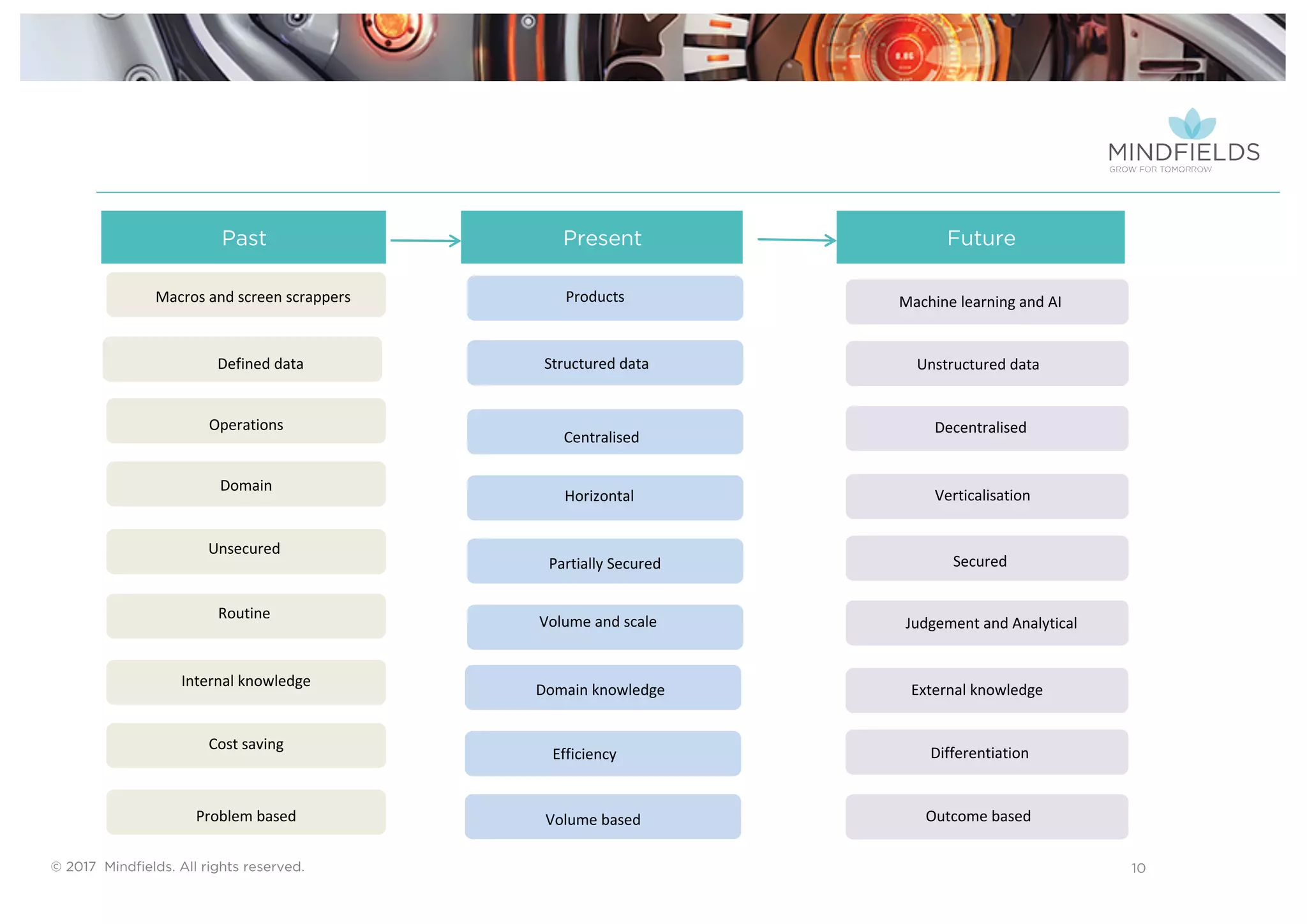
Evolution of RPA
© 2017 Mindfields. All rights reserved.
Macros	and	screen	scrappers
Defined	data
Operations
Domain
Unsecured	
Routine	
Internal	knowledge
Cost	saving
Problem	based
Products
Structured	data
Centralised
Horizontal
Partially	Secured
Volume	and	scale
Machine	learning	and	AI
Unstructured	data
10
Past Present Future
Decentralised
Verticalisation
Secured
Judgement	and	Analytical	
Efficiency
Volume	based
Domain	knowledge External	knowledge	
Differentiation
Outcome	based
© 2017 Mindfields. All rights reserved. 11
Lessons learnt
1. FFF- First Fail Fast
2.LAD- Learn Adapt Deliver
3.Automate Gain areas not Pain areas
4.How not to work with outsourcing 'partners'?
5.How to work with outsourcing 'partners'?
6.Take all the hype of RPA and halve it
7.Spend time to inform and educate people on RPA – simplify it – remove the “Robo-Language”.
8.Process documentation will be lacking and knowledge lost as people move on
9.Business don’t necessarily understand data structure that well – test what they tell you
10.People will feel threatened – be open, honest and supportive
11.Taking the Robot out of human
12.Have a clear driver and business case for Automation
13.Bottoms up approach
14.T-20 cricket match not 5 days Test match
15.Pet vs cattle approach towards processes for automation
16.Neither Human Nor BOTS are immortal. They have a plan for reverse transition.
17.Internal Organisational dynamics management
18.Aim for number of BOTs to be atleast 15% of current workforce.
19.Different strategy for different Operating models
20.Manage Change and Risk Frameworks rigorously
© 2017 Mindfields. All rights reserved. 12
Lessons learnt
21. Multiple RPA toolset in portfolio
22. Automate Smarter and Modularly
23. Maintain and challenge Meaningful Human Control (MHC)
24.How to work with outsourcing 'partners'?
25.Smart BOTs requires Smart Humans
26. Always plan for next steps after Automation .
27.Minimise learning and set up costs
28. Success and fixed price engagements with external consulting organisation
29.Involve Auditors (Stat and Internal) in the journey
30. Automate first before making it lean
© 2017 Mindfields. All rights reserved. 13
Lessons learnt regarding setting with CoE
1. There is no standard definition or composition for a successful CoE. Its construct and content differ depending on
factors such as the industry vertical and operating model. It is also a different approach within processes that were
already outsourced or offshored (including captive centres) compared to onshore and in-house processes.
2. Most organisations are only starting to set up a CoE after a proof of concept has been successfully completed.
3. Establishment of the CoE should be driven by the pace at which the organisation wants to expand its RPA delivery
capacity and increase the delivery velocity.
4. Organisations are tending to opt for a centralised CoE structure in the initial phase of their journey, before moving to
a decentralised structure in the medium to long term.
5. If set up correctly the CoE provides a great incubator for the development of RPA skills for the enterprise.
6. The CoE for RPA should be upgraded to include machine learning, cognitive computing and artificial intelligence as
the organisation’s journey progresses.
7. Before marketing the idea of RPA to the broader organisation the CoE should have demand management
capabilities, as everyone tends to want to get in first. Business units can get very creative with RPA and demand will
pick up quickly.
8. The CoE should layout guidelines for the prioritisation of processes for automation. This should include business case
tracking, RPA software selection, license allocation, hardware asset allocation, coding standards, training and
resource (talent) management.
9. It is important for the CoE to have an early engagement with colleagues within risk management, security, and other
control groups. This should include auditors (both internal and external).
10. All processes should be prepared with the acceptance that at some point a reverse transition to human interaction –
or a better brand of RPA software – may be required.
© 2017 Mindfields. All rights reserved. 14
Our clients (illustrative list)
© 2017 Mindfields. All rights reserved.
GROW FOR TOMORROW
AUSTRALIA
Level 7,
171 Clarence Street
Sydney NSW 2000
Telephone: +61 (02) 8034 6304
Facsimile: +61 (02) 8677 8400
Level 3, 480 Collins Street
Melbourne VIC 3000
Telephone: +61 (02) 8610 6327
Facsimile: +61 (02) 8610 6334
USA
276, 5th Avenue
Suite 704, New York
NY 10001
Telephone: +1 212 203 7209
Facsimile: +1 917 472 1489
INDIA
7, Barakhambha Road
Connaught Place
New Delhi 110006
703-706, 7th Floor, Arcadia
Plot No. 195, Nariman Point
Mumbai 400021
enquiries@mindfields.net.au
www.mindfields.net.au

28022017 Mohit Sharma

  • 1.
    Past, Present andFuture of RPAGROW FOR TOMORROW March 2017
  • 2.
    © 2017 Mindfields.All rights reserved. § About Mindfields § Key capability and Service offerings § Mindfields Automation Advisory Services § Statement of Work § Our Value Proposition § Our approach methodology – Phase 1 § Our approach methodology – Phase 2 § Engagement Schedule § Deliverables - Deep Dive / Process Enhancement § Deep Dive / Process Enhancement – Resources § Information required § Access to key decision makers § Pricing and Timelines § Our Clients Content 2
  • 3.
    © 2017 Mindfields.All rights reserved. § Founded in 2006, Mindfields is a vendor agnostic sourcing and management advisory firm. Our senior management date back to some of the earliest innovations in outsourcing and the nascent development of shared services. § Mindfields’ leadership team has created some of the most interesting and wide ranging price, relationship and governance benchmarks to help business leaders make informed choices about outsourcing services. § We offer a broad range of sourcing and automation advisory services to C – level executives that enables them manage costs and get more value from their vendors. § Our experienced consultants leverage exclusive IP based proprietary tools and information databases to evaluate and identify optimal vendors for your requirements. § Our team comprises of strategy consultants, subject matter experts, lawyers, investment bankers, IT specialists, automation, financial modelling and valuation experts – to name a few. About Mindfields 3
  • 4.
    © 2017 Mindfields.All rights reserved. Strategy Sourcing Vendor Management Private Equity Third Party Advisory Cloud Advisory Automation Advisory (RPA) RFP Management Business Transformation Strategic Research & Analysis Detailed Company Analysis News letters Competitive Intelligence White Papers Research based Market Studies MindFind MindPrice § Web/mobile based tools for clients to screen IT/BPO companies as well as gain insights on FTE pricing rates § Research based insights on market opportunities and emerging trends in the IT/BPO sector § Broad portfolio of IT/BPO outsourcing advisory services 4 Key Capabilities / Service Offerings Advisory Research Services Products MindHire
  • 5.
    © 2017 Mindfields.All rights reserved. Our Value Proposition Thought Leader in RPA Domain Independent and Vendor agnostic RPA software agnostic Advisory focussedSuccess based pricing 5
  • 6.
    © 2017 Mindfields.All rights reserved. Global RPA Market Forecast (2013-2020) 6 RPA – Key Insights from the Study
  • 7.
    © 2017 Mindfields.All rights reserved. Our approach is to provide research-based advisory services to the clients on Automation. We focus to provide end-to-end offerings in Automation and AI. § Research: We have conducted an independent and intensive research on Automation. What, how and why of Automation and market landscape. It is ongoing research. We are constantly updating the “Lessons learnt” after each engagement. We have sold more than 100 copies of Research Report on global basis. It also gives the buyer access to the latest development and “lessons learnt” in the Automation and Artificial Intelligence domain. § Education: We conduct workshops with CXO and Stakeholders to educate them on how automation can impact their business models and increase operational efficiencies. We have conducted more than 50 workshops globally. § Consulting: We provide advice on RPA Assessment and roadmap to our clients. It covers what process can be automated, How it can be automated (It includes advice on RPA Software/tool selection, Set up of CoE, Target Operating Model, Security, Governance model) and Why it should be automated (Business case, What should be considered in Business case). Our consulting services are fixed price depending on the scope of engagement. We are also automating our consulting process and passing the benefits to the client. § Execution: We implement and automate the process. It includes scripting, IT architecture, Security standards, mitigating risks and What can Go wrong? We charge our clients on fixed price per process, depending on various technical factors. We charge only when the process is successfully automated. We are also moving our execution of automation process to IBM Watson to enhance our execution offering with Artificial Intelligence. We would be passing the benefits to the clients at no additional costs. Artificial Intelligence Robotic Process Automation Machine Learning Research Educate Consult Execute Our Process Framework 7
  • 8.
    © 2017 Mindfields.All rights reserved. Plan and Prepare Assess Select Implementation Model Go-Live RPA Implementation Roadmap § Process assessment for RPA § Establish business case for RPA Automation Advisory Services Strategic Roadmap § Establish governance models § Track & monitor performance § Set KPIs and evaluation metrics § Finalise RPA partnership arrangements § Conduct detailed vendor capability assessments § Review current automation levels § Identify gaps, cost benefit reviews 8
  • 9.
    © 2017 Mindfields.All rights reserved. 9 RPA – Key Insights from the Study Evolution of RPA
  • 10.
    © 2017 Mindfields.All rights reserved. Macros and screen scrappers Defined data Operations Domain Unsecured Routine Internal knowledge Cost saving Problem based Products Structured data Centralised Horizontal Partially Secured Volume and scale Machine learning and AI Unstructured data 10 Past Present Future Decentralised Verticalisation Secured Judgement and Analytical Efficiency Volume based Domain knowledge External knowledge Differentiation Outcome based
  • 11.
    © 2017 Mindfields.All rights reserved. 11 Lessons learnt 1. FFF- First Fail Fast 2.LAD- Learn Adapt Deliver 3.Automate Gain areas not Pain areas 4.How not to work with outsourcing 'partners'? 5.How to work with outsourcing 'partners'? 6.Take all the hype of RPA and halve it 7.Spend time to inform and educate people on RPA – simplify it – remove the “Robo-Language”. 8.Process documentation will be lacking and knowledge lost as people move on 9.Business don’t necessarily understand data structure that well – test what they tell you 10.People will feel threatened – be open, honest and supportive 11.Taking the Robot out of human 12.Have a clear driver and business case for Automation 13.Bottoms up approach 14.T-20 cricket match not 5 days Test match 15.Pet vs cattle approach towards processes for automation 16.Neither Human Nor BOTS are immortal. They have a plan for reverse transition. 17.Internal Organisational dynamics management 18.Aim for number of BOTs to be atleast 15% of current workforce. 19.Different strategy for different Operating models 20.Manage Change and Risk Frameworks rigorously
  • 12.
    © 2017 Mindfields.All rights reserved. 12 Lessons learnt 21. Multiple RPA toolset in portfolio 22. Automate Smarter and Modularly 23. Maintain and challenge Meaningful Human Control (MHC) 24.How to work with outsourcing 'partners'? 25.Smart BOTs requires Smart Humans 26. Always plan for next steps after Automation . 27.Minimise learning and set up costs 28. Success and fixed price engagements with external consulting organisation 29.Involve Auditors (Stat and Internal) in the journey 30. Automate first before making it lean
  • 13.
    © 2017 Mindfields.All rights reserved. 13 Lessons learnt regarding setting with CoE 1. There is no standard definition or composition for a successful CoE. Its construct and content differ depending on factors such as the industry vertical and operating model. It is also a different approach within processes that were already outsourced or offshored (including captive centres) compared to onshore and in-house processes. 2. Most organisations are only starting to set up a CoE after a proof of concept has been successfully completed. 3. Establishment of the CoE should be driven by the pace at which the organisation wants to expand its RPA delivery capacity and increase the delivery velocity. 4. Organisations are tending to opt for a centralised CoE structure in the initial phase of their journey, before moving to a decentralised structure in the medium to long term. 5. If set up correctly the CoE provides a great incubator for the development of RPA skills for the enterprise. 6. The CoE for RPA should be upgraded to include machine learning, cognitive computing and artificial intelligence as the organisation’s journey progresses. 7. Before marketing the idea of RPA to the broader organisation the CoE should have demand management capabilities, as everyone tends to want to get in first. Business units can get very creative with RPA and demand will pick up quickly. 8. The CoE should layout guidelines for the prioritisation of processes for automation. This should include business case tracking, RPA software selection, license allocation, hardware asset allocation, coding standards, training and resource (talent) management. 9. It is important for the CoE to have an early engagement with colleagues within risk management, security, and other control groups. This should include auditors (both internal and external). 10. All processes should be prepared with the acceptance that at some point a reverse transition to human interaction – or a better brand of RPA software – may be required.
  • 14.
    © 2017 Mindfields.All rights reserved. 14 Our clients (illustrative list)
  • 15.
    © 2017 Mindfields.All rights reserved. GROW FOR TOMORROW AUSTRALIA Level 7, 171 Clarence Street Sydney NSW 2000 Telephone: +61 (02) 8034 6304 Facsimile: +61 (02) 8677 8400 Level 3, 480 Collins Street Melbourne VIC 3000 Telephone: +61 (02) 8610 6327 Facsimile: +61 (02) 8610 6334 USA 276, 5th Avenue Suite 704, New York NY 10001 Telephone: +1 212 203 7209 Facsimile: +1 917 472 1489 INDIA 7, Barakhambha Road Connaught Place New Delhi 110006 703-706, 7th Floor, Arcadia Plot No. 195, Nariman Point Mumbai 400021 enquiries@mindfields.net.au www.mindfields.net.au