


Getting RPA Right in 2021:
What Does it Take to Scale Your
Automation Program?
Eduardo Diquez
Consulting Director,
Intelligent Automation
Practice
Chet Chambers
Vice President,
Chief Evangelist
Americas
Jose Manuel Perez
VP of Intelligent
Automation, Quality &
Performance
W E B I N A R Wednesday, Dec 9th 2020 12:00 pm - 1:00 pm ET
Sources:
- Forrester: The Future of Work – A Pandemic Spotlight
- PwC CFO Pulse Survey, 2020
- Gartner
The adoption of RPA is accelerating at a faster rate
than any other enterprise software in history…
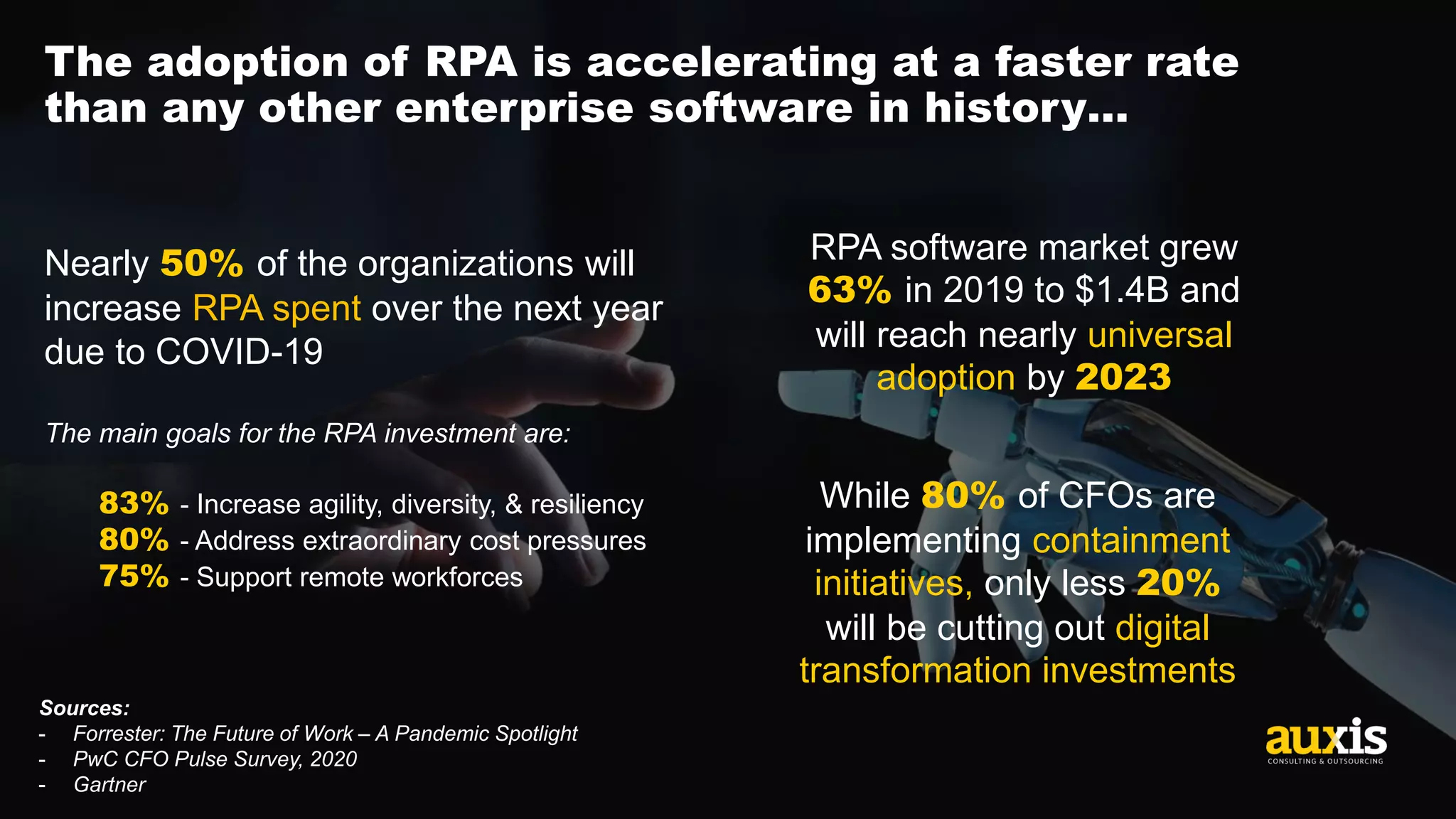
Nearly 50% of the organizations will
increase RPA spent over the next year
due to COVID-19
The main goals for the RPA investment are:
83% - Increase agility, diversity, & resiliency
80% - Address extraordinary cost pressures
75% - Support remote workforces
RPA software market grew
63% in 2019 to $1.4B and
will reach nearly universal
adoption by 2023
While 80% of CFOs are
implementing containment
initiatives, only less 20%
will be cutting out digital
transformation investments
3But still, most organizations are struggling to
successfully implement RPA at scale…
Sources:
- SSON State of Shared Services Industry Report 2020
- Deloitte Survey, The Robots Are Ready, Are You?
65% of the organizations have
not been able to automate more
than 10 processes
63% of organizations do not meet delivery
deadlines for RPA projects. For the ones
that succeeded, longer-than-anticipated
implementations delayed ROI.
Only a tiny minority (3%) of
progressive organizations have
reached any form of scale with
more than 50 processes in service
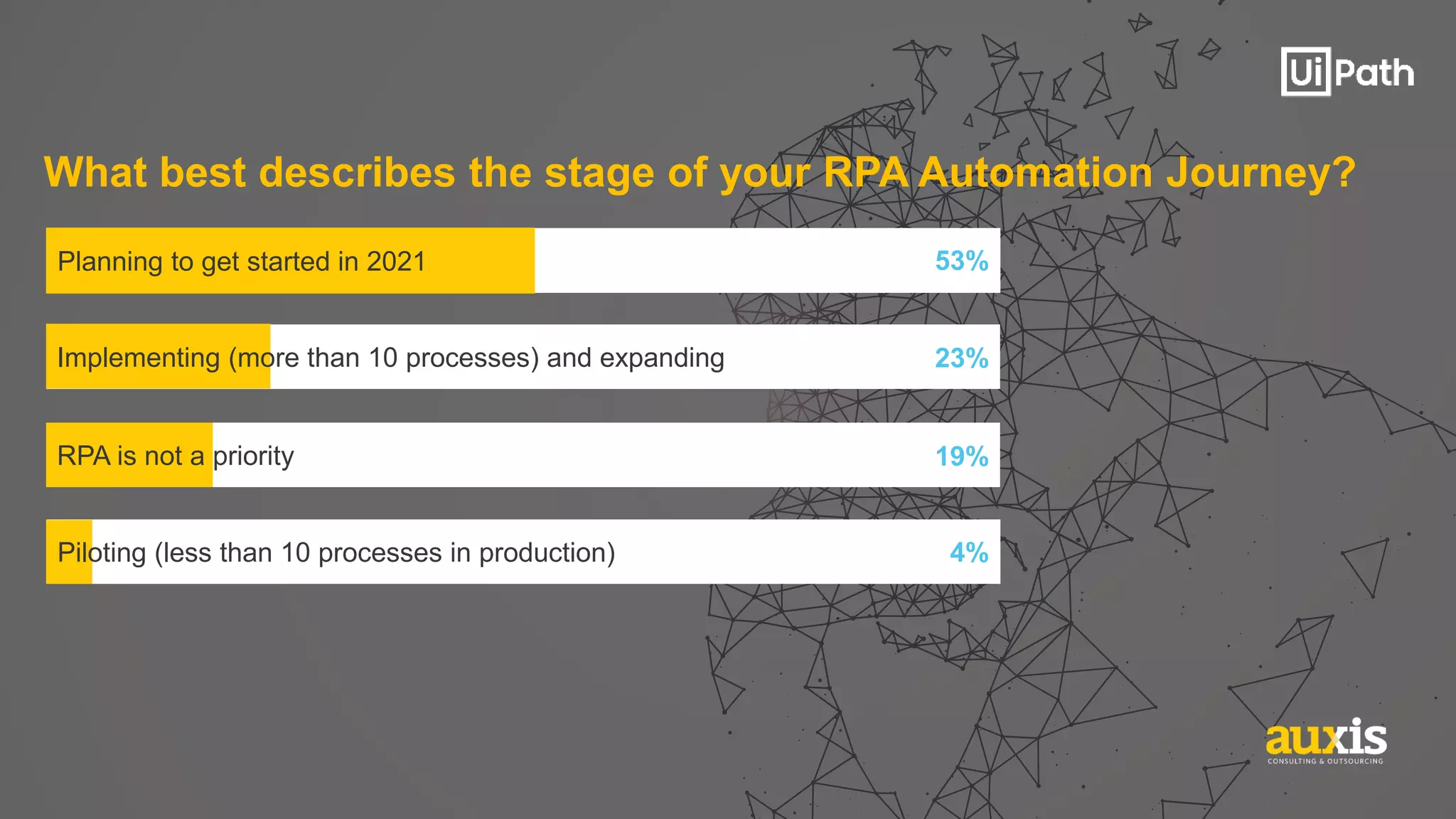
What best describes the stage of your RPA Automation Journey?
23%
19%
4%
Planning to get started in 2021 53%
Implementing (more than 10 processes) and expanding
RPA is not a priority
Piloting (less than 10 processes in production)
5
The question is…Why is it so hard
to scale an RPA program?
6
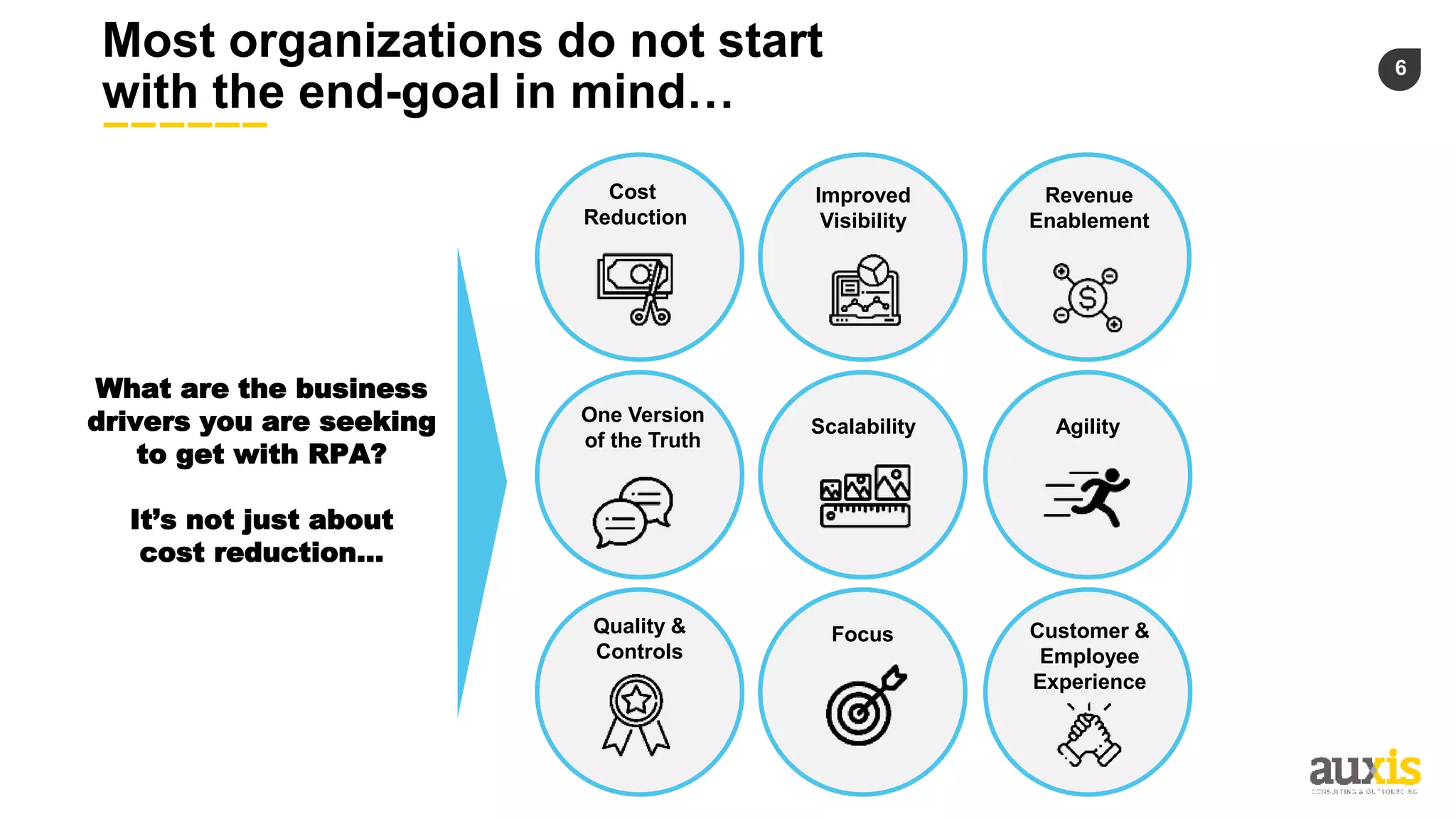
Most organizations do not start
with the end-goal in mind…
What are the business
drivers you are seeking
to get with RPA?
It’s not just about
cost reduction…
Improved
Visibility
Revenue
Enablement
Cost
Reduction
Scalability Agility
Quality &
Controls
Focus Customer &
Employee
Experience
One Version
of the Truth
7
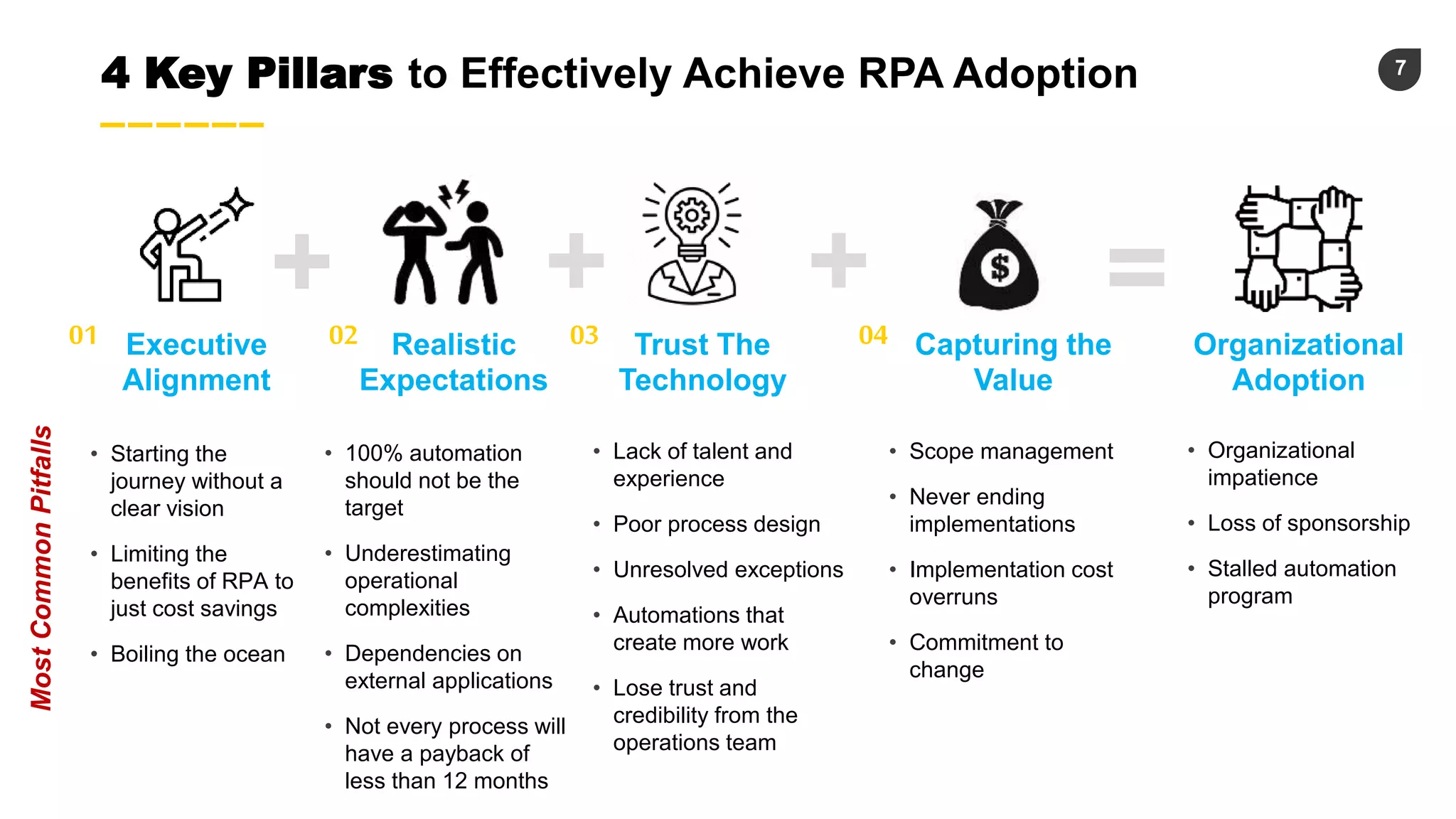
4 Key Pillars to Effectively Achieve RPA Adoption
MostCommonPitfalls
Realistic
Expectations
Executive
Alignment
Trust The
Technology
Capturing the
Value
=+ + +
Organizational
Adoption
• 100% automation
should not be the
target
• Underestimating
operational
complexities
• Dependencies on
external applications
• Not every process will
have a payback of
less than 12 months
• Lack of talent and
experience
• Poor process design
• Unresolved exceptions
• Automations that
create more work
• Lose trust and
credibility from the
operations team
• Scope management
• Never ending
implementations
• Implementation cost
overruns
• Commitment to
change
• Organizational
impatience
• Loss of sponsorship
• Stalled automation
program
• Starting the
journey without a
clear vision
• Limiting the
benefits of RPA to
just cost savings
• Boiling the ocean
01 02 03 04
8
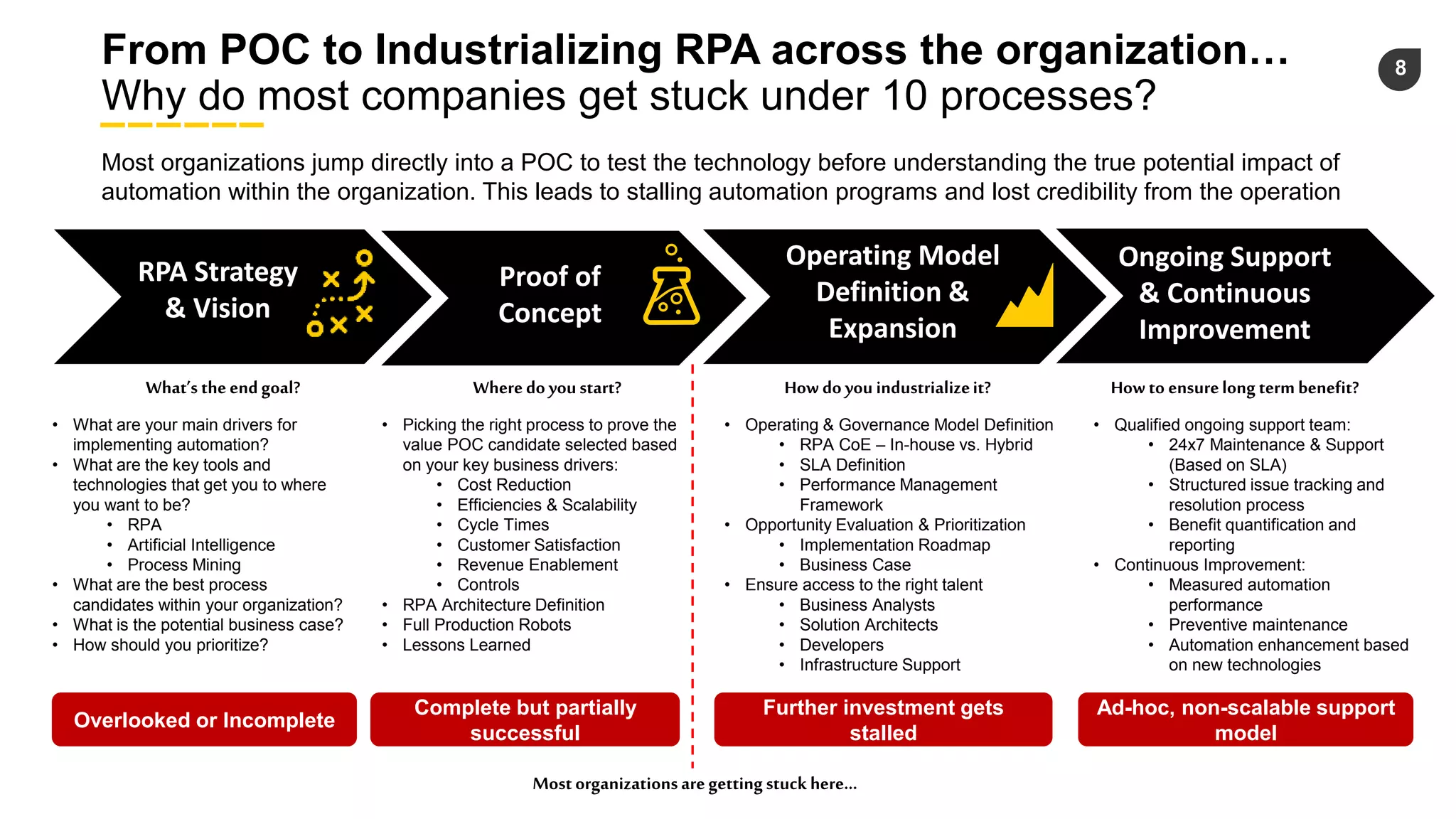
From POC to Industrializing RPA across the organization…
Why do most companies get stuck under 10 processes?
Most organizations jump directly into a POC to test the technology before understanding the true potential impact of
automation within the organization. This leads to stalling automation programs and lost credibility from the operation
Wheredo youstart?
Proof of
Concept
• Picking the right process to prove the
value POC candidate selected based
on your key business drivers:
• Cost Reduction
• Efficiencies & Scalability
• Cycle Times
• Customer Satisfaction
• Revenue Enablement
• Controls
• RPA Architecture Definition
• Full Production Robots
• Lessons Learned
What’s theendgoal?
RPA Strategy
& Vision
• What are your main drivers for
implementing automation?
• What are the key tools and
technologies that get you to where
you want to be?
• RPA
• Artificial Intelligence
• Process Mining
• What are the best process
candidates within your organization?
• What is the potential business case?
• How should you prioritize?
How do you industrializeit?
Operating Model
Definition &
Expansion
Ongoing Support
& Continuous
Improvement
How to ensurelong termbenefit?
• Qualified ongoing support team:
• 24x7 Maintenance & Support
(Based on SLA)
• Structured issue tracking and
resolution process
• Benefit quantification and
reporting
• Continuous Improvement:
• Measured automation
performance
• Preventive maintenance
• Automation enhancement based
on new technologies
Overlooked or Incomplete
Complete but partially
successful
Ad-hoc, non-scalable support
model
Further investment gets
stalled
Mostorganizationsaregettingstuck here…
• Operating & Governance Model Definition
• RPA CoE – In-house vs. Hybrid
• SLA Definition
• Performance Management
Framework
• Opportunity Evaluation & Prioritization
• Implementation Roadmap
• Business Case
• Ensure access to the right talent
• Business Analysts
• Solution Architects
• Developers
• Infrastructure Support
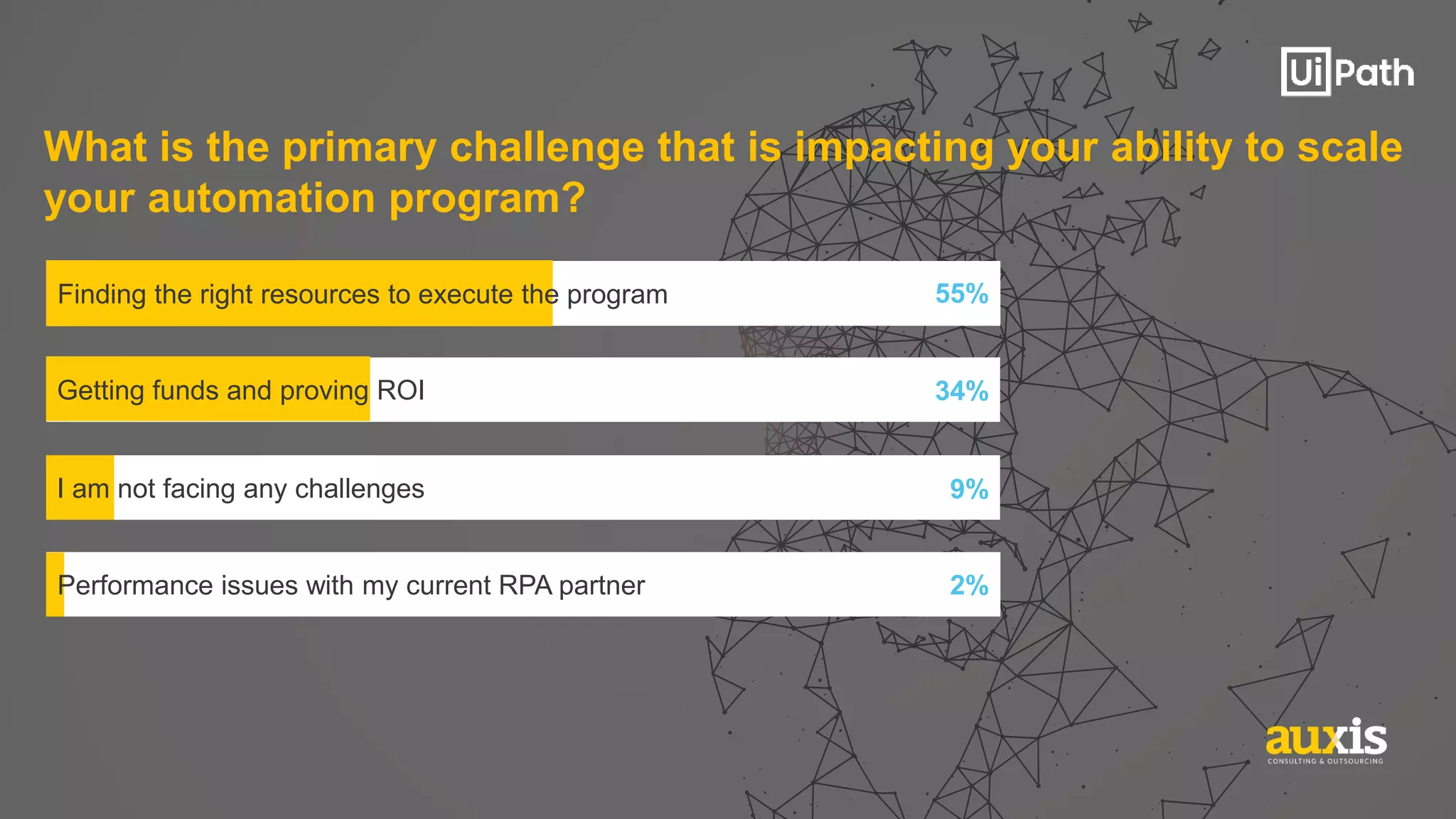
What is the primary challenge that is impacting your ability to scale
your automation program?
34%
9%
2%
Finding the right resources to execute the program 55%
Getting funds and proving ROI
I am not facing any challenges
Performance issues with my current RPA partner
10
The Impact of COVID on RPA
Market and What to Expect in 2021
11
The Importance of a Clear Vision
12
Building an Effective RPA Team
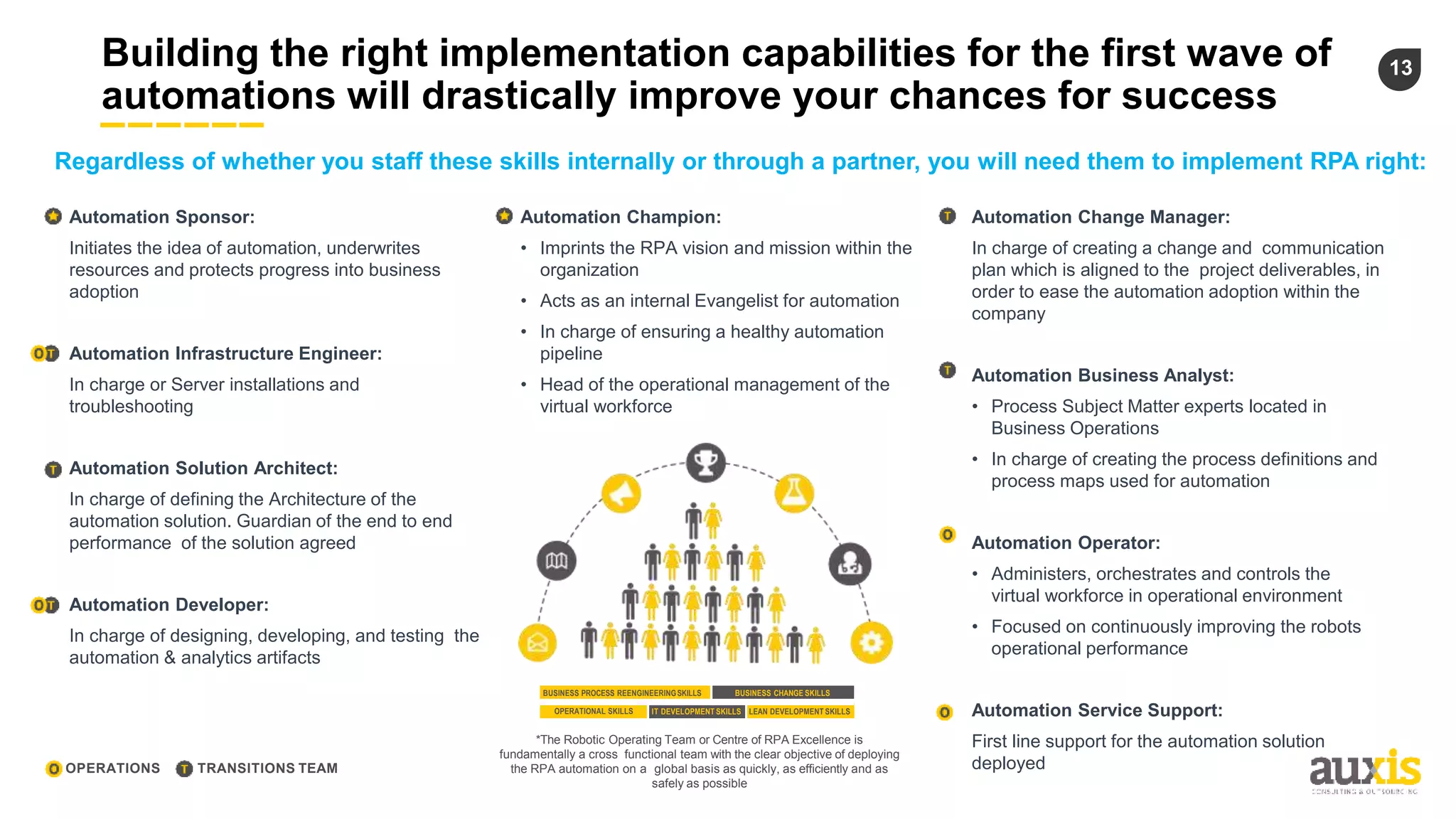
13Building the right implementation capabilities for the first wave of
automations will drastically improve your chances for success
Automation Sponsor:
Initiates the idea of automation, underwrites
resources and protects progress into business
adoption
Automation Infrastructure Engineer:
In charge or Server installations and
troubleshooting
Automation Solution Architect:
In charge of defining the Architecture of the
automation solution. Guardian of the end to end
performance of the solution agreed
Automation Developer:
In charge of designing, developing, and testing the
automation & analytics artifacts
Automation Champion:
• Imprints the RPA vision and mission within the
organization
• Acts as an internal Evangelist for automation
• In charge of ensuring a healthy automation
pipeline
• Head of the operational management of the
virtual workforce
Automation Change Manager:
In charge of creating a change and communication
plan which is aligned to the project deliverables, in
order to ease the automation adoption within the
company
Automation Business Analyst:
• Process Subject Matter experts located in
Business Operations
• In charge of creating the process definitions and
process maps used for automation
Automation Operator:
• Administers, orchestrates and controls the
virtual workforce in operational environment
• Focused on continuously improving the robots
operational performance
Automation Service Support:
First line support for the automation solution
deployedOPERATIONS TRANSITIONS TEAM
BUSINESS PROCESS REENGINEERINGSKILLS BUSINESS CHANGE SKILLS
OPERATIONAL SKILLS IT DEVELOPMENT SKILLS LEAN DEVELOPMENT SKILLS
*The Robotic Operating Team or Centre of RPA Excellence is
fundamentally a cross functional team with the clear objective of deploying
the RPA automation on a global basis as quickly, as efficiently and as
safely as possible
Regardless of whether you staff these skills internally or through a partner, you will need them to implement RPA right:
14
Organizational Adoption
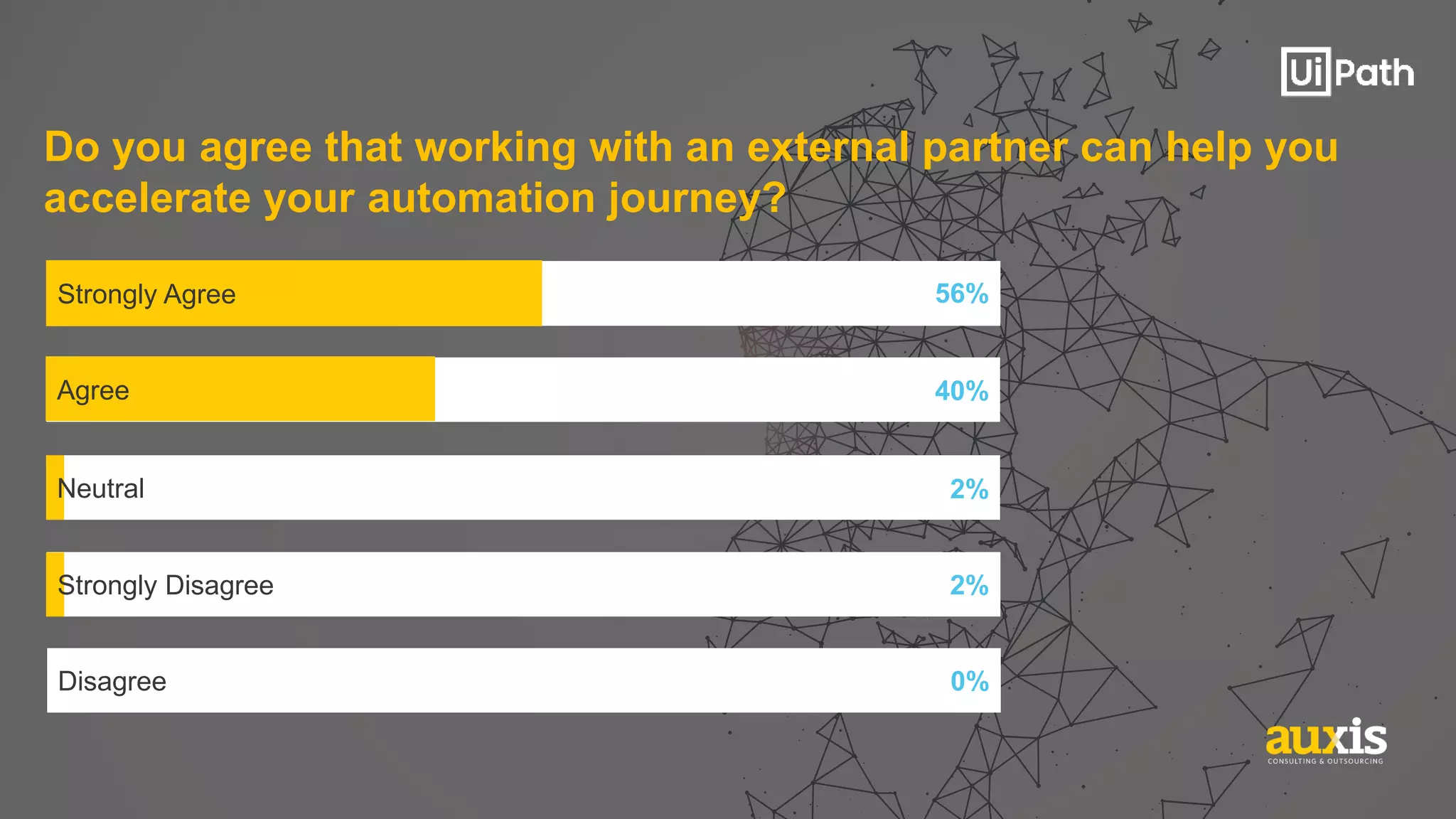
Do you agree that working with an external partner can help you
accelerate your automation journey?
40%
2%
2%
Strongly Agree 56%
Agree
Neutral
Strongly Disagree
0%Disagree
16
The Challenges of Operating
RPA At Scale
17
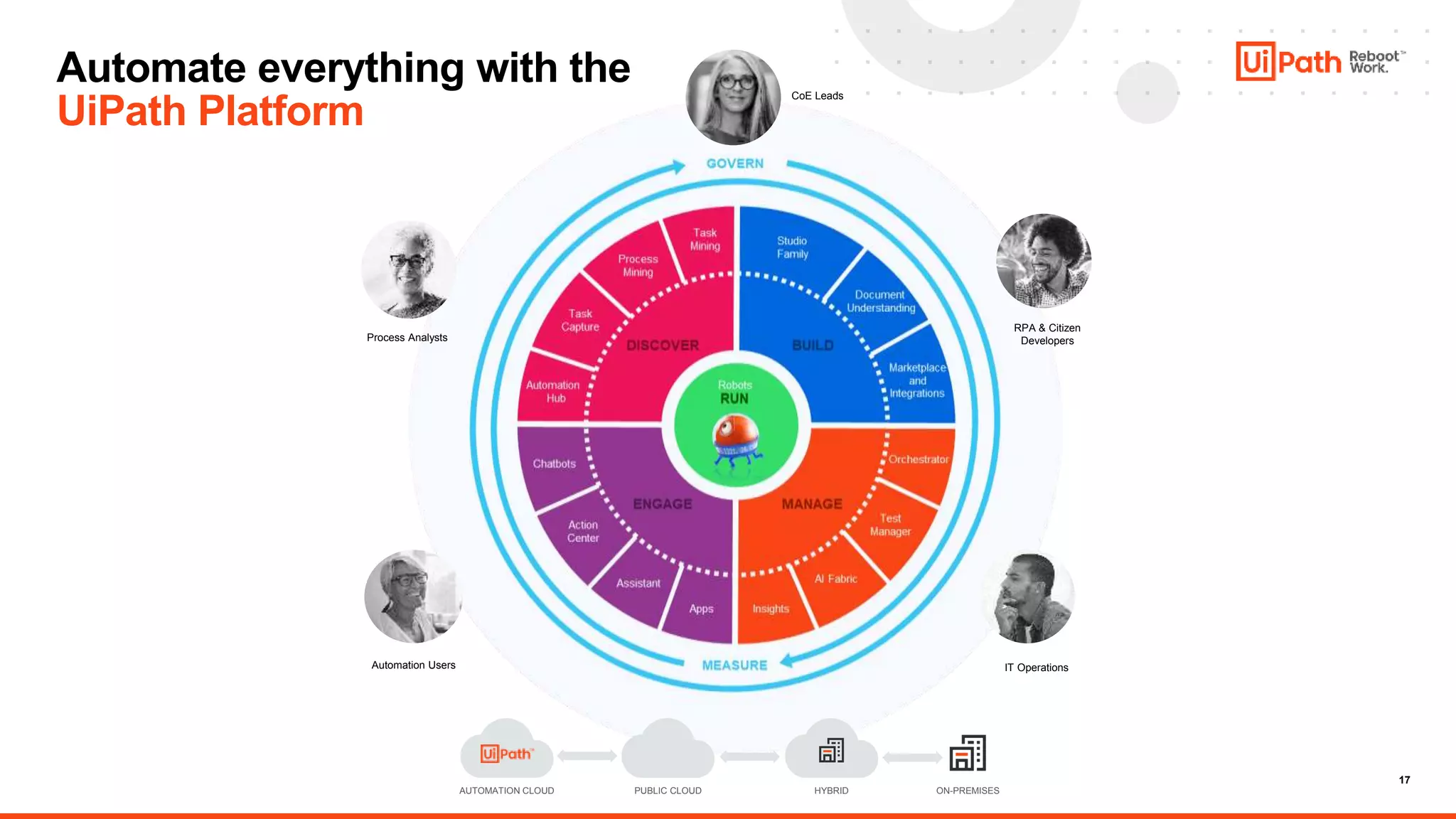
Automate everything with the
UiPath Platform
CoE Leads
RPA & Citizen
DevelopersProcess Analysts
Automation Users IT Operations
ON-PREMISESAUTOMATION CLOUD HYBRIDPUBLIC CLOUD
18
Final Lessons Learned
Would you like to schedule a consultation with
Auxis to explore ways to support your automation
program?
1. Yes
2. No
20
Mora RPA Resources you may find valuable…
• 60 Processes to Consider for RPA Automation
• Building Your RPA Center of Excellence
• Auxis RPA Survey Report: Where Are We With RPA
• 2020 Guide: Best RPA Tools
• 7 Considerations for Selecting Your RPA Partner
• How To Accelerate your RPA Journey
• RPA Case Studies
• Other RPA Webinars
• Other RPA Blogs
Thank you for
joining us today!
eduardo.diquez@gmail.com
michael.chambers@uipath.com
jperez2@amerantbank.com
Eduardo Diquez
Consulting Director,
Intelligent Automation Practice
Chet Chambers
Vice President,
Chief Evangelist Americas
Jose Manuel Perez Rebellon
VP of Intelligent Automation,
Quality & Performance

What Does it Take To Scale Your Automation Program?

  • 1.
    Getting RPA Rightin 2021: What Does it Take to Scale Your Automation Program? Eduardo Diquez Consulting Director, Intelligent Automation Practice Chet Chambers Vice President, Chief Evangelist Americas Jose Manuel Perez VP of Intelligent Automation, Quality & Performance W E B I N A R Wednesday, Dec 9th 2020 12:00 pm - 1:00 pm ET
  • 2.
    Sources: - Forrester: TheFuture of Work – A Pandemic Spotlight - PwC CFO Pulse Survey, 2020 - Gartner The adoption of RPA is accelerating at a faster rate than any other enterprise software in history… Nearly 50% of the organizations will increase RPA spent over the next year due to COVID-19 The main goals for the RPA investment are: 83% - Increase agility, diversity, & resiliency 80% - Address extraordinary cost pressures 75% - Support remote workforces RPA software market grew 63% in 2019 to $1.4B and will reach nearly universal adoption by 2023 While 80% of CFOs are implementing containment initiatives, only less 20% will be cutting out digital transformation investments
  • 3.
    3But still, mostorganizations are struggling to successfully implement RPA at scale… Sources: - SSON State of Shared Services Industry Report 2020 - Deloitte Survey, The Robots Are Ready, Are You? 65% of the organizations have not been able to automate more than 10 processes 63% of organizations do not meet delivery deadlines for RPA projects. For the ones that succeeded, longer-than-anticipated implementations delayed ROI. Only a tiny minority (3%) of progressive organizations have reached any form of scale with more than 50 processes in service
  • 4.
    What best describesthe stage of your RPA Automation Journey? 23% 19% 4% Planning to get started in 2021 53% Implementing (more than 10 processes) and expanding RPA is not a priority Piloting (less than 10 processes in production)
  • 5.
    5 The question is…Whyis it so hard to scale an RPA program?
  • 6.
    6 Most organizations donot start with the end-goal in mind… What are the business drivers you are seeking to get with RPA? It’s not just about cost reduction… Improved Visibility Revenue Enablement Cost Reduction Scalability Agility Quality & Controls Focus Customer & Employee Experience One Version of the Truth
  • 7.
    7 4 Key Pillarsto Effectively Achieve RPA Adoption MostCommonPitfalls Realistic Expectations Executive Alignment Trust The Technology Capturing the Value =+ + + Organizational Adoption • 100% automation should not be the target • Underestimating operational complexities • Dependencies on external applications • Not every process will have a payback of less than 12 months • Lack of talent and experience • Poor process design • Unresolved exceptions • Automations that create more work • Lose trust and credibility from the operations team • Scope management • Never ending implementations • Implementation cost overruns • Commitment to change • Organizational impatience • Loss of sponsorship • Stalled automation program • Starting the journey without a clear vision • Limiting the benefits of RPA to just cost savings • Boiling the ocean 01 02 03 04
  • 8.
    8 From POC toIndustrializing RPA across the organization… Why do most companies get stuck under 10 processes? Most organizations jump directly into a POC to test the technology before understanding the true potential impact of automation within the organization. This leads to stalling automation programs and lost credibility from the operation Wheredo youstart? Proof of Concept • Picking the right process to prove the value POC candidate selected based on your key business drivers: • Cost Reduction • Efficiencies & Scalability • Cycle Times • Customer Satisfaction • Revenue Enablement • Controls • RPA Architecture Definition • Full Production Robots • Lessons Learned What’s theendgoal? RPA Strategy & Vision • What are your main drivers for implementing automation? • What are the key tools and technologies that get you to where you want to be? • RPA • Artificial Intelligence • Process Mining • What are the best process candidates within your organization? • What is the potential business case? • How should you prioritize? How do you industrializeit? Operating Model Definition & Expansion Ongoing Support & Continuous Improvement How to ensurelong termbenefit? • Qualified ongoing support team: • 24x7 Maintenance & Support (Based on SLA) • Structured issue tracking and resolution process • Benefit quantification and reporting • Continuous Improvement: • Measured automation performance • Preventive maintenance • Automation enhancement based on new technologies Overlooked or Incomplete Complete but partially successful Ad-hoc, non-scalable support model Further investment gets stalled Mostorganizationsaregettingstuck here… • Operating & Governance Model Definition • RPA CoE – In-house vs. Hybrid • SLA Definition • Performance Management Framework • Opportunity Evaluation & Prioritization • Implementation Roadmap • Business Case • Ensure access to the right talent • Business Analysts • Solution Architects • Developers • Infrastructure Support
  • 9.
    What is theprimary challenge that is impacting your ability to scale your automation program? 34% 9% 2% Finding the right resources to execute the program 55% Getting funds and proving ROI I am not facing any challenges Performance issues with my current RPA partner
  • 10.
    10 The Impact ofCOVID on RPA Market and What to Expect in 2021
  • 11.
    11 The Importance ofa Clear Vision
  • 12.
  • 13.
    13Building the rightimplementation capabilities for the first wave of automations will drastically improve your chances for success Automation Sponsor: Initiates the idea of automation, underwrites resources and protects progress into business adoption Automation Infrastructure Engineer: In charge or Server installations and troubleshooting Automation Solution Architect: In charge of defining the Architecture of the automation solution. Guardian of the end to end performance of the solution agreed Automation Developer: In charge of designing, developing, and testing the automation & analytics artifacts Automation Champion: • Imprints the RPA vision and mission within the organization • Acts as an internal Evangelist for automation • In charge of ensuring a healthy automation pipeline • Head of the operational management of the virtual workforce Automation Change Manager: In charge of creating a change and communication plan which is aligned to the project deliverables, in order to ease the automation adoption within the company Automation Business Analyst: • Process Subject Matter experts located in Business Operations • In charge of creating the process definitions and process maps used for automation Automation Operator: • Administers, orchestrates and controls the virtual workforce in operational environment • Focused on continuously improving the robots operational performance Automation Service Support: First line support for the automation solution deployedOPERATIONS TRANSITIONS TEAM BUSINESS PROCESS REENGINEERINGSKILLS BUSINESS CHANGE SKILLS OPERATIONAL SKILLS IT DEVELOPMENT SKILLS LEAN DEVELOPMENT SKILLS *The Robotic Operating Team or Centre of RPA Excellence is fundamentally a cross functional team with the clear objective of deploying the RPA automation on a global basis as quickly, as efficiently and as safely as possible Regardless of whether you staff these skills internally or through a partner, you will need them to implement RPA right:
  • 14.
  • 15.
    Do you agreethat working with an external partner can help you accelerate your automation journey? 40% 2% 2% Strongly Agree 56% Agree Neutral Strongly Disagree 0%Disagree
  • 16.
    16 The Challenges ofOperating RPA At Scale
  • 17.
    17 Automate everything withthe UiPath Platform CoE Leads RPA & Citizen DevelopersProcess Analysts Automation Users IT Operations ON-PREMISESAUTOMATION CLOUD HYBRIDPUBLIC CLOUD
  • 18.
  • 19.
    Would you liketo schedule a consultation with Auxis to explore ways to support your automation program? 1. Yes 2. No
  • 20.
    20 Mora RPA Resourcesyou may find valuable… • 60 Processes to Consider for RPA Automation • Building Your RPA Center of Excellence • Auxis RPA Survey Report: Where Are We With RPA • 2020 Guide: Best RPA Tools • 7 Considerations for Selecting Your RPA Partner • How To Accelerate your RPA Journey • RPA Case Studies • Other RPA Webinars • Other RPA Blogs
  • 21.
    Thank you for joiningus today! eduardo.diquez@gmail.com michael.chambers@uipath.com jperez2@amerantbank.com Eduardo Diquez Consulting Director, Intelligent Automation Practice Chet Chambers Vice President, Chief Evangelist Americas Jose Manuel Perez Rebellon VP of Intelligent Automation, Quality & Performance

Editor's Notes

  • #12 Michael – impact of COVID in the RPA market
  • #14 Jose How did you go about selecting an implementation partner vs building all capabilities internally? What type of training are you still doing internally to embrace automation across the org? Chet Are you seeing your clients struggle with a shortage of talent? How should organizations build their implementation capabilities? What do you think should be the right mix of in-house versus external resources? Long-term operating model Test-suit in the front end (process mining run by the same person in UiPath)
  • #15 Jose How has the organization embraced RPA? Did they ever feel threatened by it? How are you guys managing change management and organizational adoption? Chet How to position robots to more resistant employees (afraid of losing their job)? Keeping and sustaining productivity in 2021 and beyond Hiring for automation attitude from the beginning – actively contributing to their ability to stay
  • #18 Chet first, then Eduardo/Jim Key things that organizations need to think as they are operating at scale If it’s not getting measured it doesn’t exist Most common implementation pitfalls Underestimating the complexity of managing and maintaining the robots. It’s not about building, it’s creating long-term, sustainable value Developers should not be doing support and viceversa Pipeline creation and prioritization
  • #19 Chet, Eduardo to chime in after Key mistakes to avoid Selecting the right platform that will enable hyperautomation