1
VIENNA
47th International Atlantic Economic Conference
March 17-22, 1999.
INCOME MEASUREMENT AND COMPARISONS
by
Ignacio Mauleón* and Jordi Sardá**.
(*) Universidad de Salamanca.
(**)Universidad de Tarragona.
Abstract
The purpose of this paper is to provide a way for a better measurement of a
country's global income when official statistics fail to take into account the
existence of a thriving underground, or black economy. A second purpose of the
research is to discuss adequate ways to perform international comparisons of
income, and income per head, and to correct for depreciation. Besides the general
interest of this problem there are two more specific reasons behind this work: the
allocation of development funds by international agencies -for example, the
structural funds in the EMS-, are conditioned on this measure; and, second, the
measurement of unemployment may be totally distorted by failing to take account
of the hidden economy.
JEL classification code: C8.
Keywords: Income per capita, underground economy, equilibrium exchange rate.
Corresponding author: Prof.Dr.Ignacio Mauleón.
Dpto. de Economía e Historia.
Fac. de Economía y Empresa (edif. FES).
Campus Miguel de Unamuno
Universidad de Salamanca.
37008 SALAMANCA
(Spain)
Phone: 34 - 23 - 294640
Fax : 34 - 23 - 294686
Email: imaul@gugu.usal.es
2
1. Introduction.1
The purpose of this paper is to discuss ways for a better measurement of a
country's global income when official statistics fail to take into account several
shortcomings. Among them, one that features prominently is, for some countries,
the existence of a thriving underground, or black economy. A second purpose of
the research is to discuss and provide improved ways to perform international
comparisons of income, and income per head, over existing ones. One important
application of the result of this work would be a proper analysis of the
convergence problem in growth analysis. The common wisdom is that countries
far off the technical frontier grow faster, but the rate of growth diminishes as the
level of income, or income per head, converges. Besides the underground
economy, there are at least three other problems relevant for the measurement of
national income, as discussed by an international agency specialised on this matter,
like the Organization for Economic Cooperation and Development (OECD): 1) the
measurement of depreciation, 2) the conversion rate between different national
currencies -i.e., the exchange rate -, and, 3) the unaccounted cost in terms of
natural resources - i.e, pollution of several kinds, for example -. According to the
OECD these rank among the highest problems in the measurement of national
income.
The paper proceeds by applying this methodology to the Spanish case,
which we consider of general interest for at least three specific reasons: the
allocation of development funds by international agencies -for example, the
structural funds in the EEC-, are conditioned on this measure; second, the
measurement of unemployment, which is rather high according to official data,
may be totally distorted by failing to take account of the hidden economy; and
third, it is of great interest to check if the spanish economy is converging to
European averages, and if this is not the case, why: this could shed light on policy
economic analysis for countries that are willing to join the EEC and share some
similarities with the spanish case, specially those coming from the former eastern
block – they had previously an autocratic political regime, and their level of
development lies below european averages, both features shared by Spain, prior to
joining the European Community -.
2. Methodological issues on income measurement.
One of the major international agencies concerned with aggregate income
measurement at the national level, is the OECD. The main concern is to establish a
set of accounting standards that yield comparable results, on which to perform
international economic policy analysis. The main focus of the system of accounts
developed by this organisation is economic production, which relates to both
goods and services. In measuring this concept, a number of methodological issues
arise, not all of them easy to solve. Some of the most relevant, always according to
1
This paper has benefited from the comments of the participants at the 47th
IAER conference in
Vienna, 1999, specially those of Michael Pickhardt from Wuppertal University. Financial support
from the Dgcyt under project SEC98-1112, and the Junta C. y L under project SA29/99 is
acknowledged. The comments of the participants at the AEA conference on Public deficits, 1997 in
Rome are also acknowledged. The authors are soley respnsible for any remaining errors.
3
the OECD, are the following four: 1) illegal activities; 2) the depreciation of the
overall capital stock; 3) international comparisons of GDP, and, 4) the
environment as a natural resource. We discuss them in turn in the next paragraphs.
Illegal activities in the national accounts are those which are usually legal,
but which become illegal when carried out by unauthorised producers (for
example, unlicensed medical practitioners, or avoiding the payment of the VAT).
Incomes from illegal production can be spent on purchasing legal goods and
services and, conversely, illegal goods and services can be purchased using
incomes derived from legal sources. Both sides of such transactions need to be
recorded within the national accounts framework if discrepancies are to be
avoided. In practice, however, it is difficult to make reliable estimates, and most
countries omit this component of income entirely in the end. But perhaps more
importantly, beyond avoiding discrepancies in the system of accounts, it is the total
volume of GDP that may be grossly underestimated in some cases, if this
component is omitted. Therefore, and however crude the estimate of the hidden
economy may be, it seems unavoidable the need for some kind of correction.
The estimate of overall production which also takes into account the fact
that capital is being used up into the course of production is net domestic product,
or NDP. While NDP provides a purer measure of production than GDP, placing a
value on consumption of fixed capital is a difficult process. In practice,
consumption of fixed capital is not calculated on a consistent basis between
countries, and so GDP is frequently used as the summary measure of a country's
economic performance.
International comparisons of GDP depend on two conditions being met.
The first is that the basis for GDP calculations are consistent for the countries
under comparison. The second is that the unit in which GDP is expressed, is
comparable. The simplest way of comparing GDP of two different countries is to
convert each amount to a common currency using official exchange rates.
However, this is widely recognised as inadequate, since official exchange rates do
not adequately reflect the comparative purchasing power of local currencies in
their own markets. The concept of purchasing power parity (PPP), was developed
to provied an alternative conversion factor for GDP, so that internationally
comparable price and volume comparisons of GDP could be established. PPPs are
the rates of currency conversion which equalise the purchasing power of different
currencies. This means that a given sum of money, when converted into different
currencies at the PPP rates, will buy the same basket of goods and services in all
countries. In other words, PPPs are the rates of currency conversion which
eliminate the differences in price and levels between countries. Thus, when
expenditures on GDP for different countries are converted into a common currency
by means of PPPs, they are expressed in effect, at the same set of international
prices, so that comparisons between countries reflect just differences in the volume
of goods and services purchases. PPPs appear also in international trade theory, but
those calculated by the OECD, as such, refer to the entire range of final goods and
services which make up GDP, as a whole including many items, such as
constructions and government services, which are not considered in international
trade.
4
Finally, the impact of economic activity on the environment, is another
aspect that in principle should be considered in the national accounts. A major
difficulty in doing so is that, because those activities are not part of the market in a
country, it is impossible to directly put a monetary value on them. The OECD
suggests producing estimates in the form of satellite accounts, not fully
incorporated in the basic system of national accounts (SNA)
Of these methodological issues, we take up the first three, and propose
solutions that will lead to better estimates of the overall economic activity, or at
least that will be complementary to existing ones. We discuss them in turn, in what
follows.
2.1. The hidden economy.
The methodology suggested in order to estimate the hidden or
underground, as sometimes is also denominated, economy is based upon the so
called currency demand approach, first put forward, and applied in a number of
papers by Gutmann (1977), Feige (1979), and Tanzi (1980, 1982, 1983), and later
developed by other authors like Matthews (1982), Isachsen et.al. (1982) and Smith
(1981). Recent applications can be found in Barthelemy (1988), Feige (1989) and
Lagenfeldt (1989). An informal presentation of the consequences of the
underground economy can be found in Quirk (1997), and estimation results for the
western economies in Schneider (1997). The fundamental hypothesis in all these
papers, is that the underground economy requires means of payment fiscally
opaque, so that abnormal changes in the currency in circulation, are assumed to be
the result of changes in the size of the underground economy. It is, therefore, an
indirect estimation procedure.
The methodology is based upon the so called currency demand approach.
Since the methodology assumes that the underground economy requires a fiscally
opaque payment system, and assuming that we can derive an estimate for the
amount of currency demanded by the legal economy, we can subtract it from the
total amount in circulation, thereby deriving an estimate of the amount of currency
demanded by the underground economy, as well. This suggestion is detailed next.
We start by considering first, a standard demand for money - currency, in the
current context -, that we make it depend on the usual variables, that is, prices, P,
income, - observed, or legal – YL , and the nominal interest rate, R. Since we want
to capture the impact of the underground economy, we have to add a measure of
fiscal pressure, c, as well. In the present paper, such measure has been taken to be
the average effective rate of the Social Security contributions - that is, total
proceeds by this concept, over accounted GDP -. The reason behind this choice is
that neither indirect taxes, nor other direct measures of fiscal pressure - like the
income tax rate - seemed able to capture adequately any effect in the demand for
currency. On the other hand, and since the bulk of the underground economy can
be safely assumed to be made up by entrepreneurial activities, this is a reasonable
choice .
The demand for money is specified in log linear terms, following the
standard procedure, that is,
5
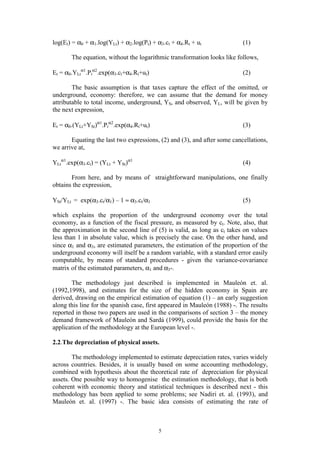
log(Et) = α0 + α1.log(YLt) + α2.log(Pt) + α3.ct + α4.Rt + ut (1)
The equation, without the logarithmic transformation looks like follows,
Et = α0.YLt
α1
.Pt
α2
.exp(α3.ct+α4.Rt+ut) (2)
The basic assumption is that taxes capture the effect of the omitted, or
underground, economy: therefore, we can assume that the demand for money
attributable to total income, underground, YS, and observed, YL, will be given by
the next expression,
Et = α0.(YLt+YSt)α1
.Pt
α2
.exp(α4.Rt+ut) (3)
Equating the last two expressions, (2) and (3), and after some cancellations,
we arrive at,
YLt
α1
.exp(α3.ct) = (YLt + YSt)α1
(4)
From here, and by means of straightforward manipulations, one finally
obtains the expression,
YSt/YLt = exp(α3.ct/α1) – 1 ≈ α3.ct/α1 (5)
which explains the proportion of the underground economy over the total
economy, as a function of the fiscal pressure, as measured by ct. Note, also, that
the approximation in the second line of (5) is valid, as long as ct takes on values
less than 1 in absolute value, which is precisely the case. On the other hand, and
since α1 and α3, are estimated parameters, the estimation of the proportion of the
underground economy will itself be a random variable, with a standard error easily
computable, by means of standard procedures - given the variance-covariance
matrix of the estimated parameters, α1 and α3-.
The methodology just described is implemented in Mauleón et. al.
(1992,1998), and estimates for the size of the hidden economy in Spain are
derived, drawing on the empirical estimation of equation (1) – an early suggestion
along this line for the spanish case, first appeared in Mauleón (1988) -. The results
reported in those two papers are used in the comparisons of section 3 – the money
demand framework of Mauleón and Sardá (1999), could provide the basis for the
application of the methodology at the European level -.
2.2.The depreciation of physical assets.
The methodology implemented to estimate depreciation rates, varies widely
across countries. Besides, it is usually based on some accounting methodology,
combined with hypothesis about the theoretical rate of depreciation for physical
assets. One possible way to homogenise the estimation methodology, that is both
coherent with economic theory and statistical techniques is described next - this
methodology has been applied to some problems; see Nadiri et. al. (1993), and
Mauleón et. al. (1997) -. The basic idea consists of estimating the rate of
6
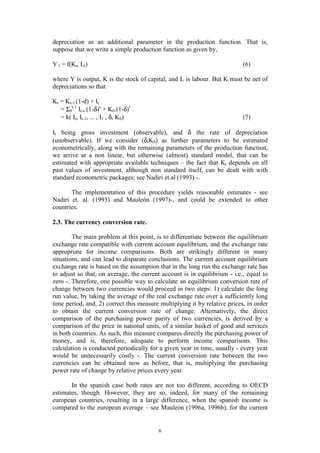
depreciation as an additional parameter in the production function. That is,
suppose that we write a simple production function as given by,
Y t = f(Kt, Lt) (6)
where Y is output, K is the stock of capital, and L is labour. But K must be net of
depreciations so that
Kt = Kt-1 (1-d) + It
= Σ0
t-1
It-s (1-δ)s
+ K0.(1-δ)t
= k( It, It-1, ... , I1 , δ, K0) (7)
It being gross investment (observable), and δ the rate of depreciation
(unobservable). If we consider (δ,K0) as further parameters to be estimated
econometrically, along with the remaining parameters of the production function,
we arrive at a non linear, but otherwise (almost) standard model, that can be
estimated with appropriate available techniques – the fact that Kt depends on all
past values of investment, although non standard itself, can be dealt with with
standard econometric packages; see Nadiri et.al (1993) -.
The implementation of this procedure yields reasonable estimates - see
Nadiri et. al. (1993) and Mauleón (1997)-, and could be extended to other
countries.
2.3. The currency conversion rate.
The main problem at this point, is to differentiate between the equilibrium
exchange rate compatible with current account equilibrium, and the exchange rate
appropriate for income comparisons. Both are strikingly different in many
situations, and can lead to disparate conclusions. The current account equilibrium
exchange rate is based on the assumption that in the long run the exchange rate has
to adjust so that, on average, the current account is in equilibrium - i.e., equal to
zero -. Therefore, one possible way to calculate an equilibrium conversion rate of
change between two currencies would proceed in two steps: 1) calculate the long
run value, by taking the average of the real exchange rate over a sufficiently long
time period, and, 2) correct this measure multiplying it by relative prices, in order
to obtain the current conversion rate of change. Alternatively, the direct
comparison of the purchasing power parity of two currencies, is derived by a
comparison of the price in national units, of a similar basket of good and services
in both countries. As such, this measure compares directly the purchasing power of
money, and is, therefore, adequate to perform income comparisons. This
calculation is conducted periodically for a given year in time, usually - every year
would be unnecessarily costly -. The current conversion rate between the two
currencies can be obtained now as before, that is, multiplying the purchasing
power rate of change by relative prices every year.
In the spanish case both rates are not too different, according to OECD
estimates, though. However, they are so, indeed, for many of the remaining
european countries, resulting in a large difference, when the spanish income is
compared to the european average – see Mauleón (1996a, 1996b), for the current
7
account equilibrium exchange rate in the spanish case -. The explanation for the
large difference is, simply, that not all goods are traded: the equilibrium exchange
rate is adequate for current account analysis, and the purchasing power rate, as
measured by comparing representative basket prices, is more appropriate for
income comparisons.
3. Results for the Spanish economy.
We shall focus on two related points: 1) the comparison of income per head
between Spain and average Europe, as a measure of relative welfare at a given
moment in time, and, 2) the convergence of this measure along time, or lack
thereof.
We have chosen to present our main results by means of comparative tables
and graphs. The data in each table is given as a percentage rate of the
corresponding variable compared to the European average. The graphs given next
depict alternative measures of income per head, or per working person, which we
deem to be fairly informative:
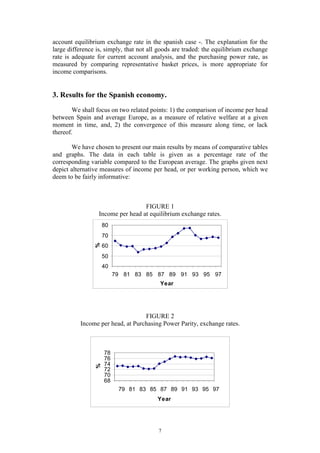
FIGURE 1
Income per head at equilibrium exchange rates.
40
50
60
70
80
79 81 83 85 87 89 91 93 95 97
Year
%
FIGURE 2
Income per head, at Purchasing Power Parity, exchange rates.
68
70
72
74
76
78
79 81 83 85 87 89 91 93 95 97
Year
%
8
FIGURE 3
figure 2, adding the hidden economy.
74
76
78
80
82
84
86
79 81 83 85 87 89 91 93 95
Year
%
FIGURE 4
figure 2, according to net income - rather than gross -.
65
70
75
80
85
79 81 83 85 87 89 91 93 95
Year
%
FIGURE 5
figure 2, measuring income per worker - rather than per head -.
75
80
85
90
95
100
105
79 81 83 85 87 89 91 93
Year
%
9
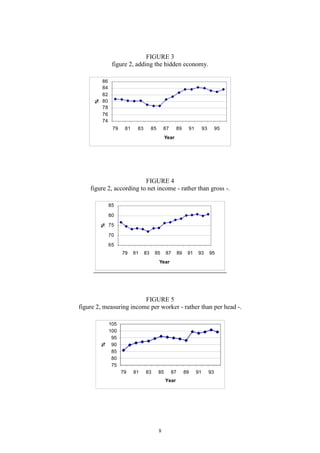
FIGURE 6
figure 2, adding the hidden economy, and using net income.
70
75
80
85
90
79 81 83 85 87 89 91 93 95
Year
%
FIGURE 7
figure 6, measuring income per worker.
80
85
90
95
100
105
110
115
79 81 83 85 87 89 91 93
Year
%
FIGURE 8
comparisons of growth rates, Spanish versus European average.
-2
0
2
4
6
79 81 83 85 87 89 91 93 95 97
Year
%
Spain U.E.
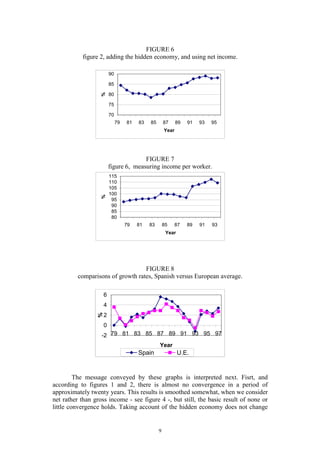
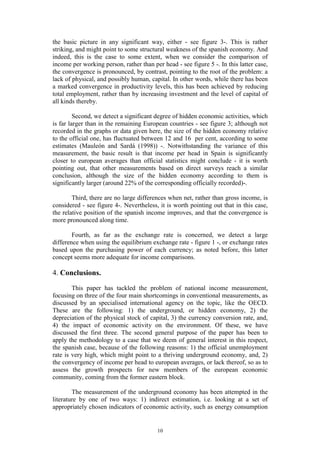
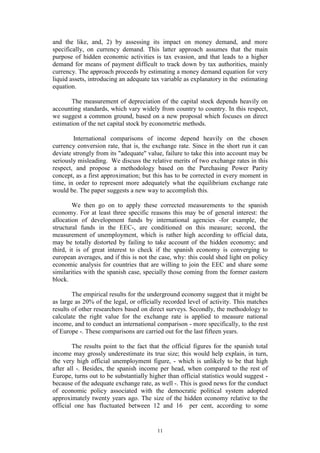
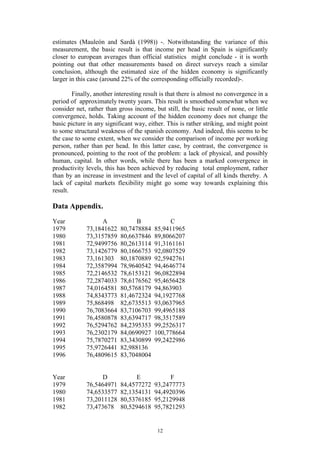
The message conveyed by these graphs is interpreted next. Fisrt, and
according to figures 1 and 2, there is almost no convergence in a period of
approximately twenty years. This results is smoothed somewhat, when we consider
net rather than gross income - see figure 4 -, but still, the basic result of none or
little convergence holds. Taking account of the hidden economy does not change
10
the basic picture in any significant way, either - see figure 3-. This is rather
striking, and might point to some structural weakness of the spanish economy. And
indeed, this is the case to some extent, when we consider the comparison of
income per working person, rather than per head - see figure 5 -. In this latter case,
the convergence is pronounced, by contrast, pointing to the root of the problem: a
lack of physical, and possibly human, capital. In other words, while there has been
a marked convergence in productivity levels, this has been achieved by reducing
total employment, rather than by increasing investment and the level of capital of
all kinds thereby.
Second, we detect a significant degree of hidden economic activities, which
is far larger than in the remaining European countries - see figure 3; although not
recorded in the graphs or data given here, the size of the hidden economy relative
to the official one, has fluctuated between 12 and 16 per cent, according to some
estimates (Mauleón and Sardá (1998)) -. Notwithstanding the variance of this
measurement, the basic result is that income per head in Spain is significantly
closer to european averages than official statistics might conclude - it is worth
pointing out, that other measurements based on direct surveys reach a similar
conclusion, although the size of the hidden economy according to them is
significantly larger (around 22% of the corresponding officially recorded)-.
Third, there are no large differences when net, rather than gross income, is
considered - see figure 4-. Nevertheless, it is worth pointing out that in this case,
the relative position of the spanish income improves, and that the convergence is
more pronounced along time.
Fourth, as far as the exchange rate is concerned, we detect a large
difference when using the equilibrium exchange rate - figure 1 -, or exchange rates
based upon the purchasing power of each currency; as noted before, this latter
concept seems more adequate for income comparisons.
4. Conclusions.
This paper has tackled the problem of national income measurement,
focusing on three of the four main shortcomings in conventional measurements, as
discussed by an specialised international agency on the topic, like the OECD.
These are the following: 1) the underground, or hidden economy, 2) the
depreciation of the physical stock of capital, 3) the currency conversion rate, and,
4) the impact of economic activity on the environment. Of these, we have
discussed the first three. The second general purpose of the paper has been to
apply the methodology to a case that we deem of general interest in this respect,
the spanish case, because of the following reasons: 1) the official unemployment
rate is very high, which might point to a thriving underground economy, and, 2)
the convergency of income per head to european averages, or lack thereof, so as to
assess the growth prospects for new members of the european economic
community, coming from the former eastern block.
The measurement of the underground economy has been attempted in the
literature by one of two ways: 1) indirect estimation, i.e. looking at a set of
appropriately chosen indicators of economic activity, such as energy consumption
11
and the like, and, 2) by assessing its impact on money demand, and more
specifically, on currency demand. This latter approach assumes that the main
purpose of hidden economic activities is tax evasion, and that leads to a higher
demand for means of payment difficult to track down by tax authorities, mainly
currency. The approach proceeds by estimating a money demand equation for very
liquid assets, introducing an adequate tax variable as explanatory in the estimating
equation.
The measurement of depreciation of the capital stock depends heavily on
accounting standards, which vary widely from country to country. In this respect,
we suggest a common ground, based on a new proposal which focuses on direct
estimation of the net capital stock by econometric methods.
International comparisons of income depend heavily on the chosen
currency conversion rate, that is, the exchange rate. Since in the short run it can
deviate strongly from its "adequate" value, failure to take this into account may be
seriously misleading. We discuss the relative merits of two exchange rates in this
respect, and propose a methodology based on the Purchasing Power Parity
concept, as a first approximation; but this has to be corrected in every moment in
time, in order to represent more adequately what the equilibrium exchange rate
would be. The paper suggests a new way to accomplish this.
We then go on to apply these corrected measurements to the spanish
economy. For at least three specific reasons this may be of general interest: the
allocation of development funds by international agencies -for example, the
structural funds in the EEC-, are conditioned on this measure; second, the
measurement of unemployment, which is rather high according to official data,
may be totally distorted by failing to take account of the hidden economy; and
third, it is of great interest to check if the spanish economy is converging to
european averages, and if this is not the case, why: this could shed light on policy
economic analysis for countries that are willing to join the EEC and share some
similarities with the spanish case, specially those coming from the former eastern
block.
The empirical results for the underground economy suggest that it might be
as large as 20% of the legal, or officially recorded level of activity. This matches
results of other researchers based on direct surveys. Secondly, the methodology to
calculate the right value for the exchange rate is applied to measure national
income, and to conduct an international comparison - more specifically, to the rest
of Europe -. These comparisons are carried out for the last fifteen years.
The results point to the fact that the official figures for the spanish total
income may grossly underestimate its true size; this would help explain, in turn,
the very high official unemployment figure, - which is unlikely to be that high
after all -. Besides, the spanish income per head, when compared to the rest of
Europe, turns out to be substantially higher than official statistics would suggest -
because of the adequate exchange rate, as well -. This is good news for the conduct
of economic policy associated with the democratic political system adopted
approximately twenty years ago. The size of the hidden economy relative to the
official one has fluctuated between 12 and 16 per cent, according to some
12
estimates (Mauleón and Sardà (1998)) -. Notwithstanding the variance of this
measurement, the basic result is that income per head in Spain is significantly
closer to european averages than official statistics might conclude - it is worth
pointing out that other measurements based on direct surveys reach a similar
conclusion, although the estimated size of the hidden economy is significantly
larger in this case (around 22% of the corresponding officially recorded)-.
Finally, another interesting result is that there is almost no convergence in a
period of approximately twenty years. This result is smoothed somewhat when we
consider net, rather than gross income, but still, the basic result of none, or little
convergence, holds. Taking account of the hidden economy does not change the
basic picture in any significant way, either. This is rather striking, and might point
to some structural weakness of the spanish economy. And indeed, this seems to be
the case to some extent, when we consider the comparison of income per working
person, rather than per head. In this latter case, by contrast, the convergence is
pronounced, pointing to the root of the problem: a lack of physical, and possibly
human, capital. In other words, while there has been a marked convergence in
productivity levels, this has been achieved by reducing total employment, rather
than by an increase in investment and the level of capital of all kinds thereby. A
lack of capital markets flexibility might go some way towards explaining this
result.
Data Appendix.
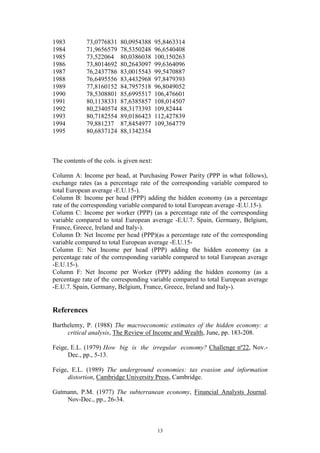
Year A B C
1979 73,1841622 80,7478884 85,9411965
1980 73,3157859 80,6637846 89,8066207
1981 72,9499756 80,2613114 91,3161161
1982 73,1426779 80,1666753 92,0807529
1983 73,161303 80,1870889 92,5942761
1984 72,3587994 78,9640542 94,4646774
1985 72,2146532 78,6153121 96,0822894
1986 72,2874033 78,6176562 95,4656428
1987 74,0164581 80,5768179 94,863903
1988 74,8343773 81,4672324 94,1927768
1989 75,868498 82,6735513 93,0637965
1990 76,7083664 83,7106703 99,4965188
1991 76,4580878 83,6394717 98,3517589
1992 76,5294762 84,2395353 99,2526317
1993 76,2302179 84,0690927 100,778664
1994 75,7870271 83,3430899 99,2422986
1995 75,9726441 82,988136
1996 76,4809615 83,7048004
Year D E F
1979 76,5464971 84,4577272 93,2477773
1980 74,6533577 82,1354131 94,4920396
1981 73,2011128 80,5376185 95,2129948
1982 73,473678 80,5294618 95,7821293
13
1983 73,0776831 80,0954388 95,8463314
1984 71,9656579 78,5350248 96,6540408
1985 73,522064 80,0386038 100,150263
1986 73,8014692 80,2643097 99,6364096
1987 76,2437786 83,0015543 99,5470887
1988 76,6495556 83,4432968 97,8479393
1989 77,8160152 84,7957518 96,8049052
1990 78,5308801 85,6995517 106,476601
1991 80,1138331 87,6385857 108,014507
1992 80,2340574 88,3173393 109,82444
1993 80,7182554 89,0186423 112,427839
1994 79,881237 87,8454977 109,364779
1995 80,6837124 88,1342354
The contents of the cols. is given next:
Column A: Income per head, at Purchasing Power Parity (PPP in what follows),
exchange rates (as a percentage rate of the corresponding variable compared to
total European average -E.U.15-).
Column B: Income per head (PPP) adding the hidden economy (as a percentage
rate of the corresponding variable compared to total European average -E.U.15-).
Column C: Income per worker (PPP) (as a percentage rate of the corresponding
variable compared to total European average -E.U.7. Spain, Germany, Belgium,
France, Greece, Ireland and Italy-).
Column D: Net Income per head (PPP)(as a percentage rate of the corresponding
variable compared to total European average -E.U.15-
Column E: Net Income per head (PPP) adding the hidden economy (as a
percentage rate of the corresponding variable compared to total European average
-E.U.15-).
Column F: Net Income per Worker (PPP) adding the hidden economy (as a
percentage rate of the corresponding variable compared to total European average
-E.U.7. Spain, Germany, Belgium, France, Greece, Ireland and Italy-).
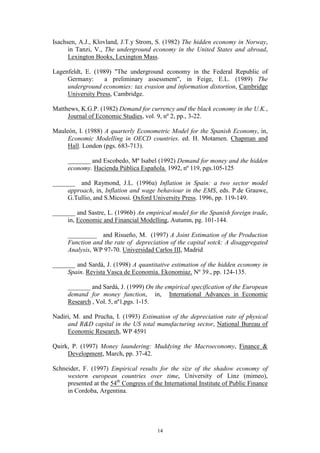
References
Barthelemy, P. (1988) The macroeconomic estimates of the hidden economy: a
critical analysis, The Review of Income and Wealth, June, pp. 183-208.
Feige, E.L. (1979) How big is the irregular economy? Challenge nº22, Nov.-
Dec., pp., 5-13.
Feige, E.L. (1989) The underground economies: tax evasion and information
distortion, Cambridge University Press, Cambridge.
Gutmann, P.M. (1977) The subterranean economy, Financial Analysts Journal.
Nov-Dec., pp., 26-34.
14
Isachsen, A.J., Klovland, J.T.y Strom, S. (1982) The hidden economy in Norway,
in Tanzi, V., The underground economy in the United States and abroad,
Lexington Books, Lexington Mass.
Lagenfeldt, E. (1989) "The underground economy in the Federal Republic of
Germany: a preliminary assessment", in Feige, E.L. (1989) The
underground economies: tax evasion and information distortion, Cambridge
University Press, Cambridge.
Matthews, K.G.P. (1982) Demand for currency and the black economy in the U.K.,
Journal of Economic Studies, vol. 9, nº 2, pp., 3-22.
Mauleón, I. (1988) A quarterly Econometric Model for the Spanish Economy, in,
Economic Modelling in OECD countries. ed. H. Motamen. Chapman and
Hall. London (pgs. 683-713).
_______ and Escobedo, Mª Isabel (1992) Demand for money and the hidden
economy. Hacienda Pública Española. 1992, nº 119, pgs.105-125
_______ and Raymond, J.L. (1996a) Inflation in Spain: a two sector model
approach, in, Inflation and wage behaviour in the EMS, eds. P.de Grauwe,
G.Tullio, and S.Micossi. Oxford University Press. 1996, pp. 119-149.
_______ and Sastre, L. (1996b) An empirical model for the Spanish foreign trade,
in, Economic and Financial Modelling, Autumn, pg. 101-144.
_________ and Risueño, M. (1997) A Joint Estimation of the Production
Function and the rate of depreciation of the capital sotck: A disaggregated
Analysis, WP 97-70. Universidad Carlos III, Madrid
_______ and Sardá, J. (1998) A quantitative estimation of the hidden economy in
Spain. Revista Vasca de Economía. Ekonomiaz. Nº 39., pp. 124-135.
_______ and Sardá, J. (1999) On the empirical specification of the European
demand for money function, in, International Advances in Economic
Research , Vol. 5, nº1,pgs. 1-15.
Nadiri, M. and Prucha, I. (1993) Estimation of the depreciation rate of physical
and R&D capital in the US total manufacturing sector, National Bureau of
Economic Research, WP 4591
Quirk, P. (1997) Money laundering: Muddying the Macroeconomy, Finance &
Development, March, pp. 37-42.
Schneider, F. (1997) Empirical results for the size of the shadow economy of
western european countries over time, University of Linz (mimeo),
presented at the 54th
Congress of the International Institute of Public Finance
in Cordoba, Argentina.
15
Smith, A. (1981) The informal economy, LLoyds Bank Review, nº 141, July, pp.
45-61.
Tanzi, V. (1980) The underground economy in the United States, Banca Nazionale
del Lavoro Quaterlv Review, December, pp. 472 - 453.
_______ (1982) The underground economy in the United States and abroad,
Lexington, Mass.
_______ (1983) The underground economy in the United States. Annual
Estimates, 1930-1980, IMF Staff Papers, March, pp., 283-305.

Income measurements and comparisons

  • 1.
    1 VIENNA 47th International AtlanticEconomic Conference March 17-22, 1999. INCOME MEASUREMENT AND COMPARISONS by Ignacio Mauleón* and Jordi Sardá**. (*) Universidad de Salamanca. (**)Universidad de Tarragona. Abstract The purpose of this paper is to provide a way for a better measurement of a country's global income when official statistics fail to take into account the existence of a thriving underground, or black economy. A second purpose of the research is to discuss adequate ways to perform international comparisons of income, and income per head, and to correct for depreciation. Besides the general interest of this problem there are two more specific reasons behind this work: the allocation of development funds by international agencies -for example, the structural funds in the EMS-, are conditioned on this measure; and, second, the measurement of unemployment may be totally distorted by failing to take account of the hidden economy. JEL classification code: C8. Keywords: Income per capita, underground economy, equilibrium exchange rate. Corresponding author: Prof.Dr.Ignacio Mauleón. Dpto. de Economía e Historia. Fac. de Economía y Empresa (edif. FES). Campus Miguel de Unamuno Universidad de Salamanca. 37008 SALAMANCA (Spain) Phone: 34 - 23 - 294640 Fax : 34 - 23 - 294686 Email: imaul@gugu.usal.es
  • 2.
    2 1. Introduction.1 The purposeof this paper is to discuss ways for a better measurement of a country's global income when official statistics fail to take into account several shortcomings. Among them, one that features prominently is, for some countries, the existence of a thriving underground, or black economy. A second purpose of the research is to discuss and provide improved ways to perform international comparisons of income, and income per head, over existing ones. One important application of the result of this work would be a proper analysis of the convergence problem in growth analysis. The common wisdom is that countries far off the technical frontier grow faster, but the rate of growth diminishes as the level of income, or income per head, converges. Besides the underground economy, there are at least three other problems relevant for the measurement of national income, as discussed by an international agency specialised on this matter, like the Organization for Economic Cooperation and Development (OECD): 1) the measurement of depreciation, 2) the conversion rate between different national currencies -i.e., the exchange rate -, and, 3) the unaccounted cost in terms of natural resources - i.e, pollution of several kinds, for example -. According to the OECD these rank among the highest problems in the measurement of national income. The paper proceeds by applying this methodology to the Spanish case, which we consider of general interest for at least three specific reasons: the allocation of development funds by international agencies -for example, the structural funds in the EEC-, are conditioned on this measure; second, the measurement of unemployment, which is rather high according to official data, may be totally distorted by failing to take account of the hidden economy; and third, it is of great interest to check if the spanish economy is converging to European averages, and if this is not the case, why: this could shed light on policy economic analysis for countries that are willing to join the EEC and share some similarities with the spanish case, specially those coming from the former eastern block – they had previously an autocratic political regime, and their level of development lies below european averages, both features shared by Spain, prior to joining the European Community -. 2. Methodological issues on income measurement. One of the major international agencies concerned with aggregate income measurement at the national level, is the OECD. The main concern is to establish a set of accounting standards that yield comparable results, on which to perform international economic policy analysis. The main focus of the system of accounts developed by this organisation is economic production, which relates to both goods and services. In measuring this concept, a number of methodological issues arise, not all of them easy to solve. Some of the most relevant, always according to 1 This paper has benefited from the comments of the participants at the 47th IAER conference in Vienna, 1999, specially those of Michael Pickhardt from Wuppertal University. Financial support from the Dgcyt under project SEC98-1112, and the Junta C. y L under project SA29/99 is acknowledged. The comments of the participants at the AEA conference on Public deficits, 1997 in Rome are also acknowledged. The authors are soley respnsible for any remaining errors.
  • 3.
    3 the OECD, arethe following four: 1) illegal activities; 2) the depreciation of the overall capital stock; 3) international comparisons of GDP, and, 4) the environment as a natural resource. We discuss them in turn in the next paragraphs. Illegal activities in the national accounts are those which are usually legal, but which become illegal when carried out by unauthorised producers (for example, unlicensed medical practitioners, or avoiding the payment of the VAT). Incomes from illegal production can be spent on purchasing legal goods and services and, conversely, illegal goods and services can be purchased using incomes derived from legal sources. Both sides of such transactions need to be recorded within the national accounts framework if discrepancies are to be avoided. In practice, however, it is difficult to make reliable estimates, and most countries omit this component of income entirely in the end. But perhaps more importantly, beyond avoiding discrepancies in the system of accounts, it is the total volume of GDP that may be grossly underestimated in some cases, if this component is omitted. Therefore, and however crude the estimate of the hidden economy may be, it seems unavoidable the need for some kind of correction. The estimate of overall production which also takes into account the fact that capital is being used up into the course of production is net domestic product, or NDP. While NDP provides a purer measure of production than GDP, placing a value on consumption of fixed capital is a difficult process. In practice, consumption of fixed capital is not calculated on a consistent basis between countries, and so GDP is frequently used as the summary measure of a country's economic performance. International comparisons of GDP depend on two conditions being met. The first is that the basis for GDP calculations are consistent for the countries under comparison. The second is that the unit in which GDP is expressed, is comparable. The simplest way of comparing GDP of two different countries is to convert each amount to a common currency using official exchange rates. However, this is widely recognised as inadequate, since official exchange rates do not adequately reflect the comparative purchasing power of local currencies in their own markets. The concept of purchasing power parity (PPP), was developed to provied an alternative conversion factor for GDP, so that internationally comparable price and volume comparisons of GDP could be established. PPPs are the rates of currency conversion which equalise the purchasing power of different currencies. This means that a given sum of money, when converted into different currencies at the PPP rates, will buy the same basket of goods and services in all countries. In other words, PPPs are the rates of currency conversion which eliminate the differences in price and levels between countries. Thus, when expenditures on GDP for different countries are converted into a common currency by means of PPPs, they are expressed in effect, at the same set of international prices, so that comparisons between countries reflect just differences in the volume of goods and services purchases. PPPs appear also in international trade theory, but those calculated by the OECD, as such, refer to the entire range of final goods and services which make up GDP, as a whole including many items, such as constructions and government services, which are not considered in international trade.
  • 4.
    4 Finally, the impactof economic activity on the environment, is another aspect that in principle should be considered in the national accounts. A major difficulty in doing so is that, because those activities are not part of the market in a country, it is impossible to directly put a monetary value on them. The OECD suggests producing estimates in the form of satellite accounts, not fully incorporated in the basic system of national accounts (SNA) Of these methodological issues, we take up the first three, and propose solutions that will lead to better estimates of the overall economic activity, or at least that will be complementary to existing ones. We discuss them in turn, in what follows. 2.1. The hidden economy. The methodology suggested in order to estimate the hidden or underground, as sometimes is also denominated, economy is based upon the so called currency demand approach, first put forward, and applied in a number of papers by Gutmann (1977), Feige (1979), and Tanzi (1980, 1982, 1983), and later developed by other authors like Matthews (1982), Isachsen et.al. (1982) and Smith (1981). Recent applications can be found in Barthelemy (1988), Feige (1989) and Lagenfeldt (1989). An informal presentation of the consequences of the underground economy can be found in Quirk (1997), and estimation results for the western economies in Schneider (1997). The fundamental hypothesis in all these papers, is that the underground economy requires means of payment fiscally opaque, so that abnormal changes in the currency in circulation, are assumed to be the result of changes in the size of the underground economy. It is, therefore, an indirect estimation procedure. The methodology is based upon the so called currency demand approach. Since the methodology assumes that the underground economy requires a fiscally opaque payment system, and assuming that we can derive an estimate for the amount of currency demanded by the legal economy, we can subtract it from the total amount in circulation, thereby deriving an estimate of the amount of currency demanded by the underground economy, as well. This suggestion is detailed next. We start by considering first, a standard demand for money - currency, in the current context -, that we make it depend on the usual variables, that is, prices, P, income, - observed, or legal – YL , and the nominal interest rate, R. Since we want to capture the impact of the underground economy, we have to add a measure of fiscal pressure, c, as well. In the present paper, such measure has been taken to be the average effective rate of the Social Security contributions - that is, total proceeds by this concept, over accounted GDP -. The reason behind this choice is that neither indirect taxes, nor other direct measures of fiscal pressure - like the income tax rate - seemed able to capture adequately any effect in the demand for currency. On the other hand, and since the bulk of the underground economy can be safely assumed to be made up by entrepreneurial activities, this is a reasonable choice . The demand for money is specified in log linear terms, following the standard procedure, that is,
  • 5.
    5 log(Et) = α0+ α1.log(YLt) + α2.log(Pt) + α3.ct + α4.Rt + ut (1) The equation, without the logarithmic transformation looks like follows, Et = α0.YLt α1 .Pt α2 .exp(α3.ct+α4.Rt+ut) (2) The basic assumption is that taxes capture the effect of the omitted, or underground, economy: therefore, we can assume that the demand for money attributable to total income, underground, YS, and observed, YL, will be given by the next expression, Et = α0.(YLt+YSt)α1 .Pt α2 .exp(α4.Rt+ut) (3) Equating the last two expressions, (2) and (3), and after some cancellations, we arrive at, YLt α1 .exp(α3.ct) = (YLt + YSt)α1 (4) From here, and by means of straightforward manipulations, one finally obtains the expression, YSt/YLt = exp(α3.ct/α1) – 1 ≈ α3.ct/α1 (5) which explains the proportion of the underground economy over the total economy, as a function of the fiscal pressure, as measured by ct. Note, also, that the approximation in the second line of (5) is valid, as long as ct takes on values less than 1 in absolute value, which is precisely the case. On the other hand, and since α1 and α3, are estimated parameters, the estimation of the proportion of the underground economy will itself be a random variable, with a standard error easily computable, by means of standard procedures - given the variance-covariance matrix of the estimated parameters, α1 and α3-. The methodology just described is implemented in Mauleón et. al. (1992,1998), and estimates for the size of the hidden economy in Spain are derived, drawing on the empirical estimation of equation (1) – an early suggestion along this line for the spanish case, first appeared in Mauleón (1988) -. The results reported in those two papers are used in the comparisons of section 3 – the money demand framework of Mauleón and Sardá (1999), could provide the basis for the application of the methodology at the European level -. 2.2.The depreciation of physical assets. The methodology implemented to estimate depreciation rates, varies widely across countries. Besides, it is usually based on some accounting methodology, combined with hypothesis about the theoretical rate of depreciation for physical assets. One possible way to homogenise the estimation methodology, that is both coherent with economic theory and statistical techniques is described next - this methodology has been applied to some problems; see Nadiri et. al. (1993), and Mauleón et. al. (1997) -. The basic idea consists of estimating the rate of
  • 6.
    6 depreciation as anadditional parameter in the production function. That is, suppose that we write a simple production function as given by, Y t = f(Kt, Lt) (6) where Y is output, K is the stock of capital, and L is labour. But K must be net of depreciations so that Kt = Kt-1 (1-d) + It = Σ0 t-1 It-s (1-δ)s + K0.(1-δ)t = k( It, It-1, ... , I1 , δ, K0) (7) It being gross investment (observable), and δ the rate of depreciation (unobservable). If we consider (δ,K0) as further parameters to be estimated econometrically, along with the remaining parameters of the production function, we arrive at a non linear, but otherwise (almost) standard model, that can be estimated with appropriate available techniques – the fact that Kt depends on all past values of investment, although non standard itself, can be dealt with with standard econometric packages; see Nadiri et.al (1993) -. The implementation of this procedure yields reasonable estimates - see Nadiri et. al. (1993) and Mauleón (1997)-, and could be extended to other countries. 2.3. The currency conversion rate. The main problem at this point, is to differentiate between the equilibrium exchange rate compatible with current account equilibrium, and the exchange rate appropriate for income comparisons. Both are strikingly different in many situations, and can lead to disparate conclusions. The current account equilibrium exchange rate is based on the assumption that in the long run the exchange rate has to adjust so that, on average, the current account is in equilibrium - i.e., equal to zero -. Therefore, one possible way to calculate an equilibrium conversion rate of change between two currencies would proceed in two steps: 1) calculate the long run value, by taking the average of the real exchange rate over a sufficiently long time period, and, 2) correct this measure multiplying it by relative prices, in order to obtain the current conversion rate of change. Alternatively, the direct comparison of the purchasing power parity of two currencies, is derived by a comparison of the price in national units, of a similar basket of good and services in both countries. As such, this measure compares directly the purchasing power of money, and is, therefore, adequate to perform income comparisons. This calculation is conducted periodically for a given year in time, usually - every year would be unnecessarily costly -. The current conversion rate between the two currencies can be obtained now as before, that is, multiplying the purchasing power rate of change by relative prices every year. In the spanish case both rates are not too different, according to OECD estimates, though. However, they are so, indeed, for many of the remaining european countries, resulting in a large difference, when the spanish income is compared to the european average – see Mauleón (1996a, 1996b), for the current
  • 7.
    7 account equilibrium exchangerate in the spanish case -. The explanation for the large difference is, simply, that not all goods are traded: the equilibrium exchange rate is adequate for current account analysis, and the purchasing power rate, as measured by comparing representative basket prices, is more appropriate for income comparisons. 3. Results for the Spanish economy. We shall focus on two related points: 1) the comparison of income per head between Spain and average Europe, as a measure of relative welfare at a given moment in time, and, 2) the convergence of this measure along time, or lack thereof. We have chosen to present our main results by means of comparative tables and graphs. The data in each table is given as a percentage rate of the corresponding variable compared to the European average. The graphs given next depict alternative measures of income per head, or per working person, which we deem to be fairly informative: FIGURE 1 Income per head at equilibrium exchange rates. 40 50 60 70 80 79 81 83 85 87 89 91 93 95 97 Year % FIGURE 2 Income per head, at Purchasing Power Parity, exchange rates. 68 70 72 74 76 78 79 81 83 85 87 89 91 93 95 97 Year %
  • 8.
    8 FIGURE 3 figure 2,adding the hidden economy. 74 76 78 80 82 84 86 79 81 83 85 87 89 91 93 95 Year % FIGURE 4 figure 2, according to net income - rather than gross -. 65 70 75 80 85 79 81 83 85 87 89 91 93 95 Year % FIGURE 5 figure 2, measuring income per worker - rather than per head -. 75 80 85 90 95 100 105 79 81 83 85 87 89 91 93 Year %
  • 9.
    9 FIGURE 6 figure 2,adding the hidden economy, and using net income. 70 75 80 85 90 79 81 83 85 87 89 91 93 95 Year % FIGURE 7 figure 6, measuring income per worker. 80 85 90 95 100 105 110 115 79 81 83 85 87 89 91 93 Year % FIGURE 8 comparisons of growth rates, Spanish versus European average. -2 0 2 4 6 79 81 83 85 87 89 91 93 95 97 Year % Spain U.E. The message conveyed by these graphs is interpreted next. Fisrt, and according to figures 1 and 2, there is almost no convergence in a period of approximately twenty years. This results is smoothed somewhat, when we consider net rather than gross income - see figure 4 -, but still, the basic result of none or little convergence holds. Taking account of the hidden economy does not change
  • 10.
    10 the basic picturein any significant way, either - see figure 3-. This is rather striking, and might point to some structural weakness of the spanish economy. And indeed, this is the case to some extent, when we consider the comparison of income per working person, rather than per head - see figure 5 -. In this latter case, the convergence is pronounced, by contrast, pointing to the root of the problem: a lack of physical, and possibly human, capital. In other words, while there has been a marked convergence in productivity levels, this has been achieved by reducing total employment, rather than by increasing investment and the level of capital of all kinds thereby. Second, we detect a significant degree of hidden economic activities, which is far larger than in the remaining European countries - see figure 3; although not recorded in the graphs or data given here, the size of the hidden economy relative to the official one, has fluctuated between 12 and 16 per cent, according to some estimates (Mauleón and Sardá (1998)) -. Notwithstanding the variance of this measurement, the basic result is that income per head in Spain is significantly closer to european averages than official statistics might conclude - it is worth pointing out, that other measurements based on direct surveys reach a similar conclusion, although the size of the hidden economy according to them is significantly larger (around 22% of the corresponding officially recorded)-. Third, there are no large differences when net, rather than gross income, is considered - see figure 4-. Nevertheless, it is worth pointing out that in this case, the relative position of the spanish income improves, and that the convergence is more pronounced along time. Fourth, as far as the exchange rate is concerned, we detect a large difference when using the equilibrium exchange rate - figure 1 -, or exchange rates based upon the purchasing power of each currency; as noted before, this latter concept seems more adequate for income comparisons. 4. Conclusions. This paper has tackled the problem of national income measurement, focusing on three of the four main shortcomings in conventional measurements, as discussed by an specialised international agency on the topic, like the OECD. These are the following: 1) the underground, or hidden economy, 2) the depreciation of the physical stock of capital, 3) the currency conversion rate, and, 4) the impact of economic activity on the environment. Of these, we have discussed the first three. The second general purpose of the paper has been to apply the methodology to a case that we deem of general interest in this respect, the spanish case, because of the following reasons: 1) the official unemployment rate is very high, which might point to a thriving underground economy, and, 2) the convergency of income per head to european averages, or lack thereof, so as to assess the growth prospects for new members of the european economic community, coming from the former eastern block. The measurement of the underground economy has been attempted in the literature by one of two ways: 1) indirect estimation, i.e. looking at a set of appropriately chosen indicators of economic activity, such as energy consumption
  • 11.
    11 and the like,and, 2) by assessing its impact on money demand, and more specifically, on currency demand. This latter approach assumes that the main purpose of hidden economic activities is tax evasion, and that leads to a higher demand for means of payment difficult to track down by tax authorities, mainly currency. The approach proceeds by estimating a money demand equation for very liquid assets, introducing an adequate tax variable as explanatory in the estimating equation. The measurement of depreciation of the capital stock depends heavily on accounting standards, which vary widely from country to country. In this respect, we suggest a common ground, based on a new proposal which focuses on direct estimation of the net capital stock by econometric methods. International comparisons of income depend heavily on the chosen currency conversion rate, that is, the exchange rate. Since in the short run it can deviate strongly from its "adequate" value, failure to take this into account may be seriously misleading. We discuss the relative merits of two exchange rates in this respect, and propose a methodology based on the Purchasing Power Parity concept, as a first approximation; but this has to be corrected in every moment in time, in order to represent more adequately what the equilibrium exchange rate would be. The paper suggests a new way to accomplish this. We then go on to apply these corrected measurements to the spanish economy. For at least three specific reasons this may be of general interest: the allocation of development funds by international agencies -for example, the structural funds in the EEC-, are conditioned on this measure; second, the measurement of unemployment, which is rather high according to official data, may be totally distorted by failing to take account of the hidden economy; and third, it is of great interest to check if the spanish economy is converging to european averages, and if this is not the case, why: this could shed light on policy economic analysis for countries that are willing to join the EEC and share some similarities with the spanish case, specially those coming from the former eastern block. The empirical results for the underground economy suggest that it might be as large as 20% of the legal, or officially recorded level of activity. This matches results of other researchers based on direct surveys. Secondly, the methodology to calculate the right value for the exchange rate is applied to measure national income, and to conduct an international comparison - more specifically, to the rest of Europe -. These comparisons are carried out for the last fifteen years. The results point to the fact that the official figures for the spanish total income may grossly underestimate its true size; this would help explain, in turn, the very high official unemployment figure, - which is unlikely to be that high after all -. Besides, the spanish income per head, when compared to the rest of Europe, turns out to be substantially higher than official statistics would suggest - because of the adequate exchange rate, as well -. This is good news for the conduct of economic policy associated with the democratic political system adopted approximately twenty years ago. The size of the hidden economy relative to the official one has fluctuated between 12 and 16 per cent, according to some
  • 12.
    12 estimates (Mauleón andSardà (1998)) -. Notwithstanding the variance of this measurement, the basic result is that income per head in Spain is significantly closer to european averages than official statistics might conclude - it is worth pointing out that other measurements based on direct surveys reach a similar conclusion, although the estimated size of the hidden economy is significantly larger in this case (around 22% of the corresponding officially recorded)-. Finally, another interesting result is that there is almost no convergence in a period of approximately twenty years. This result is smoothed somewhat when we consider net, rather than gross income, but still, the basic result of none, or little convergence, holds. Taking account of the hidden economy does not change the basic picture in any significant way, either. This is rather striking, and might point to some structural weakness of the spanish economy. And indeed, this seems to be the case to some extent, when we consider the comparison of income per working person, rather than per head. In this latter case, by contrast, the convergence is pronounced, pointing to the root of the problem: a lack of physical, and possibly human, capital. In other words, while there has been a marked convergence in productivity levels, this has been achieved by reducing total employment, rather than by an increase in investment and the level of capital of all kinds thereby. A lack of capital markets flexibility might go some way towards explaining this result. Data Appendix. Year A B C 1979 73,1841622 80,7478884 85,9411965 1980 73,3157859 80,6637846 89,8066207 1981 72,9499756 80,2613114 91,3161161 1982 73,1426779 80,1666753 92,0807529 1983 73,161303 80,1870889 92,5942761 1984 72,3587994 78,9640542 94,4646774 1985 72,2146532 78,6153121 96,0822894 1986 72,2874033 78,6176562 95,4656428 1987 74,0164581 80,5768179 94,863903 1988 74,8343773 81,4672324 94,1927768 1989 75,868498 82,6735513 93,0637965 1990 76,7083664 83,7106703 99,4965188 1991 76,4580878 83,6394717 98,3517589 1992 76,5294762 84,2395353 99,2526317 1993 76,2302179 84,0690927 100,778664 1994 75,7870271 83,3430899 99,2422986 1995 75,9726441 82,988136 1996 76,4809615 83,7048004 Year D E F 1979 76,5464971 84,4577272 93,2477773 1980 74,6533577 82,1354131 94,4920396 1981 73,2011128 80,5376185 95,2129948 1982 73,473678 80,5294618 95,7821293
  • 13.
    13 1983 73,0776831 80,095438895,8463314 1984 71,9656579 78,5350248 96,6540408 1985 73,522064 80,0386038 100,150263 1986 73,8014692 80,2643097 99,6364096 1987 76,2437786 83,0015543 99,5470887 1988 76,6495556 83,4432968 97,8479393 1989 77,8160152 84,7957518 96,8049052 1990 78,5308801 85,6995517 106,476601 1991 80,1138331 87,6385857 108,014507 1992 80,2340574 88,3173393 109,82444 1993 80,7182554 89,0186423 112,427839 1994 79,881237 87,8454977 109,364779 1995 80,6837124 88,1342354 The contents of the cols. is given next: Column A: Income per head, at Purchasing Power Parity (PPP in what follows), exchange rates (as a percentage rate of the corresponding variable compared to total European average -E.U.15-). Column B: Income per head (PPP) adding the hidden economy (as a percentage rate of the corresponding variable compared to total European average -E.U.15-). Column C: Income per worker (PPP) (as a percentage rate of the corresponding variable compared to total European average -E.U.7. Spain, Germany, Belgium, France, Greece, Ireland and Italy-). Column D: Net Income per head (PPP)(as a percentage rate of the corresponding variable compared to total European average -E.U.15- Column E: Net Income per head (PPP) adding the hidden economy (as a percentage rate of the corresponding variable compared to total European average -E.U.15-). Column F: Net Income per Worker (PPP) adding the hidden economy (as a percentage rate of the corresponding variable compared to total European average -E.U.7. Spain, Germany, Belgium, France, Greece, Ireland and Italy-). References Barthelemy, P. (1988) The macroeconomic estimates of the hidden economy: a critical analysis, The Review of Income and Wealth, June, pp. 183-208. Feige, E.L. (1979) How big is the irregular economy? Challenge nº22, Nov.- Dec., pp., 5-13. Feige, E.L. (1989) The underground economies: tax evasion and information distortion, Cambridge University Press, Cambridge. Gutmann, P.M. (1977) The subterranean economy, Financial Analysts Journal. Nov-Dec., pp., 26-34.
  • 14.
    14 Isachsen, A.J., Klovland,J.T.y Strom, S. (1982) The hidden economy in Norway, in Tanzi, V., The underground economy in the United States and abroad, Lexington Books, Lexington Mass. Lagenfeldt, E. (1989) "The underground economy in the Federal Republic of Germany: a preliminary assessment", in Feige, E.L. (1989) The underground economies: tax evasion and information distortion, Cambridge University Press, Cambridge. Matthews, K.G.P. (1982) Demand for currency and the black economy in the U.K., Journal of Economic Studies, vol. 9, nº 2, pp., 3-22. Mauleón, I. (1988) A quarterly Econometric Model for the Spanish Economy, in, Economic Modelling in OECD countries. ed. H. Motamen. Chapman and Hall. London (pgs. 683-713). _______ and Escobedo, Mª Isabel (1992) Demand for money and the hidden economy. Hacienda Pública Española. 1992, nº 119, pgs.105-125 _______ and Raymond, J.L. (1996a) Inflation in Spain: a two sector model approach, in, Inflation and wage behaviour in the EMS, eds. P.de Grauwe, G.Tullio, and S.Micossi. Oxford University Press. 1996, pp. 119-149. _______ and Sastre, L. (1996b) An empirical model for the Spanish foreign trade, in, Economic and Financial Modelling, Autumn, pg. 101-144. _________ and Risueño, M. (1997) A Joint Estimation of the Production Function and the rate of depreciation of the capital sotck: A disaggregated Analysis, WP 97-70. Universidad Carlos III, Madrid _______ and Sardá, J. (1998) A quantitative estimation of the hidden economy in Spain. Revista Vasca de Economía. Ekonomiaz. Nº 39., pp. 124-135. _______ and Sardá, J. (1999) On the empirical specification of the European demand for money function, in, International Advances in Economic Research , Vol. 5, nº1,pgs. 1-15. Nadiri, M. and Prucha, I. (1993) Estimation of the depreciation rate of physical and R&D capital in the US total manufacturing sector, National Bureau of Economic Research, WP 4591 Quirk, P. (1997) Money laundering: Muddying the Macroeconomy, Finance & Development, March, pp. 37-42. Schneider, F. (1997) Empirical results for the size of the shadow economy of western european countries over time, University of Linz (mimeo), presented at the 54th Congress of the International Institute of Public Finance in Cordoba, Argentina.
  • 15.
    15 Smith, A. (1981)The informal economy, LLoyds Bank Review, nº 141, July, pp. 45-61. Tanzi, V. (1980) The underground economy in the United States, Banca Nazionale del Lavoro Quaterlv Review, December, pp. 472 - 453. _______ (1982) The underground economy in the United States and abroad, Lexington, Mass. _______ (1983) The underground economy in the United States. Annual Estimates, 1930-1980, IMF Staff Papers, March, pp., 283-305.