Helping with a Breastfeed-
Step 5
Objectives
Getting breastfeeding
correct from the
beginning is crucial to
long-term breastfeeding
success!
Infant Feeding Cues
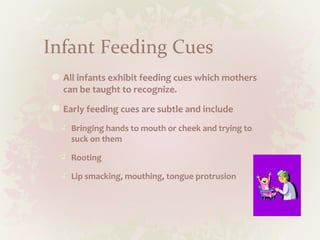
All infants exhibit feeding cues which mothers
can be taught to recognize.
Early feeding cues are subtle and include
Bringing hands to mouth or cheek and trying to
suck on them
Rooting
Lip smacking, mouthing, tongue protrusion
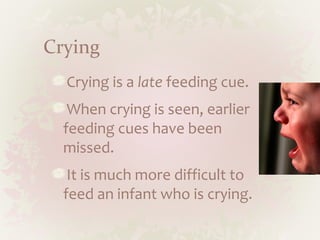
Crying
Crying is a late feeding cue.
When crying is seen, earlier
feeding cues have been
missed.
It is much more difficult to
feed an infant who is crying.
Recognizing Correct Latch-On
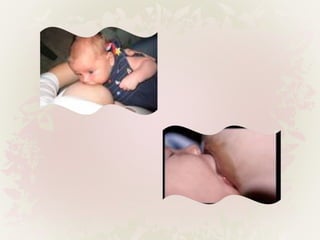
Correct latch involves three aspects:
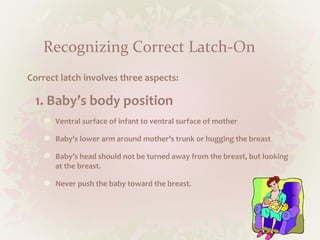
1. Baby’s body position
Ventral surface of infant to ventral surface of mother
Baby’s lower arm around mother’s trunk or hugging the breast
Baby’s head should not be turned away from the breast, but looking
at the breast.
Never push the baby toward the breast.
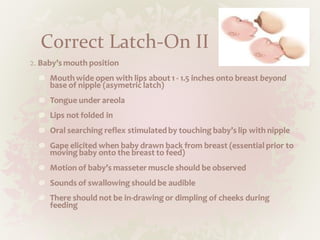
Correct Latch-On II
Correct Latch-On III
Suckling Behavior at the
Breast
Average newborn swallow is 0.6 ml at the
breast.
Stomach size is very small. Parents and
health care providers should have realistic
expectations regarding the volume the
newborn stomach can hold at each feed.
With time, the amount of milk per suck
increases.
Changes in suck-swallow ratios relate to
availability of milk via flow
Suckling
The nipple should not move in and out of the
baby’s mouth during suckling.
The mother of an infant with poor suck may be
advised to hand express or pump for extra
stimulation to increase milk production.
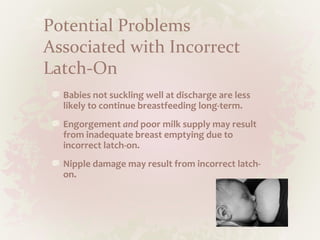
Potential Problems
Associated with Incorrect
Latch-On
Babies not suckling well at discharge are less
likely to continue breastfeeding long-term.
Engorgement and poor milk supply may result
from inadequate breast emptying due to
incorrect latch-on.
Nipple damage may result from incorrect latch-
on.
Potential Problems II
Lengthy feedings caused by poor milk transfer
may leave mother with sense of inadequacy and
failure and/or a desire to discontinue
breastfeeding.
An association has been found between the use
of analgesia/anesthesia and delay of effective
sucking.
Birth Routines Associated
with Correct Latch-On
Uninterrupted skin-to-skin after birth
Breastfeeding within the first hour of life
Rooming-in 24 hours a day with minimal separation during
stay
Knowledgeable observation of feedings with guidance for
correct positioning and latch-on
Frequent nursing “on cue”
Breastfeeding Module 3: Session 7

Breastfeeding Module 3: Session 7

  • 1.
    Helping with aBreastfeed- Step 5
  • 2.
  • 3.
    Getting breastfeeding correct fromthe beginning is crucial to long-term breastfeeding success!
  • 4.
    Infant Feeding Cues Allinfants exhibit feeding cues which mothers can be taught to recognize. Early feeding cues are subtle and include Bringing hands to mouth or cheek and trying to suck on them Rooting Lip smacking, mouthing, tongue protrusion
  • 5.
    Crying Crying is alate feeding cue. When crying is seen, earlier feeding cues have been missed. It is much more difficult to feed an infant who is crying.
  • 6.
    Recognizing Correct Latch-On Correctlatch involves three aspects: 1. Baby’s body position Ventral surface of infant to ventral surface of mother Baby’s lower arm around mother’s trunk or hugging the breast Baby’s head should not be turned away from the breast, but looking at the breast. Never push the baby toward the breast.
  • 7.
  • 8.
  • 9.
    Suckling Behavior atthe Breast Average newborn swallow is 0.6 ml at the breast. Stomach size is very small. Parents and health care providers should have realistic expectations regarding the volume the newborn stomach can hold at each feed. With time, the amount of milk per suck increases. Changes in suck-swallow ratios relate to availability of milk via flow
  • 10.
    Suckling The nipple shouldnot move in and out of the baby’s mouth during suckling. The mother of an infant with poor suck may be advised to hand express or pump for extra stimulation to increase milk production.
  • 11.
    Potential Problems Associated withIncorrect Latch-On Babies not suckling well at discharge are less likely to continue breastfeeding long-term. Engorgement and poor milk supply may result from inadequate breast emptying due to incorrect latch-on. Nipple damage may result from incorrect latch- on.
  • 12.
    Potential Problems II Lengthyfeedings caused by poor milk transfer may leave mother with sense of inadequacy and failure and/or a desire to discontinue breastfeeding. An association has been found between the use of analgesia/anesthesia and delay of effective sucking.
  • 13.
    Birth Routines Associated withCorrect Latch-On Uninterrupted skin-to-skin after birth Breastfeeding within the first hour of life Rooming-in 24 hours a day with minimal separation during stay Knowledgeable observation of feedings with guidance for correct positioning and latch-on Frequent nursing “on cue”