Zombies i trafiken: Effekter av
    kognitiv distraktion på
körprestatation och olycksrisk

      Johan Engström, Volvo Technology
     Transportforum, Linköping 2011-01-13
Driver distraction
• Currently hot topic
   – On top of the road safety agenda in the
     US (see distraction.gov)
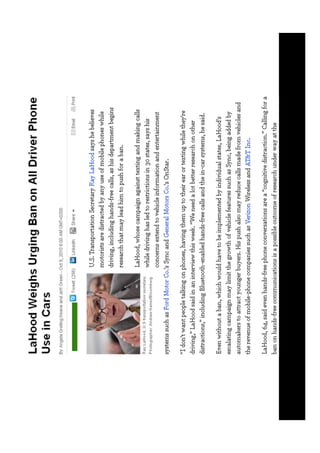
   – Mobile phone debate in Sweden
• Recent NHTSA statistics
   – 16% of fatal crashes and 20% of injury
     crashes involved reports of distracted
     driving (DOT HS 811 379)
What is driver distraction?


                           (US-EU Focus Group on Driver Distraction, Berlin, April, 2010)


• Two main types
  – Visual: Diversion of visual attention and gaze
     • Examples: Radio tuning, phone dialling, text messaging,
       looking at roadside events
  – Cognitive: Diversion of non-visual attention
     • Examples: Daydreaming, phone/passenger conversation,
       speech interface control
Effects of visual distraction (VTTI CVO study)


                                  (Hanowski et al, in review)
Cognitive distraction – inconsistent results!
•    Experimental studies
      – Delayed event detection/response (Horrey and Wickens, 2005; Caird et al., 2004)
           • However
                  – Many studies used artificial stimuli (e.g. PDT) (e.g. Swedish Mobile Phone Investigation, Patten et
                    al., 2003)
                  – Effect in lead vehicle braking studies depends on initial time headway (Engström, 2010)
                  – No effect when brake lights are turned off (Muttart et al., 2007)
      – Lateral control
           • Impairment found for artificial tracking/driving tasks (Briem and Hedman, 1995; Strayer et
             al., 2001; Creem and Profitt, 2001; Just, Keller and Cynkar; 2008 )
           • Improvement during cognitive task operation found for normal lane keeping performance
             (Östlund et al., 2004; Törnros and Bolling, 2005; Engström et al., 2005; Jamson and
             Merat, 2005; Mattes, Föhl and Schindhelm, 2007; Merat and Jamson, 2008).
•    Crash risk
      – Epidemiological studies: 4 times higher crash risk for mobile phone conversation
        (Redelmeier and Tibshirami, 1997; McEvoy et al., 2005)
      – Naturalistic driving: No increased crash/near crash risk (Dingus et al., 2006) or
        lower risk (Olson et. al. 2009) for mobile phone conversation
”Standard” information processing bottleneck models
(Pashler and Johnston, 1998; Salvucci and Taatgen, 2007)

• General prediction: Cognitive distraction -> general slow down in
  cognitive functioning -> general impairment in driving (slower
  response, impaired lateral control)
• Inconsistent with the data!


     Auditory                                               Vocal


     Visual                                                 Manual
                              Cognition
                              (bottleneck)
                                                           Response
      Perception
A possible alternative explanation: The zombie
                  hypothesis
”Zombie” behaviour (Koch, 2004)

• The application of routine, overlearned and automated,
  unconscious
• The ”default” case in everyday driving
• Includes basic actions (e.g., looking, braking, turning) as
  well as more complex sequences of actions (e.g.,
  negotiating intersections, overtaking)
• Driven top-down by contextual cues
• Fast but inflexible and stereotyped
• May involve implicit learning
Cognitive control

• May override zombie behaviour when needed/desired
• Deployed in novel or difficult situations that require
  flexibility, or when one is motivated to optimise
  performance
• Effortful and associated with conscious awareness
• Example:
   – Stroop task: Green, Blue, Red
   – Crossing the street in the UK
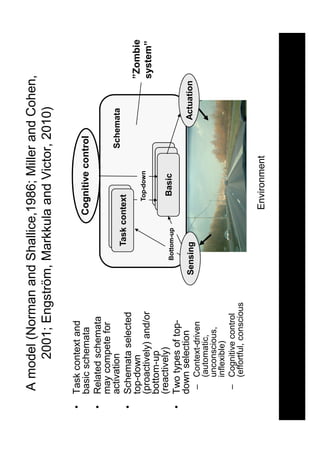
A model (Norman and Shallice,1986; Miller and Cohen,
        2001; Engström, Markkula and Victor, 2010)

•   Task context and
    basic schemata                            Cognitive control
•   Related schemata
    may compete for
    activation                        Task context           Schemata
                                     Task context
•   Schemata selected
    top-down                                                                  ”Zombie
                                                 Top-down
    (proactively) and/or                                                      system”
    bottom-up
    (reactively)                                  Schemata
                                                 Schemata
                                                  Basic
                                  Bottom-up
•   Two types of top-
    down selection             Sensing                            Actuation
     – Context-driven
       (automatic,
       unconscious,
       inflexible)
     – Cognitive control
       (effortful, conscious

                                               Environment
The zombie hypothesis

                                                  Cognitive control
•   Cognitive distraction
    involves working memory
    load                                                           Schemata
•   Working memory requires
    cognitive control to sustain               Phone                           ”Zombie
    activation of schemata in                conversation
                                                                               system”
    the absence of stimulus
    input                                            Lane keeing
•   Lack of cognitive control
    to other tasks -> zombie
                                   Sensing                              Actuation
    behaviour


                                                    Environment
Predictions
• General:
   – Cognitive distraction leads to zombie behaviour (stereotyped, inflexible,
     but still efficient in routine situations)
   – Cognitive distraction affects only non-routine (non-zombie) behaviours –
     i.e., those that rely on cognitive control
• Specific:
   – Intact performance
       •   Normal lane keeping
       •   Basic avoidance responses to closing objects (looming)
       •   Basic visual orientation to salient objects
       •   Context-driven implicit learning
   – Impaired performance
       •   Novel/difficult lateral control tasks
       •   Fast braking responses to brake lights
       •   Utilisation of non-routine predictive cues
       •   Semantic interpretation and encoding
       •   Flexible adaptation
Evidence
•   Left intact
     – Normal lane keeping (Östlund et al., 2004; Törnros and Bolling, 2005; Engström
       et al., 2005; Jamson and Merat, 2005; Mattes, Föhl and Schindhelm, 2007; Merat
       and Jamson, 2008)
     – Basic avoidance responses to closing objects (looming) (Muttart et al., 2007;
       Engström et al., in prep)
     – Basic visual orientation to salient objects (Strayer et al., 2003; Engström et al., in
       prep)
     – Context-driven implicit learning (Chun and Jiang, 1998; Engström et al., 2010)
•   Impaired
     – Novel/difficult lateral control tasks (Briem and Hedman, 1995; Strayer et al.,
       2001; Creem and Profitt, 2001)
     – Speeded braking responses to brake lights (Alm & Nilsson, 1995; Brookhuis, de
       Vries & de Ward, 1991; Lee et al., 2001; Salvucci and Beltowska, 2008; Strayer,
       Drews & Johnston. 2003; Strayer & Drews, 2004; Engström, Ljung Aust and
       Viström, 2010)
     – Utilisation of non-routine predictive cues (Muttart et al., 2007; Baumann et al.,
       2007)
     – Semantic interpretation and encoding (Strayer et al., 2003; Engström et al, 2010)
     – Flexible adaptation (Engström et al., in prep)
Example data: Glances to oncoming car
                                      Zombie learning                            Zombie behaviour                                                 Flexible adaptation
                            3,5                                                                                  3


                             3                                                                                  2,5


                            2,5
                                                                                                                 2

                             2
                                                                       No load                                                                                 No load
                                                                                                                1,5
                                                                       WM load                                                                                 WM load
                            1,5

                                                                                                                 1


 Number of glances to car
                             1


                                                                                  Mean glance duration to car
                            0,5                                                                                 0,5


                             0                                                                                   0
                                  1    2       3       4       5   6
                                                                                                                      1   2    3              4     5    6
                                           Scenario exposure
                                                                                                                                   Exposure


                            Number of glances towards car                                                       Mean duration of glances towards car


Implicit learning (”crude adaptation”)                                                                                Flexible adaptation only for
                                                                                                                      non-loaded drivers
Example data: Brake onset time

                                 1,2

                                                                                   No load
                                   1                                               WM load


                                 0,8
                                                                    WM load

                                 0,6                                              Flexible adaptation
Zombie
response
                                 0,4


                                 0,2


           Brake response time
                                                          No load

                                   0
                                        1   2      3         4          5     6

                                 -0,2


                                 -0,4
                                                Scenario exposure
Example data: Anticipatory braking

Proportion of                                                      Flexible adaptation
anticipatory
                        0,40
braking (before event
onset)

                        0,30

                                                 No load

                        0,20


                        0,10
                                                     WM load


                        0,00


                               1   2   3         4         5   6

Zombie response                            rep
Example data: Visual response time for first exposure

               0,80


               0,60


               0,40


     Mean RT
               0,20


               0,00
                         0             1

                      No load   WM   WM load
Does cognitive distraction increase crash risk?

• At least not through delayed last-second avoidance
  responses or impaired lane keeping
• However, may contribute to the development of critical
  situations when zombie behaviour is insufficient to deal
  with the situation
• This would not be expected to show up in current
  naturalistic data analyses – only analysed 5 seconds
  prior to the event
• May explain discrepancy between naturalistic and
  epidemiological studies…
Conclusions

• Cognitive distraction affects some aspects of driving
  performance but leave others intact
• Zombie hypothesis: Should only affect non-routine
  activities
• Generally supported by existing data
• Further experimental work is needed to further validate
  the hypothesis

Session 48 Johan Engström

  • 1.
    Zombies i trafiken:Effekter av kognitiv distraktion på körprestatation och olycksrisk Johan Engström, Volvo Technology Transportforum, Linköping 2011-01-13
  • 2.
    Driver distraction • Currentlyhot topic – On top of the road safety agenda in the US (see distraction.gov) – Mobile phone debate in Sweden • Recent NHTSA statistics – 16% of fatal crashes and 20% of injury crashes involved reports of distracted driving (DOT HS 811 379)
  • 4.
    What is driverdistraction? (US-EU Focus Group on Driver Distraction, Berlin, April, 2010) • Two main types – Visual: Diversion of visual attention and gaze • Examples: Radio tuning, phone dialling, text messaging, looking at roadside events – Cognitive: Diversion of non-visual attention • Examples: Daydreaming, phone/passenger conversation, speech interface control
  • 5.
    Effects of visualdistraction (VTTI CVO study) (Hanowski et al, in review)
  • 6.
    Cognitive distraction –inconsistent results! • Experimental studies – Delayed event detection/response (Horrey and Wickens, 2005; Caird et al., 2004) • However – Many studies used artificial stimuli (e.g. PDT) (e.g. Swedish Mobile Phone Investigation, Patten et al., 2003) – Effect in lead vehicle braking studies depends on initial time headway (Engström, 2010) – No effect when brake lights are turned off (Muttart et al., 2007) – Lateral control • Impairment found for artificial tracking/driving tasks (Briem and Hedman, 1995; Strayer et al., 2001; Creem and Profitt, 2001; Just, Keller and Cynkar; 2008 ) • Improvement during cognitive task operation found for normal lane keeping performance (Östlund et al., 2004; Törnros and Bolling, 2005; Engström et al., 2005; Jamson and Merat, 2005; Mattes, Föhl and Schindhelm, 2007; Merat and Jamson, 2008). • Crash risk – Epidemiological studies: 4 times higher crash risk for mobile phone conversation (Redelmeier and Tibshirami, 1997; McEvoy et al., 2005) – Naturalistic driving: No increased crash/near crash risk (Dingus et al., 2006) or lower risk (Olson et. al. 2009) for mobile phone conversation
  • 7.
    ”Standard” information processingbottleneck models (Pashler and Johnston, 1998; Salvucci and Taatgen, 2007) • General prediction: Cognitive distraction -> general slow down in cognitive functioning -> general impairment in driving (slower response, impaired lateral control) • Inconsistent with the data! Auditory Vocal Visual Manual Cognition (bottleneck) Response Perception
  • 8.
    A possible alternativeexplanation: The zombie hypothesis
  • 9.
    ”Zombie” behaviour (Koch,2004) • The application of routine, overlearned and automated, unconscious • The ”default” case in everyday driving • Includes basic actions (e.g., looking, braking, turning) as well as more complex sequences of actions (e.g., negotiating intersections, overtaking) • Driven top-down by contextual cues • Fast but inflexible and stereotyped • May involve implicit learning
  • 10.
    Cognitive control • Mayoverride zombie behaviour when needed/desired • Deployed in novel or difficult situations that require flexibility, or when one is motivated to optimise performance • Effortful and associated with conscious awareness • Example: – Stroop task: Green, Blue, Red – Crossing the street in the UK
  • 11.
    A model (Normanand Shallice,1986; Miller and Cohen, 2001; Engström, Markkula and Victor, 2010) • Task context and basic schemata Cognitive control • Related schemata may compete for activation Task context Schemata Task context • Schemata selected top-down ”Zombie Top-down (proactively) and/or system” bottom-up (reactively) Schemata Schemata Basic Bottom-up • Two types of top- down selection Sensing Actuation – Context-driven (automatic, unconscious, inflexible) – Cognitive control (effortful, conscious Environment
  • 12.
    The zombie hypothesis Cognitive control • Cognitive distraction involves working memory load Schemata • Working memory requires cognitive control to sustain Phone ”Zombie activation of schemata in conversation system” the absence of stimulus input Lane keeing • Lack of cognitive control to other tasks -> zombie Sensing Actuation behaviour Environment
  • 13.
    Predictions • General: – Cognitive distraction leads to zombie behaviour (stereotyped, inflexible, but still efficient in routine situations) – Cognitive distraction affects only non-routine (non-zombie) behaviours – i.e., those that rely on cognitive control • Specific: – Intact performance • Normal lane keeping • Basic avoidance responses to closing objects (looming) • Basic visual orientation to salient objects • Context-driven implicit learning – Impaired performance • Novel/difficult lateral control tasks • Fast braking responses to brake lights • Utilisation of non-routine predictive cues • Semantic interpretation and encoding • Flexible adaptation
  • 14.
    Evidence • Left intact – Normal lane keeping (Östlund et al., 2004; Törnros and Bolling, 2005; Engström et al., 2005; Jamson and Merat, 2005; Mattes, Föhl and Schindhelm, 2007; Merat and Jamson, 2008) – Basic avoidance responses to closing objects (looming) (Muttart et al., 2007; Engström et al., in prep) – Basic visual orientation to salient objects (Strayer et al., 2003; Engström et al., in prep) – Context-driven implicit learning (Chun and Jiang, 1998; Engström et al., 2010) • Impaired – Novel/difficult lateral control tasks (Briem and Hedman, 1995; Strayer et al., 2001; Creem and Profitt, 2001) – Speeded braking responses to brake lights (Alm & Nilsson, 1995; Brookhuis, de Vries & de Ward, 1991; Lee et al., 2001; Salvucci and Beltowska, 2008; Strayer, Drews & Johnston. 2003; Strayer & Drews, 2004; Engström, Ljung Aust and Viström, 2010) – Utilisation of non-routine predictive cues (Muttart et al., 2007; Baumann et al., 2007) – Semantic interpretation and encoding (Strayer et al., 2003; Engström et al, 2010) – Flexible adaptation (Engström et al., in prep)
  • 15.
    Example data: Glancesto oncoming car Zombie learning Zombie behaviour Flexible adaptation 3,5 3 3 2,5 2,5 2 2 No load No load 1,5 WM load WM load 1,5 1 Number of glances to car 1 Mean glance duration to car 0,5 0,5 0 0 1 2 3 4 5 6 1 2 3 4 5 6 Scenario exposure Exposure Number of glances towards car Mean duration of glances towards car Implicit learning (”crude adaptation”) Flexible adaptation only for non-loaded drivers
  • 16.
    Example data: Brakeonset time 1,2 No load 1 WM load 0,8 WM load 0,6 Flexible adaptation Zombie response 0,4 0,2 Brake response time No load 0 1 2 3 4 5 6 -0,2 -0,4 Scenario exposure
  • 17.
    Example data: Anticipatorybraking Proportion of Flexible adaptation anticipatory 0,40 braking (before event onset) 0,30 No load 0,20 0,10 WM load 0,00 1 2 3 4 5 6 Zombie response rep
  • 18.
    Example data: Visualresponse time for first exposure 0,80 0,60 0,40 Mean RT 0,20 0,00 0 1 No load WM WM load
  • 19.
    Does cognitive distractionincrease crash risk? • At least not through delayed last-second avoidance responses or impaired lane keeping • However, may contribute to the development of critical situations when zombie behaviour is insufficient to deal with the situation • This would not be expected to show up in current naturalistic data analyses – only analysed 5 seconds prior to the event • May explain discrepancy between naturalistic and epidemiological studies…
  • 20.
    Conclusions • Cognitive distractionaffects some aspects of driving performance but leave others intact • Zombie hypothesis: Should only affect non-routine activities • Generally supported by existing data • Further experimental work is needed to further validate the hypothesis