UNIT II
Social Media marketing
Presented By:
Saurabh Singh Tomar
Asst. Prof.(CSE)
UCER, Prayagraj
Introduction
 Social media marketing is the process of creating content for
social media platforms to promote your products and/or
services, build community with your target audience, and
drive traffic to your business. With new features and platforms
emerging every day, social media marketing is constantly
evolving.
 Social media marketing is all about meeting your target
audience and customers where they are and as they socially
interact with each other and your brand.
Social media marketing platform
 Facebook
 Twitter
 Instagram
 LinkedIn
 Youtube
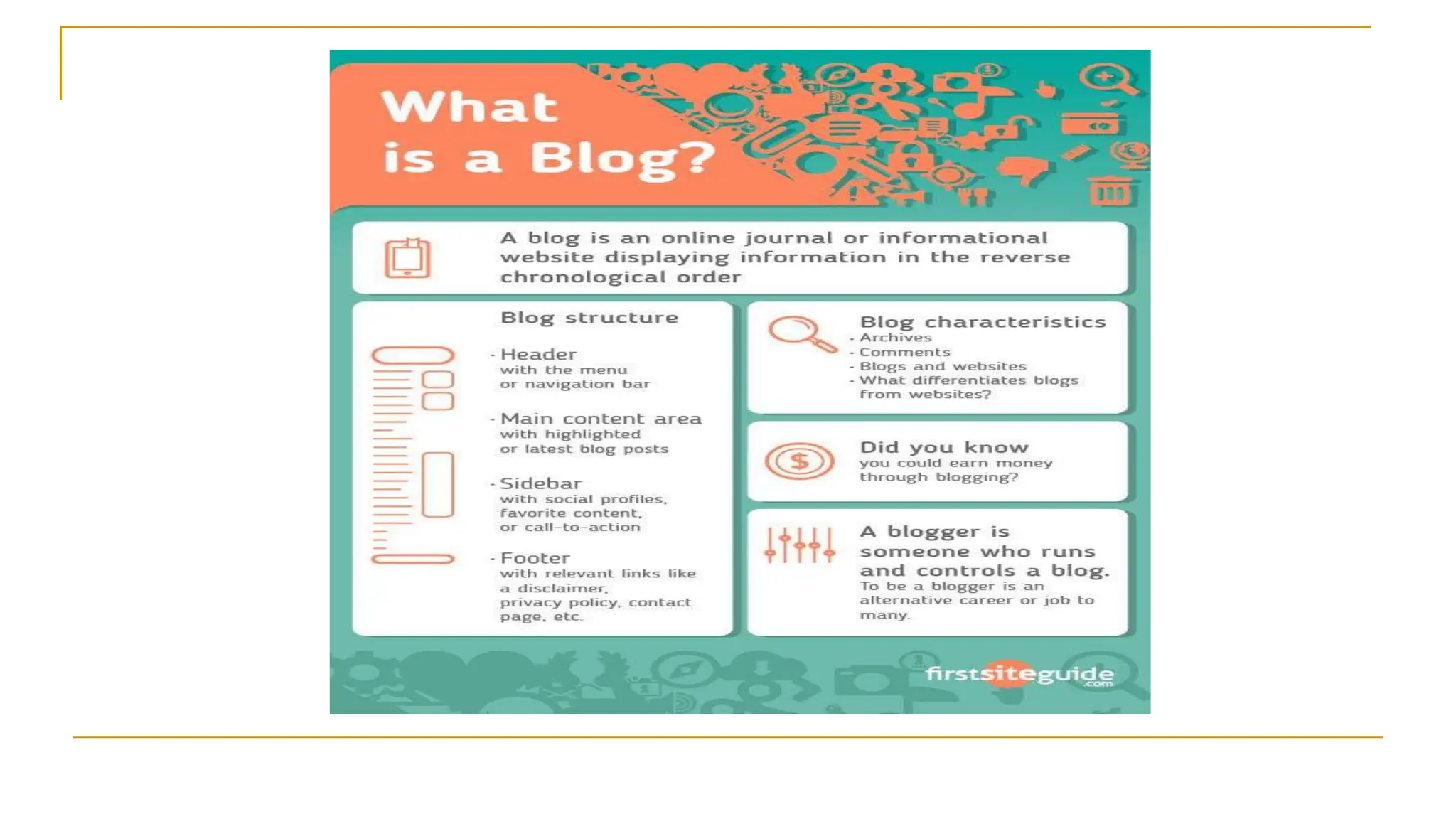
Blogging
 The term blog comes from the combination of "web" and "log"
or "weblog," and was eventually shortened to "blog."
 In the 1990s when blogs first appeared, they were primarily
online diaries, where people would provide personal accounts
of their lives. They since have grown to include writing and
media on topics such as news, politics, music, food, business,
and much more—there are even blogs about blogging.
What Is a Blog Used For?
 To Educate Others and Build Online Presence
 To Help a Business With Brand Awareness
 To Promote Programs And Attract Visitors
Types of Blogs
 Personal blog. This type of blog usually works like an online diary where the
blogger shares opinions, often not aiming to reach a target audience or sell
an item. Personal blogs can discuss various subjects, from family events and
self-reflection to work projects.
 Niche blog. Provides information on a particular topic, usually related to the
blogger’s passions, skills, and knowledge. Examples of this blog
type include book blogs, food blogs, and lifestyle blogs.
 Multimedia blog. It uses a blog format but publishes multimedia content, like
videos and podcasts, instead of written posts. It also usually includes the
video or podcast’s summary, table of contents, and essential quotes.
Cont…
 News blog. Content on this blog focuses on the latest happenings and new
releases in a specific industry. Unlike other blogs, news blogs typically do not
usually include opinions or personal content.
 Company or business blog. Its primary purpose is publishing content
relevant to a company’s industry or updating the target market regarding any
changes within its business. It may be a section on a company website or an
independent site.
 Affiliate blog. A blog based on affiliate marketing – the practice of
promoting a third party’s products and services. Affiliate blog owners will
receive a commission when someone purchases from their custom links.
Typical articles on this blog include product reviews and “best-of” listicles.
 Reverse blog. Also known as group blogs, multiple authors create blog posts
on related topics and the blog owner is the one who proofreads and posts
What Blog Marketing Is
 Blog marketing is all about using a blog to reach your target
audience, and hopefully direct attention to your business.
Business owners using blogs to market their brands will post a
variety of content, including written posts, pictures, videos, and
even audio recordings, in order to attract more customers.
 Most of the time, these posts are meant to educate the readers
about a certain aspect of an industry or reveal some ‘behind the
scenes’ information about the business, all while subtly promoting
the products and services being offered. Some business owners
even use their blogs as a source of feedback, asking their
customers to leave their opinions and suggestions in the
comments!
How to Do Blog Marketing
1. Make a Blog Marketing Plan: What are you going to share on your blog?
News, tips, resources, etc? How often will you update your blog? (Daily,
weekly, etc.)
2. Create Your Blog: Decide on your blogging platform, and set it up, including
customization that fits your business. Be sure to use the same logo on your
blog as on your website (if you have a separate website) to retain
consistency. If you use a free blog platform (not recommended for business
blogging), have a domain name pointing to the blog to make it easier for
consumers to get to your site.
3. Fill Your Blog with Several Posts ASAP: Readers don't like to visit a blog
with only one or two posts. Add ten or more posts quickly to start out, and
then switch to your regular post schedule.
Cont…
 Market Your Blog: It's very easy to integrate social media into your blogs so
that your blog posts go out to your followers. Include your blog on your
marketing materials as well.
 Reply to Comments: Remember, blogs are social, so people will ask
questions, provide feedback, or share their opinion. Delete spam posts.
The Pros of Blog Marketing
 Inexpensive to Start and Run: For the cost of a domain name and web
hosting, you can have a customized blog marketing setup.
 Easy to Use: Most blogging platforms are simple to use. If you can copy,
paste, type, drag and drop, and upload, you can have a professional-looking
blog.
 Builds Website Traffic: Offering tips, updates, and other new content gives
people a reason to come and return to your business website, which gives
them the opportunity to buy.
 Improves Search Engine Ranking: Google, in particular, likes to find and
rank new content. For that reason, many entrepreneurs use blogging
specifically for search engine optimization (SEO).
Cont…
 Creates More Opportunities for Revenue: You can accept
advertising, promote affiliate products and get sponsors, adding additional
sources of revenue to your business.
The Cons of Blog Marketing
1. Can Be Time-Consuming: Creating new content and updating your blog
can take a significant amount of time. Hiring freelance writers and a virtual
assistant can help.
2. Needs a Constant Stream of Ideas: Along with time, thinking of new
content ideas is one of the biggest challenges bloggers face.
3. It Can Take Time to See Results: It can take time to begin building an
audience for your blog—you won't necessarily see traffic right away.
Social Media Marketing Platforms
1. Facebook
• Users: 1.9 billion daily active users worldwide
• Audience: An even spread of Generation X and Millennials
• Industry impact: B2C
• Best for: Brand awareness; advertising
Facebook is the largest social media platform and the most
established. Since its launch in 2004, it has become an
invaluable tool for B2C businesses, offering advanced
advertising tools as well as organic opportunities.
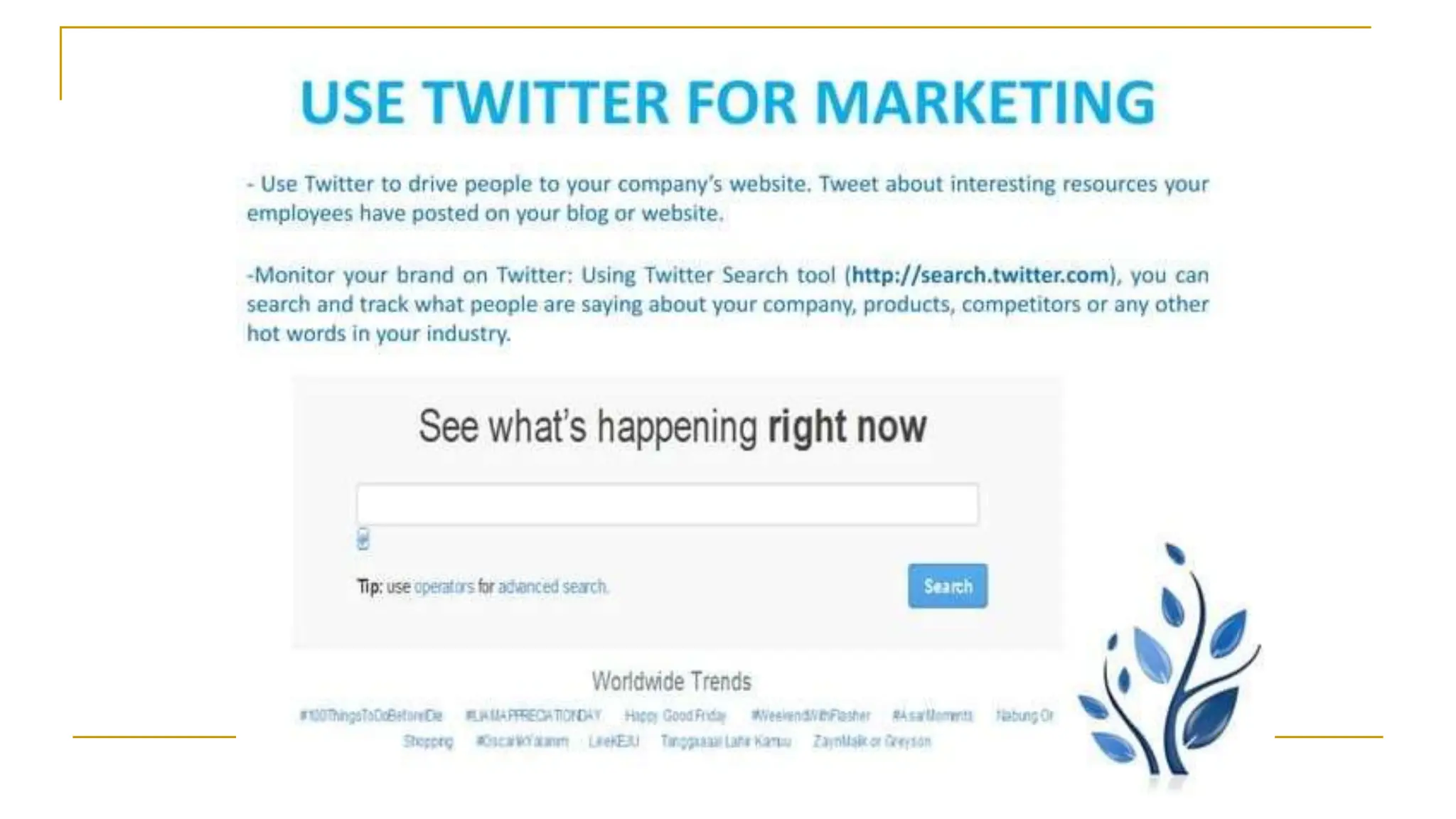
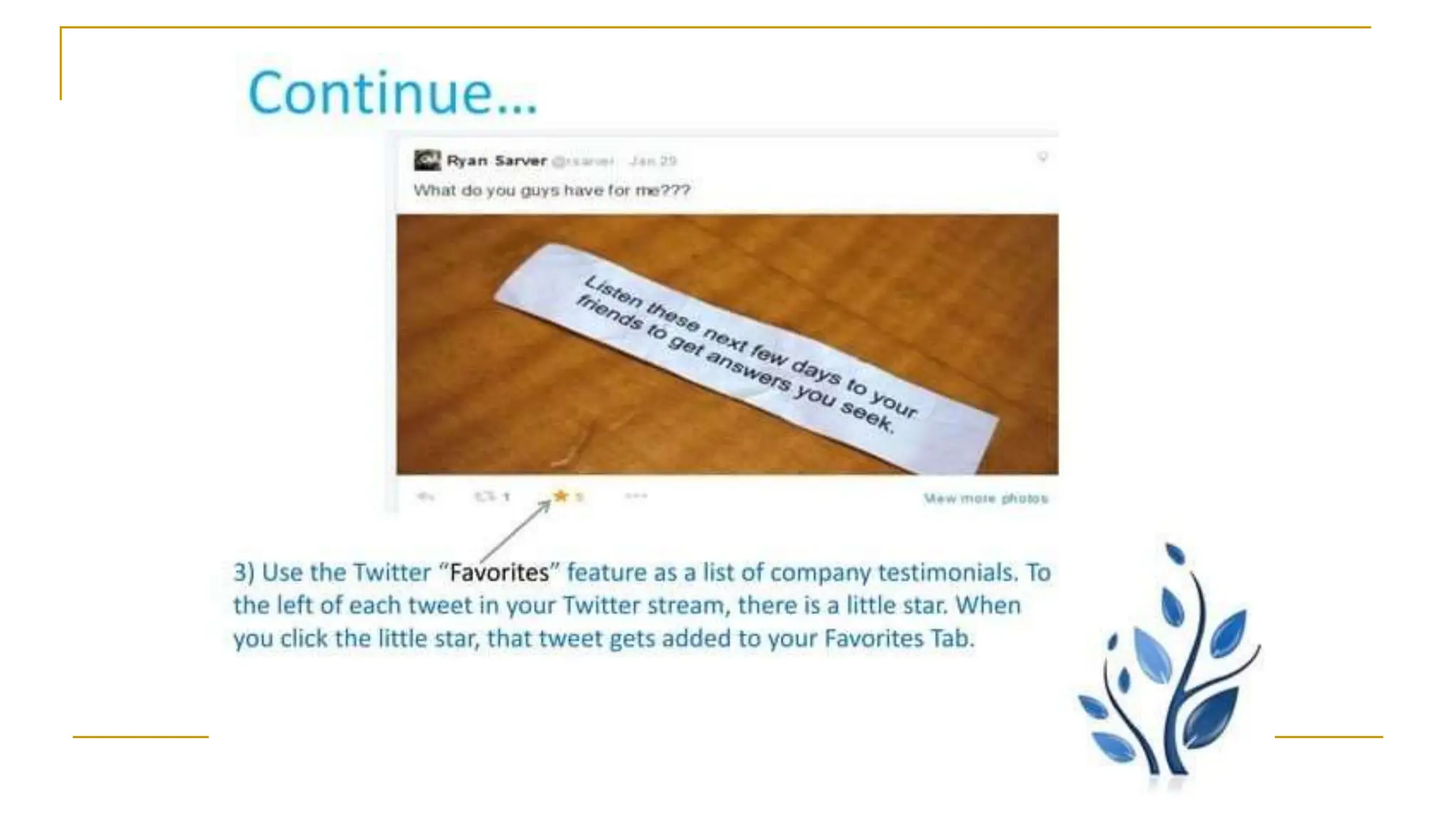
2. Twitter
• Users: 211 million daily active users worldwide
• Audience: Primarily Millennials
• Best for: Public relations; customer service; community
building
While Instagram focuses on visuals, Twitter focuses on words.
Since the early days of 140-character Tweets, the platform has
now expanded to include an audio tool called Twitter Spaces, a
community-building tool called Twitter Communities,
and Twitter Moments to share interesting content with your
followers.
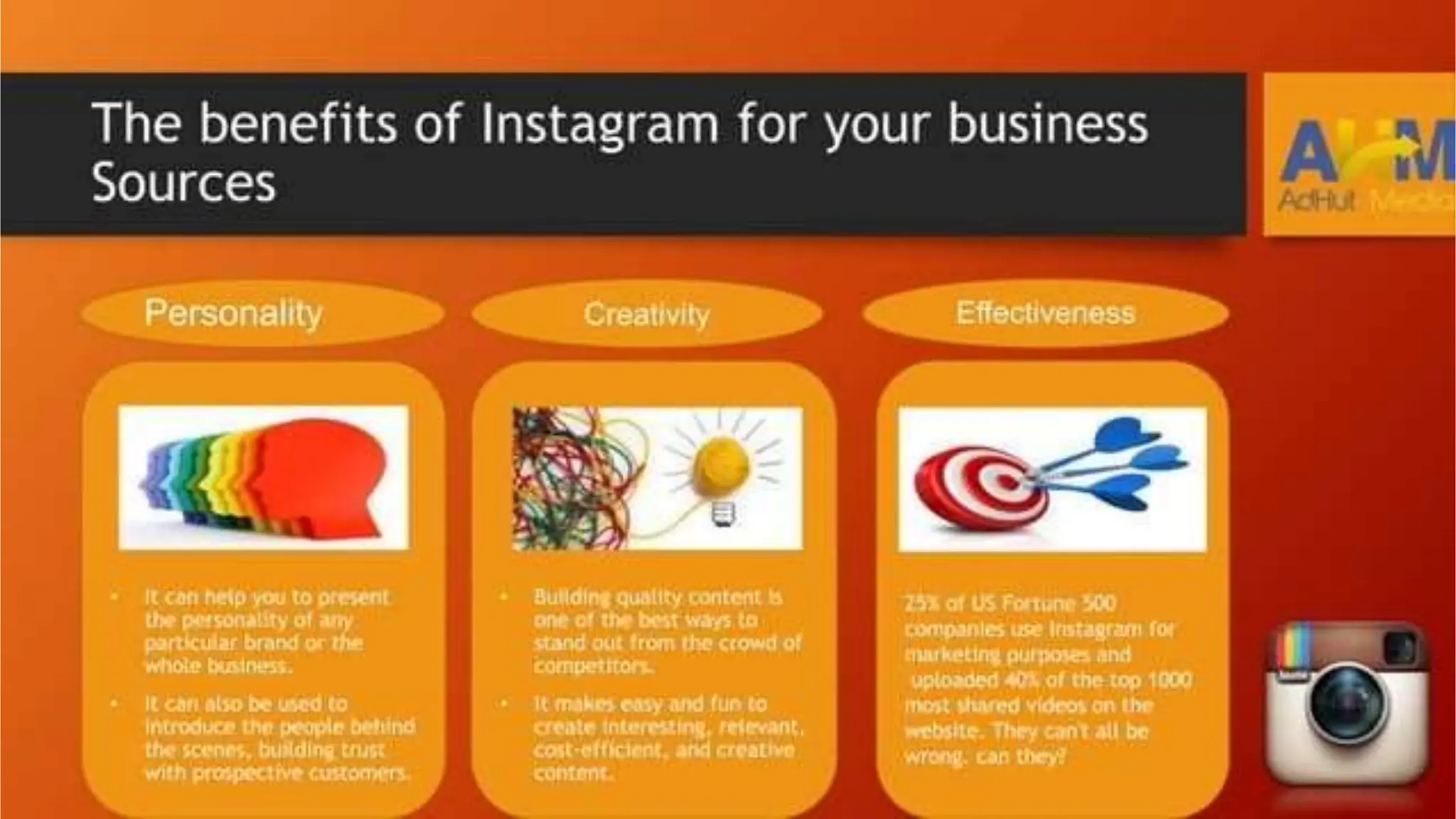
4. Instagram
• Users: 1 billion monthly active users
• Audience: Primarily Millennials
• Industry impact: B2C
• Best for: High-quality images and videos; user-generated
content; advertising
Today, users can discover brands, browse their products and/or
service, and complete a purchase without ever leaving the app
– making Instagram a hard platform to beat.
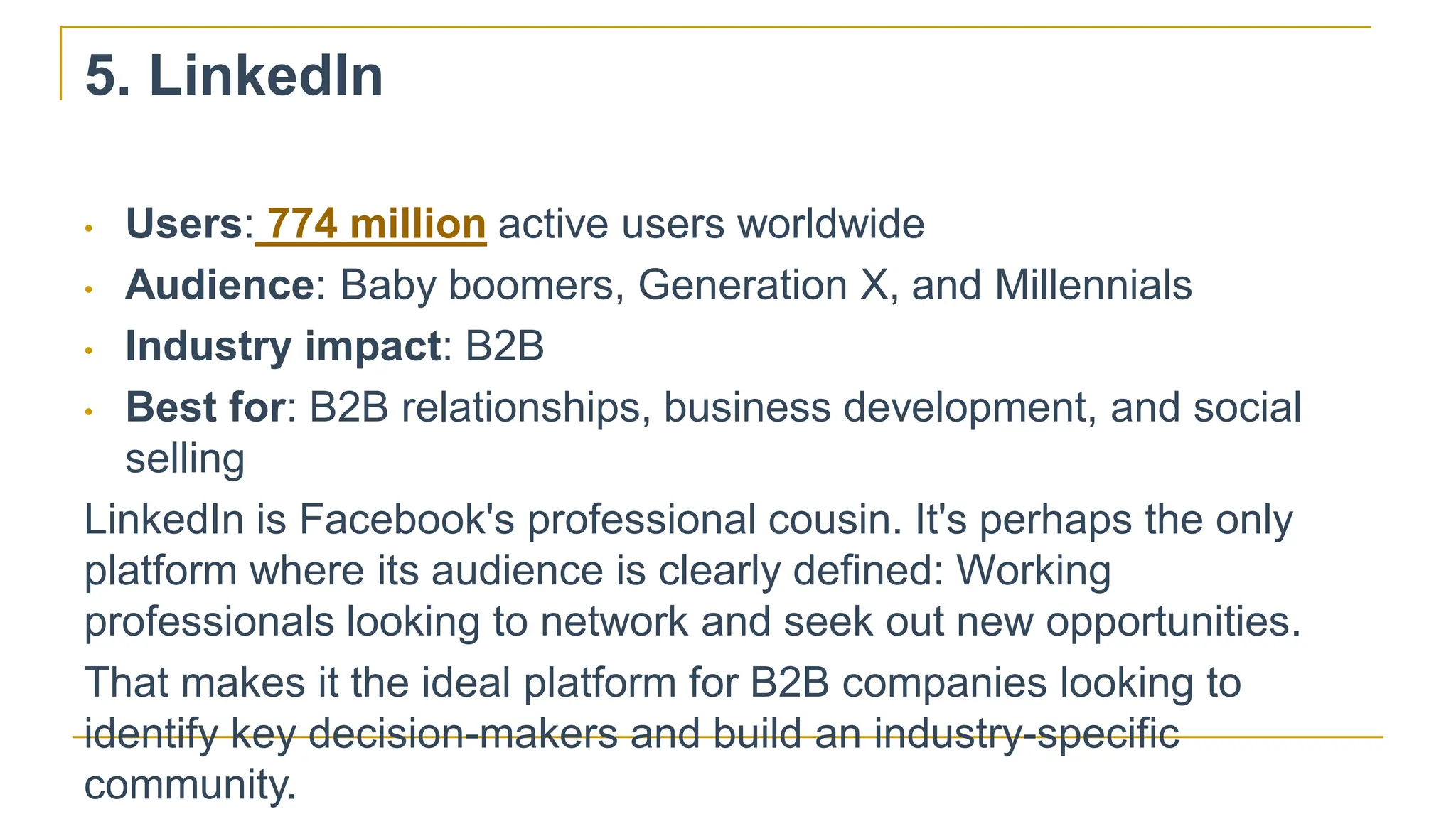
5. LinkedIn
• Users: 774 million active users worldwide
• Audience: Baby boomers, Generation X, and Millennials
• Industry impact: B2B
• Best for: B2B relationships, business development, and social
selling
LinkedIn is Facebook's professional cousin. It's perhaps the only
platform where its audience is clearly defined: Working
professionals looking to network and seek out new opportunities.
That makes it the ideal platform for B2B companies looking to
identify key decision-makers and build an industry-specific
community.
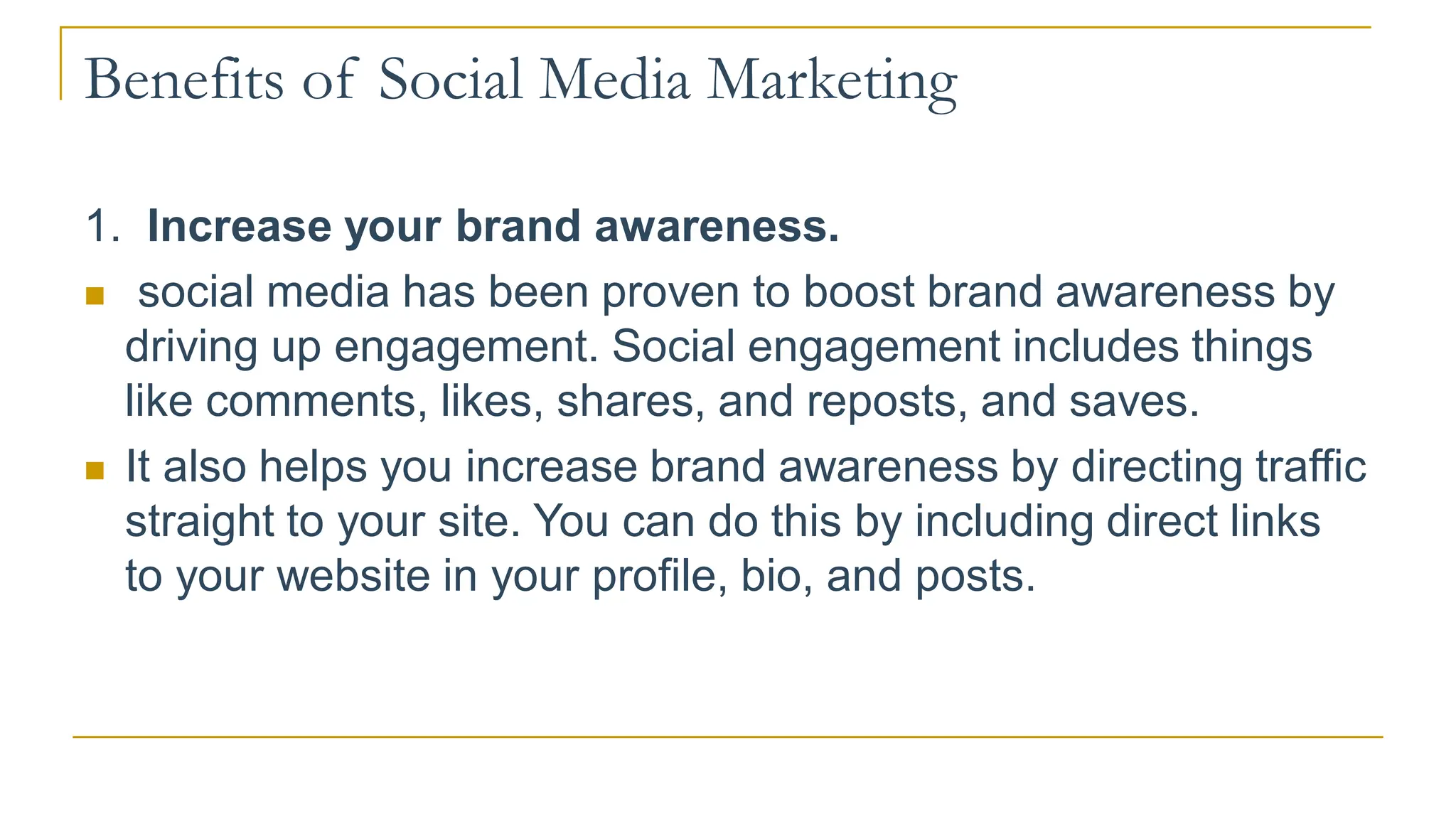
Benefits of Social Media Marketing
1. Increase your brand awareness.
 social media has been proven to boost brand awareness by
driving up engagement. Social engagement includes things
like comments, likes, shares, and reposts, and saves.
 It also helps you increase brand awareness by directing traffic
straight to your site. You can do this by including direct links
to your website in your profile, bio, and posts.
Cont..
2. Generate leads and boost conversions.
 Promoting and sharing your products on social media is a simple way to
improve lead generation, boost conversions, and increase sales because
you're advertising to people who have opted to engage with you by following
your account.
3. Foster relationships with your customers.
 By connecting and engaging with your social media followers, you'll be able
to build lasting relationships between them and your business. You can do
this by interacting with them on your posts, responding to their questions and
comments, and providing them with any help they may need.
 You can also ask your followers questions about your products, their pain
points, or create giveaways to help you build trust and show them how much
you value their input and support.
Cont..
4. Learn from your competitors.
 Social media is a great way to keep tabs on your competitors
— whether that's in reference to their social media tactics, the
products they're promoting, the campaigns they're
implementing, or their level of interaction with followers.
 Social media allows you to get a look at what is and isn't
working for your competition, and therefore helps you decide
what should or shouldn't change in terms of your company's
approach.
How to Create a Social Media Marketing Strategy
Step 1: Research your buyer personas and audience.
 The first step to creating a social media marketing strategy is to determine
who your buyer personas and audience are so you can target their needs
and interests appropriately.
Step 2: Determine which social platforms you'll market on.
 As a social media marketer, it's crucial you determine which platforms you're
going to share your content on.
 There's not necessarily a right or wrong answer when it comes to which
social channels your business should use — it's more about the needs of
your target audience and where they tend to spend their time.
 "It's important to be where your audience of potential customers is today, and
where they might be tomorrow," said Andrew Delaney, former social media
marketing manager at HubSpot. "It's better to be ahead of the curve than
behind."
Cont..
Step 3: Establish your most important metrics and KPIs.
 No matter your goals or industry, your social media strategy
should be data-driven.
 That means focusing on the social media metrics that matter.
Rather than focus on vanity metrics, dig into data that aligns
directly with your goals.
 What metrics are we talking about? Check out the breakdown
below:
Cont..
Step 4: Get to know your competition.
 A competitive analysis allows you to understand who the
competition is and what they’re doing well (and not so well).
You’ll get a good sense of what’s expected in your industry,
which will help you set social media targets of your own.
 It will also help you spot opportunities.
Cont…
Step 5: Create unique and engaging content.
Step 6: Organize a schedule for your posts.
How to Analyze Your Social Media Marketing Impact and
Results
 One of the most important aspects of social media marketing is
ensuring your efforts are successful in helping you meet your
goals. To determine this, you'll need to keep track of all of your
posts, on every channel. You can do this by reviewing and
managing your social media metrics.
Social Media Metrics
 Social media metrics are data related to the success of your
posts and your impact on your audience and customers on
various platforms. These metrics may include data about your
level of engagement, likes, follows, shares, and all other
interactions on each platform.
 Here are 10 of the most important metrics for you to track:
1. Engagement: This includes clicks, comments, likes, and
replies on your social media posts. There are also platform-
specific types of engagement such as "Saved" posts on
Instagram and "Pinned" posts on Pinterest.
2. Reach: The number of people who have seen any content
associated with your page or profile is your reach.
3. Followers: This is the number of people you have on your
profile who have clicked your "Follow" button and see your
content in their feeds regularly.
4. Impressions: This is the number of times a post from your
profile or page is seen, whether or not your audience members
click on it. This is often what happens when someone is
scrolling through their newsfeed, but not clicking on anything.
5. Video views: On Facebook, Snapchat, Instagram, or any
other social channel with video capabilities, this is the number
of views each gets.
6. Profile visits: The number of people who have opened your
social media page is your number of profile visits.
7. Mentions: This is the number of times your profile has been
mentioned by audience members in their posts.
8. Tags: This is when your audience adds the name of your
company's profile or your hashtag to another post.
9. Reposts: This is when a member of your audience posts a
piece of your content on their profile.
10. Shares: These are the posts your followers and audience
take from your profile and share with their network.
Morgan adds that the metrics you focus on will depend on
which season you're in. Here's her formula:
• If you're new, focus on building an audience and
awareness. Key metrics: reach, impressions, audience
growth.
• If you're growing, focus on building trust. Key metrics:
Likes, saves, comments, DMs.
• If you're established, focus on retaining and nurturing. Key
metrics: Likes, saves, comments, DMs.
• If you're launching something, focus on selling. Key
metrics: DMs and clickthrough rate
How to Measure Social Media Metrics
You can review social media metrics in a variety of ways, For
example, you can use the analytics tools built into the various
platforms you use. Here are a few examples:
• Twitter Analytics
• Facebook Analytics
• Instagram Insights
 You might also choose to use an analytics and tracking tool such
as Google Analytics. This is a great option if you want to track
your social media and website metrics. Lastly, many social media
scheduling solutions — as we reviewed earlier — have monitoring
and tracking features automatically built-in.
Social media marketing notes of class lecture

  • 1.
    UNIT II Social Mediamarketing Presented By: Saurabh Singh Tomar Asst. Prof.(CSE) UCER, Prayagraj
  • 2.
    Introduction  Social mediamarketing is the process of creating content for social media platforms to promote your products and/or services, build community with your target audience, and drive traffic to your business. With new features and platforms emerging every day, social media marketing is constantly evolving.  Social media marketing is all about meeting your target audience and customers where they are and as they socially interact with each other and your brand.
  • 3.
    Social media marketingplatform  Facebook  Twitter  Instagram  LinkedIn  Youtube
  • 4.
    Blogging  The termblog comes from the combination of "web" and "log" or "weblog," and was eventually shortened to "blog."  In the 1990s when blogs first appeared, they were primarily online diaries, where people would provide personal accounts of their lives. They since have grown to include writing and media on topics such as news, politics, music, food, business, and much more—there are even blogs about blogging.
  • 8.
    What Is aBlog Used For?  To Educate Others and Build Online Presence  To Help a Business With Brand Awareness  To Promote Programs And Attract Visitors
  • 9.
    Types of Blogs Personal blog. This type of blog usually works like an online diary where the blogger shares opinions, often not aiming to reach a target audience or sell an item. Personal blogs can discuss various subjects, from family events and self-reflection to work projects.  Niche blog. Provides information on a particular topic, usually related to the blogger’s passions, skills, and knowledge. Examples of this blog type include book blogs, food blogs, and lifestyle blogs.  Multimedia blog. It uses a blog format but publishes multimedia content, like videos and podcasts, instead of written posts. It also usually includes the video or podcast’s summary, table of contents, and essential quotes.
  • 10.
    Cont…  News blog.Content on this blog focuses on the latest happenings and new releases in a specific industry. Unlike other blogs, news blogs typically do not usually include opinions or personal content.  Company or business blog. Its primary purpose is publishing content relevant to a company’s industry or updating the target market regarding any changes within its business. It may be a section on a company website or an independent site.  Affiliate blog. A blog based on affiliate marketing – the practice of promoting a third party’s products and services. Affiliate blog owners will receive a commission when someone purchases from their custom links. Typical articles on this blog include product reviews and “best-of” listicles.  Reverse blog. Also known as group blogs, multiple authors create blog posts on related topics and the blog owner is the one who proofreads and posts
  • 11.
    What Blog MarketingIs  Blog marketing is all about using a blog to reach your target audience, and hopefully direct attention to your business. Business owners using blogs to market their brands will post a variety of content, including written posts, pictures, videos, and even audio recordings, in order to attract more customers.  Most of the time, these posts are meant to educate the readers about a certain aspect of an industry or reveal some ‘behind the scenes’ information about the business, all while subtly promoting the products and services being offered. Some business owners even use their blogs as a source of feedback, asking their customers to leave their opinions and suggestions in the comments!
  • 12.
    How to DoBlog Marketing 1. Make a Blog Marketing Plan: What are you going to share on your blog? News, tips, resources, etc? How often will you update your blog? (Daily, weekly, etc.) 2. Create Your Blog: Decide on your blogging platform, and set it up, including customization that fits your business. Be sure to use the same logo on your blog as on your website (if you have a separate website) to retain consistency. If you use a free blog platform (not recommended for business blogging), have a domain name pointing to the blog to make it easier for consumers to get to your site. 3. Fill Your Blog with Several Posts ASAP: Readers don't like to visit a blog with only one or two posts. Add ten or more posts quickly to start out, and then switch to your regular post schedule.
  • 13.
    Cont…  Market YourBlog: It's very easy to integrate social media into your blogs so that your blog posts go out to your followers. Include your blog on your marketing materials as well.  Reply to Comments: Remember, blogs are social, so people will ask questions, provide feedback, or share their opinion. Delete spam posts.
  • 14.
    The Pros ofBlog Marketing  Inexpensive to Start and Run: For the cost of a domain name and web hosting, you can have a customized blog marketing setup.  Easy to Use: Most blogging platforms are simple to use. If you can copy, paste, type, drag and drop, and upload, you can have a professional-looking blog.  Builds Website Traffic: Offering tips, updates, and other new content gives people a reason to come and return to your business website, which gives them the opportunity to buy.  Improves Search Engine Ranking: Google, in particular, likes to find and rank new content. For that reason, many entrepreneurs use blogging specifically for search engine optimization (SEO).
  • 15.
    Cont…  Creates MoreOpportunities for Revenue: You can accept advertising, promote affiliate products and get sponsors, adding additional sources of revenue to your business.
  • 16.
    The Cons ofBlog Marketing 1. Can Be Time-Consuming: Creating new content and updating your blog can take a significant amount of time. Hiring freelance writers and a virtual assistant can help. 2. Needs a Constant Stream of Ideas: Along with time, thinking of new content ideas is one of the biggest challenges bloggers face. 3. It Can Take Time to See Results: It can take time to begin building an audience for your blog—you won't necessarily see traffic right away.
  • 17.
    Social Media MarketingPlatforms 1. Facebook • Users: 1.9 billion daily active users worldwide • Audience: An even spread of Generation X and Millennials • Industry impact: B2C • Best for: Brand awareness; advertising Facebook is the largest social media platform and the most established. Since its launch in 2004, it has become an invaluable tool for B2C businesses, offering advanced advertising tools as well as organic opportunities.
  • 27.
    2. Twitter • Users:211 million daily active users worldwide • Audience: Primarily Millennials • Best for: Public relations; customer service; community building While Instagram focuses on visuals, Twitter focuses on words. Since the early days of 140-character Tweets, the platform has now expanded to include an audio tool called Twitter Spaces, a community-building tool called Twitter Communities, and Twitter Moments to share interesting content with your followers.
  • 54.
    4. Instagram • Users:1 billion monthly active users • Audience: Primarily Millennials • Industry impact: B2C • Best for: High-quality images and videos; user-generated content; advertising Today, users can discover brands, browse their products and/or service, and complete a purchase without ever leaving the app – making Instagram a hard platform to beat.
  • 79.
    5. LinkedIn • Users:774 million active users worldwide • Audience: Baby boomers, Generation X, and Millennials • Industry impact: B2B • Best for: B2B relationships, business development, and social selling LinkedIn is Facebook's professional cousin. It's perhaps the only platform where its audience is clearly defined: Working professionals looking to network and seek out new opportunities. That makes it the ideal platform for B2B companies looking to identify key decision-makers and build an industry-specific community.
  • 80.
    Benefits of SocialMedia Marketing 1. Increase your brand awareness.  social media has been proven to boost brand awareness by driving up engagement. Social engagement includes things like comments, likes, shares, and reposts, and saves.  It also helps you increase brand awareness by directing traffic straight to your site. You can do this by including direct links to your website in your profile, bio, and posts.
  • 81.
    Cont.. 2. Generate leadsand boost conversions.  Promoting and sharing your products on social media is a simple way to improve lead generation, boost conversions, and increase sales because you're advertising to people who have opted to engage with you by following your account. 3. Foster relationships with your customers.  By connecting and engaging with your social media followers, you'll be able to build lasting relationships between them and your business. You can do this by interacting with them on your posts, responding to their questions and comments, and providing them with any help they may need.  You can also ask your followers questions about your products, their pain points, or create giveaways to help you build trust and show them how much you value their input and support.
  • 82.
    Cont.. 4. Learn fromyour competitors.  Social media is a great way to keep tabs on your competitors — whether that's in reference to their social media tactics, the products they're promoting, the campaigns they're implementing, or their level of interaction with followers.  Social media allows you to get a look at what is and isn't working for your competition, and therefore helps you decide what should or shouldn't change in terms of your company's approach.
  • 83.
    How to Createa Social Media Marketing Strategy Step 1: Research your buyer personas and audience.  The first step to creating a social media marketing strategy is to determine who your buyer personas and audience are so you can target their needs and interests appropriately. Step 2: Determine which social platforms you'll market on.  As a social media marketer, it's crucial you determine which platforms you're going to share your content on.  There's not necessarily a right or wrong answer when it comes to which social channels your business should use — it's more about the needs of your target audience and where they tend to spend their time.  "It's important to be where your audience of potential customers is today, and where they might be tomorrow," said Andrew Delaney, former social media marketing manager at HubSpot. "It's better to be ahead of the curve than behind."

  • 84.
    Cont.. Step 3: Establishyour most important metrics and KPIs.  No matter your goals or industry, your social media strategy should be data-driven.  That means focusing on the social media metrics that matter. Rather than focus on vanity metrics, dig into data that aligns directly with your goals.  What metrics are we talking about? Check out the breakdown below:
  • 85.
    Cont.. Step 4: Getto know your competition.  A competitive analysis allows you to understand who the competition is and what they’re doing well (and not so well). You’ll get a good sense of what’s expected in your industry, which will help you set social media targets of your own.  It will also help you spot opportunities.
  • 86.
    Cont… Step 5: Createunique and engaging content. Step 6: Organize a schedule for your posts.
  • 87.
    How to AnalyzeYour Social Media Marketing Impact and Results  One of the most important aspects of social media marketing is ensuring your efforts are successful in helping you meet your goals. To determine this, you'll need to keep track of all of your posts, on every channel. You can do this by reviewing and managing your social media metrics. Social Media Metrics  Social media metrics are data related to the success of your posts and your impact on your audience and customers on various platforms. These metrics may include data about your level of engagement, likes, follows, shares, and all other interactions on each platform.
  • 88.
     Here are10 of the most important metrics for you to track: 1. Engagement: This includes clicks, comments, likes, and replies on your social media posts. There are also platform- specific types of engagement such as "Saved" posts on Instagram and "Pinned" posts on Pinterest. 2. Reach: The number of people who have seen any content associated with your page or profile is your reach. 3. Followers: This is the number of people you have on your profile who have clicked your "Follow" button and see your content in their feeds regularly. 4. Impressions: This is the number of times a post from your profile or page is seen, whether or not your audience members click on it. This is often what happens when someone is scrolling through their newsfeed, but not clicking on anything.
  • 89.
    5. Video views:On Facebook, Snapchat, Instagram, or any other social channel with video capabilities, this is the number of views each gets. 6. Profile visits: The number of people who have opened your social media page is your number of profile visits. 7. Mentions: This is the number of times your profile has been mentioned by audience members in their posts. 8. Tags: This is when your audience adds the name of your company's profile or your hashtag to another post. 9. Reposts: This is when a member of your audience posts a piece of your content on their profile. 10. Shares: These are the posts your followers and audience take from your profile and share with their network.
  • 90.
    Morgan adds thatthe metrics you focus on will depend on which season you're in. Here's her formula: • If you're new, focus on building an audience and awareness. Key metrics: reach, impressions, audience growth. • If you're growing, focus on building trust. Key metrics: Likes, saves, comments, DMs. • If you're established, focus on retaining and nurturing. Key metrics: Likes, saves, comments, DMs. • If you're launching something, focus on selling. Key metrics: DMs and clickthrough rate
  • 91.
    How to MeasureSocial Media Metrics You can review social media metrics in a variety of ways, For example, you can use the analytics tools built into the various platforms you use. Here are a few examples: • Twitter Analytics • Facebook Analytics • Instagram Insights  You might also choose to use an analytics and tracking tool such as Google Analytics. This is a great option if you want to track your social media and website metrics. Lastly, many social media scheduling solutions — as we reviewed earlier — have monitoring and tracking features automatically built-in.