Time Value of Money
Prepared By: Haseeb Yaqoob
Lecturer
Faculty of Department
of Mechanical
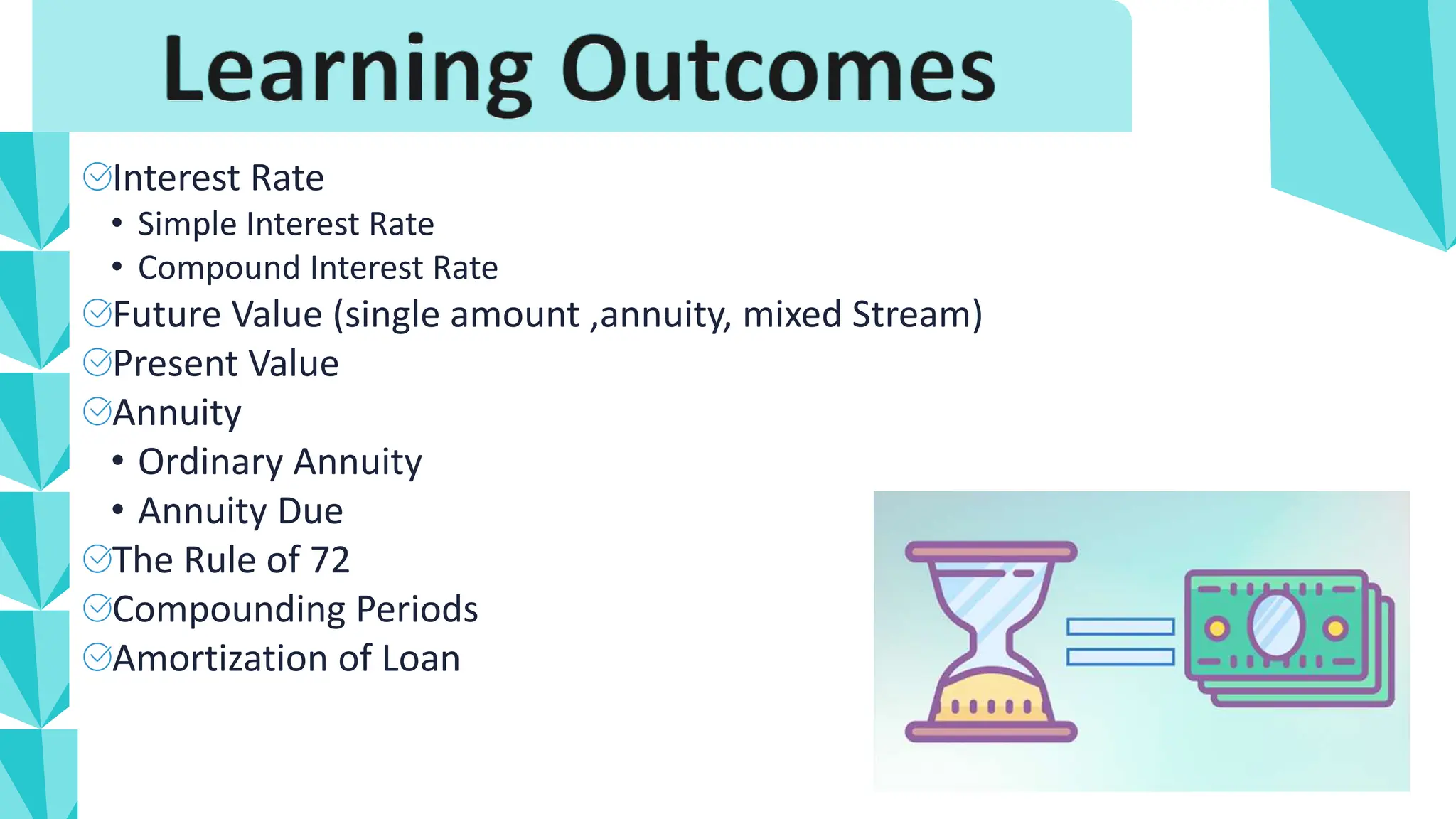
Interest Rate
• Simple Interest Rate
• Compound Interest Rate
Future Value (single amount ,annuity, mixed Stream)
Present Value
Annuity
• Ordinary Annuity
• Annuity Due
The Rule of 72
Compounding Periods
Amortization of Loan
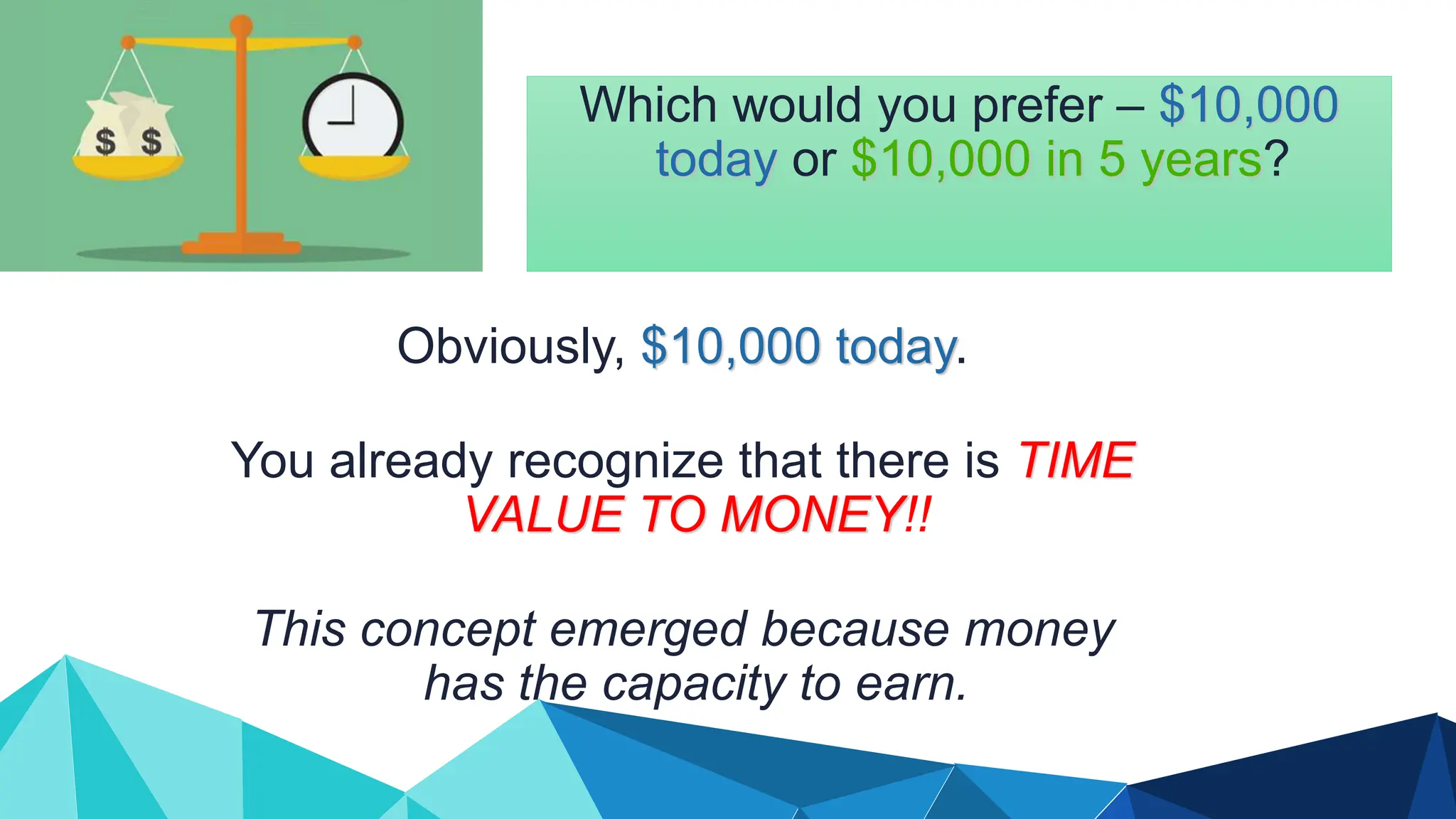
Obviously, $10,000 today.
You already recognize that there is TIME
VALUE TO MONEY!!
This concept emerged because money
has the capacity to earn.
Which would you prefer – $10,000
today or $10,000 in 5 years?
Why Time?
Why is TIME such an important
element in your decision?
TIME allows you the opportunity to postpone consumption
and earn INTEREST.
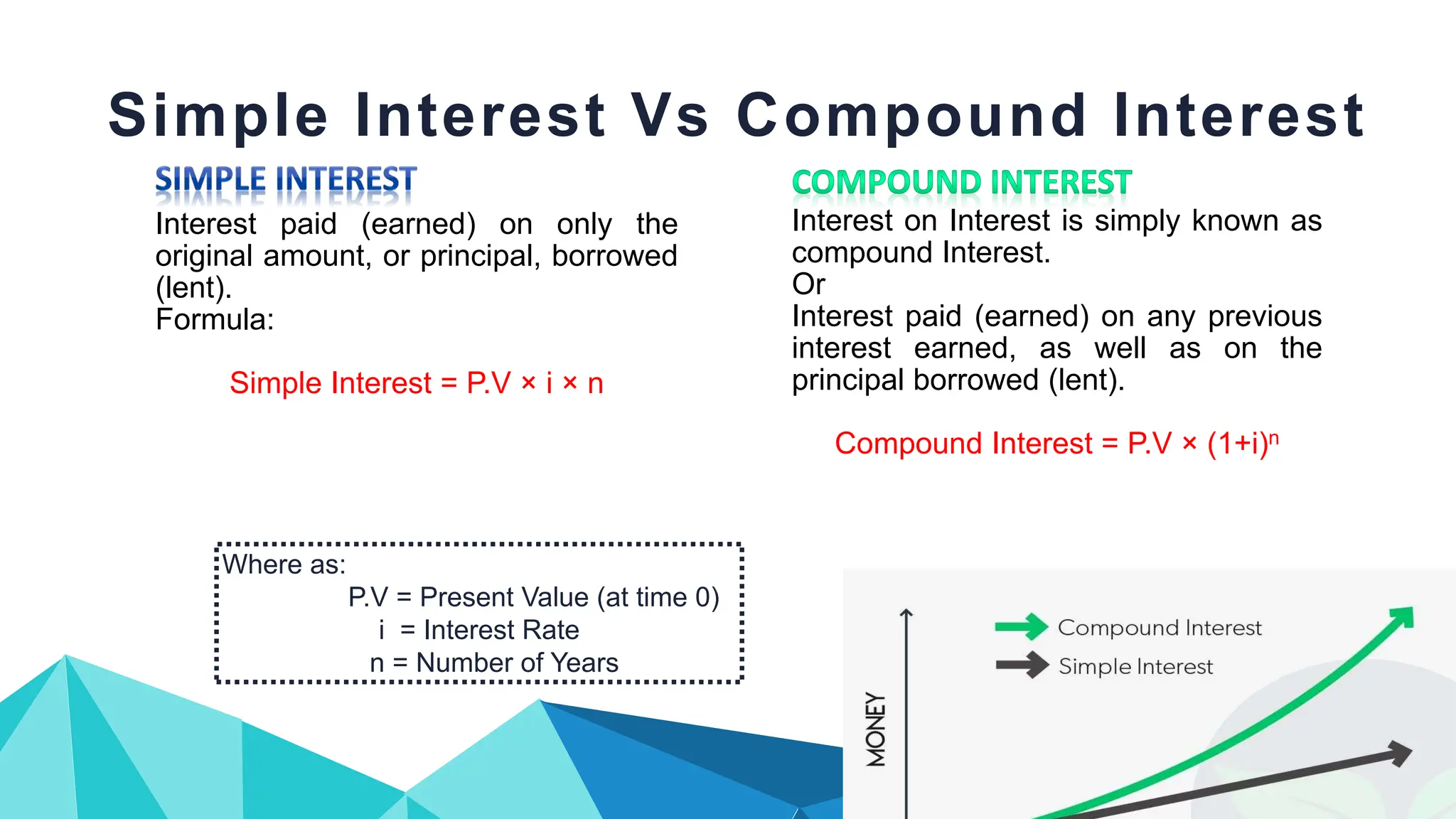
Interest on Interest is simply known as
compound Interest.
Or
Interest paid (earned) on any previous
interest earned, as well as on the
principal borrowed (lent).
Compound Interest = P.V × (1+i)n
Interest paid (earned) on only the
original amount, or principal, borrowed
(lent).
Formula:
Simple Interest = P.V × i × n
Simple Interest Vs Compound Interest
Where as:
P.V = Present Value (at time 0)
i = Interest Rate
n = Number of Years
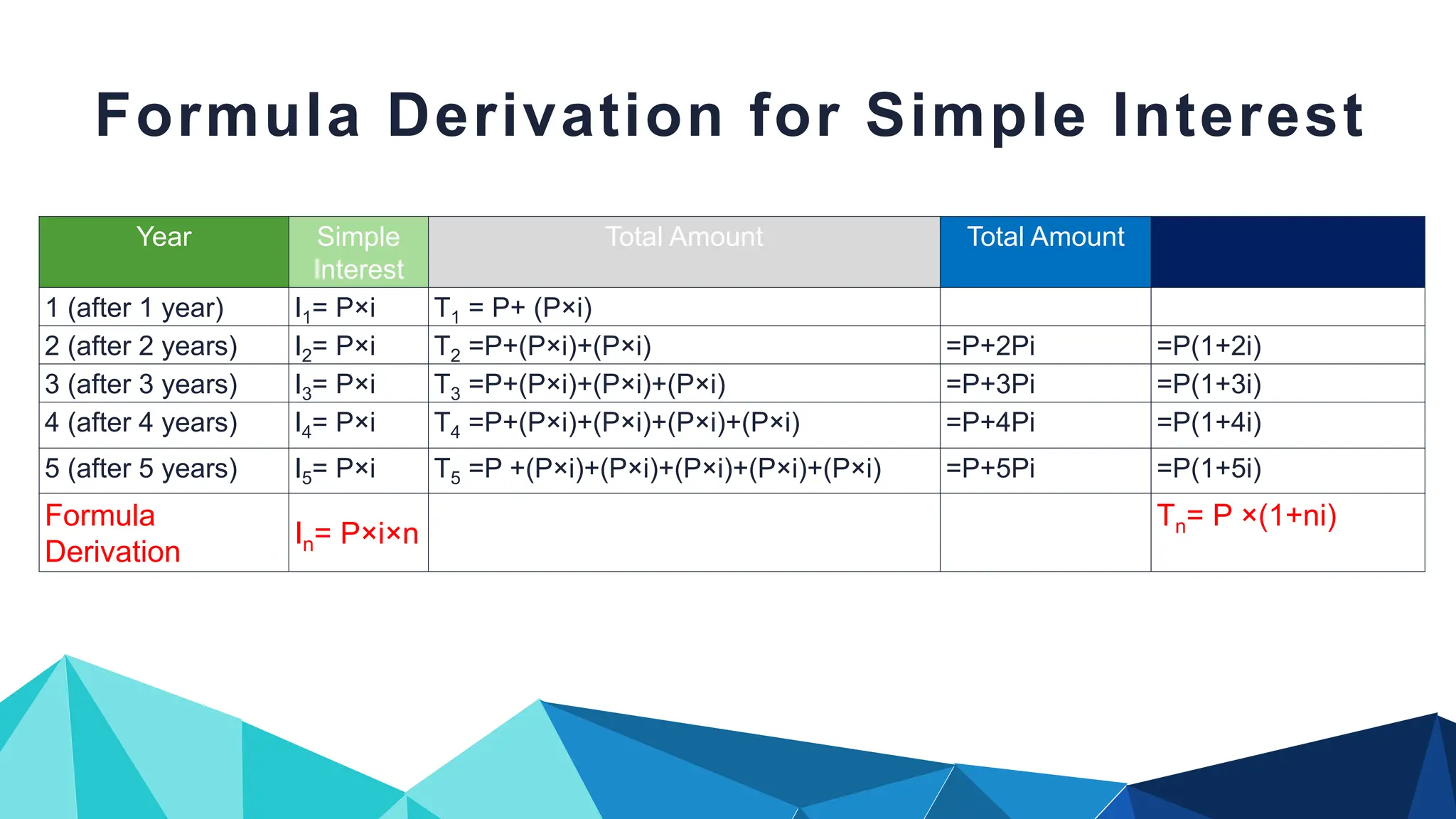
Formula Derivation for Simple Interest
Year Simple
Interest
Total Amount Total Amount
1 (after 1 year) I1= P×i T1 = P+ (P×i)
2 (after 2 years) I2= P×i T2 =P+(P×i)+(P×i) =P+2Pi =P(1+2i)
3 (after 3 years) I3= P×i T3 =P+(P×i)+(P×i)+(P×i) =P+3Pi =P(1+3i)
4 (after 4 years) I4= P×i T4 =P+(P×i)+(P×i)+(P×i)+(P×i) =P+4Pi =P(1+4i)
5 (after 5 years) I5= P×i T5 =P +(P×i)+(P×i)+(P×i)+(P×i)+(P×i) =P+5Pi =P(1+5i)
Formula
Derivation
In= P×i×n
Tn= P ×(1+ni)
Year Compound
Interest
Total Amount Total Amount
1 (after 1 year) I1= (P×i) T1 = P+ (P×i) =P(1+i) =P(1+i)
2 (after 2 years) I2= (P×i)×i T2 =P(1+i)+P(1+i)×i =P(1+i) [1+i] =P(1+i)2
3 (after 3 years) I3= (P×i)2×i T3 =P(1+i)2 + P(1+i)2 ×i =P(1+i)2[1+i] =P(1+i)3
4 (after 4 years) I4= (P×i)3×i T4 =P(1+i)3 +P(1+i)3 × i =P(1+i)3 [1+i] =P(1+i)4
5 (after 5 years) I5= (P×i)4×i T5 =P(1+i)4 +P(1+i)4 ×i =P(1+i)4 [1+i] =P(1+i)5
Formula
Derivation
Tn= P ×(1+i)n
Formula Derivation for Compound Interest
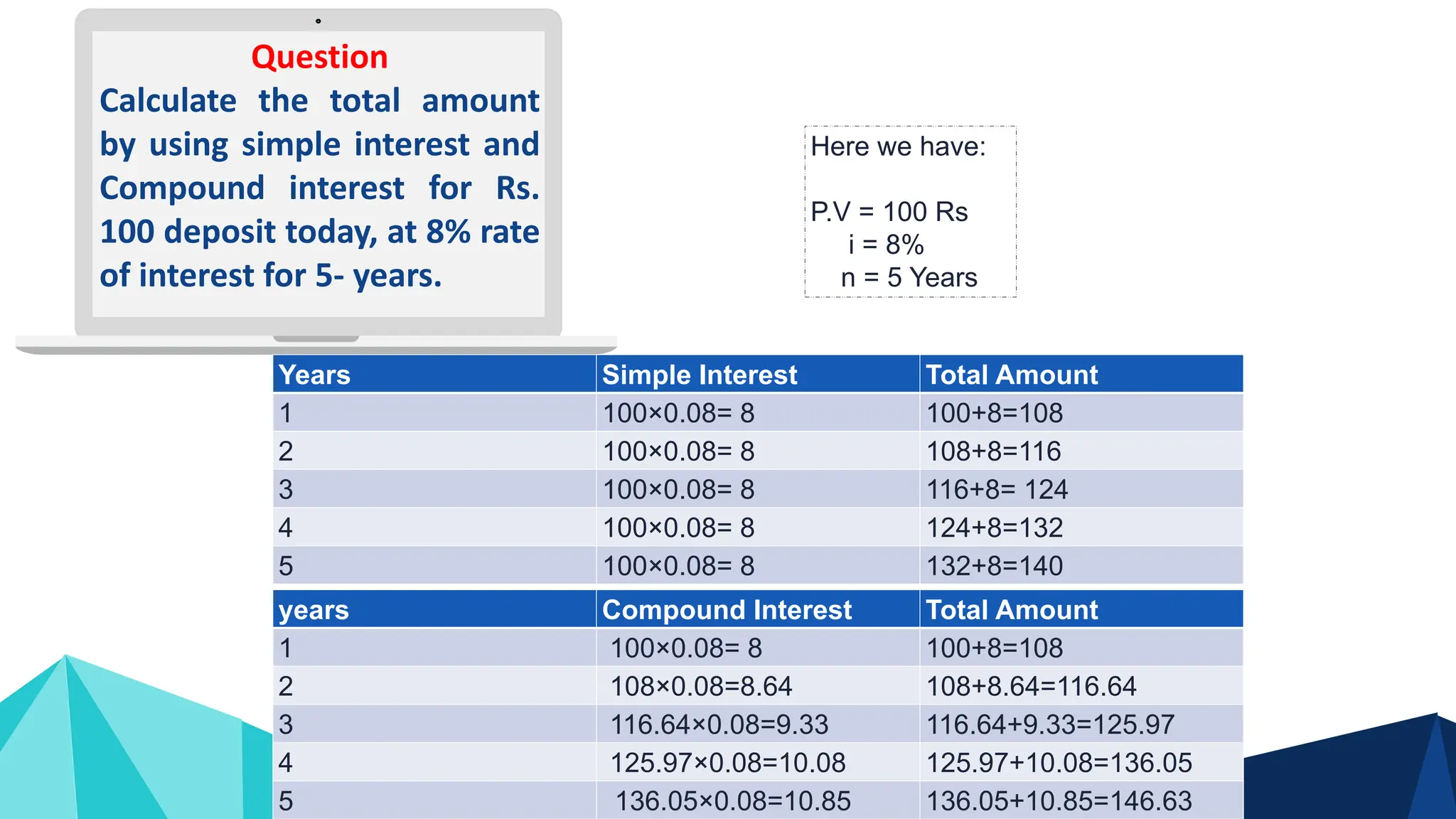
Question
Calculate the total amount
by using simple interest and
Compound interest for Rs.
100 deposit today, at 8% rate
of interest for 5- years.
Here we have:
P.V = 100 Rs
i = 8%
n = 5 Years
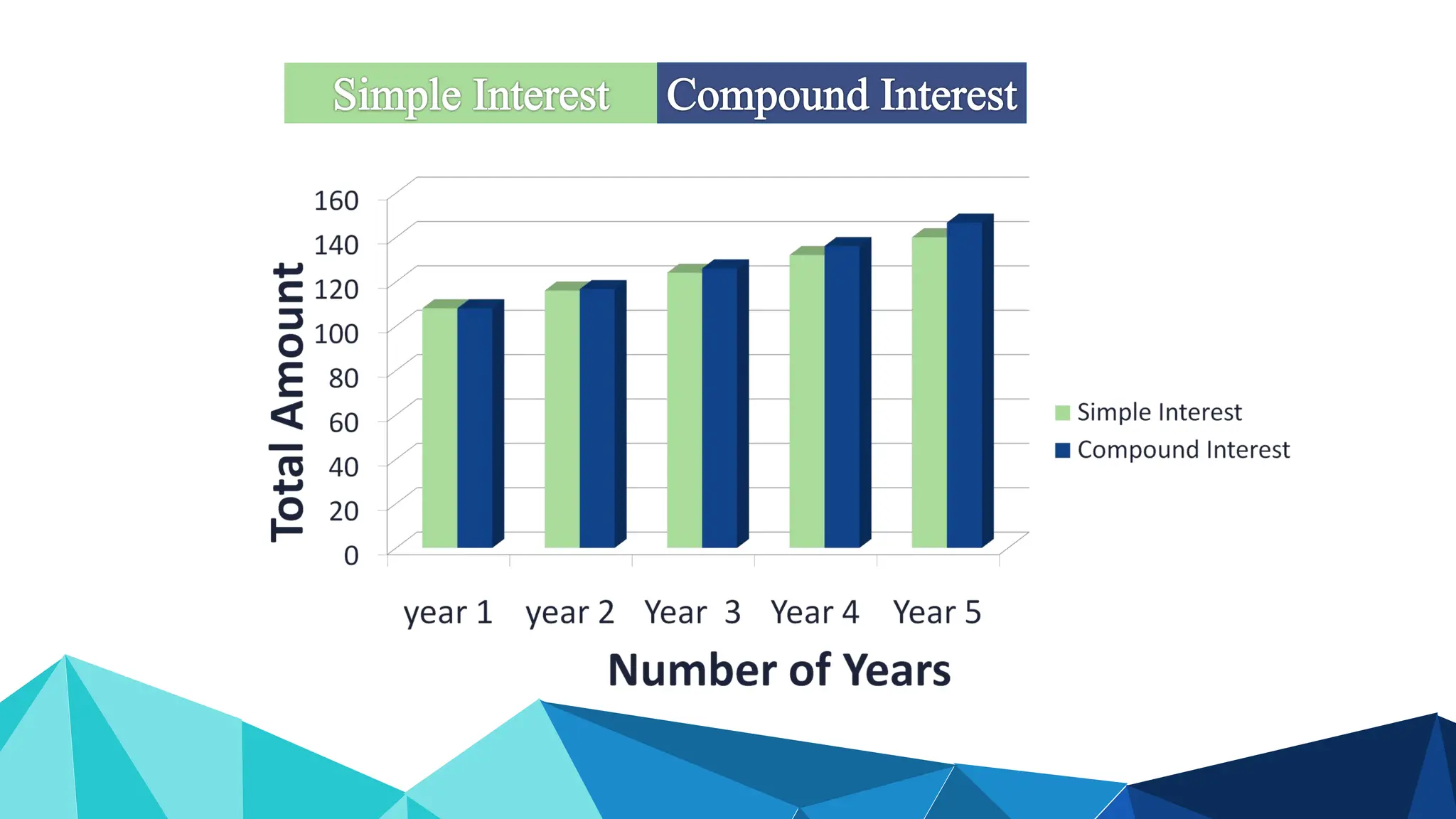
Years Simple Interest Total Amount
1 100×0.08= 8 100+8=108
2 100×0.08= 8 108+8=116
3 100×0.08= 8 116+8= 124
4 100×0.08= 8 124+8=132
5 100×0.08= 8 132+8=140
years Compound Interest Total Amount
1 100×0.08= 8 100+8=108
2 108×0.08=8.64 108+8.64=116.64
3 116.64×0.08=9.33 116.64+9.33=125.97
4 125.97×0.08=10.08 125.97+10.08=136.05
5 136.05×0.08=10.85 136.05+10.85=146.63
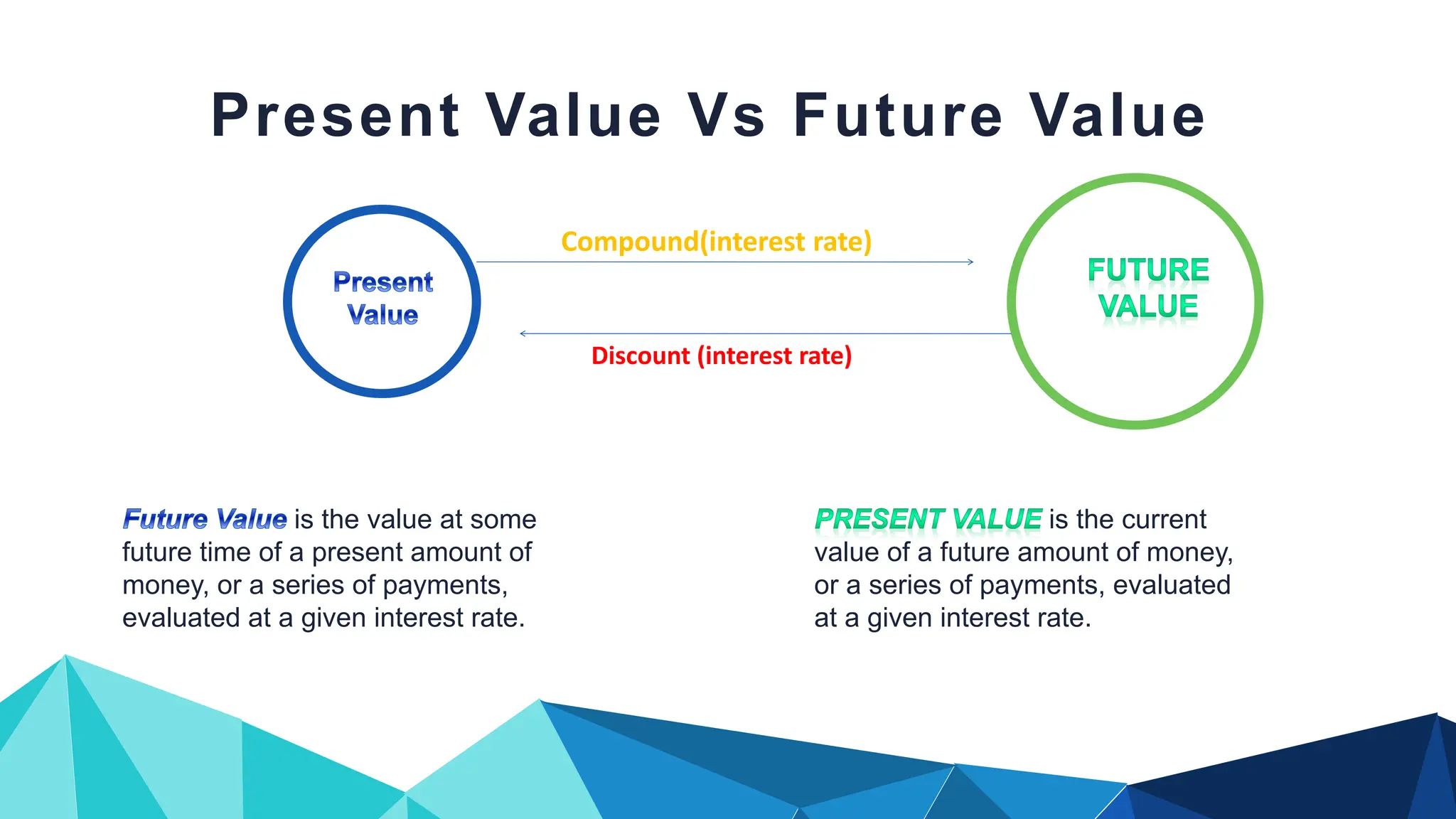
Present Value Vs Future Value
Compound(interest rate)
Discount (interest rate)
is the value at some
future time of a present amount of
money, or a series of payments,
evaluated at a given interest rate.
is the current
value of a future amount of money,
or a series of payments, evaluated
at a given interest rate.
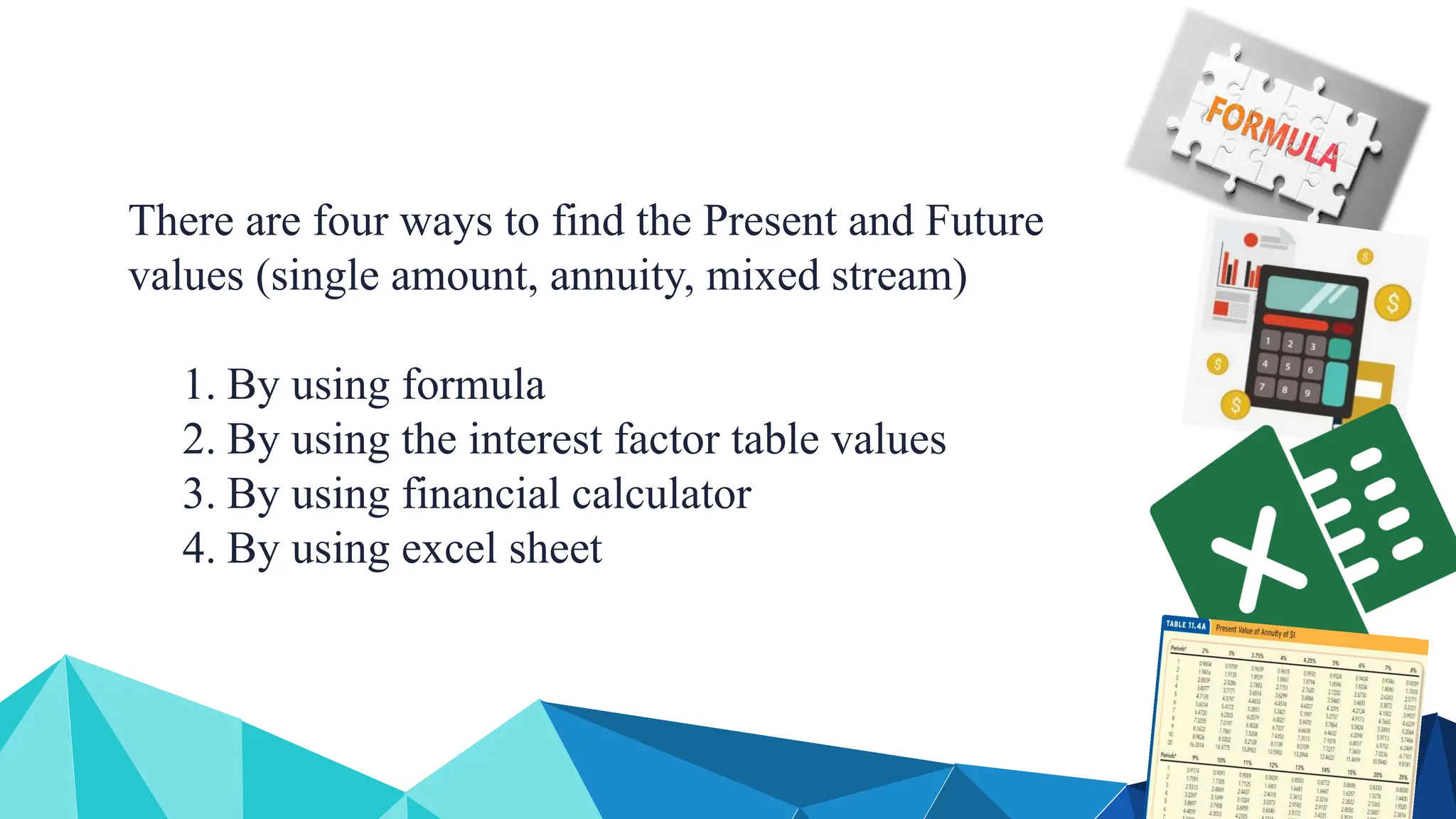
There are four ways to find the Present and Future
values (single amount, annuity, mixed stream)
1. By using formula
2. By using the interest factor table values
3. By using financial calculator
4. By using excel sheet
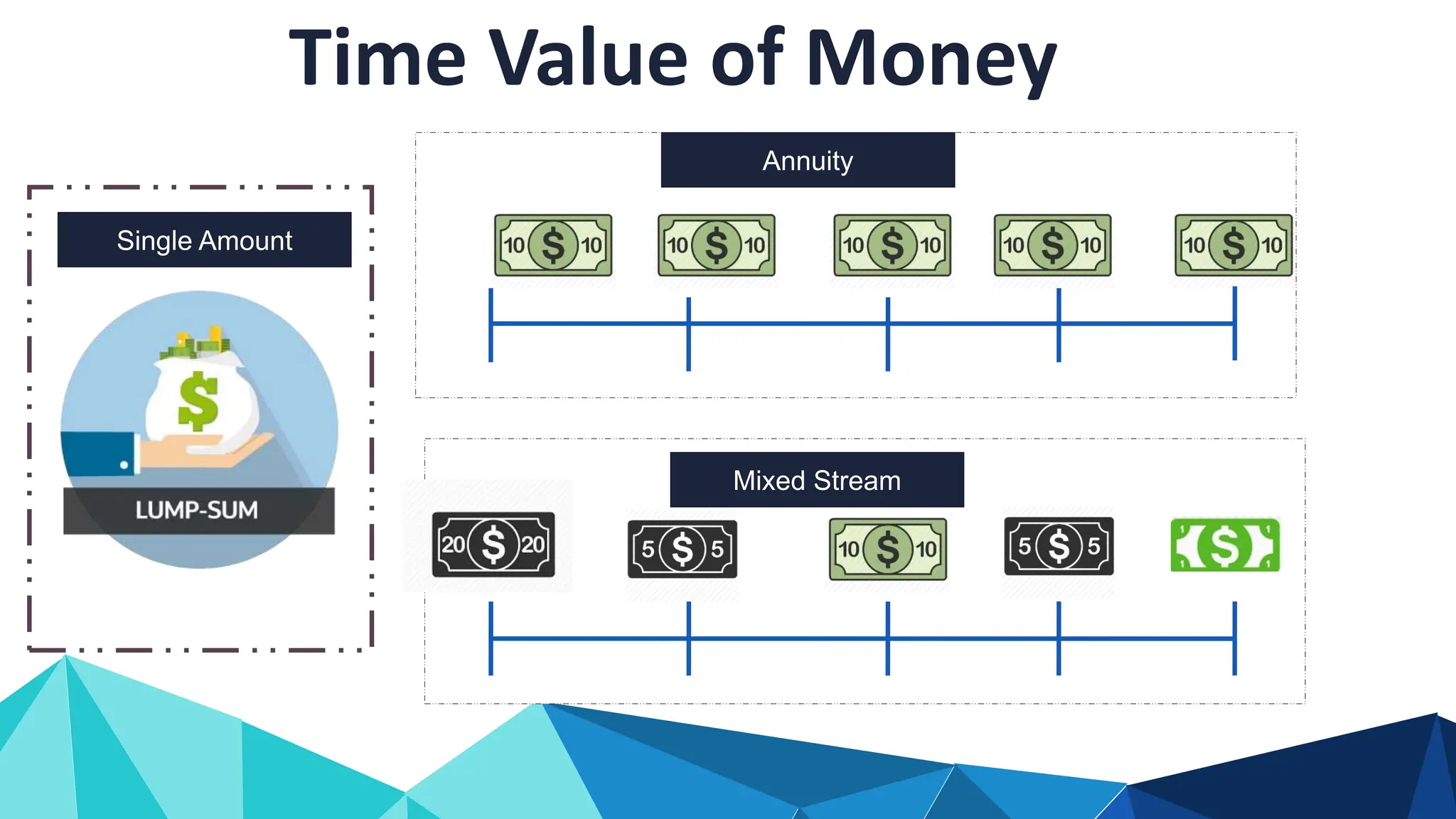
Time Value of Money
Annuity
Mixed Stream
Single Amount
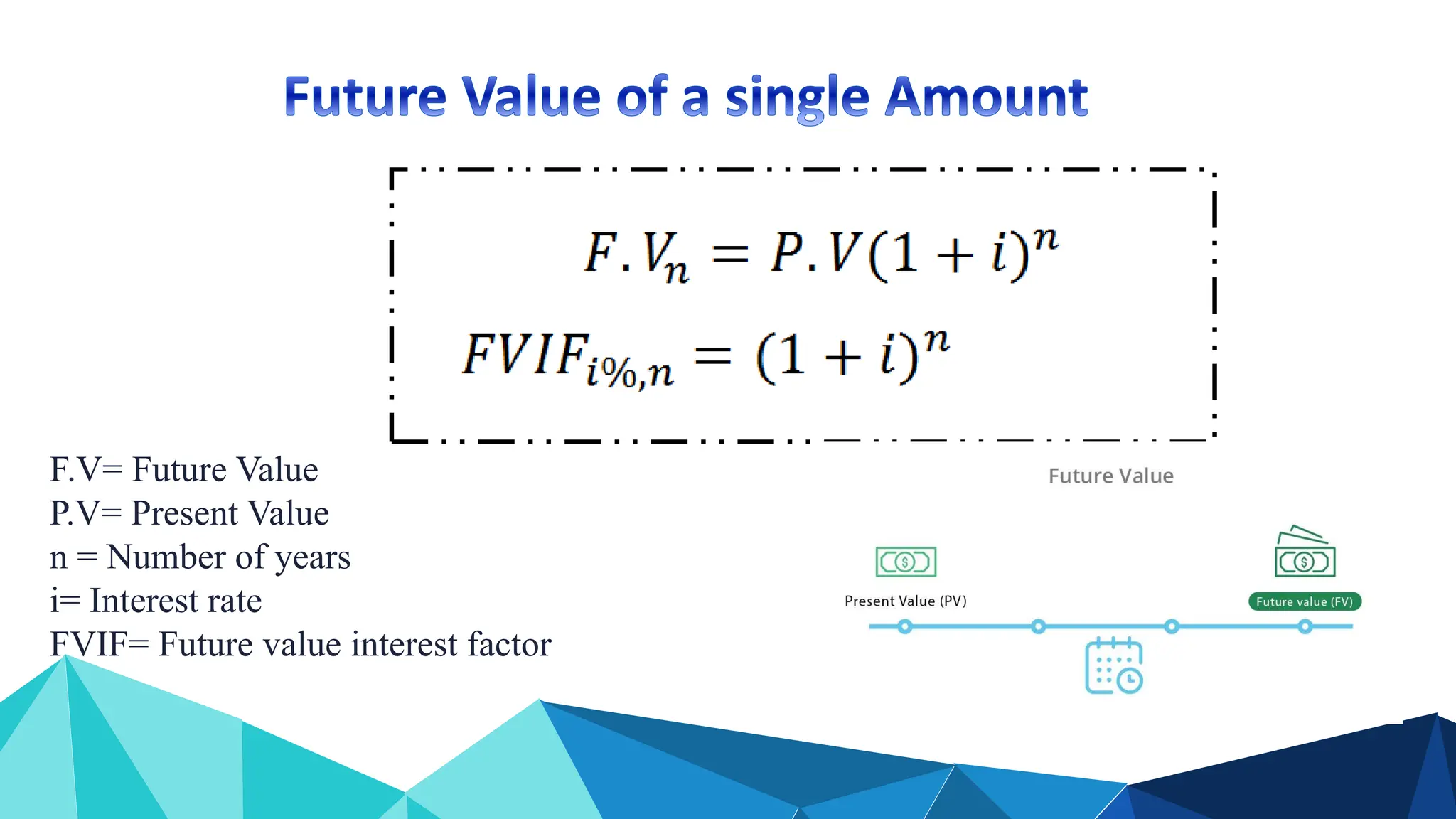
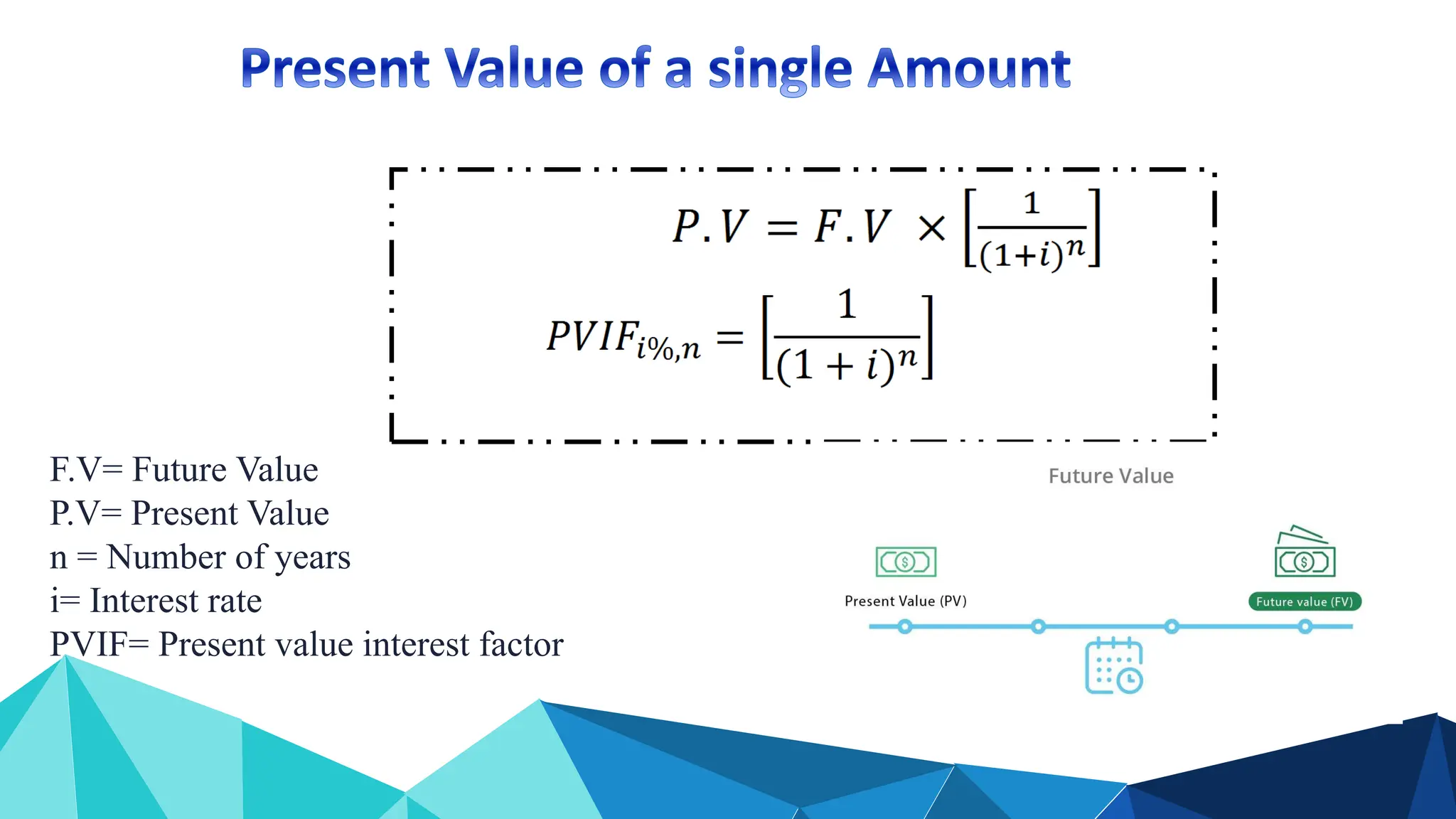
F.V= Future Value
P.V= Present Value
n = Number of years
i= Interest rate
FVIF= Future value interest factor
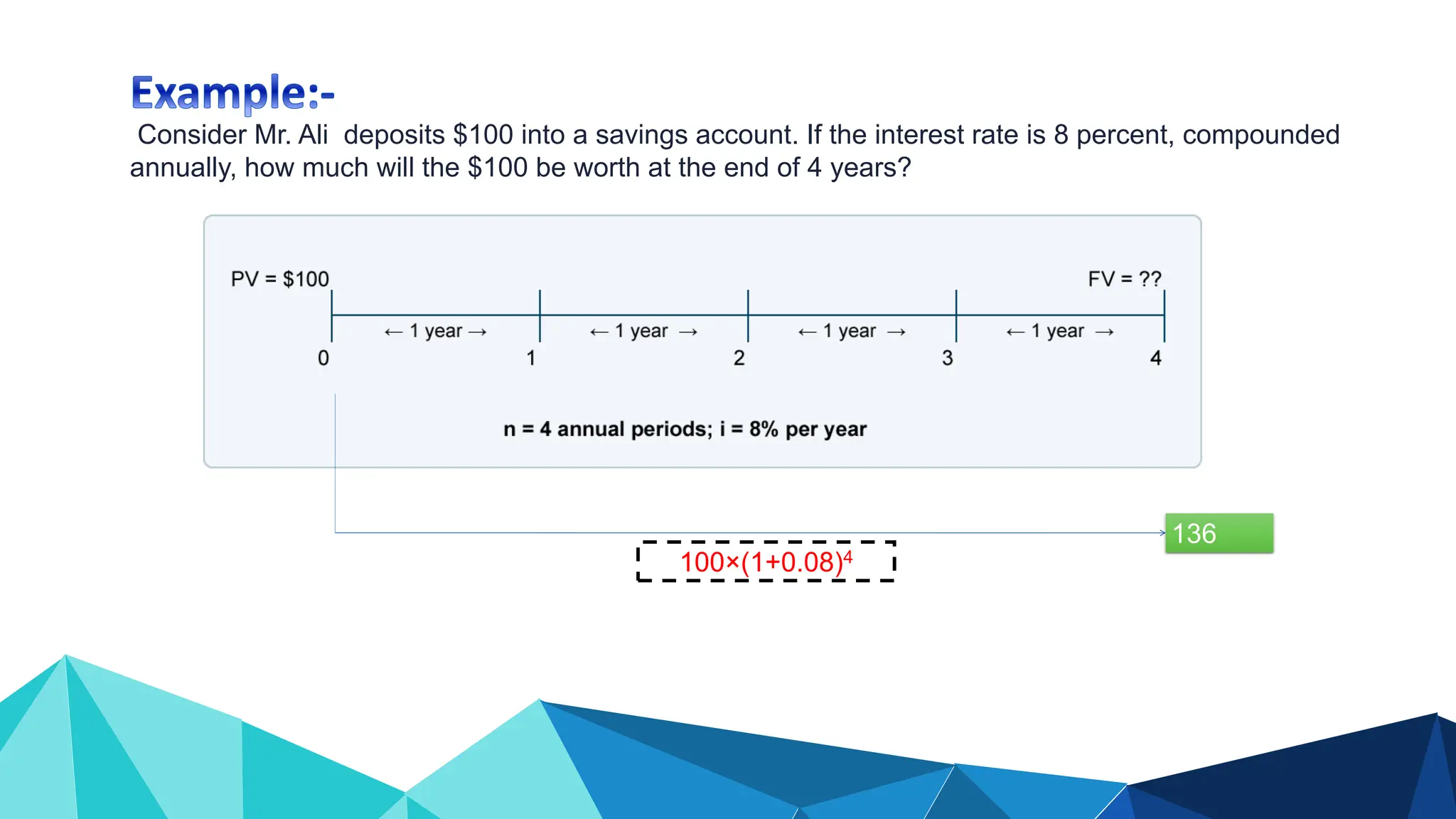
Consider Mr. Ali deposits $100 into a savings account. If the interest rate is 8 percent, compounded
annually, how much will the $100 be worth at the end of 4 years?
136
100×(1+0.08)4
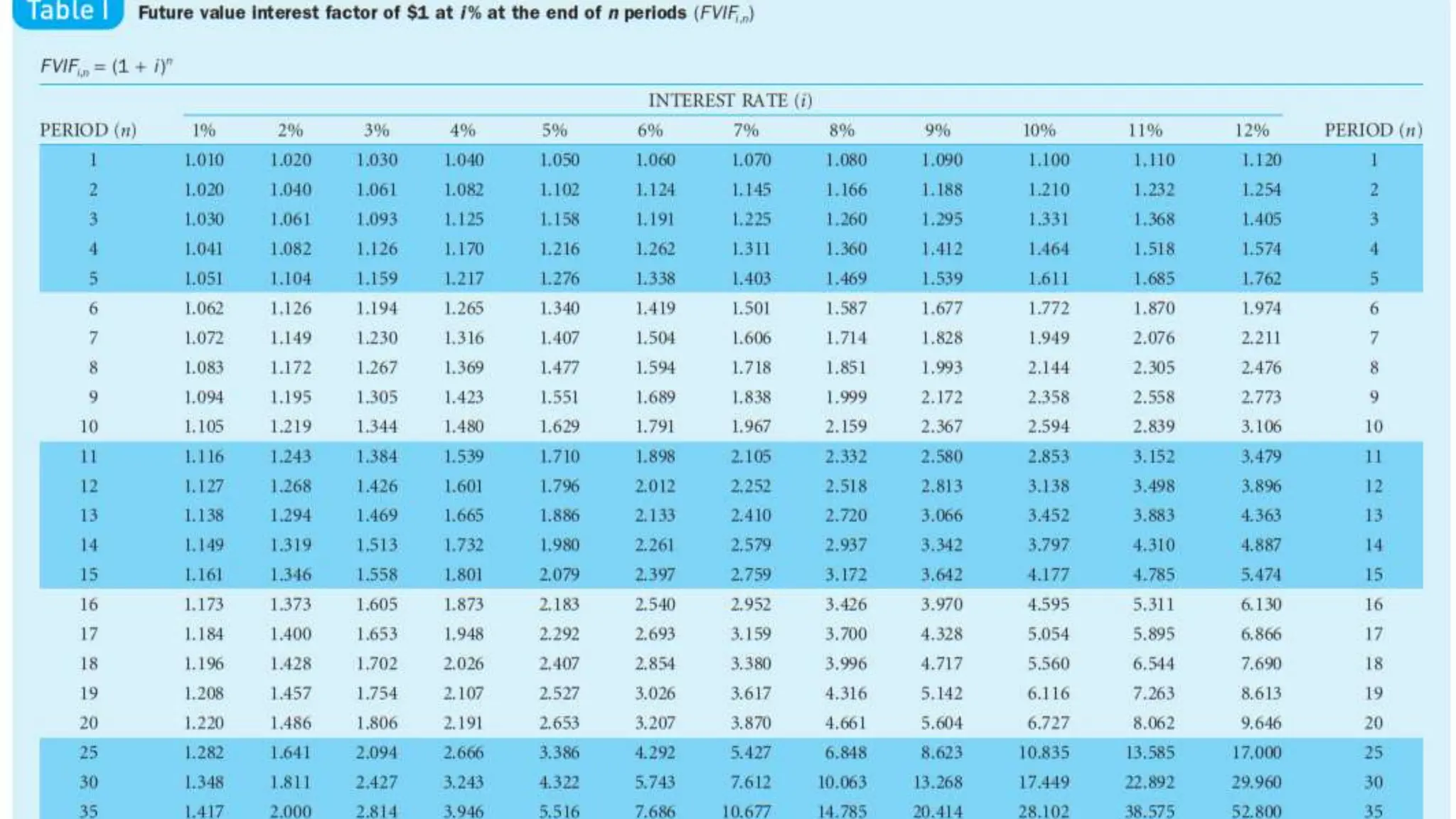
Using Table 1: Future Value Interest Factor( FVIF i%,n)
FV4 = $1,00(FVIF8%,4)
= $1,00 (1.360)
= $136 [Due to Rounding]
FVn= PV × FVIF i%,n
F.V= Future Value
P.V= Present Value
n = Number of years
i= Interest rate
PVIF= Present value interest factor
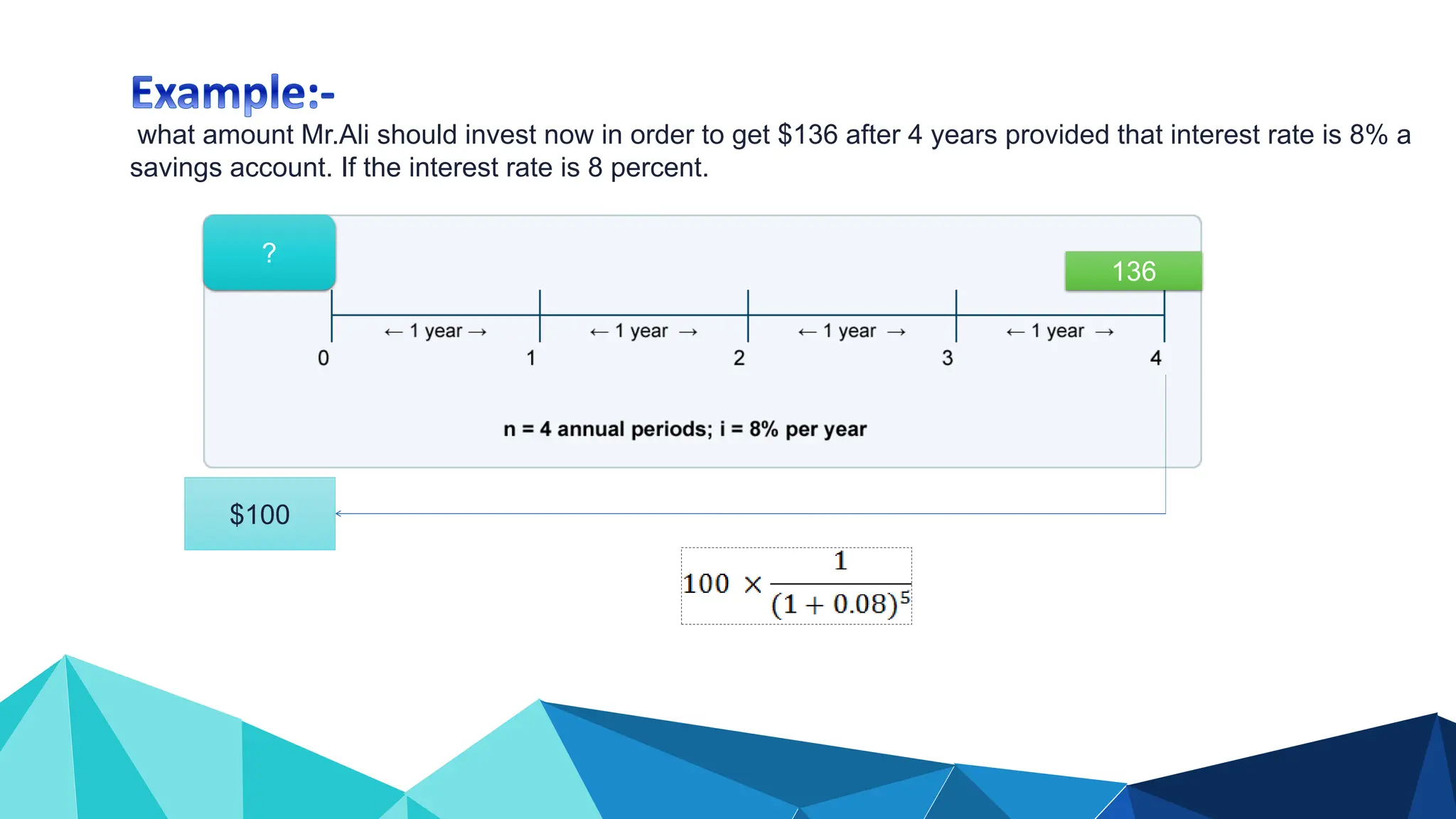
what amount Mr.Ali should invest now in order to get $136 after 4 years provided that interest rate is 8% a
savings account. If the interest rate is 8 percent.
136
?
$100
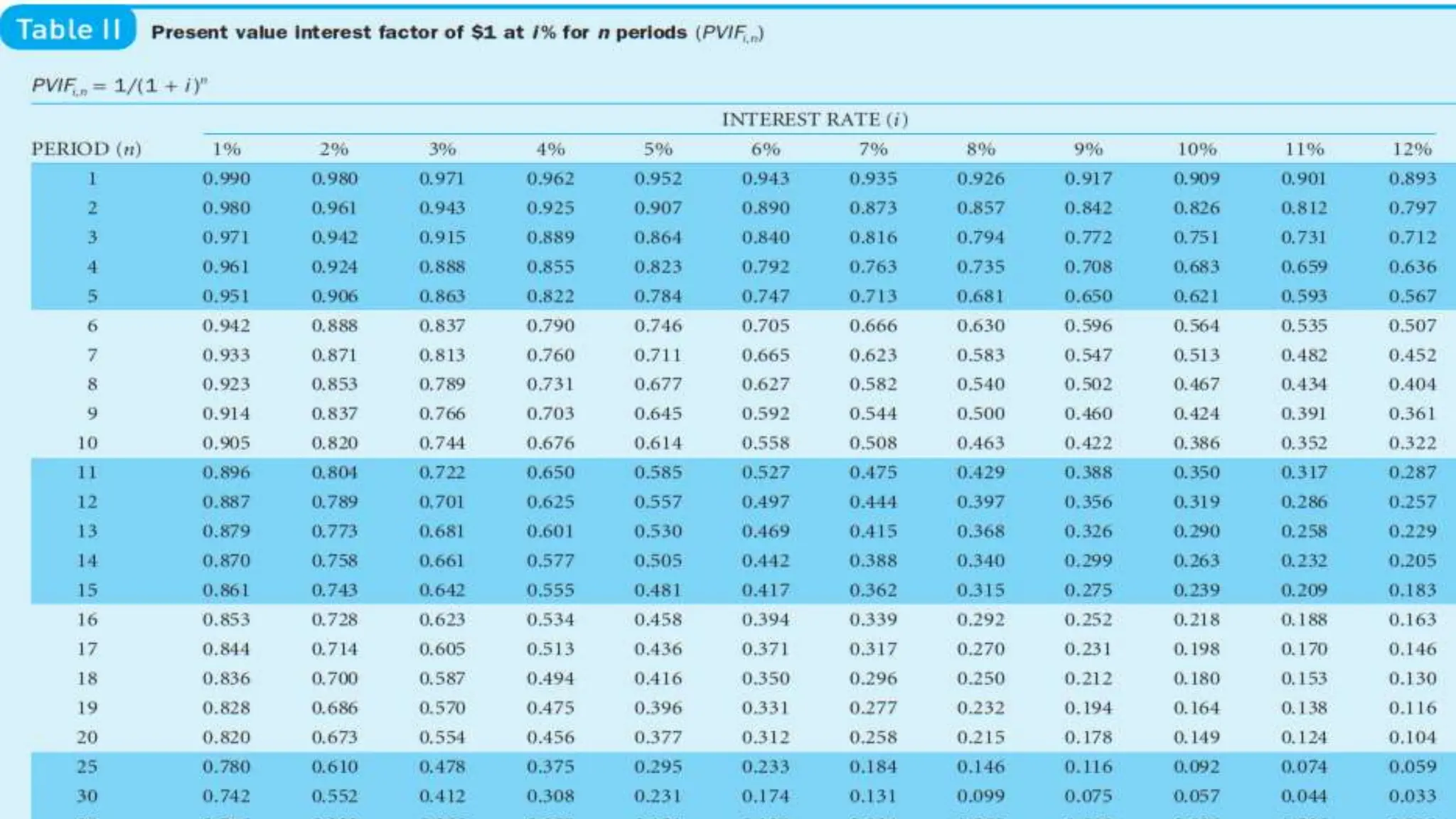
Using Table II: Present Value Interest Factor( PVIF i%,n)
PV4 = $136(PVIF8%,4)
= $136(0.735)
= $99.9 $100 [Due to Rounding]
PVn= FV ×PVIF i%,n
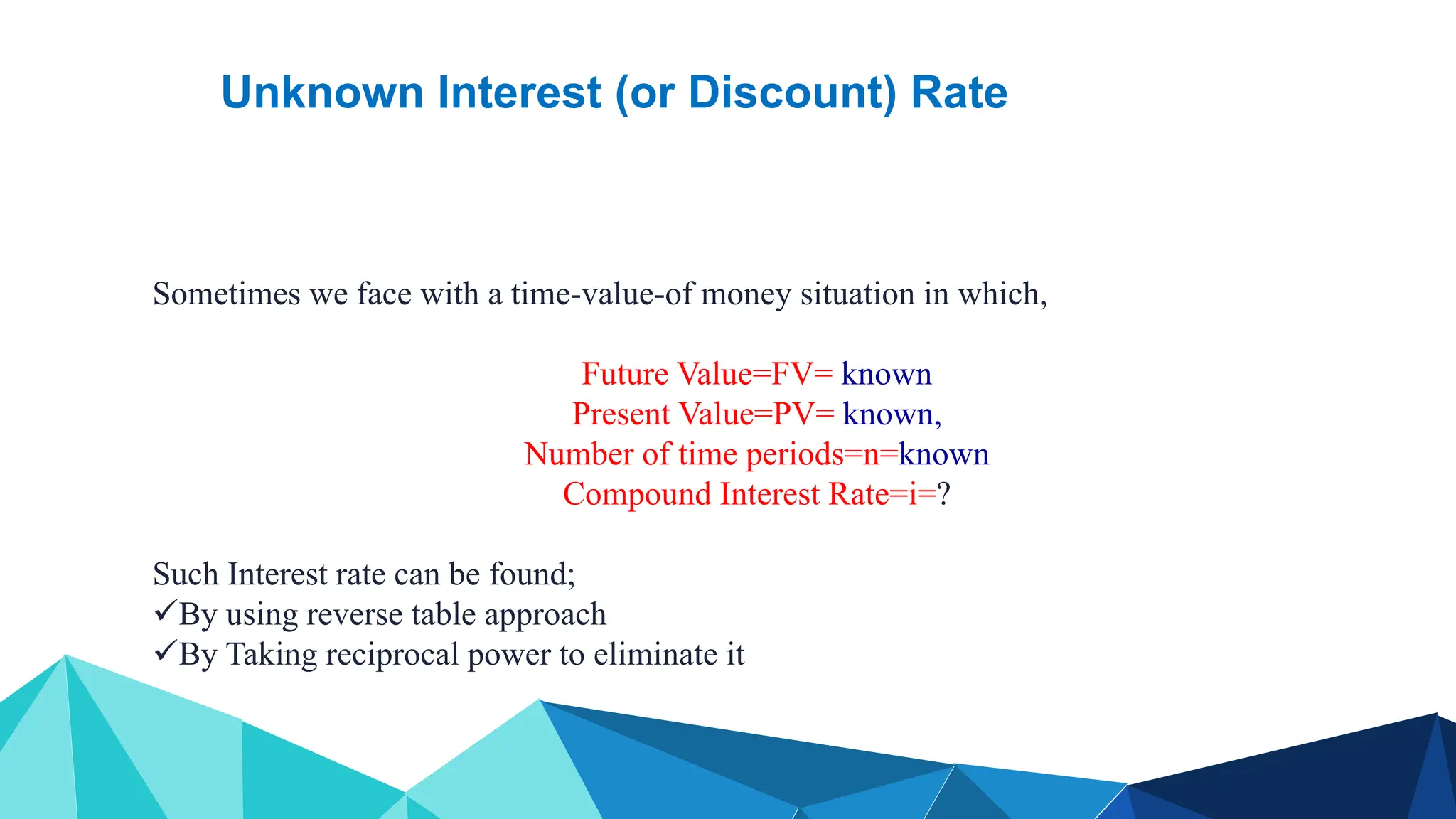
Sometimes we face with a time-value-of money situation in which,
Future Value=FV= known
Present Value=PV= known,
Number of time periods=n=known
Compound Interest Rate=i=?
Such Interest rate can be found;
By using reverse table approach
By Taking reciprocal power to eliminate it
Unknown Interest (or Discount) Rate
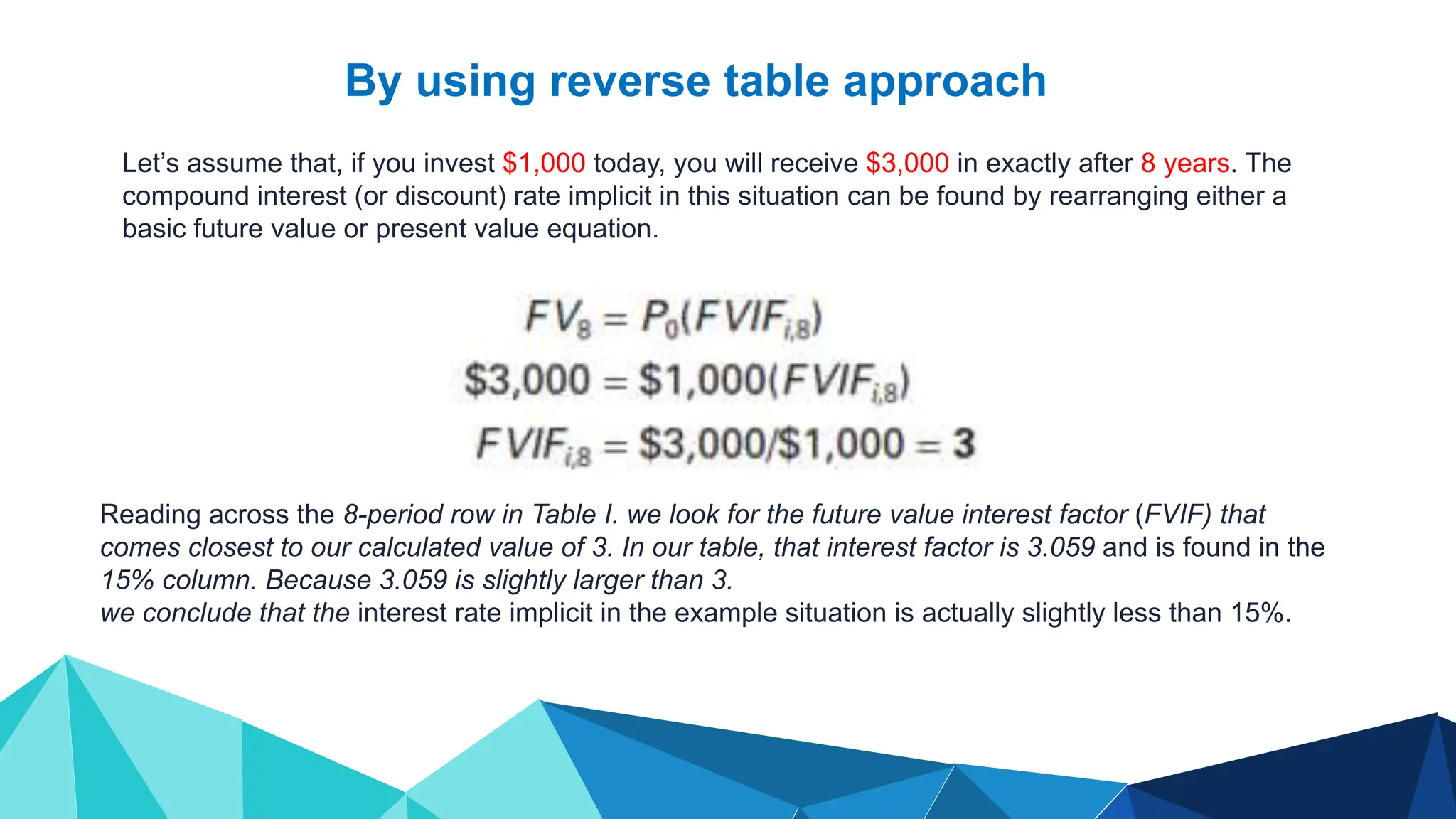
Let’s assume that, if you invest $1,000 today, you will receive $3,000 in exactly after 8 years. The
compound interest (or discount) rate implicit in this situation can be found by rearranging either a
basic future value or present value equation.
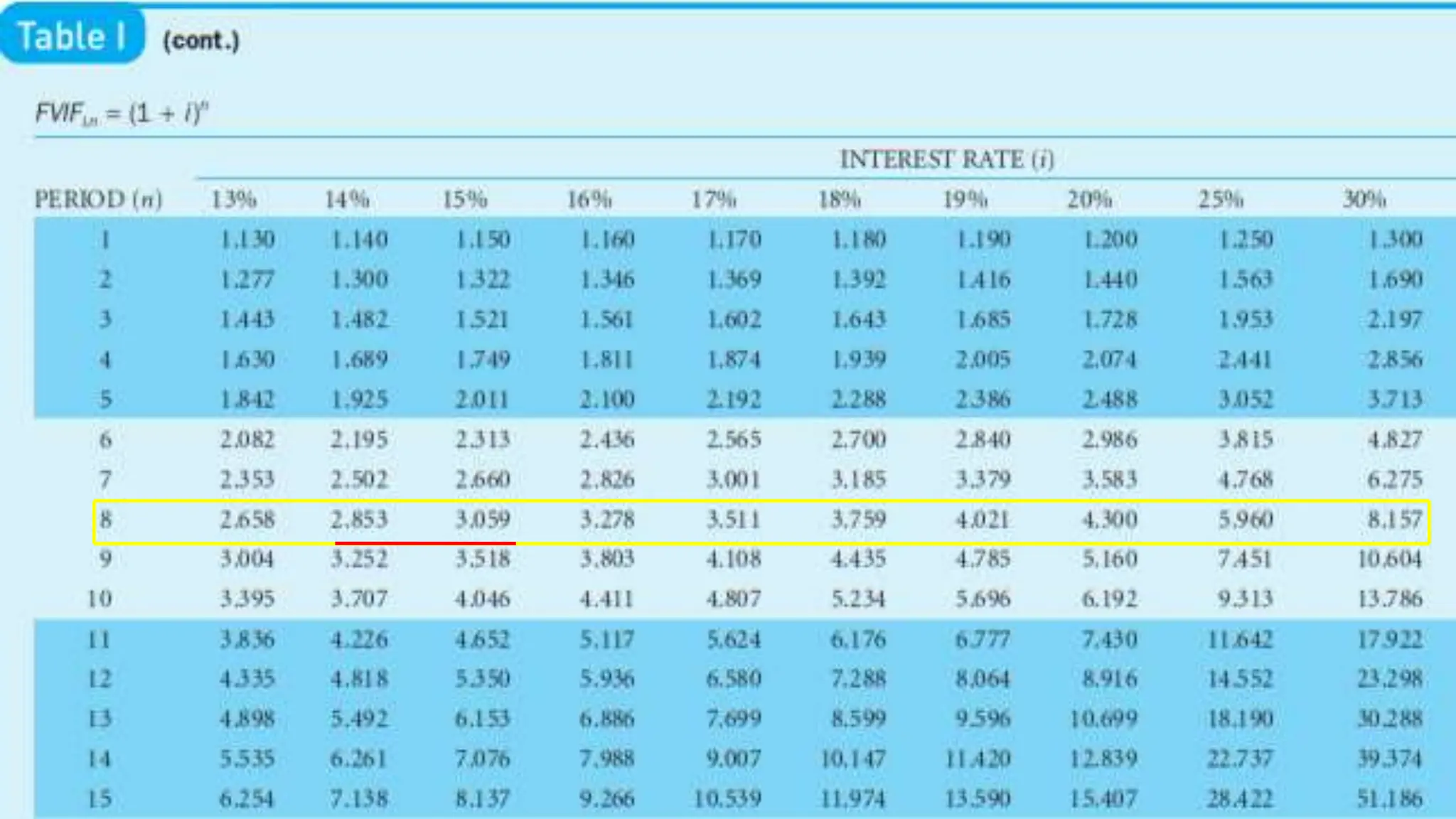
Reading across the 8-period row in Table I. we look for the future value interest factor (FVIF) that
comes closest to our calculated value of 3. In our table, that interest factor is 3.059 and is found in the
15% column. Because 3.059 is slightly larger than 3.
we conclude that the interest rate implicit in the example situation is actually slightly less than 15%.
By using reverse table approach
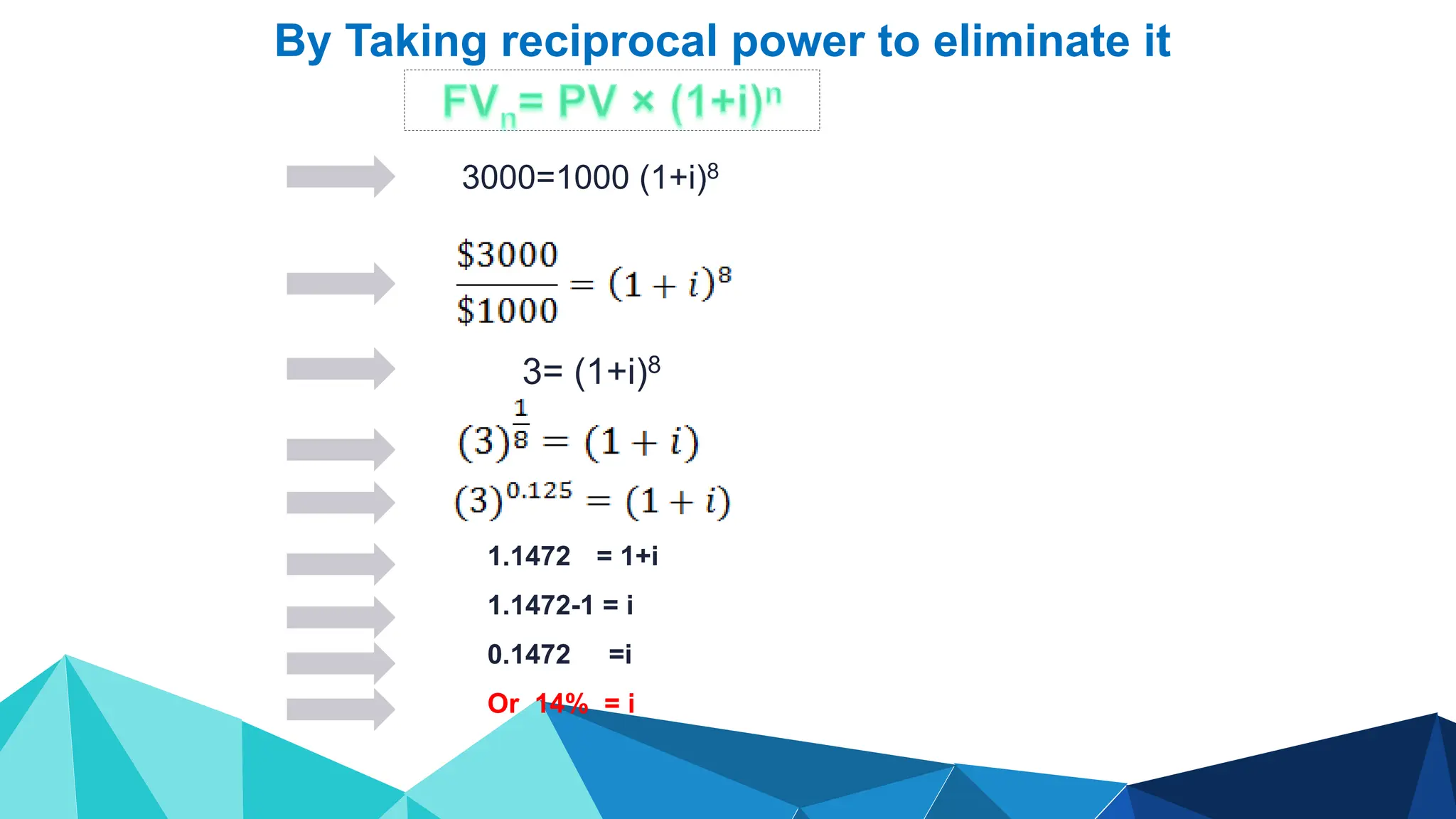
3000=1000 (1+i)8
1.1472 = 1+i
1.1472-1 = i
0.1472 =i
Or 14% = i
3= (1+i)8
By Taking reciprocal power to eliminate it
Unknown Number of Compounding (or Discounting) Periods
At times we may need to know how long it will take for a dollar amount invested today to grow
to a certain future value given a particular compound rate of interest.
For example, how long would it take for an invest$1,000 to grow to $1,900 if we invested it at a
compound annual interest rate of 10 percent?
Future Value=FV= known
Present Value=PV= known,
Compound Interest Rate=i=known
Number of time periods=n=?
The unknown period can be found;
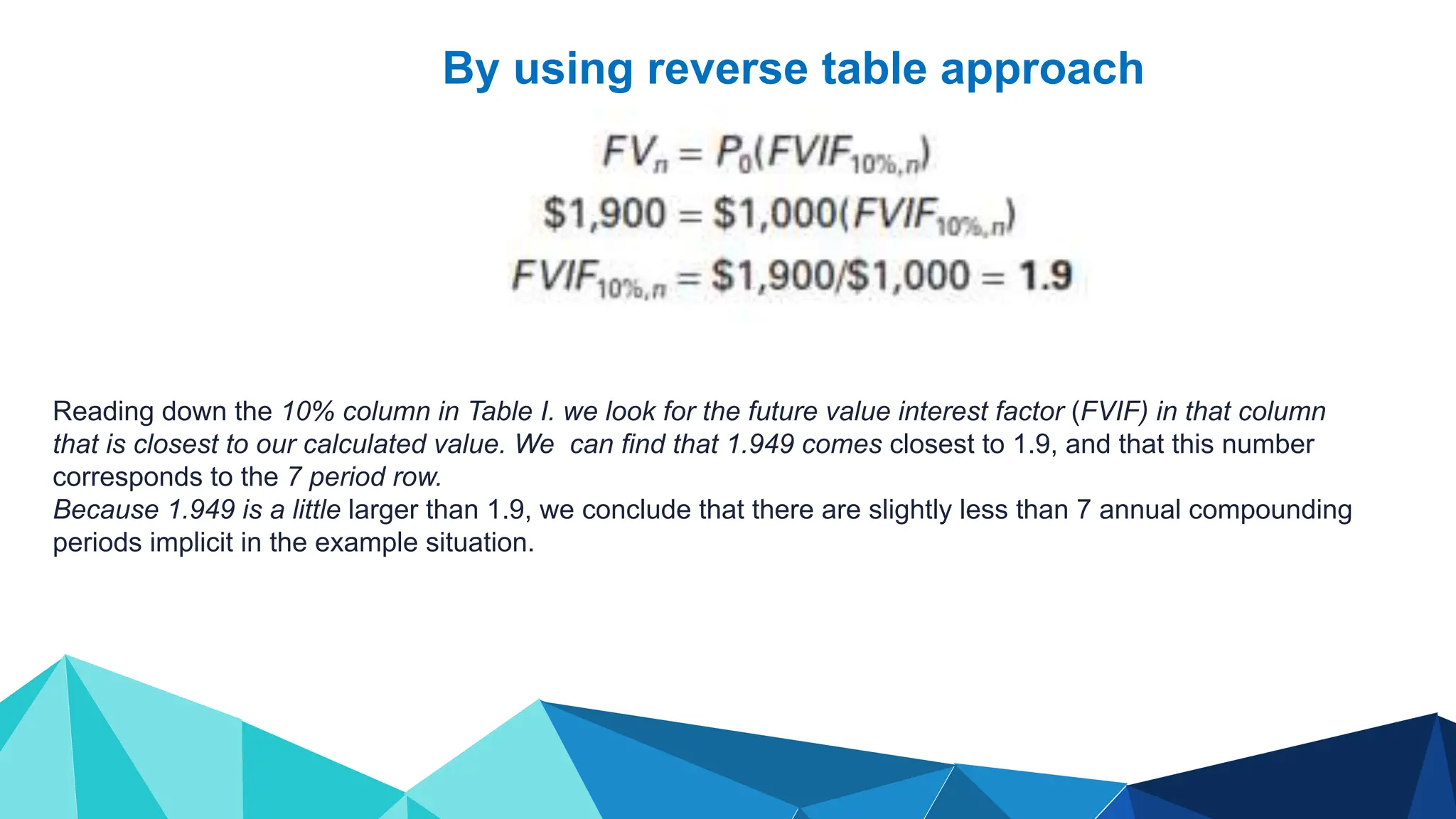
By using reverse table approach
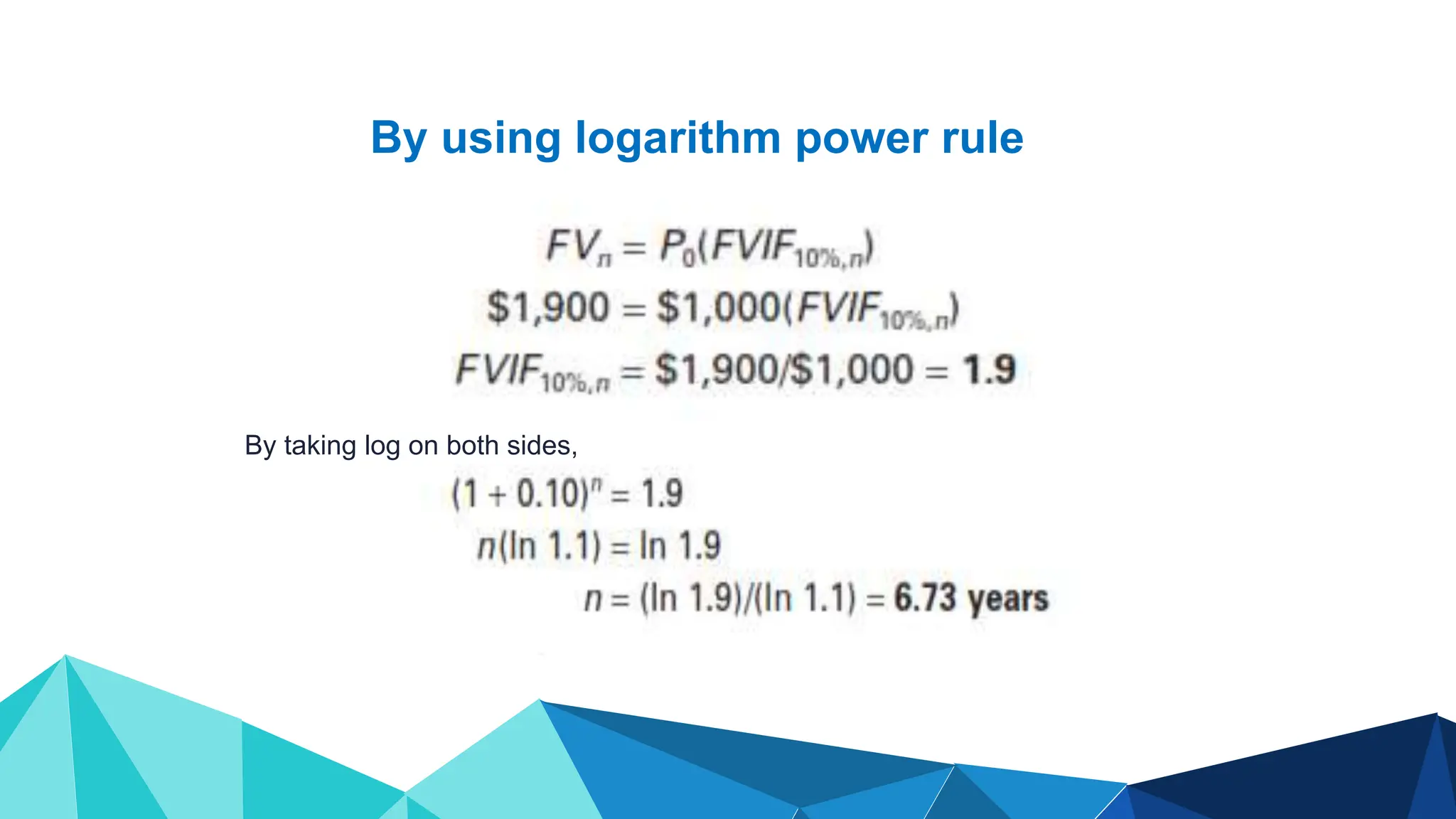
By using logarithm power rule
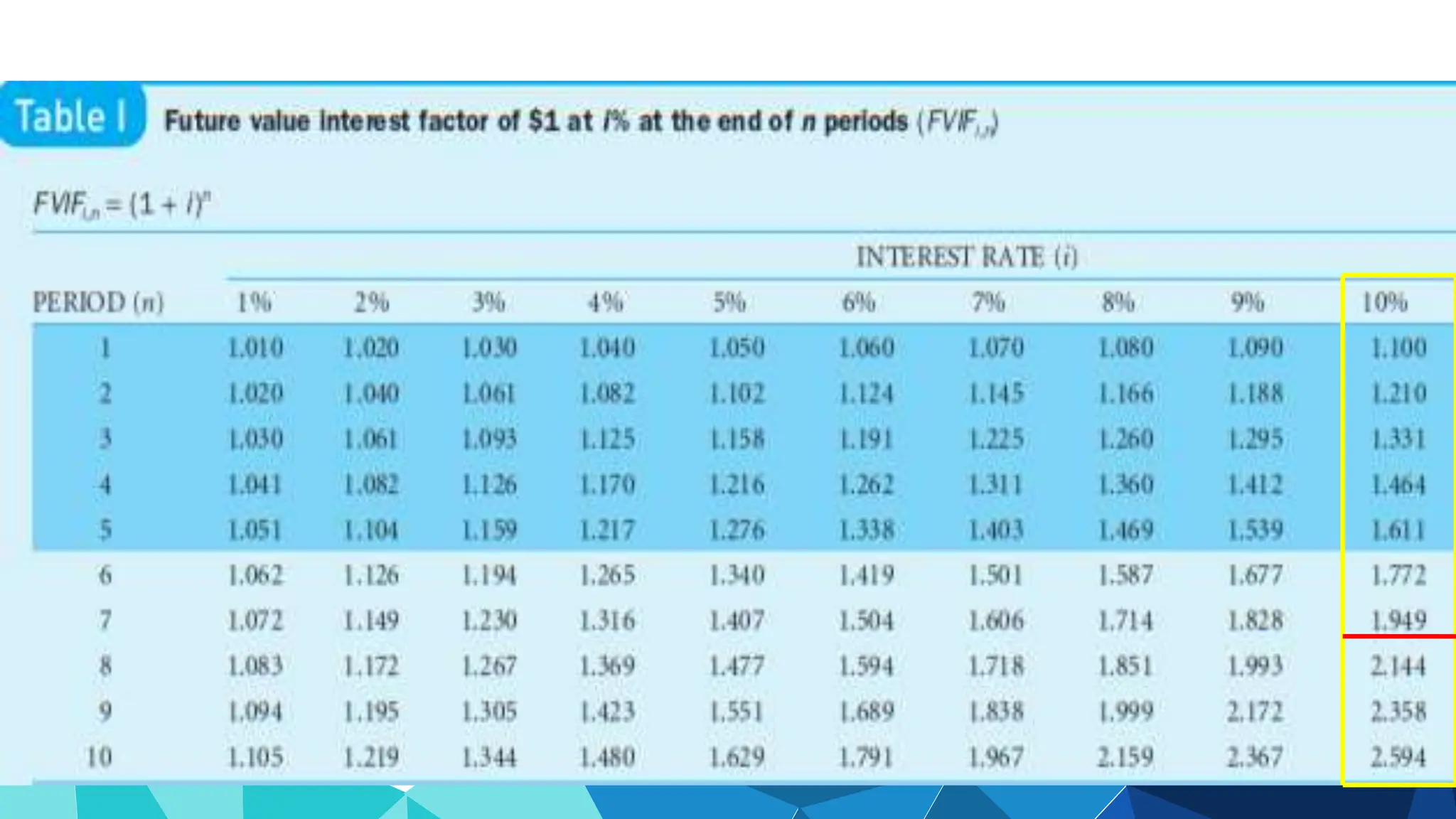
Reading down the 10% column in Table I. we look for the future value interest factor (FVIF) in that column
that is closest to our calculated value. We can find that 1.949 comes closest to 1.9, and that this number
corresponds to the 7 period row.
Because 1.949 is a little larger than 1.9, we conclude that there are slightly less than 7 annual compounding
periods implicit in the example situation.
By using reverse table approach
By using logarithm power rule
By taking log on both sides,
Class Practice Questions
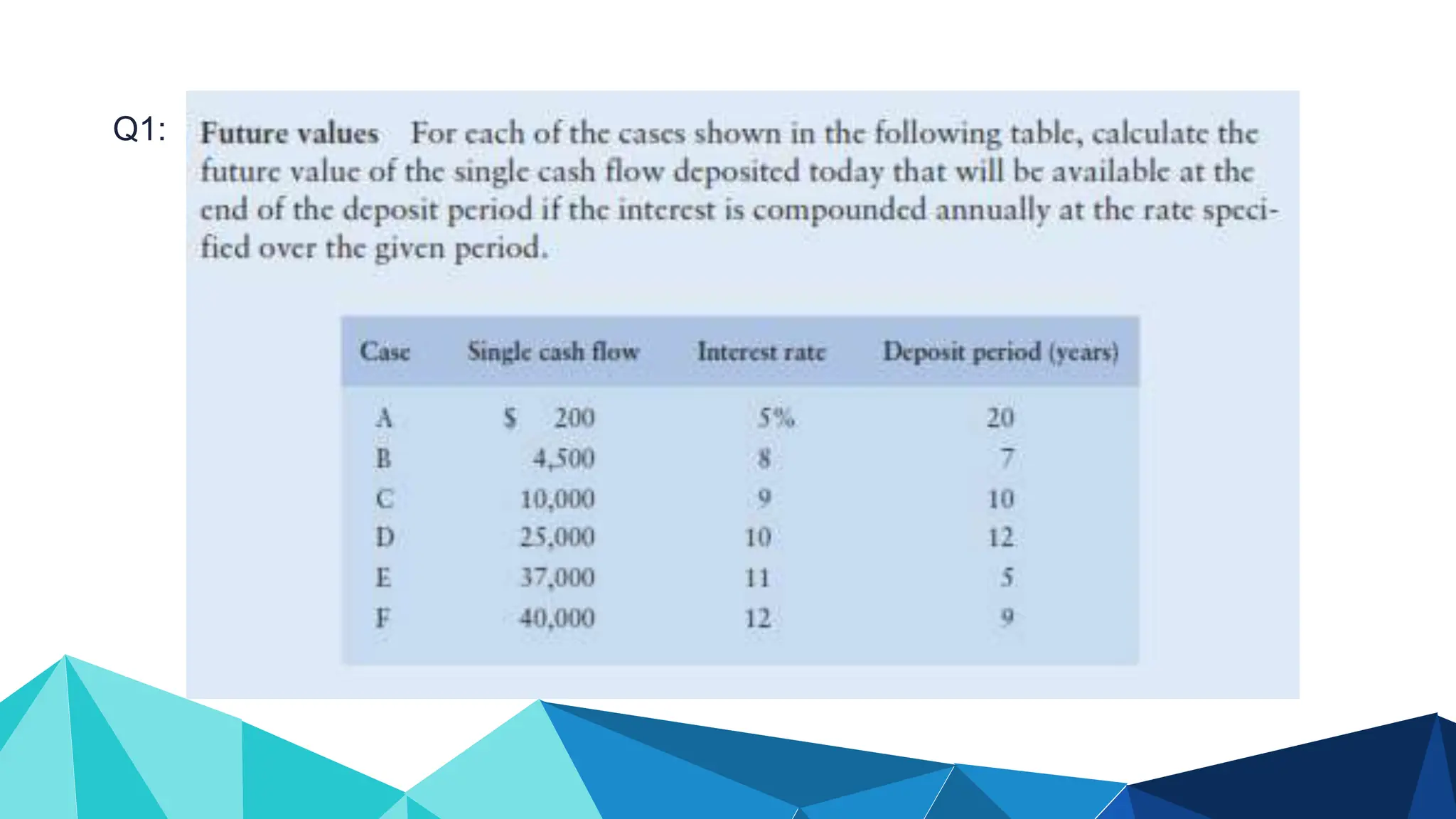
Q1:
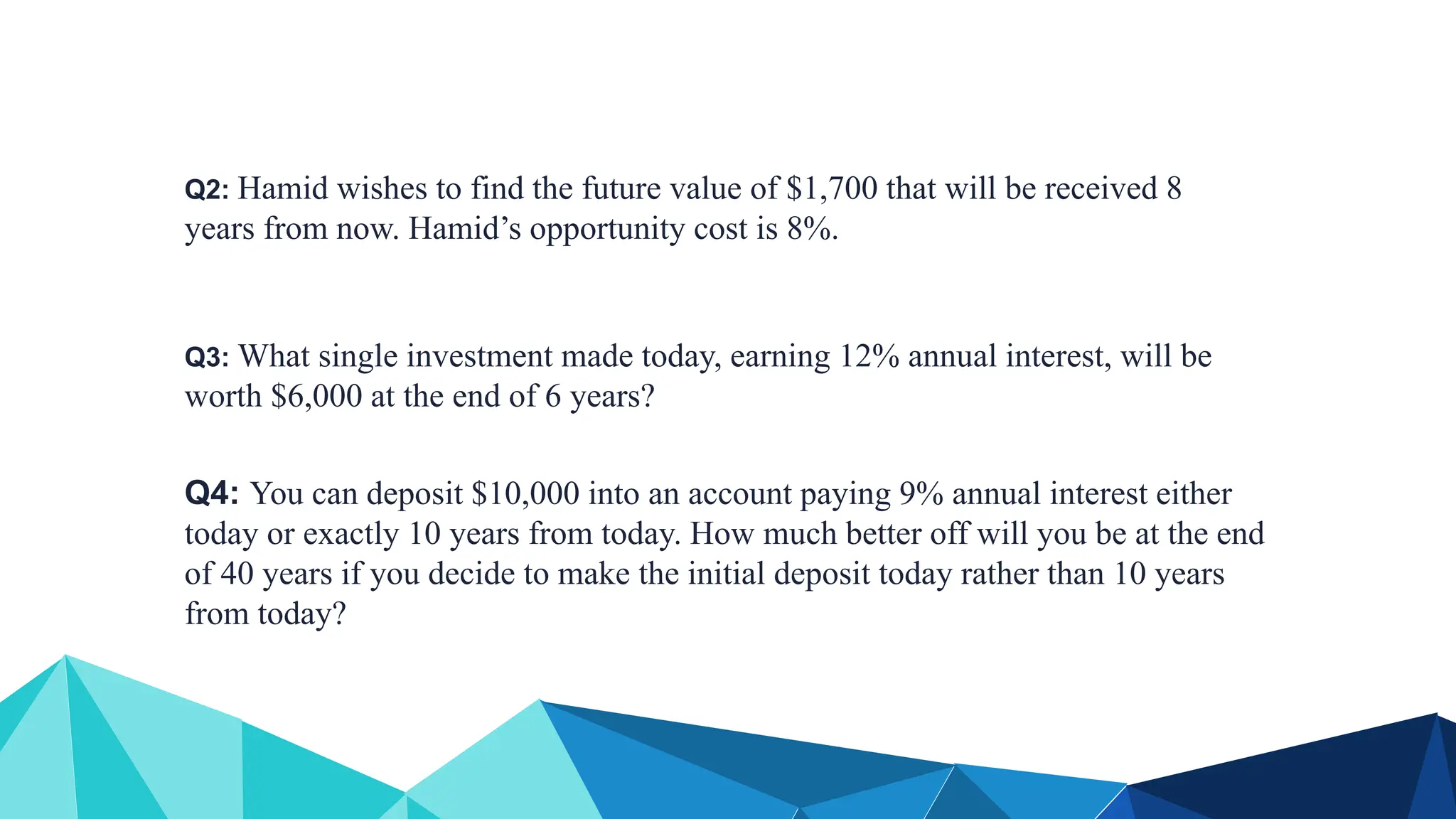
Q2: Hamid wishes to find the future value of $1,700 that will be received 8
years from now. Hamid’s opportunity cost is 8%.
Q3: What single investment made today, earning 12% annual interest, will be
worth $6,000 at the end of 6 years?
Q4: You can deposit $10,000 into an account paying 9% annual interest either
today or exactly 10 years from today. How much better off will you be at the end
of 40 years if you decide to make the initial deposit today rather than 10 years
from today?
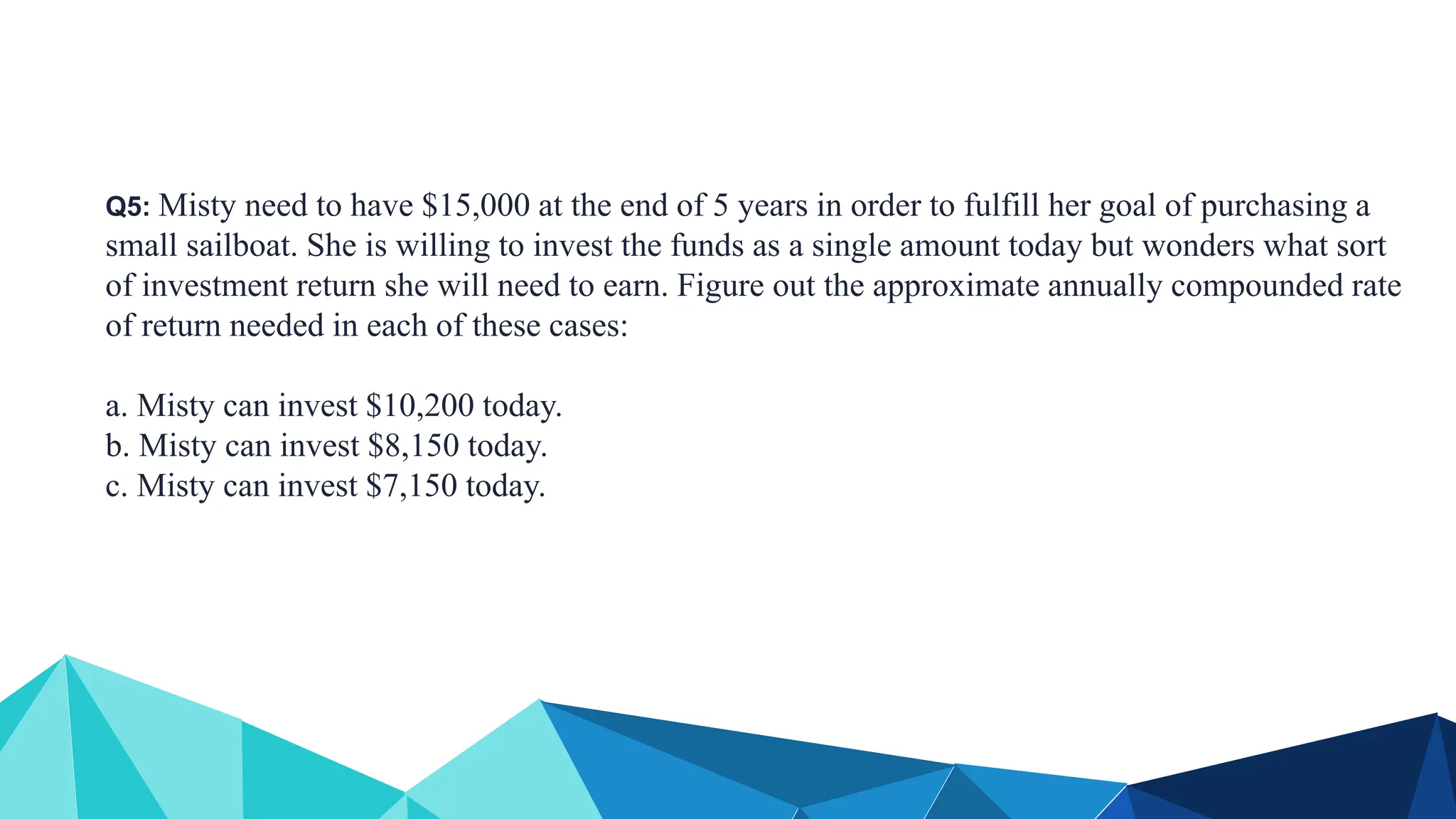
Q5: Misty need to have $15,000 at the end of 5 years in order to fulfill her goal of purchasing a
small sailboat. She is willing to invest the funds as a single amount today but wonders what sort
of investment return she will need to earn. Figure out the approximate annually compounded rate
of return needed in each of these cases:
a. Misty can invest $10,200 today.
b. Misty can invest $8,150 today.
c. Misty can invest $7,150 today.
Thanks!
You can find me at: haseeb.Yaqoob@kfueit.edu.pk
Any questions?
Time Value of Money
Prepared By: Haseeb Yaqoob
Lecturer
Faculty of Department
of Mechanical
Lecture 2
Annuity
• Student Loan Payments
• Car Loan Payments
• Insurance Premiums
• Mortgage Payments
• Retirement Savings
Examples of Annuities
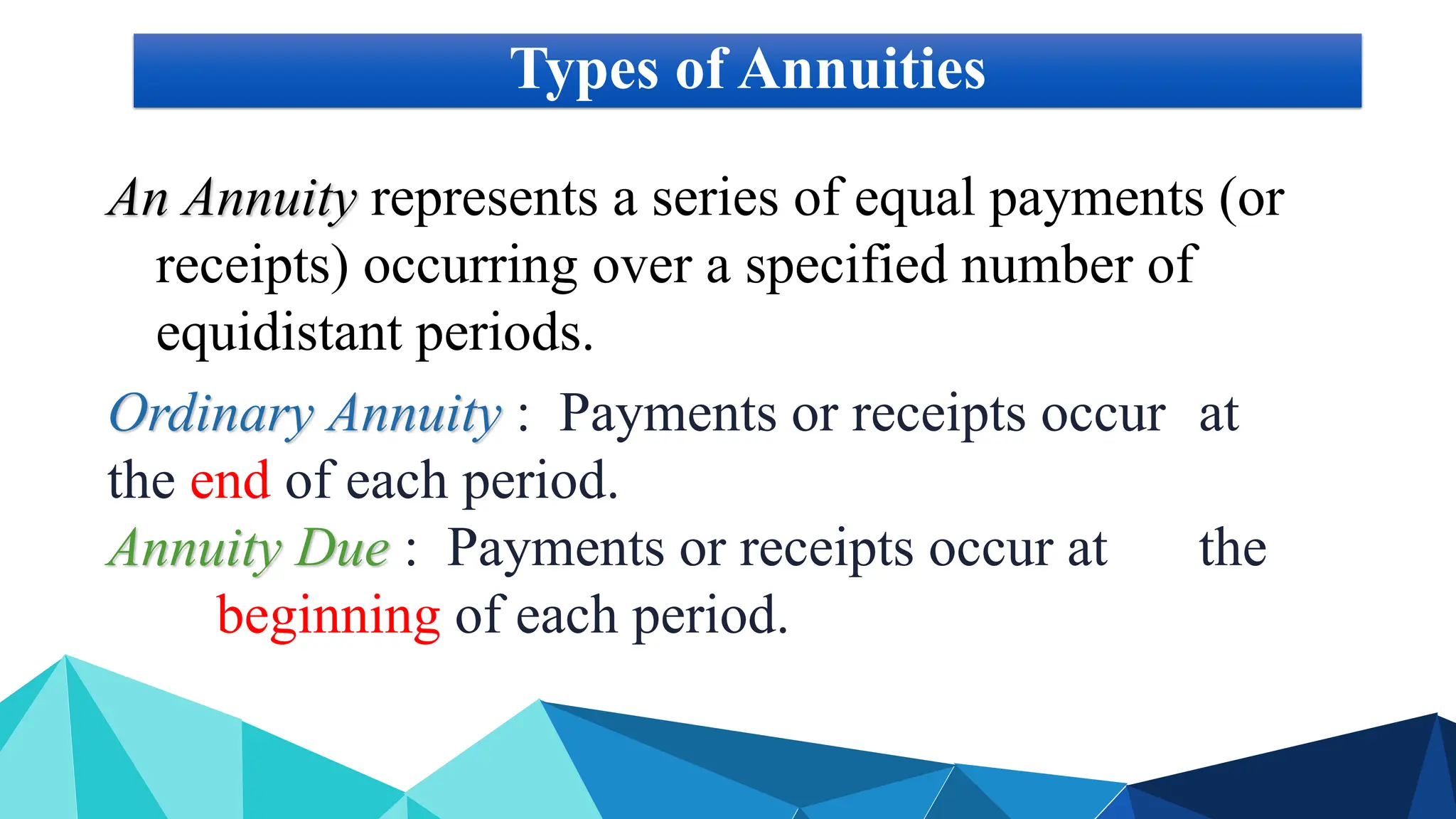
Types of Annuities
An Annuity represents a series of equal payments (or
receipts) occurring over a specified number of
equidistant periods.
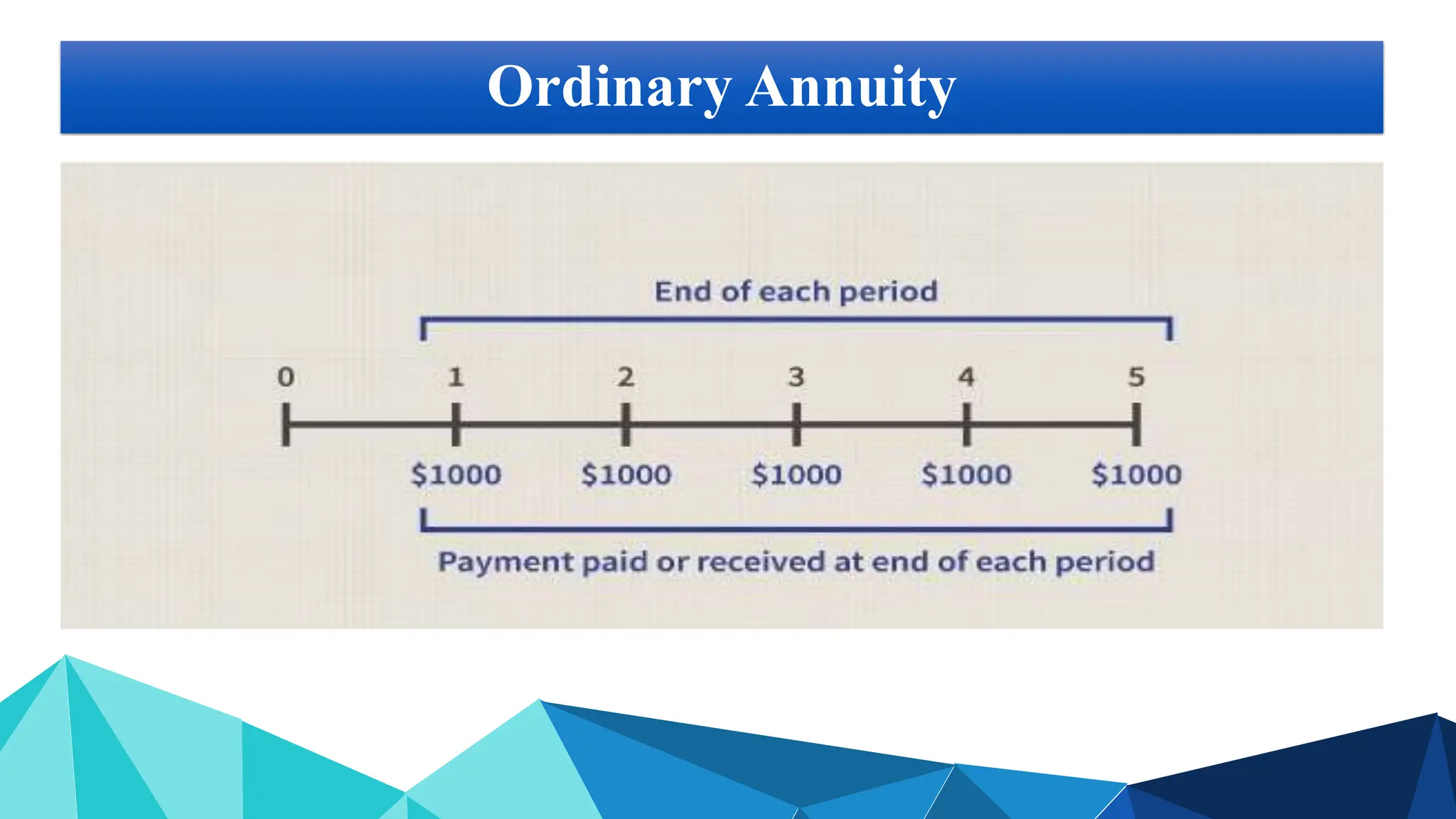
Ordinary Annuity : Payments or receipts occur at
the end of each period.
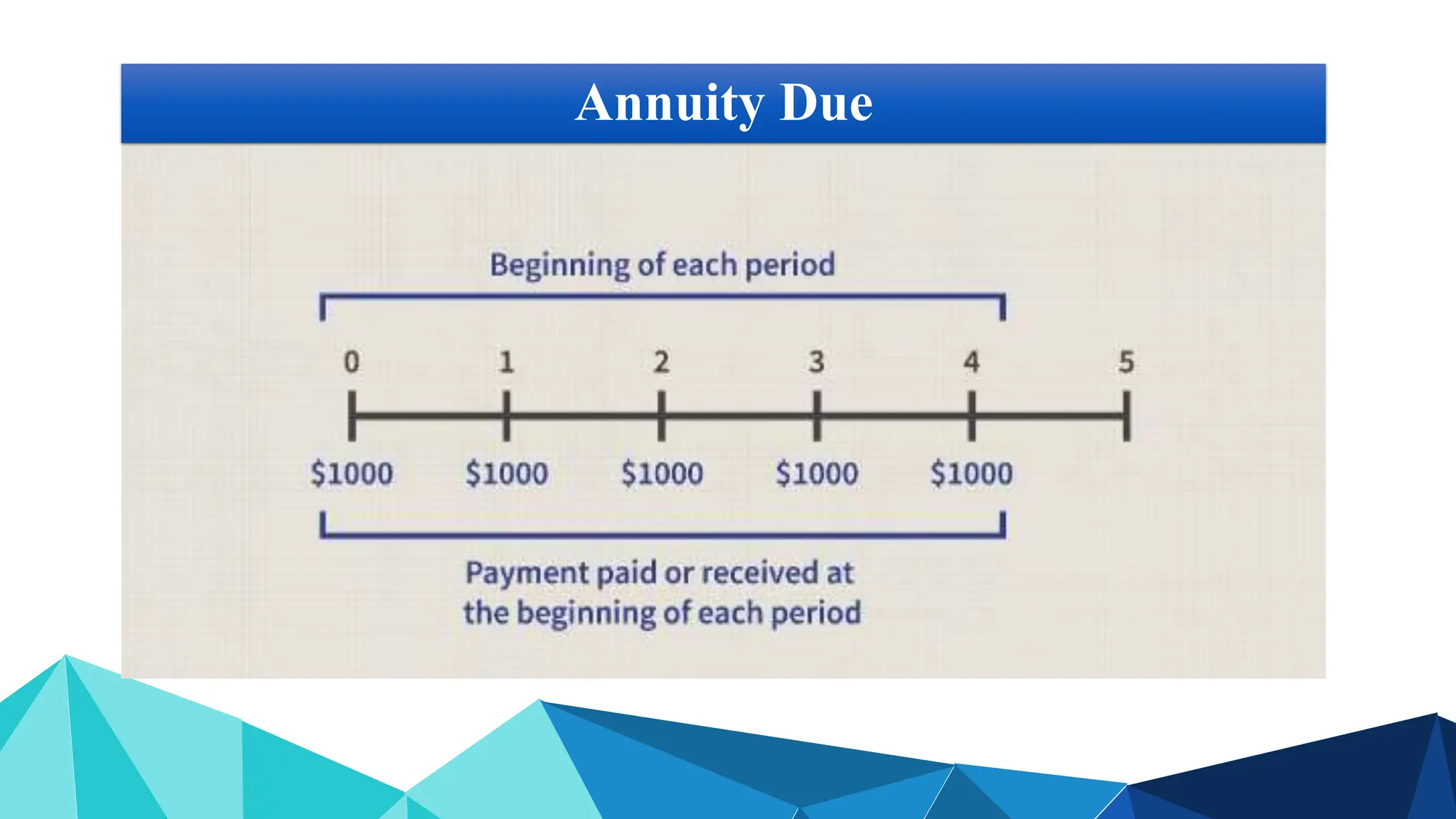
Annuity Due : Payments or receipts occur at the
beginning of each period.
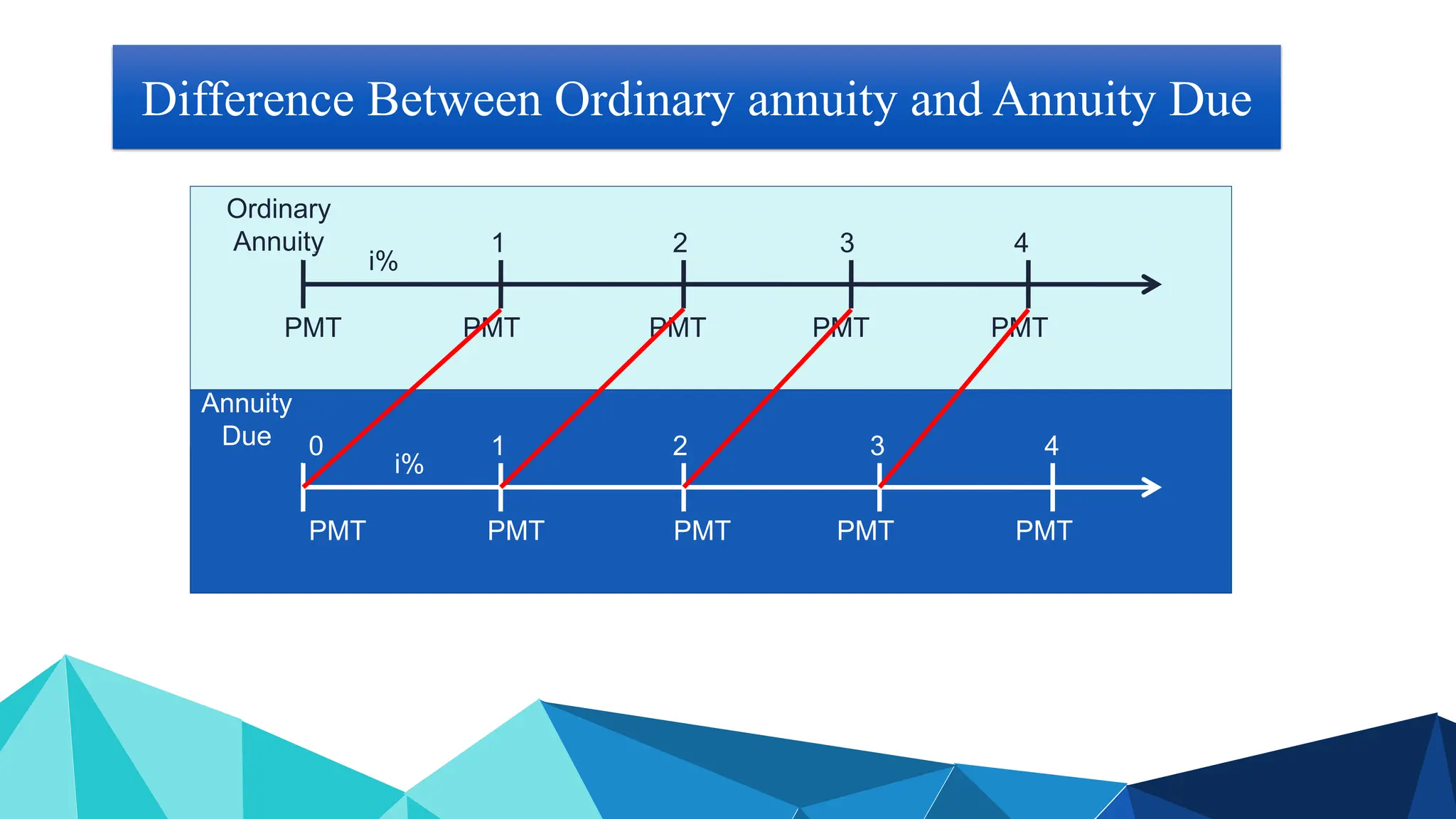
0 1 2 3 4
0 1 2 3 4
PMT PMT PMT PMT PMT
PMT PMT PMT PMT PMT
Ordinary
Annuity
Annuity
Due
i%
i%
Difference Between Ordinary annuity and Annuity Due
Ordinary Annuity-Annuity Due
Future Value
By using Formula
By Using Table
Ordinary Annuity
Future Value
By using Formula
By Using Table
Ordinary Annuity
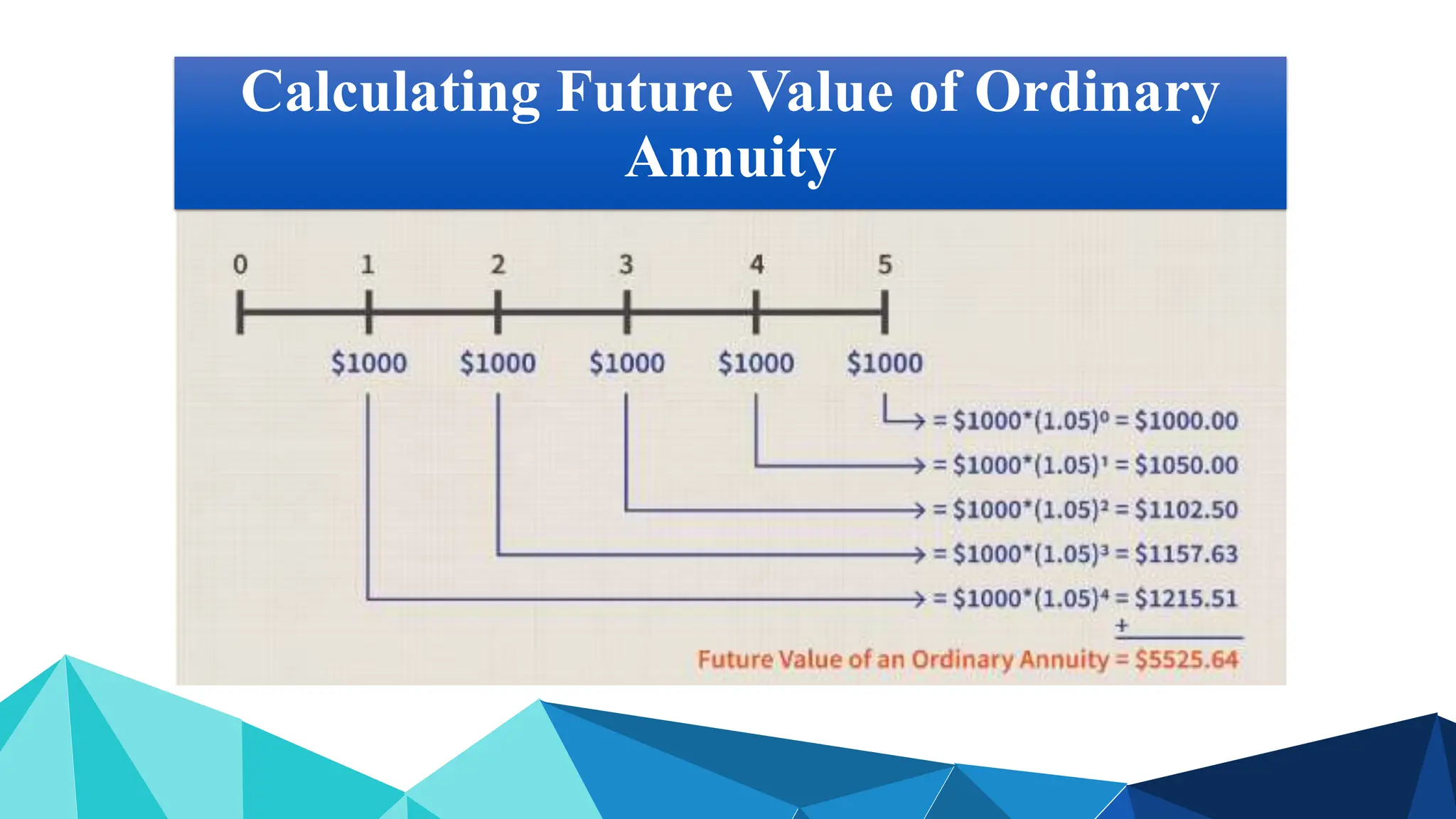
Calculating Future Value of Ordinary
Annuity
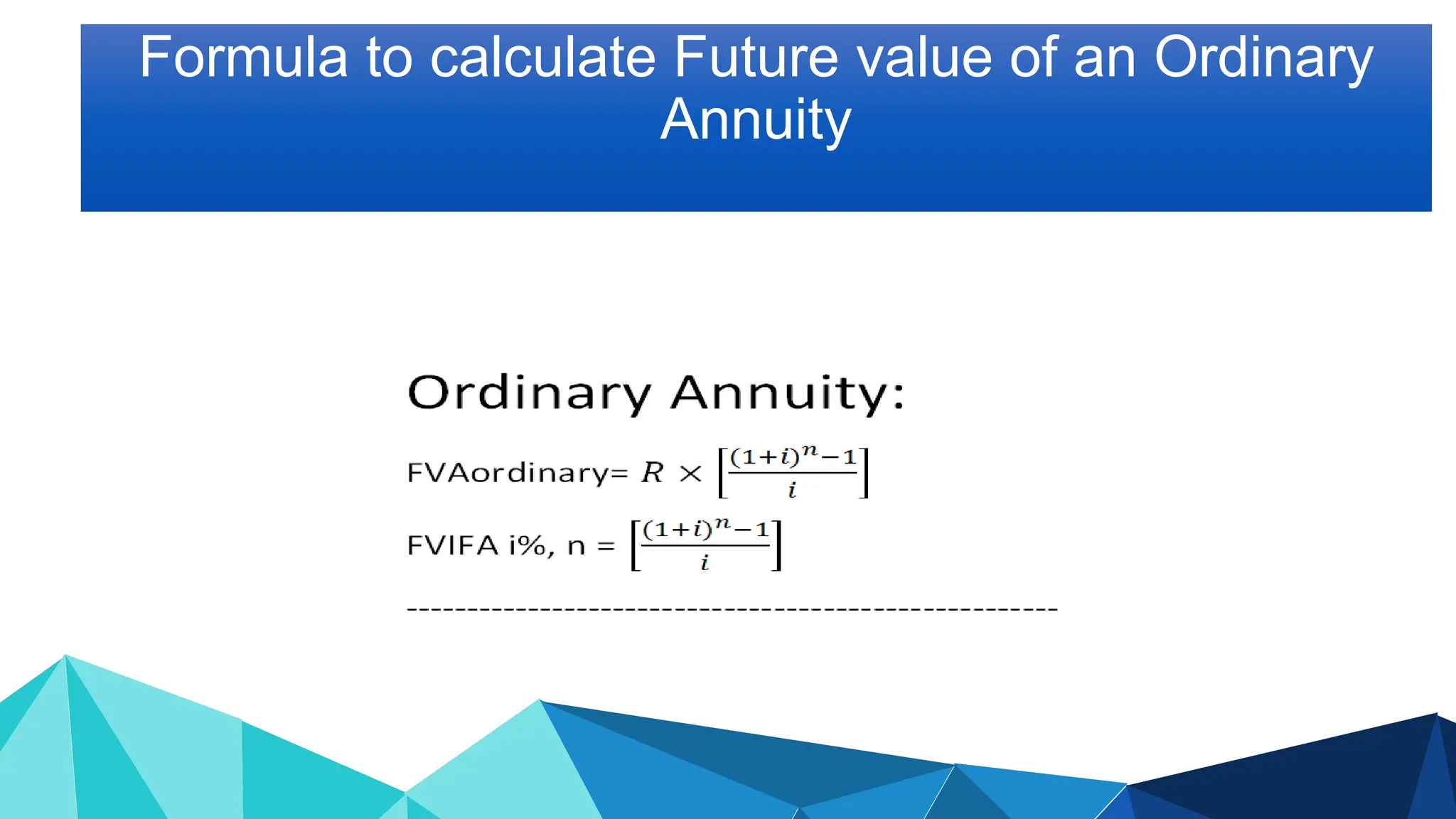
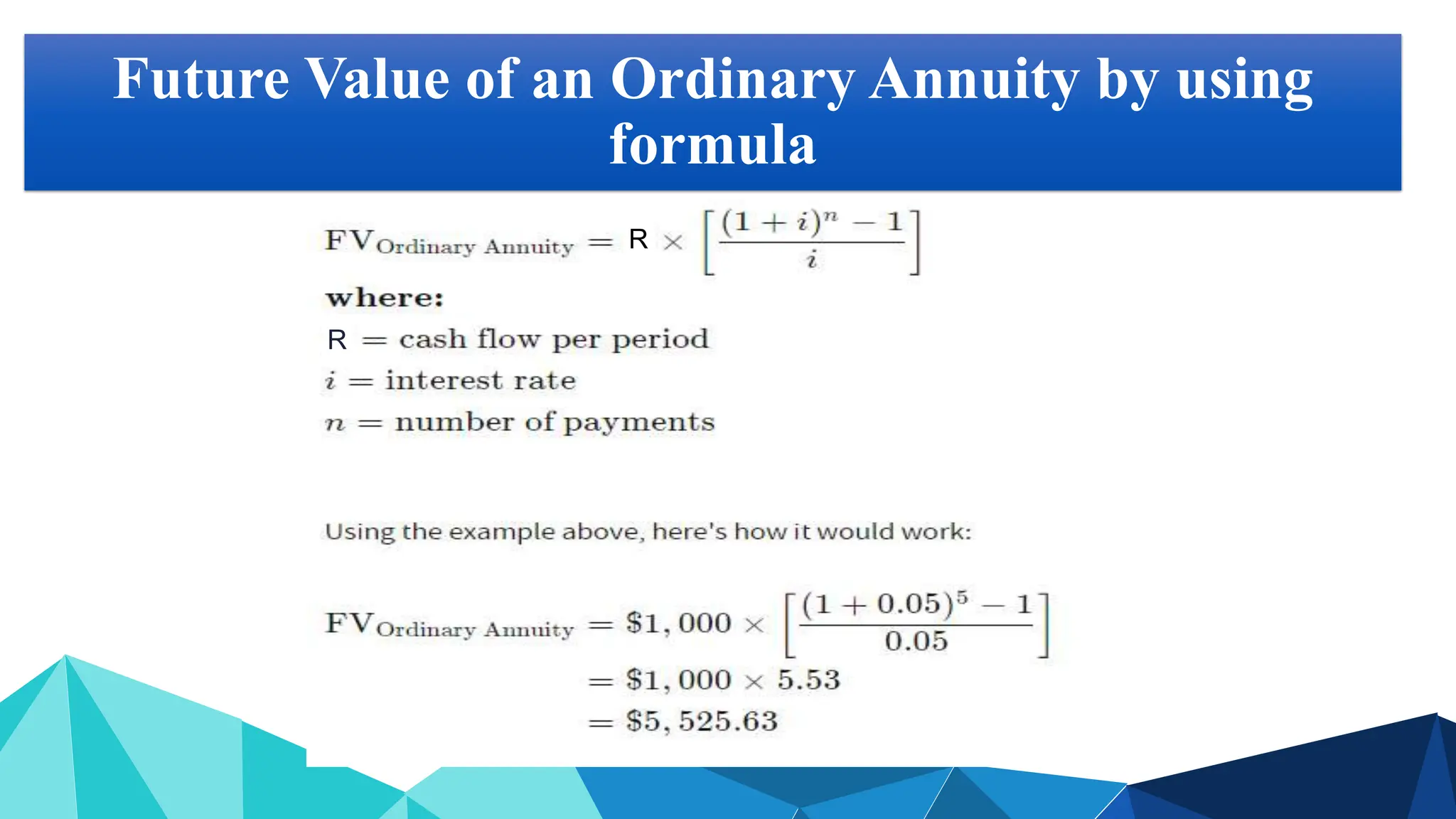
Formula to calculate Future value of an Ordinary
Annuity
Future Value of an Ordinary Annuity by using
formula
R
R
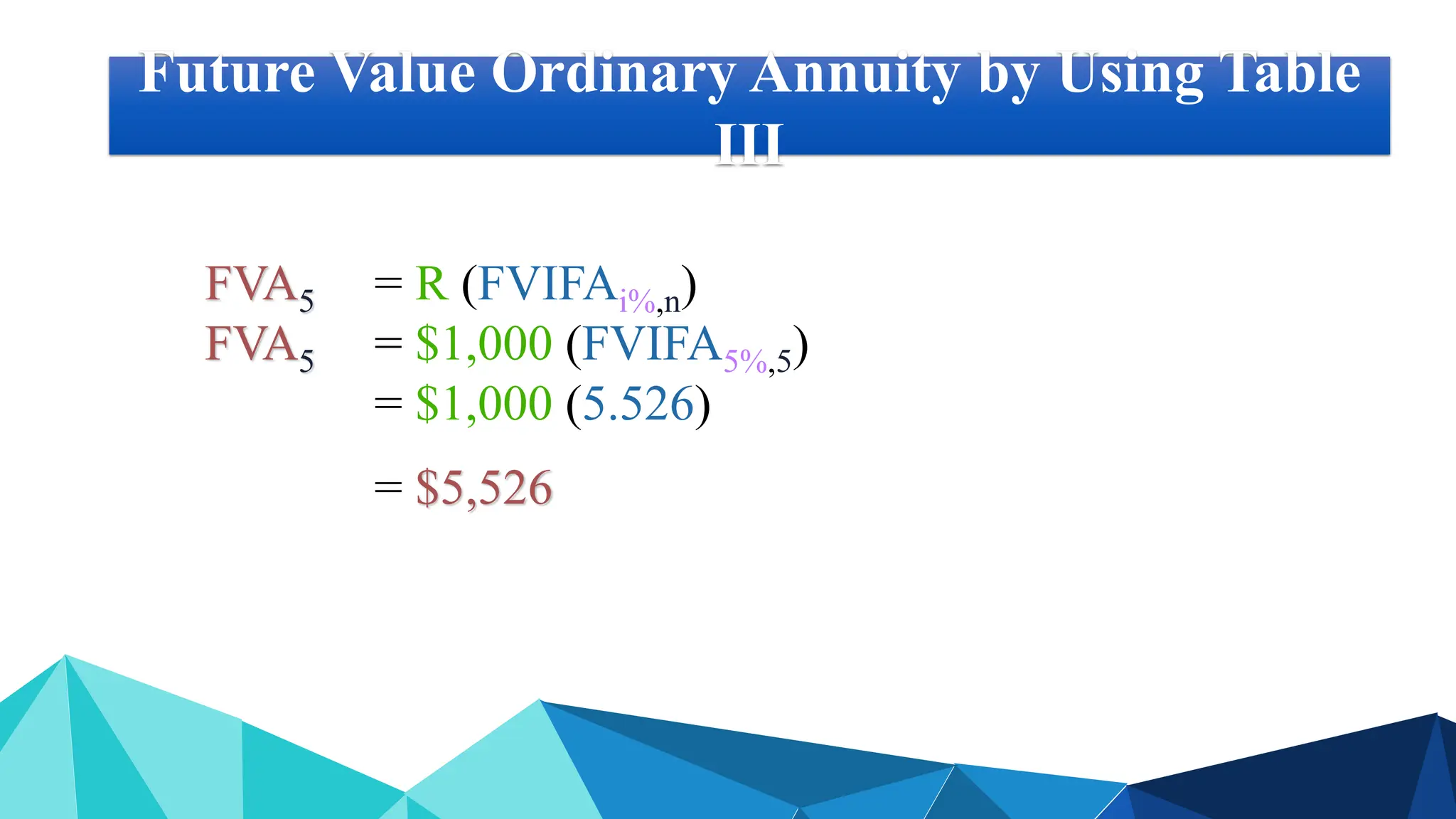
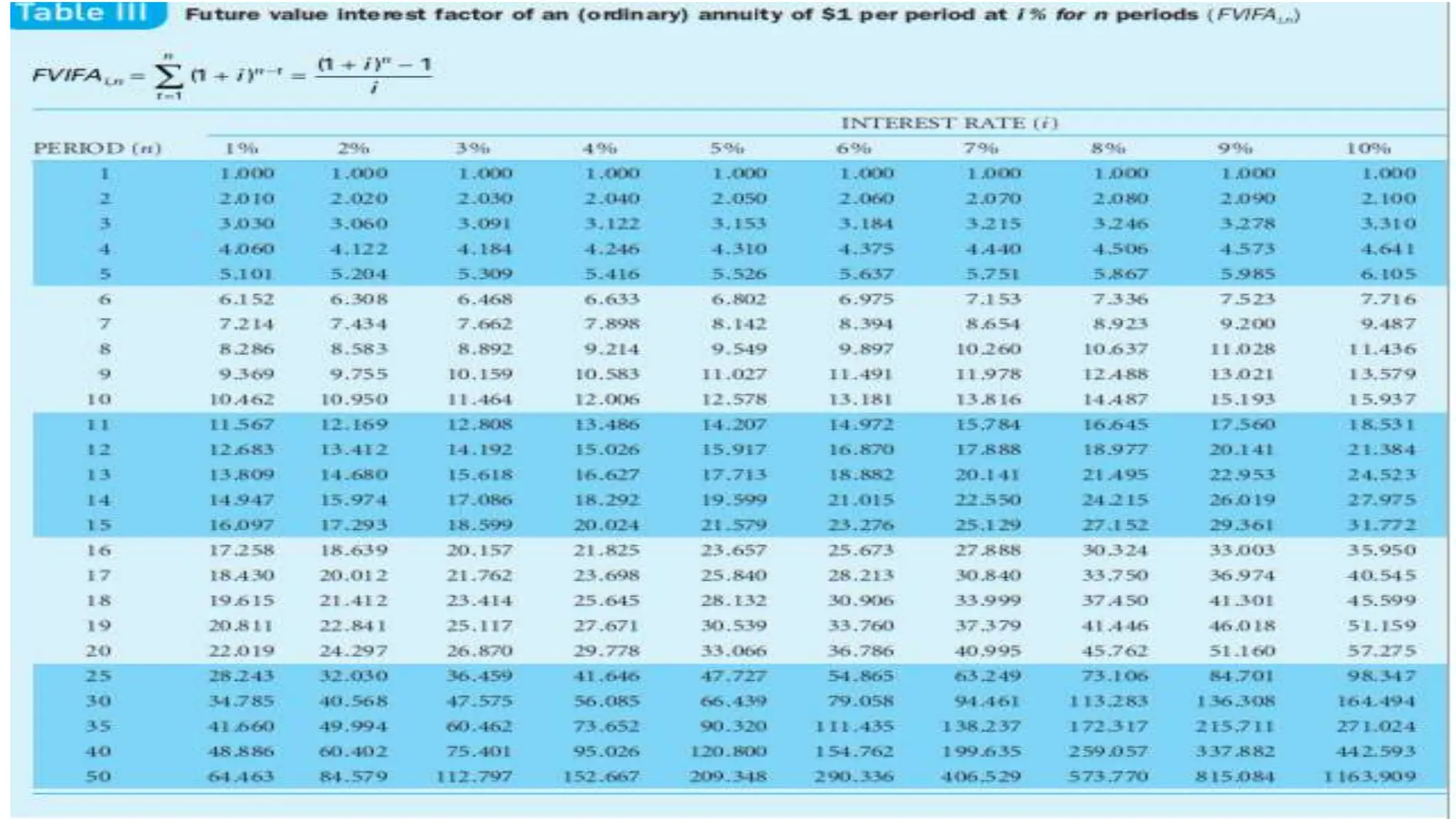
Future Value Ordinary Annuity by Using Table
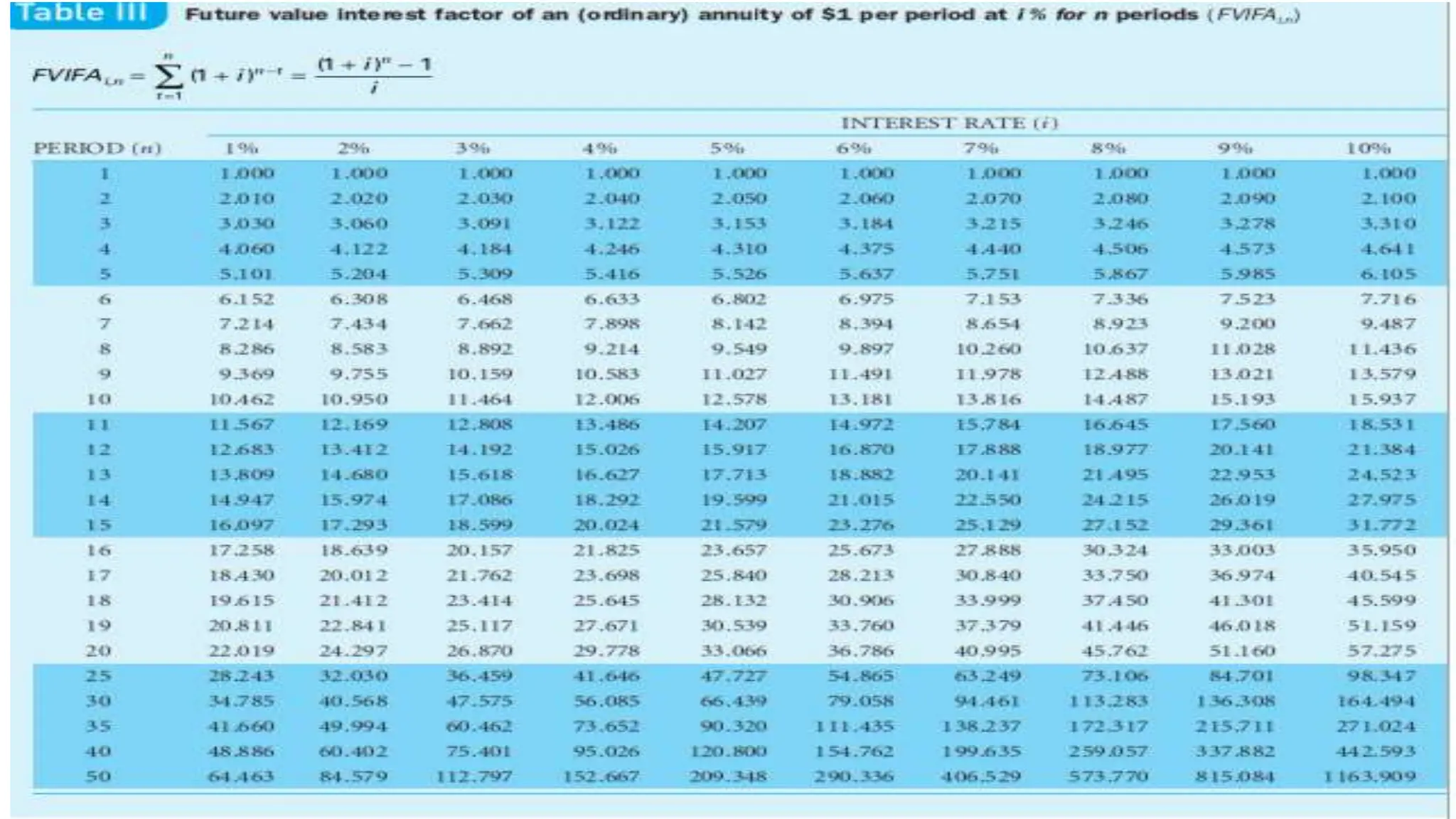
III
FVA5 = R (FVIFAi%,n)
FVA5 = $1,000 (FVIFA5%,5)
= $1,000 (5.526)
= $5,526
Annuity Due
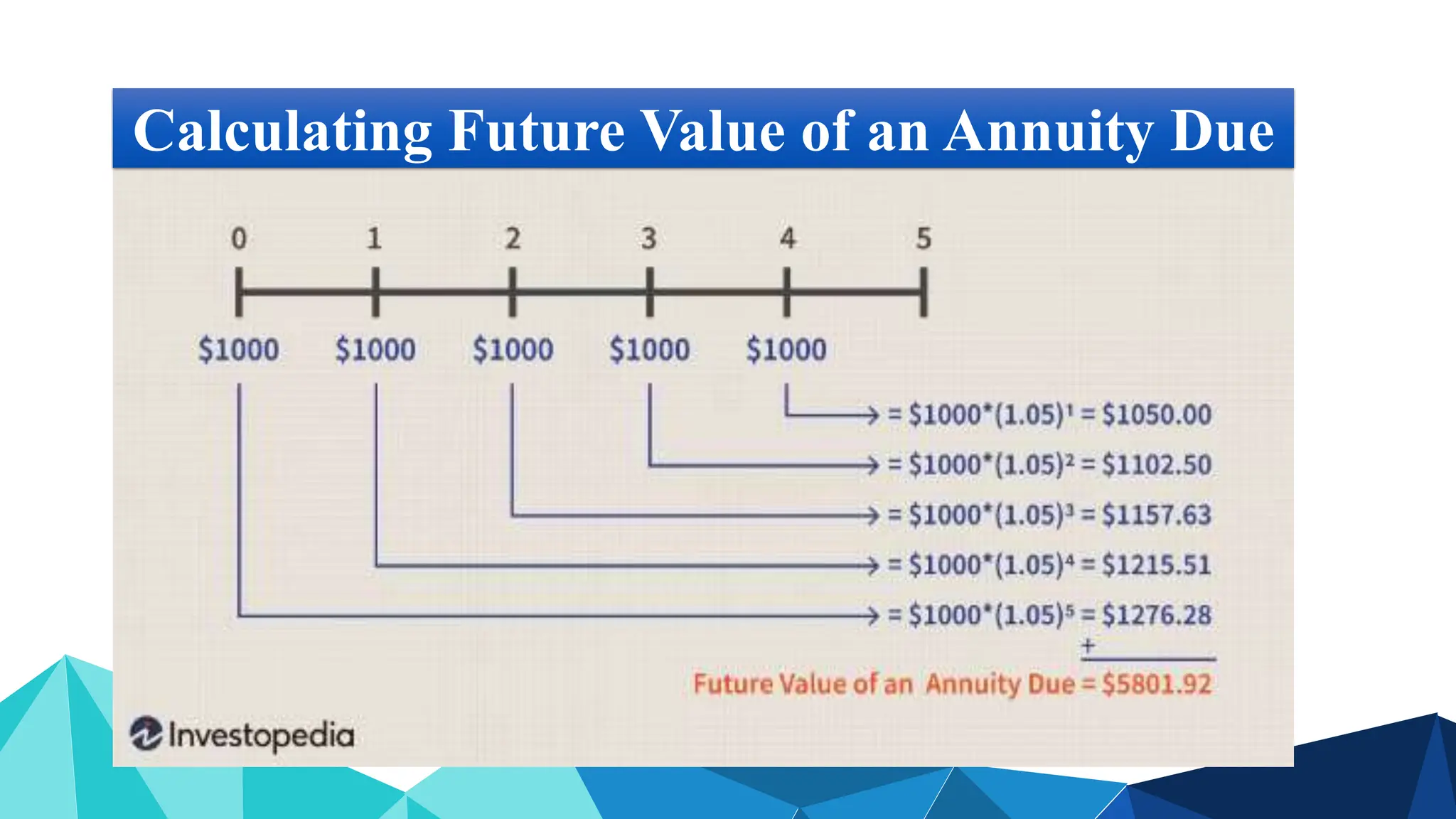
Calculating Future Value of an Annuity Due
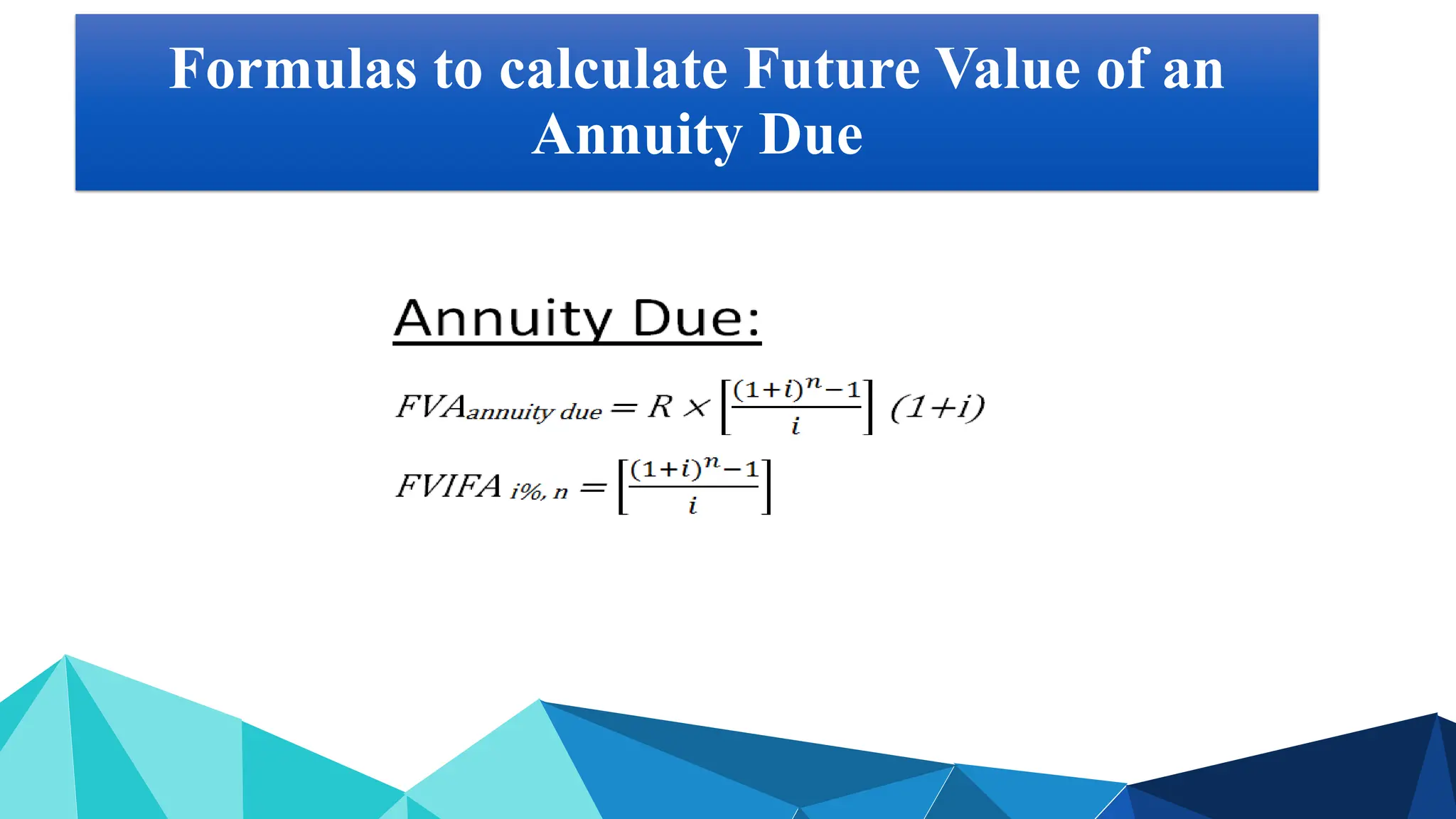
Formulas to calculate Future Value of an
Annuity Due
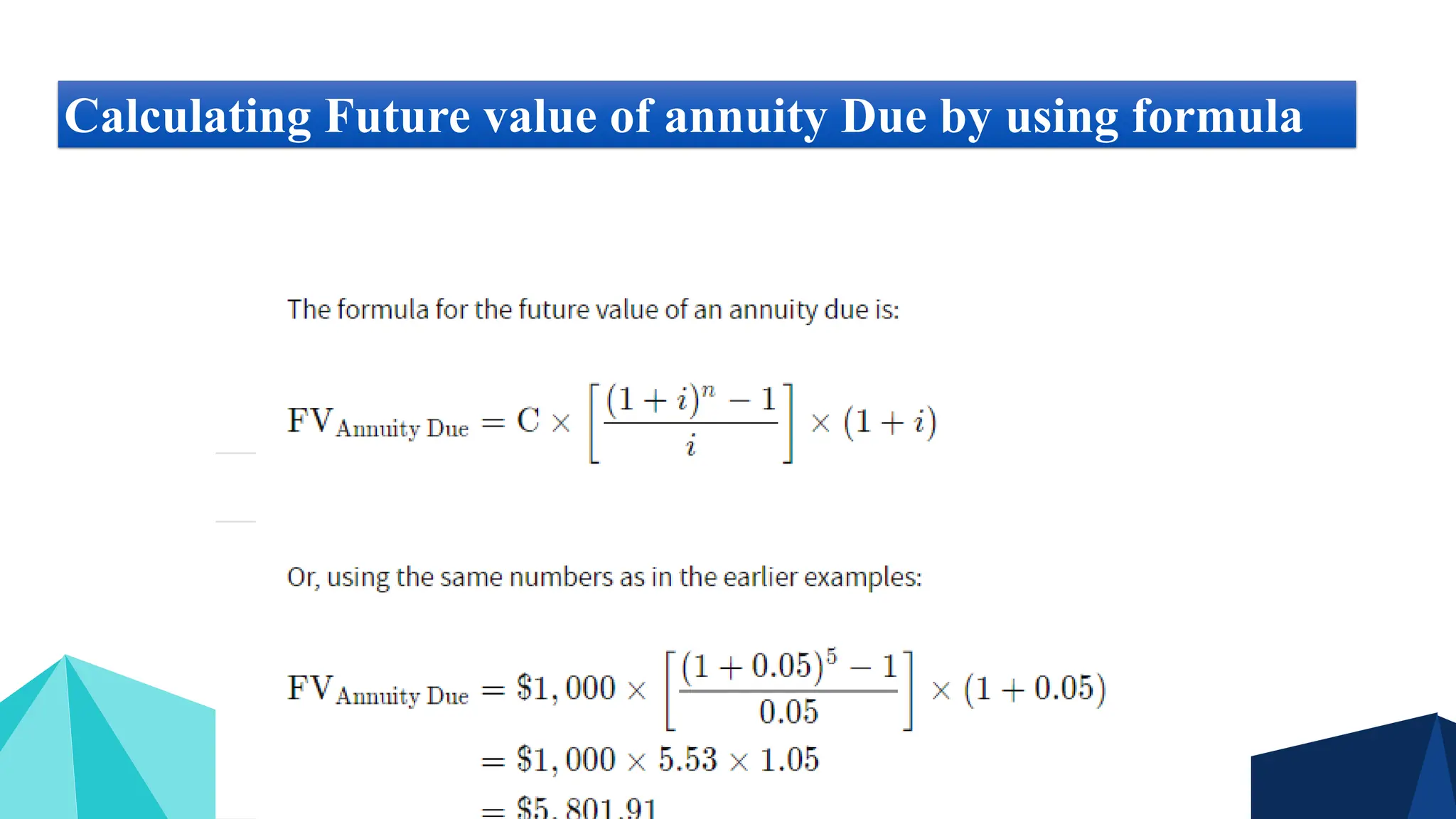
Calculating Future value of annuity Due by using formula
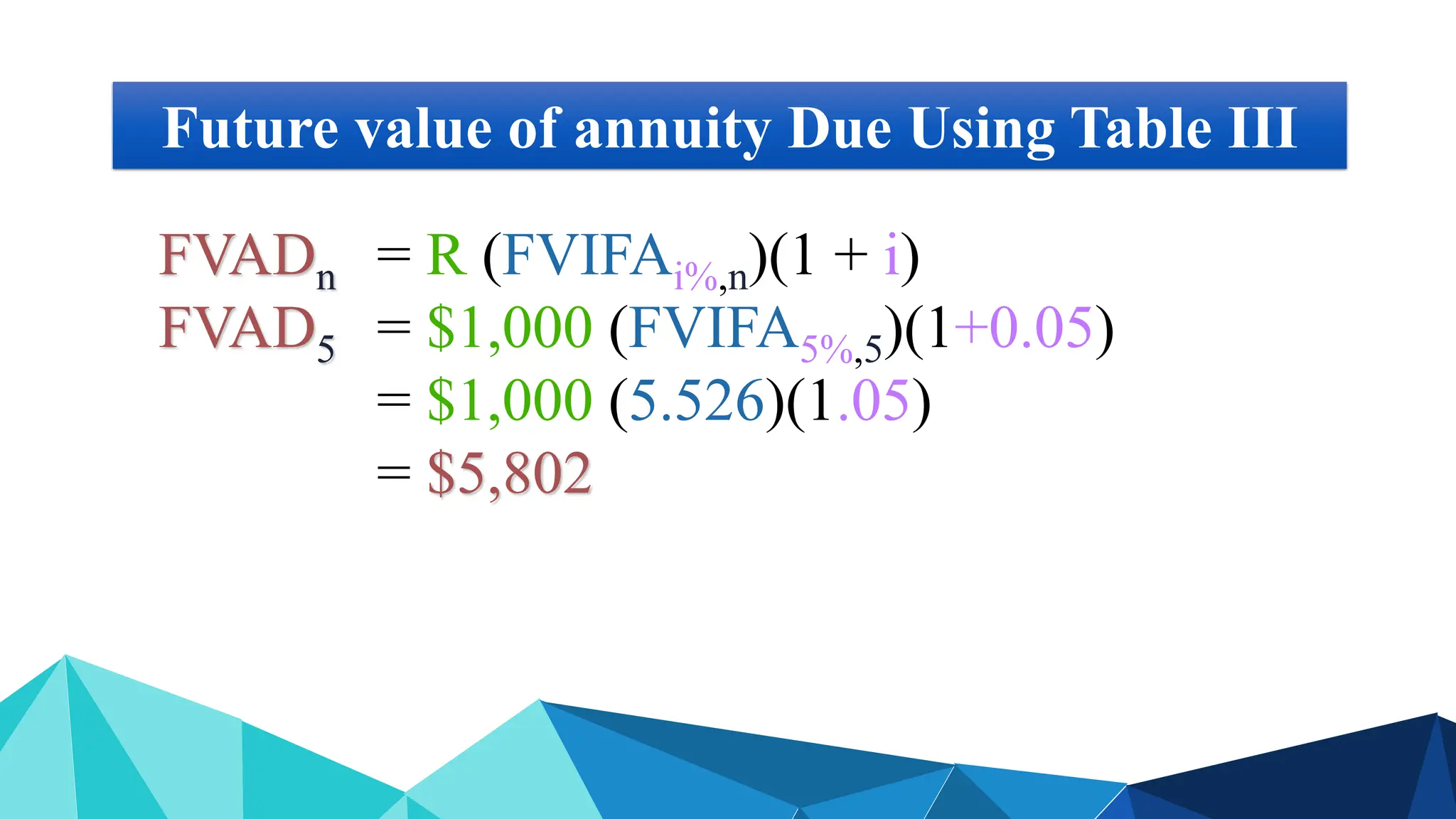
Future value of annuity Due Using Table III
FVADn = R (FVIFAi%,n)(1 + i)
FVAD5 = $1,000 (FVIFA5%,5)(1+0.05)
= $1,000 (5.526)(1.05)
= $5,802
Ordinary Annuity- Annuity Due
Present Value
By using Formula
By Using Table
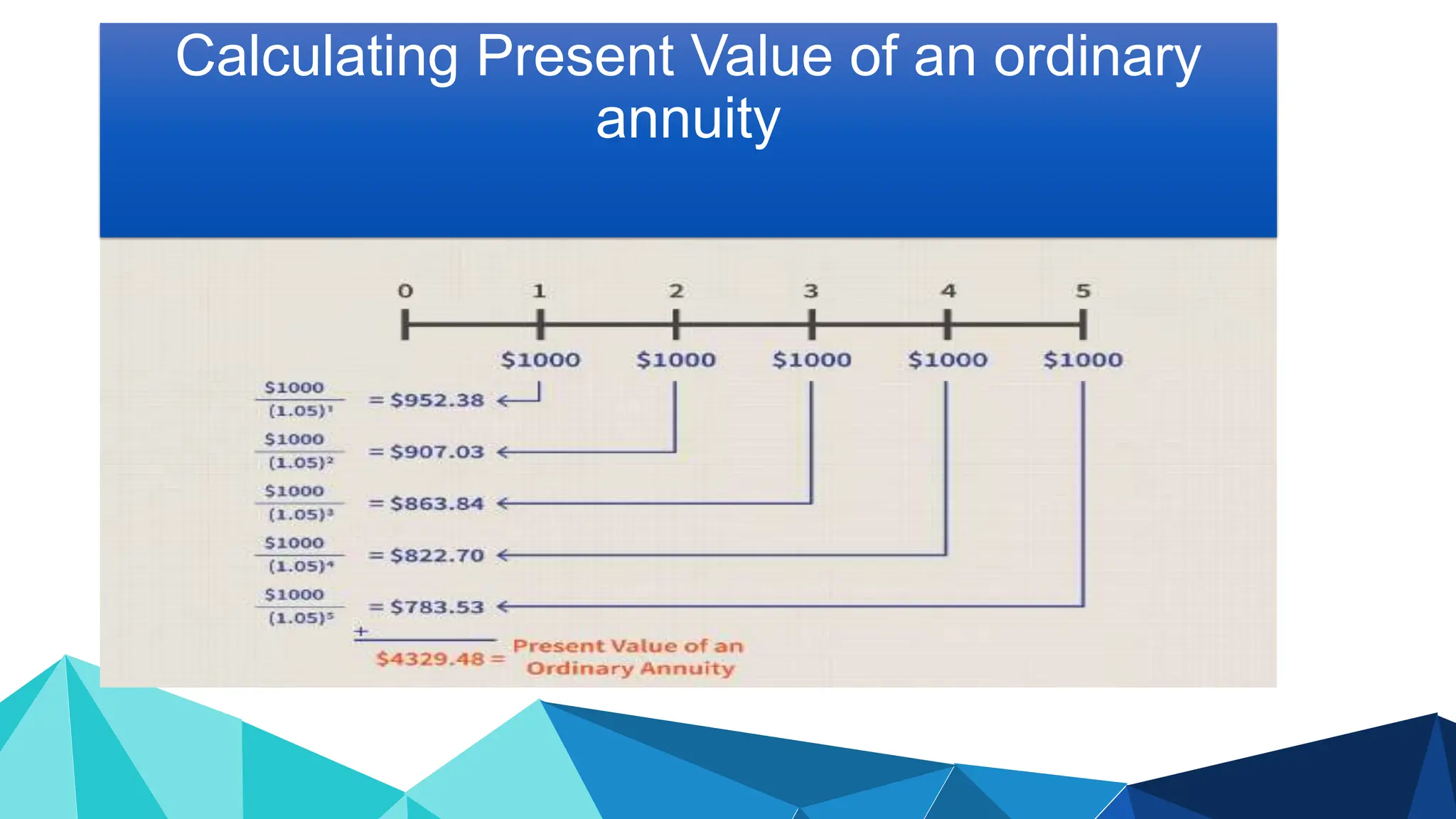
Calculating Present Value of an ordinary
annuity
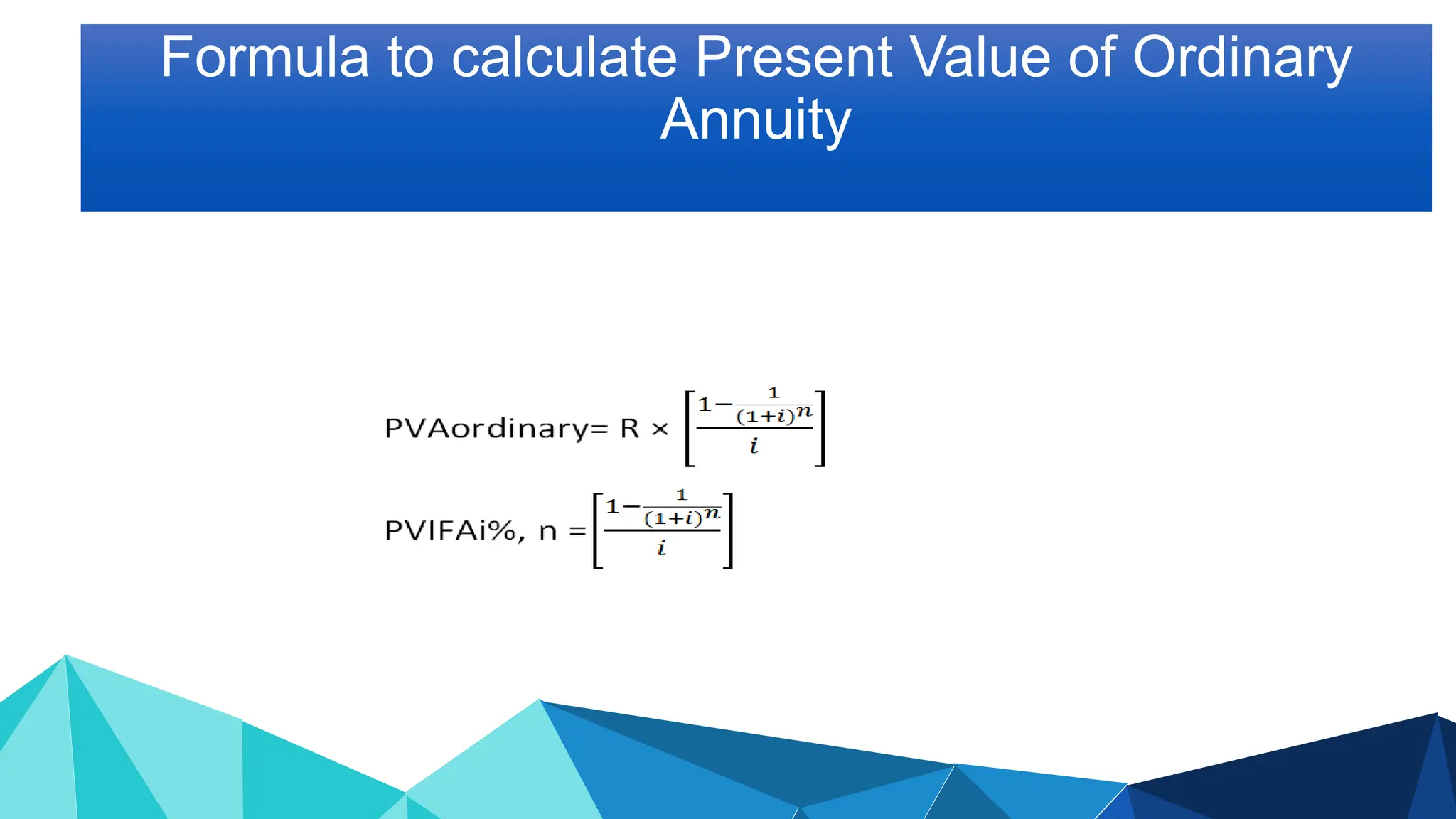
Formula to calculate Present Value of Ordinary
Annuity
Example
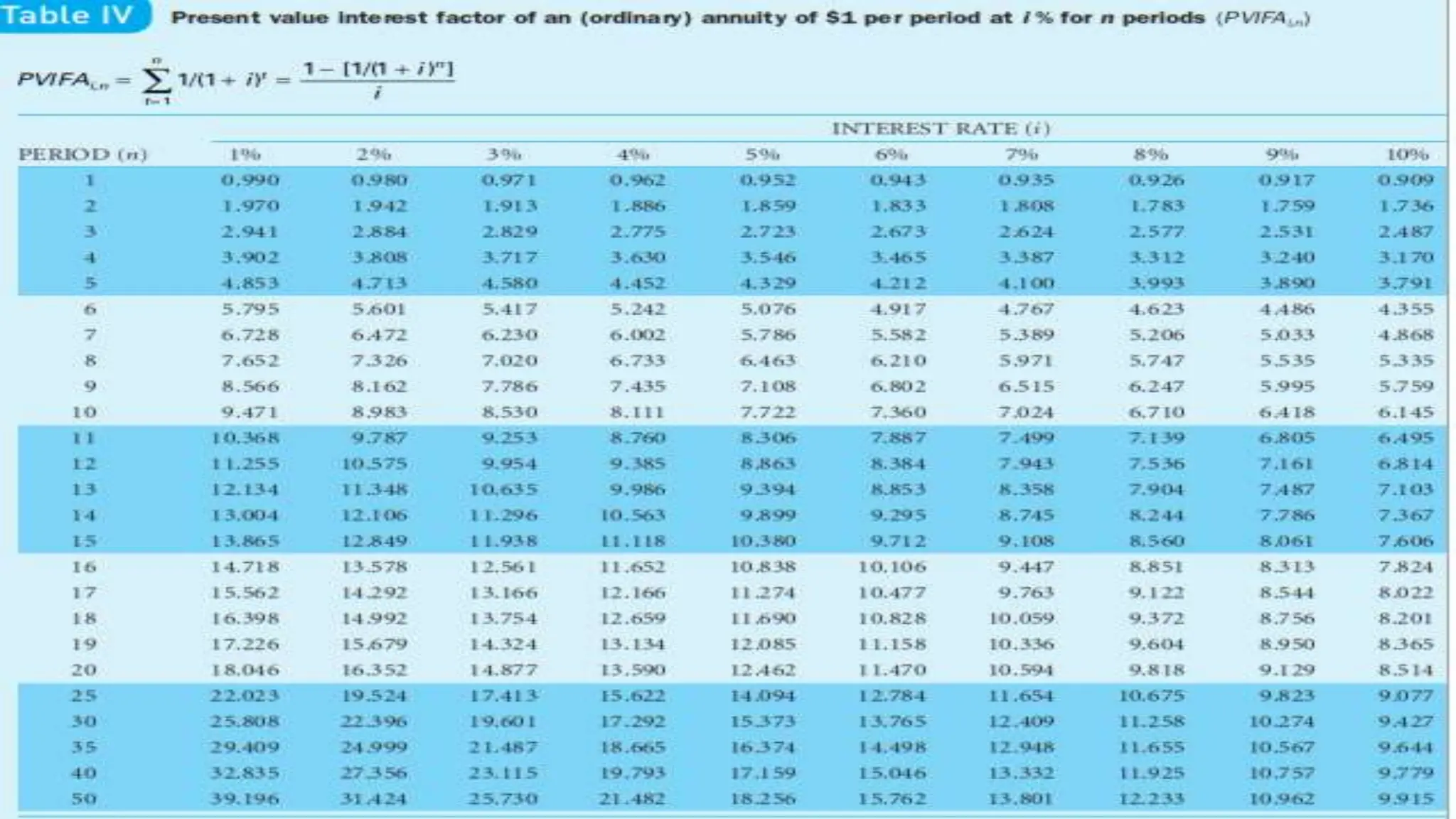
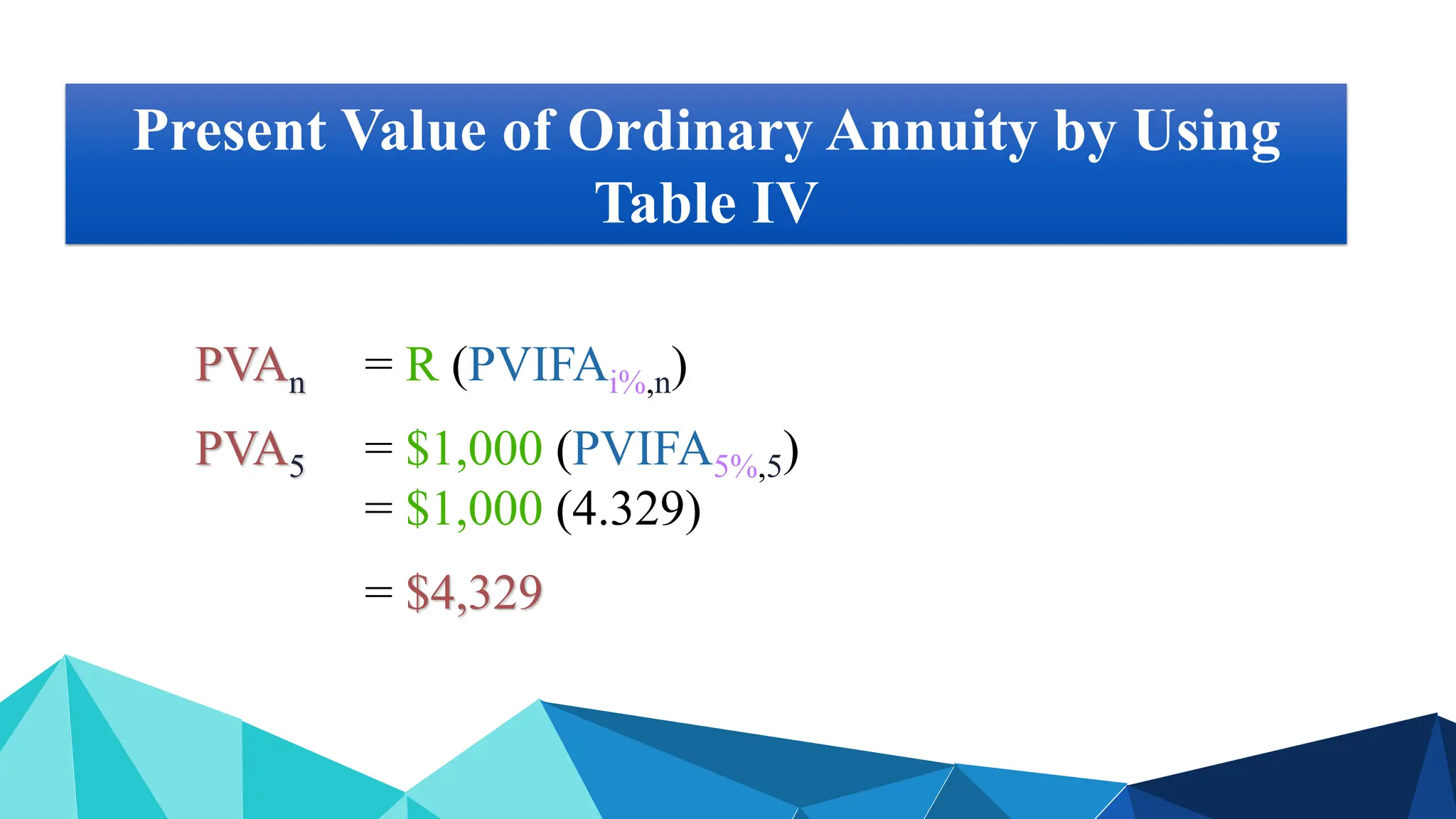
Present Value of Ordinary Annuity by Using
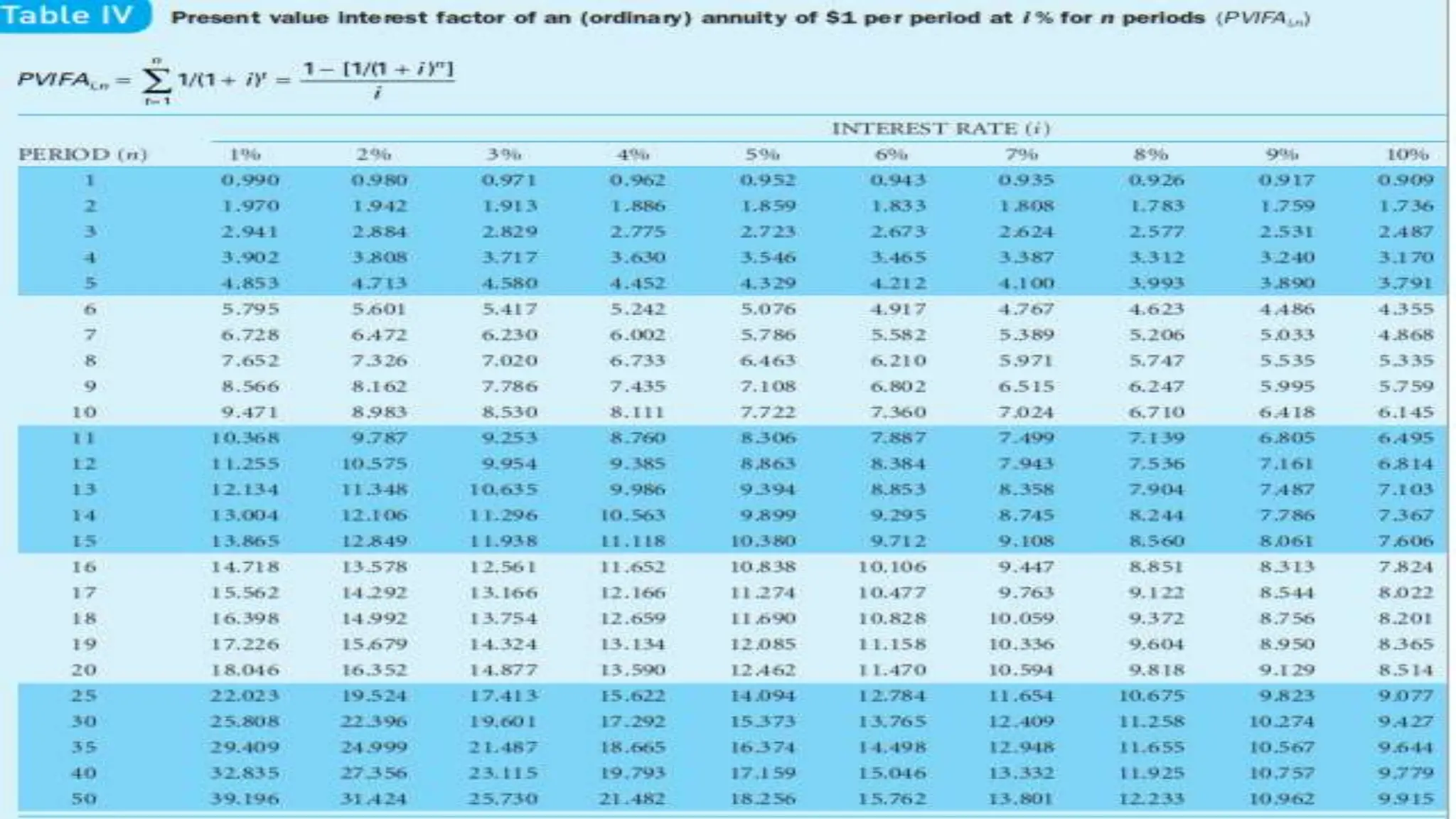
Table IV
PVAn = R (PVIFAi%,n)
PVA5 = $1,000 (PVIFA5%,5)
= $1,000 (4.329)
= $4,329
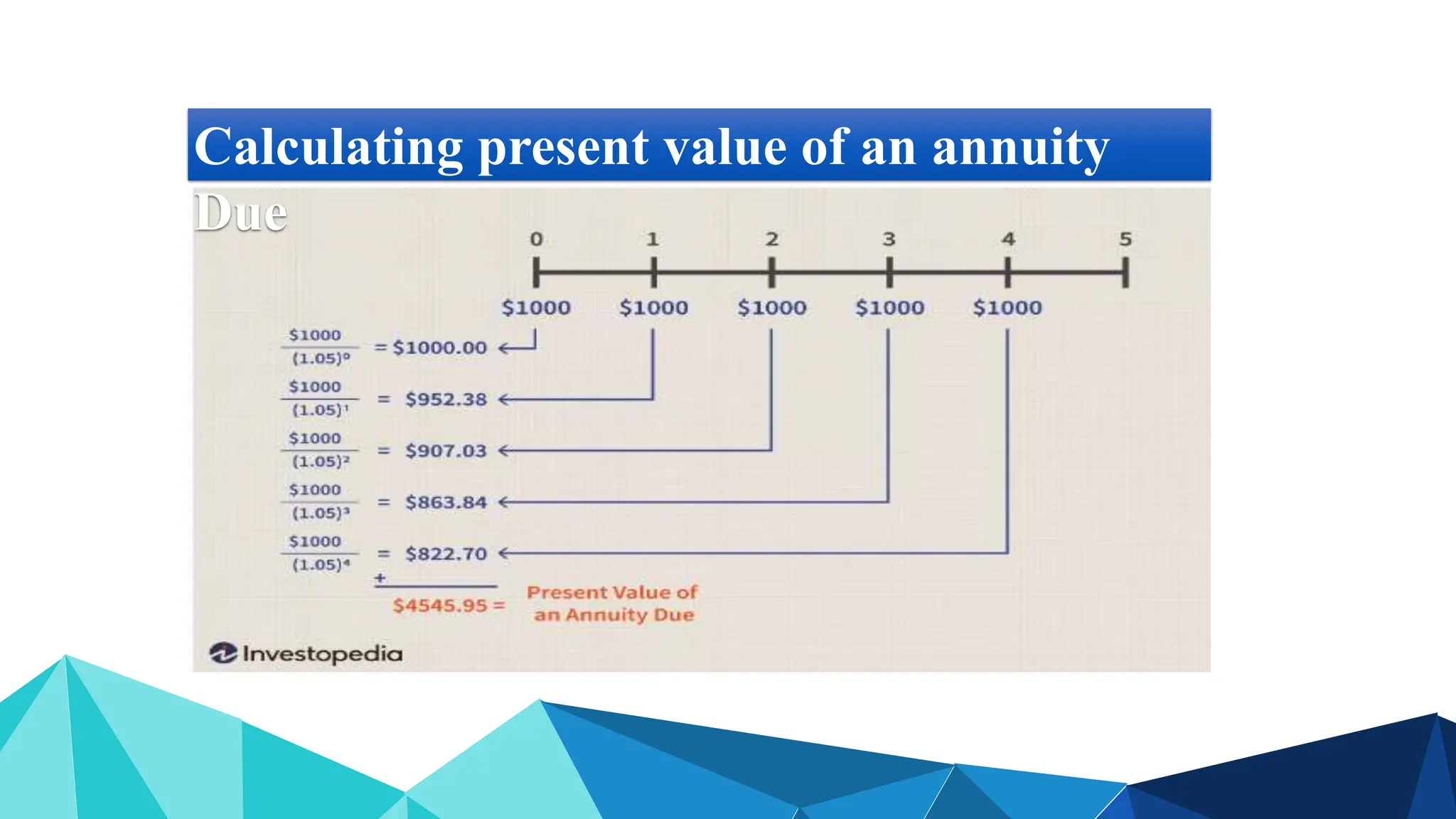
Calculating present value of an annuity
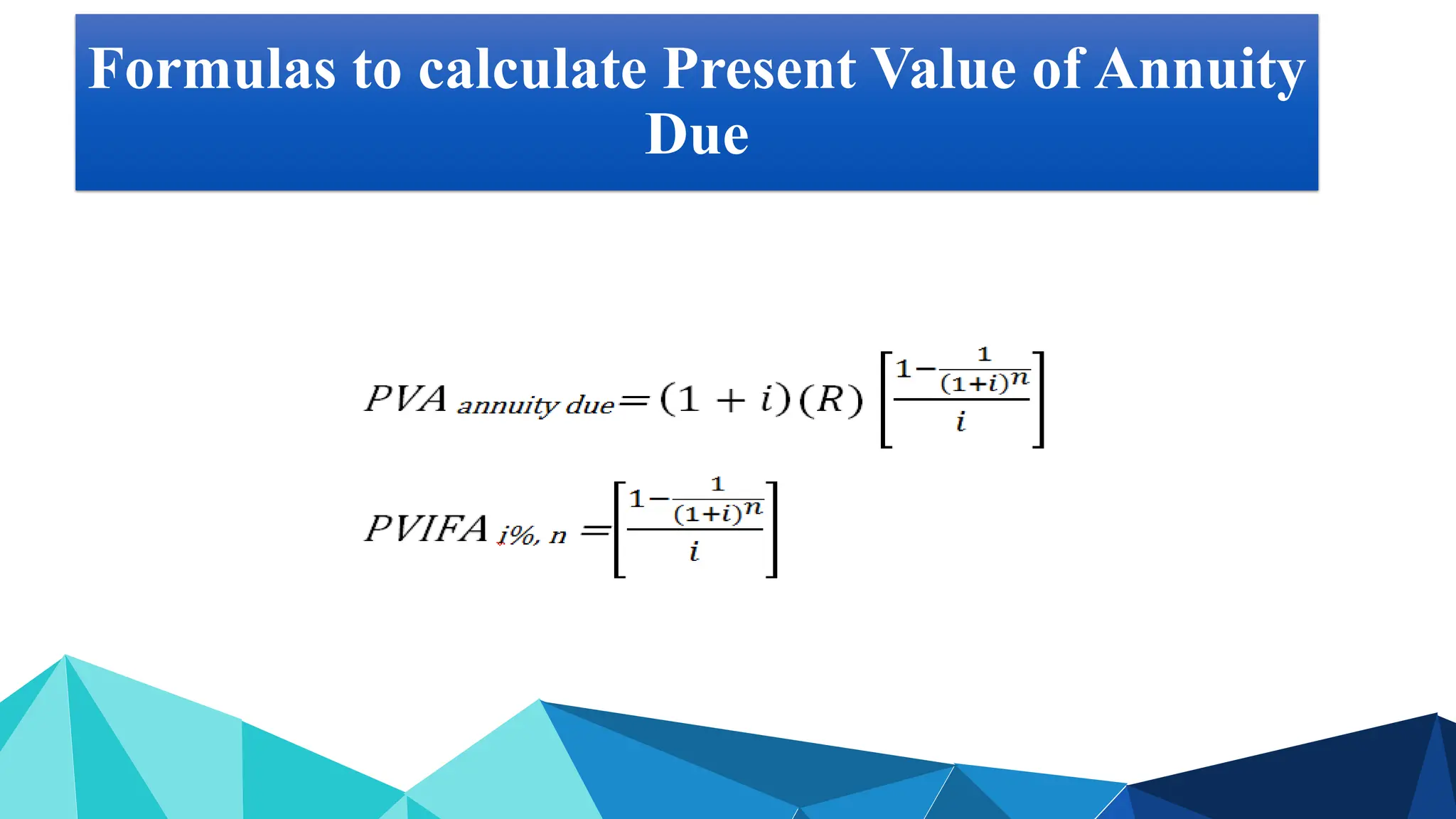
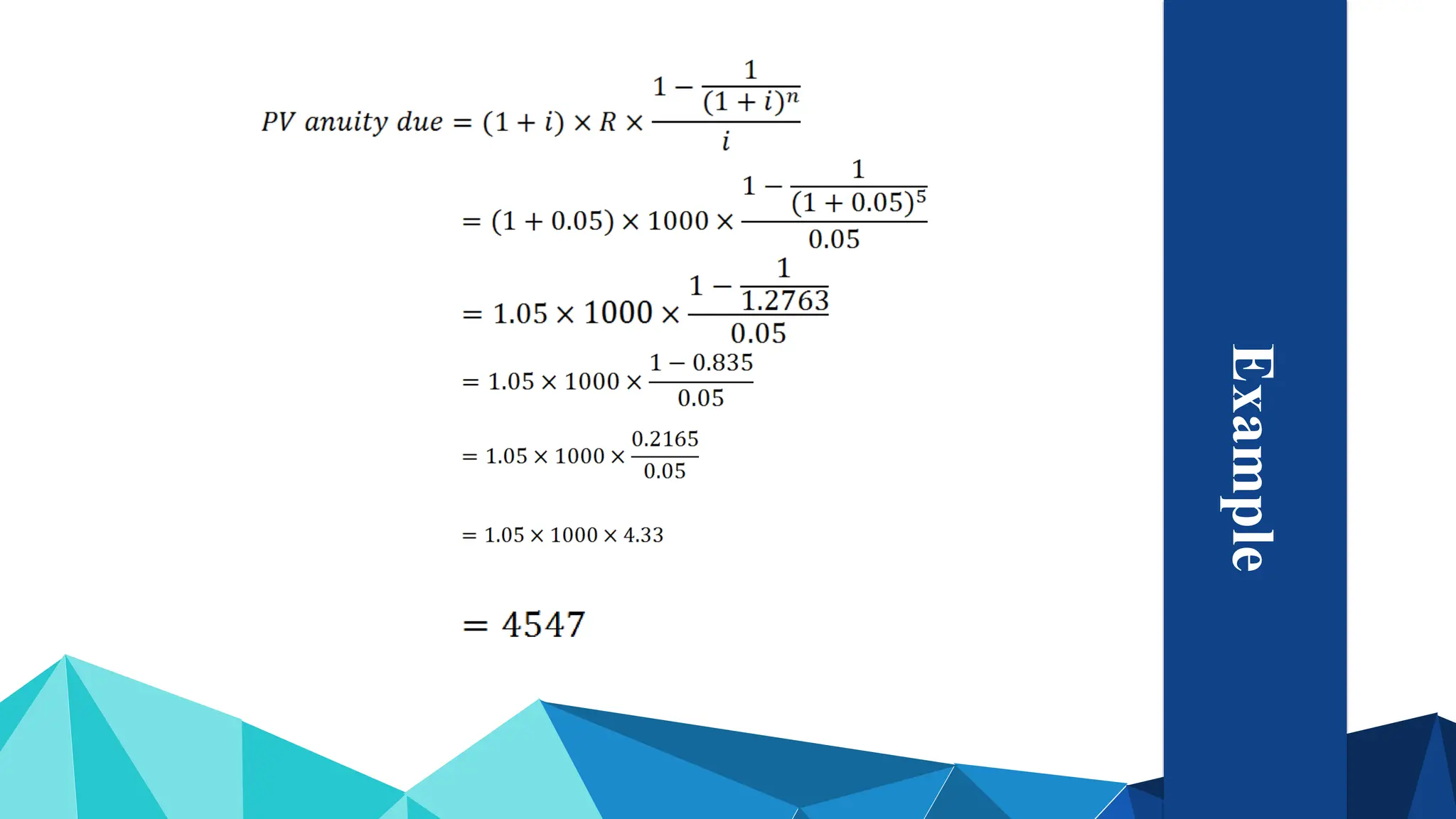
Due
Formulas to calculate Present Value of Annuity
Due
Example
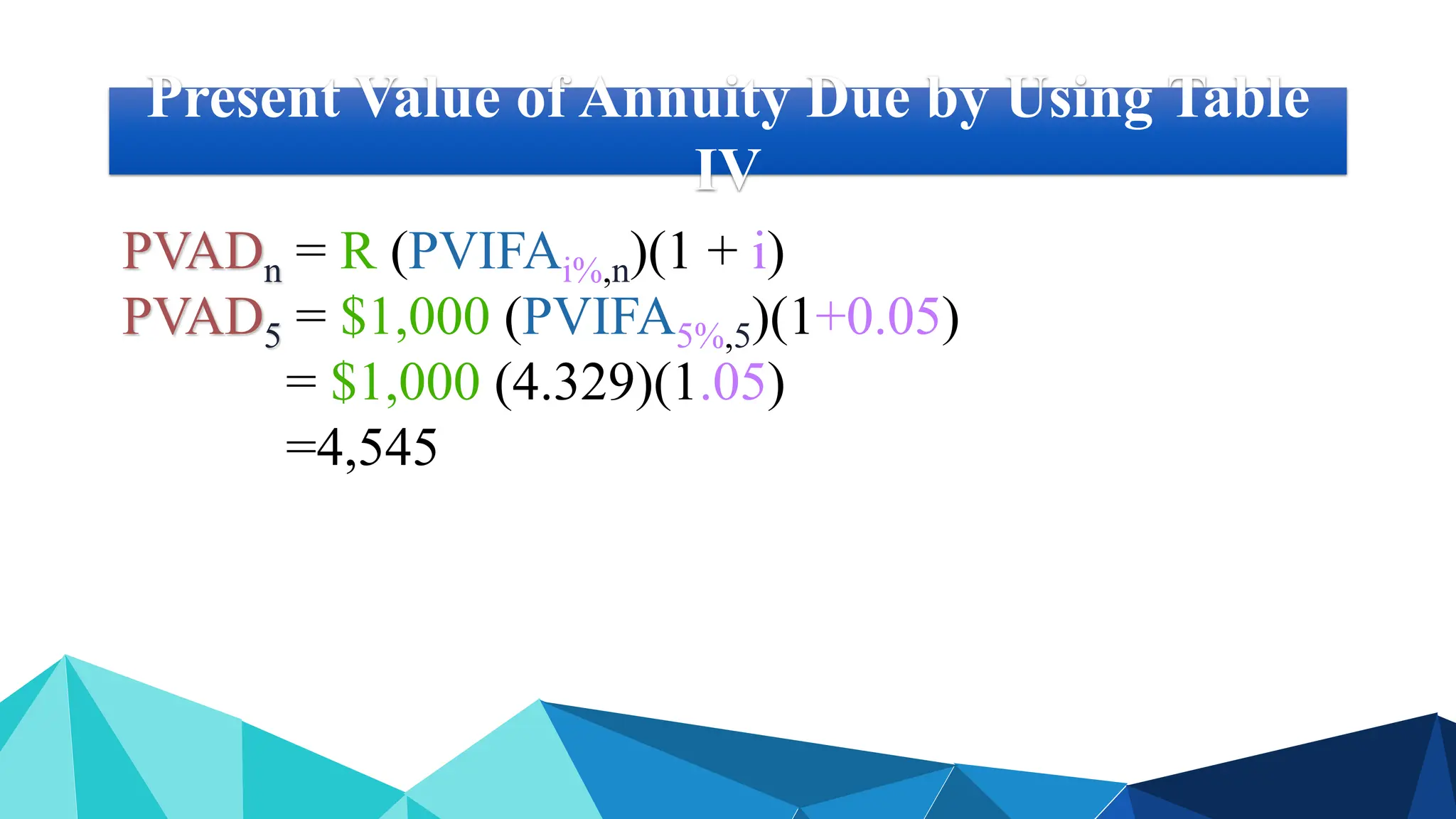
Present Value of Annuity Due by Using Table
IV
PVADn = R (PVIFAi%,n)(1 + i)
PVAD5 = $1,000 (PVIFA5%,5)(1+0.05)
= $1,000 (4.329)(1.05)
=4,545
Mixed Stream
Present Value-Future Value
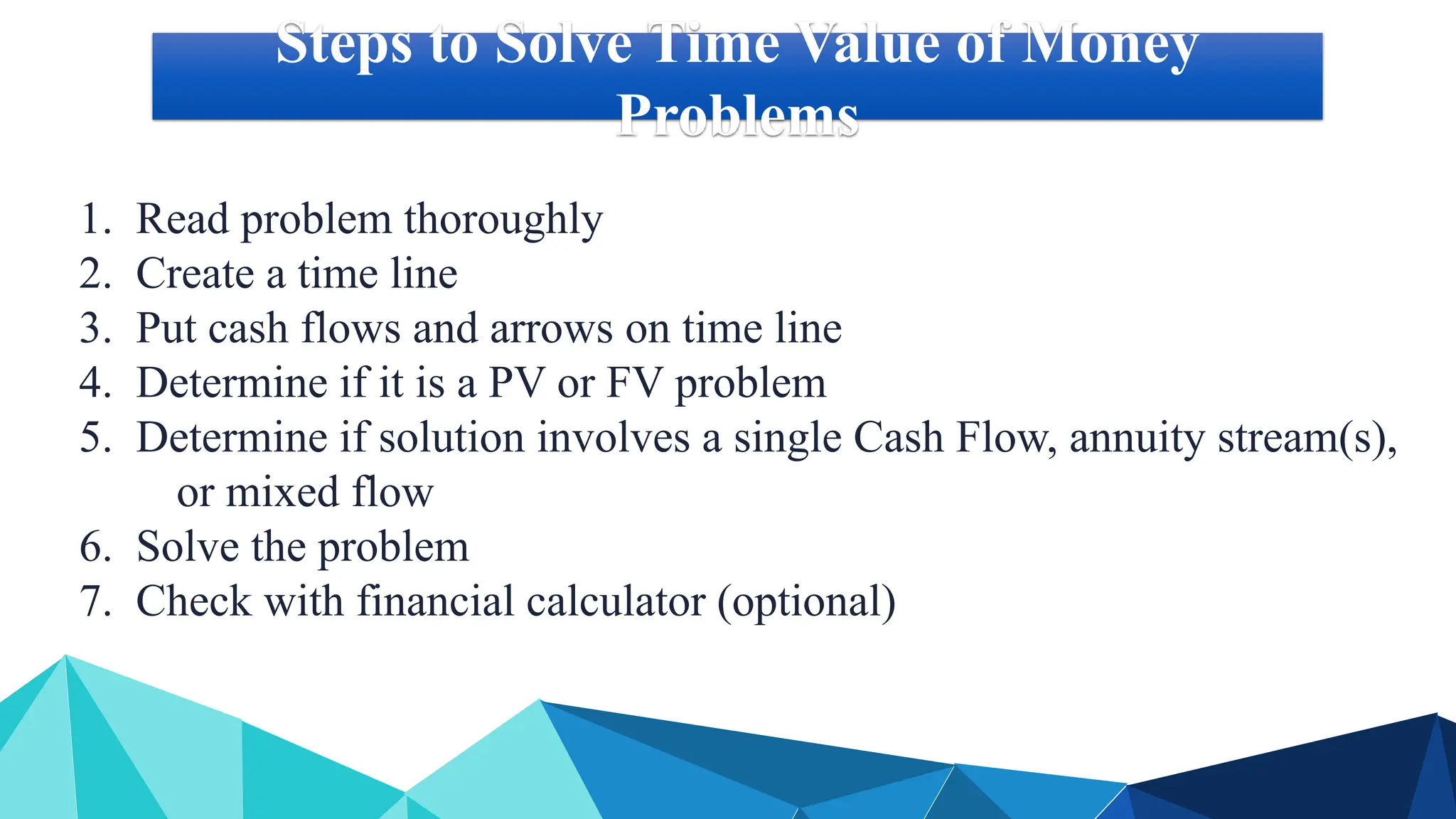
Steps to Solve Time Value of Money
Problems
1. Read problem thoroughly
2. Create a time line
3. Put cash flows and arrows on time line
4. Determine if it is a PV or FV problem
5. Determine if solution involves a single Cash Flow, annuity stream(s),
or mixed flow
6. Solve the problem
7. Check with financial calculator (optional)
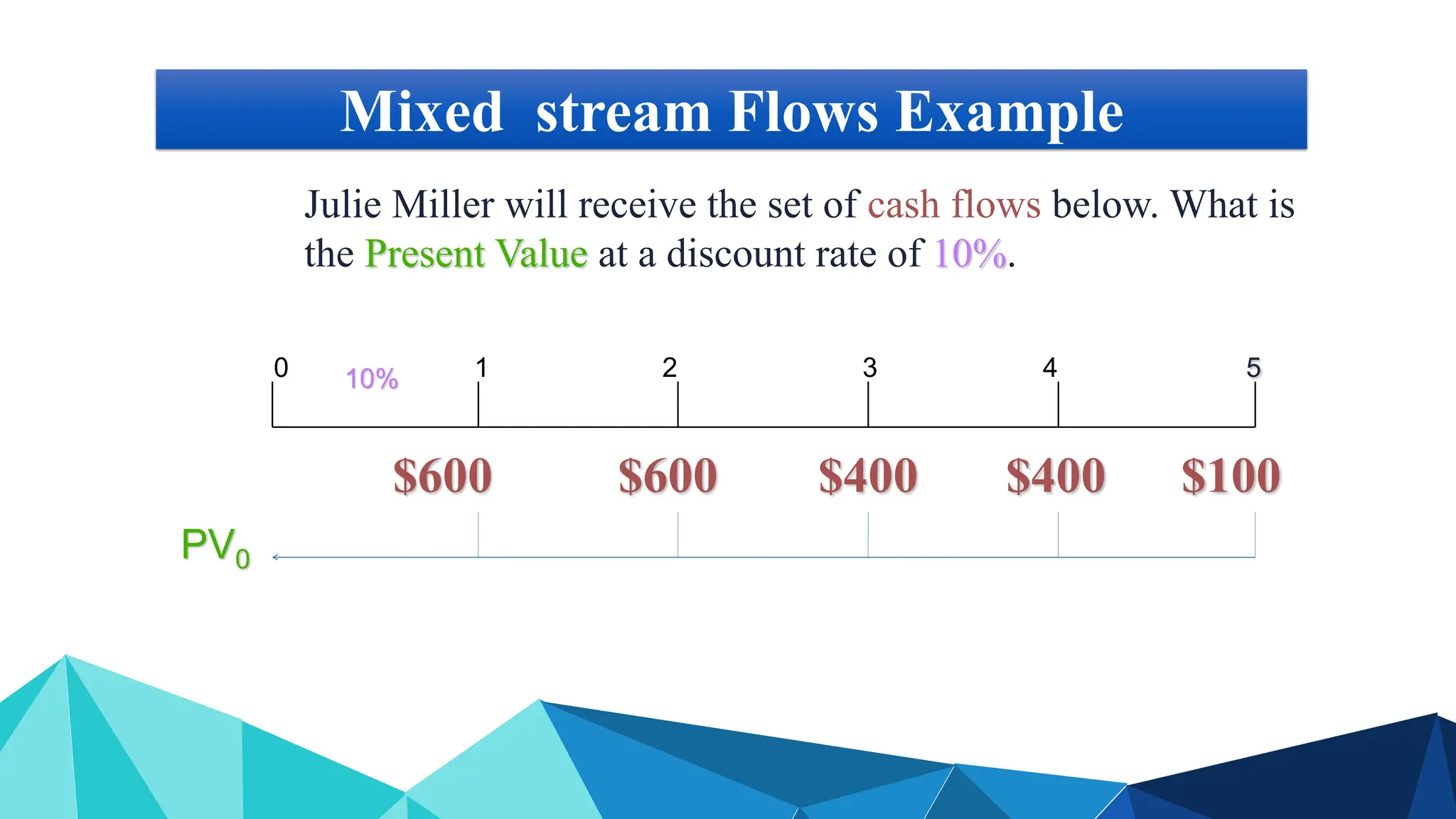
Mixed stream Flows Example
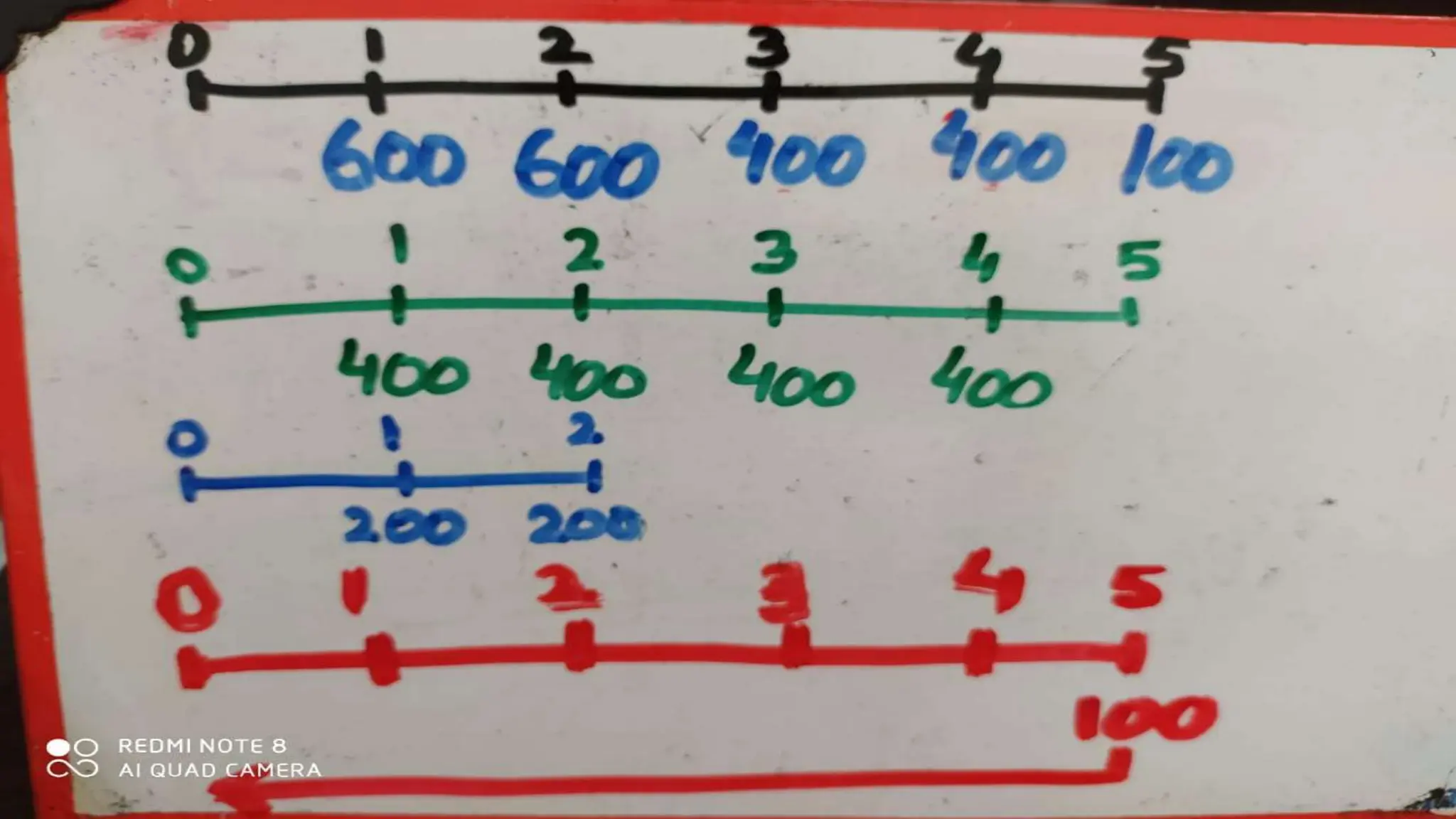
Julie Miller will receive the set of cash flows below. What is
the Present Value at a discount rate of 10%.
0 1 2 3 4 5
10%
$600 $600 $400 $400 $100
PV0
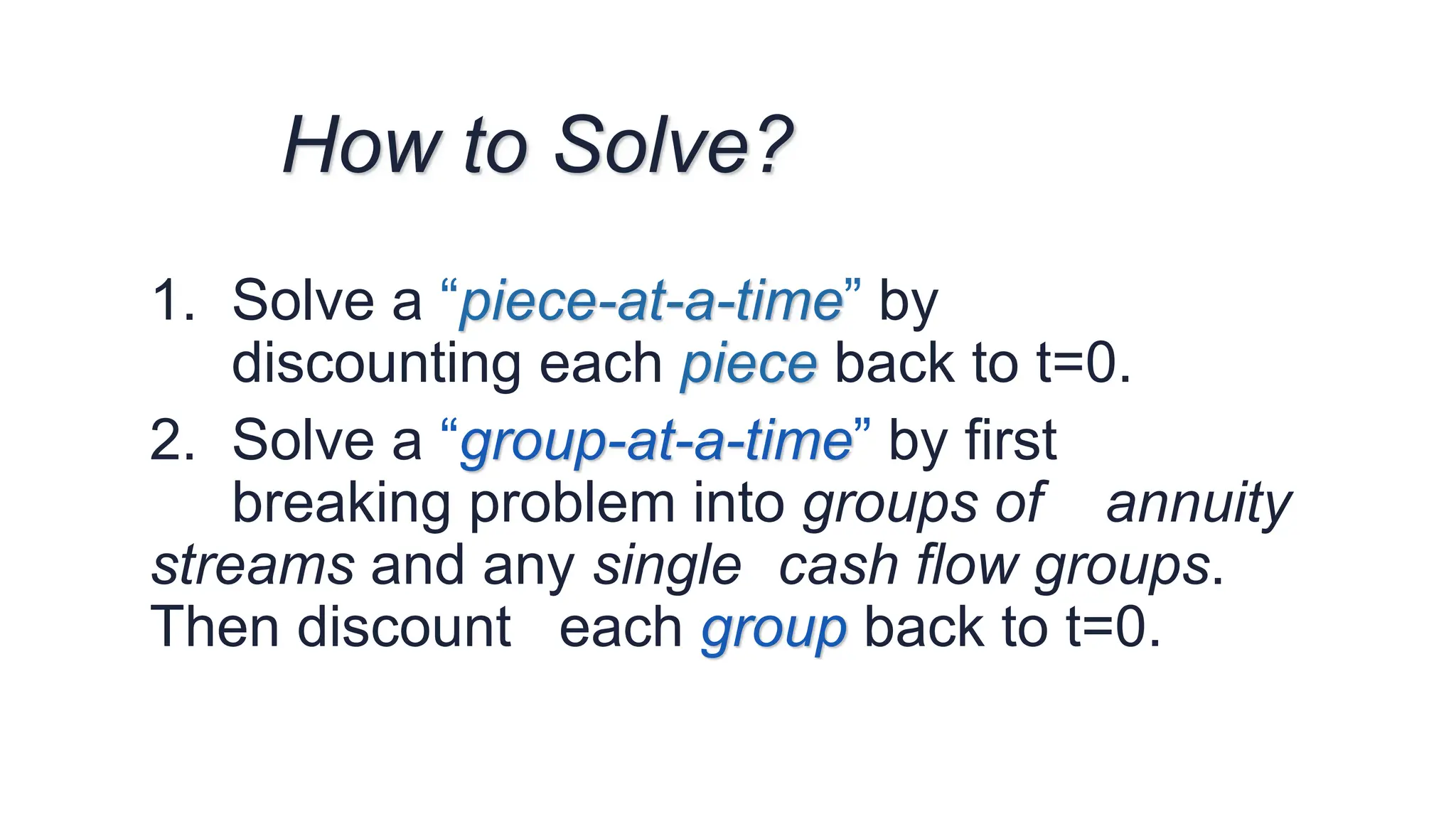
1. Solve a “piece-at-a-time” by
discounting each piece back to t=0.
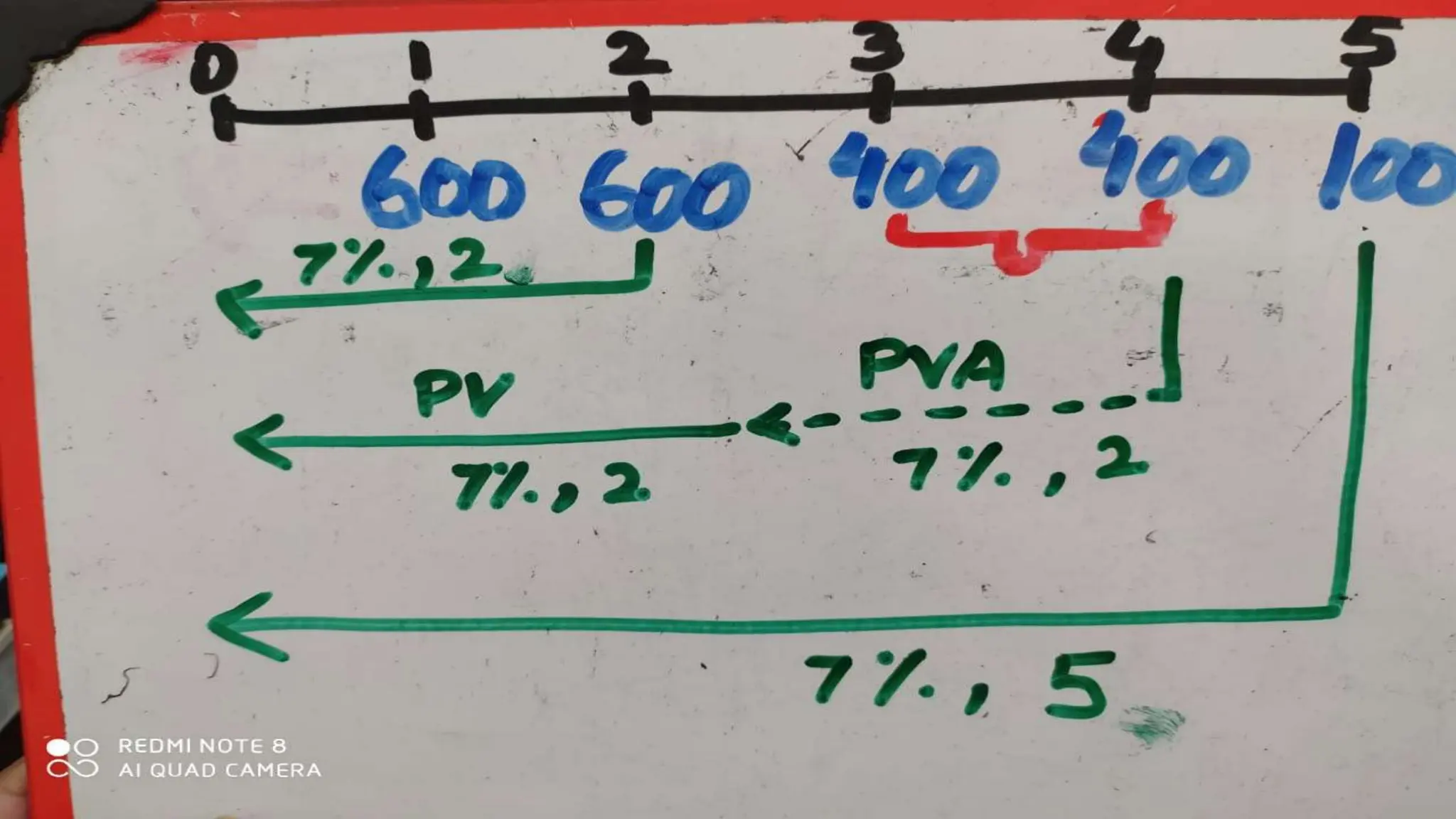
2. Solve a “group-at-a-time” by first
breaking problem into groups of annuity
streams and any single cash flow groups.
Then discount each group back to t=0.
How to Solve?
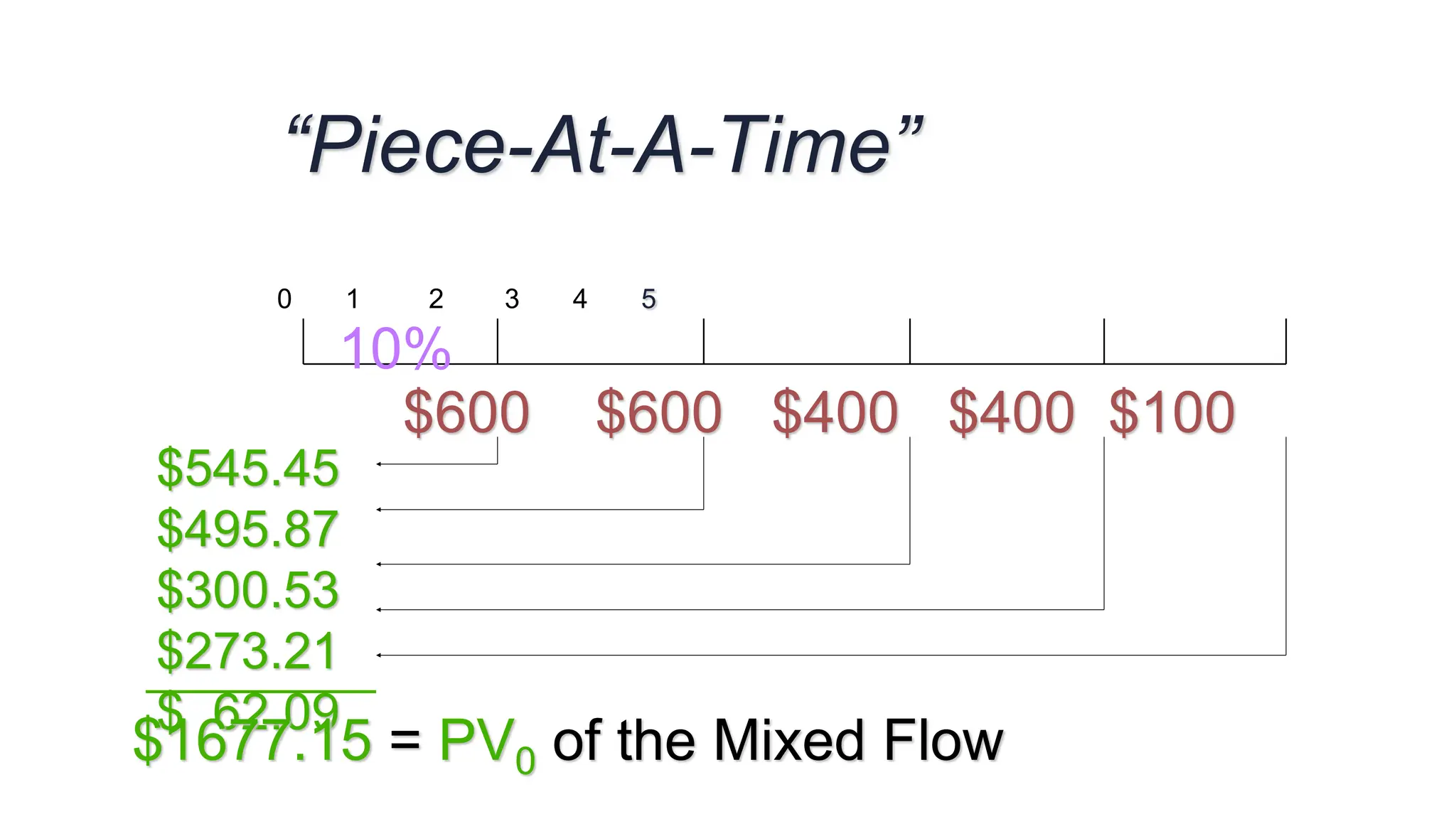
0 1 2 3 4 5
$600 $600 $400 $400 $100
10%
$545.45
$495.87
$300.53
$273.21
$ 62.09
$1677.15 = PV0 of the Mixed Flow
“Piece-At-A-Time”
0 1 2 3 4 5
$600 $600 $400 $400 $100
10%
$1,041.60
$ 573.57
$ 62.10
$1,677.27 = PV0 of Mixed Flow [Using Tables]
$600(PVIFA10%,2) = $600(1.736) = $1,041.60
$400(PVIFA10%,2)(PVIF10%,2) = $400(1.736)(0.826) = $573.57
$100 (PVIF10%,5) = $100 (0.621) = $62.10
“Group-At-A-Time” (#1)
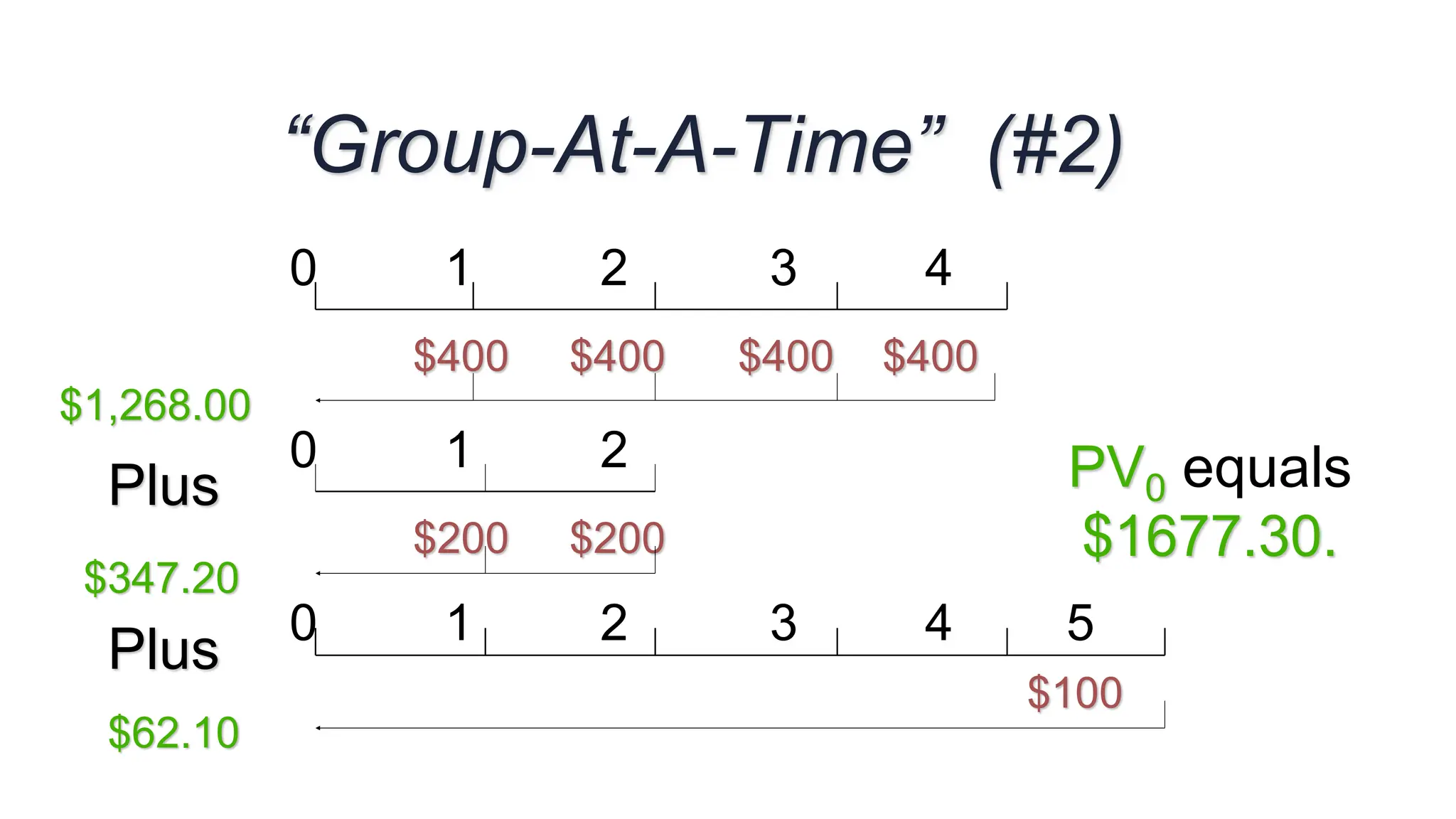
0 1 2 3 4
$400 $400 $400 $400
PV0 equals
$1677.30.
0 1 2
$200 $200
0 1 2 3 4 5
$100
$1,268.00
$347.20
$62.10
Plus
Plus
“Group-At-A-Time” (#2)
General Formula:
FVn = PV0(1 + [i/m])mn
n: Number of Years
m: Compounding Periods per Year
i: Annual Interest Rate
FVn,m: FV at the end of Year n
PV0: PV of the Cash Flow today
Frequency of Compounding
Julie Miller has $1,000 to invest for 2 Years at an
annual interest rate of 12%.
Annual FV2 = 1,000(1 + [0.12/1])(1)(2)
= 1,254.40
Semi FV2 = 1,000(1 + [0.12/2])(2)(2)
= 1,262.48
Impact of Frequency
Qrtly FV2 = 1,000(1 + [0.12/4])(4)(2)
= 1,266.77
Monthly FV2 = 1,000(1 + [0.12/12])(12)(2)
= 1,269.73
Daily FV2 = 1,000(1 + [0.12/365])(365)(2)
= 1,271.20
Impact of Frequency
Effective Annual Interest Rate
The actual rate of interest earned (paid) after
adjusting the nominal rate for factors such as
the number of compounding periods per year.
(1 + [ i / m ] )m – 1
Effective Annual
Interest Rate
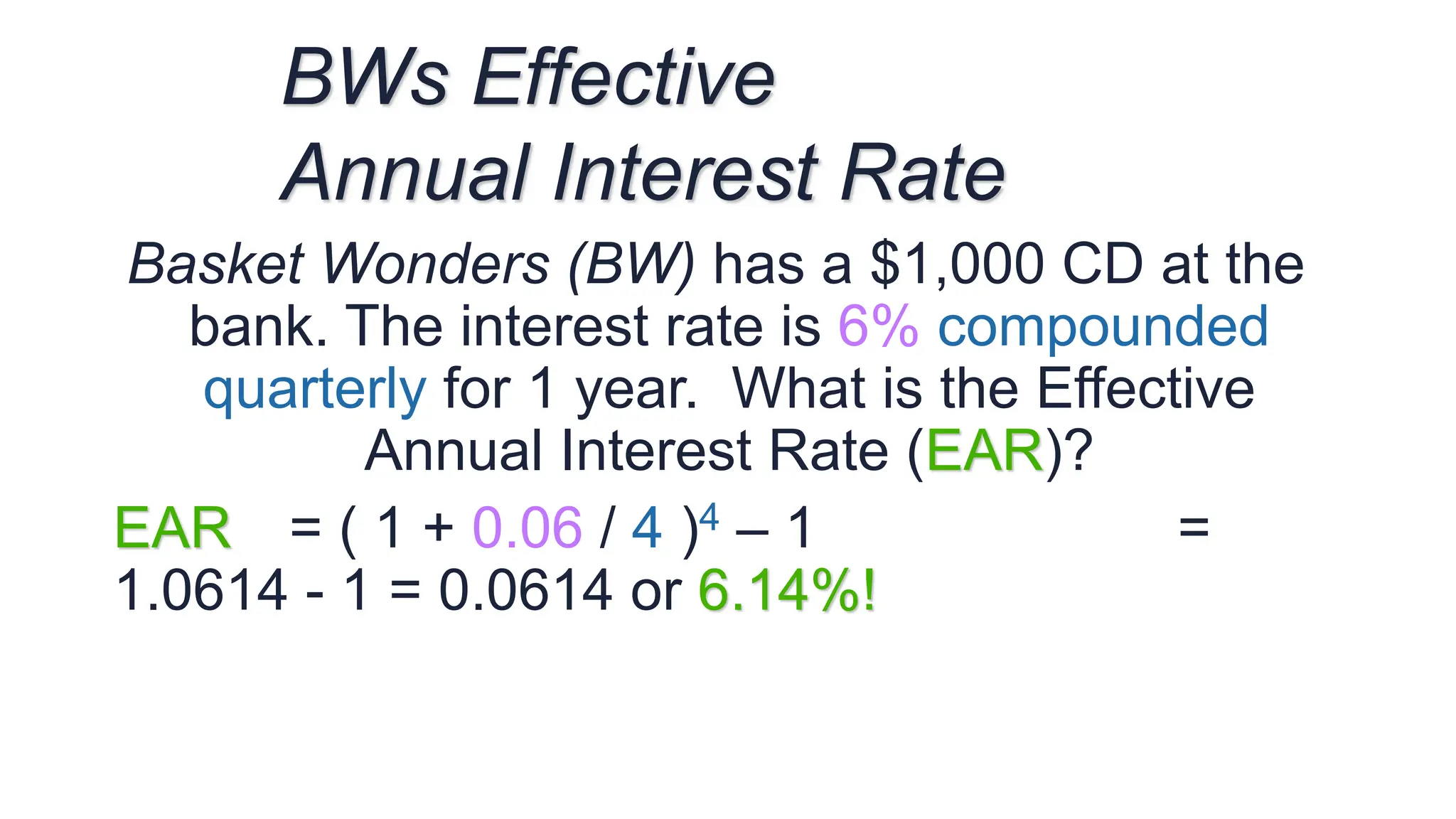
Basket Wonders (BW) has a $1,000 CD at the
bank. The interest rate is 6% compounded
quarterly for 1 year. What is the Effective
Annual Interest Rate (EAR)?
EAR = ( 1 + 0.06 / 4 )4 – 1 =
1.0614 - 1 = 0.0614 or 6.14%!
BWs Effective
Annual Interest Rate
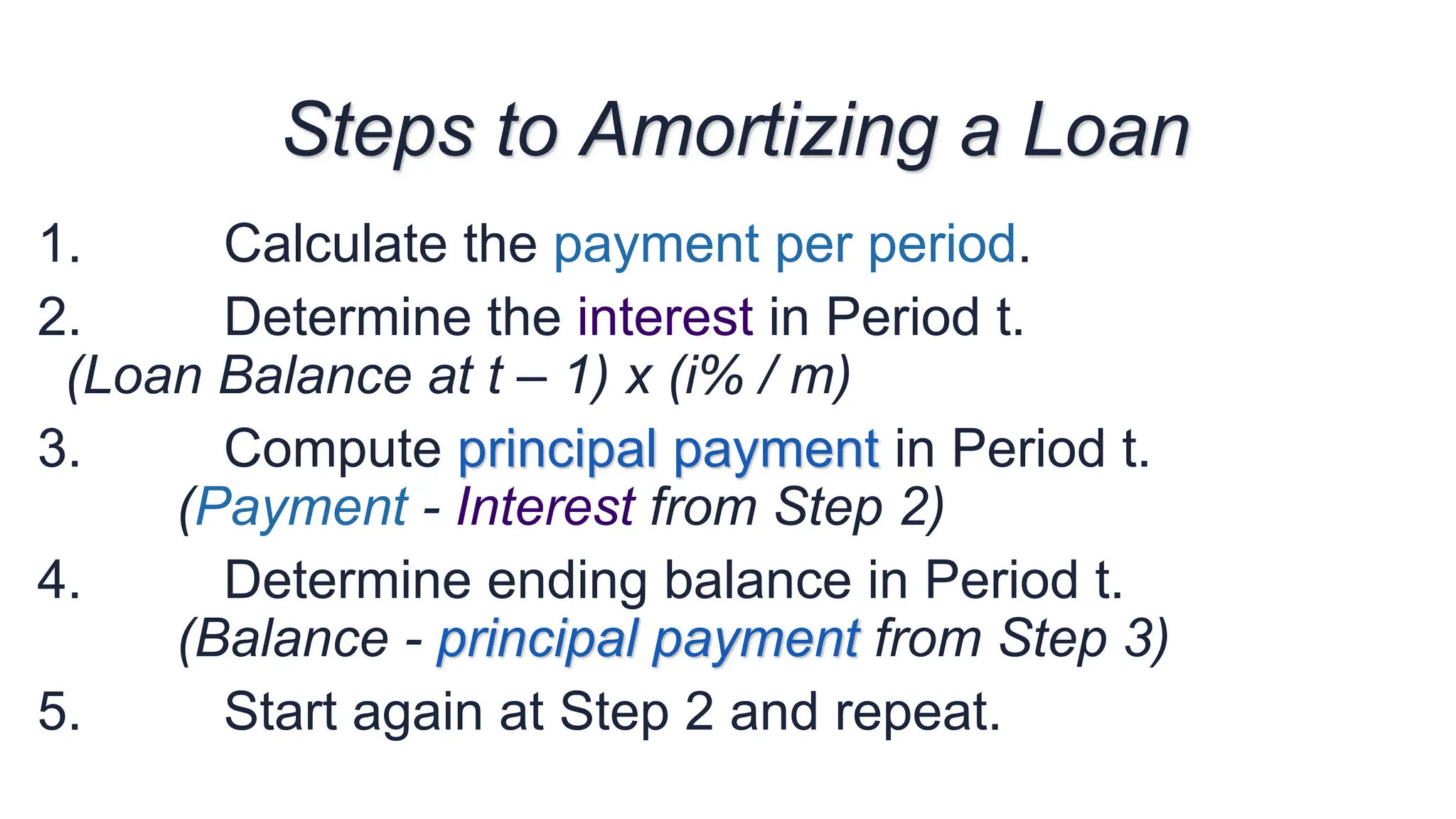
1. Calculate the payment per period.
2. Determine the interest in Period t.
(Loan Balance at t – 1) x (i% / m)
3. Compute principal payment in Period t.
(Payment - Interest from Step 2)
4. Determine ending balance in Period t.
(Balance - principal payment from Step 3)
5. Start again at Step 2 and repeat.
Steps to Amortizing a Loan
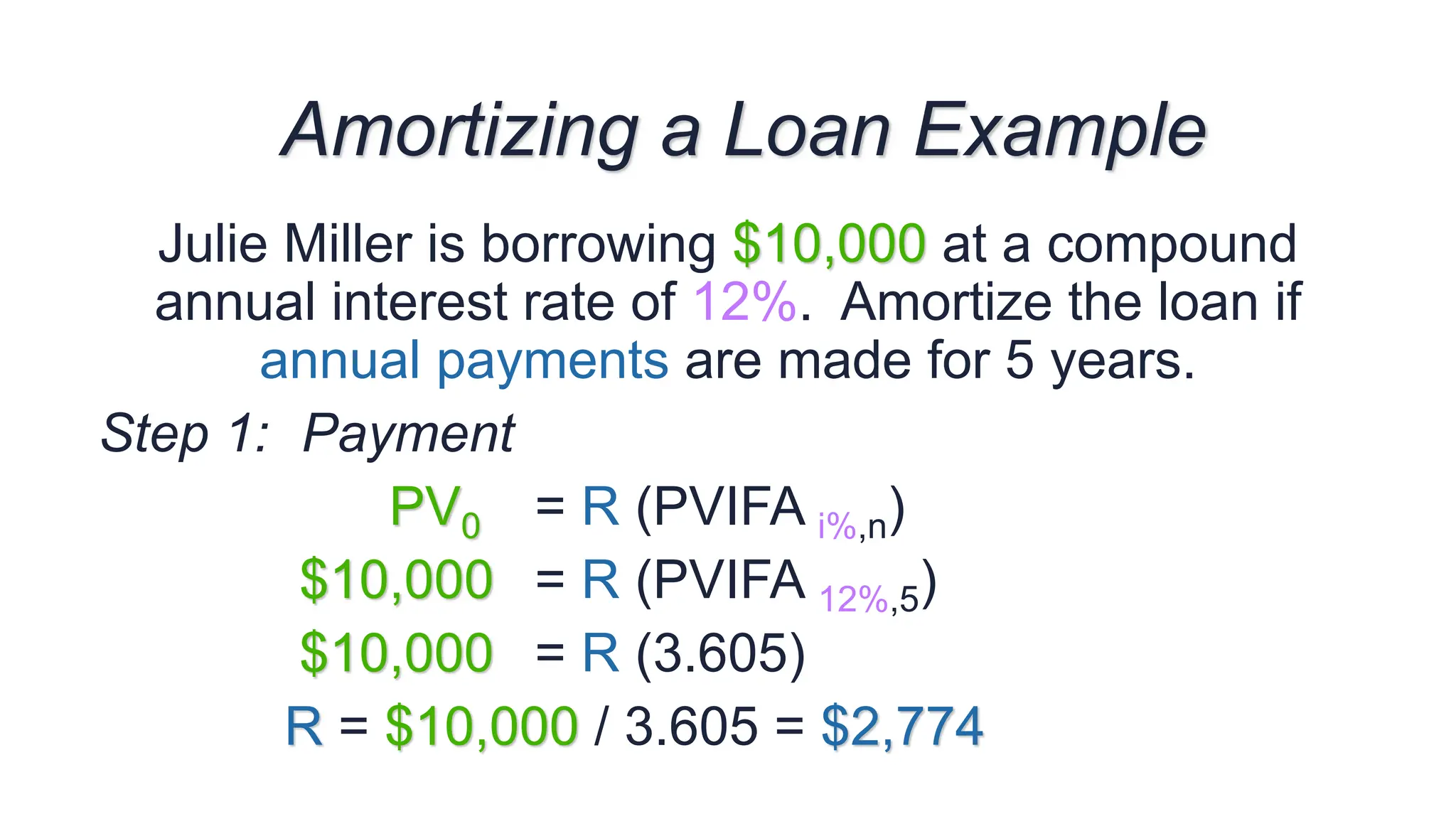
Julie Miller is borrowing $10,000 at a compound
annual interest rate of 12%. Amortize the loan if
annual payments are made for 5 years.
Step 1: Payment
PV0 = R (PVIFA i%,n)
$10,000 = R (PVIFA 12%,5)
$10,000 = R (3.605)
R = $10,000 / 3.605 = $2,774
Amortizing a Loan Example
End of
Year
Payment Interest Principal Ending
Balance
0 — — — $10,000
1 $2,774 $1,200 $1,574 8,426
2 2,774 1,011 1,763 6,663
3 2,774 800 1,974 4,689
4 2,774 563 2,211 2,478
5 2,775 297 2,478 0
$13,871 $3,871 $10,000
[Last Payment Slightly Higher Due to Rounding]
Amortizing a Loan Example
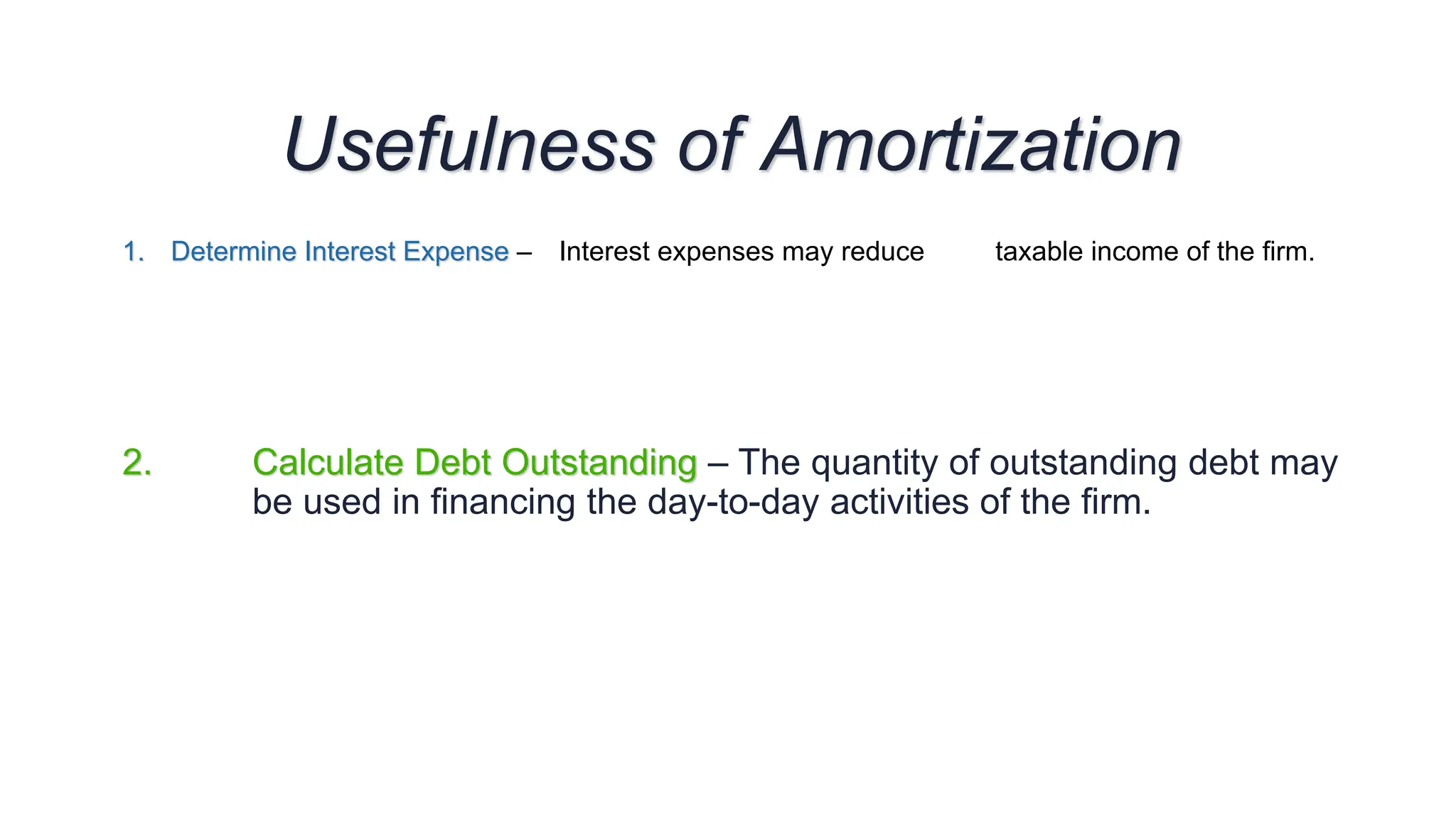
2. Calculate Debt Outstanding – The quantity of outstanding debt may
be used in financing the day-to-day activities of the firm.
1. Determine Interest Expense – Interest expenses may reduce taxable income of the firm.
Usefulness of Amortization

Time Value of Money KFUEIT-Lecture 1-2.ppt

  • 1.
    Time Value ofMoney Prepared By: Haseeb Yaqoob Lecturer Faculty of Department of Mechanical
  • 2.
    Interest Rate • SimpleInterest Rate • Compound Interest Rate Future Value (single amount ,annuity, mixed Stream) Present Value Annuity • Ordinary Annuity • Annuity Due The Rule of 72 Compounding Periods Amortization of Loan
  • 3.
    Obviously, $10,000 today. Youalready recognize that there is TIME VALUE TO MONEY!! This concept emerged because money has the capacity to earn. Which would you prefer – $10,000 today or $10,000 in 5 years?
  • 4.
    Why Time? Why isTIME such an important element in your decision? TIME allows you the opportunity to postpone consumption and earn INTEREST.
  • 5.
    Interest on Interestis simply known as compound Interest. Or Interest paid (earned) on any previous interest earned, as well as on the principal borrowed (lent). Compound Interest = P.V × (1+i)n Interest paid (earned) on only the original amount, or principal, borrowed (lent). Formula: Simple Interest = P.V × i × n Simple Interest Vs Compound Interest Where as: P.V = Present Value (at time 0) i = Interest Rate n = Number of Years
  • 6.
    Formula Derivation forSimple Interest Year Simple Interest Total Amount Total Amount 1 (after 1 year) I1= P×i T1 = P+ (P×i) 2 (after 2 years) I2= P×i T2 =P+(P×i)+(P×i) =P+2Pi =P(1+2i) 3 (after 3 years) I3= P×i T3 =P+(P×i)+(P×i)+(P×i) =P+3Pi =P(1+3i) 4 (after 4 years) I4= P×i T4 =P+(P×i)+(P×i)+(P×i)+(P×i) =P+4Pi =P(1+4i) 5 (after 5 years) I5= P×i T5 =P +(P×i)+(P×i)+(P×i)+(P×i)+(P×i) =P+5Pi =P(1+5i) Formula Derivation In= P×i×n Tn= P ×(1+ni)
  • 7.
    Year Compound Interest Total AmountTotal Amount 1 (after 1 year) I1= (P×i) T1 = P+ (P×i) =P(1+i) =P(1+i) 2 (after 2 years) I2= (P×i)×i T2 =P(1+i)+P(1+i)×i =P(1+i) [1+i] =P(1+i)2 3 (after 3 years) I3= (P×i)2×i T3 =P(1+i)2 + P(1+i)2 ×i =P(1+i)2[1+i] =P(1+i)3 4 (after 4 years) I4= (P×i)3×i T4 =P(1+i)3 +P(1+i)3 × i =P(1+i)3 [1+i] =P(1+i)4 5 (after 5 years) I5= (P×i)4×i T5 =P(1+i)4 +P(1+i)4 ×i =P(1+i)4 [1+i] =P(1+i)5 Formula Derivation Tn= P ×(1+i)n Formula Derivation for Compound Interest
  • 8.
    Question Calculate the totalamount by using simple interest and Compound interest for Rs. 100 deposit today, at 8% rate of interest for 5- years. Here we have: P.V = 100 Rs i = 8% n = 5 Years Years Simple Interest Total Amount 1 100×0.08= 8 100+8=108 2 100×0.08= 8 108+8=116 3 100×0.08= 8 116+8= 124 4 100×0.08= 8 124+8=132 5 100×0.08= 8 132+8=140 years Compound Interest Total Amount 1 100×0.08= 8 100+8=108 2 108×0.08=8.64 108+8.64=116.64 3 116.64×0.08=9.33 116.64+9.33=125.97 4 125.97×0.08=10.08 125.97+10.08=136.05 5 136.05×0.08=10.85 136.05+10.85=146.63
  • 10.
    Present Value VsFuture Value Compound(interest rate) Discount (interest rate) is the value at some future time of a present amount of money, or a series of payments, evaluated at a given interest rate. is the current value of a future amount of money, or a series of payments, evaluated at a given interest rate.
  • 11.
    There are fourways to find the Present and Future values (single amount, annuity, mixed stream) 1. By using formula 2. By using the interest factor table values 3. By using financial calculator 4. By using excel sheet
  • 12.
    Time Value ofMoney Annuity Mixed Stream Single Amount
  • 14.
    F.V= Future Value P.V=Present Value n = Number of years i= Interest rate FVIF= Future value interest factor
  • 15.
    Consider Mr. Alideposits $100 into a savings account. If the interest rate is 8 percent, compounded annually, how much will the $100 be worth at the end of 4 years? 136 100×(1+0.08)4
  • 16.
    Using Table 1:Future Value Interest Factor( FVIF i%,n) FV4 = $1,00(FVIF8%,4) = $1,00 (1.360) = $136 [Due to Rounding] FVn= PV × FVIF i%,n
  • 19.
    F.V= Future Value P.V=Present Value n = Number of years i= Interest rate PVIF= Present value interest factor
  • 20.
    what amount Mr.Alishould invest now in order to get $136 after 4 years provided that interest rate is 8% a savings account. If the interest rate is 8 percent. 136 ? $100
  • 21.
    Using Table II:Present Value Interest Factor( PVIF i%,n) PV4 = $136(PVIF8%,4) = $136(0.735) = $99.9 $100 [Due to Rounding] PVn= FV ×PVIF i%,n
  • 23.
    Sometimes we facewith a time-value-of money situation in which, Future Value=FV= known Present Value=PV= known, Number of time periods=n=known Compound Interest Rate=i=? Such Interest rate can be found; By using reverse table approach By Taking reciprocal power to eliminate it Unknown Interest (or Discount) Rate
  • 24.
    Let’s assume that,if you invest $1,000 today, you will receive $3,000 in exactly after 8 years. The compound interest (or discount) rate implicit in this situation can be found by rearranging either a basic future value or present value equation. Reading across the 8-period row in Table I. we look for the future value interest factor (FVIF) that comes closest to our calculated value of 3. In our table, that interest factor is 3.059 and is found in the 15% column. Because 3.059 is slightly larger than 3. we conclude that the interest rate implicit in the example situation is actually slightly less than 15%. By using reverse table approach
  • 26.
    3000=1000 (1+i)8 1.1472 =1+i 1.1472-1 = i 0.1472 =i Or 14% = i 3= (1+i)8 By Taking reciprocal power to eliminate it
  • 27.
    Unknown Number ofCompounding (or Discounting) Periods At times we may need to know how long it will take for a dollar amount invested today to grow to a certain future value given a particular compound rate of interest. For example, how long would it take for an invest$1,000 to grow to $1,900 if we invested it at a compound annual interest rate of 10 percent? Future Value=FV= known Present Value=PV= known, Compound Interest Rate=i=known Number of time periods=n=? The unknown period can be found; By using reverse table approach By using logarithm power rule
  • 28.
    Reading down the10% column in Table I. we look for the future value interest factor (FVIF) in that column that is closest to our calculated value. We can find that 1.949 comes closest to 1.9, and that this number corresponds to the 7 period row. Because 1.949 is a little larger than 1.9, we conclude that there are slightly less than 7 annual compounding periods implicit in the example situation. By using reverse table approach
  • 30.
    By using logarithmpower rule By taking log on both sides,
  • 31.
  • 32.
  • 33.
    Q2: Hamid wishesto find the future value of $1,700 that will be received 8 years from now. Hamid’s opportunity cost is 8%. Q3: What single investment made today, earning 12% annual interest, will be worth $6,000 at the end of 6 years? Q4: You can deposit $10,000 into an account paying 9% annual interest either today or exactly 10 years from today. How much better off will you be at the end of 40 years if you decide to make the initial deposit today rather than 10 years from today?
  • 34.
    Q5: Misty needto have $15,000 at the end of 5 years in order to fulfill her goal of purchasing a small sailboat. She is willing to invest the funds as a single amount today but wonders what sort of investment return she will need to earn. Figure out the approximate annually compounded rate of return needed in each of these cases: a. Misty can invest $10,200 today. b. Misty can invest $8,150 today. c. Misty can invest $7,150 today.
  • 35.
    Thanks! You can findme at: haseeb.Yaqoob@kfueit.edu.pk Any questions?
  • 36.
    Time Value ofMoney Prepared By: Haseeb Yaqoob Lecturer Faculty of Department of Mechanical Lecture 2
  • 37.
  • 38.
    • Student LoanPayments • Car Loan Payments • Insurance Premiums • Mortgage Payments • Retirement Savings Examples of Annuities
  • 39.
    Types of Annuities AnAnnuity represents a series of equal payments (or receipts) occurring over a specified number of equidistant periods. Ordinary Annuity : Payments or receipts occur at the end of each period. Annuity Due : Payments or receipts occur at the beginning of each period.
  • 40.
    0 1 23 4 0 1 2 3 4 PMT PMT PMT PMT PMT PMT PMT PMT PMT PMT Ordinary Annuity Annuity Due i% i% Difference Between Ordinary annuity and Annuity Due
  • 41.
    Ordinary Annuity-Annuity Due FutureValue By using Formula By Using Table
  • 42.
    Ordinary Annuity Future Value Byusing Formula By Using Table
  • 43.
  • 44.
    Calculating Future Valueof Ordinary Annuity
  • 45.
    Formula to calculateFuture value of an Ordinary Annuity
  • 46.
    Future Value ofan Ordinary Annuity by using formula R R
  • 47.
    Future Value OrdinaryAnnuity by Using Table III FVA5 = R (FVIFAi%,n) FVA5 = $1,000 (FVIFA5%,5) = $1,000 (5.526) = $5,526
  • 49.
  • 50.
    Calculating Future Valueof an Annuity Due
  • 51.
    Formulas to calculateFuture Value of an Annuity Due
  • 52.
    Calculating Future valueof annuity Due by using formula
  • 53.
    Future value ofannuity Due Using Table III FVADn = R (FVIFAi%,n)(1 + i) FVAD5 = $1,000 (FVIFA5%,5)(1+0.05) = $1,000 (5.526)(1.05) = $5,802
  • 55.
    Ordinary Annuity- AnnuityDue Present Value By using Formula By Using Table
  • 56.
    Calculating Present Valueof an ordinary annuity
  • 57.
    Formula to calculatePresent Value of Ordinary Annuity
  • 58.
  • 59.
    Present Value ofOrdinary Annuity by Using Table IV PVAn = R (PVIFAi%,n) PVA5 = $1,000 (PVIFA5%,5) = $1,000 (4.329) = $4,329
  • 61.
    Calculating present valueof an annuity Due
  • 62.
    Formulas to calculatePresent Value of Annuity Due
  • 63.
  • 64.
    Present Value ofAnnuity Due by Using Table IV PVADn = R (PVIFAi%,n)(1 + i) PVAD5 = $1,000 (PVIFA5%,5)(1+0.05) = $1,000 (4.329)(1.05) =4,545
  • 66.
  • 67.
    Steps to SolveTime Value of Money Problems 1. Read problem thoroughly 2. Create a time line 3. Put cash flows and arrows on time line 4. Determine if it is a PV or FV problem 5. Determine if solution involves a single Cash Flow, annuity stream(s), or mixed flow 6. Solve the problem 7. Check with financial calculator (optional)
  • 68.
    Mixed stream FlowsExample Julie Miller will receive the set of cash flows below. What is the Present Value at a discount rate of 10%. 0 1 2 3 4 5 10% $600 $600 $400 $400 $100 PV0
  • 71.
    1. Solve a“piece-at-a-time” by discounting each piece back to t=0. 2. Solve a “group-at-a-time” by first breaking problem into groups of annuity streams and any single cash flow groups. Then discount each group back to t=0. How to Solve?
  • 72.
    0 1 23 4 5 $600 $600 $400 $400 $100 10% $545.45 $495.87 $300.53 $273.21 $ 62.09 $1677.15 = PV0 of the Mixed Flow “Piece-At-A-Time”
  • 73.
    0 1 23 4 5 $600 $600 $400 $400 $100 10% $1,041.60 $ 573.57 $ 62.10 $1,677.27 = PV0 of Mixed Flow [Using Tables] $600(PVIFA10%,2) = $600(1.736) = $1,041.60 $400(PVIFA10%,2)(PVIF10%,2) = $400(1.736)(0.826) = $573.57 $100 (PVIF10%,5) = $100 (0.621) = $62.10 “Group-At-A-Time” (#1)
  • 74.
    0 1 23 4 $400 $400 $400 $400 PV0 equals $1677.30. 0 1 2 $200 $200 0 1 2 3 4 5 $100 $1,268.00 $347.20 $62.10 Plus Plus “Group-At-A-Time” (#2)
  • 75.
    General Formula: FVn =PV0(1 + [i/m])mn n: Number of Years m: Compounding Periods per Year i: Annual Interest Rate FVn,m: FV at the end of Year n PV0: PV of the Cash Flow today Frequency of Compounding
  • 76.
    Julie Miller has$1,000 to invest for 2 Years at an annual interest rate of 12%. Annual FV2 = 1,000(1 + [0.12/1])(1)(2) = 1,254.40 Semi FV2 = 1,000(1 + [0.12/2])(2)(2) = 1,262.48 Impact of Frequency
  • 77.
    Qrtly FV2 =1,000(1 + [0.12/4])(4)(2) = 1,266.77 Monthly FV2 = 1,000(1 + [0.12/12])(12)(2) = 1,269.73 Daily FV2 = 1,000(1 + [0.12/365])(365)(2) = 1,271.20 Impact of Frequency
  • 78.
    Effective Annual InterestRate The actual rate of interest earned (paid) after adjusting the nominal rate for factors such as the number of compounding periods per year. (1 + [ i / m ] )m – 1 Effective Annual Interest Rate
  • 79.
    Basket Wonders (BW)has a $1,000 CD at the bank. The interest rate is 6% compounded quarterly for 1 year. What is the Effective Annual Interest Rate (EAR)? EAR = ( 1 + 0.06 / 4 )4 – 1 = 1.0614 - 1 = 0.0614 or 6.14%! BWs Effective Annual Interest Rate
  • 80.
    1. Calculate thepayment per period. 2. Determine the interest in Period t. (Loan Balance at t – 1) x (i% / m) 3. Compute principal payment in Period t. (Payment - Interest from Step 2) 4. Determine ending balance in Period t. (Balance - principal payment from Step 3) 5. Start again at Step 2 and repeat. Steps to Amortizing a Loan
  • 81.
    Julie Miller isborrowing $10,000 at a compound annual interest rate of 12%. Amortize the loan if annual payments are made for 5 years. Step 1: Payment PV0 = R (PVIFA i%,n) $10,000 = R (PVIFA 12%,5) $10,000 = R (3.605) R = $10,000 / 3.605 = $2,774 Amortizing a Loan Example
  • 82.
    End of Year Payment InterestPrincipal Ending Balance 0 — — — $10,000 1 $2,774 $1,200 $1,574 8,426 2 2,774 1,011 1,763 6,663 3 2,774 800 1,974 4,689 4 2,774 563 2,211 2,478 5 2,775 297 2,478 0 $13,871 $3,871 $10,000 [Last Payment Slightly Higher Due to Rounding] Amortizing a Loan Example
  • 83.
    2. Calculate DebtOutstanding – The quantity of outstanding debt may be used in financing the day-to-day activities of the firm. 1. Determine Interest Expense – Interest expenses may reduce taxable income of the firm. Usefulness of Amortization