Culture, Consumption, and Marketing
Course: Culture, Consumption, and Marketing
Gregorio Fuschillo, gregorio.fuschillo@kedgebs.com
Agenda
• Positivist, interpretive, and critical consumer research
• Introspection
• Interviews
• The role of pictures and videos
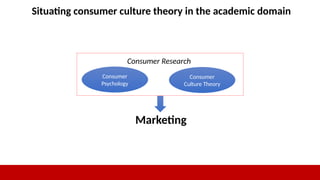
Situating consumer culture theory in the academic domain
Marketing
Consumer Research
Consumer
Psychology
Consumer
Culture Theory
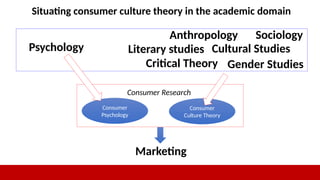
Situating consumer culture theory in the academic domain
Marketing
Consumer Research
Consumer
Psychology
Consumer
Culture Theory
Psychology
Anthropology Sociology
Critical Theory
Cultural Studies
Literary studies
Gender Studies
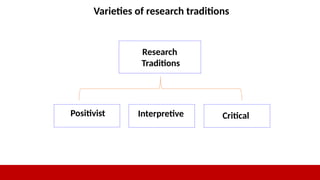
Varieties of research traditions
Research
Traditions
Positivist Critical
Interpretive
6
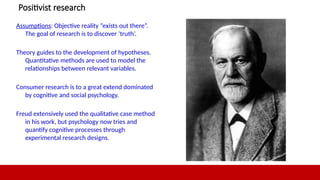
Positivist research
Assumptions: Objective reality “exists out there”.
The goal of research is to discover ‘truth’.
Theory guides to the development of hypotheses.
Quantitative methods are used to model the
relationships between relevant variables.
Consumer research is to a great extend dominated
by cognitive and social psychology.
Freud extensively used the qualitative case method
in his work, but psychology now tries and
quantify cognitive processes through
experimental research designs.
6
7
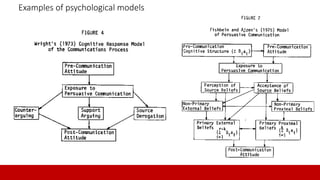
Examples of psychological models
7
8
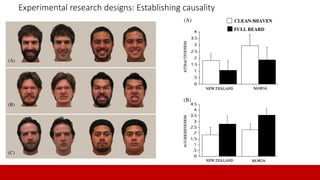
Experimental research designs: Establishing causality
8
9
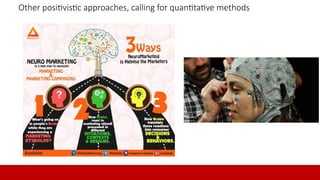
Other positivistic approaches, calling for quantitative methods
9
10
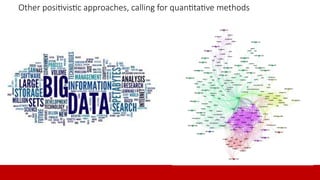
Other positivistic approaches, calling for quantitative methods
10
11
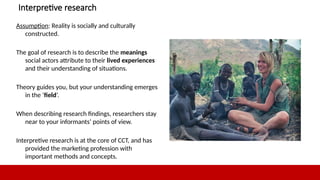
Interpretive research
Assumption: Reality is socially and culturally
constructed.
The goal of research is to describe the meanings
social actors attribute to their lived experiences
and their understanding of situations.
Theory guides you, but your understanding emerges
in the ‘field’.
When describing research findings, researchers stay
near to your informants’ points of view.
Interpretive research is at the core of CCT, and has
provided the marketing profession with
important methods and concepts.
11
12
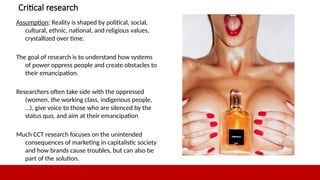
Critical research
Assumption: Reality is shaped by political, social,
cultural, ethnic, national, and religious values,
crystallized over time.
The goal of research is to understand how systems
of power oppress people and create obstacles to
their emancipation.
Researchers often take side with the oppressed
(women, the working class, indigenous people,
…), give voice to those who are silenced by the
status quo, and aim at their emancipation
Much CCT research focuses on the unintended
consequences of marketing in capitalistic society
and how brands cause troubles, but can also be
part of the solution.
12
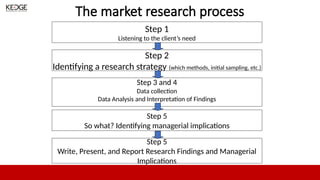
The market research process
Step 1
Listening to the client’s need
Step 2
Identifying a research strategy (which methods, initial sampling, etc.)
Step 3 and 4
Data collection
Data Analysis and Interpretation of Findings
Step 5
So what? Identifying managerial implications
Step 5
Write, Present, and Report Research Findings and Managerial
Implications
Before designing a study to satisfy a company’s market
research needs, it is important to ask yourself what you
already know about the subject.
Consumer researchers are also consumers (most of the
time), so they can use their own experience as basis for
understanding a phenomenon.
This is called introspection. You systematically
interrogate yourself about your consumption habits to
develop your first insights.
Individual introspection exercise:
You & the Sea
Write 1-2 pages about your experience with the Sea. This exercise can be very open
(so feel free to write whatever comes to your mind), but here are some ideas to
make it more structured.
• Start with your name, gender, age, nationality (city of origin), and other background information that might
be relevant.
• Have you ever taken part in sea-related causes? How would you describe it to somebody from a different
culture who has no idea of what sea protection is?
• Start from your own experience. Describe in detail the last time you have experienced the sea. Please also
describe the first time you met the sea.
• Like any human activity, sea experience can take place in a variety of ways. Think of the main typologies.
• Are there differences in the ways sea experiences take place now respect to the past? Are there between
sea experience in Marseille and in your city/country of origin? Please describe the main differences.
• Please send your output to gregorio.fuschillo@kedgebs.com (as soon as you
finish  -1 penalty to your final grade if I don’t receive it)
Consumer introspection as data source
• Consumer written introspection
• Like the exercise you have done
• Consumer intimate journal
• Informants are asked to write diary entries for extensive periods of time (e.g.,
every day for one week, every week for a couple of months, every month for a
year, …)
• Useful to investigate processes (e.g., before, during, and after an experience).
• Visual methods
• Informants are asked to take pics or videos of their experience, and then
describe them (in writing, or interview-style).
Interviews
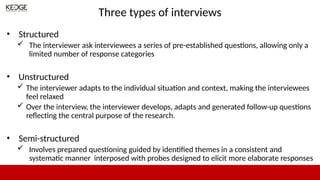
Three types of interviews
• Structured
 The interviewer ask interviewees a series of pre-established questions, allowing only a
limited number of response categories
• Unstructured
 The interviewer adapts to the individual situation and context, making the interviewees
feel relaxed
 Over the interview, the interviewer develops, adapts and generated follow-up questions
reflecting the central purpose of the research.
• Semi-structured
 Involves prepared questioning guided by identified themes in a consistent and
systematic manner interposed with probes designed to elicit more elaborate responses
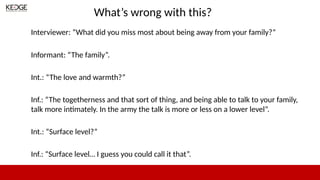
What’s wrong with this?
Interviewer: “What did you miss most about being away from your family?”
Informant: “The family”.
Int.: “The love and warmth?”
Inf.: “The togetherness and that sort of thing, and being able to talk to your family,
talk more intimately. In the army the talk is more or less on a lower level”.
Int.: “Surface level?”
Inf.: “Surface level… I guess you could call it that”.
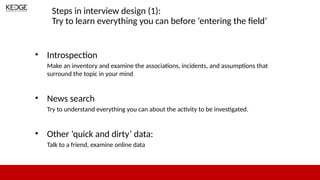
Steps in interview design (1):
Try to learn everything you can before ‘entering the field’
• Introspection
Make an inventory and examine the associations, incidents, and assumptions that
surround the topic in your mind
• News search
Try to understand everything you can about the activity to be investigated.
• Other ‘quick and dirty’ data:
Talk to a friend, examine online data
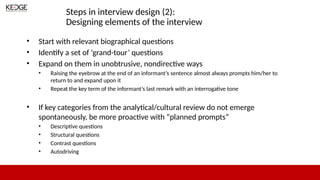
Steps in interview design (2):
Designing elements of the interview
• Start with relevant biographical questions
• Identify a set of ‘grand-tour’ questions
• Expand on them in unobtrusive, nondirective ways
• Raising the eyebrow at the end of an informant’s sentence almost always prompts him/her to
return to and expand upon it
• Repeat the key term of the informant’s last remark with an interrogative tone
• If key categories from the analytical/cultural review do not emerge
spontaneously, be more proactive with “planned prompts”
• Descriptive questions
• Structural questions
• Contrast questions
• Autodriving
Planned prompt
• Grand Tour Questions
• General questions, focusing on space, time, events, people, activities, or objects,
resulting in a verbal description of significant feature of the topic at end
• Typologies
• Typical: asks how things usually are (Could you describe a typical day at work?)
• Specific: ask about a specific instance (e.g., Could you describe what happened at
work yesterday? Tell me about last time you organized a meeting)
• Guided Ground Tour: informants are asked to show the place (not always
applicable), (e.g., can you show me your office?)
• Task-related: informant are asked to perform a simple task that aids in the
description (not always applicable), (e.g., can you show me how you cook pasta?)
Planned prompt
• Mini-tour questions
 Identical to GT questions, but dealing with a much smaller unit of experience (e.g., could you describe
what goes on in reserving a room for a meeting?)
• Example questions
 Take some simple act or event identified by the informant and ask for an example (e.g., could you give
me an example of someone giving you a hard time?)
 Informants can also be asked to recall exceptional incidents
• Structural questions
 Enables to discover information about domains, i.e., the basic units in an informant’s cultural
knowledge (e.g., what are all the stages in getting transferred in your company? Can you think of any
other kind of activities you do as a finance manager?)
• Contrast questions
 Enable to discover the elements informants employ to distinguish the objects and events in their
world (e.g., what is the difference between a holiday mean and a working day meal?)
In-class interviewing exercise:
Holydays
• Find a partner and decide who’s interviewing whom.
It’s better if you find a person you don’t know very well.
• This should be an unstructured interview, “let’s talk about
holydays”. Let the informant talk freely and in an
unobtrusive manner.
• However, if something that you feel important doesn’t
emerge spontaneously, you can use prompts (grand tour
questions, example questions, contrast questions, etc.).
The use of visual methods to enrich
interview-based research
• Pictures and videos have long been used in interpretive
research.
• From anthropology, they have now entered the domain of
consumer research
• In our image-driven societies, consumers now produce a
lot of visual data (think of selfies on Istagram) that can be
used for research.
Possible uses of photography and video
To supplement field notes
• To record visual representations of people and events, as memory aid, or the
researchers’ own reflections (video or audio memos)
For eliciting interviews
• The respondent is asked to comment on a picture, a video, or some other
stimulus, and to provide an account of what he/she sees
• This is a highly obtrusive technique, but can be very useful.
• Alternatively, informants can be asked to prepare their own stimuli (a picture
of their office, a video of their home, or a diary of their summer vacation) and
then comment on them.
Possible uses of photography and video
To supplement field notes
• To record visual representations of people and events, as memory aid, or the researchers’ own
reflections (video or audio memos)
For eliciting interviews
• The respondent is asked to comment on a picture, a video, or some other stimulus, and to
provide an account of what he/she sees
• This is a highly obtrusive technique, but can be very useful.
• Alternatively, informants can be asked to prepare their own stimuli (a picture of their office, a
video of their home, or a diary of their summer vacation) and then comment on them.
As data sources
• To record behaviors in an unobtrusive manners
• To be conducted in ethical manners
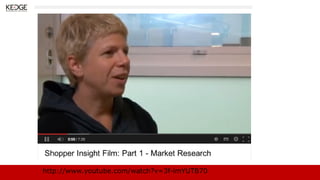
http://www.youtube.com/watch?v=3f-lmYUTB70

Session 2 hours later this evening anytime otw 7

  • 1.
    Culture, Consumption, andMarketing Course: Culture, Consumption, and Marketing Gregorio Fuschillo, gregorio.fuschillo@kedgebs.com
  • 2.
    Agenda • Positivist, interpretive,and critical consumer research • Introspection • Interviews • The role of pictures and videos
  • 3.
    Situating consumer culturetheory in the academic domain Marketing Consumer Research Consumer Psychology Consumer Culture Theory
  • 4.
    Situating consumer culturetheory in the academic domain Marketing Consumer Research Consumer Psychology Consumer Culture Theory Psychology Anthropology Sociology Critical Theory Cultural Studies Literary studies Gender Studies
  • 5.
    Varieties of researchtraditions Research Traditions Positivist Critical Interpretive
  • 6.
    6 Positivist research Assumptions: Objectivereality “exists out there”. The goal of research is to discover ‘truth’. Theory guides to the development of hypotheses. Quantitative methods are used to model the relationships between relevant variables. Consumer research is to a great extend dominated by cognitive and social psychology. Freud extensively used the qualitative case method in his work, but psychology now tries and quantify cognitive processes through experimental research designs. 6
  • 7.
  • 8.
    8 Experimental research designs:Establishing causality 8
  • 9.
    9 Other positivistic approaches,calling for quantitative methods 9
  • 10.
    10 Other positivistic approaches,calling for quantitative methods 10
  • 11.
    11 Interpretive research Assumption: Realityis socially and culturally constructed. The goal of research is to describe the meanings social actors attribute to their lived experiences and their understanding of situations. Theory guides you, but your understanding emerges in the ‘field’. When describing research findings, researchers stay near to your informants’ points of view. Interpretive research is at the core of CCT, and has provided the marketing profession with important methods and concepts. 11
  • 12.
    12 Critical research Assumption: Realityis shaped by political, social, cultural, ethnic, national, and religious values, crystallized over time. The goal of research is to understand how systems of power oppress people and create obstacles to their emancipation. Researchers often take side with the oppressed (women, the working class, indigenous people, …), give voice to those who are silenced by the status quo, and aim at their emancipation Much CCT research focuses on the unintended consequences of marketing in capitalistic society and how brands cause troubles, but can also be part of the solution. 12
  • 13.
    The market researchprocess Step 1 Listening to the client’s need Step 2 Identifying a research strategy (which methods, initial sampling, etc.) Step 3 and 4 Data collection Data Analysis and Interpretation of Findings Step 5 So what? Identifying managerial implications Step 5 Write, Present, and Report Research Findings and Managerial Implications
  • 14.
    Before designing astudy to satisfy a company’s market research needs, it is important to ask yourself what you already know about the subject. Consumer researchers are also consumers (most of the time), so they can use their own experience as basis for understanding a phenomenon. This is called introspection. You systematically interrogate yourself about your consumption habits to develop your first insights.
  • 15.
    Individual introspection exercise: You& the Sea Write 1-2 pages about your experience with the Sea. This exercise can be very open (so feel free to write whatever comes to your mind), but here are some ideas to make it more structured. • Start with your name, gender, age, nationality (city of origin), and other background information that might be relevant. • Have you ever taken part in sea-related causes? How would you describe it to somebody from a different culture who has no idea of what sea protection is? • Start from your own experience. Describe in detail the last time you have experienced the sea. Please also describe the first time you met the sea. • Like any human activity, sea experience can take place in a variety of ways. Think of the main typologies. • Are there differences in the ways sea experiences take place now respect to the past? Are there between sea experience in Marseille and in your city/country of origin? Please describe the main differences. • Please send your output to gregorio.fuschillo@kedgebs.com (as soon as you finish  -1 penalty to your final grade if I don’t receive it)
  • 16.
    Consumer introspection asdata source • Consumer written introspection • Like the exercise you have done • Consumer intimate journal • Informants are asked to write diary entries for extensive periods of time (e.g., every day for one week, every week for a couple of months, every month for a year, …) • Useful to investigate processes (e.g., before, during, and after an experience). • Visual methods • Informants are asked to take pics or videos of their experience, and then describe them (in writing, or interview-style).
  • 17.
  • 18.
    Three types ofinterviews • Structured  The interviewer ask interviewees a series of pre-established questions, allowing only a limited number of response categories • Unstructured  The interviewer adapts to the individual situation and context, making the interviewees feel relaxed  Over the interview, the interviewer develops, adapts and generated follow-up questions reflecting the central purpose of the research. • Semi-structured  Involves prepared questioning guided by identified themes in a consistent and systematic manner interposed with probes designed to elicit more elaborate responses
  • 19.
    What’s wrong withthis? Interviewer: “What did you miss most about being away from your family?” Informant: “The family”. Int.: “The love and warmth?” Inf.: “The togetherness and that sort of thing, and being able to talk to your family, talk more intimately. In the army the talk is more or less on a lower level”. Int.: “Surface level?” Inf.: “Surface level… I guess you could call it that”.
  • 20.
    Steps in interviewdesign (1): Try to learn everything you can before ‘entering the field’ • Introspection Make an inventory and examine the associations, incidents, and assumptions that surround the topic in your mind • News search Try to understand everything you can about the activity to be investigated. • Other ‘quick and dirty’ data: Talk to a friend, examine online data
  • 21.
    Steps in interviewdesign (2): Designing elements of the interview • Start with relevant biographical questions • Identify a set of ‘grand-tour’ questions • Expand on them in unobtrusive, nondirective ways • Raising the eyebrow at the end of an informant’s sentence almost always prompts him/her to return to and expand upon it • Repeat the key term of the informant’s last remark with an interrogative tone • If key categories from the analytical/cultural review do not emerge spontaneously, be more proactive with “planned prompts” • Descriptive questions • Structural questions • Contrast questions • Autodriving
  • 22.
    Planned prompt • GrandTour Questions • General questions, focusing on space, time, events, people, activities, or objects, resulting in a verbal description of significant feature of the topic at end • Typologies • Typical: asks how things usually are (Could you describe a typical day at work?) • Specific: ask about a specific instance (e.g., Could you describe what happened at work yesterday? Tell me about last time you organized a meeting) • Guided Ground Tour: informants are asked to show the place (not always applicable), (e.g., can you show me your office?) • Task-related: informant are asked to perform a simple task that aids in the description (not always applicable), (e.g., can you show me how you cook pasta?)
  • 23.
    Planned prompt • Mini-tourquestions  Identical to GT questions, but dealing with a much smaller unit of experience (e.g., could you describe what goes on in reserving a room for a meeting?) • Example questions  Take some simple act or event identified by the informant and ask for an example (e.g., could you give me an example of someone giving you a hard time?)  Informants can also be asked to recall exceptional incidents • Structural questions  Enables to discover information about domains, i.e., the basic units in an informant’s cultural knowledge (e.g., what are all the stages in getting transferred in your company? Can you think of any other kind of activities you do as a finance manager?) • Contrast questions  Enable to discover the elements informants employ to distinguish the objects and events in their world (e.g., what is the difference between a holiday mean and a working day meal?)
  • 24.
    In-class interviewing exercise: Holydays •Find a partner and decide who’s interviewing whom. It’s better if you find a person you don’t know very well. • This should be an unstructured interview, “let’s talk about holydays”. Let the informant talk freely and in an unobtrusive manner. • However, if something that you feel important doesn’t emerge spontaneously, you can use prompts (grand tour questions, example questions, contrast questions, etc.).
  • 25.
    The use ofvisual methods to enrich interview-based research • Pictures and videos have long been used in interpretive research. • From anthropology, they have now entered the domain of consumer research • In our image-driven societies, consumers now produce a lot of visual data (think of selfies on Istagram) that can be used for research.
  • 26.
    Possible uses ofphotography and video To supplement field notes • To record visual representations of people and events, as memory aid, or the researchers’ own reflections (video or audio memos) For eliciting interviews • The respondent is asked to comment on a picture, a video, or some other stimulus, and to provide an account of what he/she sees • This is a highly obtrusive technique, but can be very useful. • Alternatively, informants can be asked to prepare their own stimuli (a picture of their office, a video of their home, or a diary of their summer vacation) and then comment on them.
  • 27.
    Possible uses ofphotography and video To supplement field notes • To record visual representations of people and events, as memory aid, or the researchers’ own reflections (video or audio memos) For eliciting interviews • The respondent is asked to comment on a picture, a video, or some other stimulus, and to provide an account of what he/she sees • This is a highly obtrusive technique, but can be very useful. • Alternatively, informants can be asked to prepare their own stimuli (a picture of their office, a video of their home, or a diary of their summer vacation) and then comment on them. As data sources • To record behaviors in an unobtrusive manners • To be conducted in ethical manners
  • 28.