‘BRANDING IN THE AGE OF SOCIAL MEDIA’
Vidhi Soni – 2023AUGVPGP0001
Milind Vilas Hegde – 2023AUGVPGP0038
Aditya Pratap Aggarwal – 2023AUGVPGP0036
Digital Era
• In the era of Facebook and YouTube brand building has
become a challenging task. Almost all companies hired
creative agencies and armies of technologists to insert brands
throughout the digital universe. The thought was: Social media
would allow the company to leapfrog traditional media and
forge relationships directly with customers. Telling great stories
and connecting with customers in real time was important.
• Companies made huge bets on branded content. Yet very few
brands were successful in generating meaningful consumer
interest online.
• In reality, social media made brands less significant.
• It gave rise to crowd culture, hence changing the rules of
branding.
Why Branded Content and
Sponsorships used to Work?
• Branded content- Blurs the line between marketing and entertainment,
provides content that increases brand value.
• In the early days, companies made their brands famous and infiltrated
culture, using short-form storytelling, cinematic tricks, songs, and
empathetic characters.
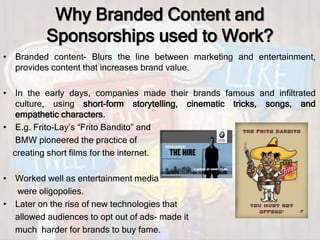
• E.g. Frito-Lay’s “Frito Bandito” and
BMW pioneered the practice of
creating short films for the internet.
• Worked well as entertainment media
were oligopolies.
• Later on the rise of new technologies that
allowed audiences to opt out of ads- made it
much harder for brands to buy fame.
Rise of Crowd culture
• Brands only succeed when they appeal to the crowd-culture which is a
mass of digital natives ready and eager to share with their like-minded
acquaintances.
• Cultural innovation earlier flowed from the margins of society,
challenging mainstream norms and conventions, companies and brands
that once acted as intermediaries.
• Today, Social media binds together communities that once were
geographically isolated, greatly increasing the pace and intensity of
collaboration. Now that these once-remote communities are densely
networked, their cultural influence has become direct and substantial.
These new crowd cultures come in two groups:
 Amplified subculture : incubate new ideologies and practices. E.g.: 3-D
printing, anime, bird-watching, homeschooling, barbeque, etc.
 Turbocharged art worlds: break new ground in entertainment.
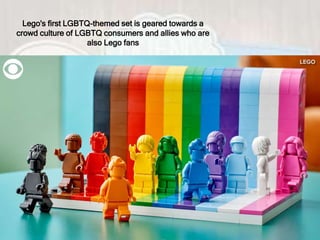
Lego's first LGBTQ-themed set is geared towards a
crowd culture of LGBTQ consumers and allies who are
also Lego fans
Turbocharged art worlds:
• In art worlds, artists (musicians, filmmakers, writers, designers,
cartoonists, and so on) gather in inspired collaborative competition:
They work together, learn from one another, play off ideas, and
push one another. The collective efforts of participants in these
“scenes” often generate major creative breakthroughs.
• Crowd culture has turbocharged art worlds, vastly increasing the
number of participants and the speed and quality of their
interactions.
• Now millions of new cultural entrepreneurs come together online
to hone their craft, exchange ideas, fine-tune their content, and
compete to produce hits. The new content is highly attuned to
audiences and production is cheap. The crowd culture members
need not wait for a year to get funding and distribution for their
short films. Social media comes to their rescue.
Beyond Branded Content
• In YouTube or Instagram, ranking of corporate brands
are very poor. Instead entertainers whom we’ve never
heard of, appear from nowhere.
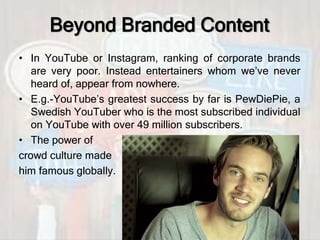
• E.g.-YouTube’s greatest success by far is PewDiePie, a
Swedish YouTuber who is the most subscribed individual
on YouTube with over 49 million subscribers.
• The power of
crowd culture made
him famous globally.
Contd..
• Comparing PewDiePie, who makes inexpensive videos
in his house, to McDonald’s, one of the world’s biggest
spenders on social media, it is seen that McDonald’s has
204,000 YouTube subscribers, while PewDiePie has
over 46 million subscribers.
• Dude Perfect , the brainchild of five college jocks from
Texas, make videos of trick shots and athletic feats, has
12 million subscribers.(DudePerfect).
• The problems companies face is structural. They excel at
coordinating and executing complex marketing programs
across multiple markets around the world. But they lack
cultural innovation.
Contd..
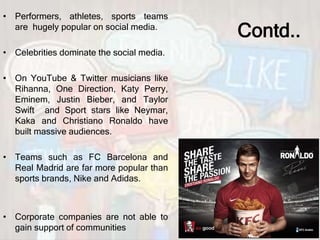
• Performers, athletes, sports teams
are hugely popular on social media.
• Celebrities dominate the social media.
• On YouTube & Twitter musicians like
Rihanna, One Direction, Katy Perry,
Eminem, Justin Bieber, and Taylor
Swift and Sport stars like Neymar,
Kaka and Christiano Ronaldo have
built massive audiences.
• Teams such as FC Barcelona and
Real Madrid are far more popular than
sports brands, Nike and Adidas.
• Corporate companies are not able to
gain support of communities
Indian Vloggers
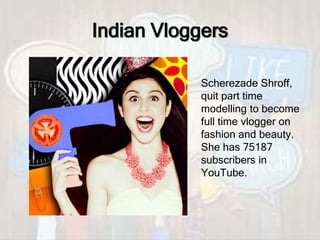
Scherezade Shroff,
quit part time
modelling to become
full time vlogger on
fashion and beauty.
She has 75187
subscribers in
YouTube.
Contd..
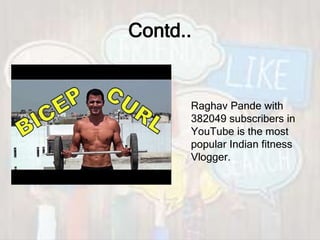
Raghav Pande with
382049 subscribers in
YouTube is the most
popular Indian fitness
Vlogger.
Contd..
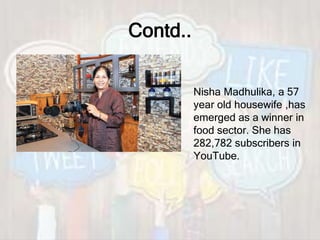
Nisha Madhulika, a 57
year old housewife ,has
emerged as a winner in
food sector. She has
282,782 subscribers in
YouTube.
How One Brand Uses Celebrities to
Break Through
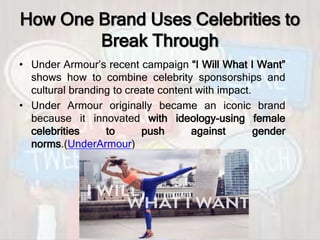
• Under Armour’s recent campaign “I Will What I Want”
shows how to combine celebrity sponsorships and
cultural branding to create content with impact.
• Under Armour originally became an iconic brand
because it innovated with ideology-using female
celebrities to push against gender
norms.(UnderArmour)
Cultural Branding
• Cultural branding is a
discipline that systematically
guides brand innovation:
pinpoint cultural opportunities
emerging in society and build
brand strategies to leverage
these opportunities.
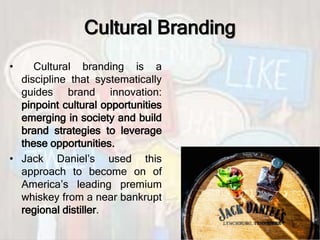
• Jack Daniel’s used this
approach to become on of
America’s leading premium
whiskey from a near bankrupt
regional distiller.
5 steps of Cultural Branding
Chipotle – the fast casual Mexican food chain –
applied the 5 steps of cultural branding to become
one of America’s most compelling and talked-about
brands,
• Map the cultural orthodoxy - the brand promotes
an innovative ideology that breaks with category
conventions. To do that, it first needs to identify
which conventions to leapfrog -- cultural
orthodoxy.
Contd..
• Locate the cultural opportunity - As time passes,
disruptions in society cause an orthodoxy to lose
traction. Consumers begin searching for alternatives,
which opens up an opportunity for innovative brands to
push forward a new ideology in their categories
• Target the crowd culture - as social media took off, an
influential and diverse cluster of overlapping subcultures
pushed hard for food innovations. They included
advocates of evolutionary nutrition and paleo diets,
sustainable ranchers, a new generation of environmental
activists, urban gardeners, and farm-to-table restaurants.
In short order, a massive cultural movement had
organized around the revival of preindustrial foods.
Chipotle succeeded because it jumped into this crowd
Contd..
• Diffuse the new ideology - In 2011 Chipotle
launched Back to the Start, an animated film with
simple wooden figures. A second film, The
Scarecrow, parodied an industrial food company
that branded its products using natural farm
imagery. Chipotle painted an inspired vision of
America returning to bucolic agricultural and food
production traditions and reversing many
problems in the dominant food system.
Scarecrow Back to the start
Contd..
• Innovate continually, using cultural flashpoints -
A brand can sustain its cultural relevance by playing off
particularly intriguing or contentious issues that dominate the
media discourse related to an ideology. To thrive, Chipotle must
continue to lead on flashpoint issues with products and
communiqués.
Turbocharged Art Worlds
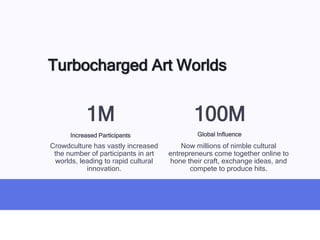
1M
Increased Participants
Crowdculture has vastly increased
the number of participants in art
worlds, leading to rapid cultural
innovation.
100M
Global Influence
Now millions of nimble cultural
entrepreneurs come together online to
hone their craft, exchange ideas, and
compete to produce hits.
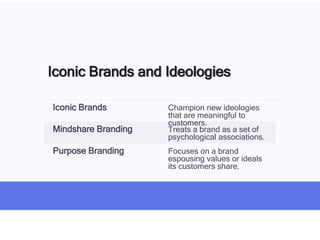
Iconic Brands and Ideologies
Iconic Brands Champion new ideologies
that are meaningful to
customers.
Mindshare Branding Treats a brand as a set of
psychological associations.
Purpose Branding Focuses on a brand
espousing values or ideals
its customers share.
Disintermediation of Brand Sponsors
Entertainment Properties
Performers, athletes, sports
teams, films, television
programs, and video games
are hugely popular on social
media.
Celebrity Dominance
On YouTube, Twitter, and
Instagram, a similar cast of
singers and media stars have
built massive audiences.
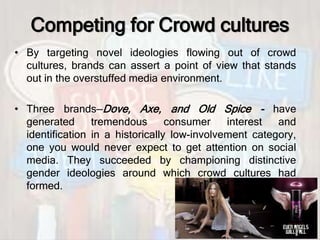
Competing for Crowd cultures
• By targeting novel ideologies flowing out of crowd
cultures, brands can assert a point of view that stands
out in the overstuffed media environment.
• Three brands—Dove, Axe, and Old Spice - have
generated tremendous consumer interest and
identification in a historically low-involvement category,
one you would never expect to get attention on social
media. They succeeded by championing distinctive
gender ideologies around which crowd cultures had
formed.
‘By targeting novel ideologies
from
crowd cultures, brands can
stand out.’
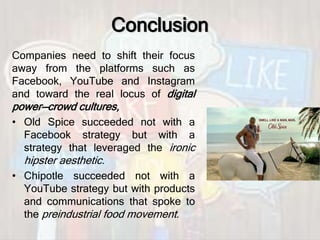
Conclusion
Companies need to shift their focus
away from the platforms such as
Facebook, YouTube and Instagram
and toward the real locus of digital
power—crowd cultures,
• Old Spice succeeded not with a
Facebook strategy but with a
strategy that leveraged the ironic
hipster aesthetic.
• Chipotle succeeded not with a
YouTube strategy but with products
and communications that spoke to
the preindustrial food movement.
Group 7- Consumer Behavior PPT kmkm ,mkm

Group 7- Consumer Behavior PPT kmkm ,mkm

  • 2.
    ‘BRANDING IN THEAGE OF SOCIAL MEDIA’ Vidhi Soni – 2023AUGVPGP0001 Milind Vilas Hegde – 2023AUGVPGP0038 Aditya Pratap Aggarwal – 2023AUGVPGP0036
  • 3.
    Digital Era • Inthe era of Facebook and YouTube brand building has become a challenging task. Almost all companies hired creative agencies and armies of technologists to insert brands throughout the digital universe. The thought was: Social media would allow the company to leapfrog traditional media and forge relationships directly with customers. Telling great stories and connecting with customers in real time was important. • Companies made huge bets on branded content. Yet very few brands were successful in generating meaningful consumer interest online. • In reality, social media made brands less significant. • It gave rise to crowd culture, hence changing the rules of branding.
  • 5.
    Why Branded Contentand Sponsorships used to Work? • Branded content- Blurs the line between marketing and entertainment, provides content that increases brand value. • In the early days, companies made their brands famous and infiltrated culture, using short-form storytelling, cinematic tricks, songs, and empathetic characters. • E.g. Frito-Lay’s “Frito Bandito” and BMW pioneered the practice of creating short films for the internet. • Worked well as entertainment media were oligopolies. • Later on the rise of new technologies that allowed audiences to opt out of ads- made it much harder for brands to buy fame.
  • 6.
    Rise of Crowdculture • Brands only succeed when they appeal to the crowd-culture which is a mass of digital natives ready and eager to share with their like-minded acquaintances. • Cultural innovation earlier flowed from the margins of society, challenging mainstream norms and conventions, companies and brands that once acted as intermediaries. • Today, Social media binds together communities that once were geographically isolated, greatly increasing the pace and intensity of collaboration. Now that these once-remote communities are densely networked, their cultural influence has become direct and substantial. These new crowd cultures come in two groups:  Amplified subculture : incubate new ideologies and practices. E.g.: 3-D printing, anime, bird-watching, homeschooling, barbeque, etc.  Turbocharged art worlds: break new ground in entertainment.
  • 7.
    Lego's first LGBTQ-themedset is geared towards a crowd culture of LGBTQ consumers and allies who are also Lego fans
  • 8.
    Turbocharged art worlds: •In art worlds, artists (musicians, filmmakers, writers, designers, cartoonists, and so on) gather in inspired collaborative competition: They work together, learn from one another, play off ideas, and push one another. The collective efforts of participants in these “scenes” often generate major creative breakthroughs. • Crowd culture has turbocharged art worlds, vastly increasing the number of participants and the speed and quality of their interactions. • Now millions of new cultural entrepreneurs come together online to hone their craft, exchange ideas, fine-tune their content, and compete to produce hits. The new content is highly attuned to audiences and production is cheap. The crowd culture members need not wait for a year to get funding and distribution for their short films. Social media comes to their rescue.
  • 9.
    Beyond Branded Content •In YouTube or Instagram, ranking of corporate brands are very poor. Instead entertainers whom we’ve never heard of, appear from nowhere. • E.g.-YouTube’s greatest success by far is PewDiePie, a Swedish YouTuber who is the most subscribed individual on YouTube with over 49 million subscribers. • The power of crowd culture made him famous globally.
  • 10.
    Contd.. • Comparing PewDiePie,who makes inexpensive videos in his house, to McDonald’s, one of the world’s biggest spenders on social media, it is seen that McDonald’s has 204,000 YouTube subscribers, while PewDiePie has over 46 million subscribers. • Dude Perfect , the brainchild of five college jocks from Texas, make videos of trick shots and athletic feats, has 12 million subscribers.(DudePerfect). • The problems companies face is structural. They excel at coordinating and executing complex marketing programs across multiple markets around the world. But they lack cultural innovation.
  • 11.
    Contd.. • Performers, athletes,sports teams are hugely popular on social media. • Celebrities dominate the social media. • On YouTube & Twitter musicians like Rihanna, One Direction, Katy Perry, Eminem, Justin Bieber, and Taylor Swift and Sport stars like Neymar, Kaka and Christiano Ronaldo have built massive audiences. • Teams such as FC Barcelona and Real Madrid are far more popular than sports brands, Nike and Adidas. • Corporate companies are not able to gain support of communities
  • 12.
    Indian Vloggers Scherezade Shroff, quitpart time modelling to become full time vlogger on fashion and beauty. She has 75187 subscribers in YouTube.
  • 13.
    Contd.. Raghav Pande with 382049subscribers in YouTube is the most popular Indian fitness Vlogger.
  • 14.
    Contd.. Nisha Madhulika, a57 year old housewife ,has emerged as a winner in food sector. She has 282,782 subscribers in YouTube.
  • 15.
    How One BrandUses Celebrities to Break Through • Under Armour’s recent campaign “I Will What I Want” shows how to combine celebrity sponsorships and cultural branding to create content with impact. • Under Armour originally became an iconic brand because it innovated with ideology-using female celebrities to push against gender norms.(UnderArmour)
  • 16.
    Cultural Branding • Culturalbranding is a discipline that systematically guides brand innovation: pinpoint cultural opportunities emerging in society and build brand strategies to leverage these opportunities. • Jack Daniel’s used this approach to become on of America’s leading premium whiskey from a near bankrupt regional distiller.
  • 17.
    5 steps ofCultural Branding Chipotle – the fast casual Mexican food chain – applied the 5 steps of cultural branding to become one of America’s most compelling and talked-about brands, • Map the cultural orthodoxy - the brand promotes an innovative ideology that breaks with category conventions. To do that, it first needs to identify which conventions to leapfrog -- cultural orthodoxy.
  • 18.
    Contd.. • Locate thecultural opportunity - As time passes, disruptions in society cause an orthodoxy to lose traction. Consumers begin searching for alternatives, which opens up an opportunity for innovative brands to push forward a new ideology in their categories • Target the crowd culture - as social media took off, an influential and diverse cluster of overlapping subcultures pushed hard for food innovations. They included advocates of evolutionary nutrition and paleo diets, sustainable ranchers, a new generation of environmental activists, urban gardeners, and farm-to-table restaurants. In short order, a massive cultural movement had organized around the revival of preindustrial foods. Chipotle succeeded because it jumped into this crowd
  • 19.
    Contd.. • Diffuse thenew ideology - In 2011 Chipotle launched Back to the Start, an animated film with simple wooden figures. A second film, The Scarecrow, parodied an industrial food company that branded its products using natural farm imagery. Chipotle painted an inspired vision of America returning to bucolic agricultural and food production traditions and reversing many problems in the dominant food system. Scarecrow Back to the start
  • 20.
    Contd.. • Innovate continually,using cultural flashpoints - A brand can sustain its cultural relevance by playing off particularly intriguing or contentious issues that dominate the media discourse related to an ideology. To thrive, Chipotle must continue to lead on flashpoint issues with products and communiqués.
  • 21.
    Turbocharged Art Worlds 1M IncreasedParticipants Crowdculture has vastly increased the number of participants in art worlds, leading to rapid cultural innovation. 100M Global Influence Now millions of nimble cultural entrepreneurs come together online to hone their craft, exchange ideas, and compete to produce hits.
  • 22.
    Iconic Brands andIdeologies Iconic Brands Champion new ideologies that are meaningful to customers. Mindshare Branding Treats a brand as a set of psychological associations. Purpose Branding Focuses on a brand espousing values or ideals its customers share.
  • 23.
    Disintermediation of BrandSponsors Entertainment Properties Performers, athletes, sports teams, films, television programs, and video games are hugely popular on social media. Celebrity Dominance On YouTube, Twitter, and Instagram, a similar cast of singers and media stars have built massive audiences.
  • 24.
    Competing for Crowdcultures • By targeting novel ideologies flowing out of crowd cultures, brands can assert a point of view that stands out in the overstuffed media environment. • Three brands—Dove, Axe, and Old Spice - have generated tremendous consumer interest and identification in a historically low-involvement category, one you would never expect to get attention on social media. They succeeded by championing distinctive gender ideologies around which crowd cultures had formed.
  • 25.
    ‘By targeting novelideologies from crowd cultures, brands can stand out.’
  • 26.
    Conclusion Companies need toshift their focus away from the platforms such as Facebook, YouTube and Instagram and toward the real locus of digital power—crowd cultures, • Old Spice succeeded not with a Facebook strategy but with a strategy that leveraged the ironic hipster aesthetic. • Chipotle succeeded not with a YouTube strategy but with products and communications that spoke to the preindustrial food movement.