2018-02-06Naturvårdsverket | Swedish Environmental Protection Agency 1
ADVANCED WASTEWATER TREATMENT
FOR SEPARATION AND REMOVAL OF
PHARMACEUTICAL RESIDUES AND
OTHER HAZARDOUS SUBSTANCES
Kerstin Bly Joyce
Swedish Environmental
Protection Agency
OECD Workshop on
Contaminants of
emerging concern in
surface waters
Paris 5 Feb
2018-02-06Naturvårdsverket | Swedish Environmental Protection Agency 2
• The Swedish Government has recognized challenges
with adverse effects of certain pharmaceuticals in the
aquatic environment
• “Advanced technologies for the removal of
pharmaceutical residues and other micropollutants should
be tested and evaluated in full scale no later than 2018”
(Govt Bill 2013/14:39)
• Government Commission to Swedish EPA on removal of
pharmaceuticals in wastewater treatment in Dec 2015
• Delivered April 2017, report at www.naturvardsverket.se
Starting points
2018-02-06Naturvårdsverket | Swedish Environmental Protection Agency 3
Commission about pharmaceuticals
Examine the conditions for using advanced
wastewater treatment to remove pharmaceutical
residues to protect the aquatic environment
Need of advanced treatment
Technical solutions including advantages and
disadvantages
Other aspects to consider
2018-02-06Naturvårdsverket | Swedish Environmental Protection Agency 4
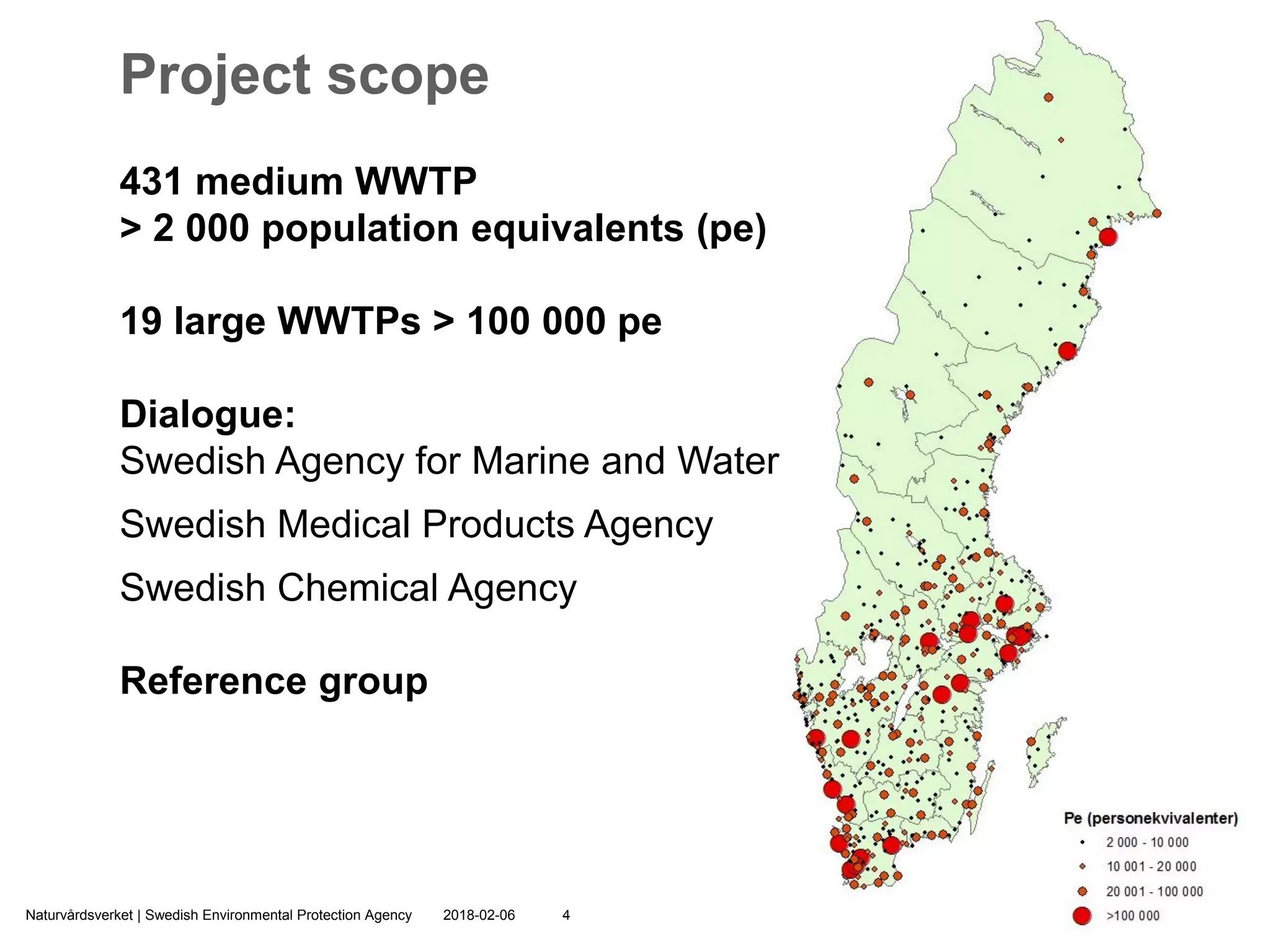
431 medium WWTP
> 2 000 population equivalents (pe)
19 large WWTPs > 100 000 pe
Dialogue:
Swedish Agency for Marine and Water Management
Swedish Medical Products Agency
Swedish Chemical Agency
Reference group
Project scope
2018-02-06Naturvårdsverket | Swedish Environmental Protection Agency 5
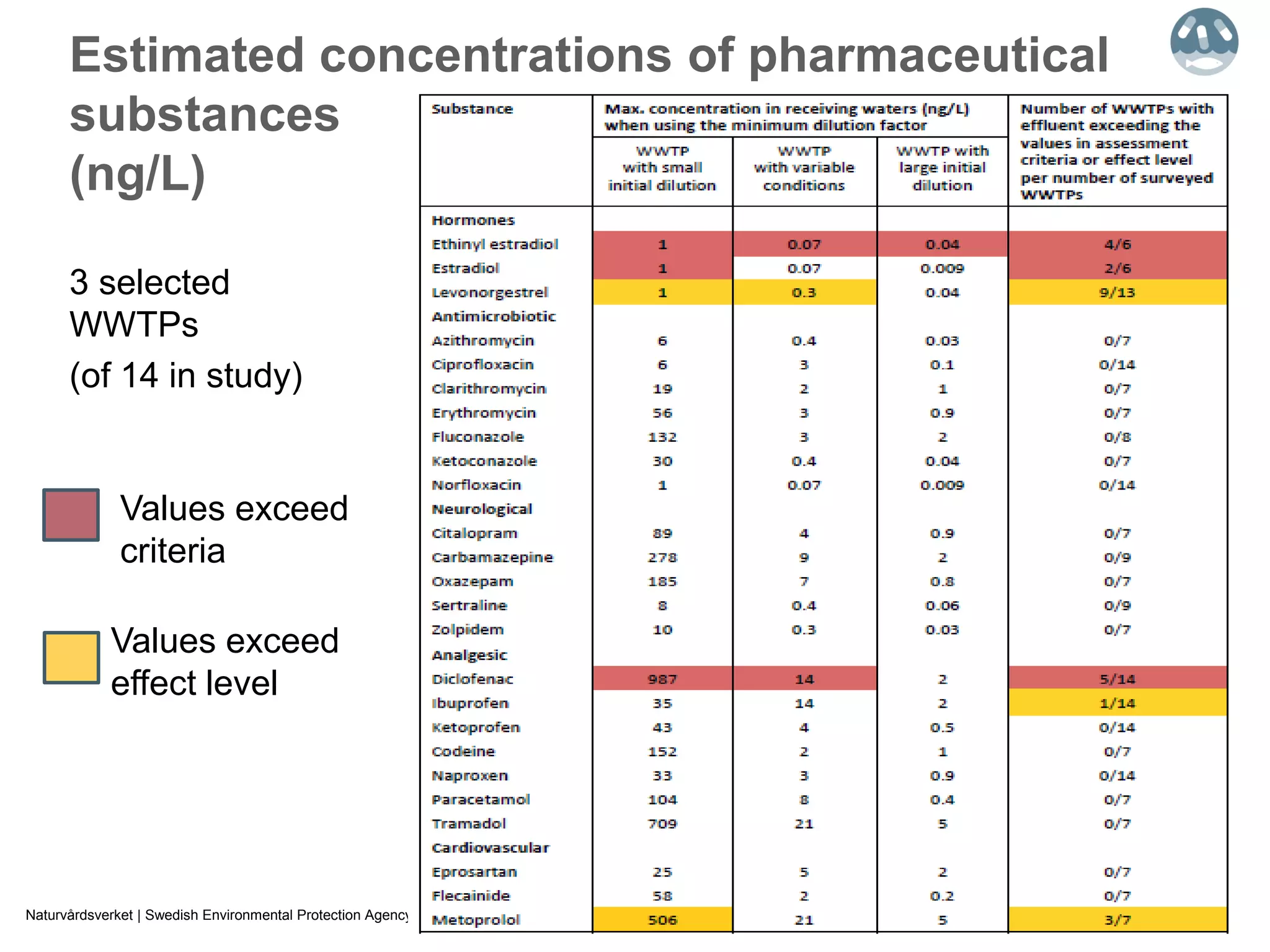
Estimated concentrations of pharmaceutical
substances
(ng/L)
Values exceed
criteria
3 selected
WWTPs
(of 14 in study)
Values exceed
effect level
2018-02-06Naturvårdsverket | Swedish Environmental Protection Agency 6
Need for advanced treatment
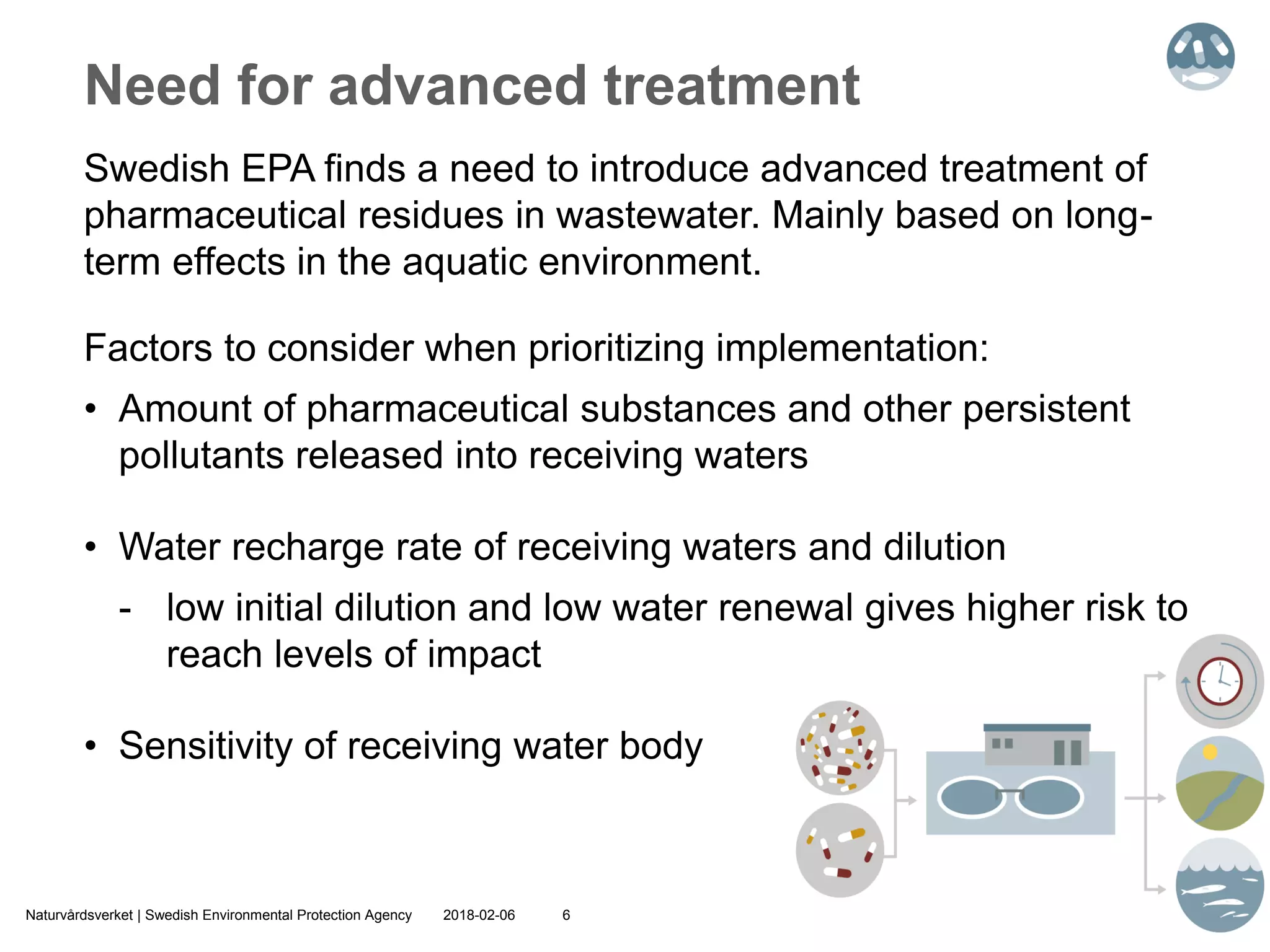
Swedish EPA finds a need to introduce advanced treatment of
pharmaceutical residues in wastewater. Mainly based on long-
term effects in the aquatic environment.
Factors to consider when prioritizing implementation:
• Amount of pharmaceutical substances and other persistent
pollutants released into receiving waters
• Water recharge rate of receiving waters and dilution
- low initial dilution and low water renewal gives higher risk to
reach levels of impact
• Sensitivity of receiving water body
2018-02-06Naturvårdsverket | Swedish Environmental Protection Agency 7
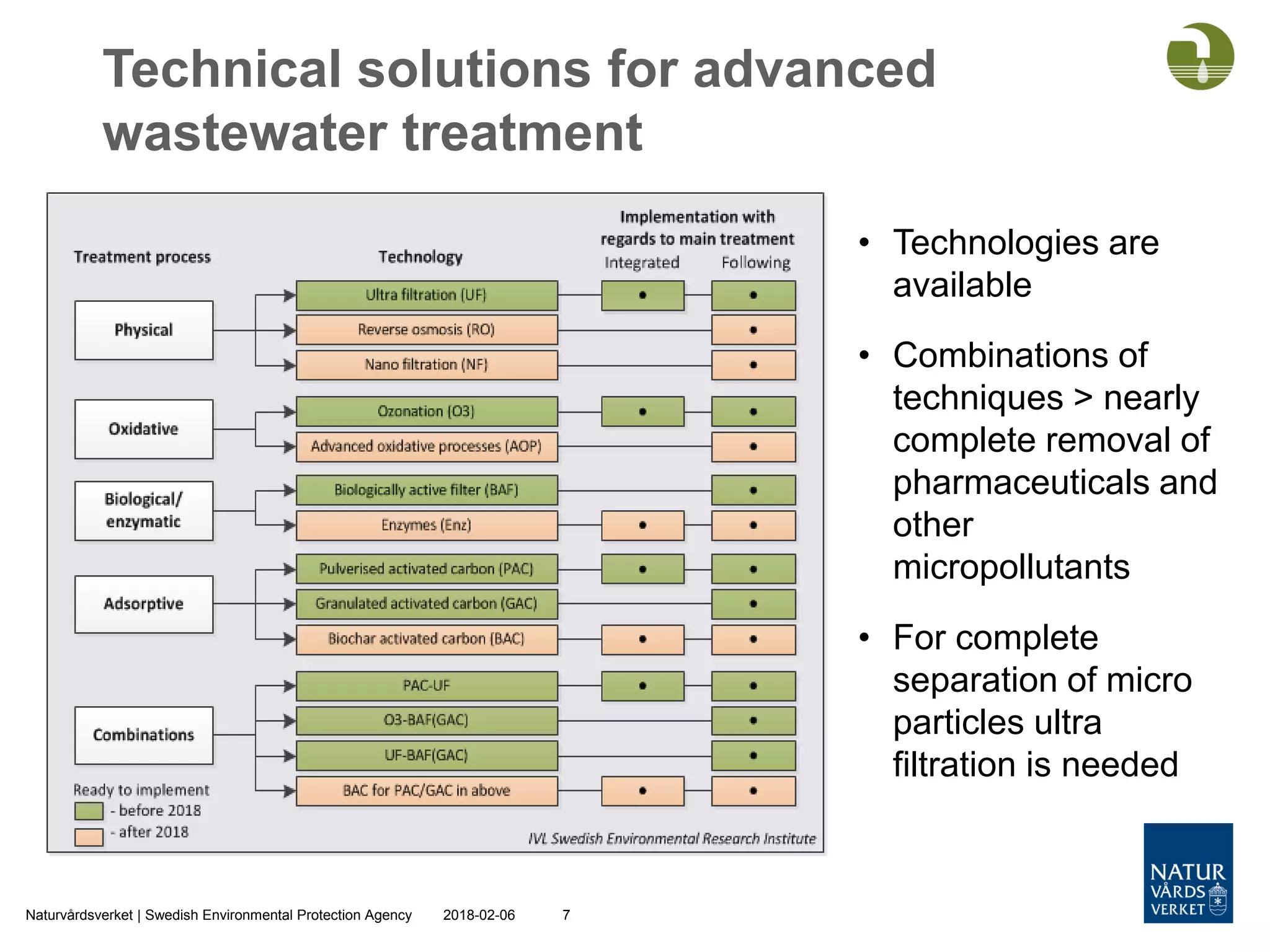
Technical solutions for advanced
wastewater treatment
• Technologies are
available
• Combinations of
techniques > nearly
complete removal of
pharmaceuticals and
other
micropollutants
• For complete
separation of micro
particles ultra
filtration is needed
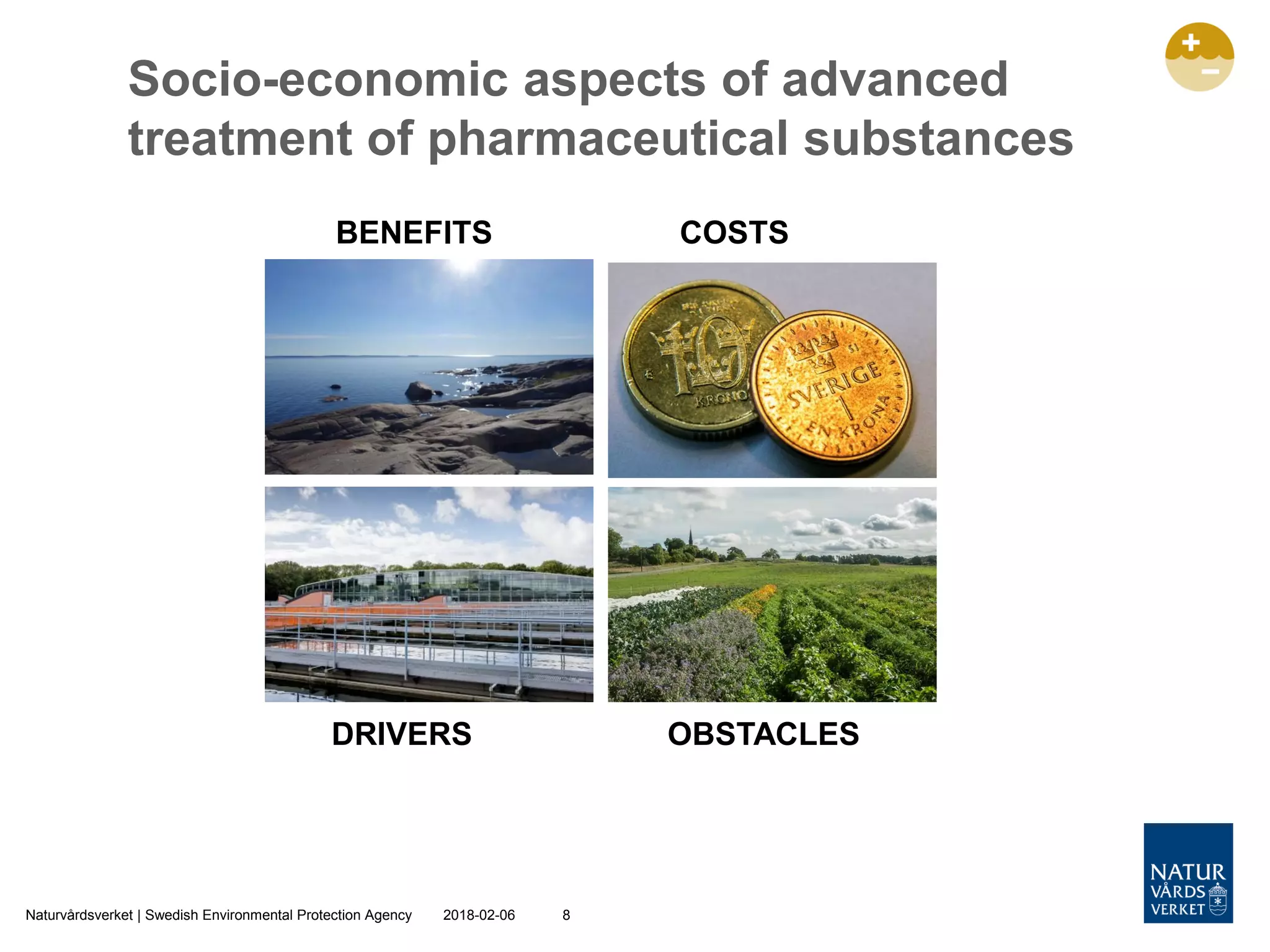
Socio-economic aspects of advanced
treatment of pharmaceutical substances
2018-02-06Naturvårdsverket | Swedish Environmental Protection Agency 8
BENEFITS COSTS
DRIVERS OBSTACLES
NEED OF ADVANCED TREATMENT
Reduce risk of negative environmental impact from
pharmaceutical residues from a long-term perspective.
Separation of other hazardous substances strengthens the
need
TECHNOLOGIES
Proven technologies exist, working on both smaller and
larger scale. Adapt to local conditions and needs.
CONSEQUENCES
Benefits identified for society, but difficult to quantify.
Further assessments of costs and benefits where need is
set against cost. Investigate governance and control.
2018-02-06Naturvårdsverket | Swedish Environmental Protection Agency 9
Summary
THANK YOU
2018-02-06Naturvårdsverket | Swedish Environmental Protection Agency 10
Kerstin Bly Joyce
Environmental Economics unit, Swedish EPA
kerstin.joyce@naturvardsverket.se

Session 1 - Jenny Hedman

  • 1.
    2018-02-06Naturvårdsverket | SwedishEnvironmental Protection Agency 1 ADVANCED WASTEWATER TREATMENT FOR SEPARATION AND REMOVAL OF PHARMACEUTICAL RESIDUES AND OTHER HAZARDOUS SUBSTANCES Kerstin Bly Joyce Swedish Environmental Protection Agency OECD Workshop on Contaminants of emerging concern in surface waters Paris 5 Feb
  • 2.
    2018-02-06Naturvårdsverket | SwedishEnvironmental Protection Agency 2 • The Swedish Government has recognized challenges with adverse effects of certain pharmaceuticals in the aquatic environment • “Advanced technologies for the removal of pharmaceutical residues and other micropollutants should be tested and evaluated in full scale no later than 2018” (Govt Bill 2013/14:39) • Government Commission to Swedish EPA on removal of pharmaceuticals in wastewater treatment in Dec 2015 • Delivered April 2017, report at www.naturvardsverket.se Starting points
  • 3.
    2018-02-06Naturvårdsverket | SwedishEnvironmental Protection Agency 3 Commission about pharmaceuticals Examine the conditions for using advanced wastewater treatment to remove pharmaceutical residues to protect the aquatic environment Need of advanced treatment Technical solutions including advantages and disadvantages Other aspects to consider
  • 4.
    2018-02-06Naturvårdsverket | SwedishEnvironmental Protection Agency 4 431 medium WWTP > 2 000 population equivalents (pe) 19 large WWTPs > 100 000 pe Dialogue: Swedish Agency for Marine and Water Management Swedish Medical Products Agency Swedish Chemical Agency Reference group Project scope
  • 5.
    2018-02-06Naturvårdsverket | SwedishEnvironmental Protection Agency 5 Estimated concentrations of pharmaceutical substances (ng/L) Values exceed criteria 3 selected WWTPs (of 14 in study) Values exceed effect level
  • 6.
    2018-02-06Naturvårdsverket | SwedishEnvironmental Protection Agency 6 Need for advanced treatment Swedish EPA finds a need to introduce advanced treatment of pharmaceutical residues in wastewater. Mainly based on long- term effects in the aquatic environment. Factors to consider when prioritizing implementation: • Amount of pharmaceutical substances and other persistent pollutants released into receiving waters • Water recharge rate of receiving waters and dilution - low initial dilution and low water renewal gives higher risk to reach levels of impact • Sensitivity of receiving water body
  • 7.
    2018-02-06Naturvårdsverket | SwedishEnvironmental Protection Agency 7 Technical solutions for advanced wastewater treatment • Technologies are available • Combinations of techniques > nearly complete removal of pharmaceuticals and other micropollutants • For complete separation of micro particles ultra filtration is needed
  • 8.
    Socio-economic aspects ofadvanced treatment of pharmaceutical substances 2018-02-06Naturvårdsverket | Swedish Environmental Protection Agency 8 BENEFITS COSTS DRIVERS OBSTACLES
  • 9.
    NEED OF ADVANCEDTREATMENT Reduce risk of negative environmental impact from pharmaceutical residues from a long-term perspective. Separation of other hazardous substances strengthens the need TECHNOLOGIES Proven technologies exist, working on both smaller and larger scale. Adapt to local conditions and needs. CONSEQUENCES Benefits identified for society, but difficult to quantify. Further assessments of costs and benefits where need is set against cost. Investigate governance and control. 2018-02-06Naturvårdsverket | Swedish Environmental Protection Agency 9 Summary
  • 10.
    THANK YOU 2018-02-06Naturvårdsverket |Swedish Environmental Protection Agency 10 Kerstin Bly Joyce Environmental Economics unit, Swedish EPA kerstin.joyce@naturvardsverket.se