State of play on policy
development to manage
CECs in the EU
Peter Korytár
European Commission, DG Environment, Sustainable chemicals
5 February 2018, OECD, Paris
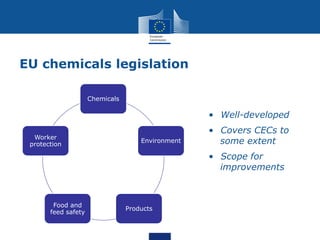
EU chemicals legislation
Chemicals
Environment
Products
Food and
feed safety
Worker
protection
• Well-developed
• Covers CECs to
some extent
• Scope for
improvements
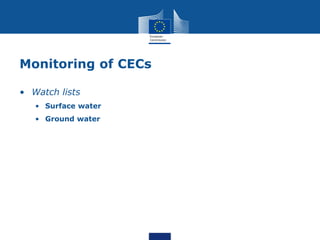
Monitoring of CECs
• Watch lists
• Surface water
• Ground water
Monitoring of CECs
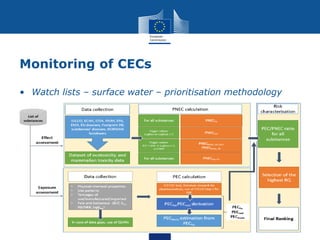
• Watch lists – surface water – prioritisation methodology
Monitoring of CECs
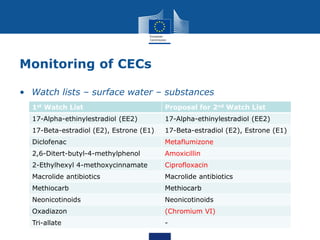
• Watch lists – surface water – substances
1st Watch List Proposal for 2nd Watch List
17-Alpha-ethinylestradiol (EE2) 17-Alpha-ethinylestradiol (EE2)
17-Beta-estradiol (E2), Estrone (E1) 17-Beta-estradiol (E2), Estrone (E1)
Diclofenac Metaflumizone
2,6-Ditert-butyl-4-methylphenol Amoxicillin
2-Ethylhexyl 4-methoxycinnamate Ciprofloxacin
Macrolide antibiotics Macrolide antibiotics
Methiocarb Methiocarb
Neonicotinoids Neonicotinoids
Oxadiazon (Chromium VI)
Tri-allate -
Monitoring of CECs
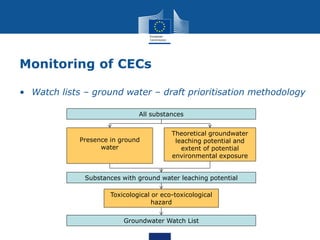
• Watch lists – ground water – draft prioritisation methodology
All substances
Presence in ground
water
Theoretical groundwater
leaching potential and
extent of potential
environmental exposure
Substances with ground water leaching potential
Toxicological or eco-toxicological
hazard
Groundwater Watch List
Monitoring of CECs
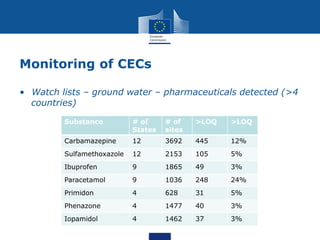
• Watch lists – ground water – pharmaceuticals detected (>4
countries)
Substance # of
States
# of
sites
>LOQ >LOQ
Carbamazepine 12 3692 445 12%
Sulfamethoxazole 12 2153 105 5%
Ibuprofen 9 1865 49 3%
Paracetamol 9 1036 248 24%
Primidon 4 628 31 5%
Phenazone 4 1477 40 3%
Iopamidol 4 1462 37 3%
Monitoring of CECs
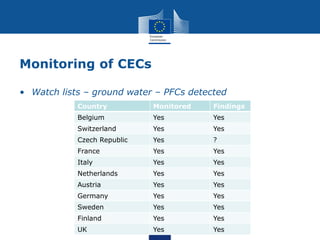
• Watch lists – ground water – PFCs detected
Country Monitored Findings
Belgium Yes Yes
Switzerland Yes Yes
Czech Republic Yes ?
France Yes Yes
Italy Yes Yes
Netherlands Yes Yes
Austria Yes Yes
Germany Yes Yes
Sweden Yes Yes
Finland Yes Yes
UK Yes Yes
Monitoring of CECs
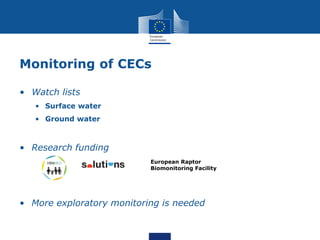
• Watch lists
• Surface water
• Ground water
European Raptor
Biomonitoring Facility
• Research funding
• More exploratory monitoring is needed
Facilitating access to data
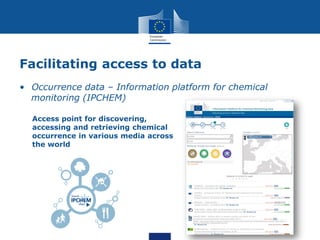
• Occurrence data – Information platform for chemical
monitoring (IPCHEM)
Access point for discovering,
accessing and retrieving chemical
occurrence in various media across
the world
Facilitating access to data
• Lack of data:
• use and production volumes of chemicals
• ecotox data
• problems with access of data
• Occurrence data – Information platform for chemical
monitoring (IPCHEM)
• Hazard (ecotox) data – in REACH, PPPR and BPR + CLP
• Research data – burdensome to get
Exploring effect-based methods
• The monitoring of individual chemicals might be
complemented or partly replaced by the monitoring of effects
or markers of effects using effect-based methods
• Overall – aim to obtain a more holistic picture of water
quality, taking into account more substances without
significantly increasing monitoring effort
• Exploratory work under the common implementation
strategy for the WFD
• NB – need to be able to identify problem substances/sources
to be able to take measures
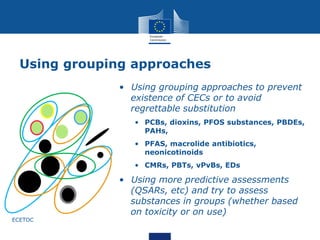
Using grouping approaches
• Using grouping approaches to prevent
existence of CECs or to avoid
regrettable substitution
• PCBs, dioxins, PFOS substances, PBDEs,
PAHs,
• PFAS, macrolide antibiotics,
neonicotinoids
• CMRs, PBTs, vPvBs, EDs
• Using more predictive assessments
(QSARs, etc) and try to assess
substances in groups (whether based
on toxicity or on use)
ECETOC
Increasing attention to persistent and
mobile substances
• Development of a new hazard class to classify/identify
substances having potential for groundwater contamination :
• Persistent (Half-life) and Mobile (Solubility in water and Log
Koc)
• Provisional screening of substance (DK EPA + DE UBA)
• 2095 substances included in the analysis using DK QSAR DB
• P: similar to PBTs; M: Sw > 0.15 mg/L and log Koc < 4.5; T: CMR,
STOT RE, classification for effects on or via lactation, DNEL < 9
ug/kg bw/d
• 3-18% fulfilled the PM screening criteria
• 0.2-3.4% fufilled the PMT screening criteria
Pharmaceuticals in the environment
• EU strategic approach to pharmaceuticals in the environment
• to be adopted by end May 2018
• possible policy options (not an exclusive list)
• covering whole life-cycle of pharma
• covering all environmental media
• Public consultation still open until 21 Feb
https://ec.europa.eu/info/consultations/public-consultation-
pharmaceuticals-environment_en
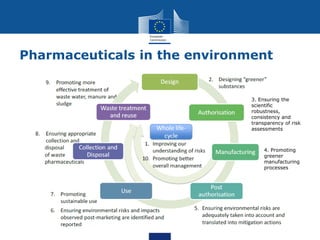
Pharmaceuticals in the environment
4. Promoting
greener
manufacturing
processes
3. Ensuring the
scientific
robustness,
consistency and
transparency of risk
assessments
Thank you

Session 4 - Peter Korytar

  • 1.
    State of playon policy development to manage CECs in the EU Peter Korytár European Commission, DG Environment, Sustainable chemicals 5 February 2018, OECD, Paris
  • 2.
    EU chemicals legislation Chemicals Environment Products Foodand feed safety Worker protection • Well-developed • Covers CECs to some extent • Scope for improvements
  • 3.
    Monitoring of CECs •Watch lists • Surface water • Ground water
  • 4.
    Monitoring of CECs •Watch lists – surface water – prioritisation methodology
  • 5.
    Monitoring of CECs •Watch lists – surface water – substances 1st Watch List Proposal for 2nd Watch List 17-Alpha-ethinylestradiol (EE2) 17-Alpha-ethinylestradiol (EE2) 17-Beta-estradiol (E2), Estrone (E1) 17-Beta-estradiol (E2), Estrone (E1) Diclofenac Metaflumizone 2,6-Ditert-butyl-4-methylphenol Amoxicillin 2-Ethylhexyl 4-methoxycinnamate Ciprofloxacin Macrolide antibiotics Macrolide antibiotics Methiocarb Methiocarb Neonicotinoids Neonicotinoids Oxadiazon (Chromium VI) Tri-allate -
  • 6.
    Monitoring of CECs •Watch lists – ground water – draft prioritisation methodology All substances Presence in ground water Theoretical groundwater leaching potential and extent of potential environmental exposure Substances with ground water leaching potential Toxicological or eco-toxicological hazard Groundwater Watch List
  • 7.
    Monitoring of CECs •Watch lists – ground water – pharmaceuticals detected (>4 countries) Substance # of States # of sites >LOQ >LOQ Carbamazepine 12 3692 445 12% Sulfamethoxazole 12 2153 105 5% Ibuprofen 9 1865 49 3% Paracetamol 9 1036 248 24% Primidon 4 628 31 5% Phenazone 4 1477 40 3% Iopamidol 4 1462 37 3%
  • 8.
    Monitoring of CECs •Watch lists – ground water – PFCs detected Country Monitored Findings Belgium Yes Yes Switzerland Yes Yes Czech Republic Yes ? France Yes Yes Italy Yes Yes Netherlands Yes Yes Austria Yes Yes Germany Yes Yes Sweden Yes Yes Finland Yes Yes UK Yes Yes
  • 9.
    Monitoring of CECs •Watch lists • Surface water • Ground water European Raptor Biomonitoring Facility • Research funding • More exploratory monitoring is needed
  • 10.
    Facilitating access todata • Occurrence data – Information platform for chemical monitoring (IPCHEM) Access point for discovering, accessing and retrieving chemical occurrence in various media across the world
  • 11.
    Facilitating access todata • Lack of data: • use and production volumes of chemicals • ecotox data • problems with access of data • Occurrence data – Information platform for chemical monitoring (IPCHEM) • Hazard (ecotox) data – in REACH, PPPR and BPR + CLP • Research data – burdensome to get
  • 12.
    Exploring effect-based methods •The monitoring of individual chemicals might be complemented or partly replaced by the monitoring of effects or markers of effects using effect-based methods • Overall – aim to obtain a more holistic picture of water quality, taking into account more substances without significantly increasing monitoring effort • Exploratory work under the common implementation strategy for the WFD • NB – need to be able to identify problem substances/sources to be able to take measures
  • 13.
    Using grouping approaches •Using grouping approaches to prevent existence of CECs or to avoid regrettable substitution • PCBs, dioxins, PFOS substances, PBDEs, PAHs, • PFAS, macrolide antibiotics, neonicotinoids • CMRs, PBTs, vPvBs, EDs • Using more predictive assessments (QSARs, etc) and try to assess substances in groups (whether based on toxicity or on use) ECETOC
  • 14.
    Increasing attention topersistent and mobile substances • Development of a new hazard class to classify/identify substances having potential for groundwater contamination : • Persistent (Half-life) and Mobile (Solubility in water and Log Koc) • Provisional screening of substance (DK EPA + DE UBA) • 2095 substances included in the analysis using DK QSAR DB • P: similar to PBTs; M: Sw > 0.15 mg/L and log Koc < 4.5; T: CMR, STOT RE, classification for effects on or via lactation, DNEL < 9 ug/kg bw/d • 3-18% fulfilled the PM screening criteria • 0.2-3.4% fufilled the PMT screening criteria
  • 15.
    Pharmaceuticals in theenvironment • EU strategic approach to pharmaceuticals in the environment • to be adopted by end May 2018 • possible policy options (not an exclusive list) • covering whole life-cycle of pharma • covering all environmental media • Public consultation still open until 21 Feb https://ec.europa.eu/info/consultations/public-consultation- pharmaceuticals-environment_en
  • 16.
    Pharmaceuticals in theenvironment 4. Promoting greener manufacturing processes 3. Ensuring the scientific robustness, consistency and transparency of risk assessments
  • 17.