Lecture 06
Disruptive technologies
Scenarios
Dr. Jorge Ramírez Medina
Readings discussion
Dr. Jorge Ramírez Medina
Readings discussion
Dr. Jorge Ramírez Medina
Readings discussion
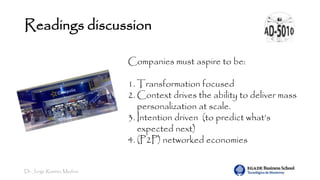
Companies must aspire to be:
1. Transformation focused
2. Context drives the ability to deliver mass
personalization at scale.
3. Intention driven (to predict what’s
expected next)
4. (P2P) networked economies
Dr. Jorge Ramírez Medina
Readings discussion
Dr. Jorge Ramírez Medina
Readings discussion
Dr. Jorge Ramírez Medina
Readings discussion
Dr. Jorge Ramírez Medina
Readings discussion
Dr. Jorge Ramírez Medina
Readings discussion
Dr. Jorge Ramírez Medina
Readings discussion
• Technology; the way an organization produces
outputs from inputs.
• Transformational work. Transactional work.
and Tacit work.
• What matters is technology change
• Every technology is born, grows, matures, and
dies when a new technology supersedes it.
Dr. Jorge Ramírez Medina
Readings discussion
• An innovator is a firm that introduces a new
technology into a market.
• Digital disruption 3 waves
• “A key characteristic of a disruptive
technology is that it changes the basis of
competition.”
Dr. Jorge Ramírez Medina
Readings discussion
• Moving from an era of B 2B and B 2C
to P 2P
• Empower organizations to compete and
to change the way we co-create and co -
innovate.
Dr. Jorge Ramírez Medina
Readings discussion
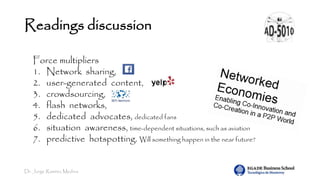
Force multipliers
1. Network sharing,
2. user-generated content,
3. crowdsourcing,
4. flash networks,
5. dedicated advocates, dedicated fans
6. situation awareness, time-dependent situations, such as aviation
7. predictive hotspotting. Will something happen in the near future?
Dr. Jorge Ramírez Medina
Readings discussion
• Moore’s Law and Metcalfe
• Complementary assets.
• Stacked ecosystem
• Ubiquitous Sensing and Ubiquitous
Connectivity.
• The Internet of everything
Dr. Jorge Ramírez Medina
Technology Strategy
• An innovator’s technology strategy is
influenced by two types of change: the
evolution of the technology’s performance and
the development of the market for the new
technology.
• S-curves and Gartner Hype-cyles
• “Crossing this chasm, must be the primary focus
of any long-term high-tech marketing plan.”
Dr. Jorge Ramírez Medina
Technology Strategy
• A choice between cooperation and
competition, and it depends on two factors:
the robustness of the “market for ideas” and
the ownership of valuable or specialized
complementary assets.
• The innovator dilema. Seven insights
• Nash Equilibrium
Dr. Jorge Ramírez Medina
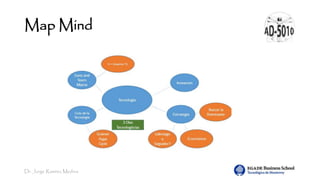
Map Mind
Dr. Jorge Ramírez Medina
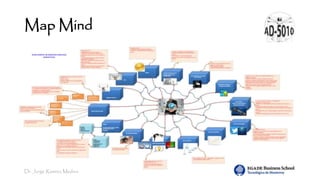
Map Mind
Dr. Jorge Ramírez Medina
Class Excercise
Dr. Jorge Ramírez Medina
End of session

Sesión 06

  • 1.
  • 2.
    Dr. Jorge RamírezMedina Readings discussion
  • 3.
    Dr. Jorge RamírezMedina Readings discussion
  • 4.
    Dr. Jorge RamírezMedina Readings discussion Companies must aspire to be: 1. Transformation focused 2. Context drives the ability to deliver mass personalization at scale. 3. Intention driven (to predict what’s expected next) 4. (P2P) networked economies
  • 5.
    Dr. Jorge RamírezMedina Readings discussion
  • 6.
    Dr. Jorge RamírezMedina Readings discussion
  • 7.
    Dr. Jorge RamírezMedina Readings discussion
  • 8.
    Dr. Jorge RamírezMedina Readings discussion
  • 9.
    Dr. Jorge RamírezMedina Readings discussion
  • 10.
    Dr. Jorge RamírezMedina Readings discussion • Technology; the way an organization produces outputs from inputs. • Transformational work. Transactional work. and Tacit work. • What matters is technology change • Every technology is born, grows, matures, and dies when a new technology supersedes it.
  • 11.
    Dr. Jorge RamírezMedina Readings discussion • An innovator is a firm that introduces a new technology into a market. • Digital disruption 3 waves • “A key characteristic of a disruptive technology is that it changes the basis of competition.”
  • 12.
    Dr. Jorge RamírezMedina Readings discussion • Moving from an era of B 2B and B 2C to P 2P • Empower organizations to compete and to change the way we co-create and co - innovate.
  • 13.
    Dr. Jorge RamírezMedina Readings discussion Force multipliers 1. Network sharing, 2. user-generated content, 3. crowdsourcing, 4. flash networks, 5. dedicated advocates, dedicated fans 6. situation awareness, time-dependent situations, such as aviation 7. predictive hotspotting. Will something happen in the near future?
  • 14.
    Dr. Jorge RamírezMedina Readings discussion • Moore’s Law and Metcalfe • Complementary assets. • Stacked ecosystem • Ubiquitous Sensing and Ubiquitous Connectivity. • The Internet of everything
  • 15.
    Dr. Jorge RamírezMedina Technology Strategy • An innovator’s technology strategy is influenced by two types of change: the evolution of the technology’s performance and the development of the market for the new technology. • S-curves and Gartner Hype-cyles • “Crossing this chasm, must be the primary focus of any long-term high-tech marketing plan.”
  • 16.
    Dr. Jorge RamírezMedina Technology Strategy • A choice between cooperation and competition, and it depends on two factors: the robustness of the “market for ideas” and the ownership of valuable or specialized complementary assets. • The innovator dilema. Seven insights • Nash Equilibrium
  • 17.
    Dr. Jorge RamírezMedina Map Mind
  • 18.
    Dr. Jorge RamírezMedina Map Mind
  • 19.
    Dr. Jorge RamírezMedina Class Excercise
  • 20.
    Dr. Jorge RamírezMedina End of session

Editor's Notes

  • #2 Planning scenarios
  • #4 When internet business models disrupted brick and mortar businesses in the 2000s. The recession of 2008 didn’t slow the pace of change We’re standing at the dawn of a digital business revolution. Yet it’s hard to quantify the shift but we can qualify This is the beginning of massive, disruptive, digital transformation. Businesses will fall by the wayside, jobs as we know them will disappear, and competitors will emerge with new value propositions. In this new world, brand mythology becomes paramount. Your company’s brand must stand for something: it must answer the “why” of the fi rm’s existence.
  • #5 Company’s brand must stand for answer the “why” of the firm’s existence.
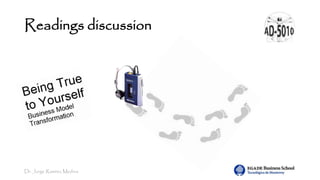
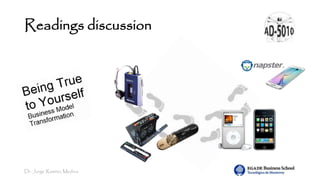
  • #6 the Sony Walkman. It was invented nearly thirty-five years ago. One could argue that this was Sony’s big transformational innovation, the one thing that really put Sony on the map as an innovator Sony actually hasn’t really innovated in the past thirty-five years. In fact, the company has been destroyed by others like Samsung because it hasn’t had much transformative innovation You could make the case that other products—perhaps TVs (Trinitron technology) You could argue that PlayStation You could say that Sony led in CD and DVD
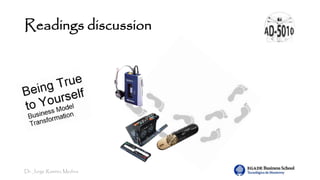
  • #7 Sony’s next innovation after the Walkman was the . It was cool. You could put two cassettes in the cassette case. You could play 180 minutes of music But that shift from the Walkman to the double cassette Walkman was an incremental innovation. The transformational piece would have been an MP3 player. Sony actually had three MP3 players. There were different divisions warring with each other within the company. Since Sony was also in the business of producing and selling music, there was no way it was going to cannibalize itself by introducing one of those three MP3 players into the market so that people could more effectively steal the company’s music. So it sat on the technology.
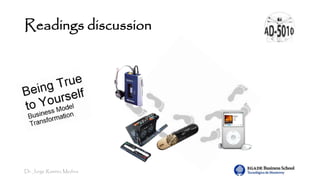
  • #8 At the same time, Apple decided to get into the music industry. And the company came through with a breakthrough innovation: the iPod. When Apple announced and launched the device, it was not the best-sounding music player. It didn’t have the best battery life. It was actually predicted to fail because of these problems. It had a great interface, but its real success was the fact that it was a business model innovation. Apple got users to spend 99 times more for music that they could get for free. People were willing to go from free to 99 cents because they liked the iTunes store, they liked the ecosystem, and they liked the interface. Apple changed the music business.
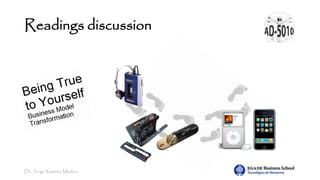
  • #9 Then Apple released another breakthrough innovation—the iPhone. The iPhone single-handedly destroyed twenty-seven business models. We’re talking about businesses that are never going to come back, businesses that were part of the 52 percent of organizations that have been eliminated, merged, acquired or fallen off the list of the Fortune 500. Where do you go to get your film developed? Not a one-hour photo shop. You don’t do that anymore. Film’s gone. Kodak’s dead. What do you do to take a memo? Do you buy a little Casio recorder? No. What do you shoot movies with? A camcorder? You don’t need that video camera anymore. You don’t need a compass. You don’t need a flashlight. You don’t need an alarm clock. It’s all on the iPhone.
  • #10 If we go back to the year 2000, the companies that were going to be hot, the companies that were in charge of mobile, that were going to change the world, were BlackBerry BlackBerry scoffed: Who wants a smartphone? Those things are ridiculous. But the fact was, this was the breakthrough innovation, the business model innovation that led the way Apple, seen as innovative, puts out one device a year. But that’s not fast enough on the phone side. Samsung, which produces many of the components for Apple, puts out a new device every thirty to forty days. It might be a Galaxy S, it might be something else, but they put out a new phone every thirty-six days.
  • #11 “A key characteristic of a disruptive technology is that it changes the basis of competition.” Ubiquitous Sensing and Ubiquitous Connectivity.
  • #13 We’re really just at the beginning of the chaos and the craziness of what will happen when we connect 75 or 80 billion devices by 2020 Three billion people on social networks by 2020. we predict to be somewhere between $70 trillion and $80 trillion in commerce by 2020. the reason we have fi rms is because we need to bring economies of scale to business actions that would be too expensive to coordinate in markets. 1937, a British economist, Ronald Coase these P2P networks actually allow us to scale up and compete with a two hundred person company. It’s the networks, stupid five types of networks. Individuals Direct teams. Partners and alliances. direct sales programs, such as Tupperware and Mary Kay Extended value chains. Firms exert influence over each of their business processes, from manufacturing and supply to distribution, sales, and marketing external advocate ecosystems. Support forums
  • #14 flash networks An example is the pop-up store that appears in the middle of a large crowd or event and then goes away afterward. It comes from a network’s ability to generate interest and attention quickly to bring people together. In March 2011, Apple created a pop-up store in Austin, Texas, to sell the new iPad. The choice of location was far from accidental: it was three blocks away from the music and fi lm festival South by Southwest. That means 20,000 technologists — media and digital influencers —were next door. PONER EL EJEMPLO DE FREEMIUN Facebook is getting better and better at predicting what you’ll do next and what you might want to spend money on. With that insight in hand, Facebook can get advertisers to pay millions to influence users’ next set of actions and decisions.