SESSION – 1
By→ Anuj Kumar Singh
Introduction to Servlet
1. Servlets are the Java programs that runs on the Java-enabled web
server or application server. They are used to handle the request
obtained from the web server, process the request, produce the
response, then send response back to the web server.
2. Properties of Servlets :
a. Servlets work on the server-side.
b. Servlets are capable of handling complex requests obtained from
web server.
Execution of Servlets :
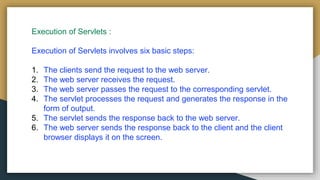
Execution of Servlets involves six basic steps:
1. The clients send the request to the web server.
2. The web server receives the request.
3. The web server passes the request to the corresponding servlet.
4. The servlet processes the request and generates the response in the
form of output.
5. The servlet sends the response back to the web server.
6. The web server sends the response back to the client and the client
browser displays it on the screen.
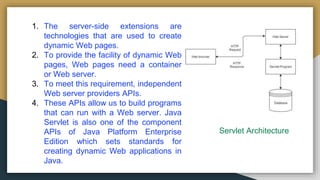
Servlet Architecture
1. The server-side extensions are
technologies that are used to create
dynamic Web pages.
2. To provide the facility of dynamic Web
pages, Web pages need a container
or Web server.
3. To meet this requirement, independent
Web server providers APIs.
4. These APIs allow us to build programs
that can run with a Web server. Java
Servlet is also one of the component
APIs of Java Platform Enterprise
Edition which sets standards for
creating dynamic Web applications in
Java.
The Servlet technology is similar to other Web server extensions such
as Common Gateway Interface (CGI) scripts and Hypertext
Preprocessor (PHP). However, Java Servlets are more acceptable since
they solve the limitations of CGI such as low performance and low
degree scalability.
What is CGI (Common Gateway Interface)?
1. CGI is actually an external application which is written by using any of the
programming languages like C or C++ and this is responsible for processing
client requests and generating dynamic content.
2. CGI Working
a. It first locates the requested web page i.e. the required CGI application
using URL.
b. It then creates a new process to service the client’s request.
c. Invokes the CGI application within the process and passes the request
information to the server.
d. Collects the response from CGI application.
e. Destroys the process, prepares the HTTP response and sends it to the
client.
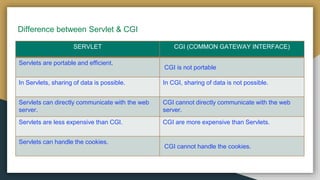
So, in CGI server has to create and
destroy the process for every request. It’s
easy to understand that this approach is
applicable for handling few clients but as
the number of clients increases, the
workload on the server increases and so
the time taken to process requests
increases.
Difference between Servlet & CGI
SERVLET CGI (COMMON GATEWAY INTERFACE)
Servlets are portable and efficient.
CGI is not portable
In Servlets, sharing of data is possible. In CGI, sharing of data is not possible.
Servlets can directly communicate with the web
server.
CGI cannot directly communicate with the web
server.
Servlets are less expensive than CGI. CGI are more expensive than Servlets.
Servlets can handle the cookies.
CGI cannot handle the cookies.
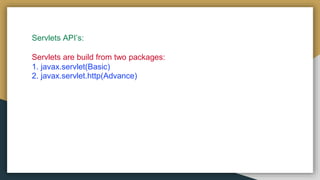
Servlets API’s:
Servlets are build from two packages:
1. javax.servlet(Basic)
2. javax.servlet.http(Advance)
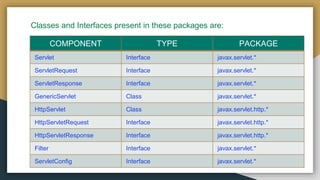
Classes and Interfaces present in these packages are:
COMPONENT TYPE PACKAGE
Servlet Interface javax.servlet.*
ServletRequest Interface javax.servlet.*
ServletResponse Interface javax.servlet.*
GenericServlet Class javax.servlet.*
HttpServlet Class javax.servlet.http.*
HttpServletRequest Interface javax.servlet.http.*
HttpServletResponse Interface javax.servlet.http.*
Filter Interface javax.servlet.*
ServletConfig Interface javax.servlet.*
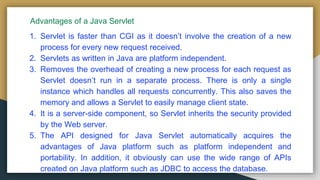
Advantages of a Java Servlet
1. Servlet is faster than CGI as it doesn’t involve the creation of a new
process for every new request received.
2. Servlets as written in Java are platform independent.
3. Removes the overhead of creating a new process for each request as
Servlet doesn’t run in a separate process. There is only a single
instance which handles all requests concurrently. This also saves the
memory and allows a Servlet to easily manage client state.
4. It is a server-side component, so Servlet inherits the security provided
by the Web server.
5. The API designed for Java Servlet automatically acquires the
advantages of Java platform such as platform independent and
portability. In addition, it obviously can use the wide range of APIs
created on Java platform such as JDBC to access the database.
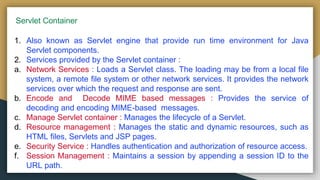
Servlet Container
1. Also known as Servlet engine that provide run time environment for Java
Servlet components.
2. Services provided by the Servlet container :
a. Network Services : Loads a Servlet class. The loading may be from a local file
system, a remote file system or other network services. It provides the network
services over which the request and response are sent.
b. Encode and Decode MIME based messages : Provides the service of
decoding and encoding MIME-based messages.
c. Manage Servlet container : Manages the lifecycle of a Servlet.
d. Resource management : Manages the static and dynamic resources, such as
HTML files, Servlets and JSP pages.
e. Security Service : Handles authentication and authorization of resource access.
f. Session Management : Maintains a session by appending a session ID to the
URL path.
Servlet   session 1

Servlet session 1

  • 1.
    SESSION – 1 By→Anuj Kumar Singh
  • 2.
    Introduction to Servlet 1.Servlets are the Java programs that runs on the Java-enabled web server or application server. They are used to handle the request obtained from the web server, process the request, produce the response, then send response back to the web server. 2. Properties of Servlets : a. Servlets work on the server-side. b. Servlets are capable of handling complex requests obtained from web server.
  • 3.
    Execution of Servlets: Execution of Servlets involves six basic steps: 1. The clients send the request to the web server. 2. The web server receives the request. 3. The web server passes the request to the corresponding servlet. 4. The servlet processes the request and generates the response in the form of output. 5. The servlet sends the response back to the web server. 6. The web server sends the response back to the client and the client browser displays it on the screen.
  • 4.
    Servlet Architecture 1. Theserver-side extensions are technologies that are used to create dynamic Web pages. 2. To provide the facility of dynamic Web pages, Web pages need a container or Web server. 3. To meet this requirement, independent Web server providers APIs. 4. These APIs allow us to build programs that can run with a Web server. Java Servlet is also one of the component APIs of Java Platform Enterprise Edition which sets standards for creating dynamic Web applications in Java.
  • 5.
    The Servlet technologyis similar to other Web server extensions such as Common Gateway Interface (CGI) scripts and Hypertext Preprocessor (PHP). However, Java Servlets are more acceptable since they solve the limitations of CGI such as low performance and low degree scalability.
  • 6.
    What is CGI(Common Gateway Interface)? 1. CGI is actually an external application which is written by using any of the programming languages like C or C++ and this is responsible for processing client requests and generating dynamic content. 2. CGI Working a. It first locates the requested web page i.e. the required CGI application using URL. b. It then creates a new process to service the client’s request. c. Invokes the CGI application within the process and passes the request information to the server. d. Collects the response from CGI application. e. Destroys the process, prepares the HTTP response and sends it to the client.
  • 7.
    So, in CGIserver has to create and destroy the process for every request. It’s easy to understand that this approach is applicable for handling few clients but as the number of clients increases, the workload on the server increases and so the time taken to process requests increases.
  • 8.
    Difference between Servlet& CGI SERVLET CGI (COMMON GATEWAY INTERFACE) Servlets are portable and efficient. CGI is not portable In Servlets, sharing of data is possible. In CGI, sharing of data is not possible. Servlets can directly communicate with the web server. CGI cannot directly communicate with the web server. Servlets are less expensive than CGI. CGI are more expensive than Servlets. Servlets can handle the cookies. CGI cannot handle the cookies.
  • 9.
    Servlets API’s: Servlets arebuild from two packages: 1. javax.servlet(Basic) 2. javax.servlet.http(Advance)
  • 10.
    Classes and Interfacespresent in these packages are: COMPONENT TYPE PACKAGE Servlet Interface javax.servlet.* ServletRequest Interface javax.servlet.* ServletResponse Interface javax.servlet.* GenericServlet Class javax.servlet.* HttpServlet Class javax.servlet.http.* HttpServletRequest Interface javax.servlet.http.* HttpServletResponse Interface javax.servlet.http.* Filter Interface javax.servlet.* ServletConfig Interface javax.servlet.*
  • 11.
    Advantages of aJava Servlet 1. Servlet is faster than CGI as it doesn’t involve the creation of a new process for every new request received. 2. Servlets as written in Java are platform independent. 3. Removes the overhead of creating a new process for each request as Servlet doesn’t run in a separate process. There is only a single instance which handles all requests concurrently. This also saves the memory and allows a Servlet to easily manage client state. 4. It is a server-side component, so Servlet inherits the security provided by the Web server. 5. The API designed for Java Servlet automatically acquires the advantages of Java platform such as platform independent and portability. In addition, it obviously can use the wide range of APIs created on Java platform such as JDBC to access the database.
  • 12.
    Servlet Container 1. Alsoknown as Servlet engine that provide run time environment for Java Servlet components. 2. Services provided by the Servlet container : a. Network Services : Loads a Servlet class. The loading may be from a local file system, a remote file system or other network services. It provides the network services over which the request and response are sent. b. Encode and Decode MIME based messages : Provides the service of decoding and encoding MIME-based messages. c. Manage Servlet container : Manages the lifecycle of a Servlet. d. Resource management : Manages the static and dynamic resources, such as HTML files, Servlets and JSP pages. e. Security Service : Handles authentication and authorization of resource access. f. Session Management : Maintains a session by appending a session ID to the URL path.