
C.K. Prahalad
&
Allen Hammond
( From HBR September 2002 issue)
Arindum Mukhopadhyay
32nd FDP Participant
IIM Ahmedabad
31st Aug 2016
Serving the World’s Poor, Profitably
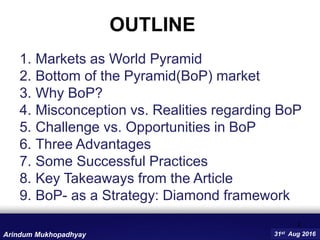
1. Markets as World Pyramid
2. Bottom of the Pyramid(BoP) market
3. Why BoP?
4. Misconception vs. Realities regarding BoP
5. Challenge vs. Opportunities in BoP
6. Three Advantages
7. Some Successful Practices
8. Key Takeaways from the Article
9. BoP- as a Strategy: Diamond framework
OUTLINE
Arindum Mukhopadhyay
2
31st Aug 2016
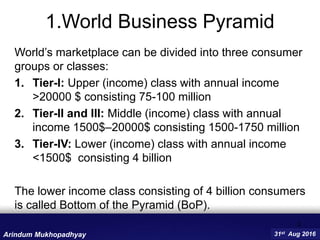
World’s marketplace can be divided into three consumer
groups or classes:
1. Tier-I: Upper (income) class with annual income
>20000 $ consisting 75-100 million
2. Tier-II and III: Middle (income) class with annual
income 1500$–20000$ consisting 1500-1750 million
3. Tier-IV: Lower (income) class with annual income
<1500$ consisting 4 billion
The lower income class consisting of 4 billion consumers
is called Bottom of the Pyramid (BoP).
1.World Business Pyramid
Arindum Mukhopadhyay
3
31st Aug 2016
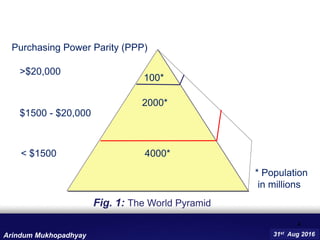
Fig. 1: The World Pyramid
2000*
4000*
* Population
in millions
100*
Purchasing Power Parity (PPP)
>$20,000
$1500 - $20,000
< $1500
Arindum Mukhopadhyay 31st Aug 2016
4
• There is untapped market potential among the poor, and
corporations can generate significant profits by targeting
BoP population, generally defined as people whose income
is about US$2 per day or less.
• BoP Strategy: Making profit while
• Alleviating poverty,
• Securing safety,
• Completing recovery from the global
recession
5
Arindum Mukhopadhyay
Bottom of the Pyramid(BoP) Market
31st Aug 2016
Poor markets are under-served:
Although the segment is desirous for low-priced, high quality products
and services - aggregate prices can be 10 to 500% more for varying
items, from water and food to phone calls and credit.
Cost saving opportunities:
Utilizing cheap labor and implementing innovation based product or
services.
Investing a company’s operations and the workforce of the poorer
regions of the world.
And because the market is under-served, companies are already making
significant innovations to serve this niche.
6
31st Aug 2016
Scope ( Why BoP? )
Arindum Mukhopadhyay
Misconception vs. Realities
regarding BoP
7
31st Aug 2016Arindum Mukhopadhyay
8
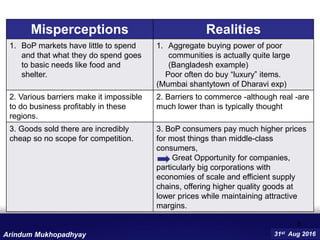
Misperceptions Realities
1. BoP markets have little to spend
and that what they do spend goes
to basic needs like food and
shelter.
1. Aggregate buying power of poor
communities is actually quite large
(Bangladesh example)
Poor often do buy “luxury” items.
(Mumbai shantytown of Dharavi exp)
2. Various barriers make it impossible
to do business profitably in these
regions.
2. Barriers to commerce -although real -are
much lower than is typically thought
3. Goods sold there are incredibly
cheap so no scope for competition.
3. BoP consumers pay much higher prices
for most things than middle-class
consumers,
Great Opportunity for companies,
particularly big corporations with
economies of scale and efficient supply
chains, offering higher quality goods at
lower prices while maintaining attractive
margins.
31st Aug 2016Arindum Mukhopadhyay
9
Misperceptions Realities
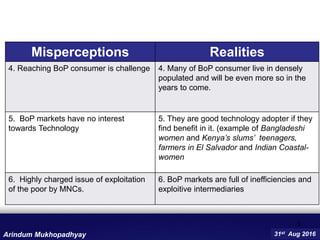
4. Reaching BoP consumer is challenge 4. Many of BoP consumer live in densely
populated and will be even more so in the
years to come.
5. BoP markets have no interest
towards Technology
5. They are good technology adopter if they
find benefit in it. (example of Bangladeshi
women and Kenya’s slums’ teenagers,
farmers in El Salvador and Indian Coastal-
women
6. Highly charged issue of exploitation
of the poor by MNCs.
6. BoP markets are full of inefficiencies and
exploitive intermediaries
31st Aug 2016Arindum Mukhopadhyay
Challenges vs. Opportunities
in BoP
10
31st Aug 2016Arindum Mukhopadhyay
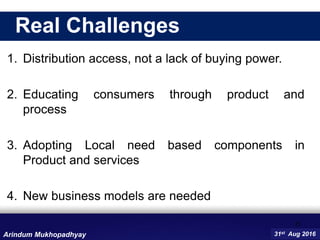
1. Distribution access, not a lack of buying power.
2. Educating consumers through product and
process
3. Adopting Local need based components in
Product and services
4. New business models are needed
11
31st Aug 2016Arindum Mukhopadhyay
Real Challenges
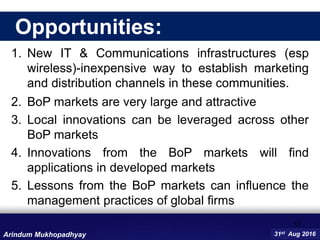
1. New IT & Communications infrastructures (esp
wireless)-inexpensive way to establish marketing
and distribution channels in these communities.
2. BoP markets are very large and attractive
3. Local innovations can be leveraged across other
BoP markets
4. Innovations from the BoP markets will find
applications in developed markets
5. Lessons from the BoP markets can influence the
management practices of global firms
12
31st Aug 2016Arindum Mukhopadhyay
Opportunities:
13
31st Aug 2016Arindum Mukhopadhyay
Three Advantages by serving the poor
Businesses can gain three important advantages by serving the poor.
1. New source of revenue growth- MNCs are now saturated in existing
markets. The BoP markets being new, growth can be rapid.
Opportunities for low-priced, high-quality goods or services are
enormous.
2. Greater efficiency- By shared access model with higher resource
utilization, outsourcing operations to low-cost labor markets,
restructuring products, finances, and supply chains to enhance
productivity.
3. Access to innovation- Developing ways to produce and deliver BoP
customers low cost product or services with the help of rapidly
growing IT. The aim remains low-price, high-quality or efficiency.
Above advantages can be easily transferred to existing markets for higher
profits.
I. When HLL introduced cheap and high quality candy, it became the
fastest growing category in their portfolio. Not only profitable, it
estimates revenues at $200 million per year. Similar success with
low-priced detergent and iodized salt. (New sources of profit)
II. OrphanIT.com’s marketing telecentres in India and the Philippines
pay 10% of labour costs in the U.S. (Reduced operation costs)
III. Ericsson’s Mini-GSM cellphone service provides stand-alone
networks for up to 5,000 users within a 35km radius. Capital costs
to the operator, usually a local entrepreneur, can be as low as $4
when cell phones are shared in communities. (Innovation).
14
31st Aug 2016Arindum Mukhopadhyay
Some Successful Practices:
Strategies for Serving BOP Markets:
(i.) Changing Mindset of executives
(ii) R&D for especially BoP markets
(iii) Seeding entrepreneurial efforts
(iv) Diversified workforce internally to promote innovation
(v) Partnership with entrepreneurs
(vi) Special attention to women entrepreneurs
(vii) Bypassing intermediaries
Above strategies will work best if the external
barriers are removed.
15
31st Aug 2016Arindum Mukhopadhyay
16
31st Aug 2016Arindum Mukhopadhyay
1. The article advocates in favor of marketing to the BoP, stress
on the benefits of providing product choices at an affordable
price that fulfills the needs of the poor
2. The BOP consumers are part of “high cost micro-economic
systems”. They lack access to good quality products and
services; often exploited by various entities such as
moneylenders.
3. There is lot of opportunities for MNCs to prosper through BoP
markets.
4. Assuming External barriers can be overcome, MNCs with
their (technological, managerial, and financial) capabilities
must enter BoP market for the human-welfare, monetary-
profitability and long term growth.
Key Takeaways from the Article
Additional: BoP
17
31st Aug 2016Arindum Mukhopadhyay
18
31st Aug 2016Arindum Mukhopadhyay
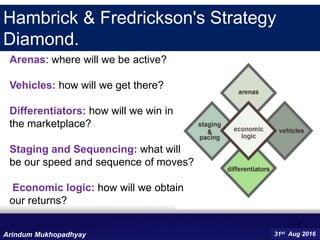
Arenas: where will we be active?
Vehicles: how will we get there?
Differentiators: how will we win in
the marketplace?
Staging and Sequencing: what will
be our speed and sequence of moves?
Economic logic: how will we obtain
our returns?
Hambrick & Fredrickson's Strategy
Diamond.
19
31st Aug 2016Arindum Mukhopadhyay
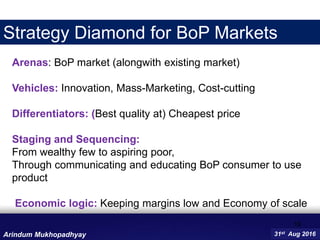
Arenas: BoP market (alongwith existing market)
Vehicles: Innovation, Mass-Marketing, Cost-cutting
Differentiators: (Best quality at) Cheapest price
Staging and Sequencing:
From wealthy few to aspiring poor,
Through communicating and educating BoP consumer to use
product
Economic logic: Keeping margins low and Economy of scale
Strategy Diamond for BoP Markets
Thank You
Arindum Mukhopadhyay
20
31st Aug 2016

Serving the world’s poor, profitably

  • 1.
    C.K. Prahalad & Allen Hammond (From HBR September 2002 issue) Arindum Mukhopadhyay 32nd FDP Participant IIM Ahmedabad 31st Aug 2016 Serving the World’s Poor, Profitably
  • 2.
    1. Markets asWorld Pyramid 2. Bottom of the Pyramid(BoP) market 3. Why BoP? 4. Misconception vs. Realities regarding BoP 5. Challenge vs. Opportunities in BoP 6. Three Advantages 7. Some Successful Practices 8. Key Takeaways from the Article 9. BoP- as a Strategy: Diamond framework OUTLINE Arindum Mukhopadhyay 2 31st Aug 2016
  • 3.
    World’s marketplace canbe divided into three consumer groups or classes: 1. Tier-I: Upper (income) class with annual income >20000 $ consisting 75-100 million 2. Tier-II and III: Middle (income) class with annual income 1500$–20000$ consisting 1500-1750 million 3. Tier-IV: Lower (income) class with annual income <1500$ consisting 4 billion The lower income class consisting of 4 billion consumers is called Bottom of the Pyramid (BoP). 1.World Business Pyramid Arindum Mukhopadhyay 3 31st Aug 2016
  • 4.
    Fig. 1: TheWorld Pyramid 2000* 4000* * Population in millions 100* Purchasing Power Parity (PPP) >$20,000 $1500 - $20,000 < $1500 Arindum Mukhopadhyay 31st Aug 2016 4
  • 5.
    • There isuntapped market potential among the poor, and corporations can generate significant profits by targeting BoP population, generally defined as people whose income is about US$2 per day or less. • BoP Strategy: Making profit while • Alleviating poverty, • Securing safety, • Completing recovery from the global recession 5 Arindum Mukhopadhyay Bottom of the Pyramid(BoP) Market 31st Aug 2016
  • 6.
    Poor markets areunder-served: Although the segment is desirous for low-priced, high quality products and services - aggregate prices can be 10 to 500% more for varying items, from water and food to phone calls and credit. Cost saving opportunities: Utilizing cheap labor and implementing innovation based product or services. Investing a company’s operations and the workforce of the poorer regions of the world. And because the market is under-served, companies are already making significant innovations to serve this niche. 6 31st Aug 2016 Scope ( Why BoP? ) Arindum Mukhopadhyay
  • 7.
    Misconception vs. Realities regardingBoP 7 31st Aug 2016Arindum Mukhopadhyay
  • 8.
    8 Misperceptions Realities 1. BoPmarkets have little to spend and that what they do spend goes to basic needs like food and shelter. 1. Aggregate buying power of poor communities is actually quite large (Bangladesh example) Poor often do buy “luxury” items. (Mumbai shantytown of Dharavi exp) 2. Various barriers make it impossible to do business profitably in these regions. 2. Barriers to commerce -although real -are much lower than is typically thought 3. Goods sold there are incredibly cheap so no scope for competition. 3. BoP consumers pay much higher prices for most things than middle-class consumers, Great Opportunity for companies, particularly big corporations with economies of scale and efficient supply chains, offering higher quality goods at lower prices while maintaining attractive margins. 31st Aug 2016Arindum Mukhopadhyay
  • 9.
    9 Misperceptions Realities 4. ReachingBoP consumer is challenge 4. Many of BoP consumer live in densely populated and will be even more so in the years to come. 5. BoP markets have no interest towards Technology 5. They are good technology adopter if they find benefit in it. (example of Bangladeshi women and Kenya’s slums’ teenagers, farmers in El Salvador and Indian Coastal- women 6. Highly charged issue of exploitation of the poor by MNCs. 6. BoP markets are full of inefficiencies and exploitive intermediaries 31st Aug 2016Arindum Mukhopadhyay
  • 10.
    Challenges vs. Opportunities inBoP 10 31st Aug 2016Arindum Mukhopadhyay
  • 11.
    1. Distribution access,not a lack of buying power. 2. Educating consumers through product and process 3. Adopting Local need based components in Product and services 4. New business models are needed 11 31st Aug 2016Arindum Mukhopadhyay Real Challenges
  • 12.
    1. New IT& Communications infrastructures (esp wireless)-inexpensive way to establish marketing and distribution channels in these communities. 2. BoP markets are very large and attractive 3. Local innovations can be leveraged across other BoP markets 4. Innovations from the BoP markets will find applications in developed markets 5. Lessons from the BoP markets can influence the management practices of global firms 12 31st Aug 2016Arindum Mukhopadhyay Opportunities:
  • 13.
    13 31st Aug 2016ArindumMukhopadhyay Three Advantages by serving the poor Businesses can gain three important advantages by serving the poor. 1. New source of revenue growth- MNCs are now saturated in existing markets. The BoP markets being new, growth can be rapid. Opportunities for low-priced, high-quality goods or services are enormous. 2. Greater efficiency- By shared access model with higher resource utilization, outsourcing operations to low-cost labor markets, restructuring products, finances, and supply chains to enhance productivity. 3. Access to innovation- Developing ways to produce and deliver BoP customers low cost product or services with the help of rapidly growing IT. The aim remains low-price, high-quality or efficiency. Above advantages can be easily transferred to existing markets for higher profits.
  • 14.
    I. When HLLintroduced cheap and high quality candy, it became the fastest growing category in their portfolio. Not only profitable, it estimates revenues at $200 million per year. Similar success with low-priced detergent and iodized salt. (New sources of profit) II. OrphanIT.com’s marketing telecentres in India and the Philippines pay 10% of labour costs in the U.S. (Reduced operation costs) III. Ericsson’s Mini-GSM cellphone service provides stand-alone networks for up to 5,000 users within a 35km radius. Capital costs to the operator, usually a local entrepreneur, can be as low as $4 when cell phones are shared in communities. (Innovation). 14 31st Aug 2016Arindum Mukhopadhyay Some Successful Practices:
  • 15.
    Strategies for ServingBOP Markets: (i.) Changing Mindset of executives (ii) R&D for especially BoP markets (iii) Seeding entrepreneurial efforts (iv) Diversified workforce internally to promote innovation (v) Partnership with entrepreneurs (vi) Special attention to women entrepreneurs (vii) Bypassing intermediaries Above strategies will work best if the external barriers are removed. 15 31st Aug 2016Arindum Mukhopadhyay
  • 16.
    16 31st Aug 2016ArindumMukhopadhyay 1. The article advocates in favor of marketing to the BoP, stress on the benefits of providing product choices at an affordable price that fulfills the needs of the poor 2. The BOP consumers are part of “high cost micro-economic systems”. They lack access to good quality products and services; often exploited by various entities such as moneylenders. 3. There is lot of opportunities for MNCs to prosper through BoP markets. 4. Assuming External barriers can be overcome, MNCs with their (technological, managerial, and financial) capabilities must enter BoP market for the human-welfare, monetary- profitability and long term growth. Key Takeaways from the Article
  • 17.
    Additional: BoP 17 31st Aug2016Arindum Mukhopadhyay
  • 18.
    18 31st Aug 2016ArindumMukhopadhyay Arenas: where will we be active? Vehicles: how will we get there? Differentiators: how will we win in the marketplace? Staging and Sequencing: what will be our speed and sequence of moves? Economic logic: how will we obtain our returns? Hambrick & Fredrickson's Strategy Diamond.
  • 19.
    19 31st Aug 2016ArindumMukhopadhyay Arenas: BoP market (alongwith existing market) Vehicles: Innovation, Mass-Marketing, Cost-cutting Differentiators: (Best quality at) Cheapest price Staging and Sequencing: From wealthy few to aspiring poor, Through communicating and educating BoP consumer to use product Economic logic: Keeping margins low and Economy of scale Strategy Diamond for BoP Markets
  • 20.