ECONOMIC POVERTY:
BOTTOM OF THE PYRAMID
Bagus Aryo, PhD
Magister of Social Welfare
University of Indonesia
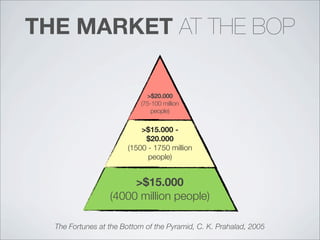
THE MARKET AT THE BOP
>$15.000
(4000 million people)
The Fortunes at the Bottom of the Pyramid, C. K. Prahalad, 2005
>$15.000 -
$20.000
(1500 - 1750 million
people)
>$20.000
(75-100 million
people)
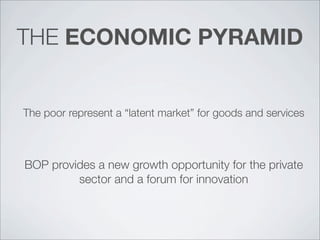
THE ECONOMIC PYRAMID
The poor represent a “latent market” for goods and services
BOP provides a new growth opportunity for the private
sector and a forum for innovation
THE REAL NATURE OF THE
BOP MARKET
• There is Money at the BOP
e.g The GDP per capita in China is US$1,000 - US$1.2 trillion economy (1.2billion people).
But its purchasing power parity is US$5 Trillion, making it the second largest economy
globally
• Local Monopolies
Due to local monopolies, inadequate access, poor distribution, and strong traditional
intermediaries, the poor pays 5 to 25 times what the rich pays in the same economy -->
potential of unlocking the talent purchasing power
THE REAL NATURE OF THE
BOP MARKET
• Access to BOP Markets
Rural markets are inaccessible to audio and television signals. Example: Media Dark - the rural
poor do not know what products / services are available and how to use them.
One solution: HLL Ltd (a subsidiary of Unilever) in India trained entrepreneurial women to
become distributors. They earn US$60-150 per month and become a new class of
consumers themselves
• The BOP Markets are Brand-Conscious
They are indeed brand-conscious and value conscious by necessity; they expect good quality
at the prices they can afford
• BOP Consumers Accept Advanced Technology Readily
Evidenced by the rapid spread of wireless devices, PD kiosks, etc.
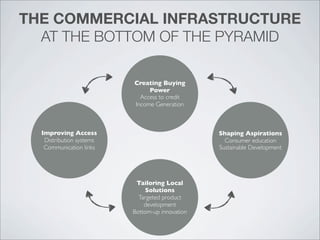
THE COMMERCIAL INFRASTRUCTURE
AT THE BOTTOM OF THE PYRAMID
Creating Buying
Power
Access to credit
Income Generation
Shaping Aspirations
Consumer education
Sustainable Development
Tailoring Local
Solutions
Targeted product
development
Bottom-up innovation
Improving Access
Distribution systems
Communication links
MARKET DEVELOPMENT
IMPERATIVE
1.Create the Capacity to Consume
Cash-poor and with a low level of income, the BOP consumer has to be
accesed differently
Make unit packages (single-serves) that are small and much more
affordable
Based on 3 principles
• Affordability (without sacrificing quality)
• Access (e.g. the poor may start their shopping after 7.00 pm)
• Availability
MARKET DEVELOPMENT
IMPERATIVE
2.The Need for New Goods and Services
The involvement at the BOP can provide opportunitiesfor developing
new goods and services
e.g. access to good quality housing, clean energy from solar and wind
power, good quality furniture. (from an IKEA for the middle class to an
IKEA for the developing world!)
MARKET DEVELOPMENT
IMPERATIVE
3.Dignity and Choice
When the poor are converted into consumers, they also acquire the
dignity of attention and choices previously reserved for the middle-class
and rich
Switching costs for single-serve goods are negligible for the BOP
Consumers
Trust is a Prerequisite
Firms must focus on building trust between themselves and the
consumers
The default rate among the poor is actually lower than the rich: they pay
on-time
CONCERNS ABOUT BOP
• Creating non-existent needs
• Confusing BOP business with the CSR concept and taking attention
away from the need for ODA
• Unscrupulous players taking advantage of BOP consumers vulnerability
• Who carries the innovation risk?
This has developed as a business concept
• Foundation of BOP was the business need to find new markets, not as a
development tool
• Therefore does not explore the wider needs of poverty alleviation
I don’t think there is much middle ground between
Professor Prahalad’s Bottom of the Pyramid proposition
and my views. The BOP emphasizes selling to the poor:
I emphasize viewing the poor as producers and buying
from the poor. The primary issue is to increase the
income of the poor: we need to create employment
opportunities for the poor”
- Prof. Aneel Karnani, University of Michigan
“
“

Economic Poverty: Bottom of the Pyramid

  • 1.
    ECONOMIC POVERTY: BOTTOM OFTHE PYRAMID Bagus Aryo, PhD Magister of Social Welfare University of Indonesia
  • 2.
    THE MARKET ATTHE BOP >$15.000 (4000 million people) The Fortunes at the Bottom of the Pyramid, C. K. Prahalad, 2005 >$15.000 - $20.000 (1500 - 1750 million people) >$20.000 (75-100 million people)
  • 3.
    THE ECONOMIC PYRAMID Thepoor represent a “latent market” for goods and services BOP provides a new growth opportunity for the private sector and a forum for innovation
  • 4.
    THE REAL NATUREOF THE BOP MARKET • There is Money at the BOP e.g The GDP per capita in China is US$1,000 - US$1.2 trillion economy (1.2billion people). But its purchasing power parity is US$5 Trillion, making it the second largest economy globally • Local Monopolies Due to local monopolies, inadequate access, poor distribution, and strong traditional intermediaries, the poor pays 5 to 25 times what the rich pays in the same economy --> potential of unlocking the talent purchasing power
  • 5.
    THE REAL NATUREOF THE BOP MARKET • Access to BOP Markets Rural markets are inaccessible to audio and television signals. Example: Media Dark - the rural poor do not know what products / services are available and how to use them. One solution: HLL Ltd (a subsidiary of Unilever) in India trained entrepreneurial women to become distributors. They earn US$60-150 per month and become a new class of consumers themselves • The BOP Markets are Brand-Conscious They are indeed brand-conscious and value conscious by necessity; they expect good quality at the prices they can afford • BOP Consumers Accept Advanced Technology Readily Evidenced by the rapid spread of wireless devices, PD kiosks, etc.
  • 6.
    THE COMMERCIAL INFRASTRUCTURE ATTHE BOTTOM OF THE PYRAMID Creating Buying Power Access to credit Income Generation Shaping Aspirations Consumer education Sustainable Development Tailoring Local Solutions Targeted product development Bottom-up innovation Improving Access Distribution systems Communication links
  • 7.
    MARKET DEVELOPMENT IMPERATIVE 1.Create theCapacity to Consume Cash-poor and with a low level of income, the BOP consumer has to be accesed differently Make unit packages (single-serves) that are small and much more affordable Based on 3 principles • Affordability (without sacrificing quality) • Access (e.g. the poor may start their shopping after 7.00 pm) • Availability
  • 8.
    MARKET DEVELOPMENT IMPERATIVE 2.The Needfor New Goods and Services The involvement at the BOP can provide opportunitiesfor developing new goods and services e.g. access to good quality housing, clean energy from solar and wind power, good quality furniture. (from an IKEA for the middle class to an IKEA for the developing world!)
  • 9.
    MARKET DEVELOPMENT IMPERATIVE 3.Dignity andChoice When the poor are converted into consumers, they also acquire the dignity of attention and choices previously reserved for the middle-class and rich Switching costs for single-serve goods are negligible for the BOP Consumers Trust is a Prerequisite Firms must focus on building trust between themselves and the consumers The default rate among the poor is actually lower than the rich: they pay on-time
  • 10.
    CONCERNS ABOUT BOP •Creating non-existent needs • Confusing BOP business with the CSR concept and taking attention away from the need for ODA • Unscrupulous players taking advantage of BOP consumers vulnerability • Who carries the innovation risk? This has developed as a business concept • Foundation of BOP was the business need to find new markets, not as a development tool • Therefore does not explore the wider needs of poverty alleviation
  • 11.
    I don’t thinkthere is much middle ground between Professor Prahalad’s Bottom of the Pyramid proposition and my views. The BOP emphasizes selling to the poor: I emphasize viewing the poor as producers and buying from the poor. The primary issue is to increase the income of the poor: we need to create employment opportunities for the poor” - Prof. Aneel Karnani, University of Michigan “ “