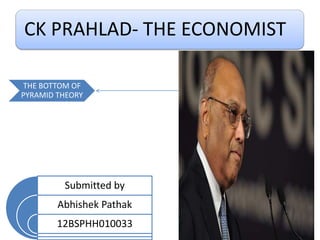
CK PRAHLAD- THE ECONOMIST
THE BOTTOM OF
PYRAMID THEORY
Submitted by
Abhishek Pathak
12BSPHH010033
About : CK-PRAHLAD (Bottom of The Pyramid)
After graduating from Harvard, Prahalad returned to his master's degree alma mater, the Indian
Institute of Management Ahmedabad. But he soon returned to the United States, when in 1977, he was
hired by the University of Michigan's School of Business Administration, where he advanced to the top
tenured appointment as a full professor. In 2005, Dr. Prahalad earned the university's highest
distinction, Distinguished University Professor
Professions and teaching
He was born in 1941 in kannada speaking family in coimbtore. At 19 he joined Union Carbide after
completing his BSC degree in physics from LOYALA University Chennai.
Early life
Professor of Corporate Strategy at the Stephen M. Ross School of Business in the University of
Michigan.
About CK PRAHLAD (1941- 2010)
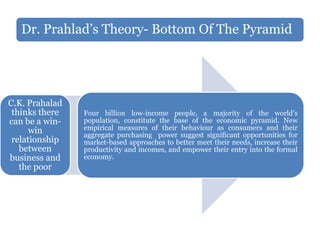
Dr. Prahlad’s Theory- Bottom Of The Pyramid
C.K. Prahalad
thinks there
can be a win-
win
relationship
between
business and
the poor
Four billion low-income people, a majority of the world’s
population, constitute the base of the economic pyramid. New
empirical measures of their behaviour as consumers and their
aggregate purchasing power suggest significant opportunities for
market-based approaches to better meet their needs, increase their
productivity and incomes, and empower their entry into the formal
economy.
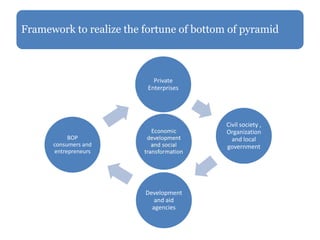
Framework to realize the fortune of bottom of pyramid
Private
Enterprises
Civil society ,
Organization
and local
government
Development
and aid
agencies
BOP
consumers and
entrepreneurs
Concept revolving around BOP
If we stop thinking poor as a victim or
burden and start recognising them as
resilient and creative entrepreneurs
and value conscious consumer, a whole
new world of opportunity will open up.
Mr Prahalad reckons that there are huge
potential profits to be made from serving
the 4 billion-5 billion people on under $2
a day—an economic opportunity he
values globally at $13 trillion a year
The win for the poor of being served by
big business includes, he says, being
empowered by choice and being freed
from having to pay the currently
widespread “poverty penalty”
Example
In shanty towns near Mumbai, for
example, the poor pay a premium
on everything from rice to credit—
often five to 25 times what the rich
pay for the same services. Driving
down these premiums can make
serving the BOP more profitable
than serving the top, he argues, and
points to a growing number of
leading firms—from Unilever in
India to Cemex in Mexico and Casas
Bahia in Brazil—that are profiting
by doing precisely that.
Relevancy of BOP
Big business needs to swap its usual incremental approach for an
entrepreneurial mind-set, because BOP markets need to be built.
firms cannot simply edge down market fine-tuning the products they
already sell to rich customers. Instead, they must thoroughly re-
engineer products to reflect the very different economics of BOP:
small unit packages, low margin per unit, high volume.
Products will have to be made available in affordable units—most
sales of shampoo in India, for example, are of single sachets.
Distribution networks may need to be rethought, not least to involve
entrepreneurs from among the poor
Customers may need to be educated in how to consume, and even
why—about credit, say, or even about the benefits of washed hands.
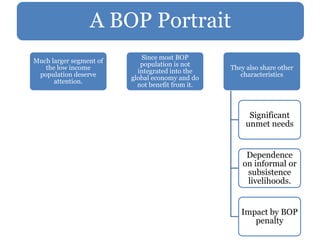
A BOP Portrait
Much larger segment of
the low income
population deserve
attention.
Since most BOP
population is not
integrated into the
global economy and do
not benefit from it.
They also share other
characteristics
Significant
unmet needs
Dependence
on informal or
subsistence
livelihoods.
Impact by BOP
penalty
Taking a market based
approach to poverty reduction
This approach can help frame the debate on poverty reduction
more in terms of enabling opportunity and less in terms of aid.
A market-based approach thus focuses on people as consumers
and producers and on solutions that can make markets more
efficient, competitive, and inclusive—so that the BOP can
benefit from them.
Perhaps most important, traditional approaches do not
point toward sustainable solutions—while a market-
oriented approach recognizes that only sustainable
solutions can scale to meet the needs of 4 billion people
Growing interest, growing success in BOP
markets
Business interest in BOP markets is rising. Multinational
companies have been pioneers, especially in food and consumer
products
Large national companies have proved to be among the most
innovative in meeting the needs of BOP consumers and producers,
especially in such sectors as housing, agriculture, consumer goods,
and financial services
small start-ups and social entrepreneurs focusing on BOP markets
are rapidly growing in number. But perhaps the strongest and most
dramatic BOP success story is mobile telephony.
Example
Between 2000 and 2005 the number of mobile
subscribers in developing countries grew more
than fivefold—to nearly 1.4 billion. Growth was
rapid in all regions, but fastest in sub-
Saharan Africa—Nigeria’s sub- scriber base grew
from 370,000 to 16.8 million in just four years
(World Bank2006b).
Household surveys confirm substantial and
growing mobile phone use in the BOP
population, which has clearly benefited from
the access mobile phones provide to jobs, to
medicalcare, to market prices,to family
members working away from home and the
remittances they can send, and, increasingly, to
financial services (Vodafone 2005).
Example 2 (telephone industry)
A strong value proposition for low-
income consumers has translated into
financial success for mobile companies. Celtel,
an entrepreneurial company operating in
some of the poorest and least stable countries
in Africa, went from start-up to telecom giant
in just seven years. Acquired for US$3.4
billion in 2005, the company now has
operations in 15 African countries and licenses
covering more than 30% of the continent.
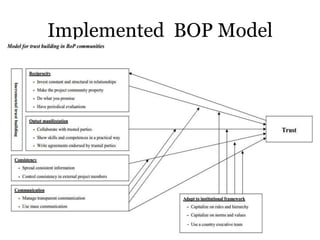
Implemented BOP Model
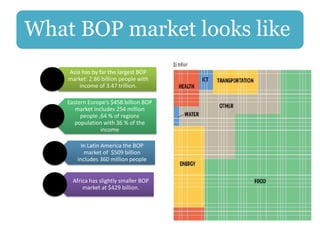
What BOP market looks like
Asia has by far the largest BOP
market: 2.86 billion people with
income of 3.47 trillion.
Eastern Europe’s $458 billion BOP
market includes 254 million
people ,64 % of regions
population with 36 % of the
income
In Latin America the BOP
market of $509 billion
includes 360 million people
Africa has slightly smaller BOP
market at $429 billion.
BOP business strategies that work
Why are some enterprises succeeding in meeting BOP needs, and others are not? Successful enterprises
operating in these markets use four broad strategies that appear to be critical:
A) Focusing on the BOP
B) Localizing Value Creation
C) Enabling access to goods and services.
D) Unconventional partnering with governments , NGO or groups of multiple stakeholders to bring the
necessary capabilities . Examples are found in energy, transportation, health care, financial services, and
food and consumer goods.
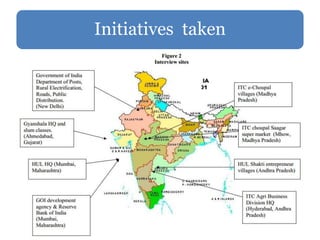
Initiatives taken
Assumption of BOP
The poor can not participate in the benefit
of globalization without an active
involvement of the private sector.
BOP market must become an integral part
of work and of core business of the private
sector.
BOP markets can not merely be left to the
realm of CSR.
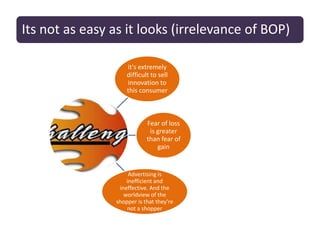
Its not as easy as it looks (irrelevance of BOP)
it's extremely
difficult to sell
innovation to
this consumer
Fear of loss
is greater
than fear of
gain
Advertising is
inefficient and
ineffective. And the
worldview of the
shopper is that they're
not a shopper
Example ( NIKE & HLL)
A) A typical example is the Word Shoe project of Nike. In its attempt to supply low priced
shoes to the low-income-populations in China, it failed in meeting its sales goals. Nike was
unsuccessful in reaching the target consumer because its business model was not based on an
emphatic understanding.
B) the detergent product ‘Wheel’ of Unilevers subsidiary Hindustan Lever Ltd. (HLL) perfectly
illustrates this failure to make a BoP initiative grow. Thebusiness model was based on single
serve packaging, low-cost production, and distribution through small local companies.
Although rapid growing sales figures were visible in the beginning, the business model was not
suitable to reach 500 million potential customers in rural villages
Hence, “Project Shakti” came into existence: through women’s self help groups, HLL trained
thousands of entrepreneurial women in building a local HLL micro-franchise
Critical Inquiries of C.K. Prahalad’s “Bottom of the Pyramid” Concept
Base of the pyramid business offers the promise of great economic gains for
companies and the possibility of a powerful new approach to alleviate poverty
This framework is used to illustrate the limitations of CSR in terms of likely
impacts on poverty reduction through each of the channels identified and also
to point to areas in which CSR may have some positive benefits.
According to the 'doing well by doing good' proposition, firms have a
corporate social responsibility to achieve some larger social goals,
The currently influential model for information and communication technologies
for development (ICT4D) is based on increasing the well-being of the poor
through market-based solutions, and by using low-cost but advanced
technologies
selling consumer goods to four billion poor people at the bottom of the
economic pyramid (BoP) both generates sizeable profits for large businesses.
References
• Books & journal ( Philip Kotler )
• http://hbr.org/2011/06/the-globe-segmenting-the-base-of-the-
pyramid/ar/1
• http://www.baseofthepyramid.nl/docs/Becoming%20trusted%2
0at%20the%20Base-of-the-Pyramid.pdf
• http://www.fastcompany.com/1687863/marketing-bottom-
pyramid
• http://www.imtfi.uci.edu/imtfi_bibcritique
• http://www.insead.edu/facultyresearch/research/doc.cfm?did=
45042
Ck.prahlad abhishek.pathak

Ck.prahlad abhishek.pathak

  • 1.
    CK PRAHLAD- THEECONOMIST THE BOTTOM OF PYRAMID THEORY Submitted by Abhishek Pathak 12BSPHH010033
  • 2.
    About : CK-PRAHLAD(Bottom of The Pyramid) After graduating from Harvard, Prahalad returned to his master's degree alma mater, the Indian Institute of Management Ahmedabad. But he soon returned to the United States, when in 1977, he was hired by the University of Michigan's School of Business Administration, where he advanced to the top tenured appointment as a full professor. In 2005, Dr. Prahalad earned the university's highest distinction, Distinguished University Professor Professions and teaching He was born in 1941 in kannada speaking family in coimbtore. At 19 he joined Union Carbide after completing his BSC degree in physics from LOYALA University Chennai. Early life Professor of Corporate Strategy at the Stephen M. Ross School of Business in the University of Michigan. About CK PRAHLAD (1941- 2010)
  • 3.
    Dr. Prahlad’s Theory-Bottom Of The Pyramid C.K. Prahalad thinks there can be a win- win relationship between business and the poor Four billion low-income people, a majority of the world’s population, constitute the base of the economic pyramid. New empirical measures of their behaviour as consumers and their aggregate purchasing power suggest significant opportunities for market-based approaches to better meet their needs, increase their productivity and incomes, and empower their entry into the formal economy.
  • 4.
    Framework to realizethe fortune of bottom of pyramid Private Enterprises Civil society , Organization and local government Development and aid agencies BOP consumers and entrepreneurs
  • 5.
    Concept revolving aroundBOP If we stop thinking poor as a victim or burden and start recognising them as resilient and creative entrepreneurs and value conscious consumer, a whole new world of opportunity will open up. Mr Prahalad reckons that there are huge potential profits to be made from serving the 4 billion-5 billion people on under $2 a day—an economic opportunity he values globally at $13 trillion a year The win for the poor of being served by big business includes, he says, being empowered by choice and being freed from having to pay the currently widespread “poverty penalty”
  • 6.
    Example In shanty townsnear Mumbai, for example, the poor pay a premium on everything from rice to credit— often five to 25 times what the rich pay for the same services. Driving down these premiums can make serving the BOP more profitable than serving the top, he argues, and points to a growing number of leading firms—from Unilever in India to Cemex in Mexico and Casas Bahia in Brazil—that are profiting by doing precisely that.
  • 7.
    Relevancy of BOP Bigbusiness needs to swap its usual incremental approach for an entrepreneurial mind-set, because BOP markets need to be built. firms cannot simply edge down market fine-tuning the products they already sell to rich customers. Instead, they must thoroughly re- engineer products to reflect the very different economics of BOP: small unit packages, low margin per unit, high volume. Products will have to be made available in affordable units—most sales of shampoo in India, for example, are of single sachets. Distribution networks may need to be rethought, not least to involve entrepreneurs from among the poor Customers may need to be educated in how to consume, and even why—about credit, say, or even about the benefits of washed hands.
  • 8.
    A BOP Portrait Muchlarger segment of the low income population deserve attention. Since most BOP population is not integrated into the global economy and do not benefit from it. They also share other characteristics Significant unmet needs Dependence on informal or subsistence livelihoods. Impact by BOP penalty
  • 9.
    Taking a marketbased approach to poverty reduction This approach can help frame the debate on poverty reduction more in terms of enabling opportunity and less in terms of aid. A market-based approach thus focuses on people as consumers and producers and on solutions that can make markets more efficient, competitive, and inclusive—so that the BOP can benefit from them. Perhaps most important, traditional approaches do not point toward sustainable solutions—while a market- oriented approach recognizes that only sustainable solutions can scale to meet the needs of 4 billion people
  • 10.
    Growing interest, growingsuccess in BOP markets Business interest in BOP markets is rising. Multinational companies have been pioneers, especially in food and consumer products Large national companies have proved to be among the most innovative in meeting the needs of BOP consumers and producers, especially in such sectors as housing, agriculture, consumer goods, and financial services small start-ups and social entrepreneurs focusing on BOP markets are rapidly growing in number. But perhaps the strongest and most dramatic BOP success story is mobile telephony.
  • 11.
    Example Between 2000 and2005 the number of mobile subscribers in developing countries grew more than fivefold—to nearly 1.4 billion. Growth was rapid in all regions, but fastest in sub- Saharan Africa—Nigeria’s sub- scriber base grew from 370,000 to 16.8 million in just four years (World Bank2006b). Household surveys confirm substantial and growing mobile phone use in the BOP population, which has clearly benefited from the access mobile phones provide to jobs, to medicalcare, to market prices,to family members working away from home and the remittances they can send, and, increasingly, to financial services (Vodafone 2005).
  • 12.
    Example 2 (telephoneindustry) A strong value proposition for low- income consumers has translated into financial success for mobile companies. Celtel, an entrepreneurial company operating in some of the poorest and least stable countries in Africa, went from start-up to telecom giant in just seven years. Acquired for US$3.4 billion in 2005, the company now has operations in 15 African countries and licenses covering more than 30% of the continent.
  • 13.
  • 14.
    What BOP marketlooks like Asia has by far the largest BOP market: 2.86 billion people with income of 3.47 trillion. Eastern Europe’s $458 billion BOP market includes 254 million people ,64 % of regions population with 36 % of the income In Latin America the BOP market of $509 billion includes 360 million people Africa has slightly smaller BOP market at $429 billion.
  • 15.
    BOP business strategiesthat work Why are some enterprises succeeding in meeting BOP needs, and others are not? Successful enterprises operating in these markets use four broad strategies that appear to be critical: A) Focusing on the BOP B) Localizing Value Creation C) Enabling access to goods and services. D) Unconventional partnering with governments , NGO or groups of multiple stakeholders to bring the necessary capabilities . Examples are found in energy, transportation, health care, financial services, and food and consumer goods.
  • 16.
  • 17.
    Assumption of BOP Thepoor can not participate in the benefit of globalization without an active involvement of the private sector. BOP market must become an integral part of work and of core business of the private sector. BOP markets can not merely be left to the realm of CSR.
  • 18.
    Its not aseasy as it looks (irrelevance of BOP) it's extremely difficult to sell innovation to this consumer Fear of loss is greater than fear of gain Advertising is inefficient and ineffective. And the worldview of the shopper is that they're not a shopper
  • 19.
    Example ( NIKE& HLL) A) A typical example is the Word Shoe project of Nike. In its attempt to supply low priced shoes to the low-income-populations in China, it failed in meeting its sales goals. Nike was unsuccessful in reaching the target consumer because its business model was not based on an emphatic understanding. B) the detergent product ‘Wheel’ of Unilevers subsidiary Hindustan Lever Ltd. (HLL) perfectly illustrates this failure to make a BoP initiative grow. Thebusiness model was based on single serve packaging, low-cost production, and distribution through small local companies. Although rapid growing sales figures were visible in the beginning, the business model was not suitable to reach 500 million potential customers in rural villages Hence, “Project Shakti” came into existence: through women’s self help groups, HLL trained thousands of entrepreneurial women in building a local HLL micro-franchise
  • 20.
    Critical Inquiries ofC.K. Prahalad’s “Bottom of the Pyramid” Concept Base of the pyramid business offers the promise of great economic gains for companies and the possibility of a powerful new approach to alleviate poverty This framework is used to illustrate the limitations of CSR in terms of likely impacts on poverty reduction through each of the channels identified and also to point to areas in which CSR may have some positive benefits. According to the 'doing well by doing good' proposition, firms have a corporate social responsibility to achieve some larger social goals, The currently influential model for information and communication technologies for development (ICT4D) is based on increasing the well-being of the poor through market-based solutions, and by using low-cost but advanced technologies selling consumer goods to four billion poor people at the bottom of the economic pyramid (BoP) both generates sizeable profits for large businesses.
  • 21.
    References • Books &journal ( Philip Kotler ) • http://hbr.org/2011/06/the-globe-segmenting-the-base-of-the- pyramid/ar/1 • http://www.baseofthepyramid.nl/docs/Becoming%20trusted%2 0at%20the%20Base-of-the-Pyramid.pdf • http://www.fastcompany.com/1687863/marketing-bottom- pyramid • http://www.imtfi.uci.edu/imtfi_bibcritique • http://www.insead.edu/facultyresearch/research/doc.cfm?did= 45042