SERVICEABILITY REQUIREMENTS
A structure may be unfit for use only when it collapses but when it violates the serviceability requirements such as
deflection, cracking, etc
Limit states are the acceptable limits for the safety and serviceability requirements of the structure before failure occurs.
The two major limit states that are usually considered are
1.Limit state of collapse :
• Here the structure is likely to collapse due to rupture of one or more critical sections or loss of overall stability due to
buckling or overturning.
• It corresponds to Flexure, compression, shear, tension
2. Limit state of serviceability :
• It is related to the performance of the structure at the working loads .
• It is the limit state at which structure undergoes excessive deflection, which adversely affects the finishes causing
discomfort to the users and excessive cracking which effects the efficiency or appearance of the structure .
• Limit state may correspond to
1.Deflection
2. Cracking
3.Other Limit states(vibration ,fire resistance, durability )
bjnroh@gmail.com
The primary serviceability conditions are :
• Limit state of deflection : the member should not undergo excessive deformation
under service loads.
• Limit state of cracking: The width of the cracks developed on the surfaces of RC
members under service loads should be under permissible limits as per IS 456 code
• Accordingly, cl. 35.1.1 of IS 456 stipulates that the designer should consider all
relevant limit states to ensure an adequate degree of safety and serviceability.
• Clause 35.3 of IS 456 refers to the limit state of serviceability comprising deflection in
cl. 35.3.1 and cracking in cl. 35.3.2.
• Concrete is said to be durable when it performs satisfactorily in the working
environment during its anticipated exposure conditions during service.
• Clause 8 of IS 456 refers to the durability aspects of concrete. Stability of the structure
against overturning and sliding (cl. 20 of IS 456), and fire resistance (cl. 21 of IS 456)
are some of the other importance issues to be kept in mind while designing reinforced
concrete structures. bjnroh@gmail.com
• Table 18 of IS code specifies the combination of loads for serviceability conditions
(largest value should be considered)
• Codes specify two methods for control of deflection
1. The empirical method in which the (l/d) ratio is limited to specified value as per
code.
2. The theoretical method in which the actual deflection is computed and checked
with codified permissible deflections.
• Codes specify two methods for control of deflection
1. The empirical method which requires detailing of reinforcement according to
codal provisions ,
2. The theoretical method involves computation of actual width of cracks and
checking them with the codal provisions required as per environmental
conditions.
bjnroh@gmail.com
• Codified deflection limits
• Clause 23.2 :
• Clause 23.2 of IS 456 stipulates the limiting deflections under two heads as given below:
• (a) The maximum final deflection should not normally exceed span/250 due to all loads
including the effects of temperatures, creep and shrinkage and measured from the as-cast level
of the supports of floors, roof and all other horizontal members.
• (b) The maximum deflection should not normally exceed the lesser of span/350 or 20 mm
including the effects of temperature, creep and shrinkage occurring after erection of partitions
and the application of finishes.
• It is essential that both the requirements are to be fulfilled for every structure.
• Deflection computations (Theoretical method)
• Factors that influence deflection : self weight and imposed loads, strength and modulus of
elasticity, reinforcement percentage, span of structural member, type of support, flexural
rigidity, creep and shrinkage of concrete.
• The computations of deflection is done generally in two parts :
1. Instantaneous or short term deflection that occurs on application of load
2. Long term deflection resulting from differential shrinkage and creep under sustained loading .
Annexure C of code bjnroh@gmail.com
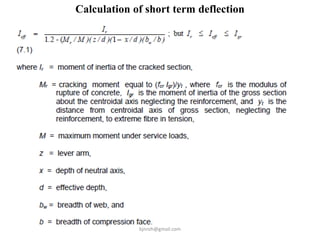
Calculation of short term deflection
bjnroh@gmail.com
bjnroh@gmail.com
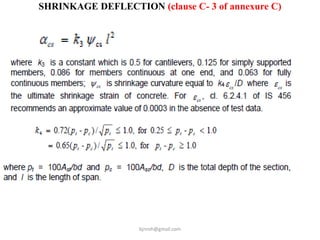
SHRINKAGE DEFLECTION (clause C- 3 of annexure C)
bjnroh@gmail.com
DEFLECTION DUE TO CREEP (CLAUSE C-4 ANNEXURE C)
bjnroh@gmail.com
CONTROL OF CRACKING IN RC MEMBERS (CL 35.3.2)
The main causes of cracks are due to :
• Excessive flexural tensile stresses due to bending under applied loads since
the tensile strength of concrete is only a tenth of its compressive strength
• Differential shrinkage, creep, thermal and aggressive enviromental effects
• Settlement of supports and excessive curvature due to continuity effects.
• Shear and diagonal tension cracks
• Splitting cracks along with reinforcement due to bond and anchorage
failure,
bjnroh@gmail.com
Codal crack width limits
• 0.3mm for surface cracks widths for RC members.(when protected against aggressive
environment)
• If not protected against aggressive environment , then 0.004mm times of nominal cover
is taken as limit (Table 5)
• For structures exposed to moderate environment , crack width limit is 0.2mm
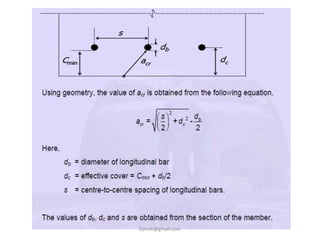
Crack width calculation
bjnroh@gmail.com
bjnroh@gmail.com

Serviceability(images are taken for reference from net and important points are together)

  • 1.
    SERVICEABILITY REQUIREMENTS A structuremay be unfit for use only when it collapses but when it violates the serviceability requirements such as deflection, cracking, etc Limit states are the acceptable limits for the safety and serviceability requirements of the structure before failure occurs. The two major limit states that are usually considered are 1.Limit state of collapse : • Here the structure is likely to collapse due to rupture of one or more critical sections or loss of overall stability due to buckling or overturning. • It corresponds to Flexure, compression, shear, tension 2. Limit state of serviceability : • It is related to the performance of the structure at the working loads . • It is the limit state at which structure undergoes excessive deflection, which adversely affects the finishes causing discomfort to the users and excessive cracking which effects the efficiency or appearance of the structure . • Limit state may correspond to 1.Deflection 2. Cracking 3.Other Limit states(vibration ,fire resistance, durability ) bjnroh@gmail.com
  • 2.
    The primary serviceabilityconditions are : • Limit state of deflection : the member should not undergo excessive deformation under service loads. • Limit state of cracking: The width of the cracks developed on the surfaces of RC members under service loads should be under permissible limits as per IS 456 code • Accordingly, cl. 35.1.1 of IS 456 stipulates that the designer should consider all relevant limit states to ensure an adequate degree of safety and serviceability. • Clause 35.3 of IS 456 refers to the limit state of serviceability comprising deflection in cl. 35.3.1 and cracking in cl. 35.3.2. • Concrete is said to be durable when it performs satisfactorily in the working environment during its anticipated exposure conditions during service. • Clause 8 of IS 456 refers to the durability aspects of concrete. Stability of the structure against overturning and sliding (cl. 20 of IS 456), and fire resistance (cl. 21 of IS 456) are some of the other importance issues to be kept in mind while designing reinforced concrete structures. bjnroh@gmail.com
  • 3.
    • Table 18of IS code specifies the combination of loads for serviceability conditions (largest value should be considered) • Codes specify two methods for control of deflection 1. The empirical method in which the (l/d) ratio is limited to specified value as per code. 2. The theoretical method in which the actual deflection is computed and checked with codified permissible deflections. • Codes specify two methods for control of deflection 1. The empirical method which requires detailing of reinforcement according to codal provisions , 2. The theoretical method involves computation of actual width of cracks and checking them with the codal provisions required as per environmental conditions. bjnroh@gmail.com
  • 4.
    • Codified deflectionlimits • Clause 23.2 : • Clause 23.2 of IS 456 stipulates the limiting deflections under two heads as given below: • (a) The maximum final deflection should not normally exceed span/250 due to all loads including the effects of temperatures, creep and shrinkage and measured from the as-cast level of the supports of floors, roof and all other horizontal members. • (b) The maximum deflection should not normally exceed the lesser of span/350 or 20 mm including the effects of temperature, creep and shrinkage occurring after erection of partitions and the application of finishes. • It is essential that both the requirements are to be fulfilled for every structure. • Deflection computations (Theoretical method) • Factors that influence deflection : self weight and imposed loads, strength and modulus of elasticity, reinforcement percentage, span of structural member, type of support, flexural rigidity, creep and shrinkage of concrete. • The computations of deflection is done generally in two parts : 1. Instantaneous or short term deflection that occurs on application of load 2. Long term deflection resulting from differential shrinkage and creep under sustained loading . Annexure C of code bjnroh@gmail.com
  • 5.
    Calculation of shortterm deflection bjnroh@gmail.com
  • 6.
  • 7.
    SHRINKAGE DEFLECTION (clauseC- 3 of annexure C) bjnroh@gmail.com
  • 8.
    DEFLECTION DUE TOCREEP (CLAUSE C-4 ANNEXURE C) bjnroh@gmail.com
  • 9.
    CONTROL OF CRACKINGIN RC MEMBERS (CL 35.3.2) The main causes of cracks are due to : • Excessive flexural tensile stresses due to bending under applied loads since the tensile strength of concrete is only a tenth of its compressive strength • Differential shrinkage, creep, thermal and aggressive enviromental effects • Settlement of supports and excessive curvature due to continuity effects. • Shear and diagonal tension cracks • Splitting cracks along with reinforcement due to bond and anchorage failure, bjnroh@gmail.com
  • 10.
    Codal crack widthlimits • 0.3mm for surface cracks widths for RC members.(when protected against aggressive environment) • If not protected against aggressive environment , then 0.004mm times of nominal cover is taken as limit (Table 5) • For structures exposed to moderate environment , crack width limit is 0.2mm Crack width calculation bjnroh@gmail.com
  • 11.