Food service skills
Published by Hodder Education  J Cousins, D Lillicrap and S Weekes
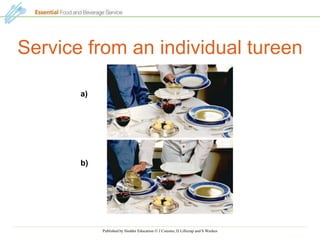
Silver service of soup
• Soup can be served:
 pre-plated
 from a large tureen at the sideboard
 from an individual tureen.
Published by Hodder Education  J Cousins, D Lillicrap and S Weekes
Service from an individual tureen
a)
b)
Published by Hodder Education  J Cousins, D Lillicrap and S Weekes
Service of plated foods
• Serve from the right.
• Ensure that placement on the table is
consistent.
• Serve cold food before hot food.
Published by Hodder Education  J Cousins, D Lillicrap and S Weekes
Silver service from flats
• Flats are always held on napkin on palm of hand.
• Food is always presented to the customer before
serving.
• Serving dish is held a little above the hot joint
plate with the front edge slightly overlapping the
rim of the plate.
• Portion is placed on the plate in the 6 o’clock
position.
Published by Hodder Education  J Cousins, D Lillicrap and S Weekes
Silver service of potatoes and
vegetables
• Serving dishes are always held on napkin on
palm of hand.
• General rule is to serve potatoes before other
vegetables.
• A separate service spoon and fork should be
used for each different type of potato and
vegetable dish to be served.
Published by Hodder Education  J Cousins, D Lillicrap and S Weekes
Silver service of potatoes and
vegetables
• Potatoes are served in
the 2 o’clock position.
• Vegetables are served
in the 10 o’clock
position.
Published by Hodder Education  J Cousins, D Lillicrap and S Weekes
Standard placement of food items
Example of standard placement of food items
Published by Hodder Education  J Cousins, D Lillicrap and S Weekes
Service of accompanying sauces
• Should be presented in a sauceboat on an under
plate.
• Ladleful of sauce should be lifted clear of the
sauceboat.
• Underside of the sauce ladle should then be run
over the edge of the sauceboat to prevent any
drips falling.
• Should be napped over the food or at the side
depending on the customer’s preference.
Published by Hodder Education  J Cousins, D Lillicrap and S Weekes
Service for larger groups
• Larger groups can be
served:
 all together
 on a wave system,
where one table is
served at a time until
the whole room is
completed
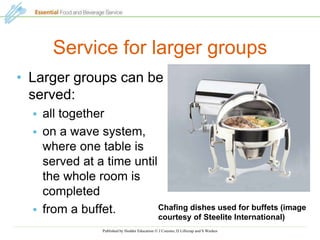
 from a buffet. Chafing dishes used for buffets (image
courtesy of Steelite International)
Published by Hodder Education  J Cousins, D Lillicrap and S Weekes
Tray service
• Main differences:
 Tray cloth replaces the tablecloth.
 Under plates are usually left out to reduce the
weight of the tray.
• When carrying:
 Bottled proprietary sauces are laid flat to avoid
accidents when carrying the tray.
 Spouts of hot beverage pots or jugs should
face inwards, to avoid spillages.
Published by Hodder Education  J Cousins, D Lillicrap and S Weekes
Room service tables
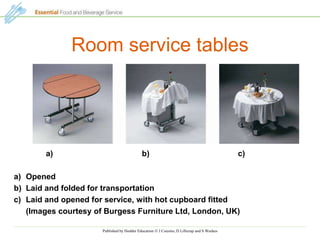
a) b) c)
a) Opened
b) Laid and folded for transportation
c) Laid and opened for service, with hot cupboard fitted
(Images courtesy of Burgess Furniture Ltd, London, UK)
Published by Hodder Education  J Cousins, D Lillicrap and S Weekes
Lounge and bar service
• Service of food in lounges and bar is similar
to serving in a restaurant.
• Key differences include:
 need to lay a cover each time an order is
taken
 higher volume of people (customers and
staff) moving within the area.
Published by Hodder Education  J Cousins, D Lillicrap and S Weekes
Food and beverage displays
• May be left at room temperature for limited
periods during service or when on display.
• These flexibilities can be used only once for
each batch of food:
 Chilled foods can only exceed 8ºC for a
maximum of four hours.
 Hot foods can only fall below 63ºC for a
maximum of two hours.
Published by Hodder Education  J Cousins, D Lillicrap and S Weekes
Service enhancements
• Includes service from trolleys such as
cheese, sweet, carving or drinks trolleys
and also gueridon service.
• The trolleys are selling aids as they display
the items on offer to the customers.
• Service enhancements are sometimes
referred to as ‘restaurant theatre’.
Published by Hodder Education  J Cousins, D Lillicrap and S Weekes
Enhancements are more costly
• This is because they:
 take longer than plated or silver service
 require a higher level of service skills
 use more expensive and elaborate
equipment
 require larger service areas to allow for
the movement of the trolleys.
Published by Hodder Education  J Cousins, D Lillicrap and S Weekes
Serving from a trolley
• Trolleys should always be:
 pushed, not pulled
 positioned between the staff and customer for service
 attractively presented from the customer’s point of view
 well laid out from the server’s point of view (from
behind the trolley).
• Staff should talk with customers from behind the
trolley, to the side of it or standing by the
customer’s table – not in front of the trolley.
Published by Hodder Education  J Cousins, D Lillicrap and S Weekes
Cheese trolley
Image courtesy of Steelite International
Published by Hodder Education  J Cousins, D Lillicrap and S Weekes
Gueridon service
• Allows an enhanced form of table service.
• Usually indicates serving foods onto the
customers’ plates at a gueridon (movable service
table, or trolley).
• Also used to refer to other enhanced service
techniques such as service using a drinks trolley,
carving trolley, cheese trolley or a sweet trolley.
Published by Hodder Education  J Cousins, D Lillicrap and S Weekes
Gueridon lay-up
Example of a basic gueridon lay-up
Published by Hodder Education  J Cousins, D Lillicrap and S Weekes
Further enhancements
• Further enhancements, beyond basic
gueridon service, include:
 preparing and serving foods in the service area
such as salads and dressings
 carving, jointing or filleting foods in a service
area
 flambage (the preparation and finishing, or
cooking, of foods in the restaurant, which are
also flambéed).
Published by Hodder Education  J Cousins, D Lillicrap and S Weekes
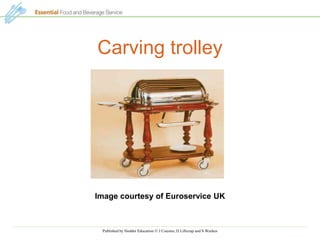
Carving trolley
Image courtesy of Euroservice UK

Service style powerpoints

  • 1.
  • 2.
    Published by HodderEducation  J Cousins, D Lillicrap and S Weekes Silver service of soup • Soup can be served:  pre-plated  from a large tureen at the sideboard  from an individual tureen.
  • 3.
    Published by HodderEducation  J Cousins, D Lillicrap and S Weekes Service from an individual tureen a) b)
  • 4.
    Published by HodderEducation  J Cousins, D Lillicrap and S Weekes Service of plated foods • Serve from the right. • Ensure that placement on the table is consistent. • Serve cold food before hot food.
  • 5.
    Published by HodderEducation  J Cousins, D Lillicrap and S Weekes Silver service from flats • Flats are always held on napkin on palm of hand. • Food is always presented to the customer before serving. • Serving dish is held a little above the hot joint plate with the front edge slightly overlapping the rim of the plate. • Portion is placed on the plate in the 6 o’clock position.
  • 6.
    Published by HodderEducation  J Cousins, D Lillicrap and S Weekes Silver service of potatoes and vegetables • Serving dishes are always held on napkin on palm of hand. • General rule is to serve potatoes before other vegetables. • A separate service spoon and fork should be used for each different type of potato and vegetable dish to be served.
  • 7.
    Published by HodderEducation  J Cousins, D Lillicrap and S Weekes Silver service of potatoes and vegetables • Potatoes are served in the 2 o’clock position. • Vegetables are served in the 10 o’clock position.
  • 8.
    Published by HodderEducation  J Cousins, D Lillicrap and S Weekes Standard placement of food items Example of standard placement of food items
  • 9.
    Published by HodderEducation  J Cousins, D Lillicrap and S Weekes Service of accompanying sauces • Should be presented in a sauceboat on an under plate. • Ladleful of sauce should be lifted clear of the sauceboat. • Underside of the sauce ladle should then be run over the edge of the sauceboat to prevent any drips falling. • Should be napped over the food or at the side depending on the customer’s preference.
  • 10.
    Published by HodderEducation  J Cousins, D Lillicrap and S Weekes Service for larger groups • Larger groups can be served:  all together  on a wave system, where one table is served at a time until the whole room is completed  from a buffet. Chafing dishes used for buffets (image courtesy of Steelite International)
  • 11.
    Published by HodderEducation  J Cousins, D Lillicrap and S Weekes Tray service • Main differences:  Tray cloth replaces the tablecloth.  Under plates are usually left out to reduce the weight of the tray. • When carrying:  Bottled proprietary sauces are laid flat to avoid accidents when carrying the tray.  Spouts of hot beverage pots or jugs should face inwards, to avoid spillages.
  • 12.
    Published by HodderEducation  J Cousins, D Lillicrap and S Weekes Room service tables a) b) c) a) Opened b) Laid and folded for transportation c) Laid and opened for service, with hot cupboard fitted (Images courtesy of Burgess Furniture Ltd, London, UK)
  • 13.
    Published by HodderEducation  J Cousins, D Lillicrap and S Weekes Lounge and bar service • Service of food in lounges and bar is similar to serving in a restaurant. • Key differences include:  need to lay a cover each time an order is taken  higher volume of people (customers and staff) moving within the area.
  • 14.
    Published by HodderEducation  J Cousins, D Lillicrap and S Weekes Food and beverage displays • May be left at room temperature for limited periods during service or when on display. • These flexibilities can be used only once for each batch of food:  Chilled foods can only exceed 8ºC for a maximum of four hours.  Hot foods can only fall below 63ºC for a maximum of two hours.
  • 15.
    Published by HodderEducation  J Cousins, D Lillicrap and S Weekes Service enhancements • Includes service from trolleys such as cheese, sweet, carving or drinks trolleys and also gueridon service. • The trolleys are selling aids as they display the items on offer to the customers. • Service enhancements are sometimes referred to as ‘restaurant theatre’.
  • 16.
    Published by HodderEducation  J Cousins, D Lillicrap and S Weekes Enhancements are more costly • This is because they:  take longer than plated or silver service  require a higher level of service skills  use more expensive and elaborate equipment  require larger service areas to allow for the movement of the trolleys.
  • 17.
    Published by HodderEducation  J Cousins, D Lillicrap and S Weekes Serving from a trolley • Trolleys should always be:  pushed, not pulled  positioned between the staff and customer for service  attractively presented from the customer’s point of view  well laid out from the server’s point of view (from behind the trolley). • Staff should talk with customers from behind the trolley, to the side of it or standing by the customer’s table – not in front of the trolley.
  • 18.
    Published by HodderEducation  J Cousins, D Lillicrap and S Weekes Cheese trolley Image courtesy of Steelite International
  • 19.
    Published by HodderEducation  J Cousins, D Lillicrap and S Weekes Gueridon service • Allows an enhanced form of table service. • Usually indicates serving foods onto the customers’ plates at a gueridon (movable service table, or trolley). • Also used to refer to other enhanced service techniques such as service using a drinks trolley, carving trolley, cheese trolley or a sweet trolley.
  • 20.
    Published by HodderEducation  J Cousins, D Lillicrap and S Weekes Gueridon lay-up Example of a basic gueridon lay-up
  • 21.
    Published by HodderEducation  J Cousins, D Lillicrap and S Weekes Further enhancements • Further enhancements, beyond basic gueridon service, include:  preparing and serving foods in the service area such as salads and dressings  carving, jointing or filleting foods in a service area  flambage (the preparation and finishing, or cooking, of foods in the restaurant, which are also flambéed).
  • 22.
    Published by HodderEducation  J Cousins, D Lillicrap and S Weekes Carving trolley Image courtesy of Euroservice UK