Dr. Josef Adersberger, CTO & Co-Founder QAware
Serverless containers
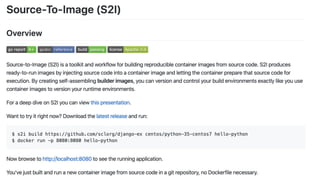
… with source-to-image
https://github.com/adersberger/source2image
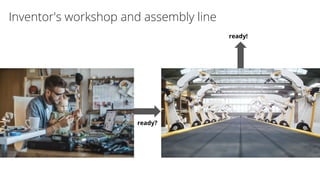
Inventor's workshop and assembly line
ready?
ready!
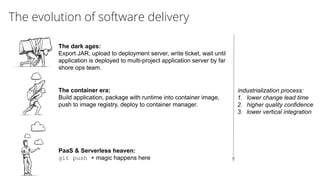
The evolution of software delivery
The dark ages:
Export JAR, upload to deployment server, write ticket, wait until
application is deployed to multi-project application server by far
shore ops team.
The container era:
Build application, package with runtime into container image,
push to image registry, deploy to container manager.
PaaS & Serverless heaven:
git push + magic happens here
industrialization process:
1. lower change lead time
2. higher quality confidence
3. lower vertical integration
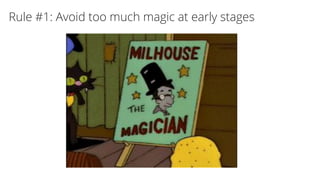
Rule #1: Avoid too much magic at early stages
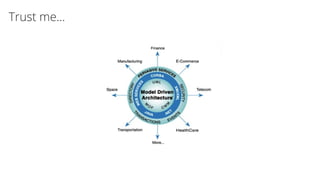
Trust me...
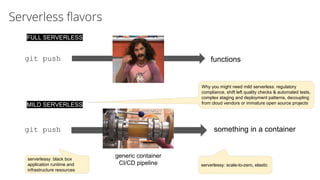
Serverless flavors
git push functions
git push something in a container
generic container
CI/CD pipeline
FULL SERVERLESS
MILD SERVERLESS
serverlessy: black box
application runtime and
infrastructure resources
Why you might need mild serverless: regulatory
compliance, shift left quality checks & automated tests,
complex staging and deployment patterns, decoupling
from cloud vendors or immature open source projects
serverlessy: scale-to-zero, elastic
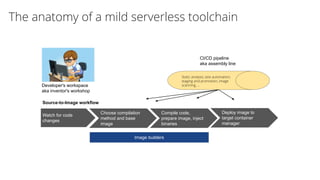
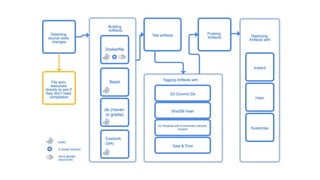
The anatomy of a mild serverless toolchain
Watch for code
changes
Choose compilation
method and base
image
Compile code,
prepare image, inject
binaries
Deploy image to
target container
manager
Source-to-Image workflow
Developer's workspace
aka inventor's workshop
CI/CD pipeline
aka assembly line
Static analysis, test automation,
staging and promotion, image
scanning, ...
Image builders
8
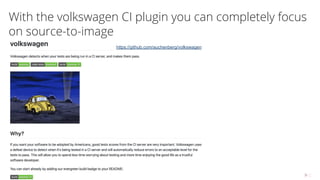
With the volkswagen CI plugin you can completely focus
on source-to-image
https://github.com/auchenberg/volkswagen
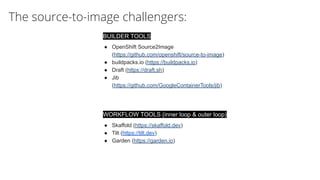
The source-to-image challengers:
WORKFLOW TOOLS (inner loop & outer loop)
● Skaffold (https://skaffold.dev)
● Tilt (https://tilt.dev)
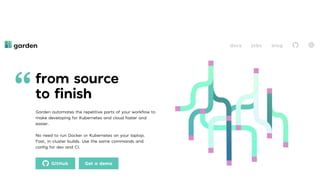
● Garden (https://garden.io)
BUILDER TOOLS
● OpenShift Source2Image
(https://github.com/openshift/source-to-image)
● buildpacks.io (https://buildpacks.io)
● Draft (https://draft.sh)
● Jib
(https://github.com/GoogleContainerTools/jib)
10
SHOOT OUT !
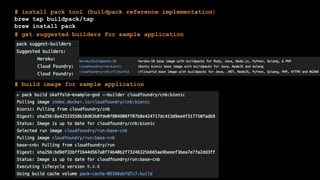
# install pack tool (buildpack reference implementation)
brew tap buildpack/tap
brew install pack
# get suggested builders for sample application
# build image for sample application
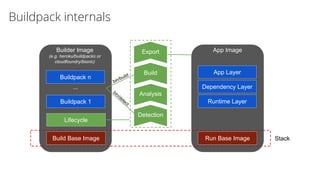
Buildpack internals
Builder Image
(e.g. heroku/buildpacks or
cloudfoundry/bionic)
App Image
StackBuild Base Image Run Base Image
Lifecycle
Buildpack 1
Buildpack n
...
Detection
Analysis
Build
Export
bin/detect
bin/build
Runtime Layer
Dependency Layer
App Layer
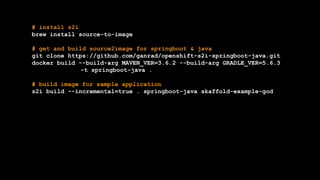
# install s2i
brew install source-to-image
# get and build source2image for springboot & java
git clone https://github.com/ganrad/openshift-s2i-springboot-java.git
docker build --build-arg MAVEN_VER=3.6.2 --build-arg GRADLE_VER=5.6.3
-t springboot-java .
# build image for sample application
s2i build --incremental=true . springboot-java skaffold-example-god
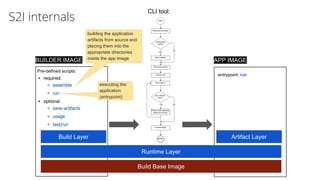
S2I internals
BUILDER IMAGE
Pre-defined scripts:
APP IMAGE
Build Base Image
building the application
artifacts from source and
placing them into the
appropriate directories
inside the app image
executing the
application
(entrypoint)
Runtime Layer
Build Layer Artifact Layer
CLI tool:
entrypoint: run
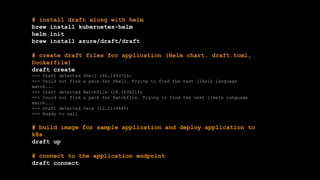
# install draft along with helm
brew install kubernetes-helm
helm init
brew install azure/draft/draft
# create draft files for application (Helm chart, draft.toml,
Dockerfile)
draft create
--> Draft detected Shell (46.149372%)
--> Could not find a pack for Shell. Trying to find the next likely language
match...
--> Draft detected Batchfile (28.163621%)
--> Could not find a pack for Batchfile. Trying to find the next likely language
match...
--> Draft detected Java (12.213444%)
--> Ready to sail
# build image for sample application and deploy application to
k8s
draft up
# connect to the application endpoint
draft connect
Draft internals
BUILDER HELM CHART APPLICATION HELM CHART
[environments]
[environments.development]
name = "god"
namespace = "default"
wait = true
watch = false
watch-delay = 2
auto-connect = false
dockerfile = "Dockerfile"
chart = ""
draft.toml
java
primary language detection by github linguist and
mapped to chart directory by language name
generated by draft create
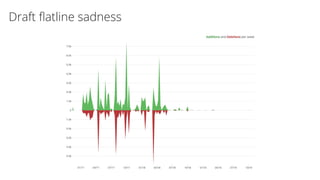
Draft flatline sadness
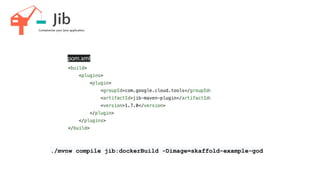
./mvnw compile jib:dockerBuild -Dimage=skaffold-example-god
pom.xml
Custom
(SH)
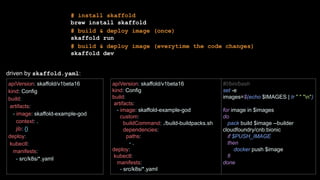
# install skaffold
brew install skaffold
# build & deploy image (once)
skaffold run
# build & deploy image (everytime the code changes)
skaffold dev
apiVersion: skaffold/v1beta16
kind: Config
build:
artifacts:
- image: skaffold-example-god
context: .
jib: {}
deploy:
kubectl:
manifests:
- src/k8s/*.yaml
apiVersion: skaffold/v1beta16
kind: Config
build:
artifacts:
- image: skaffold-example-god
custom:
buildCommand: ./build-buildpacks.sh
dependencies:
paths:
- .
deploy:
kubectl:
manifests:
- src/k8s/*.yaml
#!/bin/bash
set -e
images=$(echo $IMAGES | tr " " "n")
for image in $images
do
pack build $image --builder
cloudfoundry/cnb:bionic
if $PUSH_IMAGE
then
docker push $image
fi
done
driven by skaffold.yaml:
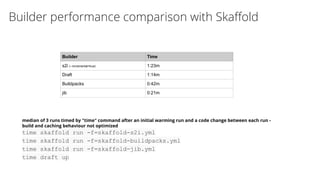
Builder performance comparison with Skaffold
Builder Time
s2i (--incremental=true) 1:23m
Draft 1:14m
Buildpacks 0:42m
jib 0:21m
median of 3 runs timed by "time" command after an initial warming run and a code change between each run -
build and caching behaviour not optimized
time skaffold run -f=skaffold-s2i.yml
time skaffold run -f=skaffold-buildpacks.yml
time skaffold run -f=skaffold-jib.yml
time draft up
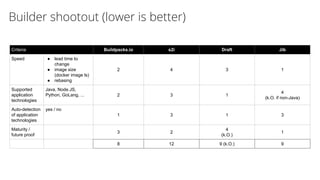
Builder shootout (lower is better)
Criteria Buildpacks.io s2i Draft Jib
Speed ● lead time to
change
● image size
(docker image ls)
● rebasing
2 4 3 1
Supported
application
technologies
Java, Node.JS,
Python, GoLang, ... 2 3 1
4
(k.O. if non-Java)
Auto-detection
of application
technologies
yes / no
1 3 1 3
Maturity /
future proof
3 2
4
(k.O.)
1
8 12 9 (k.O.) 9
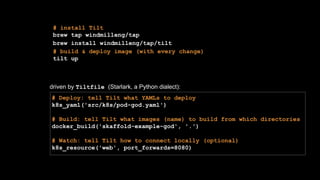
# install Tilt
brew tap windmilleng/tap
brew install windmilleng/tap/tilt
# build & deploy image (with every change)
tilt up
# Deploy: tell Tilt what YAMLs to deploy
k8s_yaml('src/k8s/pod-god.yaml')
# Build: tell Tilt what images (name) to build from which directories
docker_build('skaffold-example-god', '.')
# Watch: tell Tilt how to connect locally (optional)
k8s_resource('web', port_forwards=8080)
driven by Tiltfile (Starlark, a Python dialect):
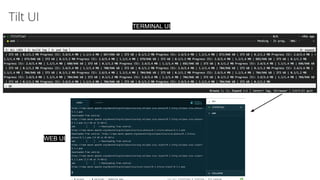
Tilt UI
TERMINAL UI
WEB UI
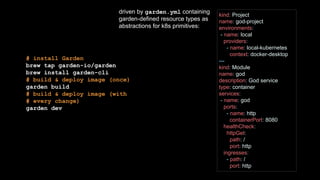
# install Garden
brew tap garden-io/garden
brew install garden-cli
# build & deploy image (once)
garden build
# build & deploy image (with
# every change)
garden dev
kind: Project
name: god-project
environments:
- name: local
providers:
- name: local-kubernetes
context: docker-desktop
---
kind: Module
name: god
description: God service
type: container
services:
- name: god
ports:
- name: http
containerPort: 8080
healthCheck:
httpGet:
path: /
port: http
ingresses:
- path: /
port: http
driven by garden.yml containing
garden-defined resource types as
abstractions for k8s primitives:
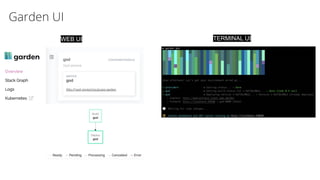
Garden UI
TERMINAL UIWEB UI
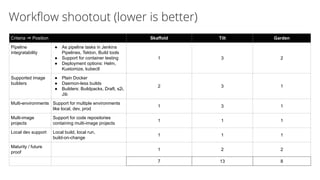
Workflow shootout (lower is better)
Criteria ⇒ Position Skaffold Tilt Garden
Pipeline
integratability
● As pipeline tasks in Jenkins
Pipelines, Tekton, Build tools
● Support for container testing
● Deployment options: Helm,
Kustomize, kubectl
1 3 2
Supported image
builders
● Plain Docker
● Daemon-less builds
● Builders: Buildpacks, Draft, s2i,
Jib
2 3 1
Multi-environments Support for multiple environments
like local, dev, prod
1 3 1
Multi-image
projects
Support for code repositories
containing multi-image projects
1 1 1
Local dev support Local build, local run,
build-on-change
1 1 1
Maturity / future
proof
1 2 2
7 13 8
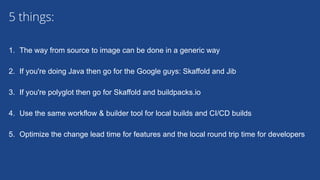
1. The way from source to image can be done in a generic way
2. If you're doing Java then go for the Google guys: Skaffold and Jib
3. If you're polyglot then go for Skaffold and buildpacks.io
4. Use the same workflow & builder tool for local builds and CI/CD builds
5. Optimize the change lead time for features and the local round trip time for developers
5 things:
@adersberger
37
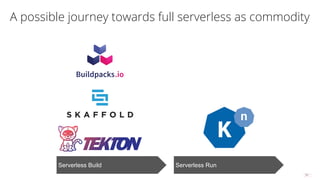
A possible journey towards full serverless as commodity
Serverless Build Serverless Run
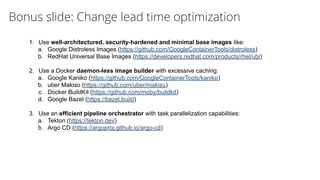
Bonus slide: Change lead time optimization
1. Use well-architectured, security-hardened and minimal base images like:
a. Google Distroless Images (https://github.com/GoogleContainerTools/distroless)
b. RedHat Universal Base Images (https://developers.redhat.com/products/rhel/ubi)
2. Use a Docker daemon-less image builder with excessive caching:
a. Google Kaniko (https://github.com/GoogleContainerTools/kaniko)
b. uber Makiso (https://github.com/uber/makisu)
c. Docker BuildKit (https://github.com/moby/buildkit)
d. Google Bazel (https://bazel.build)
3. Use an efficient pipeline orchestrator with task parallelization capabilities:
a. Tekton (https://tekton.dev)
b. Argo CD (https://argoproj.github.io/argo-cd)

Serverless containers … with source-to-image

  • 1.
    Dr. Josef Adersberger,CTO & Co-Founder QAware Serverless containers … with source-to-image https://github.com/adersberger/source2image
  • 2.
    Inventor's workshop andassembly line ready? ready!
  • 3.
    The evolution ofsoftware delivery The dark ages: Export JAR, upload to deployment server, write ticket, wait until application is deployed to multi-project application server by far shore ops team. The container era: Build application, package with runtime into container image, push to image registry, deploy to container manager. PaaS & Serverless heaven: git push + magic happens here industrialization process: 1. lower change lead time 2. higher quality confidence 3. lower vertical integration
  • 4.
    Rule #1: Avoidtoo much magic at early stages
  • 5.
  • 6.
    Serverless flavors git pushfunctions git push something in a container generic container CI/CD pipeline FULL SERVERLESS MILD SERVERLESS serverlessy: black box application runtime and infrastructure resources Why you might need mild serverless: regulatory compliance, shift left quality checks & automated tests, complex staging and deployment patterns, decoupling from cloud vendors or immature open source projects serverlessy: scale-to-zero, elastic
  • 7.
    The anatomy ofa mild serverless toolchain Watch for code changes Choose compilation method and base image Compile code, prepare image, inject binaries Deploy image to target container manager Source-to-Image workflow Developer's workspace aka inventor's workshop CI/CD pipeline aka assembly line Static analysis, test automation, staging and promotion, image scanning, ... Image builders
  • 8.
    8 With the volkswagenCI plugin you can completely focus on source-to-image https://github.com/auchenberg/volkswagen
  • 9.
    The source-to-image challengers: WORKFLOWTOOLS (inner loop & outer loop) ● Skaffold (https://skaffold.dev) ● Tilt (https://tilt.dev) ● Garden (https://garden.io) BUILDER TOOLS ● OpenShift Source2Image (https://github.com/openshift/source-to-image) ● buildpacks.io (https://buildpacks.io) ● Draft (https://draft.sh) ● Jib (https://github.com/GoogleContainerTools/jib)
  • 10.
  • 12.
    # install packtool (buildpack reference implementation) brew tap buildpack/tap brew install pack # get suggested builders for sample application # build image for sample application
  • 13.
    Buildpack internals Builder Image (e.g.heroku/buildpacks or cloudfoundry/bionic) App Image StackBuild Base Image Run Base Image Lifecycle Buildpack 1 Buildpack n ... Detection Analysis Build Export bin/detect bin/build Runtime Layer Dependency Layer App Layer
  • 15.
    # install s2i brewinstall source-to-image # get and build source2image for springboot & java git clone https://github.com/ganrad/openshift-s2i-springboot-java.git docker build --build-arg MAVEN_VER=3.6.2 --build-arg GRADLE_VER=5.6.3 -t springboot-java . # build image for sample application s2i build --incremental=true . springboot-java skaffold-example-god
  • 16.
    S2I internals BUILDER IMAGE Pre-definedscripts: APP IMAGE Build Base Image building the application artifacts from source and placing them into the appropriate directories inside the app image executing the application (entrypoint) Runtime Layer Build Layer Artifact Layer CLI tool: entrypoint: run
  • 18.
    # install draftalong with helm brew install kubernetes-helm helm init brew install azure/draft/draft # create draft files for application (Helm chart, draft.toml, Dockerfile) draft create --> Draft detected Shell (46.149372%) --> Could not find a pack for Shell. Trying to find the next likely language match... --> Draft detected Batchfile (28.163621%) --> Could not find a pack for Batchfile. Trying to find the next likely language match... --> Draft detected Java (12.213444%) --> Ready to sail # build image for sample application and deploy application to k8s draft up # connect to the application endpoint draft connect
  • 19.
    Draft internals BUILDER HELMCHART APPLICATION HELM CHART [environments] [environments.development] name = "god" namespace = "default" wait = true watch = false watch-delay = 2 auto-connect = false dockerfile = "Dockerfile" chart = "" draft.toml java primary language detection by github linguist and mapped to chart directory by language name generated by draft create
  • 20.
  • 22.
    ./mvnw compile jib:dockerBuild-Dimage=skaffold-example-god pom.xml
  • 24.
  • 25.
    # install skaffold brewinstall skaffold # build & deploy image (once) skaffold run # build & deploy image (everytime the code changes) skaffold dev apiVersion: skaffold/v1beta16 kind: Config build: artifacts: - image: skaffold-example-god context: . jib: {} deploy: kubectl: manifests: - src/k8s/*.yaml apiVersion: skaffold/v1beta16 kind: Config build: artifacts: - image: skaffold-example-god custom: buildCommand: ./build-buildpacks.sh dependencies: paths: - . deploy: kubectl: manifests: - src/k8s/*.yaml #!/bin/bash set -e images=$(echo $IMAGES | tr " " "n") for image in $images do pack build $image --builder cloudfoundry/cnb:bionic if $PUSH_IMAGE then docker push $image fi done driven by skaffold.yaml:
  • 26.
    Builder performance comparisonwith Skaffold Builder Time s2i (--incremental=true) 1:23m Draft 1:14m Buildpacks 0:42m jib 0:21m median of 3 runs timed by "time" command after an initial warming run and a code change between each run - build and caching behaviour not optimized time skaffold run -f=skaffold-s2i.yml time skaffold run -f=skaffold-buildpacks.yml time skaffold run -f=skaffold-jib.yml time draft up
  • 27.
    Builder shootout (loweris better) Criteria Buildpacks.io s2i Draft Jib Speed ● lead time to change ● image size (docker image ls) ● rebasing 2 4 3 1 Supported application technologies Java, Node.JS, Python, GoLang, ... 2 3 1 4 (k.O. if non-Java) Auto-detection of application technologies yes / no 1 3 1 3 Maturity / future proof 3 2 4 (k.O.) 1 8 12 9 (k.O.) 9
  • 29.
    # install Tilt brewtap windmilleng/tap brew install windmilleng/tap/tilt # build & deploy image (with every change) tilt up # Deploy: tell Tilt what YAMLs to deploy k8s_yaml('src/k8s/pod-god.yaml') # Build: tell Tilt what images (name) to build from which directories docker_build('skaffold-example-god', '.') # Watch: tell Tilt how to connect locally (optional) k8s_resource('web', port_forwards=8080) driven by Tiltfile (Starlark, a Python dialect):
  • 30.
  • 32.
    # install Garden brewtap garden-io/garden brew install garden-cli # build & deploy image (once) garden build # build & deploy image (with # every change) garden dev kind: Project name: god-project environments: - name: local providers: - name: local-kubernetes context: docker-desktop --- kind: Module name: god description: God service type: container services: - name: god ports: - name: http containerPort: 8080 healthCheck: httpGet: path: / port: http ingresses: - path: / port: http driven by garden.yml containing garden-defined resource types as abstractions for k8s primitives:
  • 33.
  • 34.
    Workflow shootout (loweris better) Criteria ⇒ Position Skaffold Tilt Garden Pipeline integratability ● As pipeline tasks in Jenkins Pipelines, Tekton, Build tools ● Support for container testing ● Deployment options: Helm, Kustomize, kubectl 1 3 2 Supported image builders ● Plain Docker ● Daemon-less builds ● Builders: Buildpacks, Draft, s2i, Jib 2 3 1 Multi-environments Support for multiple environments like local, dev, prod 1 3 1 Multi-image projects Support for code repositories containing multi-image projects 1 1 1 Local dev support Local build, local run, build-on-change 1 1 1 Maturity / future proof 1 2 2 7 13 8
  • 35.
    1. The wayfrom source to image can be done in a generic way 2. If you're doing Java then go for the Google guys: Skaffold and Jib 3. If you're polyglot then go for Skaffold and buildpacks.io 4. Use the same workflow & builder tool for local builds and CI/CD builds 5. Optimize the change lead time for features and the local round trip time for developers 5 things:
  • 36.
  • 37.
    37 A possible journeytowards full serverless as commodity Serverless Build Serverless Run
  • 38.
    Bonus slide: Changelead time optimization 1. Use well-architectured, security-hardened and minimal base images like: a. Google Distroless Images (https://github.com/GoogleContainerTools/distroless) b. RedHat Universal Base Images (https://developers.redhat.com/products/rhel/ubi) 2. Use a Docker daemon-less image builder with excessive caching: a. Google Kaniko (https://github.com/GoogleContainerTools/kaniko) b. uber Makiso (https://github.com/uber/makisu) c. Docker BuildKit (https://github.com/moby/buildkit) d. Google Bazel (https://bazel.build) 3. Use an efficient pipeline orchestrator with task parallelization capabilities: a. Tekton (https://tekton.dev) b. Argo CD (https://argoproj.github.io/argo-cd)