announcements
sponsors
platinum
gold
silver
Architecting the Future
Abstractions and Metadata
Dan Barker @barkerd427
danbarker.codes
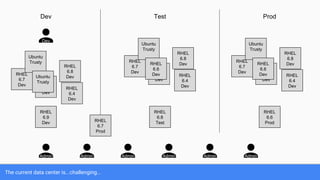
The current data center is...challenging...
RHEL
6.9
Dev
RHEL
6.8
Test
RHEL
6.6
Prod
Dev Test Prod
RHEL
6.7
Prod
Admin Admin Admin Admin Admin Admin
Dev
RHEL
6.7
Dev
RHEL
6.4
Dev
RHEL
6.8
Dev
Ubuntu
Trusty
RHEL
6.9
Dev
RHEL
6.6
Dev
Ubuntu
Trusty
RHEL
6.7
Dev
RHEL
6.4
Dev
RHEL
6.8
Dev
Ubuntu
Trusty
RHEL
6.9
Dev
RHEL
6.6
Dev
RHEL
6.7
Dev
RHEL
6.4
Dev
RHEL
6.8
Dev
Ubuntu
Trusty
RHEL
6.9
Dev
RHEL
6.6
Dev
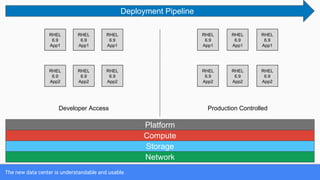
The new data center is understandable and usable.
Developer Access Production Controlled
Network
Storage
Compute
Platform
Deployment Pipeline
RHEL
6.9
App1
RHEL
6.9
App1
RHEL
6.9
App1
RHEL
6.9
App1
RHEL
6.9
App1
RHEL
6.9
App1
RHEL
6.9
App2
RHEL
6.9
App2
RHEL
6.9
App2
RHEL
6.9
App2
RHEL
6.9
App2
RHEL
6.9
App2
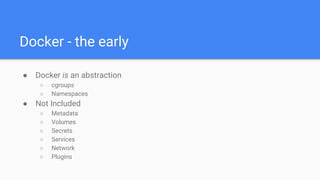
Docker - the early
● Docker is an abstraction
○ cgroups
○ Namespaces
● Not Included
○ Metadata
○ Volumes
○ Secrets
○ Services
○ Network
○ Plugins
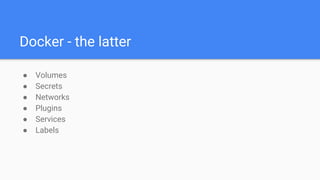
Docker - the latter
● Volumes
● Secrets
● Networks
● Plugins
● Services
● Labels
Kubernetes (k8s)
● Secrets
● PersistentVolumes
● Services
● Pods
● Ingress
● DaemonSets
● ReplicaSets
● Deployments
OpenShift
● Routes
○ > Ingress
● DeploymentConfig
○ > Deployments
● ImageStream
● BuildConfig
● RBAC
Services will
change your life
Services
● Identifies a set of pods using label selectors
○ Can be any label
○ Should be specific to avoid picking up disparate applications unintentionally
● Passes requests to pods internally to a Kubernetes cluster
○ Routes and Services are different
● Provides an abstraction for a Route to pass traffic from outside the cluster
to desired endpoints
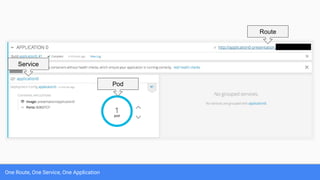
One Route, One Service, One Application
Route
Service
Pod
The Route directs to the Service application0
➜ ~ oc export routes application0
apiVersion: v1
kind: Route
[...]
spec:
host: application0-presentation...
to:
kind: Service
name: application0
weight: 100
[...]
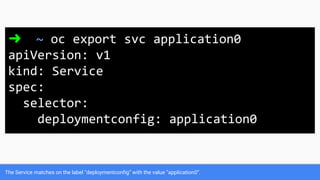
The Service matches on the label “deploymentconfig” with the value “application0”.
➜ ~ oc export svc application0
apiVersion: v1
kind: Service
spec:
selector:
deploymentconfig: application0
The Pod has many labels.
➜ ~ oc export -o yaml po/application0-1-ao16l
apiVersion: v1
kind: Pod
metadata:
labels:
app: application0
deploymentconfig: application0
environment: dev
partition: customerA
release: stable
tier: frontend
[...]
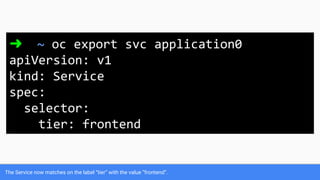
The Service now matches on the label “tier” with the value “frontend”.
➜ ~ oc export svc application0
apiVersion: v1
kind: Service
spec:
selector:
tier: frontend
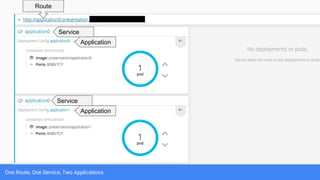
One Route, One Service, Two Applications
Route
Application
Application
Service
Service
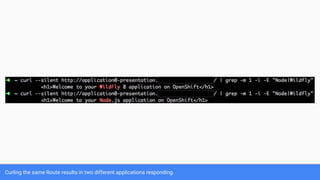
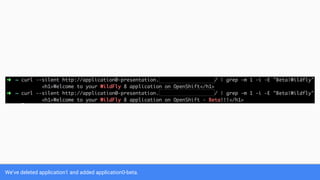
Curling the same Route results in two different applications responding.
The Pod has many labels.
➜ ~ oc export -o yaml po/application0-beta-1-ao16l
apiVersion: v1
kind: Pod
metadata:
labels:
app: application0-beta
deploymentconfig: application0-beta
environment: dev
partition: customerA
release: stable
tier: frontend
[...]
We’ve deleted application1 and added application0-beta.
ImageStreams
are an image
abstraction
ImageStreams
● May contain images from:
○ Image repository in OpenShift’s integrated registry
○ Other image streams
○ Image repositories from external registries
● Automatically trigger an action when new images are created
● Convenient abstraction
○ Related images
○ Image organization
○ Image history
ImageStreams
● Metadata
○ Commands
○ Entrypoint
○ Environment variables
○ Image Layers
○ Labels
○ Ports
● Could also reference other container kinds like rkt
CoreOS
Operators are
magical
(not really)
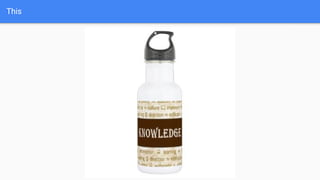
Not this
This
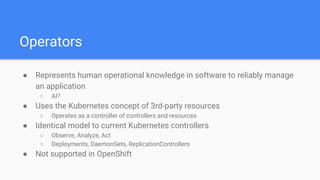
Operators
● Represents human operational knowledge in software to reliably manage
an application
○ AI?
● Uses the Kubernetes concept of 3rd-party resources
○ Operates as a controller of controllers and resources
● Identical model to current Kubernetes controllers
○ Observe, Analyze, Act
○ Deployments, DaemonSets, ReplicationControllers
● Not supported in OpenShift
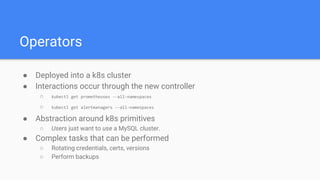
Operators
● Deployed into a k8s cluster
● Interactions occur through the new controller
○ kubectl get prometheuses --all-namespaces
○ kubectl get alertmanagers --all-namespaces
● Abstraction around k8s primitives
○ Users just want to use a MySQL cluster.
● Complex tasks that can be performed
○ Rotating credentials, certs, versions
○ Perform backups
Deployment
Pipeline’s have
fallen behind
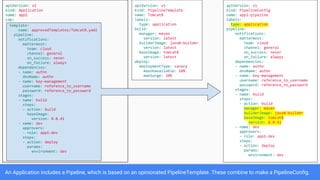
An Application includes a Pipeline, which is based on an opinionated PipelineTemplate. These combine to make a PipelineConfig.
apiVersion: v1
kind: Application
name: app1
cap:
template:
name: approvedTemplates/Tomcat8.yaml
pipeline:
notifications:
mattermost:
team: cloud
channel: general
on_success: never
on_failure: always
dependencies:
- name: authn
dnsName: authn
- name: key-management
username: reference_to_username
password: reference_to_password
stages:
- name: build
steps:
- action: build
baseImage:
version: 8.0.41
- name: dev
approvers:
- role: app1-dev
steps:
- action: deploy
params:
environment: dev
apiVersion: v1
kind: PipelineTemplate
name: Tomcat8
labels:
type: application
build:
manager: maven
version: latest
builderImage: java8-builder
version: latest
baseImage: tomcat8
version: latest
deploy:
deploymentType: canary
maxUnavailable: 10%
maxSurge: 20%
apiVersion: v1
kind: PipelineConfig
name: app1-pipeline
labels:
type: application
pipeline:
notifications:
mattermost:
team: cloud
channel: general
on_success: never
on_failure: always
dependencies:
- name: authn
dnsName: authn
- name: key-management
username: reference_to_username
password: reference_to_password
stages:
- name: build
steps:
- action: build
manager: maven
builderImage: java8-builder
baseImage: tomcat8
version: 8.0.41
- name: dev
approvers:
- role: app1-dev
steps:
- action: deploy
params:
environment: dev
Pipelines
● Stages
● Steps
● Application
● PipelineTemplate
● PipelineConfig
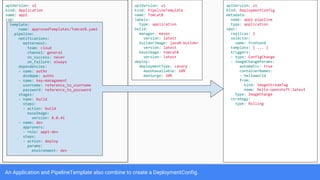
An Application and PipelineTemplate also combine to create a DeploymentConfig.
apiVersion: v1
kind: Application
name: app1
cap:
template:
name: approvedTemplates/Tomcat8.yaml
pipeline:
notifications:
mattermost:
team: cloud
channel: general
on_success: never
on_failure: always
dependencies:
- name: authn
dnsName: authn
- name: key-management
username: reference_to_username
password: reference_to_password
stages:
- name: build
steps:
- action: build
baseImage:
version: 8.0.41
- name: dev
approvers:
- role: app1-dev
steps:
- action: deploy
params:
environment: dev
apiVersion: v1
kind: PipelineTemplate
name: Tomcat8
labels:
type: application
build:
manager: maven
version: latest
builderImage: java8-builder
version: latest
baseImage: tomcat8
version: latest
deploy:
deploymentType: canary
maxUnavailable: 10%
maxSurge: 20%
apiVersion: v1
kind: DeploymentConfig
metadata:
name: app1-pipeline
type: application
spec:
replicas: 2
selector:
name: frontend
template: { ... }
triggers:
- type: ConfigChange
- imageChangeParams:
automatic: true
containerNames:
- helloworld
from:
kind: ImageStreamTag
name: hello-openshift:latest
type: ImageChange
strategy:
type: Rolling
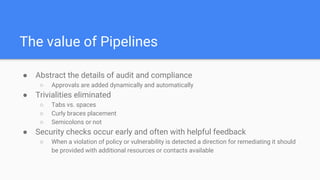
The value of Pipelines
● Abstract the details of audit and compliance
○ Approvals are added dynamically and automatically
● Trivialities eliminated
○ Tabs vs. spaces
○ Curly braces placement
○ Semicolons or not
● Security checks occur early and often with helpful feedback
○ When a violation of policy or vulnerability is detected a direction for remediating it should
be provided with additional resources or contacts available
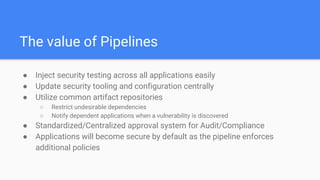
The value of Pipelines
● Inject security testing across all applications easily
● Update security tooling and configuration centrally
● Utilize common artifact repositories
○ Restrict undesirable dependencies
○ Notify dependent applications when a vulnerability is discovered
● Standardized/Centralized approval system for Audit/Compliance
● Applications will become secure by default as the pipeline enforces
additional policies
announcements

Architecting the Future: Abstractions and Metadata - STL SilverLinings

  • 1.
  • 2.
  • 3.
    Architecting the Future Abstractionsand Metadata Dan Barker @barkerd427 danbarker.codes
  • 5.
    The current datacenter is...challenging... RHEL 6.9 Dev RHEL 6.8 Test RHEL 6.6 Prod Dev Test Prod RHEL 6.7 Prod Admin Admin Admin Admin Admin Admin Dev RHEL 6.7 Dev RHEL 6.4 Dev RHEL 6.8 Dev Ubuntu Trusty RHEL 6.9 Dev RHEL 6.6 Dev Ubuntu Trusty RHEL 6.7 Dev RHEL 6.4 Dev RHEL 6.8 Dev Ubuntu Trusty RHEL 6.9 Dev RHEL 6.6 Dev RHEL 6.7 Dev RHEL 6.4 Dev RHEL 6.8 Dev Ubuntu Trusty RHEL 6.9 Dev RHEL 6.6 Dev
  • 6.
    The new datacenter is understandable and usable. Developer Access Production Controlled Network Storage Compute Platform Deployment Pipeline RHEL 6.9 App1 RHEL 6.9 App1 RHEL 6.9 App1 RHEL 6.9 App1 RHEL 6.9 App1 RHEL 6.9 App1 RHEL 6.9 App2 RHEL 6.9 App2 RHEL 6.9 App2 RHEL 6.9 App2 RHEL 6.9 App2 RHEL 6.9 App2
  • 7.
    Docker - theearly ● Docker is an abstraction ○ cgroups ○ Namespaces ● Not Included ○ Metadata ○ Volumes ○ Secrets ○ Services ○ Network ○ Plugins
  • 8.
    Docker - thelatter ● Volumes ● Secrets ● Networks ● Plugins ● Services ● Labels
  • 9.
    Kubernetes (k8s) ● Secrets ●PersistentVolumes ● Services ● Pods ● Ingress ● DaemonSets ● ReplicaSets ● Deployments
  • 10.
    OpenShift ● Routes ○ >Ingress ● DeploymentConfig ○ > Deployments ● ImageStream ● BuildConfig ● RBAC
  • 11.
  • 12.
    Services ● Identifies aset of pods using label selectors ○ Can be any label ○ Should be specific to avoid picking up disparate applications unintentionally ● Passes requests to pods internally to a Kubernetes cluster ○ Routes and Services are different ● Provides an abstraction for a Route to pass traffic from outside the cluster to desired endpoints
  • 13.
    One Route, OneService, One Application Route Service Pod
  • 14.
    The Route directsto the Service application0 ➜ ~ oc export routes application0 apiVersion: v1 kind: Route [...] spec: host: application0-presentation... to: kind: Service name: application0 weight: 100 [...]
  • 15.
    The Service matcheson the label “deploymentconfig” with the value “application0”. ➜ ~ oc export svc application0 apiVersion: v1 kind: Service spec: selector: deploymentconfig: application0
  • 16.
    The Pod hasmany labels. ➜ ~ oc export -o yaml po/application0-1-ao16l apiVersion: v1 kind: Pod metadata: labels: app: application0 deploymentconfig: application0 environment: dev partition: customerA release: stable tier: frontend [...]
  • 17.
    The Service nowmatches on the label “tier” with the value “frontend”. ➜ ~ oc export svc application0 apiVersion: v1 kind: Service spec: selector: tier: frontend
  • 18.
    One Route, OneService, Two Applications Route Application Application Service Service
  • 19.
    Curling the sameRoute results in two different applications responding.
  • 20.
    The Pod hasmany labels. ➜ ~ oc export -o yaml po/application0-beta-1-ao16l apiVersion: v1 kind: Pod metadata: labels: app: application0-beta deploymentconfig: application0-beta environment: dev partition: customerA release: stable tier: frontend [...]
  • 21.
    We’ve deleted application1and added application0-beta.
  • 22.
  • 23.
    ImageStreams ● May containimages from: ○ Image repository in OpenShift’s integrated registry ○ Other image streams ○ Image repositories from external registries ● Automatically trigger an action when new images are created ● Convenient abstraction ○ Related images ○ Image organization ○ Image history
  • 24.
    ImageStreams ● Metadata ○ Commands ○Entrypoint ○ Environment variables ○ Image Layers ○ Labels ○ Ports ● Could also reference other container kinds like rkt
  • 25.
  • 26.
  • 27.
  • 28.
    Operators ● Represents humanoperational knowledge in software to reliably manage an application ○ AI? ● Uses the Kubernetes concept of 3rd-party resources ○ Operates as a controller of controllers and resources ● Identical model to current Kubernetes controllers ○ Observe, Analyze, Act ○ Deployments, DaemonSets, ReplicationControllers ● Not supported in OpenShift
  • 29.
    Operators ● Deployed intoa k8s cluster ● Interactions occur through the new controller ○ kubectl get prometheuses --all-namespaces ○ kubectl get alertmanagers --all-namespaces ● Abstraction around k8s primitives ○ Users just want to use a MySQL cluster. ● Complex tasks that can be performed ○ Rotating credentials, certs, versions ○ Perform backups
  • 30.
  • 31.
    An Application includesa Pipeline, which is based on an opinionated PipelineTemplate. These combine to make a PipelineConfig. apiVersion: v1 kind: Application name: app1 cap: template: name: approvedTemplates/Tomcat8.yaml pipeline: notifications: mattermost: team: cloud channel: general on_success: never on_failure: always dependencies: - name: authn dnsName: authn - name: key-management username: reference_to_username password: reference_to_password stages: - name: build steps: - action: build baseImage: version: 8.0.41 - name: dev approvers: - role: app1-dev steps: - action: deploy params: environment: dev apiVersion: v1 kind: PipelineTemplate name: Tomcat8 labels: type: application build: manager: maven version: latest builderImage: java8-builder version: latest baseImage: tomcat8 version: latest deploy: deploymentType: canary maxUnavailable: 10% maxSurge: 20% apiVersion: v1 kind: PipelineConfig name: app1-pipeline labels: type: application pipeline: notifications: mattermost: team: cloud channel: general on_success: never on_failure: always dependencies: - name: authn dnsName: authn - name: key-management username: reference_to_username password: reference_to_password stages: - name: build steps: - action: build manager: maven builderImage: java8-builder baseImage: tomcat8 version: 8.0.41 - name: dev approvers: - role: app1-dev steps: - action: deploy params: environment: dev
  • 32.
    Pipelines ● Stages ● Steps ●Application ● PipelineTemplate ● PipelineConfig
  • 33.
    An Application andPipelineTemplate also combine to create a DeploymentConfig. apiVersion: v1 kind: Application name: app1 cap: template: name: approvedTemplates/Tomcat8.yaml pipeline: notifications: mattermost: team: cloud channel: general on_success: never on_failure: always dependencies: - name: authn dnsName: authn - name: key-management username: reference_to_username password: reference_to_password stages: - name: build steps: - action: build baseImage: version: 8.0.41 - name: dev approvers: - role: app1-dev steps: - action: deploy params: environment: dev apiVersion: v1 kind: PipelineTemplate name: Tomcat8 labels: type: application build: manager: maven version: latest builderImage: java8-builder version: latest baseImage: tomcat8 version: latest deploy: deploymentType: canary maxUnavailable: 10% maxSurge: 20% apiVersion: v1 kind: DeploymentConfig metadata: name: app1-pipeline type: application spec: replicas: 2 selector: name: frontend template: { ... } triggers: - type: ConfigChange - imageChangeParams: automatic: true containerNames: - helloworld from: kind: ImageStreamTag name: hello-openshift:latest type: ImageChange strategy: type: Rolling
  • 34.
    The value ofPipelines ● Abstract the details of audit and compliance ○ Approvals are added dynamically and automatically ● Trivialities eliminated ○ Tabs vs. spaces ○ Curly braces placement ○ Semicolons or not ● Security checks occur early and often with helpful feedback ○ When a violation of policy or vulnerability is detected a direction for remediating it should be provided with additional resources or contacts available
  • 35.
    The value ofPipelines ● Inject security testing across all applications easily ● Update security tooling and configuration centrally ● Utilize common artifact repositories ○ Restrict undesirable dependencies ○ Notify dependent applications when a vulnerability is discovered ● Standardized/Centralized approval system for Audit/Compliance ● Applications will become secure by default as the pipeline enforces additional policies
  • 36.