Build and run applications in a
Dockerless Kubernetes world
Jorge Morales
OpenShift Developer Advocate
DevConf India 2018
August 5th - 11:45 - Room 1
Me (aka Jorge Morales)
● Spanish by nature and by language
● Work at Red Hat
● OpenShift Developer Advocate
● Mostly Java developer
● Obsessed with improving the developer experience
@jorgemoralespou
github.com/jorgemoralespou
http://jorgemoral.es
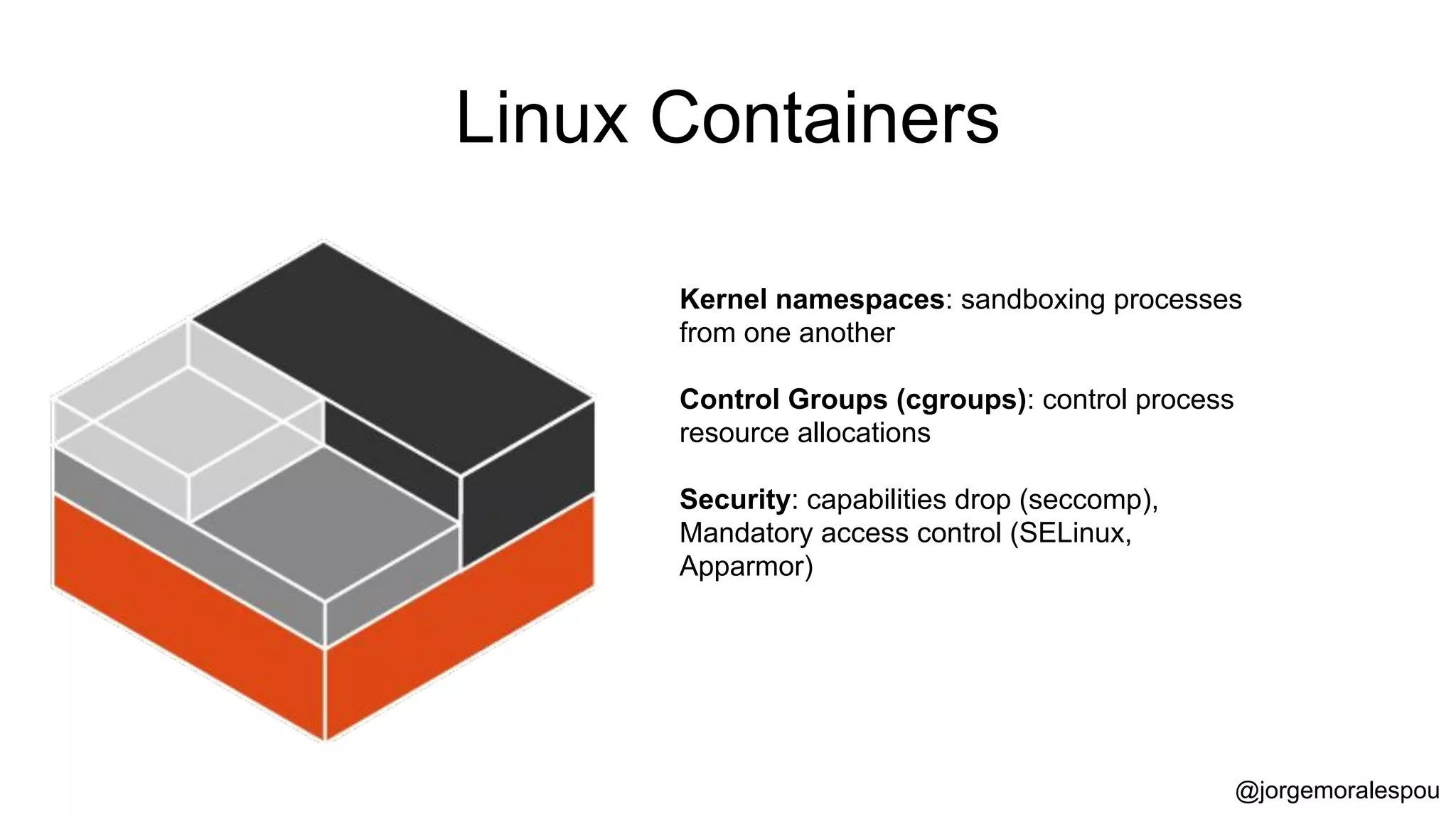
Kernel namespaces: sandboxing processes
from one another
Control Groups (cgroups): control process
resource allocations
Security: capabilities drop (seccomp),
Mandatory access control (SELinux,
Apparmor)
Linux Containers
@jorgemoralespou
@jorgemoralespou
@jorgemoralespou
@jorgemoralespou
@jorgemoralespou
With scale came complexity
Orchestration
@jorgemoralespou
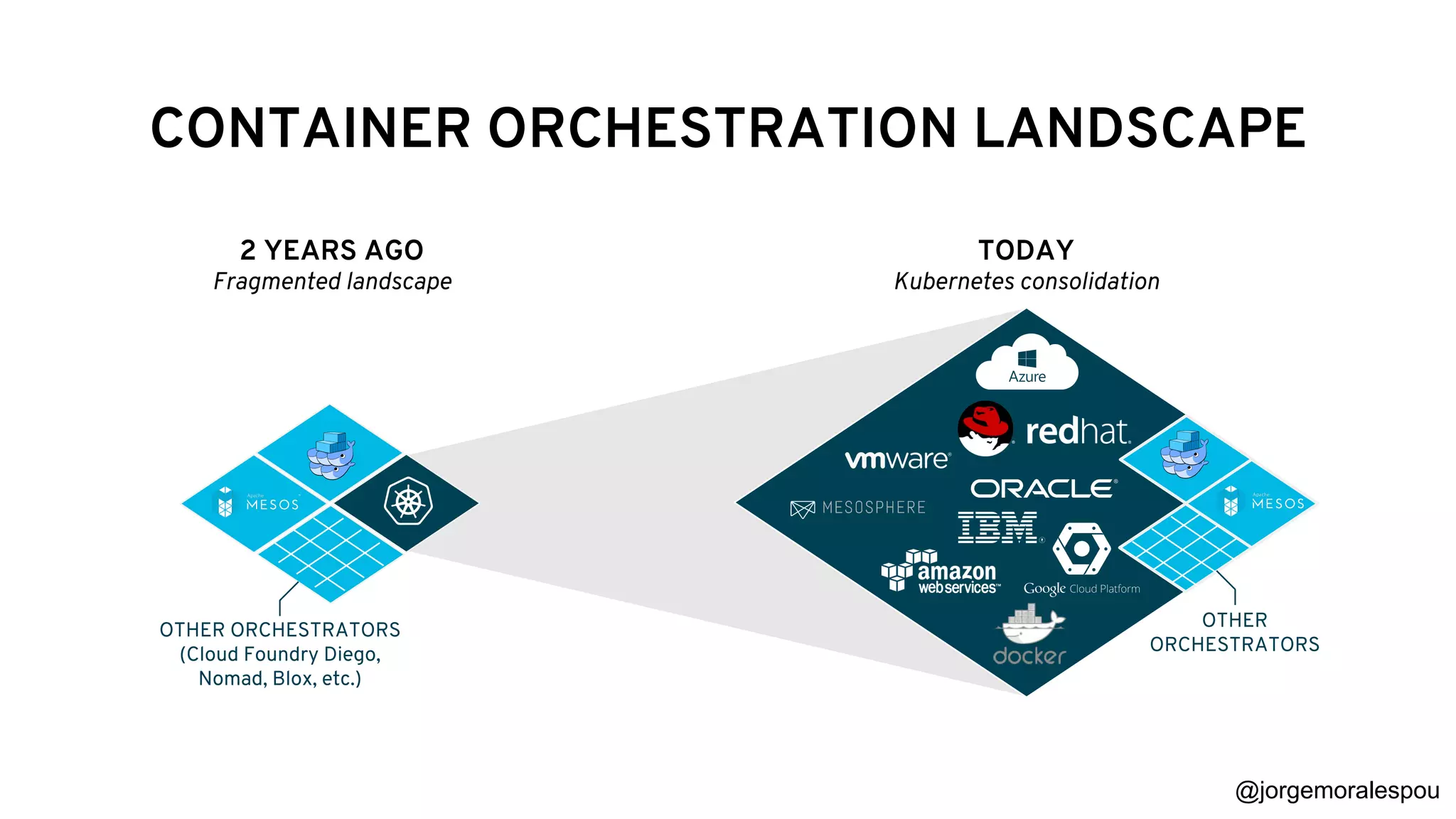
OTHER ORCHESTRATORS
(Cloud Foundry Diego,
Nomad, Blox, etc.)
2 YEARS AGO
Fragmented landscape
TODAY
Kubernetes consolidation
OTHER
ORCHESTRATORS
CONTAINER ORCHESTRATION LANDSCAPE
@jorgemoralespou
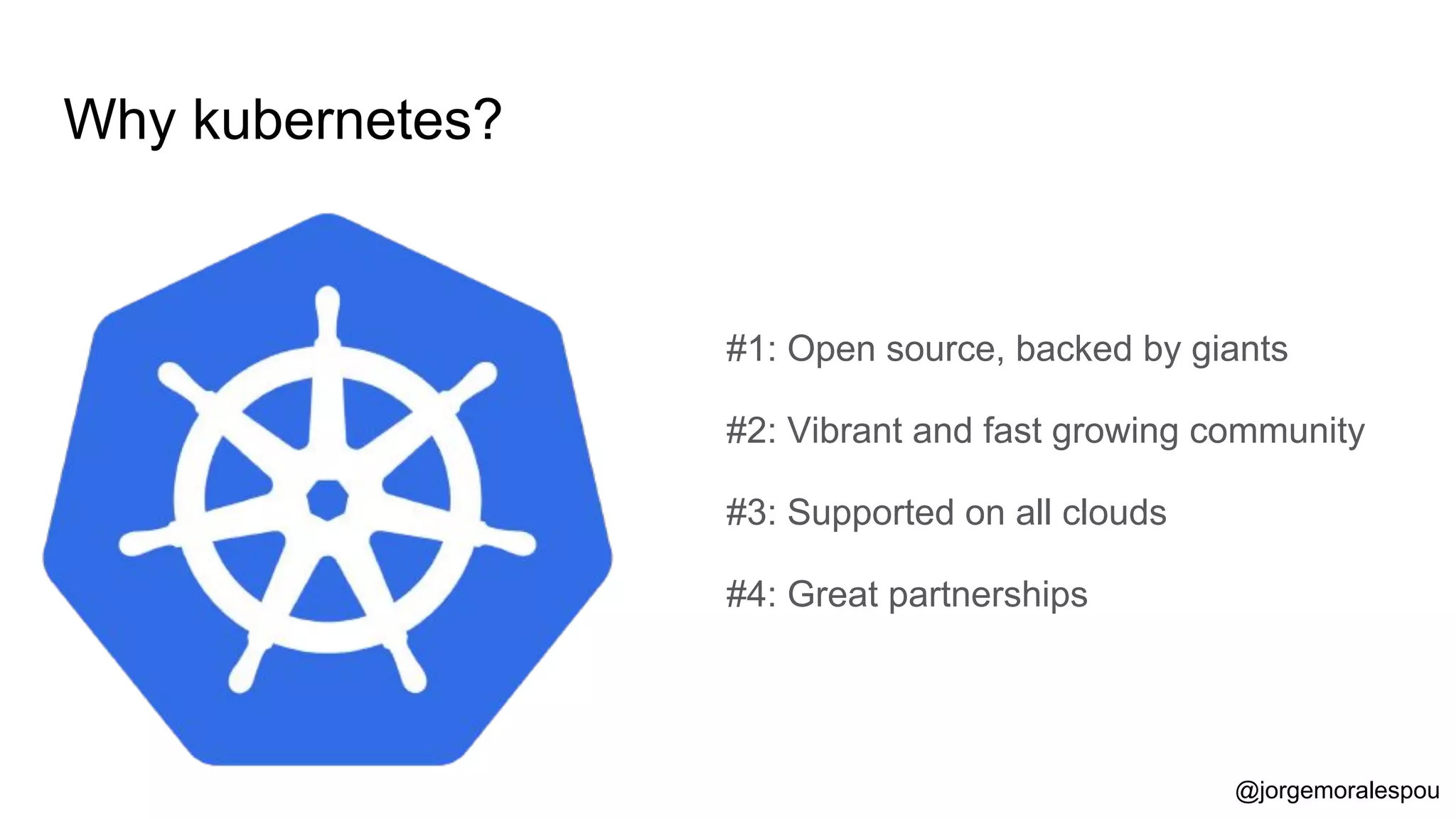
Why kubernetes?
#1: Open source, backed by giants
#2: Vibrant and fast growing community
#3: Supported on all clouds
#4: Great partnerships
@jorgemoralespou
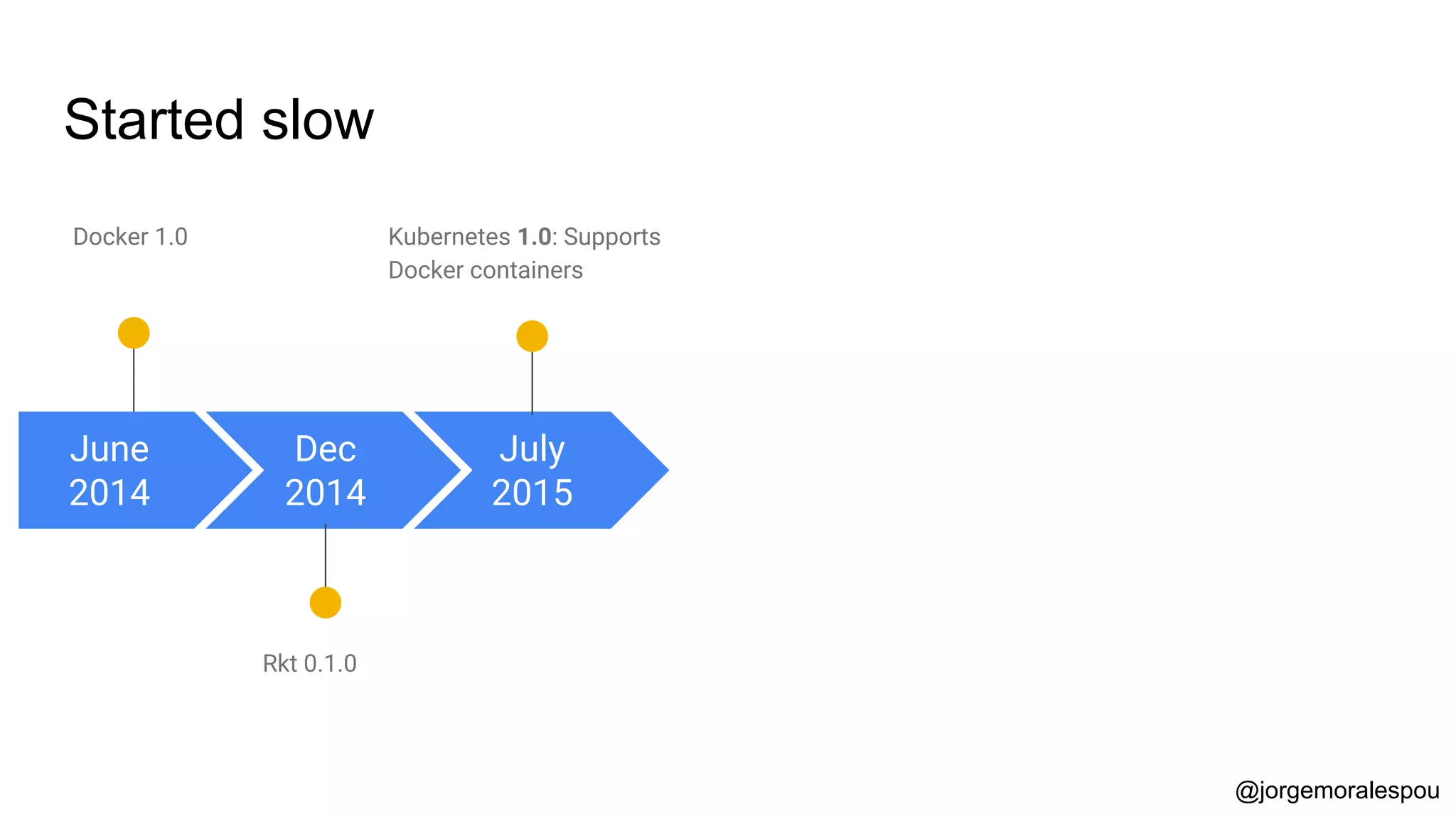
Started slow
June
2014
Docker 1.0
Dec
2014
Kubernetes 1.0: Supports
Docker containers
Rkt 0.1.0
July
2015
@jorgemoralespou
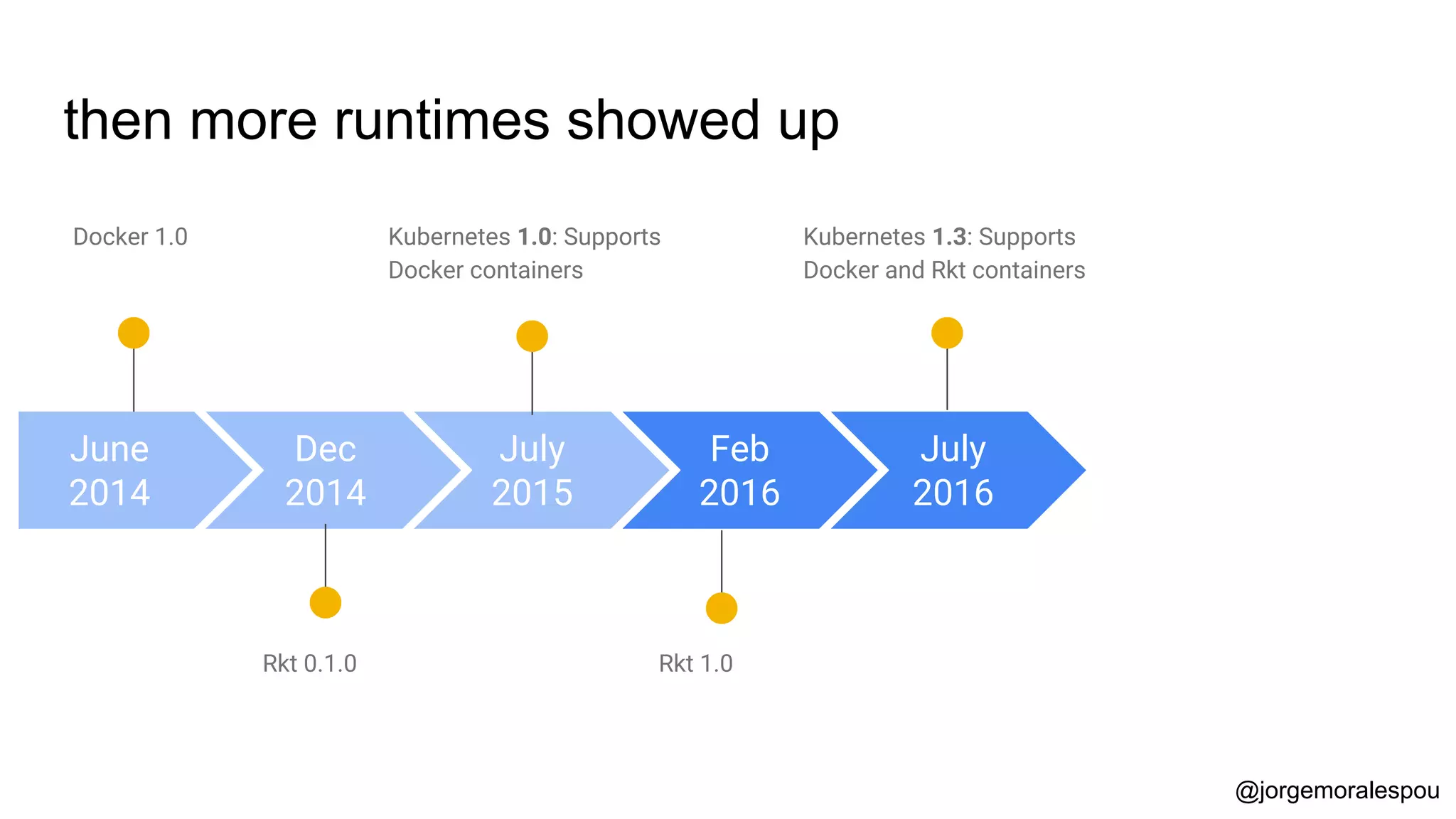
then more runtimes showed up
Rkt 1.0
Feb
2016
Kubernetes 1.3: Supports
Docker and Rkt containers
July
2016
June
2014
Docker 1.0
Dec
2014
Kubernetes 1.0: Supports
Docker containers
Rkt 0.1.0
July
2015
@jorgemoralespou
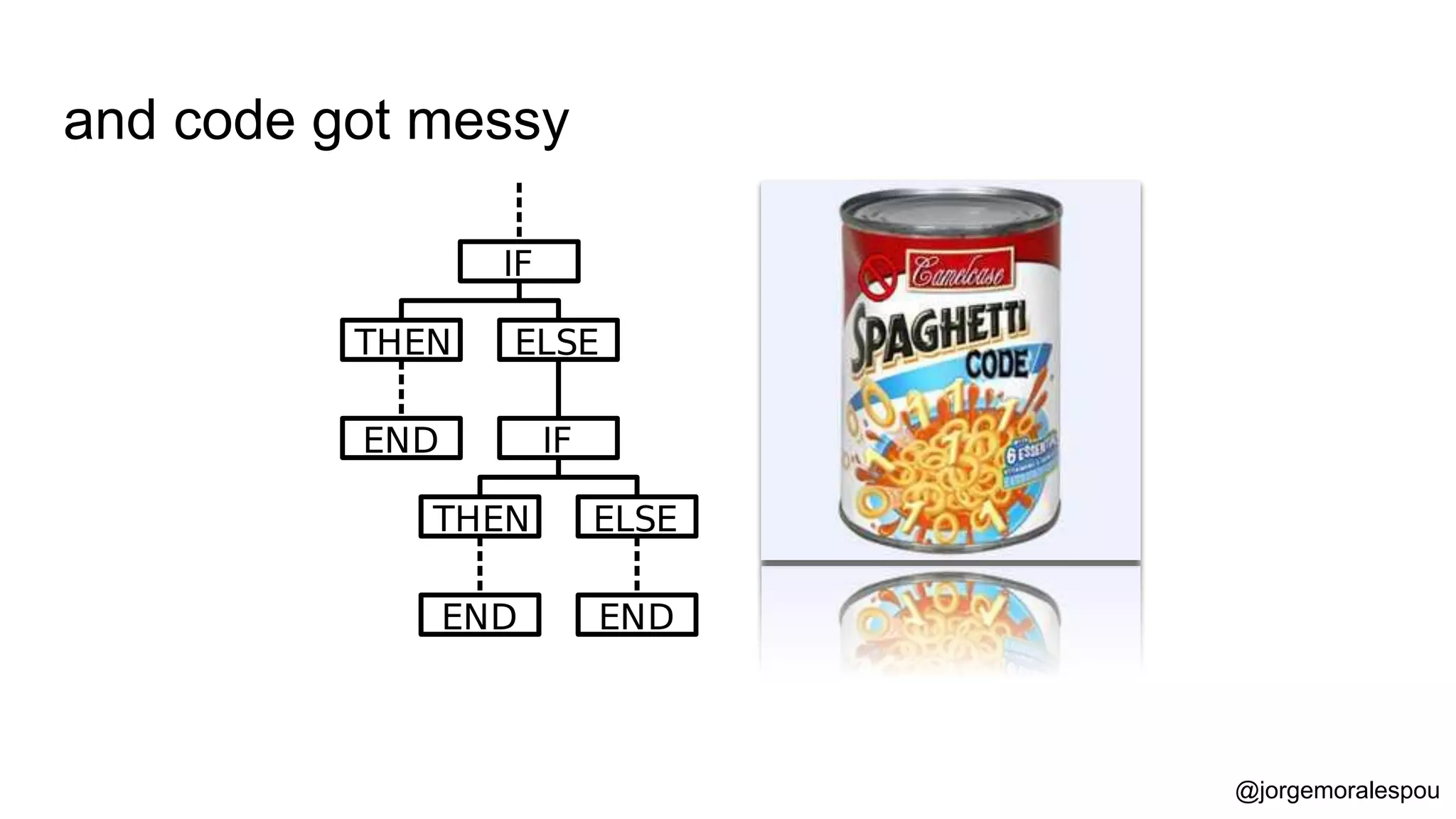
and code got messy
@jorgemoralespou
“Change is the essential
process of all of
existence.”
—SPOCK
Standardize containers
● Runtime spec (runc = Reference implementation)
● Image spec
● Distribution spec (proposal)
@jorgemoralespou
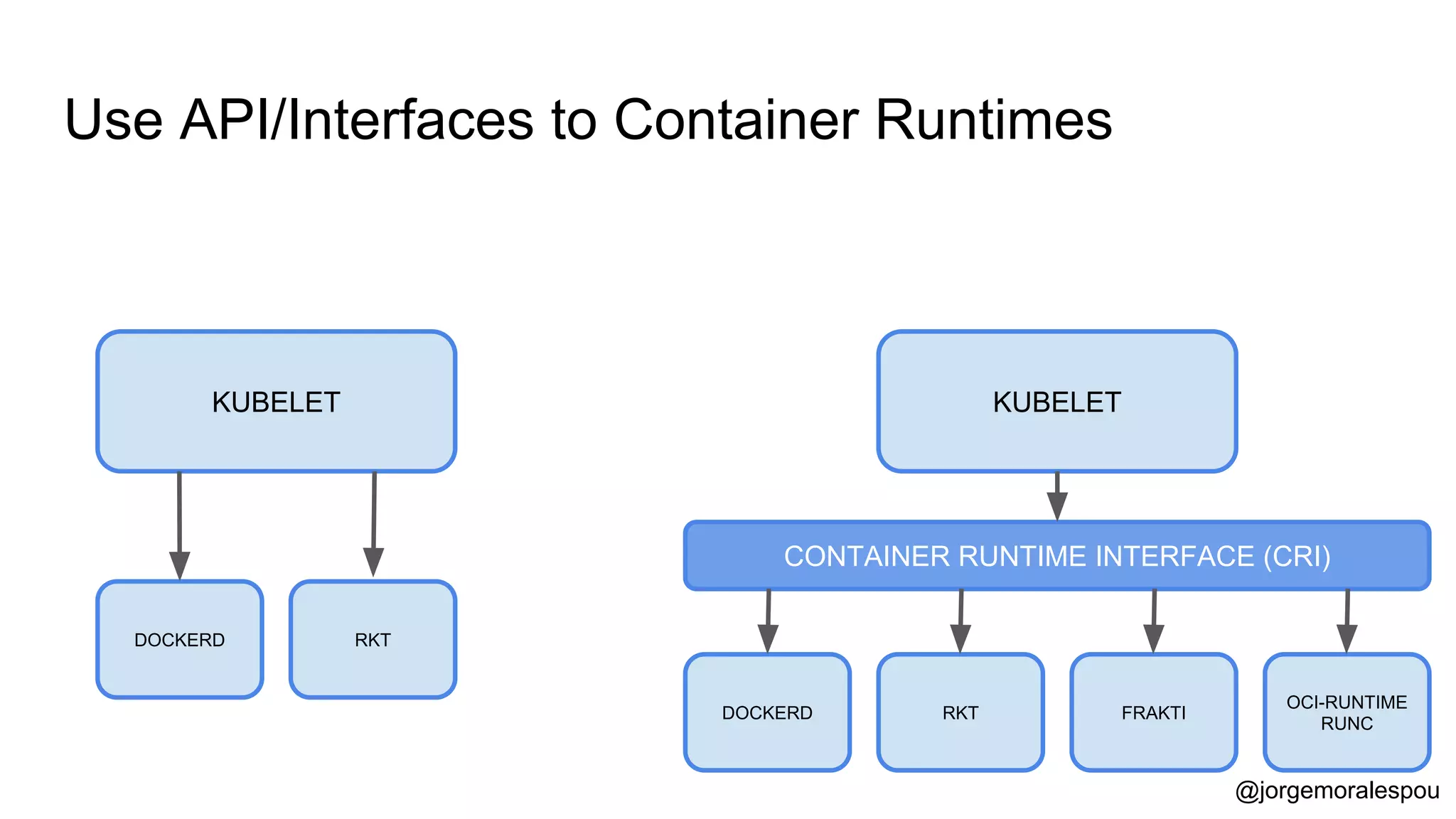
Use API/Interfaces to Container Runtimes
KUBELET
FRAKTI
OCI-RUNTIME
RUNC
DOCKERD RKT
CONTAINER RUNTIME INTERFACE (CRI)
DOCKERD RKT
KUBELET
@jorgemoralespou
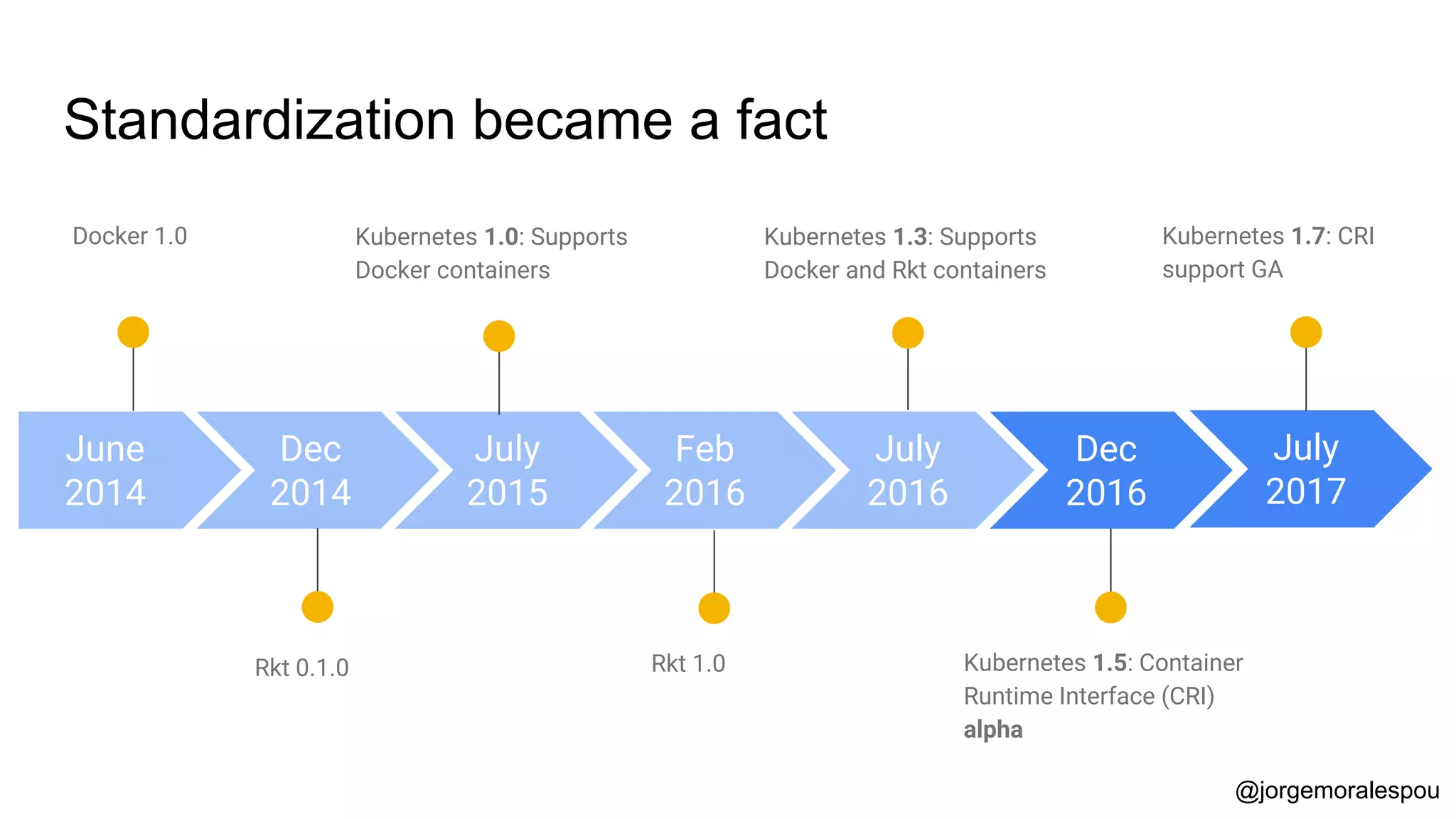
Standardization became a fact
Rkt 1.0
Feb
2016
Kubernetes 1.3: Supports
Docker and Rkt containers
July
2016
June
2014
Docker 1.0
Dec
2014
Kubernetes 1.0: Supports
Docker containers
Rkt 0.1.0
July
2015
Dec
2016
Kubernetes 1.5: Container
Runtime Interface (CRI)
alpha
July
2017
Kubernetes 1.7: CRI
support GA
@jorgemoralespou
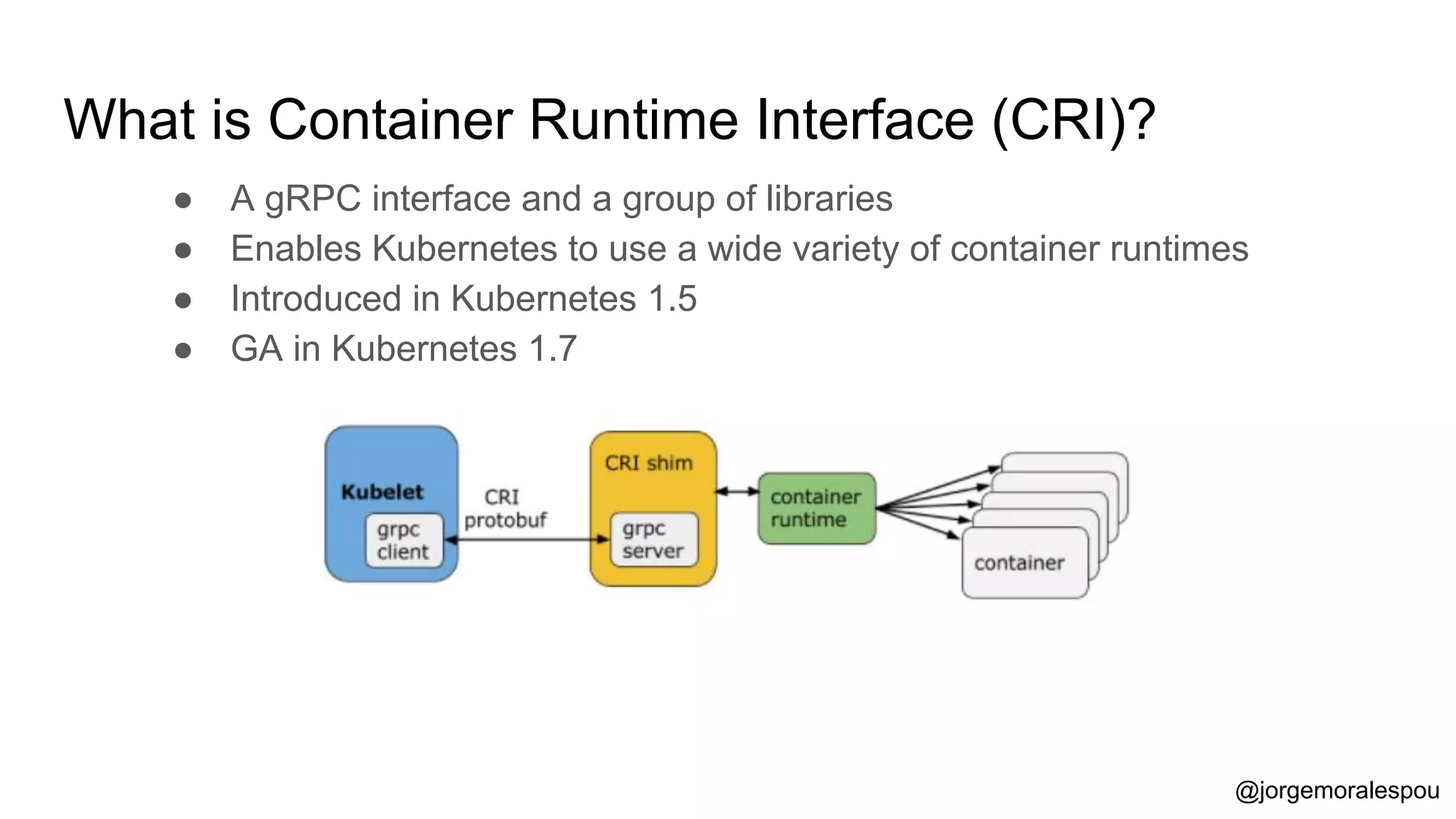
What is Container Runtime Interface (CRI)?
● A gRPC interface and a group of libraries
● Enables Kubernetes to use a wide variety of container runtimes
● Introduced in Kubernetes 1.5
● GA in Kubernetes 1.7
@jorgemoralespou
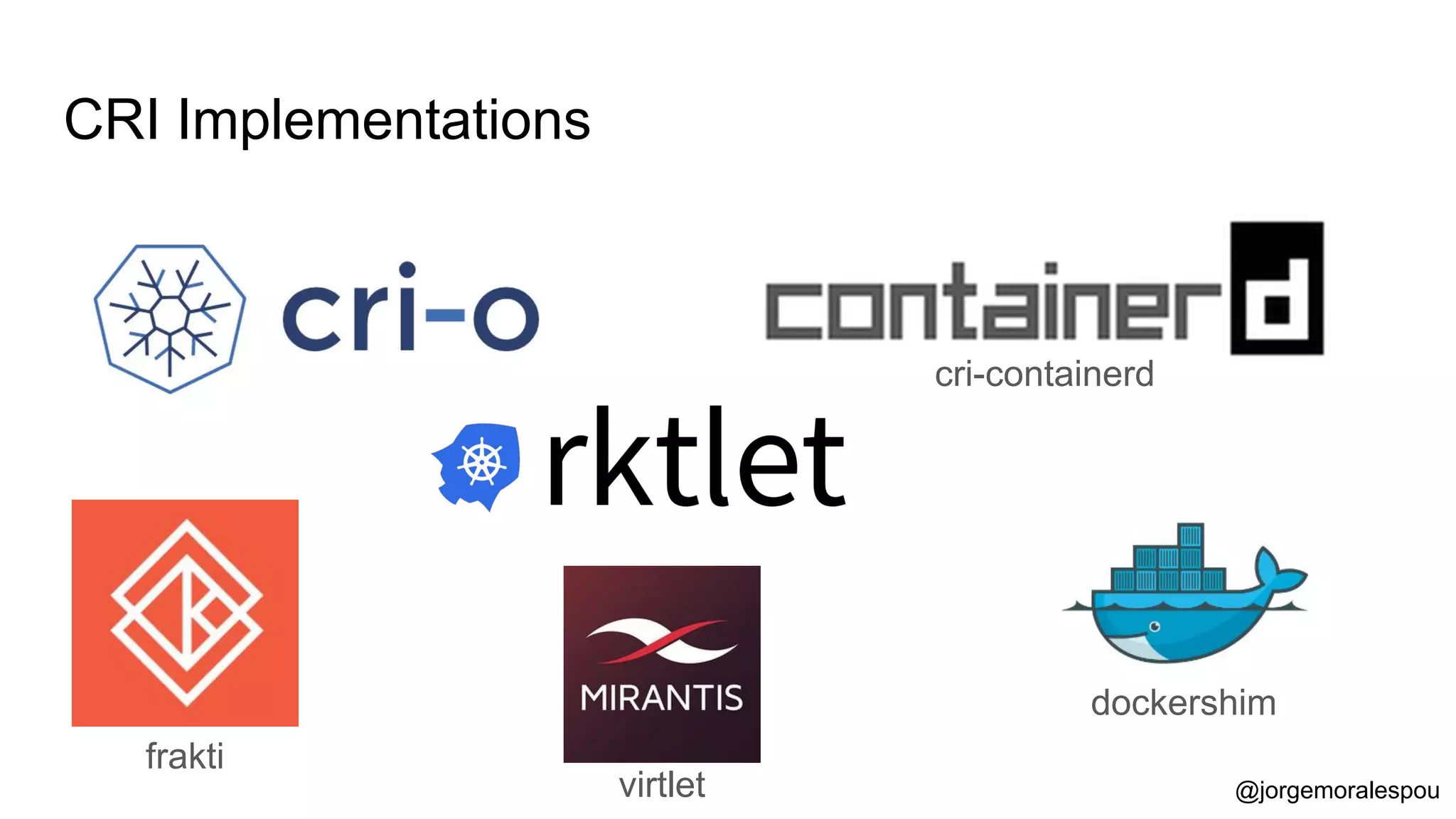
CRI Implementations
frakti
cri-containerd
dockershim
virtlet @jorgemoralespou
CRI-O
● Open source & Open governance
● Lean, Stable, Secure and BORING!
○ Tied to the CRI
○ No features that can mine stability
and performance
○ Shaped around Kubernetes
○ Only supported user is Kubernetes
○ Versioning and Support are tied to
Kubernetes
@jorgemoralespou
Man, this guy is so boring!
When is the live demo?
@jorgemoralespou
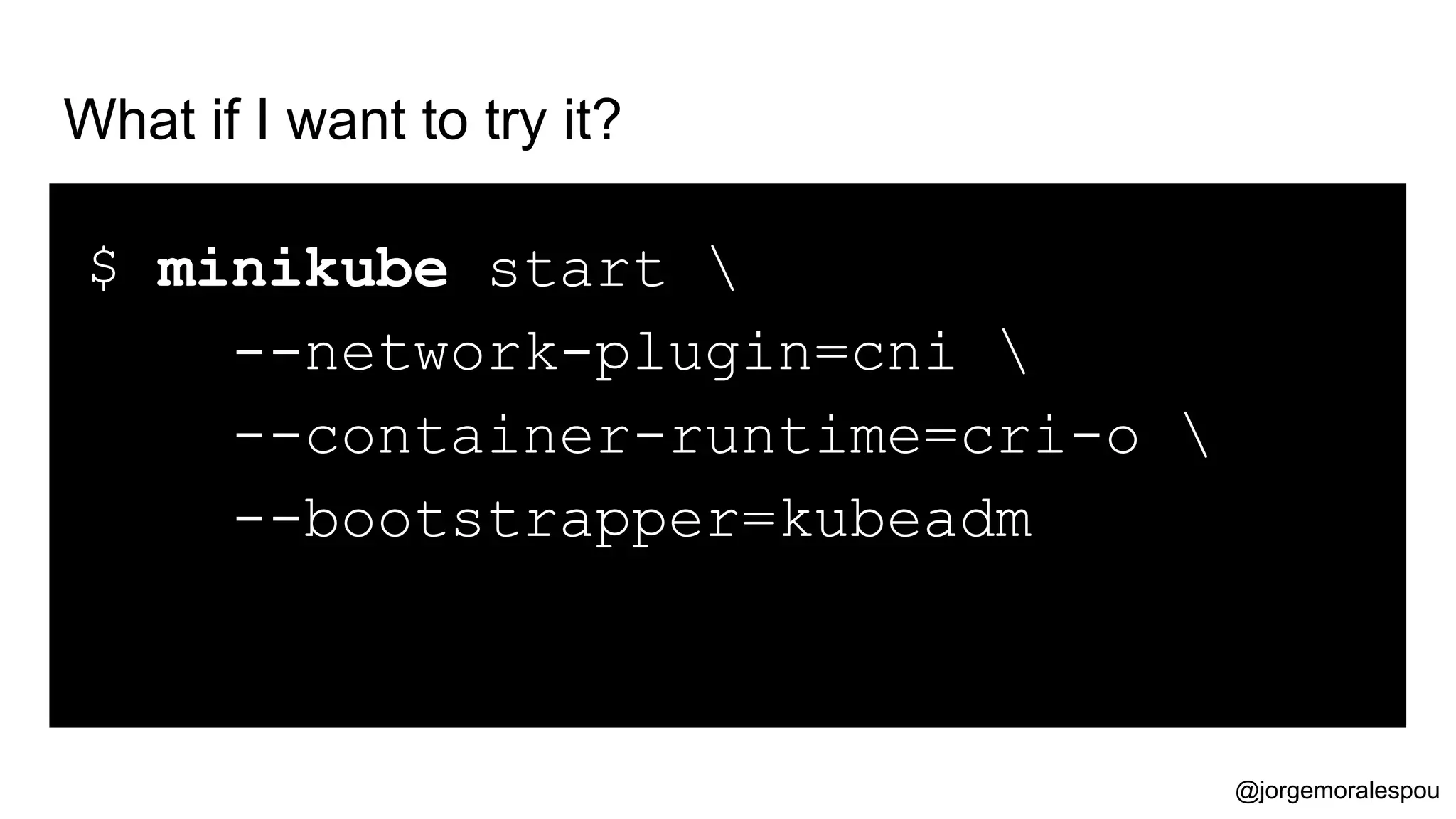
What if I want to try it?
$ minikube start 
--network-plugin=cni 
--container-runtime=cri-o 
--bootstrapper=kubeadm
@jorgemoralespou
@jorgemoralespou
skopeo
● Copy images from/to (multiple transports/storages):
○ containers-storage:docker-reference
○ dir:path
○ docker://docker-reference
○ docker-archive:path[:docker-reference]
○ docker-daemon:docker-reference
○ oci:path:tag
○ ostree:image[@/absolute/repo/path]
● Inspect images
● Delete an image from a repository
● Standalone binary / No daemon running
● Perfect for pipelines (e.g. Jenkins)
@jorgemoralespou
@jorgemoralespou
buildah
● Build images
● No daemon running
● shell-like syntax
● Build from Dockerfile(s)
@jorgemoralespou
@jorgemoralespou
libpod/podman
Library (libpod) and CLI (podman) for
managing OCI-based Pods, Containers, and
Container Images
● Replacement for docker cli
○ known CLI
● Integrated with CRI-O (soon)
● No daemon running
@jorgemoralespou
“Our ancestors called it
magic, but you call it
[computer] science.
I come from a land where
they are one and the same.”
—THOR
@jorgemoralespou
@jorgemoralespou
Daemon-less Dockerfile builds
● Consume a Dockerfile, but build image without a docker daemon
● Pros
○ Docker build-like experience (just write a Dockerfile)
○ Potentially more control over image layers (combine or shard)
○ Aim is for greater security
● Cons
○ Dockerfile fidelity might make difficult some use cases
○ Different approaches to image layer construction
@jorgemoralespou
Daemon-less Dockerfile builds
● Buildah
○ a tool that facilitates building OCI container images
● Img
○ Standalone, daemon-less, unprivileged Dockerfile and OCI compatible
container image builder.
○ The commands/UX are the same as docker (drop-in replacement)
● Kaniko
○ kaniko is a tool to build OCI container images from a Dockerfile, inside a
container or Kubernetes cluster
○ executes each command within a Dockerfile completely in userspace
● more...
@jorgemoralespou
Dockerfile-less builds
● User input is source / intent: “I want to run a Node.js web server”
● Pros:
○ Less configuration
○ Tools can intelligently build layers, better/safe layer caching
○ Docker image best practices can be codified into tools
● Cons:
○ Less flexible - Opinionated builds
○ Very fragmented across vendors, no real standard
@jorgemoralespou
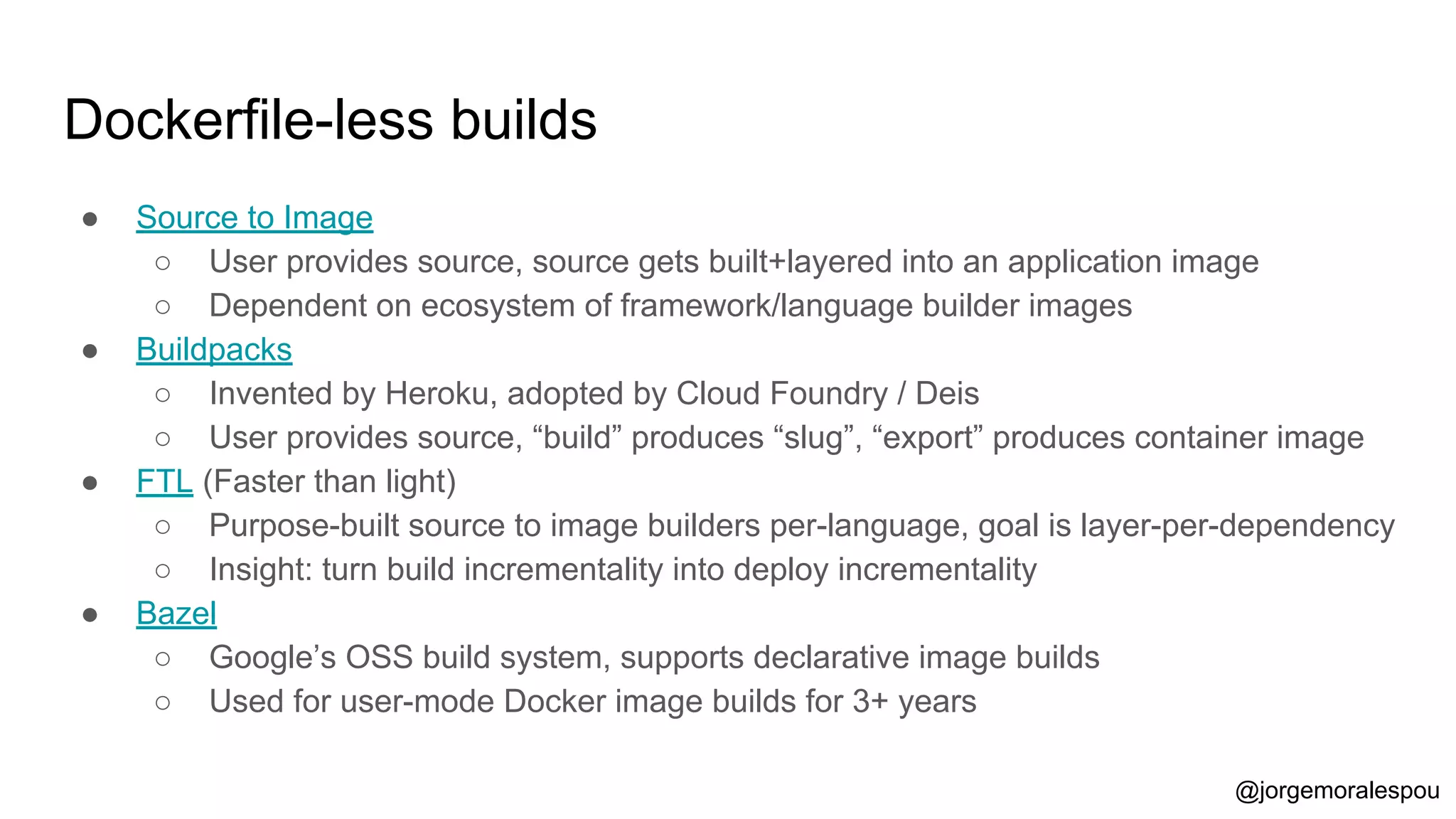
Dockerfile-less builds
● Source to Image
○ User provides source, source gets built+layered into an application image
○ Dependent on ecosystem of framework/language builder images
● Buildpacks
○ Invented by Heroku, adopted by Cloud Foundry / Deis
○ User provides source, “build” produces “slug”, “export” produces container image
● FTL (Faster than light)
○ Purpose-built source to image builders per-language, goal is layer-per-dependency
○ Insight: turn build incrementality into deploy incrementality
● Bazel
○ Google’s OSS build system, supports declarative image builds
○ Used for user-mode Docker image builds for 3+ years
@jorgemoralespou
And don’t forget to
tweet if you liked it
(or if you didn’t)
@jorgemoralespou
@jorgemoralespou

Build and run applications in a dockerless kubernetes world - DevConf India 18

  • 1.
    Build and runapplications in a Dockerless Kubernetes world Jorge Morales OpenShift Developer Advocate DevConf India 2018 August 5th - 11:45 - Room 1
  • 2.
    Me (aka JorgeMorales) ● Spanish by nature and by language ● Work at Red Hat ● OpenShift Developer Advocate ● Mostly Java developer ● Obsessed with improving the developer experience @jorgemoralespou github.com/jorgemoralespou http://jorgemoral.es
  • 5.
    Kernel namespaces: sandboxingprocesses from one another Control Groups (cgroups): control process resource allocations Security: capabilities drop (seccomp), Mandatory access control (SELinux, Apparmor) Linux Containers @jorgemoralespou
  • 6.
  • 7.
  • 9.
  • 10.
  • 11.
    With scale camecomplexity
  • 12.
  • 13.
    OTHER ORCHESTRATORS (Cloud FoundryDiego, Nomad, Blox, etc.) 2 YEARS AGO Fragmented landscape TODAY Kubernetes consolidation OTHER ORCHESTRATORS CONTAINER ORCHESTRATION LANDSCAPE @jorgemoralespou
  • 14.
    Why kubernetes? #1: Opensource, backed by giants #2: Vibrant and fast growing community #3: Supported on all clouds #4: Great partnerships @jorgemoralespou
  • 15.
    Started slow June 2014 Docker 1.0 Dec 2014 Kubernetes1.0: Supports Docker containers Rkt 0.1.0 July 2015 @jorgemoralespou
  • 16.
    then more runtimesshowed up Rkt 1.0 Feb 2016 Kubernetes 1.3: Supports Docker and Rkt containers July 2016 June 2014 Docker 1.0 Dec 2014 Kubernetes 1.0: Supports Docker containers Rkt 0.1.0 July 2015 @jorgemoralespou
  • 17.
    and code gotmessy @jorgemoralespou
  • 18.
    “Change is theessential process of all of existence.” —SPOCK
  • 19.
    Standardize containers ● Runtimespec (runc = Reference implementation) ● Image spec ● Distribution spec (proposal) @jorgemoralespou
  • 20.
    Use API/Interfaces toContainer Runtimes KUBELET FRAKTI OCI-RUNTIME RUNC DOCKERD RKT CONTAINER RUNTIME INTERFACE (CRI) DOCKERD RKT KUBELET @jorgemoralespou
  • 21.
    Standardization became afact Rkt 1.0 Feb 2016 Kubernetes 1.3: Supports Docker and Rkt containers July 2016 June 2014 Docker 1.0 Dec 2014 Kubernetes 1.0: Supports Docker containers Rkt 0.1.0 July 2015 Dec 2016 Kubernetes 1.5: Container Runtime Interface (CRI) alpha July 2017 Kubernetes 1.7: CRI support GA @jorgemoralespou
  • 22.
    What is ContainerRuntime Interface (CRI)? ● A gRPC interface and a group of libraries ● Enables Kubernetes to use a wide variety of container runtimes ● Introduced in Kubernetes 1.5 ● GA in Kubernetes 1.7 @jorgemoralespou
  • 23.
  • 24.
    CRI-O ● Open source& Open governance ● Lean, Stable, Secure and BORING! ○ Tied to the CRI ○ No features that can mine stability and performance ○ Shaped around Kubernetes ○ Only supported user is Kubernetes ○ Versioning and Support are tied to Kubernetes @jorgemoralespou
  • 25.
    Man, this guyis so boring! When is the live demo? @jorgemoralespou
  • 27.
    What if Iwant to try it? $ minikube start --network-plugin=cni --container-runtime=cri-o --bootstrapper=kubeadm @jorgemoralespou
  • 28.
  • 29.
    skopeo ● Copy imagesfrom/to (multiple transports/storages): ○ containers-storage:docker-reference ○ dir:path ○ docker://docker-reference ○ docker-archive:path[:docker-reference] ○ docker-daemon:docker-reference ○ oci:path:tag ○ ostree:image[@/absolute/repo/path] ● Inspect images ● Delete an image from a repository ● Standalone binary / No daemon running ● Perfect for pipelines (e.g. Jenkins) @jorgemoralespou
  • 30.
  • 31.
    buildah ● Build images ●No daemon running ● shell-like syntax ● Build from Dockerfile(s) @jorgemoralespou
  • 32.
  • 33.
    libpod/podman Library (libpod) andCLI (podman) for managing OCI-based Pods, Containers, and Container Images ● Replacement for docker cli ○ known CLI ● Integrated with CRI-O (soon) ● No daemon running @jorgemoralespou
  • 35.
    “Our ancestors calledit magic, but you call it [computer] science. I come from a land where they are one and the same.” —THOR
  • 36.
  • 37.
  • 38.
    Daemon-less Dockerfile builds ●Consume a Dockerfile, but build image without a docker daemon ● Pros ○ Docker build-like experience (just write a Dockerfile) ○ Potentially more control over image layers (combine or shard) ○ Aim is for greater security ● Cons ○ Dockerfile fidelity might make difficult some use cases ○ Different approaches to image layer construction @jorgemoralespou
  • 39.
    Daemon-less Dockerfile builds ●Buildah ○ a tool that facilitates building OCI container images ● Img ○ Standalone, daemon-less, unprivileged Dockerfile and OCI compatible container image builder. ○ The commands/UX are the same as docker (drop-in replacement) ● Kaniko ○ kaniko is a tool to build OCI container images from a Dockerfile, inside a container or Kubernetes cluster ○ executes each command within a Dockerfile completely in userspace ● more... @jorgemoralespou
  • 40.
    Dockerfile-less builds ● Userinput is source / intent: “I want to run a Node.js web server” ● Pros: ○ Less configuration ○ Tools can intelligently build layers, better/safe layer caching ○ Docker image best practices can be codified into tools ● Cons: ○ Less flexible - Opinionated builds ○ Very fragmented across vendors, no real standard @jorgemoralespou
  • 41.
    Dockerfile-less builds ● Sourceto Image ○ User provides source, source gets built+layered into an application image ○ Dependent on ecosystem of framework/language builder images ● Buildpacks ○ Invented by Heroku, adopted by Cloud Foundry / Deis ○ User provides source, “build” produces “slug”, “export” produces container image ● FTL (Faster than light) ○ Purpose-built source to image builders per-language, goal is layer-per-dependency ○ Insight: turn build incrementality into deploy incrementality ● Bazel ○ Google’s OSS build system, supports declarative image builds ○ Used for user-mode Docker image builds for 3+ years @jorgemoralespou
  • 42.
    And don’t forgetto tweet if you liked it (or if you didn’t) @jorgemoralespou @jorgemoralespou