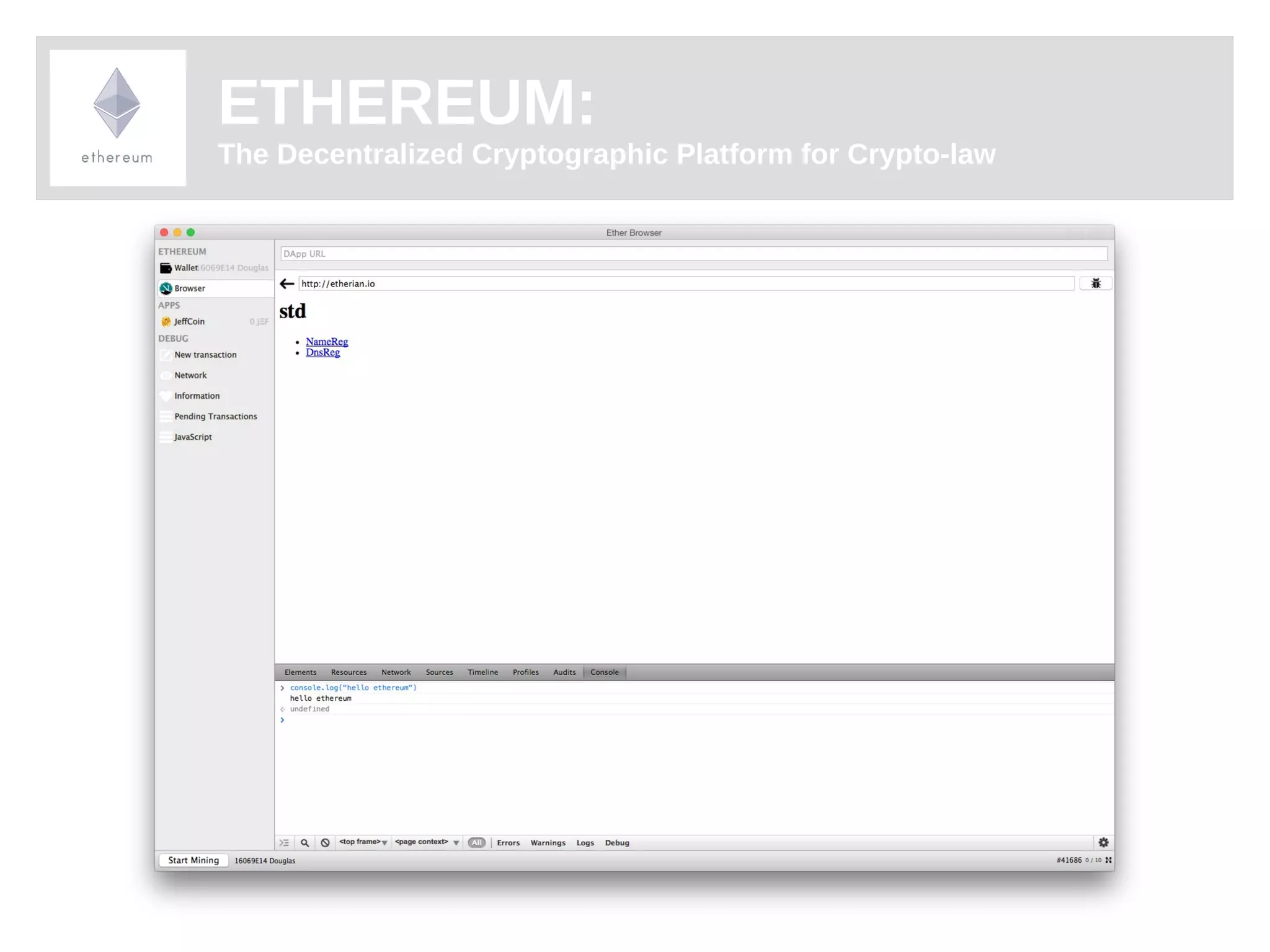
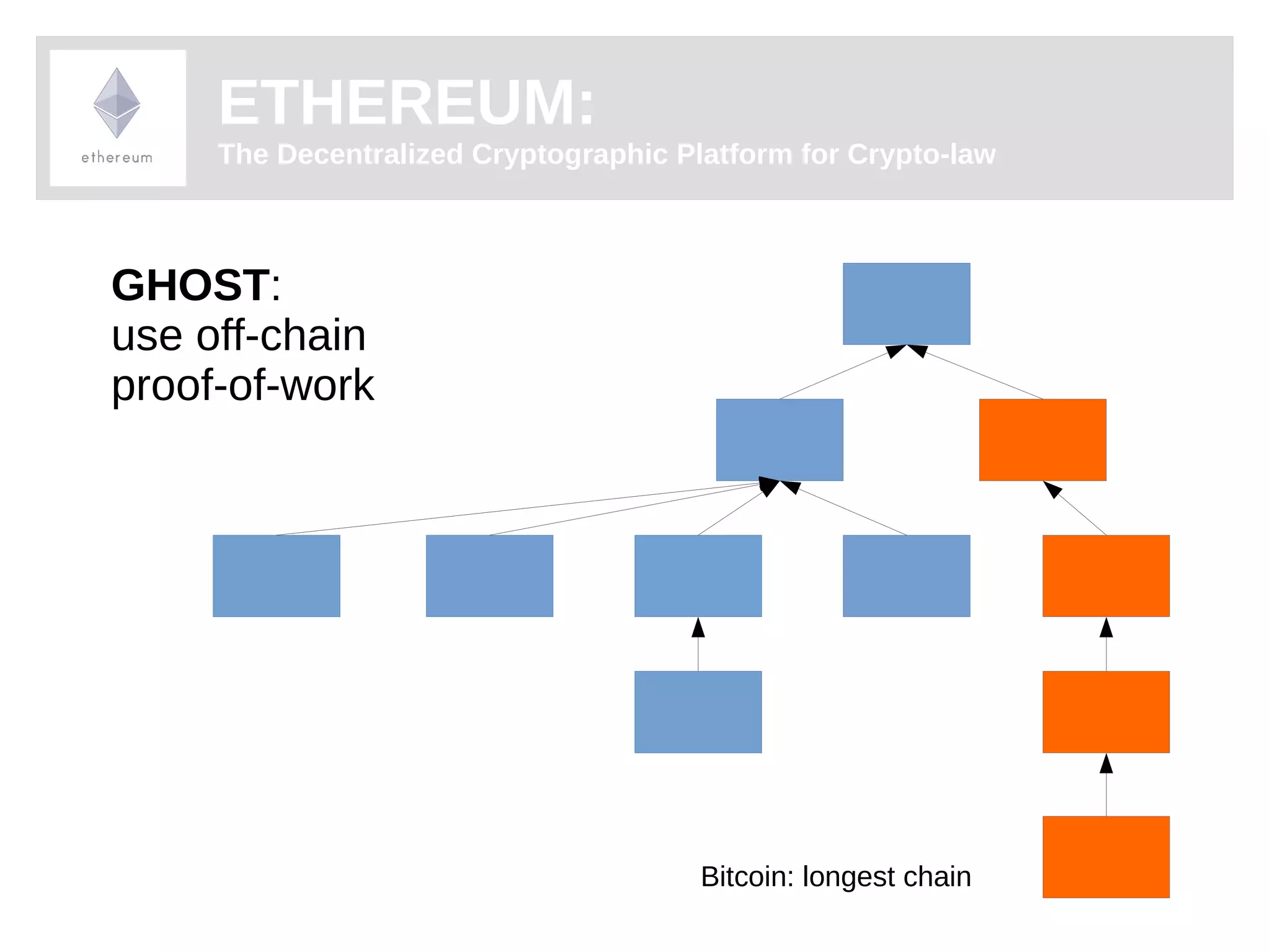
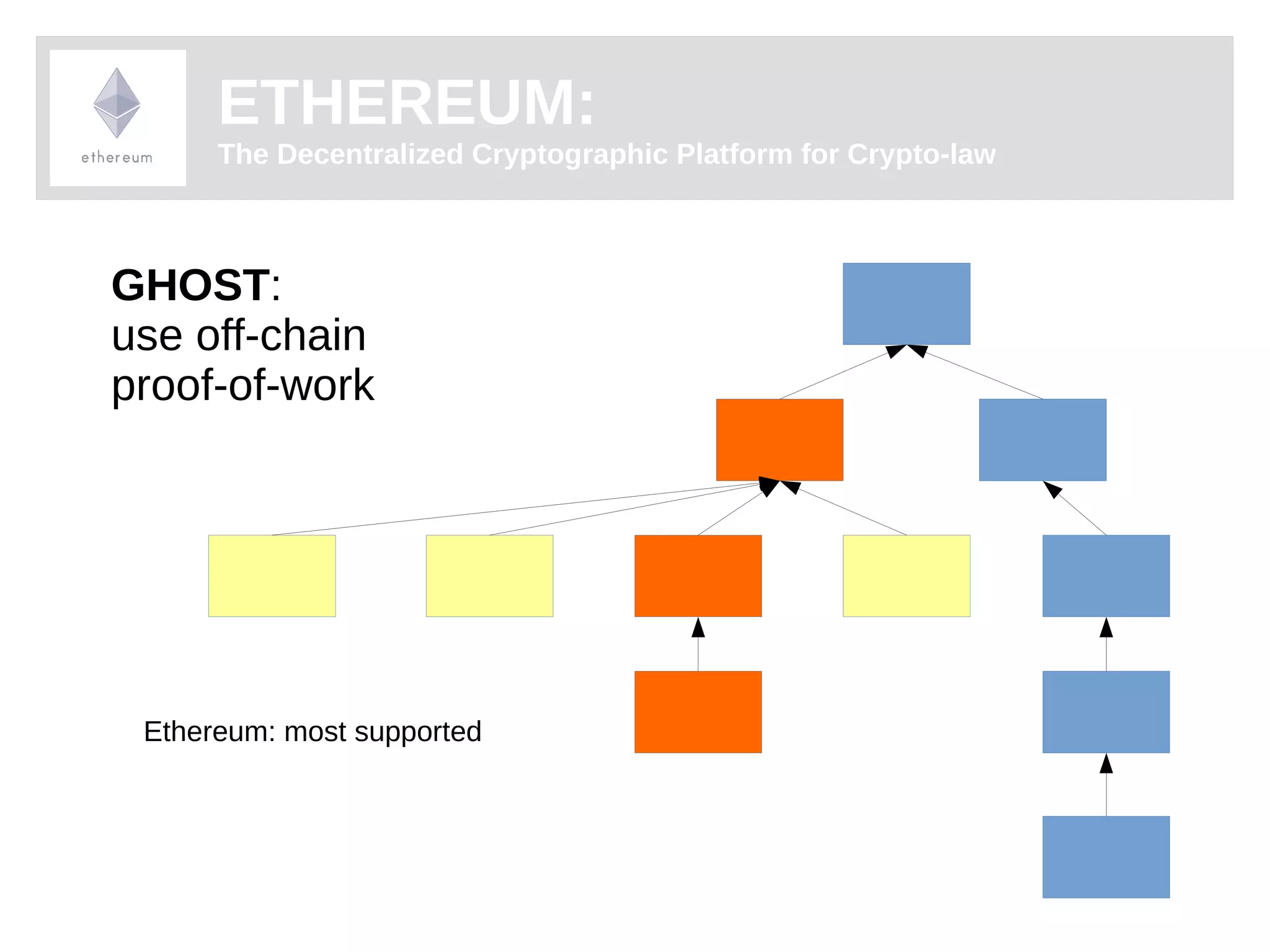
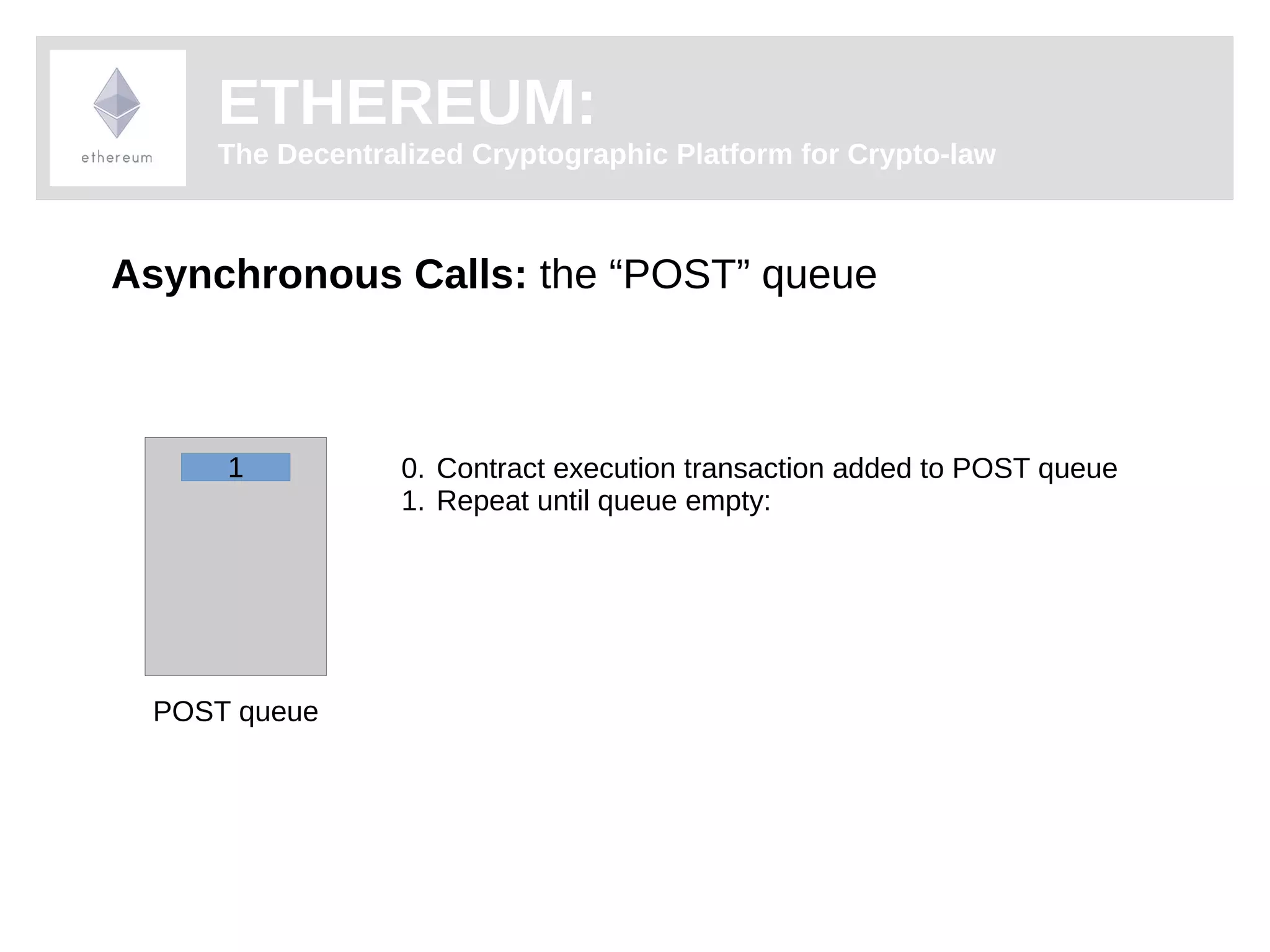
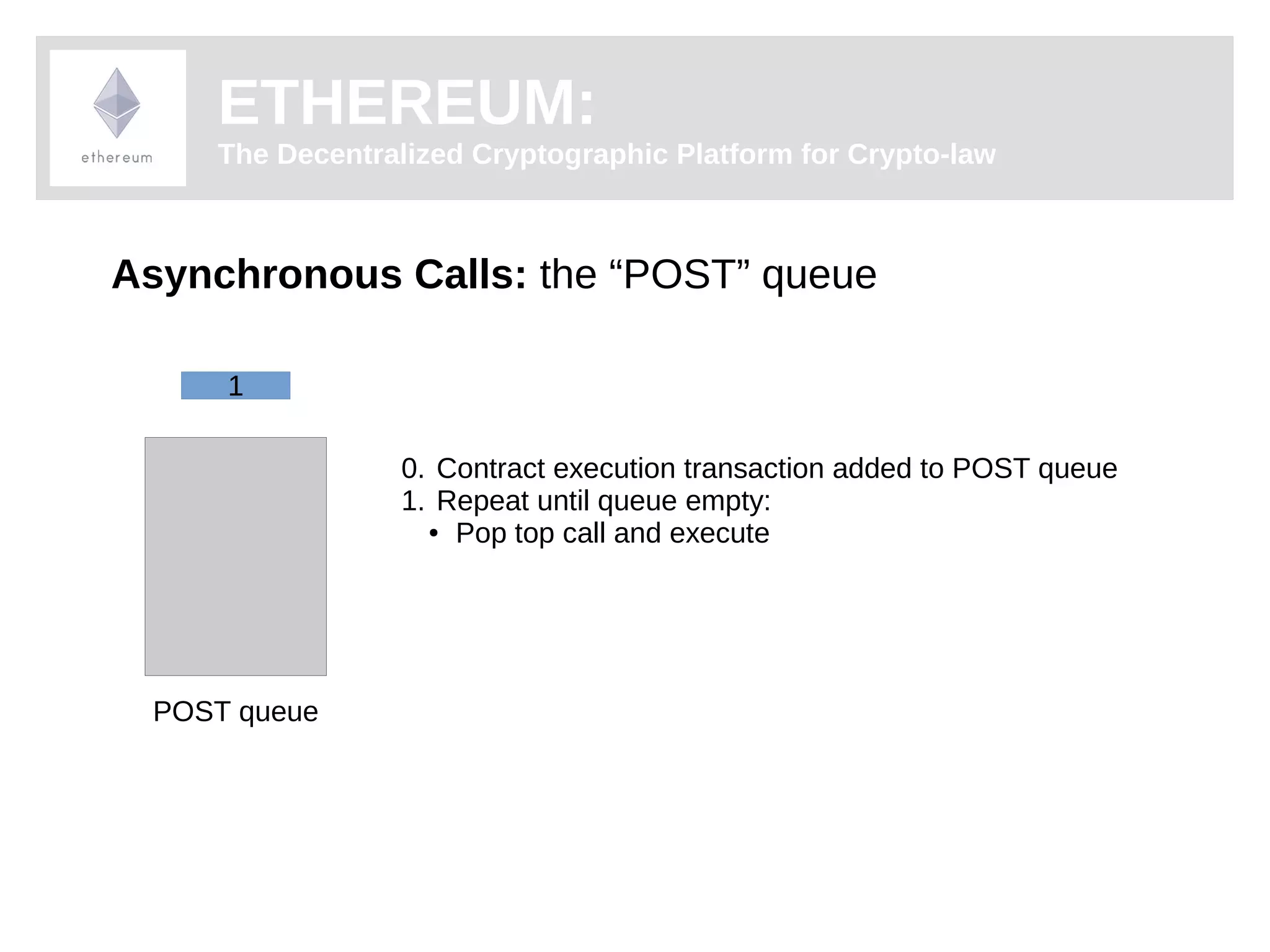
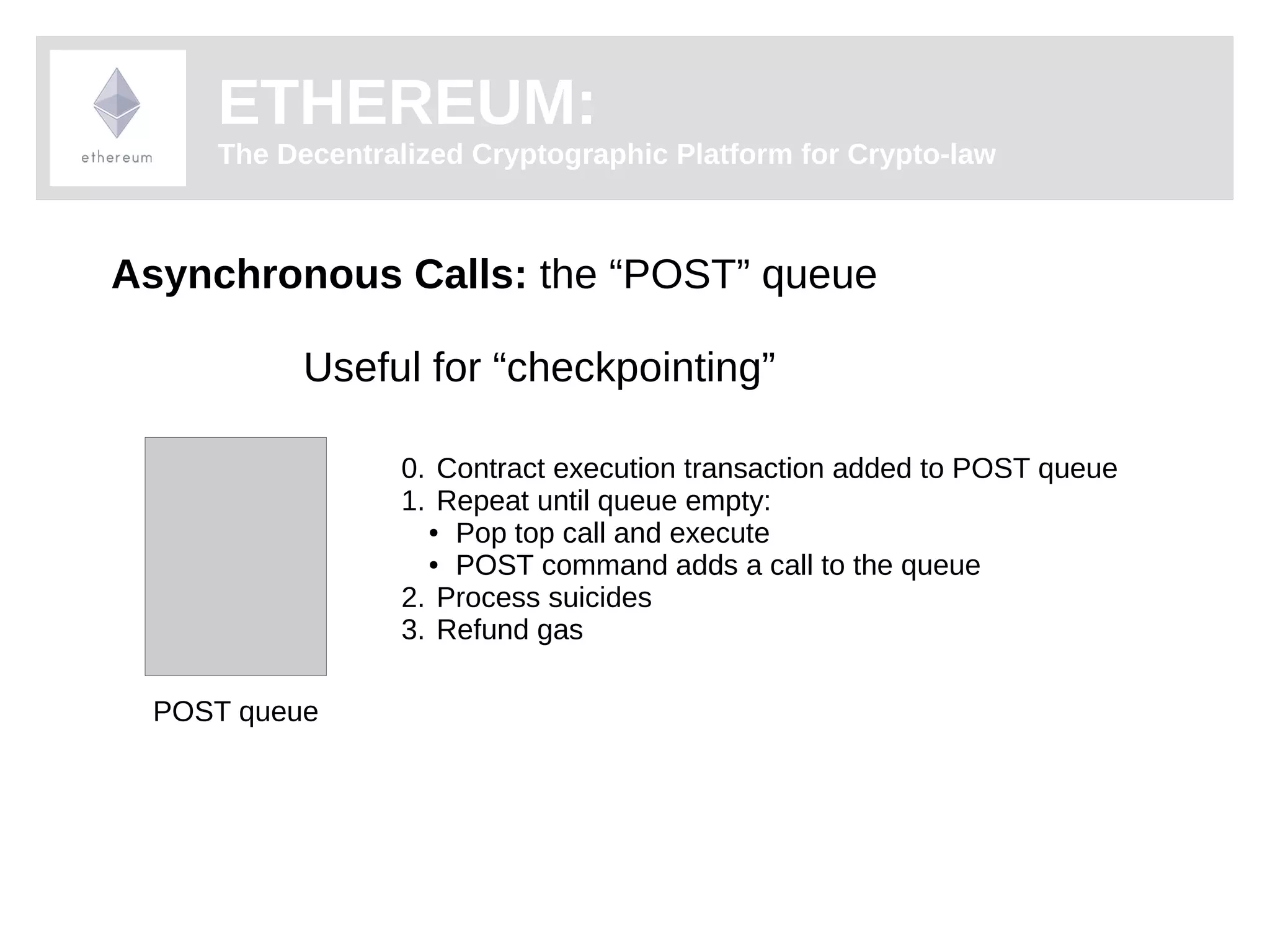
The document discusses recent updates to the Ethereum platform including a reduced block time from 12 to 4 seconds, implementing GHOST for increased robustness, adding the POST opcode for asynchronous calls, and recapping Ethereum coding practices. It provides information on contract deployment, storage, and transactions.







![ETHEREUM:
The Decentralized Cryptographic Platform for Crypto-law
Ethereum coding recap:
{
[[69]] (caller)
(returnlll
(when (= (caller) @@69)
[[ (calldataload 0) ]] (calldataload 32)
)
)
}](https://image.slidesharecdn.com/septhackathon-141021150351-conversion-gate01/75/September-Ethereum-Berlin-Workshop-14-2048.jpg)
![ETHEREUM:
The Decentralized Cryptographic Platform for Crypto-law
Ethereum coding recap:
EVM
non-volatile
code
ROM
storage
RAM
volatile
args
ROM
memory
RAM
stack
[[<addr>]]
@@<addr>
[<addr>]
@<addr>
Calldataload <byte>](https://image.slidesharecdn.com/septhackathon-141021150351-conversion-gate01/75/September-Ethereum-Berlin-Workshop-15-2048.jpg)
![ETHEREUM:
The Decentralized Cryptographic Platform for Crypto-law
Ethereum coding recap:
{
[[69]] (caller)
(returnlll
(when (= (caller) @@69)
(for {} (< @i (calldatasize)) [i](+ @i 64)
[[ (calldataload @i) ]] (calldataload (+ @i 32))
)
)
)
}](https://image.slidesharecdn.com/septhackathon-141021150351-conversion-gate01/75/September-Ethereum-Berlin-Workshop-16-2048.jpg)
![ETHEREUM:
The Decentralized Cryptographic Platform for Crypto-law
Ethereum coding recap:
{
;; Give caller a whole bunch of cash.
[[ (caller) ]]: 0x1000000000000000000000000
;; Register with the NameReg contract.
[0] "GavCoin"
(call (- (gas) 100) 0x2d0aceee7e5ab874e22ccf8d1a649f59106d74e8 0 0 7 0 0)
(returnlll {
(when (!= (calldatasize) 64) (stop)) ; stop if there's
; not enough data passed.
[fromBal] @@(caller)
[toBal]: @@(calldataload 0)
[value]: (calldataload 32)
(when (< @fromBal @value) (stop)) ; stop if there's
; not enough for the transfer.
[[ (caller) ]]: (- @fromBal @value) ; subtract amount
; from caller's account.
[[ (calldataload 0) ]]: (+ @toBal @value) ; add amount on to recipient's account.
})
}](https://image.slidesharecdn.com/septhackathon-141021150351-conversion-gate01/75/September-Ethereum-Berlin-Workshop-17-2048.jpg)


![[4] 아두이노와 인터넷](https://cdn.slidesharecdn.com/ss_thumbnails/4-160816180634-thumbnail.jpg?width=640&height=640&fit=bounds)


![[213] ethereum](https://cdn.slidesharecdn.com/ss_thumbnails/231ethereum-150915024025-lva1-app6891-thumbnail.jpg?width=640&height=640&fit=bounds)


![[DSC Europe 25] Jon Dajci - Bridging TradFi and DeFi: Building the Future of ...](https://cdn.slidesharecdn.com/ss_thumbnails/fqmhfvlbqhkihjvqvhmu-7-251211083849-6af7e325-thumbnail.jpg?width=640&height=640&fit=bounds)

![[DSC Europe 25] Branko Dzakula - From Defense to Attack: How AI Redefines Cyb...](https://cdn.slidesharecdn.com/ss_thumbnails/80bdzdxpr3ky2g0qvyk9-8-251211083048-ce5fc1ee-thumbnail.jpg?width=640&height=640&fit=bounds)
![[DSC Europe 25] Marija Vlajkovic & Andrea Radonjanin - Integration of AI tool...](https://cdn.slidesharecdn.com/ss_thumbnails/qf1jrglttoc3bm8s3aop-final-integration-of-ai-tools-251208151905-394f3a6a-thumbnail.jpg?width=640&height=640&fit=bounds)
![[DSC Europe 25] Branko Urosevic -Rethinking Financial Talent: Integrating Cod...](https://cdn.slidesharecdn.com/ss_thumbnails/8jjrus8ttko6qj64f58f-3-251212103250-642c6374-thumbnail.jpg?width=640&height=640&fit=bounds)
![[DSC Europe 25] Vladimir Jelic - The AI-Driven Security Shift From Reactive D...](https://cdn.slidesharecdn.com/ss_thumbnails/6g5gj25mtjwayniqem1t-6-251209104645-7a5a5fc6-thumbnail.jpg?width=640&height=640&fit=bounds)

![[DSC Europe 25] Dusan Nesic - Securing Tomorrow’s Infrastructure: Why Cyber-P...](https://cdn.slidesharecdn.com/ss_thumbnails/qikbszfftyowjm2q6duw-1-251211083848-8f2ead6b-thumbnail.jpg?width=640&height=640&fit=bounds)
![[DSC Europe 25] Milan Zdravkovic - The road less traveled in District Heating...](https://cdn.slidesharecdn.com/ss_thumbnails/nfaboniqwsz4ucyctnmy-2-milan-zdravkovic-dsc2025-the-road-less-traveled-in-district-heating-operation-251208151905-f56388a5-thumbnail.jpg?width=640&height=640&fit=bounds)


![[DSC Europe 25] Sara Polak - The Ancient Operating System: What Archaeology T...](https://cdn.slidesharecdn.com/ss_thumbnails/3vch2p6tttdnwhsgazoz-3-sara-polak-smart-cities-251208152532-64404202-thumbnail.jpg?width=640&height=640&fit=bounds)
![[DSC Europe 25] Debmalya Biswas - Agentification: the art of transforming man...](https://cdn.slidesharecdn.com/ss_thumbnails/r5azlggvtqiaiiusrqdr-4-251212103249-5a12c89b-thumbnail.jpg?width=640&height=640&fit=bounds)
![[DSC Europe 25] Sara Polak - The Archaeology of Innovation: AI as the Next Cr...](https://cdn.slidesharecdn.com/ss_thumbnails/7ecbscdnt8mlcuqbd2ln-2-sara-polak-ai-creative-industries-251208152533-aa1fcf54-thumbnail.jpg?width=640&height=640&fit=bounds)

![[DSC Europe 25] Aleksandra Dragicevic - AI-Boosted Research in Healthcare: Fr...](https://cdn.slidesharecdn.com/ss_thumbnails/iqwngszurf2r7pi1lnnj-4-aleksandra-dragicevic-ad-dsc-europe-conference-20-251208151905-37c3238a-thumbnail.jpg?width=640&height=640&fit=bounds)