Developing Blockchain
Applications
November 28, 2018
getting started with ethereum
our	goal	today
1. Understand	how	Ethereum	applications	work
2. Understand	the	framework	and	how	projects	are	structured
3. Write	and	deploy	code
few	questions	before	we	start…
• Have	you	transacted	ETH?
• Do	you	know	what	dapps are?	
• Have	you	used	a	dapp?	
• Have	you	written	a	smart	contract	or	developed	a	dapp?
Part	1:	Ethereum	Architecture
and	how	do	Ethereum	apps	work?
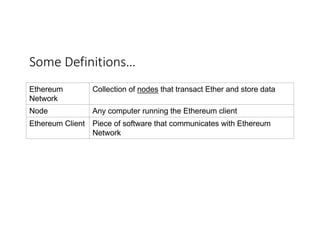
Some	Definitions…
Ethereum
Network
Collection of nodes that transact Ether and store data
Node Any computer running the Ethereum client
Ethereum Client Piece of software that communicates with Ethereum
Network
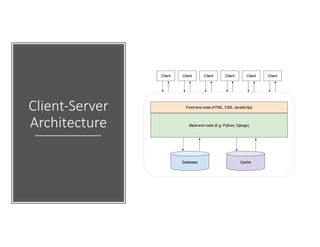
Client-Server	
Architecture
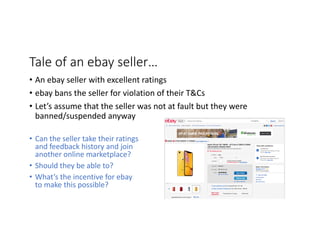
Tale	of	an	ebay	seller…
• Can	the	seller	take	their	ratings	
and	feedback	history	and	join	
another	online	marketplace?
• Should	they	be	able	to?	
• What’s	the	incentive	for	ebay	
to	make	this	possible?	
• An	ebay	seller	with	excellent	ratings
• ebay	bans	the	seller	for	violation	of	their	T&Cs
• Let’s	assume	that	the	seller	was	not	at	fault	but	they	were	
banned/suspended	anyway
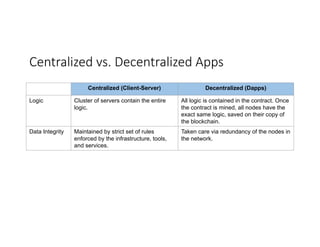
Centralized	vs.	Decentralized	Apps
Centralized (Client-Server) Decentralized (Dapps)
Logic Cluster of servers contain the entire
logic.
All logic is contained in the contract. Once
the contract is mined, all nodes have the
exact same logic, saved on their copy of
the blockchain.
Data Integrity Maintained by strict set of rules
enforced by the infrastructure, tools,
and services.
Taken care via redundancy of the nodes in
the network.
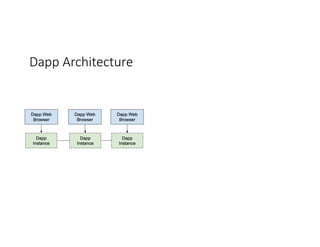
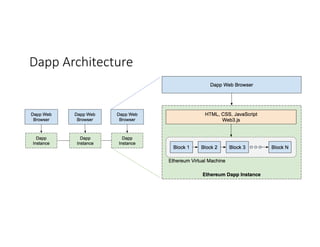
Dapp Architecture
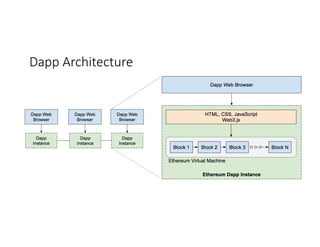
Dapp Architecture
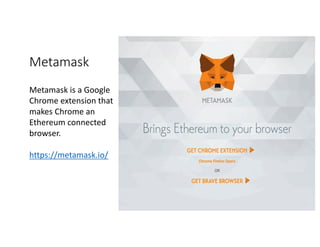
Metamask
Metamask	is	a	Google	
Chrome	extension	that	
makes	Chrome	an	
Ethereum	connected	
browser.
https://metamask.io/
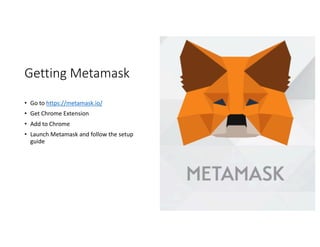
Getting	Metamask
• Go	to	https://metamask.io/
• Get	Chrome	Extension
• Add	to	Chrome
• Launch	Metamask	and	follow	the	setup	
guide
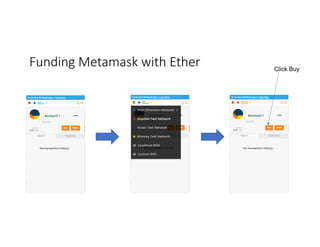
Funding	Metamask	with	Ether	 Click Buy
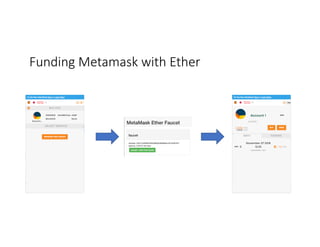
Funding	Metamask	with	Ether
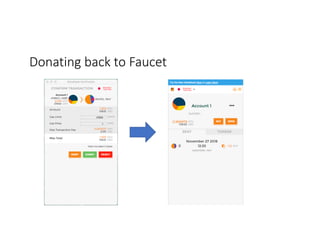
Donating	back	to	Faucet
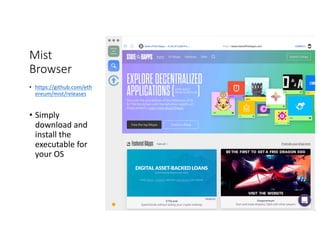
Mist	
Browser
• https://github.com/eth
ereum/mist/releases
• Simply	
download	and	
install	the	
executable	for	
your	OS
Dapp Examples
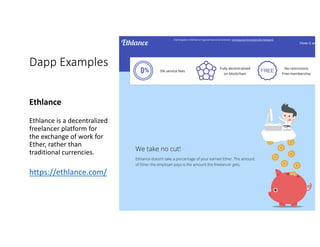
Ethlance
Ethlance	is	a	decentralized	
freelancer	platform	for	
the	exchange	of	work	for	
Ether,	rather	than	
traditional	currencies.
https://ethlance.com/
Dapp Examples
Swarm	City	
Swarm	City	is	a	decentralized	P2P	sharing	
economy.	Some	have	called	it	Uber	or	
Craigslist	on	the	blockchain.	It	requires	
users	to	have	a	Swarm	City	Token	in	
order	to	pay	for	transactions	in	the	
ecosystem.
https://swarm.city/
Dapp Examples
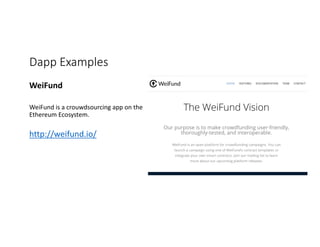
WeiFund
WeiFund is	a	crouwdsourcing app	on	the	
Ethereum	Ecosystem.	
http://weifund.io/
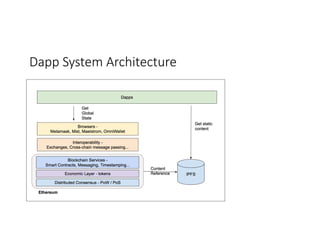
Dapp Architecture
Dapp System	Architecture
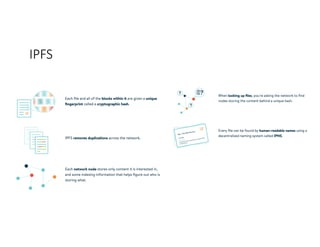
IPFS
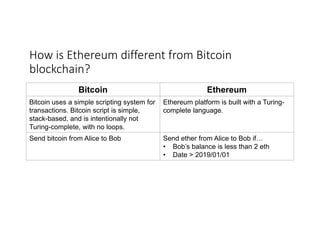
How	is	Ethereum	different	from	Bitcoin	
blockchain?
Bitcoin Ethereum
Bitcoin uses a simple scripting system for
transactions. Bitcoin script is simple,
stack-based, and is intentionally not
Turing-complete, with no loops.
Ethereum platform is built with a Turing-
complete language.
Send bitcoin from Alice to Bob Send ether from Alice to Bob if…
• Bob’s balance is less than 2 eth
• Date > 2019/01/01
Ethereum	Accounts
• External	
• Contract
Part	2:	Dev	Setup
Install	the	tools	and	understand	the	framework
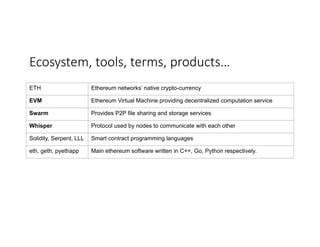
Ecosystem,	tools,	terms,	products…
ETH Ethereum networks’ native crypto-currency
EVM Ethereum Virtual Machine providing decentralized computation service
Swarm Provides P2P file sharing and storage services
Whisper Protocol used by nodes to communicate with each other
Solidity, Serpent, LLL Smart contract programming languages
eth, geth, pyethapp Main ethereum software written in C++, Go, Python respectively.
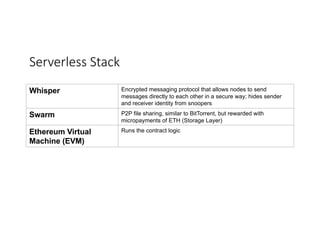
Serverless	Stack
Whisper Encrypted messaging protocol that allows nodes to send
messages directly to each other in a secure way; hides sender
and receiver identity from snoopers
Swarm P2P file sharing, similar to BitTorrent, but rewarded with
micropayments of ETH (Storage Layer)
Ethereum Virtual
Machine (EVM)
Runs the contract logic
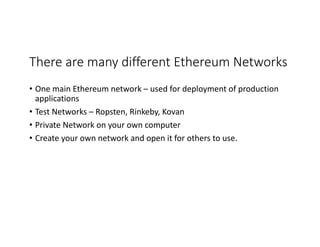
There	are	many	different	Ethereum	Networks
• One	main	Ethereum	network	– used	for	deployment	of	production	
applications
• Test	Networks	– Ropsten,	Rinkeby,	Kovan
• Private	Network	on	your	own	computer
• Create	your	own	network	and	open	it	for	others	to	use.
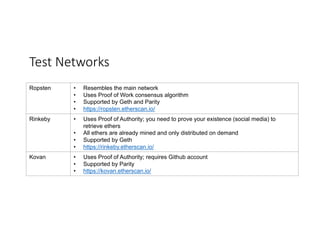
Test	Networks
Ropsten • Resembles the main network
• Uses Proof of Work consensus algorithm
• Supported by Geth and Parity
• https://ropsten.etherscan.io/
Rinkeby • Uses Proof of Authority; you need to prove your existence (social media) to
retrieve ethers
• All ethers are already mined and only distributed on demand
• Supported by Geth
• https://rinkeby.etherscan.io/
Kovan • Uses Proof of Authority; requires Github account
• Supported by Parity
• https://kovan.etherscan.io/
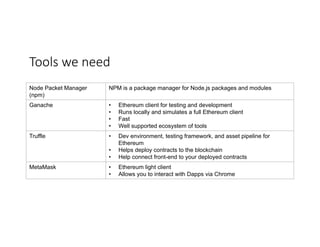
Tools	we	need
Node Packet Manager
(npm)
NPM is a package manager for Node.js packages and modules
Ganache • Ethereum client for testing and development
• Runs locally and simulates a full Ethereum client
• Fast
• Well supported ecosystem of tools
Truffle • Dev environment, testing framework, and asset pipeline for
Ethereum
• Helps deploy contracts to the blockchain
• Help connect front-end to your deployed contracts
MetaMask • Ethereum light client
• Allows you to interact with Dapps via Chrome
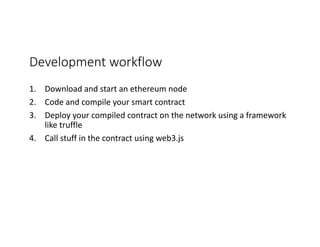
Development	workflow
1. Download	and	start	an	ethereum	node
2. Code	and	compile	your	smart	contract
3. Deploy	your	compiled	contract	on	the	network	using	a	framework	
like	truffle
4. Call	stuff	in	the	contract	using	web3.js
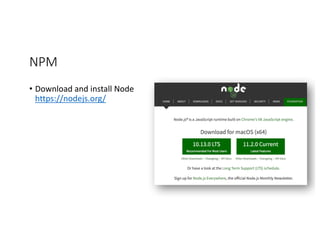
NPM	
• Download	and	install	Node
https://nodejs.org/
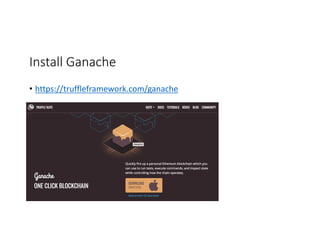
Install	Ganache
• https://truffleframework.com/ganache
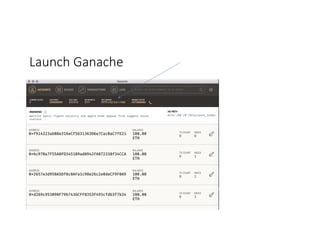
Launch	Ganache
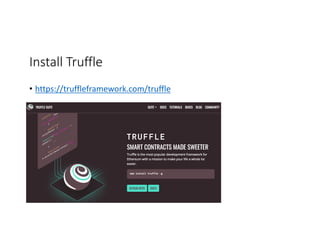
Install	Truffle
• https://truffleframework.com/truffle
Part	3:	Code	and	Deploy
Code	your	first	smart	contract	and	deploy	it	on	blockchain
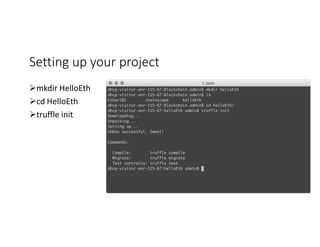
Setting	up	your	project
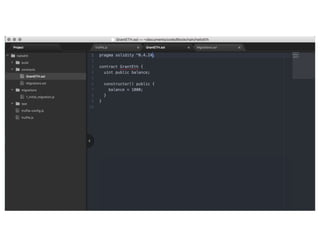
Ømkdir HelloEth
Øcd HelloEth
Øtruffle init
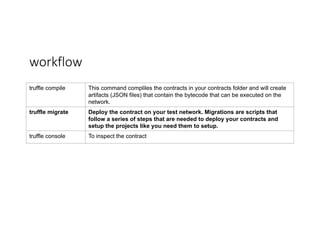
workflow
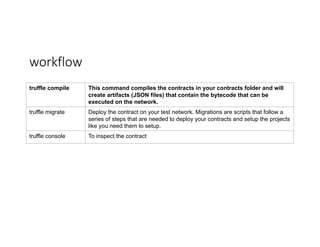
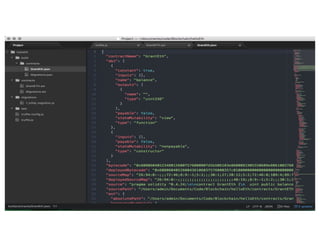
truffle compile This command compiles the contracts in your contracts folder and will
create artifacts (JSON files) that contain the bytecode that can be
executed on the network.
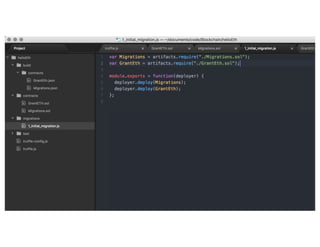
truffle migrate Deploy the contract on your test network. Migrations are scripts that follow a
series of steps that are needed to deploy your contracts and setup the projects
like you need them to setup.
truffle console To inspect the contract
workflow
truffle compile This command compliles the contracts in your contracts folder and will create
artifacts (JSON files) that contain the bytecode that can be executed on the
network.
truffle migrate Deploy the contract on your test network. Migrations are scripts that
follow a series of steps that are needed to deploy your contracts and
setup the projects like you need them to setup.
truffle console To inspect the contract
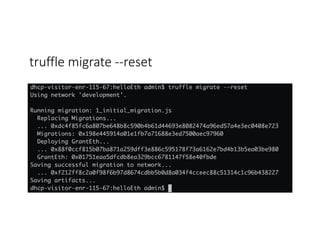
truffle	migrate	--reset
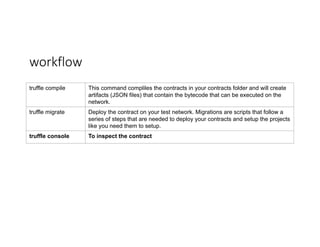
workflow
truffle compile This command compliles the contracts in your contracts folder and will create
artifacts (JSON files) that contain the bytecode that can be executed on the
network.
truffle migrate Deploy the contract on your test network. Migrations are scripts that follow a
series of steps that are needed to deploy your contracts and setup the projects
like you need them to setup.
truffle console To inspect the contract
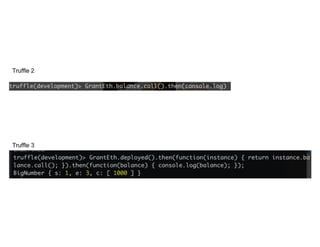
Truffle 3
Truffle 2
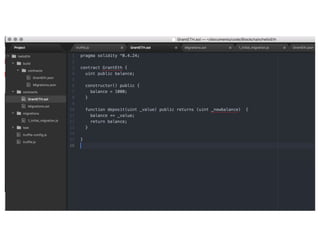
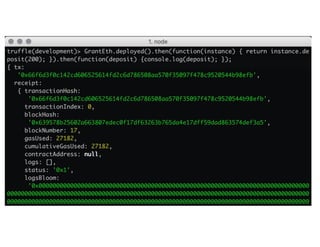
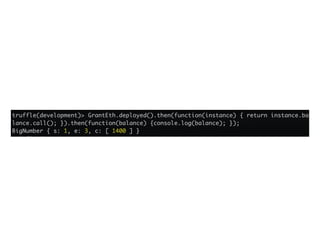
Now	that	we	can	call()	our	contract,	let’s	create	a	
transaction	that	changes	state.
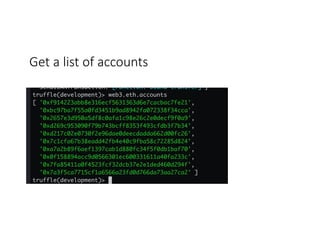
Get	a	list	of	accounts
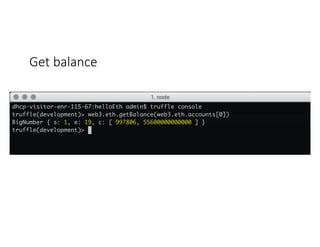
Get	balance
Summary	of	what	we	did	today
1. Understand	how	Ethereum	applications	work
2. Overview	of	the	framework	and	a	small	sliver	of	tools	in	the	
ecosystem
3. Wrote	and	deployed	a	smart	contract
Thank you

Developing Blockchain Applications