Ingredients for
creating Dapps
by stefaan ponnet
API Craftsmanship Meetup aug 11 2016
The basics: Ethereum as a smart
contract platform
Blockchain
Nodes and mining
Transactions
EVM
Smart Contracts
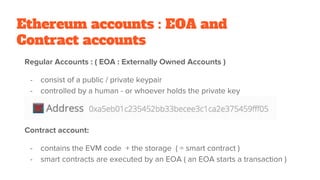
Ethereum accounts : EOA and
Contract accounts
Regular Accounts : ( EOA : Externally Owned Accounts )
- consist of a public / private keypair
- controlled by a human - or whoever holds the private key
Contract account:
- contains the EVM code + the storage ( = smart contract )
- smart contracts are executed by an EOA ( an EOA starts a transaction )
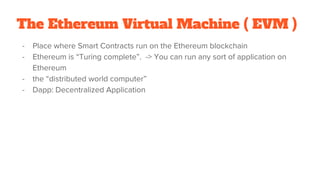
The Ethereum Virtual Machine ( EVM )
- Place where Smart Contracts run on the Ethereum blockchain
- Ethereum is “Turing complete”. -> You can run any sort of application on
Ethereum
- the “distributed world computer”
- Dapp: Decentralized Application
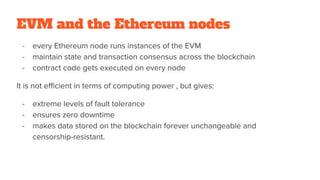
EVM and the Ethereum nodes
- every Ethereum node runs instances of the EVM
- maintain state and transaction consensus across the blockchain
- contract code gets executed on every node
It is not efficient in terms of computing power , but gives:
- extreme levels of fault tolerance
- ensures zero downtime
- makes data stored on the blockchain forever unchangeable and
censorship-resistant.
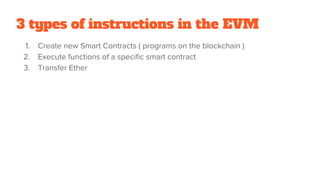
3 types of instructions in the EVM
1. Create new Smart Contracts ( programs on the blockchain )
2. Execute functions of a specific smart contract
3. Transfer Ether
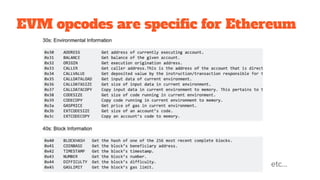
EVM opcodes are specific for Ethereum
etc...
Preventing spam
Problem
Public blockchain : if anyone can deploy and run contracts - it gets
overloaded
Solution
Use a anti-spam payment token : Gas
Gas
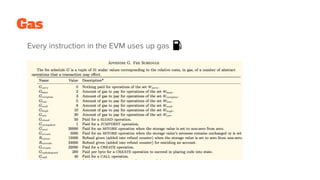
Every instruction in the EVM uses up gas
- Gas is bought using Ether by the caller to fuel the EVM.
- There is a (dynamic) gasprice ( ETH / gas )
- You set a gas limit per transaction to avoid draining the caller’s account
- When the execution of the contract ends within the gas limit , the new
state is saved on the blockchain and the leftover gas is refunded.
Gas
Gas
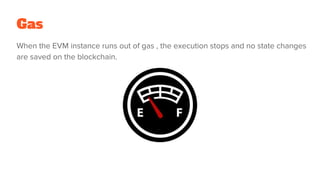
When the EVM instance runs out of gas , the execution stops and no state changes
are saved on the blockchain.
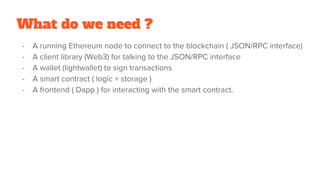
What do we need ?
- A running Ethereum node to connect to the blockchain ( JSON/RPC interface)
- A client library (Web3) for talking to the JSON/RPC interface
- A wallet (lightwallet) to sign transactions
- A smart contract ( logic + storage )
- A frontend ( Dapp ) for interacting with the smart contract.
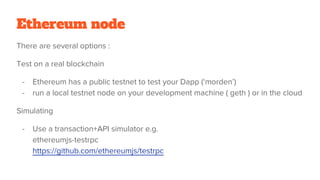
Ethereum node
There are several options :
Test on a real blockchain
- Ethereum has a public testnet to test your Dapp (‘morden’)
- run a local testnet node on your development machine ( geth ) or in the cloud
Simulating
- Use a transaction+API simulator e.g.
ethereumjs-testrpc
https://github.com/ethereumjs/testrpc
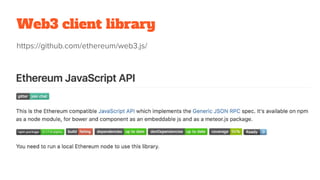
Web3 client library
https://github.com/ethereum/web3.js/
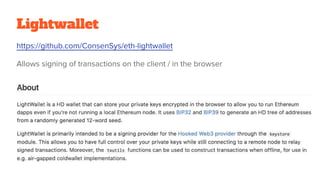
Lightwallet
https://github.com/ConsenSys/eth-lightwallet
Allows signing of transactions on the client / in the browser
A Smart contract
To create the EVM bytecode - we use a special programming language called
Solidity
and we need a compiler that converts out solidity files into EVM bytecode for us.
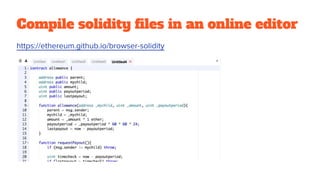
Compile solidity files in an online editor
https://ethereum.github.io/browser-solidity
Compile solidity files using Truffle
https://truffle.readthedocs.io/en/latest/
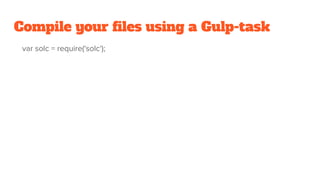
Compile your files using a Gulp-task
var solc = require('solc');
Example : Macaulay’s allowance
As a parent you want to give a weekly allowance to your kid - which your kid can
claim once every week.
We will create a contract that :
- Holds the allowance funds
- Allows the parent to define the kid’s wallet account (recepient of the funds)
- Allows the kid to periodically claim funds out of the allowance contract.
Create the contract
→ See example...
Creating the Dapp
We will use Polymer to create a quick app
we want to be able to
- As a parent : deploy a new contract and set the rules for our kid’s allowance
- As a kid : be able to get the allowance
Create a few Polymer components
- yo polymer → Scaffold out the base app
- bower install web3-wallet → add web3-wallet component
- yo polymer:el allowance-wallet → visualize your wallet & show balance
- yo polymer:el allowance-create → create a new allowance contract
- yo polymer:el allowance-claim → extract funds from the contract
Deploy and test the app
Only deploy the HTML/js files
There is no central backend server
Hosting can also be decentral ( IPFS : Interplanetary File System )
→ Demo time !
Thats it!
Get the code here : https://github.com/sponnet/allowance
DAO initiatives
If you like this & want to learn more and put it into practice :
We are rolling out several DAO’s ( https://www.ethereum.org/dao ) in which you can
participate immediately as
- developer
- curator
- investor
- marketing ...
e.g. decentralized video platform ( blocktu.be ) / a product DAO ( KimRadio ) / and a
blockchain expert group DAO
Next meetups
Starting in september we will host 1 meetup per month like this one
And every week we’ll be organizing free open-table discussions here at BIA.
Join our group to recieve updates: http://www.meetup.com/API-Craftsmanship/
Hope to see you soon !
@sponnet - stefaan@ponnet.com - https://www.linkedin.com/in/sponnet

Ingredients for creating dapps

  • 1.
    Ingredients for creating Dapps bystefaan ponnet API Craftsmanship Meetup aug 11 2016
  • 2.
    The basics: Ethereumas a smart contract platform Blockchain Nodes and mining Transactions EVM Smart Contracts
  • 3.
    Ethereum accounts :EOA and Contract accounts Regular Accounts : ( EOA : Externally Owned Accounts ) - consist of a public / private keypair - controlled by a human - or whoever holds the private key Contract account: - contains the EVM code + the storage ( = smart contract ) - smart contracts are executed by an EOA ( an EOA starts a transaction )
  • 4.
    The Ethereum VirtualMachine ( EVM ) - Place where Smart Contracts run on the Ethereum blockchain - Ethereum is “Turing complete”. -> You can run any sort of application on Ethereum - the “distributed world computer” - Dapp: Decentralized Application
  • 5.
    EVM and theEthereum nodes - every Ethereum node runs instances of the EVM - maintain state and transaction consensus across the blockchain - contract code gets executed on every node It is not efficient in terms of computing power , but gives: - extreme levels of fault tolerance - ensures zero downtime - makes data stored on the blockchain forever unchangeable and censorship-resistant.
  • 6.
    3 types ofinstructions in the EVM 1. Create new Smart Contracts ( programs on the blockchain ) 2. Execute functions of a specific smart contract 3. Transfer Ether
  • 7.
    EVM opcodes arespecific for Ethereum etc...
  • 8.
    Preventing spam Problem Public blockchain: if anyone can deploy and run contracts - it gets overloaded Solution Use a anti-spam payment token : Gas
  • 9.
    Gas Every instruction inthe EVM uses up gas
  • 10.
    - Gas isbought using Ether by the caller to fuel the EVM. - There is a (dynamic) gasprice ( ETH / gas ) - You set a gas limit per transaction to avoid draining the caller’s account - When the execution of the contract ends within the gas limit , the new state is saved on the blockchain and the leftover gas is refunded. Gas
  • 11.
    Gas When the EVMinstance runs out of gas , the execution stops and no state changes are saved on the blockchain.
  • 12.
    What do weneed ? - A running Ethereum node to connect to the blockchain ( JSON/RPC interface) - A client library (Web3) for talking to the JSON/RPC interface - A wallet (lightwallet) to sign transactions - A smart contract ( logic + storage ) - A frontend ( Dapp ) for interacting with the smart contract.
  • 13.
    Ethereum node There areseveral options : Test on a real blockchain - Ethereum has a public testnet to test your Dapp (‘morden’) - run a local testnet node on your development machine ( geth ) or in the cloud Simulating - Use a transaction+API simulator e.g. ethereumjs-testrpc https://github.com/ethereumjs/testrpc
  • 14.
  • 15.
  • 16.
    A Smart contract Tocreate the EVM bytecode - we use a special programming language called Solidity and we need a compiler that converts out solidity files into EVM bytecode for us.
  • 17.
    Compile solidity filesin an online editor https://ethereum.github.io/browser-solidity
  • 18.
    Compile solidity filesusing Truffle https://truffle.readthedocs.io/en/latest/
  • 19.
    Compile your filesusing a Gulp-task var solc = require('solc');
  • 20.
    Example : Macaulay’sallowance As a parent you want to give a weekly allowance to your kid - which your kid can claim once every week. We will create a contract that : - Holds the allowance funds - Allows the parent to define the kid’s wallet account (recepient of the funds) - Allows the kid to periodically claim funds out of the allowance contract.
  • 21.
  • 22.
    Creating the Dapp Wewill use Polymer to create a quick app we want to be able to - As a parent : deploy a new contract and set the rules for our kid’s allowance - As a kid : be able to get the allowance
  • 23.
    Create a fewPolymer components - yo polymer → Scaffold out the base app - bower install web3-wallet → add web3-wallet component - yo polymer:el allowance-wallet → visualize your wallet & show balance - yo polymer:el allowance-create → create a new allowance contract - yo polymer:el allowance-claim → extract funds from the contract
  • 24.
    Deploy and testthe app Only deploy the HTML/js files There is no central backend server Hosting can also be decentral ( IPFS : Interplanetary File System ) → Demo time !
  • 25.
    Thats it! Get thecode here : https://github.com/sponnet/allowance
  • 26.
    DAO initiatives If youlike this & want to learn more and put it into practice : We are rolling out several DAO’s ( https://www.ethereum.org/dao ) in which you can participate immediately as - developer - curator - investor - marketing ... e.g. decentralized video platform ( blocktu.be ) / a product DAO ( KimRadio ) / and a blockchain expert group DAO
  • 27.
    Next meetups Starting inseptember we will host 1 meetup per month like this one And every week we’ll be organizing free open-table discussions here at BIA. Join our group to recieve updates: http://www.meetup.com/API-Craftsmanship/ Hope to see you soon ! @sponnet - stefaan@ponnet.com - https://www.linkedin.com/in/sponnet