Gaurav K sardhara
 Search Engine Optimization, SEO, is the active
practice of optimizing a website, by improving
internal and external aspects, in order to increase
the traffic from search engines.
 As an Internet marketing strategy, SEO considers
how search engines work and what people search
for. Optimizing a website primarily involves editing
its content and HTML and associated coding to
both increase its relevance to specific keywords
and to remove barriers to the indexing activities of
search engines.
Gaurav K sardhara
 Search becomes the main aspect of the society. The way
people work, play, shop, research, and interact has changed
forever
 Organizations of all kinds (businesses and charities), as well
as individuals, need to have a presence on the Web and they
need the search engines to bring them traffic.
 As our society moves ever closer to a professional Consumer
economy, the ways in which people create, publish,
distribute, and ultimately find information and resources on
the Internet will continue to be of great importance
Gaurav K sardhara
 With more than 12 billion searches being performed
each month.
 Approximately 400 million web searches are performed
every day.
 This means that on average more than 4,500 searches
are performed every single second of every day.
 Therefore search engine optimization, is at the center of
the Web and is your key to success in the new web
economy.
Gaurav K sardhara
 Search engines generate revenue primarily through paid
advertising. The great majority of this revenue comes
from a pay-per-click in which the advertisers pay only
for users who click on their ads.
 Since web searchers are free to use any of the many
available search engines on the Web.
 Find what they are seeking, the burden is on the search
engines to develop a relevant, fast, and fresh search
experience.
 For the most part, search engines accomplish this by
providing the most relevant results and delivering them
the fastest, as users will go to the search engine they
think will get them the answers they want in the least
amount of time.
Gaurav K sardhara
 As a result, search engines invest a tremendous amount of
time, energy, and capital in improving their relevance. This
includes performing extensive studies of user responses to
their search results, comparing their results against those of
other search engines.
 Because the search engines’ success depends so greatly on
the relevance of their search results, manipulations of search
engine rankings that result in non-relevant results (generally
referred to as spam) are dealt with very seriously.
 Each major search engine employs a team of people who
focus solely on finding and eliminating spam from their
search results. This matters to SEO practitioners because they
need to be careful that the policey they employ will not be
seen as spam by the search engines and carry the risk of
resulting in penalties for the websites they work on.
Gaurav K sardhara
Gaurav K sardhara
 Global:
Google 85.72%
Yahoo 6.42%
Baidu 3.67%
Bing 2.14%
Ask.com 0.56%
Other 0.49%
 United States:
 Google 84.58%
 Yahoo 8.13%
 Bing 5.38%
 Ask.com 0.79%
 Other 1.12%

Gaurav K sardhara
 The basic goal of a human searcher is to obtain
information relevant to her inquiry.
 However, searcher inquiries can take many
different forms.
 One of the most important elements to building an
online marketing strategy for a website around SEO
and search rankings is understanding of the
psychology of your target audience.
 Once you understand how the average searcher,
and more specifically, your target market, uses
search engines, you can more effectively reach and
keep those users.
Gaurav K sardhara
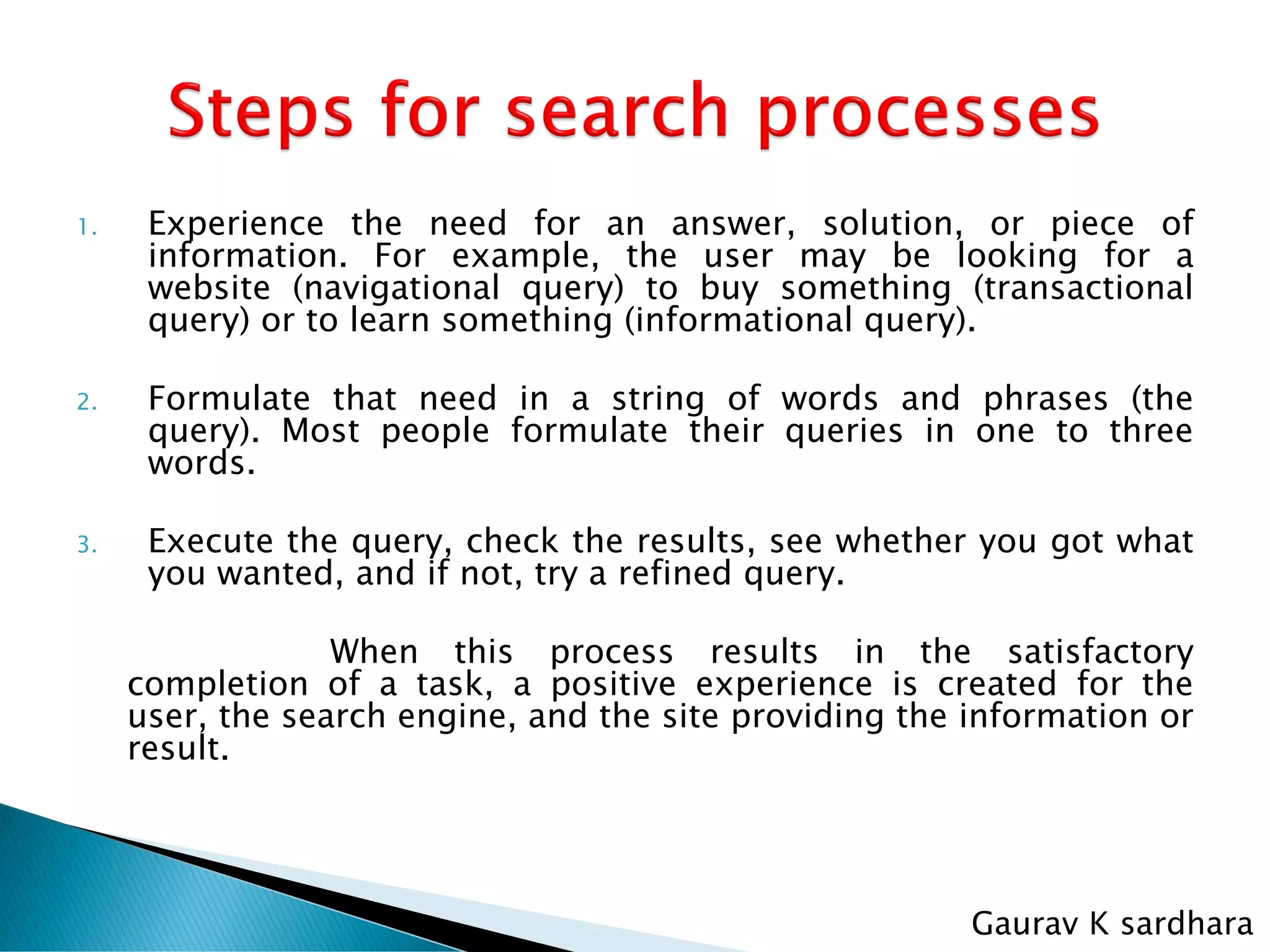
1. Experience the need for an answer, solution, or piece of
information. For example, the user may be looking for a
website (navigational query) to buy something (transactional
query) or to learn something (informational query).
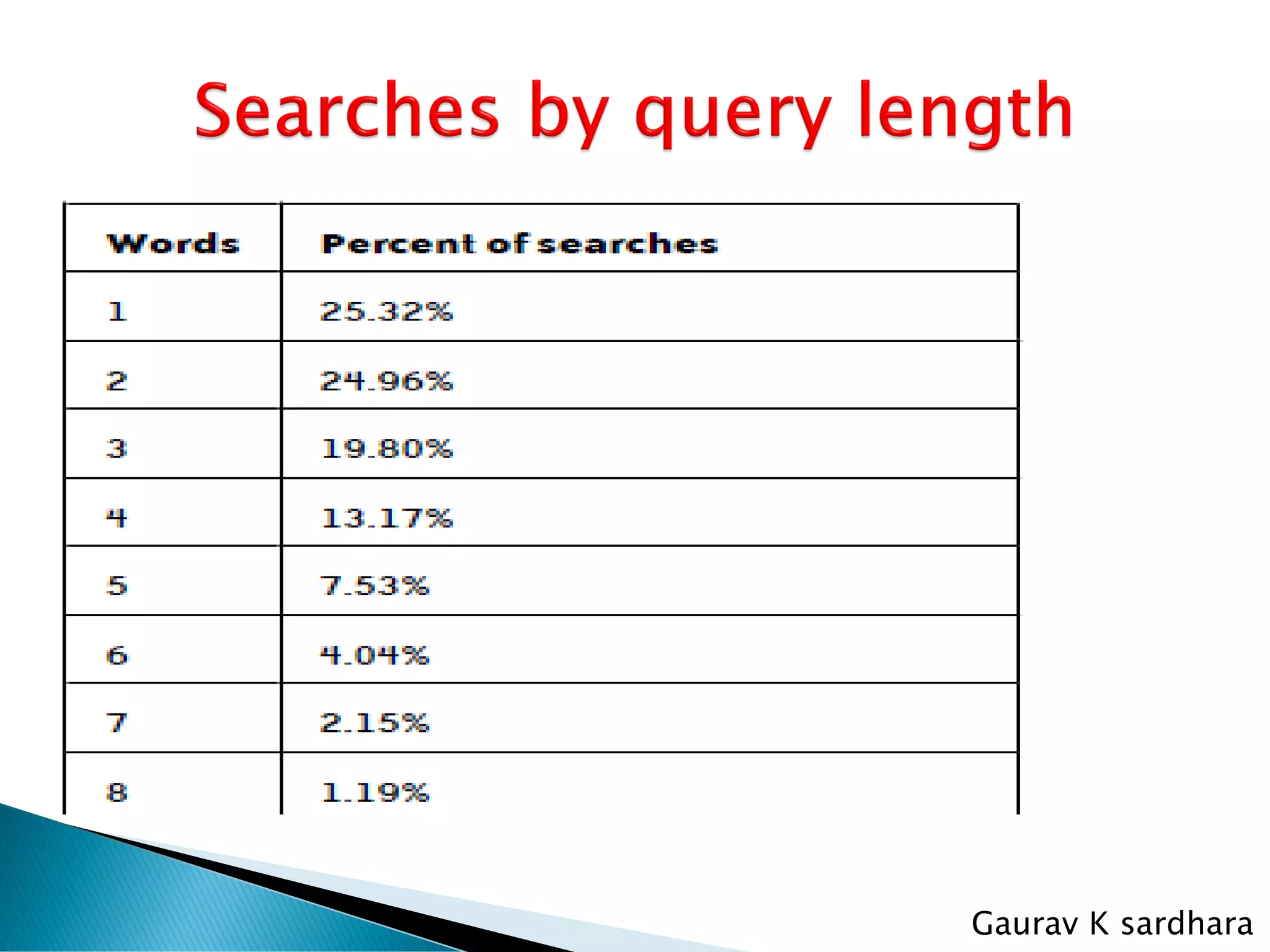
2. Formulate that need in a string of words and phrases (the
query). Most people formulate their queries in one to three
words.
3. Execute the query, check the results, see whether you got what
you wanted, and if not, try a refined query.
When this process results in the satisfactory
completion of a task, a positive experience is created for the
user, the search engine, and the site providing the information or
result.
Gaurav K sardhara
Gaurav K sardhara
 ComScore data shows that just under 79 million people in the
United States were using a search engine on a given day in
January 2009.
 Search engine users were slightly more likely to be women
than men (50.4% versus 49.6%).
 Internet usage increases with household income
Gaurav K sardhara
 Household income Internet users
 $15,000–$24,999 5,792
 $25,000–$39,999 16,108
 $40,000–$59,999 39,716
 $60,000–$74,999 20,947
 $75,000–$99,000 28,995
 $100,000 or more 44,627
Gaurav K sardhara
 All of this research data leads us to some important conclusions
about web search and marketing through search engines.
 For example:
1. Search is very, very popular. It reaches nearly every online
American and billions of people around the world.
2. Google is the dominant player in most world markets
3. Users tend to use short search phrases, but these are
gradually getting longer
4. Search covers all types of markets.
Search is undoubtedly one of the best and most important ways
to reach consumers and build a business, no matter the size,
reach, or focus.
Gaurav K sardhara
 Smart SEO practitioners and the search engines have a common goal
of providing searchers with results that are relevant to their queries.

 Therefore, a crucial element to building an online marketing strategy
around SEO and search rankings is to understand your audience.
Once you grasp how your target market searches for your service,
product, or resource, you can more effectively reach and keep those
users.
 Search engine marketers need to be aware that search engines are
depend upon intent.
Gaurav K sardhara
 Using the search box is fundamentally different from entering a
URL into the address bar, clicking on a bookmark, or picking a
link on your start page to go to a website.
 It is unique from a click on the button in your toolbar or a visit
to your favorite blog.
 Searches are performed with intent; the user wants to find
something in particular, rather than just land on it by chance.
 First decide different types of queries, their categories,
characteristics, and processes.
Gaurav K sardhara
 Navigational Queries
 Informational Queries
 Transactional Queries
Gaurav K sardhara
 Navigational searches are performed with the intent of surfing directly to
a specific website.
 In some cases, the user may not know the exact URL, and the search
engine serves as the “WhitePages.”
For example :
 Searching for the detail of Indian airlines
 OR searching for a particular college like Sunshine college
Opportunities:
Pull searcher away from destination; get additional or investigatory traffic
Average value:
Generally low, with the exception of navigational searches on the
publisher’s own brand, where the value is very high as these types of
searches tend to lead to very high conversion rates.
Gaurav K sardhara
 Informational searches involve a huge range of queries
 For example local weather, maps and directions, details
on the latest Hollywood awards ceremony etc.
 Informational searches are primarily non-transaction-
oriented the information itself is the goal and no
interaction beyond clicking and reading is required.
 Users are interested in finding as much information as
possible with informational queries. For example, “What
is a prime factor?” or ‘prime factor’ is an informational
query. Its goal is finding the meaning of ‘prime factor’.
Gaurav K sardhara
 Top 10 students of GTU
 Iifa award winner in male category
 Here no fix site url is required to search but
we need general information from any site
Gaurav K sardhara
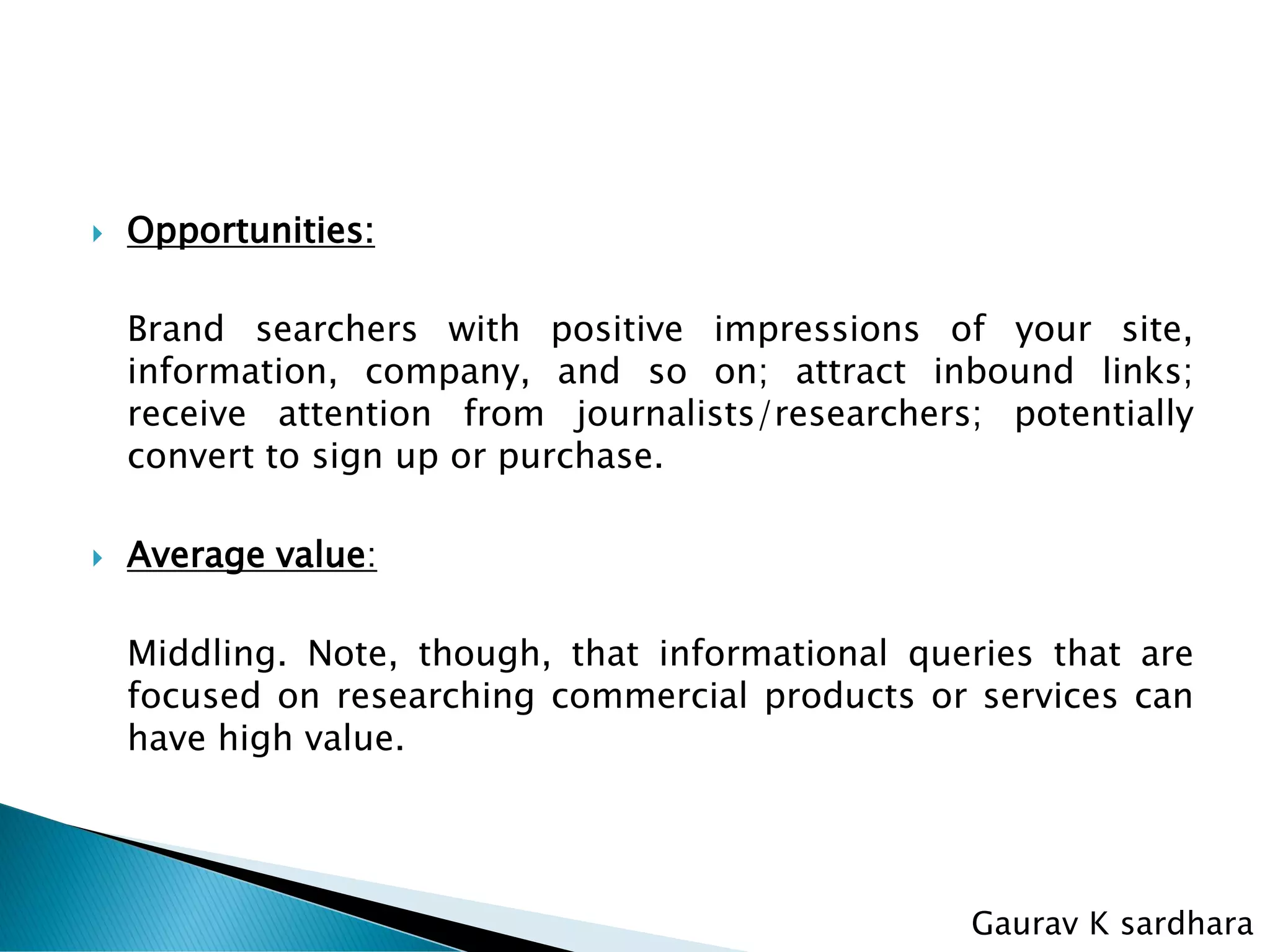
 Opportunities:
Brand searchers with positive impressions of your site,
information, company, and so on; attract inbound links;
receive attention from journalists/researchers; potentially
convert to sign up or purchase.
 Average value:
Middling. Note, though, that informational queries that are
focused on researching commercial products or services can
have high value.
Gaurav K sardhara
 Transactional searches don’t necessarily involve a credit card or wire
transfer. Creating a Gmail account, paying a parking ticket, or
finding the best local restaurant for dinner tonight are all
transactional queries.
 Users are interested in finding a document that offers the service
 described in a transactional query.
 For example..
 “from where to download songs?’
 Songs?” or ‘old songs’ is a transactional query. Users do not desire
to learn
 about lyrics of old songs, but simply a desire to download the songs
Gaurav K sardhara
 Finding a restaurant at Rajkot.
 Online pay bill
 Opportunities:
 Achieve transaction (financial or other).
 Average value:
 Very high.
Gaurav K sardhara
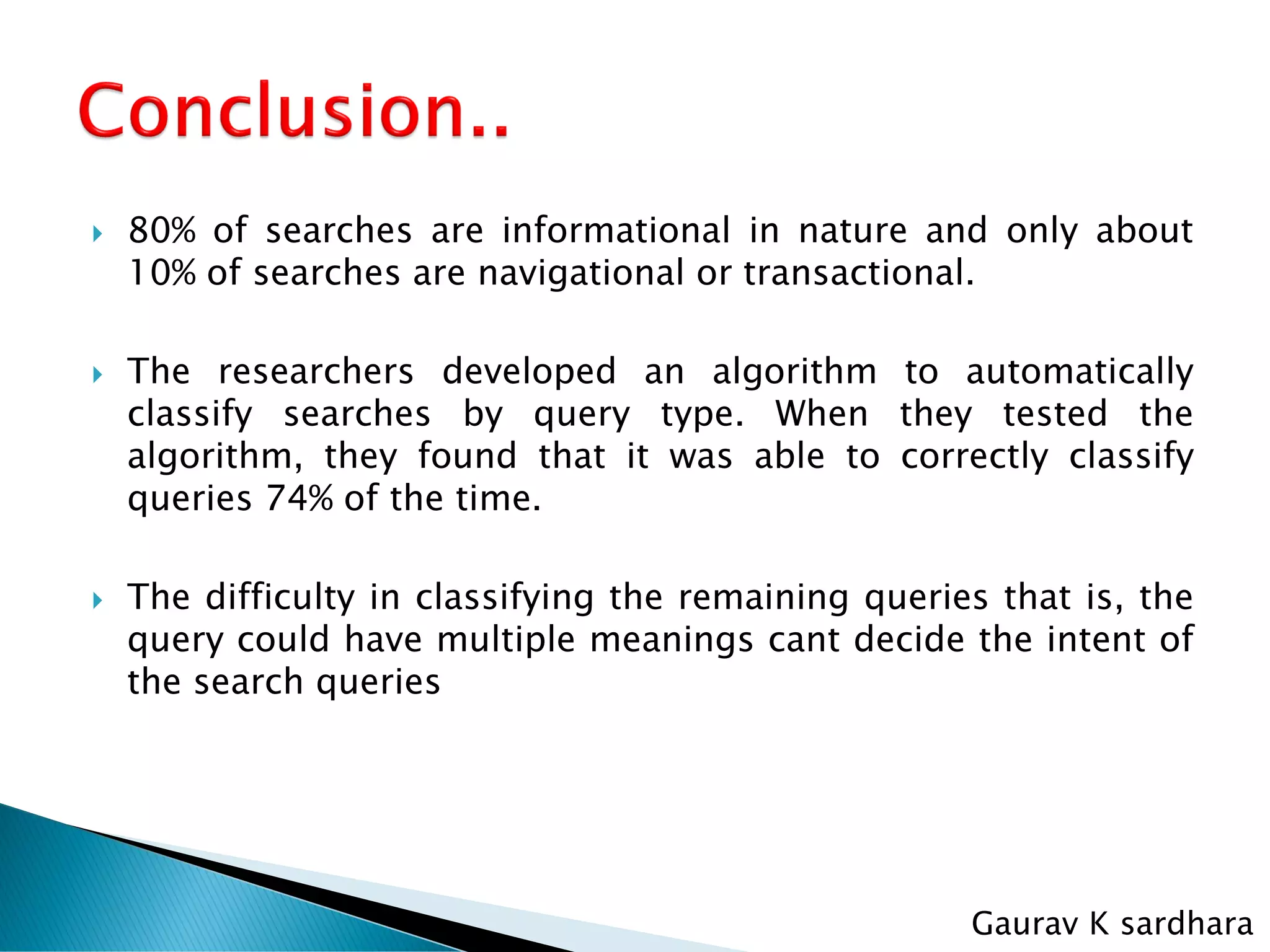
 80% of searches are informational in nature and only about
10% of searches are navigational or transactional.
 The researchers developed an algorithm to automatically
classify searches by query type. When they tested the
algorithm, they found that it was able to correctly classify
queries 74% of the time.
 The difficulty in classifying the remaining queries that is, the
query could have multiple meanings cant decide the intent of
the search queries
Gaurav K sardhara
Gaurav K sardhara
 Although informational queries are less likely to immediately
convert into sales, this does not necessarily mean you should
foregot rankings on such queries. If you are able to build a
relationship with users who find your site after an
informational query, they may be more likely to come to you
to make the related purchase at a later date.
 One problem is that when most searchers frame their search
query they provide very limited data to the search engine,
usually in just one to three words. Since most people don’t
have a keen understanding of how search engines work, they
can often provide a query that is too general or in a way that
does not provide the search engine (or the marketer) with
what it needs to determine their intent.
Gaurav K sardhara
 For this reason, general queries are important to most
businesses because they often get the brand and site on the
searcher’s, and this initiates the process of building trust with
the user. Over time, the user will move on to more specific
searches that are more transactional or navigational in nature.
 If, for instance, companies buying pay-per-click (PPC) search
ads bought only the high converting navigational and
transactional terms and left the informational ones to
competitors, they would lose market share to those
competitors.
 Based on this later study, more than 20% of users did not find
what they were looking for.
Gaurav K sardhara
 This suggests that there is plenty of room to improve the
overall search experience. As an SEO practitioner, you should
be aware that many of the visitors that you succeed in
attracting to your site may have arrived for the wrong reasons
(i.e., they were really looking for something else), .
Gaurav K sardhara
 Search engines invest significant resources into
understanding how people use search, enabling them to
produce better (i.e., faster, fresher, and more relevant) search
engine results. For website publishers, the information
regarding how people use search can be used to help improve
the usability of the site as well as search engine compatibility.
Gaurav K sardhara
Gaurav K sardhara
Gaurav K sardhara
Gaurav K sardhara
 In this sequence, the user performs five searches over a 55+
minute period before making a final selection. The user is
clearly trying to solve a problem and works at it in a
persistent fashion until the task is done.
 This means people are thinking about their tasks in stages.
As in our Merrell shoes example in people frequently begin
with a general term and gradually get more specific as they
get closer to their goal. They may also try different flavors of
general terms. In above example , it looks like the user did
not find what she wanted when she searched on Merrell
shoes, so she then tried discount Merrell shoes. You can then
see her refine her search in the process, until she finally
settles on Easy Spirit as the type of shoe she wants.
 This is just one example of a search sequence, and the variety
is endless
Gaurav K sardhara
 Some time it happens that users are reached to the different
search result after go through the result of each search
because after each search trial they got the knowledge.
 For example ..
 One start the searching of a medicine for the headache and
after each search she got the knowledge of different types of
problems like diabetes so finally she start searching for the
doctor of diabetes because she feel that she have it.
Gaurav K sardhara
 Our next search session example begins with a navigational
search, where the user simply wants to find the site for the
travel website Jirawala . The user’s stay there is quite short,
and she progresses to a search on all inclusive vacation
packages. Following that she searches on a few specific
resorts but finally settles on Taj hotels, after which it appears
she may have booked her hotel—the final site visited on that
search is Bookings.mytrip.com, and the direction of her
searches changes after that.
Gaurav K sardhara
 Users traverse through countless different scenarios when
they are searching for something. Search engines do a lot of
modeling of these scenarios to enable them to provide better
results to users. The SEO practitioner can benefit from a basic
understanding of searcher behavior as well.
Gaurav K sardhara
 People make use of search engines for a wide variety of
purposes, with some of the most popular being to research,
locate, and buy products.
 There is also a significant amount of interaction between
search and local offline commerce.
 74% of respondents used search engines to find local
business information versus 50% who used Internet Yellow
Pages, and 44% who used traditional newspapers.
 • 86% surveyed said they have used the Internet to find a
local business, a rise from the 70% figure reported the year
before.
 • 80% reported researching a product or service online, then
making that purchase offline from a local business.
 Local search is an increasingly important component of SEO
Gaurav K sardhara
 Research firms Enquiro, Eyetools, and Didit
conducted heat-map testing with search engine users
that produced results about what users see and focus
on when engaged in search activity.
 Figure below depicts a heat map showing a test
performed on Google. The graphic indicates that
users spent the most amount of time focusing their
eyes in the top-left area where shading is the
darkest.
 This particular study perfectly illustrates how little
attention is paid to results lower on the page versus
those higher up, and how users’ eyes are drawn to
bold keywords, titles, and descriptions in the natural
results versus the paid search which receive
comparatively little attention.
Gaurav K sardhara
Gaurav K sardhara
 This research study also showed that different physical
positioning of on-screen search results resulted in different
user eye-tracking patterns.
 When viewing a standard Google results page, users tended
to create an “F-shaped” pattern with their eye movements,
focusing first and longest on the upper-left hand corner of
the screen; moving down vertically through the first two or
three results; moving across the page to the first paid page
result; moving down another few vertical results; and then
moving across again to the second paid result.
Gaurav K sardhara
 In May 2008, Google introduced the notion of Universal
Search. This was a move from simply showing the 10 most
relevant web pages (now referred to as “10 blue links”) to
showing other types of media, such as videos, images,
news results, and so on, as part of the results in the base
search engine.
 Industry now refers to this general concept as Blended
Search.
 Blended Search, however, creates more of a chunking
effect, where the chunks are around the various rich media
objects, such as images or video. Understandably, users
focus on the image first. Then they look at the text beside
it to see whether it corresponds to the image or video.
Gaurav K sardhara
 Users’ eyes then tend to move in shorter paths to the side,
with the image rather than the upper-left-corner text as their
anchor. Note, however, that this is the case only when the
image is placed above the fold, so that the user can see it
without having to scroll down on the page.
 Images below the fold do not influence initial search
behavior until the searcher scrolls down. This study is a vivid
reminder of how important search engine results pages
(SERPs) really are. And as the eye-tracking research
demonstrates, “rich” or “personalized” search, as it evolves,
will alter users’ search patterns even more: there will be more
items on the page for them to focus on, and more ways for
them to remember and access the search listings. Search
marketers need to be prepared for this as well.
Gaurav K sardhara
 How Users Click on Results, Natural Versus Paid
 We always want to be on the top of the search engine results
pages( SERPs). It never hurts to be #1 in the natural search
results.
 In a bit of contrast to that, data shows that you may not want
to be #1 in the paid search results, because the resulting cost
to gain the #1 position can reduce the total net margin on
your campaign.
 A study released by AdGooroo in June 2008 found that:
 Bidding for top positions usually makes financial sense only
for high-budget, brand-name advertisers. Most other
advertisers will find the optimal position for the majority of
their keywords to lie between positions 5–7.
Gaurav K sardhara
Gaurav K sardhara
 Of course, many advertisers may seek the #1 position in paid
search results for a number of reasons. For example, if they
have a really solid backend on their website and are able to
make money when they are in the #1 position, they may well
choose to pursue it. Nonetheless, the data from the survey
suggests that there are many organizations for which being
#1 in paid search does not make sense.
 Even if your natural ranking is #1, you can still increase the
ranking page’s click rate by having a sponsored ad above it or
in the right column. The AdGooroo survey showed that a
prominent paid ad on the same search results page makes
your #1 natural ranking receive 20% more clicks.
Gaurav K sardhara
 This example from Google shows how the
paid results appear above and to the right of
the natural search results.
 Note that Google often does not show paid
results above the natural resuts, in which
case the paid results show up only on the
right.
Gaurav K sardhara
 Your position in the results has a huge impact on the traffic
you will receive. Here is some data about that:
 62% of search engine users click on a search result within the
first page of results, and 90% within the first three pages.
 41% of search engine users who continue their search when
not finding what they seek ,change their search term and/or
search engine if they do not find what they’re looking for on
the first page of results; 88% report doing so after three
pages.
 36% of users agree that “seeing a company listed among the
top results on a search engine makes me think that the
company is a top one within its field.”
Gaurav K sardhara
 In addition, the first 10 results received 89.71% of all click-
through traffic; the next 10 results (normally listed on the
second page of results) received 4.37%; the third page 2.42%;
and the fifth page 1.07%. All other pages of results received
less than 1% of total search traffic clicks.
 According to the study, 72% of searchers click on the first link
of interest, whereas 25.5% read all listings first and then
decide which one to click. Both effects (most likely play a role
in searcher behavior.
Gaurav K sardhara
Gaurav K sardhara
Gaurav K sardhara
Gaurav K sardhara
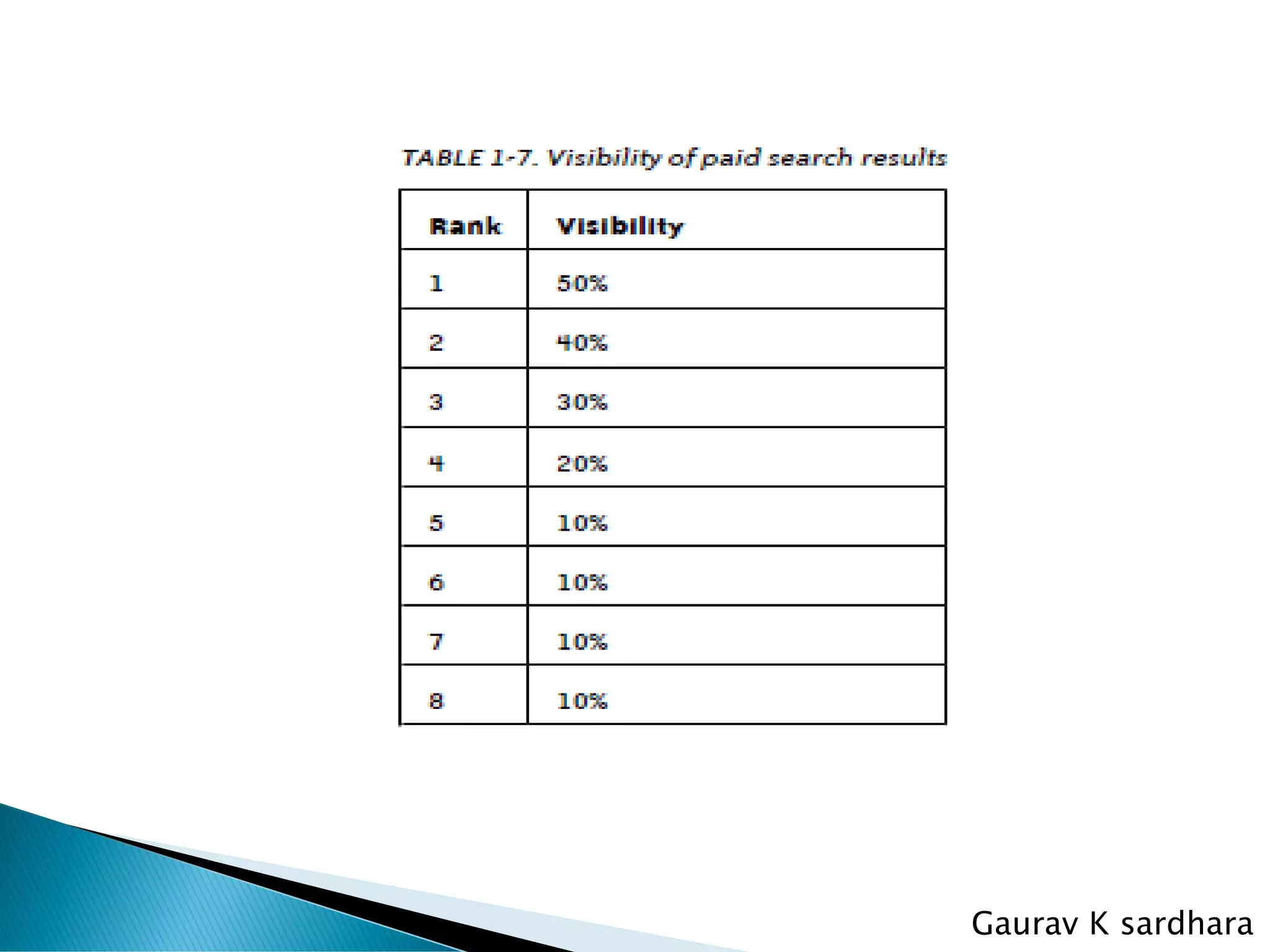
 Notice how the visibility of a listing in the natural results is
double or more (up to six times) of the visibility of the same
position in the paid results.
 For example,
 In position 5 only 60% of users ever even notice the natural
search result. But the paid search results fare even worse, with
only 10% of users noticing the result in the fifth position.
 85% of searchers click on natural results
 The top four sponsored slots are equivalent in views to being
ranked at 7–10 in natural search in terms of visibility and click-
through.
 This means if you need to make a business case for natural
search, then (assuming you can attain at least the #3 rank in
natural search for the same keywords you bid on) natural search
could be worth two to three times your PPC results.
Gaurav K sardhara
 It is interesting to note that in spite of this data, companies
are much more likely to spend money on PPC than SEO
 Because, the PPC model is easier for companies to understand
because it is more similar to traditional direct marketing
methods than SEO is. The ROI of PPC can be tracked and
demonstrated more reliably than SEO;
 Thus, to date it has been considered more accountable as a
marketing channel.
 However, as budgets are tightening and the focus is shifting
to the highest ROI search investments, the focus is
increasingly on SEO.
Gaurav K sardhara
 ICrossing published a report that showed a strong interaction
between natural and paid search. The study shows what
happens when you incorporate natural search into an existing
paid search compare its performance to the performance of
the sole paid search. Figure below summarizes the
improvement in the results.
 Our empirical findings suggest that click-throughs on organic
listings have a positive interdependence with click-throughs
on paid listings, and vice-versa.
 we show that on an average this positive interdependence
leads to an increase in expected profits for the firm ranging
from 4.2 % to 6.15 % when compared to profits in the absence
of this interdependence.
 The total click-through rates, conversions rates and revenues
in the presence of both paid and organic search listings are
significantly higher than those in the absence of paid search
advertisements.
Gaurav K sardhara
Gaurav K sardhara
 There are many other aspects to consider when thinking
about search and your business. Which are as follow…
 1. Number of visits before purchase:-
 A May 2007 study by ScanAlert showed that only 43% of users
who made a purchase on a site made that purchase within an
hour of their initial visit to the site.
 So, to translate that a bit, only 43% of users were likely to
have made their purchase upon their first visit to the site. In
addition, 26% of purchasers made their purchases after three
days or more!
 This suggests that it is very important for publishers to plan
on more complex interactions with users across multiple
visits to the site.
Gaurav K sardhara
 2. Presentation changes made by the search engines:-
 In February 2008, Yahoo! announced its SearchMonkey
platform. This platform allows publishers and
developers to directly influence the search results
shown when your web pages are included in those
results.
 Figure below shows a sample search result that
demonstrates this.
 Notice how the third listing (Yelp) looks different from
the rest of the results. The difference in the look of the
results really catches the eye, and can significantly
impact click-through rates. And it works.
Gaurav K sardhara
Gaurav K sardhara
1. What is mean by SEO? Why SEO is required?
2. Comment on : “Determining Searcher Intent: A Challenge
for Both Marketers and Search Engines”
3. What are the different types of queries?
4. What are the methods to know how people search?
Or
5. Explain the following methods
eye tracking, click tracking
1. Explain paid v/s natural results Explain which one is more
preferable.
2. How paid and natural results are interdependent
…comment
Gaurav K sardhara
 Explain the following terms
 Organic search or unpaid search or natural
search
 Paid search
 Click-through rate
Gaurav K sardhara

SEO_beginner

  • 1.
  • 2.
     Search EngineOptimization, SEO, is the active practice of optimizing a website, by improving internal and external aspects, in order to increase the traffic from search engines.  As an Internet marketing strategy, SEO considers how search engines work and what people search for. Optimizing a website primarily involves editing its content and HTML and associated coding to both increase its relevance to specific keywords and to remove barriers to the indexing activities of search engines. Gaurav K sardhara
  • 3.
     Search becomesthe main aspect of the society. The way people work, play, shop, research, and interact has changed forever  Organizations of all kinds (businesses and charities), as well as individuals, need to have a presence on the Web and they need the search engines to bring them traffic.  As our society moves ever closer to a professional Consumer economy, the ways in which people create, publish, distribute, and ultimately find information and resources on the Internet will continue to be of great importance Gaurav K sardhara
  • 4.
     With morethan 12 billion searches being performed each month.  Approximately 400 million web searches are performed every day.  This means that on average more than 4,500 searches are performed every single second of every day.  Therefore search engine optimization, is at the center of the Web and is your key to success in the new web economy. Gaurav K sardhara
  • 5.
     Search enginesgenerate revenue primarily through paid advertising. The great majority of this revenue comes from a pay-per-click in which the advertisers pay only for users who click on their ads.  Since web searchers are free to use any of the many available search engines on the Web.  Find what they are seeking, the burden is on the search engines to develop a relevant, fast, and fresh search experience.  For the most part, search engines accomplish this by providing the most relevant results and delivering them the fastest, as users will go to the search engine they think will get them the answers they want in the least amount of time. Gaurav K sardhara
  • 6.
     As aresult, search engines invest a tremendous amount of time, energy, and capital in improving their relevance. This includes performing extensive studies of user responses to their search results, comparing their results against those of other search engines.  Because the search engines’ success depends so greatly on the relevance of their search results, manipulations of search engine rankings that result in non-relevant results (generally referred to as spam) are dealt with very seriously.  Each major search engine employs a team of people who focus solely on finding and eliminating spam from their search results. This matters to SEO practitioners because they need to be careful that the policey they employ will not be seen as spam by the search engines and carry the risk of resulting in penalties for the websites they work on. Gaurav K sardhara
  • 7.
  • 8.
     Global: Google 85.72% Yahoo6.42% Baidu 3.67% Bing 2.14% Ask.com 0.56% Other 0.49%  United States:  Google 84.58%  Yahoo 8.13%  Bing 5.38%  Ask.com 0.79%  Other 1.12%  Gaurav K sardhara
  • 9.
     The basicgoal of a human searcher is to obtain information relevant to her inquiry.  However, searcher inquiries can take many different forms.  One of the most important elements to building an online marketing strategy for a website around SEO and search rankings is understanding of the psychology of your target audience.  Once you understand how the average searcher, and more specifically, your target market, uses search engines, you can more effectively reach and keep those users. Gaurav K sardhara
  • 10.
    1. Experience theneed for an answer, solution, or piece of information. For example, the user may be looking for a website (navigational query) to buy something (transactional query) or to learn something (informational query). 2. Formulate that need in a string of words and phrases (the query). Most people formulate their queries in one to three words. 3. Execute the query, check the results, see whether you got what you wanted, and if not, try a refined query. When this process results in the satisfactory completion of a task, a positive experience is created for the user, the search engine, and the site providing the information or result. Gaurav K sardhara
  • 11.
  • 12.
     ComScore datashows that just under 79 million people in the United States were using a search engine on a given day in January 2009.  Search engine users were slightly more likely to be women than men (50.4% versus 49.6%).  Internet usage increases with household income Gaurav K sardhara
  • 13.
     Household incomeInternet users  $15,000–$24,999 5,792  $25,000–$39,999 16,108  $40,000–$59,999 39,716  $60,000–$74,999 20,947  $75,000–$99,000 28,995  $100,000 or more 44,627 Gaurav K sardhara
  • 14.
     All ofthis research data leads us to some important conclusions about web search and marketing through search engines.  For example: 1. Search is very, very popular. It reaches nearly every online American and billions of people around the world. 2. Google is the dominant player in most world markets 3. Users tend to use short search phrases, but these are gradually getting longer 4. Search covers all types of markets. Search is undoubtedly one of the best and most important ways to reach consumers and build a business, no matter the size, reach, or focus. Gaurav K sardhara
  • 15.
     Smart SEOpractitioners and the search engines have a common goal of providing searchers with results that are relevant to their queries.   Therefore, a crucial element to building an online marketing strategy around SEO and search rankings is to understand your audience. Once you grasp how your target market searches for your service, product, or resource, you can more effectively reach and keep those users.  Search engine marketers need to be aware that search engines are depend upon intent. Gaurav K sardhara
  • 16.
     Using thesearch box is fundamentally different from entering a URL into the address bar, clicking on a bookmark, or picking a link on your start page to go to a website.  It is unique from a click on the button in your toolbar or a visit to your favorite blog.  Searches are performed with intent; the user wants to find something in particular, rather than just land on it by chance.  First decide different types of queries, their categories, characteristics, and processes. Gaurav K sardhara
  • 17.
     Navigational Queries Informational Queries  Transactional Queries Gaurav K sardhara
  • 18.
     Navigational searchesare performed with the intent of surfing directly to a specific website.  In some cases, the user may not know the exact URL, and the search engine serves as the “WhitePages.” For example :  Searching for the detail of Indian airlines  OR searching for a particular college like Sunshine college Opportunities: Pull searcher away from destination; get additional or investigatory traffic Average value: Generally low, with the exception of navigational searches on the publisher’s own brand, where the value is very high as these types of searches tend to lead to very high conversion rates. Gaurav K sardhara
  • 19.
     Informational searchesinvolve a huge range of queries  For example local weather, maps and directions, details on the latest Hollywood awards ceremony etc.  Informational searches are primarily non-transaction- oriented the information itself is the goal and no interaction beyond clicking and reading is required.  Users are interested in finding as much information as possible with informational queries. For example, “What is a prime factor?” or ‘prime factor’ is an informational query. Its goal is finding the meaning of ‘prime factor’. Gaurav K sardhara
  • 20.
     Top 10students of GTU  Iifa award winner in male category  Here no fix site url is required to search but we need general information from any site Gaurav K sardhara
  • 21.
     Opportunities: Brand searcherswith positive impressions of your site, information, company, and so on; attract inbound links; receive attention from journalists/researchers; potentially convert to sign up or purchase.  Average value: Middling. Note, though, that informational queries that are focused on researching commercial products or services can have high value. Gaurav K sardhara
  • 22.
     Transactional searchesdon’t necessarily involve a credit card or wire transfer. Creating a Gmail account, paying a parking ticket, or finding the best local restaurant for dinner tonight are all transactional queries.  Users are interested in finding a document that offers the service  described in a transactional query.  For example..  “from where to download songs?’  Songs?” or ‘old songs’ is a transactional query. Users do not desire to learn  about lyrics of old songs, but simply a desire to download the songs Gaurav K sardhara
  • 23.
     Finding arestaurant at Rajkot.  Online pay bill  Opportunities:  Achieve transaction (financial or other).  Average value:  Very high. Gaurav K sardhara
  • 24.
     80% ofsearches are informational in nature and only about 10% of searches are navigational or transactional.  The researchers developed an algorithm to automatically classify searches by query type. When they tested the algorithm, they found that it was able to correctly classify queries 74% of the time.  The difficulty in classifying the remaining queries that is, the query could have multiple meanings cant decide the intent of the search queries Gaurav K sardhara
  • 25.
  • 26.
     Although informationalqueries are less likely to immediately convert into sales, this does not necessarily mean you should foregot rankings on such queries. If you are able to build a relationship with users who find your site after an informational query, they may be more likely to come to you to make the related purchase at a later date.  One problem is that when most searchers frame their search query they provide very limited data to the search engine, usually in just one to three words. Since most people don’t have a keen understanding of how search engines work, they can often provide a query that is too general or in a way that does not provide the search engine (or the marketer) with what it needs to determine their intent. Gaurav K sardhara
  • 27.
     For thisreason, general queries are important to most businesses because they often get the brand and site on the searcher’s, and this initiates the process of building trust with the user. Over time, the user will move on to more specific searches that are more transactional or navigational in nature.  If, for instance, companies buying pay-per-click (PPC) search ads bought only the high converting navigational and transactional terms and left the informational ones to competitors, they would lose market share to those competitors.  Based on this later study, more than 20% of users did not find what they were looking for. Gaurav K sardhara
  • 28.
     This suggeststhat there is plenty of room to improve the overall search experience. As an SEO practitioner, you should be aware that many of the visitors that you succeed in attracting to your site may have arrived for the wrong reasons (i.e., they were really looking for something else), . Gaurav K sardhara
  • 29.
     Search enginesinvest significant resources into understanding how people use search, enabling them to produce better (i.e., faster, fresher, and more relevant) search engine results. For website publishers, the information regarding how people use search can be used to help improve the usability of the site as well as search engine compatibility. Gaurav K sardhara
  • 30.
  • 31.
  • 32.
  • 33.
     In thissequence, the user performs five searches over a 55+ minute period before making a final selection. The user is clearly trying to solve a problem and works at it in a persistent fashion until the task is done.  This means people are thinking about their tasks in stages. As in our Merrell shoes example in people frequently begin with a general term and gradually get more specific as they get closer to their goal. They may also try different flavors of general terms. In above example , it looks like the user did not find what she wanted when she searched on Merrell shoes, so she then tried discount Merrell shoes. You can then see her refine her search in the process, until she finally settles on Easy Spirit as the type of shoe she wants.  This is just one example of a search sequence, and the variety is endless Gaurav K sardhara
  • 34.
     Some timeit happens that users are reached to the different search result after go through the result of each search because after each search trial they got the knowledge.  For example ..  One start the searching of a medicine for the headache and after each search she got the knowledge of different types of problems like diabetes so finally she start searching for the doctor of diabetes because she feel that she have it. Gaurav K sardhara
  • 35.
     Our nextsearch session example begins with a navigational search, where the user simply wants to find the site for the travel website Jirawala . The user’s stay there is quite short, and she progresses to a search on all inclusive vacation packages. Following that she searches on a few specific resorts but finally settles on Taj hotels, after which it appears she may have booked her hotel—the final site visited on that search is Bookings.mytrip.com, and the direction of her searches changes after that. Gaurav K sardhara
  • 36.
     Users traversethrough countless different scenarios when they are searching for something. Search engines do a lot of modeling of these scenarios to enable them to provide better results to users. The SEO practitioner can benefit from a basic understanding of searcher behavior as well. Gaurav K sardhara
  • 37.
     People makeuse of search engines for a wide variety of purposes, with some of the most popular being to research, locate, and buy products.  There is also a significant amount of interaction between search and local offline commerce.  74% of respondents used search engines to find local business information versus 50% who used Internet Yellow Pages, and 44% who used traditional newspapers.  • 86% surveyed said they have used the Internet to find a local business, a rise from the 70% figure reported the year before.  • 80% reported researching a product or service online, then making that purchase offline from a local business.  Local search is an increasingly important component of SEO Gaurav K sardhara
  • 38.
     Research firmsEnquiro, Eyetools, and Didit conducted heat-map testing with search engine users that produced results about what users see and focus on when engaged in search activity.  Figure below depicts a heat map showing a test performed on Google. The graphic indicates that users spent the most amount of time focusing their eyes in the top-left area where shading is the darkest.  This particular study perfectly illustrates how little attention is paid to results lower on the page versus those higher up, and how users’ eyes are drawn to bold keywords, titles, and descriptions in the natural results versus the paid search which receive comparatively little attention. Gaurav K sardhara
  • 39.
  • 40.
     This researchstudy also showed that different physical positioning of on-screen search results resulted in different user eye-tracking patterns.  When viewing a standard Google results page, users tended to create an “F-shaped” pattern with their eye movements, focusing first and longest on the upper-left hand corner of the screen; moving down vertically through the first two or three results; moving across the page to the first paid page result; moving down another few vertical results; and then moving across again to the second paid result. Gaurav K sardhara
  • 41.
     In May2008, Google introduced the notion of Universal Search. This was a move from simply showing the 10 most relevant web pages (now referred to as “10 blue links”) to showing other types of media, such as videos, images, news results, and so on, as part of the results in the base search engine.  Industry now refers to this general concept as Blended Search.  Blended Search, however, creates more of a chunking effect, where the chunks are around the various rich media objects, such as images or video. Understandably, users focus on the image first. Then they look at the text beside it to see whether it corresponds to the image or video. Gaurav K sardhara
  • 42.
     Users’ eyesthen tend to move in shorter paths to the side, with the image rather than the upper-left-corner text as their anchor. Note, however, that this is the case only when the image is placed above the fold, so that the user can see it without having to scroll down on the page.  Images below the fold do not influence initial search behavior until the searcher scrolls down. This study is a vivid reminder of how important search engine results pages (SERPs) really are. And as the eye-tracking research demonstrates, “rich” or “personalized” search, as it evolves, will alter users’ search patterns even more: there will be more items on the page for them to focus on, and more ways for them to remember and access the search listings. Search marketers need to be prepared for this as well. Gaurav K sardhara
  • 43.
     How UsersClick on Results, Natural Versus Paid  We always want to be on the top of the search engine results pages( SERPs). It never hurts to be #1 in the natural search results.  In a bit of contrast to that, data shows that you may not want to be #1 in the paid search results, because the resulting cost to gain the #1 position can reduce the total net margin on your campaign.  A study released by AdGooroo in June 2008 found that:  Bidding for top positions usually makes financial sense only for high-budget, brand-name advertisers. Most other advertisers will find the optimal position for the majority of their keywords to lie between positions 5–7. Gaurav K sardhara
  • 44.
  • 45.
     Of course,many advertisers may seek the #1 position in paid search results for a number of reasons. For example, if they have a really solid backend on their website and are able to make money when they are in the #1 position, they may well choose to pursue it. Nonetheless, the data from the survey suggests that there are many organizations for which being #1 in paid search does not make sense.  Even if your natural ranking is #1, you can still increase the ranking page’s click rate by having a sponsored ad above it or in the right column. The AdGooroo survey showed that a prominent paid ad on the same search results page makes your #1 natural ranking receive 20% more clicks. Gaurav K sardhara
  • 46.
     This examplefrom Google shows how the paid results appear above and to the right of the natural search results.  Note that Google often does not show paid results above the natural resuts, in which case the paid results show up only on the right. Gaurav K sardhara
  • 47.
     Your positionin the results has a huge impact on the traffic you will receive. Here is some data about that:  62% of search engine users click on a search result within the first page of results, and 90% within the first three pages.  41% of search engine users who continue their search when not finding what they seek ,change their search term and/or search engine if they do not find what they’re looking for on the first page of results; 88% report doing so after three pages.  36% of users agree that “seeing a company listed among the top results on a search engine makes me think that the company is a top one within its field.” Gaurav K sardhara
  • 48.
     In addition,the first 10 results received 89.71% of all click- through traffic; the next 10 results (normally listed on the second page of results) received 4.37%; the third page 2.42%; and the fifth page 1.07%. All other pages of results received less than 1% of total search traffic clicks.  According to the study, 72% of searchers click on the first link of interest, whereas 25.5% read all listings first and then decide which one to click. Both effects (most likely play a role in searcher behavior. Gaurav K sardhara
  • 49.
  • 50.
  • 51.
  • 52.
     Notice howthe visibility of a listing in the natural results is double or more (up to six times) of the visibility of the same position in the paid results.  For example,  In position 5 only 60% of users ever even notice the natural search result. But the paid search results fare even worse, with only 10% of users noticing the result in the fifth position.  85% of searchers click on natural results  The top four sponsored slots are equivalent in views to being ranked at 7–10 in natural search in terms of visibility and click- through.  This means if you need to make a business case for natural search, then (assuming you can attain at least the #3 rank in natural search for the same keywords you bid on) natural search could be worth two to three times your PPC results. Gaurav K sardhara
  • 53.
     It isinteresting to note that in spite of this data, companies are much more likely to spend money on PPC than SEO  Because, the PPC model is easier for companies to understand because it is more similar to traditional direct marketing methods than SEO is. The ROI of PPC can be tracked and demonstrated more reliably than SEO;  Thus, to date it has been considered more accountable as a marketing channel.  However, as budgets are tightening and the focus is shifting to the highest ROI search investments, the focus is increasingly on SEO. Gaurav K sardhara
  • 54.
     ICrossing publisheda report that showed a strong interaction between natural and paid search. The study shows what happens when you incorporate natural search into an existing paid search compare its performance to the performance of the sole paid search. Figure below summarizes the improvement in the results.  Our empirical findings suggest that click-throughs on organic listings have a positive interdependence with click-throughs on paid listings, and vice-versa.  we show that on an average this positive interdependence leads to an increase in expected profits for the firm ranging from 4.2 % to 6.15 % when compared to profits in the absence of this interdependence.  The total click-through rates, conversions rates and revenues in the presence of both paid and organic search listings are significantly higher than those in the absence of paid search advertisements. Gaurav K sardhara
  • 55.
  • 56.
     There aremany other aspects to consider when thinking about search and your business. Which are as follow…  1. Number of visits before purchase:-  A May 2007 study by ScanAlert showed that only 43% of users who made a purchase on a site made that purchase within an hour of their initial visit to the site.  So, to translate that a bit, only 43% of users were likely to have made their purchase upon their first visit to the site. In addition, 26% of purchasers made their purchases after three days or more!  This suggests that it is very important for publishers to plan on more complex interactions with users across multiple visits to the site. Gaurav K sardhara
  • 57.
     2. Presentationchanges made by the search engines:-  In February 2008, Yahoo! announced its SearchMonkey platform. This platform allows publishers and developers to directly influence the search results shown when your web pages are included in those results.  Figure below shows a sample search result that demonstrates this.  Notice how the third listing (Yelp) looks different from the rest of the results. The difference in the look of the results really catches the eye, and can significantly impact click-through rates. And it works. Gaurav K sardhara
  • 58.
  • 59.
    1. What ismean by SEO? Why SEO is required? 2. Comment on : “Determining Searcher Intent: A Challenge for Both Marketers and Search Engines” 3. What are the different types of queries? 4. What are the methods to know how people search? Or 5. Explain the following methods eye tracking, click tracking 1. Explain paid v/s natural results Explain which one is more preferable. 2. How paid and natural results are interdependent …comment Gaurav K sardhara
  • 60.
     Explain thefollowing terms  Organic search or unpaid search or natural search  Paid search  Click-through rate Gaurav K sardhara