1
Academic Writing
English sentences
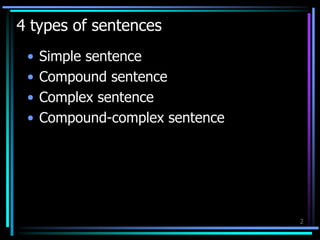
4 types of sentences
• Simple sentence
• Compound sentence
• Complex sentence
• Compound-complex sentence
2
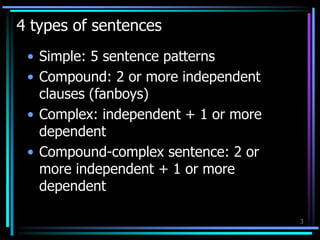
4 types of sentences
• Simple: 5 sentence patterns
• Compound: 2 or more independent
clauses (fanboys)
• Complex: independent + 1 or more
dependent
• Compound-complex sentence: 2 or
more independent + 1 or more
dependent
3
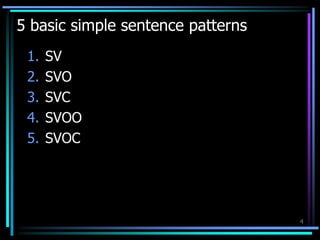
5 basic simple sentence patterns
1. SV
2. SVO
3. SVC
4. SVOO
5. SVOC
4
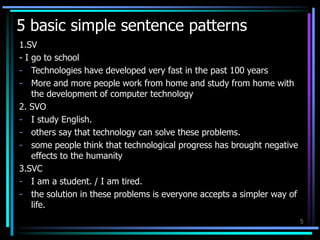
5 basic simple sentence patterns
1.SV
- I go to school
- Technologies have developed very fast in the past 100 years
- More and more people work from home and study from home with
the development of computer technology
2. SVO
- I study English.
- others say that technology can solve these problems.
- some people think that technological progress has brought negative
effects to the humanity
3.SVC
- I am a student. / I am tired.
- the solution in these problems is everyone accepts a simpler way of
life.
5
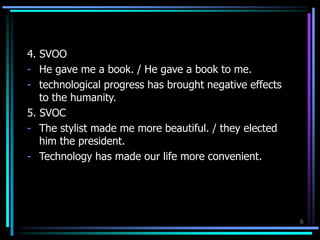
4. SVOO
- He gave me a book. / He gave a book to me.
- technological progress has brought negative effects
to the humanity.
5. SVOC
- The stylist made me more beautiful. / they elected
him the president.
- Technology has made our life more convenient.
6
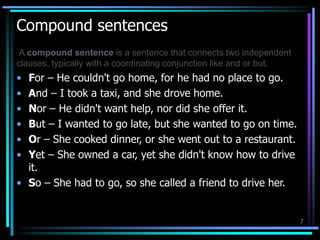
Compound sentences
​​A compound sentence is a sentence that connects two independent
clauses, typically with a coordinating conjunction like and or but.
• For – He couldn't go home, for he had no place to go.
• And – I took a taxi, and she drove home.
• Nor – He didn't want help, nor did she offer it.
• But – I wanted to go late, but she wanted to go on time.
• Or – She cooked dinner, or she went out to a restaurant.
• Yet – She owned a car, yet she didn't know how to drive
it.
• So – She had to go, so she called a friend to drive her.
7
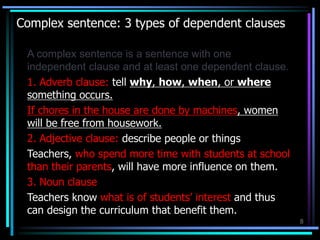
Complex sentence: 3 types of dependent clauses
A complex sentence is a sentence with one
independent clause and at least one dependent clause.
1. Adverb clause: tell why, how, when, or where
something occurs.
If chores in the house are done by machines, women
will be free from housework.
2. Adjective clause: describe people or things
Teachers, who spend more time with students at school
than their parents, will have more influence on them.
3. Noun clause
Teachers know what is of students’ interest and thus
can design the curriculum that benefit them.
8
9
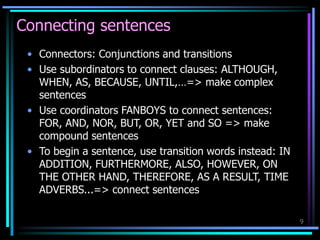
Connecting sentences
• Connectors: Conjunctions and transitions
• Use subordinators to connect clauses: ALTHOUGH,
WHEN, AS, BECAUSE, UNTIL,…=> make complex
sentences
• Use coordinators FANBOYS to connect sentences:
FOR, AND, NOR, BUT, OR, YET and SO => make
compound sentences
• To begin a sentence, use transition words instead: IN
ADDITION, FURTHERMORE, ALSO, HOWEVER, ON
THE OTHER HAND, THEREFORE, AS A RESULT, TIME
ADVERBS...=> connect sentences
Practice
1. Analyse sentence patterns.
2. Combine simple sentence to make a compound and
complex sentence.
3. Sentence correction.
10

Sentence-pattern.ppt

  • 1.
  • 2.
    4 types ofsentences • Simple sentence • Compound sentence • Complex sentence • Compound-complex sentence 2
  • 3.
    4 types ofsentences • Simple: 5 sentence patterns • Compound: 2 or more independent clauses (fanboys) • Complex: independent + 1 or more dependent • Compound-complex sentence: 2 or more independent + 1 or more dependent 3
  • 4.
    5 basic simplesentence patterns 1. SV 2. SVO 3. SVC 4. SVOO 5. SVOC 4
  • 5.
    5 basic simplesentence patterns 1.SV - I go to school - Technologies have developed very fast in the past 100 years - More and more people work from home and study from home with the development of computer technology 2. SVO - I study English. - others say that technology can solve these problems. - some people think that technological progress has brought negative effects to the humanity 3.SVC - I am a student. / I am tired. - the solution in these problems is everyone accepts a simpler way of life. 5
  • 6.
    4. SVOO - Hegave me a book. / He gave a book to me. - technological progress has brought negative effects to the humanity. 5. SVOC - The stylist made me more beautiful. / they elected him the president. - Technology has made our life more convenient. 6
  • 7.
    Compound sentences ​​A compoundsentence is a sentence that connects two independent clauses, typically with a coordinating conjunction like and or but. • For – He couldn't go home, for he had no place to go. • And – I took a taxi, and she drove home. • Nor – He didn't want help, nor did she offer it. • But – I wanted to go late, but she wanted to go on time. • Or – She cooked dinner, or she went out to a restaurant. • Yet – She owned a car, yet she didn't know how to drive it. • So – She had to go, so she called a friend to drive her. 7
  • 8.
    Complex sentence: 3types of dependent clauses A complex sentence is a sentence with one independent clause and at least one dependent clause. 1. Adverb clause: tell why, how, when, or where something occurs. If chores in the house are done by machines, women will be free from housework. 2. Adjective clause: describe people or things Teachers, who spend more time with students at school than their parents, will have more influence on them. 3. Noun clause Teachers know what is of students’ interest and thus can design the curriculum that benefit them. 8
  • 9.
    9 Connecting sentences • Connectors:Conjunctions and transitions • Use subordinators to connect clauses: ALTHOUGH, WHEN, AS, BECAUSE, UNTIL,…=> make complex sentences • Use coordinators FANBOYS to connect sentences: FOR, AND, NOR, BUT, OR, YET and SO => make compound sentences • To begin a sentence, use transition words instead: IN ADDITION, FURTHERMORE, ALSO, HOWEVER, ON THE OTHER HAND, THEREFORE, AS A RESULT, TIME ADVERBS...=> connect sentences
  • 10.
    Practice 1. Analyse sentencepatterns. 2. Combine simple sentence to make a compound and complex sentence. 3. Sentence correction. 10