Sensory Organization Test (SOT)
Clinical testing of sensory integration on balance test
(CTSIB)
-Harsh & Akhil
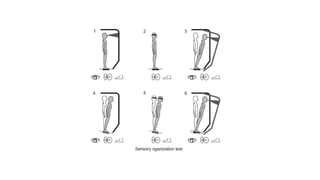
6 Main Condition of measurment
• Standing on firm surface with open eyes.
• Standing on firm surface with close eyes.
• Standing on Fixed support with moveble chamber with open
eyes.
• Standing on movable support with unmovable chamber with
eyes open.
• Standing on movable support with closed eye.
• Standing on movable support and movable chamber with eyes
open
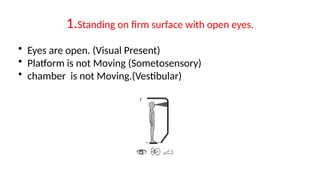
1.Standing on firm surface with open eyes.
• Eyes are open. (Visual Present)
• Platform is not Moving (Sometosensory)
• chamber is not Moving.(Vestibular)
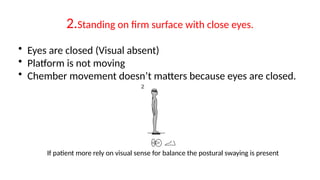
2.Standing on firm surface with close eyes.
• Eyes are closed (Visual absent)
• Platform is not moving
• Chember movement doesn’t matters because eyes are closed.
If patient more rely on visual sense for balance the postural swaying is present
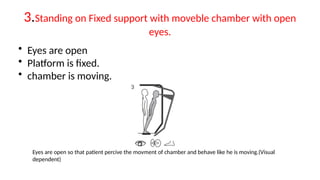
3.Standing on Fixed support with moveble chamber with open
eyes.
• Eyes are open
• Platform is fixed.
• chamber is moving.
Eyes are open so that patient percive the movment of chamber and behave like he is moving.(Visual
dependent)
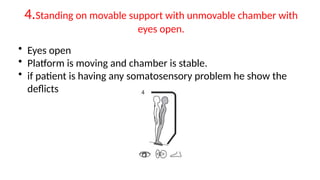
4.Standing on movable support with unmovable chamber with
eyes open.
• Eyes open
• Platform is moving and chamber is stable.
• if patient is having any somatosensory problem he show the
deflicts
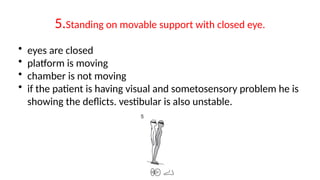
5.Standing on movable support with closed eye.
• eyes are closed
• platform is moving
• chamber is not moving
• if the patient is having visual and sometosensory problem he is
showing the deflicts. vestibular is also unstable.
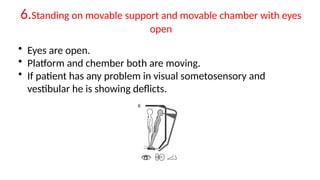
6.Standing on movable support and movable chamber with eyes
open
• Eyes are open.
• Platform and chember both are moving.
• If patient has any problem in visual sometosensory and
vestibular he is showing deflicts.
Thank You
kisi ko koi doubt?

Sensory organization test (CTSIB) for balance

  • 1.
    Sensory Organization Test(SOT) Clinical testing of sensory integration on balance test (CTSIB) -Harsh & Akhil
  • 2.
    6 Main Conditionof measurment • Standing on firm surface with open eyes. • Standing on firm surface with close eyes. • Standing on Fixed support with moveble chamber with open eyes. • Standing on movable support with unmovable chamber with eyes open. • Standing on movable support with closed eye. • Standing on movable support and movable chamber with eyes open
  • 4.
    1.Standing on firmsurface with open eyes. • Eyes are open. (Visual Present) • Platform is not Moving (Sometosensory) • chamber is not Moving.(Vestibular)
  • 5.
    2.Standing on firmsurface with close eyes. • Eyes are closed (Visual absent) • Platform is not moving • Chember movement doesn’t matters because eyes are closed. If patient more rely on visual sense for balance the postural swaying is present
  • 6.
    3.Standing on Fixedsupport with moveble chamber with open eyes. • Eyes are open • Platform is fixed. • chamber is moving. Eyes are open so that patient percive the movment of chamber and behave like he is moving.(Visual dependent)
  • 7.
    4.Standing on movablesupport with unmovable chamber with eyes open. • Eyes open • Platform is moving and chamber is stable. • if patient is having any somatosensory problem he show the deflicts
  • 8.
    5.Standing on movablesupport with closed eye. • eyes are closed • platform is moving • chamber is not moving • if the patient is having visual and sometosensory problem he is showing the deflicts. vestibular is also unstable.
  • 9.
    6.Standing on movablesupport and movable chamber with eyes open • Eyes are open. • Platform and chember both are moving. • If patient has any problem in visual sometosensory and vestibular he is showing deflicts.
  • 10.