






Krishna D K
10753
Visual Semiotics
“A message is a construction of
signs and through interaction
with the viewer it produces
meaning”
(Fiske, 1990)
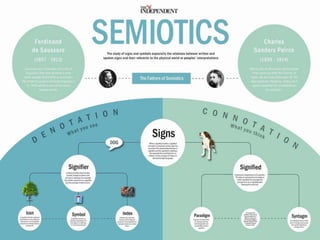
• Semiotics is generally described as the
“study of signs.”
• Semiotics tries to investigate how images
create meaning.
• Visual semiotics is a subdomain of
semiotics that analyzes visual signs.
Three important principles when analyzing a
semiotic system:
1. Semioticians believe all people see the world
through signs.
2. The meaning of signs is created by people
and does not exist separately from them and
the life of their social/cultural community.
3. Semiotic systems provide people with a
variety of resources for making meaning.
Sign Systems
• A set of signs is called a sign system or a code.
• Meaning comes not just from the individual
sign, but more importantly from the set of
signs within which it appears.
• Codes include language, gestures,food,
clothing, objects, dance, and music.
• In real life, just as no one sign stands alone,
codes must be understood in terms of their
mutual influences.
Cultural criticism
Criticism
• Literary criticism
• Social criticism
• Cultural criticism
Etymology of criticism
• French, from Greek kritike, the art of criticism, from
kritikos, critical
• Latin, crtiticus, from adjective, “decisive”, from
Greek kritikos, able to discern, critical from kritos,
separated, chosen, from krinein, to separate,
choose
• Greek kriterion, a means for judging, standard from
krites, a judge, umpire, from krinein, to separate,
choose (Grolier, 1986: 314).
Definition of criticism
• The act of making judgments and or criticizing
• A passing of unfavorable judgment, censure,
disapproval
• The art, skill, or profession of making discriminating
judgments and evaluation, especially of literary or
other artistic works
• A review or other article expressing such judgment
and evaluation
• The detailed investigation of the origin and history of
literary documents (Grolier, 1986: 314).
Definition of cultural criticism
• The practice of describing, interpreting, and
evaluating culture.
• Cultural criticism makes the term culture refer
to popular and classic culture. It breaks down
the boundary between high and low culture,
and discovers the political reason why a cultural
product is more valued than others (Smith, ed.,
1992: 312-313).
Functions of cultural criticism
• Criticizing cultural works
• Verifying cultural theory
• Supporting cultural history
Objects of cultural criticism
• Music
• Media
• Lifestyle
• Game
• Film
Visual Techniques
Salience
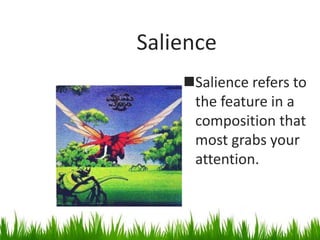
Salience refers to
the feature in a
composition that
most grabs your
attention.
An image can be made salient through:
• Placement: usually an image becomes
“heavier” if placed towards the top or left.
• Colour
• Size
• Focus
• Distance
• A combination of these things.
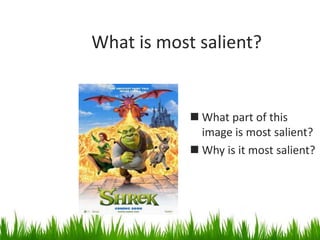
What is most salient?
 What part of this
image is most salient?
 Why is it most salient?
Reading paths
A reading path is the path you take through a
visual text. The path moves from the most
salient to the least salient elements.
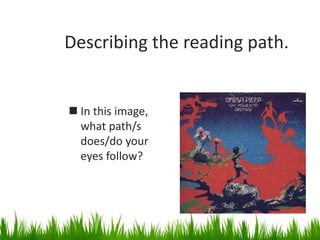
Describing the reading path.
 In this image,
what path/s
does/do your
eyes follow?
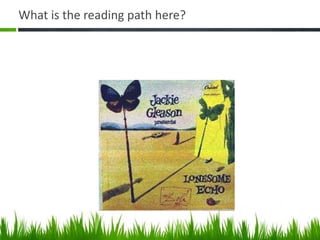
What is the reading path here?
Vectors
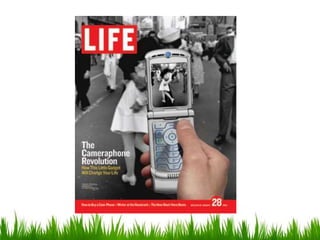
A vector is a line that leads your eye from one
element to another.
A vector may be a visible line or an invisible
one.
It can be created by such things as a gaze,
pointing fingers or extended arms.
The centre
Images here are the nucleus information.
The margin images are subservient.
Framing
Elements in a layout can be disconnected and
marked off from each other or connected. If
elements are cut off from one another they
are strongly framed.
Framing.
Framing can be achieved by borders,
discontinuities of colour and shape, or by
white space.
Connectedness can be achieved by vectors
and devices such as overlapping or
superimposition of images.
Gaze
Demands and offers.
Demand: subject looks out of the image at the
responder.
This establishes a connection between subject
and viewer.
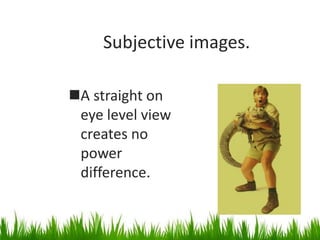
Subjective images.
A straight on
eye level view
creates no
power
difference.
Objective images
The viewer is not drawn into involvement with
the image. Meaning comes from the symbolic
connection made by the reader.
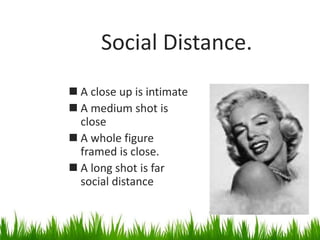
Social Distance.
 A close up is intimate
 A medium shot is
close
 A whole figure
framed is close.
 A long shot is far
social distance
Lighting and Colour
Lighting creates mood
-Shadows may suggest concealment or fear
and despair
-Light, hope and inspiration.
-Soft light, romance.
Colour can be symbolic
How is mood created here?
How is light used here?

VISUAL SEMIOTICS AND CULTURAL CRITICISM

  • 1.
  • 2.
    “A message isa construction of signs and through interaction with the viewer it produces meaning” (Fiske, 1990)
  • 3.
    • Semiotics isgenerally described as the “study of signs.” • Semiotics tries to investigate how images create meaning. • Visual semiotics is a subdomain of semiotics that analyzes visual signs.
  • 4.
    Three important principleswhen analyzing a semiotic system: 1. Semioticians believe all people see the world through signs. 2. The meaning of signs is created by people and does not exist separately from them and the life of their social/cultural community. 3. Semiotic systems provide people with a variety of resources for making meaning.
  • 6.
    Sign Systems • Aset of signs is called a sign system or a code. • Meaning comes not just from the individual sign, but more importantly from the set of signs within which it appears. • Codes include language, gestures,food, clothing, objects, dance, and music. • In real life, just as no one sign stands alone, codes must be understood in terms of their mutual influences.
  • 7.
  • 8.
    Criticism • Literary criticism •Social criticism • Cultural criticism
  • 9.
    Etymology of criticism •French, from Greek kritike, the art of criticism, from kritikos, critical • Latin, crtiticus, from adjective, “decisive”, from Greek kritikos, able to discern, critical from kritos, separated, chosen, from krinein, to separate, choose • Greek kriterion, a means for judging, standard from krites, a judge, umpire, from krinein, to separate, choose (Grolier, 1986: 314).
  • 10.
    Definition of criticism •The act of making judgments and or criticizing • A passing of unfavorable judgment, censure, disapproval • The art, skill, or profession of making discriminating judgments and evaluation, especially of literary or other artistic works • A review or other article expressing such judgment and evaluation • The detailed investigation of the origin and history of literary documents (Grolier, 1986: 314).
  • 11.
    Definition of culturalcriticism • The practice of describing, interpreting, and evaluating culture. • Cultural criticism makes the term culture refer to popular and classic culture. It breaks down the boundary between high and low culture, and discovers the political reason why a cultural product is more valued than others (Smith, ed., 1992: 312-313).
  • 12.
    Functions of culturalcriticism • Criticizing cultural works • Verifying cultural theory • Supporting cultural history
  • 13.
    Objects of culturalcriticism • Music • Media • Lifestyle • Game • Film
  • 14.
  • 15.
    Salience Salience refers to thefeature in a composition that most grabs your attention.
  • 16.
    An image canbe made salient through: • Placement: usually an image becomes “heavier” if placed towards the top or left. • Colour • Size • Focus • Distance • A combination of these things.
  • 17.
    What is mostsalient?  What part of this image is most salient?  Why is it most salient?
  • 18.
    Reading paths A readingpath is the path you take through a visual text. The path moves from the most salient to the least salient elements.
  • 19.
    Describing the readingpath.  In this image, what path/s does/do your eyes follow?
  • 21.
    What is thereading path here?
  • 22.
    Vectors A vector isa line that leads your eye from one element to another. A vector may be a visible line or an invisible one. It can be created by such things as a gaze, pointing fingers or extended arms.
  • 24.
    The centre Images hereare the nucleus information. The margin images are subservient.
  • 26.
    Framing Elements in alayout can be disconnected and marked off from each other or connected. If elements are cut off from one another they are strongly framed.
  • 28.
    Framing. Framing can beachieved by borders, discontinuities of colour and shape, or by white space. Connectedness can be achieved by vectors and devices such as overlapping or superimposition of images.
  • 30.
    Gaze Demands and offers. Demand:subject looks out of the image at the responder. This establishes a connection between subject and viewer.
  • 31.
    Subjective images. A straighton eye level view creates no power difference.
  • 32.
    Objective images The vieweris not drawn into involvement with the image. Meaning comes from the symbolic connection made by the reader.
  • 34.
    Social Distance.  Aclose up is intimate  A medium shot is close  A whole figure framed is close.  A long shot is far social distance
  • 35.
    Lighting and Colour Lightingcreates mood -Shadows may suggest concealment or fear and despair -Light, hope and inspiration. -Soft light, romance. Colour can be symbolic
  • 36.
    How is moodcreated here?
  • 37.
    How is lightused here?