Study of Various Aspect of Tunnelling for Highway or Water 
Resources Work with Case Study of Important Tunnels Constructed 
Presented by 
Santosh Kumar Sahu 
(M.Tech) 
Roll No.- 12MT03 
Under the Guidance of 
Prof. Suresh Kumar 
Department of Civil Engineering 
CAMBRIDGE INSTITUTE OF TECHNOLOGY 
TATISILWAI, RANCHI 
835103
Content 
1. Introduction 
2. Rule Base Navigation in current analysis 
3. Some of the Rules for RBT 
4. Simulation results 
5. Conclusion and future work 
6. References
Introduction 
• Now-a-days mobile robots are widely used in various field of engineering such as aerospace 
research, nuclear research, mining industry and the production industry. 
• Navigation of mobile robot is one of the elementary problems in robotic research field. In 
general the navigation algorithms are classified as global and local, depending on the 
surrounding environment. 
• In global navigation, the surrounding environment is completely known to the mobile robot 
and the path which avoids the obstacle is predefined. 
• In other side local navigation, the surrounding environment is completely unknown to the 
robot and various types of sensors are used to detect and recognize obstacles and avoid 
collisions. 
• Several efficient techniques have been developed by the researchers in the navigation of 
mobile robot. 
• The hallmark of this presentation describes navigation of an autonomous mobile robot in a 
cluttered environment using Rule Based Sensor Network .
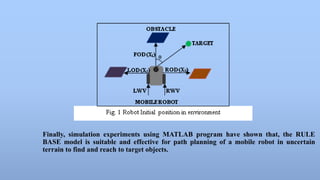
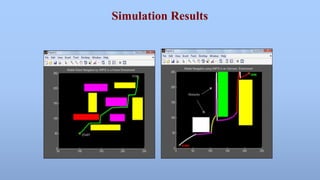
Finally, simulation experiments using MATLAB program have shown that, the RULE 
BASE model is suitable and effective for path planning of a mobile robot in uncertain 
terrain to find and reach to target objects.
Rule Base Navigation in current analysis 
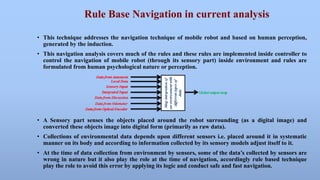
• This technique addresses the navigation technique of mobile robot and based on human perception, 
generated by the induction. 
• This navigation analysis covers much of the rules and these rules are implemented inside controller to 
control the navigation of mobile robot (through its sensory part) inside environment and rules are 
formulated from human psychological nature or perception. 
• A Sensory part senses the objects placed around the robot surrounding (as a digital image) and 
converted these objects image into digital form (primarily as raw data). 
• Collections of environmental data depends upon different sensors i.e. placed around it in systematic 
manner on its body and according to information collected by its sensory models adjust itself to it. 
• At the time of data collection from environment by sensors, some of the data’s collected by sensors are 
wrong in nature but it also play the role at the time of navigation, accordingly rule based technique 
play the role to avoid this error by applying its logic and conduct safe and fast navigation.
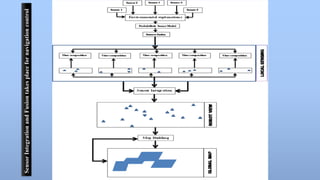
Sensor Integration and Fusion takes place for navigation control
Some of the Rules for Rule Based Technique 
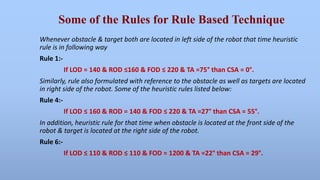
Whenever obstacle & target both are located in left side of the robot that time heuristic 
rule is in following way 
Rule 1:- 
If LOD = 140 & ROD ≤160 & FOD ≤ 220 & TA =75° than CSA = 0°. 
Similarly, rule also formulated with reference to the obstacle as well as targets are located 
in right side of the robot. Some of the heuristic rules listed below: 
Rule 4:- 
If LOD ≤ 160 & ROD = 140 & FOD ≤ 220 & TA =27° than CSA = 55°. 
In addition, heuristic rule for that time when obstacle is located at the front side of the 
robot & target is located at the right side of the robot. 
Rule 6:- 
If LOD ≤ 110 & ROD ≤ 110 & FOD = 1200 & TA =22° than CSA = 29°.
Simulation Results
Conclusion and future work 
• The approach is based on the advantages of knowledge base reasoning of rule base 
interference system. 
• RULE BASE system has advantages of replacing the large number of simulation data. 
• The proposed technique was analyzed in a number of simulated experiments and it was 
found that the results compromise with satisfaction the obstacle avoidance and moving 
towards the requirements. 
• The above technique also compared with other techniques to proved the authenticity of the 
RULE BASE controller. 
• The proposed technique show the efficiency of the navigational controller by simulation 
results. 
• FutureWork could be included the multiple mobile robots with dynamic obstacles.
References 
• Coax Flight Simulator in Webots by Edgard Font Calafell (Master Thesis) on 06/28/2011. 
• Velappa Ganapathy, Soh Chin Yun and Wen Lik Dennis Lui, “Utilization of Webots and Khepera II as a Platform for Neural Q-Learning Controllers,”IEEE Symposium on 
Industrial Electronics & Applications (ISIEA 2009) Kuala Lumpur, Malaysia 4-6 October 2009 Volume 2 pp. 547-1032. 
• Olivier Michel, “Symbiosis between Virtual and Real Mobile Robots” , Virtual World Lecture Notes in Computer Science, Microprocessor and Interface Lab, Swiss Federal 
Institute of Technology, Lausanne, Switzerland, Volume 1434, 1998, pp. 254-263. 
• Lukasz Przytula, M. Szczuka,“On Simulation of NAO Soccer Robots in Webots”, Proceedings of the International Workshop CS&P, September 28-30, Pułtusk, Poland 
(2011). 
• V. Nunez, L.I. Olvera and J.A. Pamanes, “Simulation and Experimentation of Walking of the bioloid Humanoid Robot”, 13th World Congress in Mechanism and Machine 
Science, Guanajuato, Mexico, 19-25 June (2011). 
• S. K. Pradhan, D. R. Parhi and A. K. Panda, “Navigation of Multiple Mobile Robots using Rule-based-neuro-fuzzy technique”, International journal of computational 
intelligent, vol-3, no. 2, pp. 142–152, October (2005). 
• A. Abubaker, “A Novel Mobile Robot Navigation System Using Neuro-Fuzzy Rule-Based Optimization Technique”, Research journal of Applied science Engineering and 
Technology, vol-4, no. 15, pp. 2577–2583, (2012). 
• M. A. Batalin, G. S. Sukhatme, and M. Hattig, “Mobile Robot Navigation Using a Sensor Network”, IEEE International Conference of Robotics and Automation, pp. 636- 
642, May (2004). 
• E. M. Saad, M. H. Awadalla, A. M. Hamdy, and H. I. Ali, “Efficient Distributed Controller for Wandering Robot Formations using Local Sensing and Limited Range 
Communications”, International Journal of computers, vol-2, no. 3, pp. 330–339, (2008). 
• P. Benavidez and M. Jamshidi, “Mobile robot navigation and target tracking system”, 6th International Conference on System of Systems Engineering, pp. 299–304, Jun. 
(2011).
Seminar ppt

Seminar ppt

  • 1.
    Study of VariousAspect of Tunnelling for Highway or Water Resources Work with Case Study of Important Tunnels Constructed Presented by Santosh Kumar Sahu (M.Tech) Roll No.- 12MT03 Under the Guidance of Prof. Suresh Kumar Department of Civil Engineering CAMBRIDGE INSTITUTE OF TECHNOLOGY TATISILWAI, RANCHI 835103
  • 2.
    Content 1. Introduction 2. Rule Base Navigation in current analysis 3. Some of the Rules for RBT 4. Simulation results 5. Conclusion and future work 6. References
  • 3.
    Introduction • Now-a-daysmobile robots are widely used in various field of engineering such as aerospace research, nuclear research, mining industry and the production industry. • Navigation of mobile robot is one of the elementary problems in robotic research field. In general the navigation algorithms are classified as global and local, depending on the surrounding environment. • In global navigation, the surrounding environment is completely known to the mobile robot and the path which avoids the obstacle is predefined. • In other side local navigation, the surrounding environment is completely unknown to the robot and various types of sensors are used to detect and recognize obstacles and avoid collisions. • Several efficient techniques have been developed by the researchers in the navigation of mobile robot. • The hallmark of this presentation describes navigation of an autonomous mobile robot in a cluttered environment using Rule Based Sensor Network .
  • 4.
    Finally, simulation experimentsusing MATLAB program have shown that, the RULE BASE model is suitable and effective for path planning of a mobile robot in uncertain terrain to find and reach to target objects.
  • 5.
    Rule Base Navigationin current analysis • This technique addresses the navigation technique of mobile robot and based on human perception, generated by the induction. • This navigation analysis covers much of the rules and these rules are implemented inside controller to control the navigation of mobile robot (through its sensory part) inside environment and rules are formulated from human psychological nature or perception. • A Sensory part senses the objects placed around the robot surrounding (as a digital image) and converted these objects image into digital form (primarily as raw data). • Collections of environmental data depends upon different sensors i.e. placed around it in systematic manner on its body and according to information collected by its sensory models adjust itself to it. • At the time of data collection from environment by sensors, some of the data’s collected by sensors are wrong in nature but it also play the role at the time of navigation, accordingly rule based technique play the role to avoid this error by applying its logic and conduct safe and fast navigation.
  • 6.
    Sensor Integration andFusion takes place for navigation control
  • 7.
    Some of theRules for Rule Based Technique Whenever obstacle & target both are located in left side of the robot that time heuristic rule is in following way Rule 1:- If LOD = 140 & ROD ≤160 & FOD ≤ 220 & TA =75° than CSA = 0°. Similarly, rule also formulated with reference to the obstacle as well as targets are located in right side of the robot. Some of the heuristic rules listed below: Rule 4:- If LOD ≤ 160 & ROD = 140 & FOD ≤ 220 & TA =27° than CSA = 55°. In addition, heuristic rule for that time when obstacle is located at the front side of the robot & target is located at the right side of the robot. Rule 6:- If LOD ≤ 110 & ROD ≤ 110 & FOD = 1200 & TA =22° than CSA = 29°.
  • 8.
  • 9.
    Conclusion and futurework • The approach is based on the advantages of knowledge base reasoning of rule base interference system. • RULE BASE system has advantages of replacing the large number of simulation data. • The proposed technique was analyzed in a number of simulated experiments and it was found that the results compromise with satisfaction the obstacle avoidance and moving towards the requirements. • The above technique also compared with other techniques to proved the authenticity of the RULE BASE controller. • The proposed technique show the efficiency of the navigational controller by simulation results. • FutureWork could be included the multiple mobile robots with dynamic obstacles.
  • 10.
    References • CoaxFlight Simulator in Webots by Edgard Font Calafell (Master Thesis) on 06/28/2011. • Velappa Ganapathy, Soh Chin Yun and Wen Lik Dennis Lui, “Utilization of Webots and Khepera II as a Platform for Neural Q-Learning Controllers,”IEEE Symposium on Industrial Electronics & Applications (ISIEA 2009) Kuala Lumpur, Malaysia 4-6 October 2009 Volume 2 pp. 547-1032. • Olivier Michel, “Symbiosis between Virtual and Real Mobile Robots” , Virtual World Lecture Notes in Computer Science, Microprocessor and Interface Lab, Swiss Federal Institute of Technology, Lausanne, Switzerland, Volume 1434, 1998, pp. 254-263. • Lukasz Przytula, M. Szczuka,“On Simulation of NAO Soccer Robots in Webots”, Proceedings of the International Workshop CS&P, September 28-30, Pułtusk, Poland (2011). • V. Nunez, L.I. Olvera and J.A. Pamanes, “Simulation and Experimentation of Walking of the bioloid Humanoid Robot”, 13th World Congress in Mechanism and Machine Science, Guanajuato, Mexico, 19-25 June (2011). • S. K. Pradhan, D. R. Parhi and A. K. Panda, “Navigation of Multiple Mobile Robots using Rule-based-neuro-fuzzy technique”, International journal of computational intelligent, vol-3, no. 2, pp. 142–152, October (2005). • A. Abubaker, “A Novel Mobile Robot Navigation System Using Neuro-Fuzzy Rule-Based Optimization Technique”, Research journal of Applied science Engineering and Technology, vol-4, no. 15, pp. 2577–2583, (2012). • M. A. Batalin, G. S. Sukhatme, and M. Hattig, “Mobile Robot Navigation Using a Sensor Network”, IEEE International Conference of Robotics and Automation, pp. 636- 642, May (2004). • E. M. Saad, M. H. Awadalla, A. M. Hamdy, and H. I. Ali, “Efficient Distributed Controller for Wandering Robot Formations using Local Sensing and Limited Range Communications”, International Journal of computers, vol-2, no. 3, pp. 330–339, (2008). • P. Benavidez and M. Jamshidi, “Mobile robot navigation and target tracking system”, 6th International Conference on System of Systems Engineering, pp. 299–304, Jun. (2011).