Grade11
MANAGEMENT
FUNCTIONS
Fabie M. Pasilan
Department of Education
Santa Rosa, Laguna
HENRI FAYOL and
FREDERICK WINSLOW
TAYLOR: Their
Contribution to
Management Thought
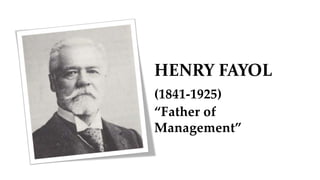
HENRY FAYOL
(1841-1925)
“Father of
Management”
CONTRIBUTIONS
INDUSTRIAL ACTIVITIES:
“All activities to which industrial
undertakings can be divided into technical,
commercial, financial, security, accounting
and management activities.
ELEMENTS OF
MANAGEMENT:
“To forecast and plan, to organize, to
command, to coordinate, and to
control”.
1.PLANNING
Drawing up a good plan of action is the
hardest among the functions of
management. It requires active
participation of the entire organization.
2. ORGANIZING
An organization can only function well if it is
well-organized. This means that there must
be sufficient staff and raw materials so that
the organization can run smoothly and it
can build a good working structure.
3. COMMANDING
Return from all employees will be optimized if
they are given concrete instructions with
respect to the activities that must be carried out
by them.
4. COORDINATING
When all activities are harmonized, the
organization will function better. It aims to
stimulate motivation and discipline within the
group dynamics.
5. CONTROLLING
Verifying whether everything is going according
to plan, the organization knows exactly whether
the activities are carried out in conformity with
the plan.
Four Steps process where control takes
place
1. Establish performance standards based on
organization objectives
2. Measure and report on actual performance.
3. Compare results with
performance and standards.
4. Take corrective or preventive
measures as needed.
6. Managerial which includes activities like
planning, organizing, commanding, coordinating and controlling
Acts as an overall function in relation to the five
functions
GENERAL PRINCIPLES
OF MANAGEMENT
Fayol outlines the fourteen principles of
management.
14 Principles of
Management
Guideline for decision making and
management actions.
1. DIVISION OF WORK
Specialization promotes efficiency of the
workforce as it increases productivity,
accuracy and speed.
2. AUTHORITY AND
RESPONSIBILITY
Accompanying power or authority gives the
management the right to give orders to the
subordinates
3. DISCIPLINE
Part of the core values of a mission and
vision in the form of good conduct and
respectful interactions.
4. UNITY OF COMMAND
Individual employee should receive
orders from one manager and that the
employee is answerable to that manager.
5. UNITY OF DIRECTION
Focus and unity. All activities must be
carried out by one group that forms a
team.
6. SUBORDINATION OF
INDIVIDUAL INTEREST
Personal interests are subordinate to the
interest of the organization
7. REMUNERATION
Argues that remuneration should be
sufficient to keep employees motivated and
productive.
8. DEGREE OF
CENTRALIZATION
Implies the sharing of authorities for the
decision making process with lower
levels(middle and lower management).
9. SCALAR CHAIN
There should be clear line in the
area of authority
10. ORDER
Employees in an organization must have
the right resources at their disposal so
that they can function properly.
11. EQUITY
Employees must be treated kindly and
equally. They must be in the right place in
the organization to do the right things.
12. STABILITY OF TENURE
OF PERSONNEL
Represents deployment and managing of
personnel and this should be in balance with
service that is provided from the
organization.
13. INITIATIVE
Employees should be allowed to express
new ideas which encourages interests and
involvement and creates added value for
the company.
14. ESPRIT DE CORPS
Strives for the involvement and unity of
employees. Managers are responsible for the
development of the morale of the employees;
individually and in the area of communication.
QUALITIES OF
MANAGER:
A business requires a basis in the
people who carry them out: physical,
mental, moral and general education
MANAGERIAL DUTIES
OF AN
ORGANIZATION:
In organizing a business is to provide it
with everything useful for its functioning
raw materials, tools, capital, personnel.
COMMAND:
Sets the human organization in motion
towards its objective which is to get
optimum return from all employees.
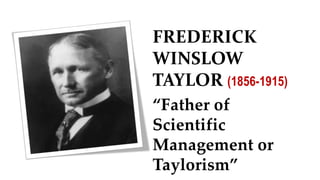
FREDERICK
WINSLOW
TAYLOR (1856-1915)
“Father of
Scientific
Management or
Taylorism”
PRINCIPLES OF
MANAGEMENT:
1. The development of scientific method
of designing jobs to replace the old-rule-
of-thumb methods.
2. The scientific selection and progressive
teaching and development of employees.
3. Bringing together of scientifically
selected employees and scientifically
developed methods for designing jobs.
4. Division of work resulting in the
interdependence between management
and the workers.
MECHANISM OF
MANAGEMENT:
Putting the right person on the job with
the correct equipment.
PHILOSOPHY OF
MANAGEMENT:
Scientific management was a complete
mental revolution for both management and
employees towards their respective duties
towards each other
FAYOL VS. TAYLOR
• Essentially complementary
• Believed that proper
management of personnel and
other resources was the key to
organizational success.
• Used scientific approach to
management
IDEAS OF FAYOL AND
TAYLOR THAT UNITE
THEIR WORK (Berdayes, 2002)
Work processes, organizational structures,
and an emphasis on a hierarchical division of
labor.
Creation of the concept of organization
as a whole.
Emphasis on formal rationality by
supporting scientific techniques,
order, and efficiency
The role of managers is to work
along with the workers.
Their major difference was in their
orientation. Fayol stressed the
management of organization
while Taylor stressed the
management of operative work.
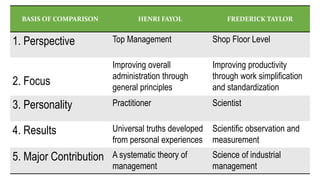
BASIS OF COMPARISON HENRI FAYOL FREDERICK TAYLOR
1. Perspective Top Management Shop Floor Level
2. Focus
Improving overall
administration through
general principles
Improving productivity
through work simplification
and standardization
3. Personality Practitioner Scientist
4. Results Universal truths developed
from personal experiences
Scientific observation and
measurement
5. Major Contribution A systematic theory of
management
Science of industrial
management
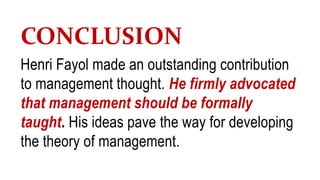
CONCLUSION
Henri Fayol made an outstanding contribution
to management thought. He firmly advocated
that management should be formally
taught. His ideas pave the way for developing
the theory of management.
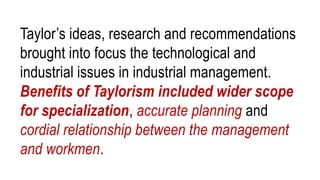
Taylor’s ideas, research and recommendations
brought into focus the technological and
industrial issues in industrial management.
Benefits of Taylorism included wider scope
for specialization, accurate planning and
cordial relationship between the management
and workmen.
The greatest contribution
of a leader is to make other
leaders.
Simon Sinek
Reference:
Rahman, Hasebur Md. (2012) Henry Fayol and Frederick Winslow Taylor’s Contribution to Management Thought: An
Overview, ABC Journal of Advanced Research, Volume 1, No 2 (2012)

Seminar in School Administration

  • 1.
  • 2.
    HENRI FAYOL and FREDERICKWINSLOW TAYLOR: Their Contribution to Management Thought
  • 3.
  • 4.
    CONTRIBUTIONS INDUSTRIAL ACTIVITIES: “All activitiesto which industrial undertakings can be divided into technical, commercial, financial, security, accounting and management activities.
  • 5.
    ELEMENTS OF MANAGEMENT: “To forecastand plan, to organize, to command, to coordinate, and to control”.
  • 6.
    1.PLANNING Drawing up agood plan of action is the hardest among the functions of management. It requires active participation of the entire organization.
  • 7.
    2. ORGANIZING An organizationcan only function well if it is well-organized. This means that there must be sufficient staff and raw materials so that the organization can run smoothly and it can build a good working structure.
  • 8.
    3. COMMANDING Return fromall employees will be optimized if they are given concrete instructions with respect to the activities that must be carried out by them.
  • 9.
    4. COORDINATING When allactivities are harmonized, the organization will function better. It aims to stimulate motivation and discipline within the group dynamics.
  • 10.
    5. CONTROLLING Verifying whethereverything is going according to plan, the organization knows exactly whether the activities are carried out in conformity with the plan.
  • 11.
    Four Steps processwhere control takes place 1. Establish performance standards based on organization objectives 2. Measure and report on actual performance.
  • 12.
    3. Compare resultswith performance and standards. 4. Take corrective or preventive measures as needed.
  • 13.
    6. Managerial whichincludes activities like planning, organizing, commanding, coordinating and controlling Acts as an overall function in relation to the five functions
  • 14.
    GENERAL PRINCIPLES OF MANAGEMENT Fayoloutlines the fourteen principles of management.
  • 15.
    14 Principles of Management Guidelinefor decision making and management actions.
  • 16.
    1. DIVISION OFWORK Specialization promotes efficiency of the workforce as it increases productivity, accuracy and speed.
  • 17.
    2. AUTHORITY AND RESPONSIBILITY Accompanyingpower or authority gives the management the right to give orders to the subordinates
  • 18.
    3. DISCIPLINE Part ofthe core values of a mission and vision in the form of good conduct and respectful interactions.
  • 19.
    4. UNITY OFCOMMAND Individual employee should receive orders from one manager and that the employee is answerable to that manager.
  • 20.
    5. UNITY OFDIRECTION Focus and unity. All activities must be carried out by one group that forms a team.
  • 21.
    6. SUBORDINATION OF INDIVIDUALINTEREST Personal interests are subordinate to the interest of the organization
  • 22.
    7. REMUNERATION Argues thatremuneration should be sufficient to keep employees motivated and productive.
  • 23.
    8. DEGREE OF CENTRALIZATION Impliesthe sharing of authorities for the decision making process with lower levels(middle and lower management).
  • 24.
    9. SCALAR CHAIN Thereshould be clear line in the area of authority
  • 25.
    10. ORDER Employees inan organization must have the right resources at their disposal so that they can function properly.
  • 26.
    11. EQUITY Employees mustbe treated kindly and equally. They must be in the right place in the organization to do the right things.
  • 27.
    12. STABILITY OFTENURE OF PERSONNEL Represents deployment and managing of personnel and this should be in balance with service that is provided from the organization.
  • 28.
    13. INITIATIVE Employees shouldbe allowed to express new ideas which encourages interests and involvement and creates added value for the company.
  • 29.
    14. ESPRIT DECORPS Strives for the involvement and unity of employees. Managers are responsible for the development of the morale of the employees; individually and in the area of communication.
  • 30.
    QUALITIES OF MANAGER: A businessrequires a basis in the people who carry them out: physical, mental, moral and general education
  • 31.
    MANAGERIAL DUTIES OF AN ORGANIZATION: Inorganizing a business is to provide it with everything useful for its functioning raw materials, tools, capital, personnel.
  • 32.
    COMMAND: Sets the humanorganization in motion towards its objective which is to get optimum return from all employees.
  • 33.
  • 34.
    PRINCIPLES OF MANAGEMENT: 1. Thedevelopment of scientific method of designing jobs to replace the old-rule- of-thumb methods.
  • 35.
    2. The scientificselection and progressive teaching and development of employees. 3. Bringing together of scientifically selected employees and scientifically developed methods for designing jobs.
  • 36.
    4. Division ofwork resulting in the interdependence between management and the workers.
  • 37.
    MECHANISM OF MANAGEMENT: Putting theright person on the job with the correct equipment.
  • 38.
    PHILOSOPHY OF MANAGEMENT: Scientific managementwas a complete mental revolution for both management and employees towards their respective duties towards each other
  • 39.
  • 40.
    • Essentially complementary •Believed that proper management of personnel and other resources was the key to organizational success.
  • 41.
    • Used scientificapproach to management
  • 42.
    IDEAS OF FAYOLAND TAYLOR THAT UNITE THEIR WORK (Berdayes, 2002) Work processes, organizational structures, and an emphasis on a hierarchical division of labor.
  • 43.
    Creation of theconcept of organization as a whole. Emphasis on formal rationality by supporting scientific techniques, order, and efficiency
  • 44.
    The role ofmanagers is to work along with the workers.
  • 45.
    Their major differencewas in their orientation. Fayol stressed the management of organization while Taylor stressed the management of operative work.
  • 46.
    BASIS OF COMPARISONHENRI FAYOL FREDERICK TAYLOR 1. Perspective Top Management Shop Floor Level 2. Focus Improving overall administration through general principles Improving productivity through work simplification and standardization 3. Personality Practitioner Scientist 4. Results Universal truths developed from personal experiences Scientific observation and measurement 5. Major Contribution A systematic theory of management Science of industrial management
  • 47.
    CONCLUSION Henri Fayol madean outstanding contribution to management thought. He firmly advocated that management should be formally taught. His ideas pave the way for developing the theory of management.
  • 48.
    Taylor’s ideas, researchand recommendations brought into focus the technological and industrial issues in industrial management. Benefits of Taylorism included wider scope for specialization, accurate planning and cordial relationship between the management and workmen.
  • 49.
    The greatest contribution ofa leader is to make other leaders. Simon Sinek
  • 50.
    Reference: Rahman, Hasebur Md.(2012) Henry Fayol and Frederick Winslow Taylor’s Contribution to Management Thought: An Overview, ABC Journal of Advanced Research, Volume 1, No 2 (2012)