L Li*, DSW Ng, W-C Mah, FF Almeida, SA Rahmat, VK Rao, SC Leow, F Laudisi, MT Peh, AM
Goh, JSY Lim, GD Wright, A Mortellaro, R Taneja, F Ginhoux, CG Lee, PK Moore and DP Lane*
Commentator: Dr. Yao Chang
Speaker: Yi-Zhen Wu
Date: 2015.11.04
1
A unique role for p53 in the regulation of M2 macrophage polarization
2
Macrophage
Phagocytosis
Antigen presentation
Inflammation
Innate immunity Adaptive immunity
3
Front. Immunol., 16 November 2011
Macrophage subtypes
1. parasite containment
2. Wound healing
3. signatures is production of enzyme Arginase-1
1. help killing pathogens
2. secrete pro-inflammatory cytokines
and chemokines
Dynamic changePolarization
4
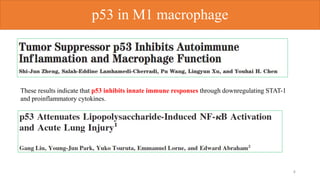
p53 in M1 macrophage
These results indicate that p53 inhibits innate immune responses through downregulating STAT-1
and proinflammatory cytokines.
Transcriptional factor p53
5
6
p53 network
Journal of Cell Science 2003 116: 4077-4085; doi: 10.1242/jcs.00739
Specific Aim
Although a role for p53 in M1 macrophage function has been suggested,
there is little information relating to its effect in M2 macrophages.
7
To investigate the role of p53 in M2 macrophage polarization
Does the polarization of M2 macrophage activate the p53 ?
8
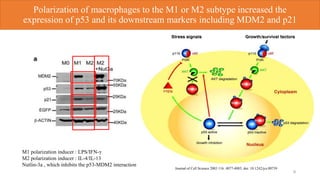
Polarization of macrophages to the M1 or M2 subtype increased the
expression of p53 and its downstream markers including MDM2 and p21
9
M1 polarization inducer : LPS/IFN-γ
M2 polarization inducer : IL-4/IL-13
Nutlin-3a , which inhibits the p53-MDM2 interaction
Journal of Cell Science 2003 116: 4077-4085; doi: 10.1242/jcs.00739
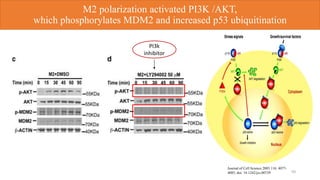
M2 polarization activated PI3K /AKT,
which phosphorylates MDM2 and increased p53 ubiquitination
10
PI3k
inhibitor
Journal of Cell Science 2003 116: 4077-
4085; doi: 10.1242/jcs.00739
11
proteasome
inhibitor
M2 polarization activated PI3K /AKT,
which phosphorylates MDM2 and increased p53 ubiquitination
Does p53 regulate polarization of M2 macrophage in vitro ?
12
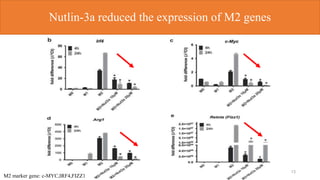
Nutlin-3a reduced the expression of M2 genes
13
M2 marker gene: c-MYC,IRF4,FIZZ1
14
Nutlin-3a reduced the expression of M2 genes
M2 marker gene: c-MYC,IRF4,FIZZ1
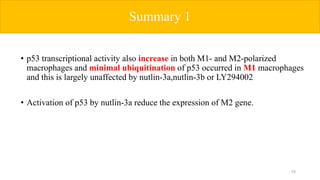
• p53 transcriptional activity also increase in both M1- and M2-polarized
macrophages and minimal ubiquitination of p53 occurred in M1 macrophages
and this is largely unaffected by nutlin-3a,nutlin-3b or LY294002
• Activation of p53 by nutlin-3a reduce the expression of M2 gene.
15
Summary 1
Does the activation of p53 in M2 macrophages result in a macrophage
phenotype intermediate between M1 and M2 ?
16
17
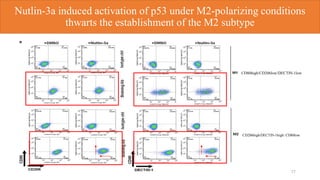
Nutlin-3a induced activation of p53 under M2-polarizing conditions
thwarts the establishment of the M2 subtype
CD80high/CD206low/DECTIN-1low
CD206high/DECTIN-1high/ CD80low
18
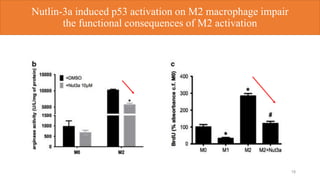
Nutlin-3a induced p53 activation on M2 macrophage impair
the functional consequences of M2 activation
Summary 2
• Nutlin-3a induced p53 activation in M2 polarization macrophage impairs
not only M2 gene expression but also the functional consequences of
M2 activation.
19
Loss of p53 increased the expression of several M2 genes
20
M2 marker gene: c-MYC,IRF4,FIZZ1
21
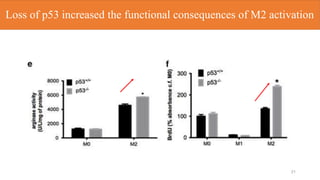
Loss of p53 increased the functional consequences of M2 activation
Trp53R172H Mutant mice
• Trp53R172H affects the overall structure of the p53 DNA-binding domain
• p53 accumulated in mutant cells, it did not cause translation of downstream target proteins.
22
23
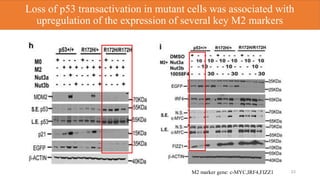
Loss of p53 transactivation in mutant cells was associated with
upregulation of the expression of several key M2 markers
M2 marker gene: c-MYC,IRF4,FIZZ1
• Loss of p53 increased the expression of several M2 genes, increased arginase
activity and enhanced proliferation of M2 macrophages.
• Loss of p53 transactivation in mutant cells was associated with upregulation
of the expression of several key M2 markers
Summary 3
24
What is the molecular mechanism of p53 in regulating M2 polarization ?
25
26
c-MYC
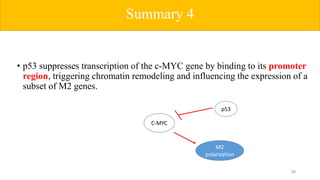
• p53 activation downregulates c-myc expression through binding to the c-myc promoter
• The M2 polarization requires the transcription factor c-MYC
p53
C-MYC
M2
polarization
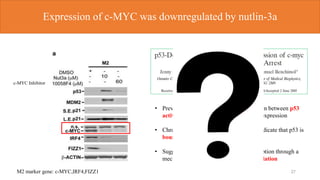
Expression of c-MYC was downregulated by nutlin-3a
27
c-MYC Inhibitor
• Previous studies have shown an association between p53
activation and downregulation of c-myc expression
• Chromatin immunoprecipitation assays indicate that p53 is
bound to the c-myc promoter in vivo.
• Suggest that p53 represses c-myc transcription through a
mechanism that involves histone deacetylation
M2 marker gene: c-MYC,IRF4,FIZZ1
28
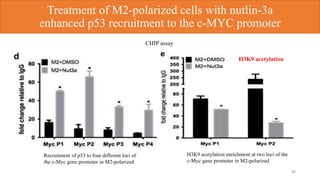
Treatment of M2-polarized cells with nutlin-3a
enhanced p53 recruitment to the c-MYC promoter
CHIP assay
Recruitment of p53 to four different loci of
the c-Myc gene promoter in M2-polarized
H3K9 acetylation enrichment at two loci of the
c-Myc gene promoter in M2-polarized
H3K9 acetylation
• p53 suppresses transcription of the c-MYC gene by binding to its promoter
region, triggering chromatin remodeling and influencing the expression of a
subset of M2 genes.
Summary 4
29
p53
C-MYC
M2
polarization
Dose endogenous p53 regulates IL4-elicited M2 functional phenotype
in peritoneal macrophages in vivo ?
30
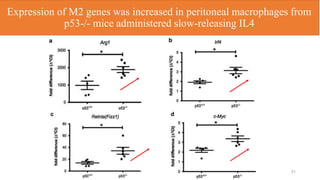
Expression of M2 genes was increased in peritoneal macrophages from
p53-/- mice administered slow-releasing IL4
31
32
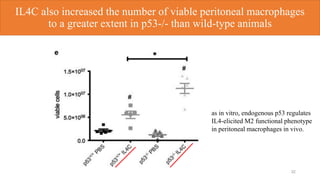
IL4C also increased the number of viable peritoneal macrophages
to a greater extent in p53-/- than wild-type animals
as in vitro, endogenous p53 regulates
IL4-elicited M2 functional phenotype
in peritoneal macrophages in vivo.
• As M2-polarized macrophages are important for the development of tolerance to LPS
• Gene responses during endotoxin tolerance were similar to those found during M2 polarization,
including reduced production of proinflammatory mediators.
• LPS tolerance, defined as the reduced capacity of a cell to respond to LPS activation after an initial
exposure to this stimulus
33
Previous Studies
34
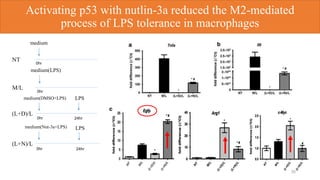
Does p53 mediate M2 polarization during LPS tolerance
in macrophages?
Activating p53 with nutlin-3a reduced the M2-mediated
process of LPS tolerance in macrophages
35
medium
NT
M/L
(L+D)/L
(L+N)/L
medium(LPS)
medium(DMSO+LPS)
medium(Nut-3a+LPS)
LPS
LPS
24hr0hr
0hr
0hr
0hr
24hr
36
Effect of nutlin-3a on plasma TNFα & IL6
• Overall, these data show that endogenous p53 regulates M2 polarization
during LPS tolerance in vitro and in vivo.
Summary 5
37
p53
M2
polarization
inflammationLPS
tolerance
degradation
PI3K
AKT
p53
P
LY294002
Nutlin-3a
IL4 / IL13
p53
p53 M2 gene
Conclusions
MDM2
P
10058F4
38
P
c-MYC
M2 gene
p53
M2 polarization Activate p53
Activate
c-MYC
PI3K
AKT
P
MDM2
P
P
STAT6
STAT6
c-MYC
P c-MYC
• In conclusion, p53 is the first transcription factor reported to suppress M2
macrophage polarization.
• We propose that manipulation of the p53 system provides an additional approach to
study the molecular basis of macrophage plasticity and a new therapeutic target
for small molecule p53 activators such as nutlin-3a.
39
Discussion 1
• This, coupled with the ability of p53 to regulate M2 marker expression, raises the
possibility that activating macrophage p53 may reduce the density and the
protumoral phenotype of M2-like tumor-associated macrophages (TAM).
40
Discussion 2
41
42
M2 Macrophage
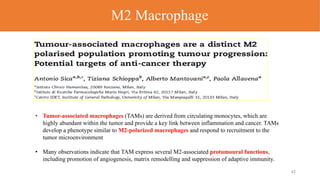
• Tumor-associated macrophages (TAMs) are derived from circulating monocytes, which are
highly abundant within the tumor and provide a key link between inflammation and cancer. TAMs
develop a phenotype similar to M2-polarized macrophages and respond to recruitment to the
tumor microenvironment
• Many observations indicate that TAM express several M2-associated protumoural functions,
including promotion of angiogenesis, matrix remodelling and suppression of adaptive immunity.
43
At an evolutionary scale of the development of macrophage-like immune cells, arginase-1 may
have been primarily a wound healing protein, transcriptionally induced by proteins of the TGF-
β family
• Principal Component Analysis (PCA) was used to gauge the extent
that samples differ significantly from each other and to identify
potential biological outliers
44
• 為什麼要看C-MYC
• The transcription factor c-Myc is essential for cellular proliferation
and is one of the most frequently activated oncogenes
45
46
TNF-α & IL6 affect lung histology in LPS-tolerant animals
Previous Studies
47
v
v
48
Nutlin-3a reduced the expression of M2 genes
The molecular mechanism of action of p53 in
regulating M2 polarization is unknown
49
Expression of M1 marker gene was also reduced by nutlin-3
50
51
52
Nutlin-3a did not affect the expression of M2 markers in macrophages
from p53-/-animals thereby confirming that this effect is p53-dependent
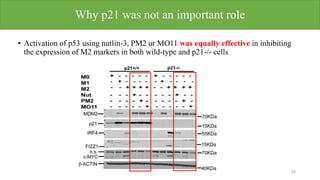
Why p21 was not an important role
• Activation of p53 using nutlin-3, PM2 or MO11 was equally effective in inhibiting
the expression of M2 markers in both wild-type and p21-/- cells
53
10058F4 reduced the expression of M2 markers in p53R172H/R172H macrophages
does not require a functional p53 to be effective
54
c-MYC inhibitor
IL4 / IL13
55
C-MYC
M2 gene
M2 macrophage
P
c-MYC
P
STAT6
56
10058F4 & Nutlin-3a suppressed a similar subset of
M2 transcriptome activation

Seminar 1104

  • 1.
    L Li*, DSWNg, W-C Mah, FF Almeida, SA Rahmat, VK Rao, SC Leow, F Laudisi, MT Peh, AM Goh, JSY Lim, GD Wright, A Mortellaro, R Taneja, F Ginhoux, CG Lee, PK Moore and DP Lane* Commentator: Dr. Yao Chang Speaker: Yi-Zhen Wu Date: 2015.11.04 1 A unique role for p53 in the regulation of M2 macrophage polarization
  • 2.
  • 3.
    3 Front. Immunol., 16November 2011 Macrophage subtypes 1. parasite containment 2. Wound healing 3. signatures is production of enzyme Arginase-1 1. help killing pathogens 2. secrete pro-inflammatory cytokines and chemokines Dynamic changePolarization
  • 4.
    4 p53 in M1macrophage These results indicate that p53 inhibits innate immune responses through downregulating STAT-1 and proinflammatory cytokines.
  • 5.
  • 6.
    6 p53 network Journal ofCell Science 2003 116: 4077-4085; doi: 10.1242/jcs.00739
  • 7.
    Specific Aim Although arole for p53 in M1 macrophage function has been suggested, there is little information relating to its effect in M2 macrophages. 7 To investigate the role of p53 in M2 macrophage polarization
  • 8.
    Does the polarizationof M2 macrophage activate the p53 ? 8
  • 9.
    Polarization of macrophagesto the M1 or M2 subtype increased the expression of p53 and its downstream markers including MDM2 and p21 9 M1 polarization inducer : LPS/IFN-γ M2 polarization inducer : IL-4/IL-13 Nutlin-3a , which inhibits the p53-MDM2 interaction Journal of Cell Science 2003 116: 4077-4085; doi: 10.1242/jcs.00739
  • 10.
    M2 polarization activatedPI3K /AKT, which phosphorylates MDM2 and increased p53 ubiquitination 10 PI3k inhibitor Journal of Cell Science 2003 116: 4077- 4085; doi: 10.1242/jcs.00739
  • 11.
    11 proteasome inhibitor M2 polarization activatedPI3K /AKT, which phosphorylates MDM2 and increased p53 ubiquitination
  • 12.
    Does p53 regulatepolarization of M2 macrophage in vitro ? 12
  • 13.
    Nutlin-3a reduced theexpression of M2 genes 13 M2 marker gene: c-MYC,IRF4,FIZZ1
  • 14.
    14 Nutlin-3a reduced theexpression of M2 genes M2 marker gene: c-MYC,IRF4,FIZZ1
  • 15.
    • p53 transcriptionalactivity also increase in both M1- and M2-polarized macrophages and minimal ubiquitination of p53 occurred in M1 macrophages and this is largely unaffected by nutlin-3a,nutlin-3b or LY294002 • Activation of p53 by nutlin-3a reduce the expression of M2 gene. 15 Summary 1
  • 16.
    Does the activationof p53 in M2 macrophages result in a macrophage phenotype intermediate between M1 and M2 ? 16
  • 17.
    17 Nutlin-3a induced activationof p53 under M2-polarizing conditions thwarts the establishment of the M2 subtype CD80high/CD206low/DECTIN-1low CD206high/DECTIN-1high/ CD80low
  • 18.
    18 Nutlin-3a induced p53activation on M2 macrophage impair the functional consequences of M2 activation
  • 19.
    Summary 2 • Nutlin-3ainduced p53 activation in M2 polarization macrophage impairs not only M2 gene expression but also the functional consequences of M2 activation. 19
  • 20.
    Loss of p53increased the expression of several M2 genes 20 M2 marker gene: c-MYC,IRF4,FIZZ1
  • 21.
    21 Loss of p53increased the functional consequences of M2 activation
  • 22.
    Trp53R172H Mutant mice •Trp53R172H affects the overall structure of the p53 DNA-binding domain • p53 accumulated in mutant cells, it did not cause translation of downstream target proteins. 22
  • 23.
    23 Loss of p53transactivation in mutant cells was associated with upregulation of the expression of several key M2 markers M2 marker gene: c-MYC,IRF4,FIZZ1
  • 24.
    • Loss ofp53 increased the expression of several M2 genes, increased arginase activity and enhanced proliferation of M2 macrophages. • Loss of p53 transactivation in mutant cells was associated with upregulation of the expression of several key M2 markers Summary 3 24
  • 25.
    What is themolecular mechanism of p53 in regulating M2 polarization ? 25
  • 26.
    26 c-MYC • p53 activationdownregulates c-myc expression through binding to the c-myc promoter • The M2 polarization requires the transcription factor c-MYC p53 C-MYC M2 polarization
  • 27.
    Expression of c-MYCwas downregulated by nutlin-3a 27 c-MYC Inhibitor • Previous studies have shown an association between p53 activation and downregulation of c-myc expression • Chromatin immunoprecipitation assays indicate that p53 is bound to the c-myc promoter in vivo. • Suggest that p53 represses c-myc transcription through a mechanism that involves histone deacetylation M2 marker gene: c-MYC,IRF4,FIZZ1
  • 28.
    28 Treatment of M2-polarizedcells with nutlin-3a enhanced p53 recruitment to the c-MYC promoter CHIP assay Recruitment of p53 to four different loci of the c-Myc gene promoter in M2-polarized H3K9 acetylation enrichment at two loci of the c-Myc gene promoter in M2-polarized H3K9 acetylation
  • 29.
    • p53 suppressestranscription of the c-MYC gene by binding to its promoter region, triggering chromatin remodeling and influencing the expression of a subset of M2 genes. Summary 4 29 p53 C-MYC M2 polarization
  • 30.
    Dose endogenous p53regulates IL4-elicited M2 functional phenotype in peritoneal macrophages in vivo ? 30
  • 31.
    Expression of M2genes was increased in peritoneal macrophages from p53-/- mice administered slow-releasing IL4 31
  • 32.
    32 IL4C also increasedthe number of viable peritoneal macrophages to a greater extent in p53-/- than wild-type animals as in vitro, endogenous p53 regulates IL4-elicited M2 functional phenotype in peritoneal macrophages in vivo.
  • 33.
    • As M2-polarizedmacrophages are important for the development of tolerance to LPS • Gene responses during endotoxin tolerance were similar to those found during M2 polarization, including reduced production of proinflammatory mediators. • LPS tolerance, defined as the reduced capacity of a cell to respond to LPS activation after an initial exposure to this stimulus 33 Previous Studies
  • 34.
    34 Does p53 mediateM2 polarization during LPS tolerance in macrophages?
  • 35.
    Activating p53 withnutlin-3a reduced the M2-mediated process of LPS tolerance in macrophages 35 medium NT M/L (L+D)/L (L+N)/L medium(LPS) medium(DMSO+LPS) medium(Nut-3a+LPS) LPS LPS 24hr0hr 0hr 0hr 0hr 24hr
  • 36.
    36 Effect of nutlin-3aon plasma TNFα & IL6
  • 37.
    • Overall, thesedata show that endogenous p53 regulates M2 polarization during LPS tolerance in vitro and in vivo. Summary 5 37 p53 M2 polarization inflammationLPS tolerance
  • 38.
    degradation PI3K AKT p53 P LY294002 Nutlin-3a IL4 / IL13 p53 p53M2 gene Conclusions MDM2 P 10058F4 38 P c-MYC M2 gene p53 M2 polarization Activate p53 Activate c-MYC PI3K AKT P MDM2 P P STAT6 STAT6 c-MYC P c-MYC
  • 39.
    • In conclusion,p53 is the first transcription factor reported to suppress M2 macrophage polarization. • We propose that manipulation of the p53 system provides an additional approach to study the molecular basis of macrophage plasticity and a new therapeutic target for small molecule p53 activators such as nutlin-3a. 39 Discussion 1
  • 40.
    • This, coupledwith the ability of p53 to regulate M2 marker expression, raises the possibility that activating macrophage p53 may reduce the density and the protumoral phenotype of M2-like tumor-associated macrophages (TAM). 40 Discussion 2
  • 41.
  • 42.
    42 M2 Macrophage • Tumor-associatedmacrophages (TAMs) are derived from circulating monocytes, which are highly abundant within the tumor and provide a key link between inflammation and cancer. TAMs develop a phenotype similar to M2-polarized macrophages and respond to recruitment to the tumor microenvironment • Many observations indicate that TAM express several M2-associated protumoural functions, including promotion of angiogenesis, matrix remodelling and suppression of adaptive immunity.
  • 43.
    43 At an evolutionaryscale of the development of macrophage-like immune cells, arginase-1 may have been primarily a wound healing protein, transcriptionally induced by proteins of the TGF- β family
  • 44.
    • Principal ComponentAnalysis (PCA) was used to gauge the extent that samples differ significantly from each other and to identify potential biological outliers 44
  • 45.
    • 為什麼要看C-MYC • Thetranscription factor c-Myc is essential for cellular proliferation and is one of the most frequently activated oncogenes 45
  • 46.
    46 TNF-α & IL6affect lung histology in LPS-tolerant animals
  • 47.
  • 48.
    48 Nutlin-3a reduced theexpression of M2 genes
  • 49.
    The molecular mechanismof action of p53 in regulating M2 polarization is unknown 49
  • 50.
    Expression of M1marker gene was also reduced by nutlin-3 50
  • 51.
  • 52.
    52 Nutlin-3a did notaffect the expression of M2 markers in macrophages from p53-/-animals thereby confirming that this effect is p53-dependent
  • 53.
    Why p21 wasnot an important role • Activation of p53 using nutlin-3, PM2 or MO11 was equally effective in inhibiting the expression of M2 markers in both wild-type and p21-/- cells 53
  • 54.
    10058F4 reduced theexpression of M2 markers in p53R172H/R172H macrophages does not require a functional p53 to be effective 54 c-MYC inhibitor
  • 55.
    IL4 / IL13 55 C-MYC M2gene M2 macrophage P c-MYC P STAT6
  • 56.
    56 10058F4 & Nutlin-3asuppressed a similar subset of M2 transcriptome activation

Editor's Notes

  • #14 為什麼可以當M2 marker
  • #20 在這裡要說明下一個figure反證看p53對M2 macrophage的影響
  • #23 P53 mutant 最主要功能是讓p53喪失binding 到DNA的能力,使下游基因無法繼續轉錄
  • #24 兩條就好
  • #27 先前研究指出The alternative polarization of macrophages requires the transcription factor c-MYC In macrophages, IL-4 and different stimuli sustaining M2-like polarization induce c-MYC expression and its translocation to the nucleus. indicating that induction of c-MYC depends on STAT6. 在M2 polarization的過程是需要 the transcription factor c-MYC 而且會受到IL4的誘導而入核去活化M2 gene
  • #34 確定了p53在 in vivo & in vitro有抑制M2 polarization的角色後,近幾年有研究指出M2 polarization對LPS tolerance發展的重要性 所以作者想利用這樣的關係測試p53是否參與其中,藉此來發展治療敗血性休克的可能性!