$100 – Main Event
$200 – Important Figure
$300 – Fill in the Blank
$400 – Multiple Choice
$500 – Short Answer
$100 $100 $100 $100     $100 $100

$200   $200 $200 $200   $200   $200

$300 $300 $300   $300   $300 $300

$400 $400 $400 $400     $400 $400

$500 $500 $500 $500     $500 $500
$100

What was the encomienda
system?
$100

A system in which a monarch gave grants
of land and Native Americans to
Spaniards. The Native Americans
provided labor. Profits went to the
Spanish masters, who were supposed to
care for the workers, but exploited them
instead.
$200

Who was John Winthrop?
$200

The governor of Massachusetts
Bay and a Puritan
$300

 The ____, also known as _____ ,
were a group of Puritans who
didn’t want to reform the Church
of England, but wanted to
organize a separate church.
$300

Pilgrims. Separatists
$400

What was the main force driving people to
colonies on the North American Atlantic
Coast?
A)Money
B) Escape enslavement
C) Escape marriage
D) Religion
E) Work
$400


       D
$500

How did the colonists start to develop
government?
What made them develop the type of
government they did?
$500

With the Mayflower Compact, the Pilgrims vowed to make decisions
based on the majority’s interests. This compact was one of the
earliest forms of a written constitution which established the powers
and duties of government. Virginia also made the House of Burgess
in 1619, which was the first representative assembly. The
Massachusetts Bay Colony allowed free white male Puritans to vote
in elections. The English allowed to colonists some self-rule, and
the from England the colonists brought the ideas of independence
and representative government.
$100

What is Bacon’s Rebellion?
$100

A rebellion that began as a disagreement over
access to a fur trade license that escalated due to a
Governor’s limited response to an Indian attack and
the subsequent creation of a volunteer army to
combat all types on Indians. Purpose of rebellion
shifted to the rebels wanting to display their
discontent with the Governor’s ruling and their
want of reform. Ended with the death of the leader
of the rebels due to illness.
$200

Who is Edmund Andros?
$200

He arrived in 1686 as the governor of the
Dominion of New England by James II. He
abolished elective assemblies, enforced the
Navigation Acts rigorously, collected taxes not
approved by the population, and backed the courts
with supporters who hated New Englanders.
During the Glorious Revolution in the Bay Colony
he was overthrown by colonists unanimously and
jailed without violence.
$300

In New England, the population
boomed because of
___________________, but in the
Chesapeake colonies was much more
stagnant due to 1)_______________,
2)_____________, and
3)______________.
$300

High life expectancy
1)Causes of death (malaria, disease, salt
in drinking water),
2)6:1 male to female ration,
3)indentured servitude (cut into prime
time to form a family),
and/or low life expectancy?
$400

Which option is not a characteristic or
idea of the Mercantilist System?
a.World’s wealth is a fixed supply
b.Export more goods than you import
c.Strict, uniform doctrine that clearly
sets out economic standards
d. Colonies were deemed important due
to their natural resources for its success
$400


       C
$500

Discuss the facets of the Navigation
Acts. Why did they come about?
What were their effects?
$500

-Navigation Act of 1660 said that 1) no ship could trade in colonies unless it was
constructed in England or America and had a crew at least 75% English (counting
Colonists), and 2) goods such as tobacco, sugar, cotton, ect. that were not produced
in England could only be transported from the colonies to England or another
colonial port
-Staple Act of 1663 said nothing could be imported into America that wasn’t first
transshiped through England-Navigation Act of 1673 established a plantation duty
or customs on the enumerated goods
-In response to wars with Dutch. England recognized that the economic strength of
the colonies were growing and wanted to take advantage.
-Effects: took business away from Dutch (with time), England established Lords of
Trade (replaced with the Board of Trade), created imperial legislation in 1696, and
benefited England’s accumulation of wealth.
-Most importantly, it caused a dependence on goods from England because they
were the sole legal source of goods.
$100

Name the plan set forth by the British, that
was a proposed colonial government and
involved elected colonial officials and way
to govern the colonies by colonists.
$100

The Albany Plan
$200

This man was one of the leaders of the Great
Awakening and a devout Calvinist from
Connecticut, who preached how insignificant and
sinful the American people are.
$200

John Edwards
$300

_________’s propaganda helped
unite the colonists against the
British because he appealed to the
fight for independence through
logic, like his most famous work
_________
$300

Thomas Payne, Common Sense
$400

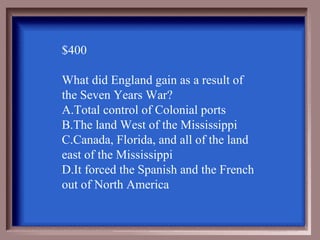
What did England gain as a result of
the Seven Years War?
A.Total control of Colonial ports
B.The land West of the Mississippi
C.Canada, Florida, and all of the land
east of the Mississippi
D.It forced the Spanish and the French
out of North America
$400


       C
$500

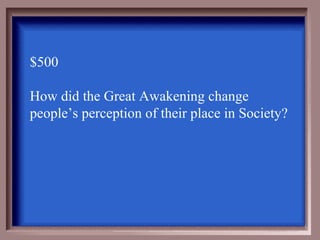
How did the Great Awakening change
people’s perception of their place in Society?
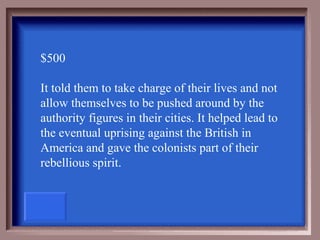
$500

It told them to take charge of their lives and not
allow themselves to be pushed around by the
authority figures in their cities. It helped lead to
the eventual uprising against the British in
America and gave the colonists part of their
rebellious spirit.
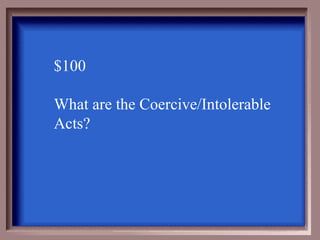
$100

What are the Coercive/Intolerable
Acts?
$100

A series of acts which brought the
Massachusetts government under
direct British control, closed the port of
Boston to trade, and required Boston
residents to house British troops.
$200

Who was Thomas Paine?
$200

He published the pamphlet "Common
Sense", urging colonists to declare
independence from Britain.
$300

Opponents of British policies spread
information and coordinated actions in
communities throughout the colonies by
forming________________.”
$300

Committees of Correspondence
$400

The British shifted to a southern strategy after 1778
because:
a.they felt they could exploit slave unrest.
b.they felt they could exploit loyalist support.
c.they had been driven out of their beachheads in
northern cities.
d.the Continental Army was tied down defending
the North.
$400

       B
$500

In what ways did revolutionaries
attempt to gain public support for
declaring independence?
$500

Public speeches and rallies, like those of
Patrick Henry, pamphlets, the publication of
newspapers, and the formation of groups like
the Sons of Liberty.
$100

Define “republicanism.”
$100

The political culture of a newly independent
America. It emphasized a government led by
the people, and not a king. This new spirit of
republican ideals led to Americans
questioning their traditional social order and
identity.
$200

Describe the effect James Madison had
on the growth of young America.
$200

Madison was one of the masterminds behind the creation of the Constitution,
pushing other leaders of the time to hold a top-secret meeting to discuss its
creation, or at least a revision of the ineffective Articles of Confederation. Not
only did he initiate the push to create a constitution, but he also carefully and
brilliantly manipulated the other delegates at the Philadelphia Convention to
create a Constitution that worked the way he wanted it to, minus a few
compromises to increase the documents appeal to delegates and state legislatures.
 Madison was also one of the first Federalists, a major political party rising to the
top later in American history. His work with the Federalist party helped
strengthen and centralize the power of the federal government, many of whose
regulations were laid out in the Constitution. Madison (along with other key
figures like Alexander Hamilton and John Jay) also published a series of essays
called The Federalist to help garner support for the new Constitution and lay the
foundation for the Federalist rise to power.
$300

________ gained strong ground during and
after the revolution with them being able to
_______ in 1 state and were allowed access to
education and _________. They were
eventually denied the right to _____ because it
affected the election of _________.
$300

Women, vote, divorce, vote, public
officials
$400

How did the people react to young America’s
republican ideals?
a)They approached them cautiously, trying to
hold the ideas of the cause in mind, but also
trying to keep with traditions
b)Dove into a new era where people militantly
defended the ideals of Republicanism
c)Rather apathetic towards the ideas, but happy
with the increase in the quality of life.
d)Defended the ideals, but were reproachful of
the idea of universal white male suffrage.
$400

       B
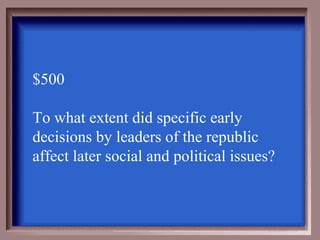
$500

To what extent did specific early
decisions by leaders of the republic
affect later social and political issues?
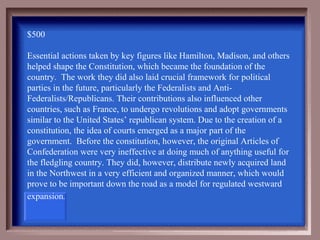
$500

Essential actions taken by key figures like Hamilton, Madison, and others
helped shape the Constitution, which became the foundation of the
country. The work they did also laid crucial framework for political
parties in the future, particularly the Federalists and Anti-
Federalists/Republicans. Their contributions also influenced other
countries, such as France, to undergo revolutions and adopt governments
similar to the United States’ republican system. Due to the creation of a
constitution, the idea of courts emerged as a major part of the
government. Before the constitution, however, the original Articles of
Confederation were very ineffective at doing much of anything useful for
the fledgling country. They did, however, distribute newly acquired land
in the Northwest in a very efficient and organized manner, which would
prove to be important down the road as a model for regulated westward
expansion. 
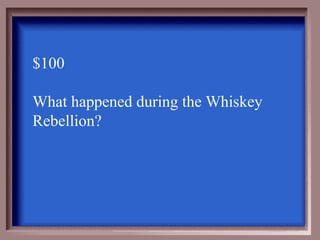
$100

What happened during the Whiskey
Rebellion?
$100

Farmers in Pennsylvania that protested the payment
of federal tax on whiskey. Suppressed by George
Washington who called federal action of 15,000
troops. No bloodshed and helped establish Federal
authority. Westerners, however condemned the act as
an unwarranted use of force on the common people.
$200


Who was Alexander Hamilton and what were
his views on government?
$200

Hamilton argued for a strong national government
and central economic planning in the hands of the
wealthy to ensure order in political and economic
affairs. He wished to transform the United States into
a self-sufficient industrial power, pay off national
debt at face value, the government assume war debts
from the states, high tariffs on imports, create a
national bank
$300

In 1797, French officials demanded a bribe
from American peace commissioners before
talks can begin. This event is commonly
known as __________.
$300


The XYZ Affair
$400

The Virginia and Kentucky Resolutions
presented that
a.states had the power to organize political
parties
b.Congress had no power to legislate on
questions of immigration
c.states could nullify acts of Congress
d.Congress should consult the state be declaring
ware. Constitution should be amended
$400


       C
$500

Compare and contrast the views and actions
of Thomas Jefferson and Alexander Hamilton
while they were members of President
Washington's cabinet.
$500

Washington's disliked political squabbling, as Americans began to divide
into two camps: the Federalists, led by Secretary of the Treasury Alexander
Hamilton, and the Republicans, led by Secretary of State Thomas Jefferson.
These factions developed and advocated diverse, dynamic, and differing
ideas and visions about the role and nature of government, society,
economic policy, foreign affiliations, diplomacy, and interpretation of the
Constitution. Hamilton argued for a strong national government and central
economic planning in the hands of the wealthy to ensure order in political
and economic affairs. Jefferson feared such a government would become
oppressive, threatening states' rights and infringing upon individual liberty.
Hamilton wished to transform the United States into a self-sufficient
industrial power, while Jefferson hoped the nation would remain one of
small, independent farmers.

Semester Final Review Jeopardy Ch.1 - 7

  • 2.
    $100 – MainEvent $200 – Important Figure $300 – Fill in the Blank $400 – Multiple Choice $500 – Short Answer
  • 3.
    $100 $100 $100$100 $100 $100 $200 $200 $200 $200 $200 $200 $300 $300 $300 $300 $300 $300 $400 $400 $400 $400 $400 $400 $500 $500 $500 $500 $500 $500
  • 4.
    $100 What was theencomienda system?
  • 5.
    $100 A system inwhich a monarch gave grants of land and Native Americans to Spaniards. The Native Americans provided labor. Profits went to the Spanish masters, who were supposed to care for the workers, but exploited them instead.
  • 6.
  • 7.
    $200 The governor ofMassachusetts Bay and a Puritan
  • 8.
    $300 The ____,also known as _____ , were a group of Puritans who didn’t want to reform the Church of England, but wanted to organize a separate church.
  • 9.
  • 10.
    $400 What was themain force driving people to colonies on the North American Atlantic Coast? A)Money B) Escape enslavement C) Escape marriage D) Religion E) Work
  • 11.
  • 12.
    $500 How did thecolonists start to develop government? What made them develop the type of government they did?
  • 13.
    $500 With the MayflowerCompact, the Pilgrims vowed to make decisions based on the majority’s interests. This compact was one of the earliest forms of a written constitution which established the powers and duties of government. Virginia also made the House of Burgess in 1619, which was the first representative assembly. The Massachusetts Bay Colony allowed free white male Puritans to vote in elections. The English allowed to colonists some self-rule, and the from England the colonists brought the ideas of independence and representative government.
  • 14.
  • 15.
    $100 A rebellion thatbegan as a disagreement over access to a fur trade license that escalated due to a Governor’s limited response to an Indian attack and the subsequent creation of a volunteer army to combat all types on Indians. Purpose of rebellion shifted to the rebels wanting to display their discontent with the Governor’s ruling and their want of reform. Ended with the death of the leader of the rebels due to illness.
  • 16.
  • 17.
    $200 He arrived in1686 as the governor of the Dominion of New England by James II. He abolished elective assemblies, enforced the Navigation Acts rigorously, collected taxes not approved by the population, and backed the courts with supporters who hated New Englanders. During the Glorious Revolution in the Bay Colony he was overthrown by colonists unanimously and jailed without violence.
  • 18.
    $300 In New England,the population boomed because of ___________________, but in the Chesapeake colonies was much more stagnant due to 1)_______________, 2)_____________, and 3)______________.
  • 19.
    $300 High life expectancy 1)Causesof death (malaria, disease, salt in drinking water), 2)6:1 male to female ration, 3)indentured servitude (cut into prime time to form a family), and/or low life expectancy?
  • 20.
    $400 Which option isnot a characteristic or idea of the Mercantilist System? a.World’s wealth is a fixed supply b.Export more goods than you import c.Strict, uniform doctrine that clearly sets out economic standards d. Colonies were deemed important due to their natural resources for its success
  • 21.
  • 22.
    $500 Discuss the facetsof the Navigation Acts. Why did they come about? What were their effects?
  • 23.
    $500 -Navigation Act of1660 said that 1) no ship could trade in colonies unless it was constructed in England or America and had a crew at least 75% English (counting Colonists), and 2) goods such as tobacco, sugar, cotton, ect. that were not produced in England could only be transported from the colonies to England or another colonial port -Staple Act of 1663 said nothing could be imported into America that wasn’t first transshiped through England-Navigation Act of 1673 established a plantation duty or customs on the enumerated goods -In response to wars with Dutch. England recognized that the economic strength of the colonies were growing and wanted to take advantage. -Effects: took business away from Dutch (with time), England established Lords of Trade (replaced with the Board of Trade), created imperial legislation in 1696, and benefited England’s accumulation of wealth. -Most importantly, it caused a dependence on goods from England because they were the sole legal source of goods.
  • 24.
    $100 Name the planset forth by the British, that was a proposed colonial government and involved elected colonial officials and way to govern the colonies by colonists.
  • 25.
  • 26.
    $200 This man wasone of the leaders of the Great Awakening and a devout Calvinist from Connecticut, who preached how insignificant and sinful the American people are.
  • 27.
  • 28.
    $300 _________’s propaganda helped unitethe colonists against the British because he appealed to the fight for independence through logic, like his most famous work _________
  • 29.
  • 30.
    $400 What did Englandgain as a result of the Seven Years War? A.Total control of Colonial ports B.The land West of the Mississippi C.Canada, Florida, and all of the land east of the Mississippi D.It forced the Spanish and the French out of North America
  • 31.
  • 32.
    $500 How did theGreat Awakening change people’s perception of their place in Society?
  • 33.
    $500 It told themto take charge of their lives and not allow themselves to be pushed around by the authority figures in their cities. It helped lead to the eventual uprising against the British in America and gave the colonists part of their rebellious spirit.
  • 34.
    $100 What are theCoercive/Intolerable Acts?
  • 35.
    $100 A series ofacts which brought the Massachusetts government under direct British control, closed the port of Boston to trade, and required Boston residents to house British troops.
  • 36.
  • 37.
    $200 He published thepamphlet "Common Sense", urging colonists to declare independence from Britain.
  • 38.
    $300 Opponents of Britishpolicies spread information and coordinated actions in communities throughout the colonies by forming________________.”
  • 39.
  • 40.
    $400 The British shiftedto a southern strategy after 1778 because: a.they felt they could exploit slave unrest. b.they felt they could exploit loyalist support. c.they had been driven out of their beachheads in northern cities. d.the Continental Army was tied down defending the North.
  • 41.
  • 42.
    $500 In what waysdid revolutionaries attempt to gain public support for declaring independence?
  • 43.
    $500 Public speeches andrallies, like those of Patrick Henry, pamphlets, the publication of newspapers, and the formation of groups like the Sons of Liberty.
  • 44.
  • 45.
    $100 The political cultureof a newly independent America. It emphasized a government led by the people, and not a king. This new spirit of republican ideals led to Americans questioning their traditional social order and identity.
  • 46.
    $200 Describe the effectJames Madison had on the growth of young America.
  • 47.
    $200 Madison was oneof the masterminds behind the creation of the Constitution, pushing other leaders of the time to hold a top-secret meeting to discuss its creation, or at least a revision of the ineffective Articles of Confederation. Not only did he initiate the push to create a constitution, but he also carefully and brilliantly manipulated the other delegates at the Philadelphia Convention to create a Constitution that worked the way he wanted it to, minus a few compromises to increase the documents appeal to delegates and state legislatures. Madison was also one of the first Federalists, a major political party rising to the top later in American history. His work with the Federalist party helped strengthen and centralize the power of the federal government, many of whose regulations were laid out in the Constitution. Madison (along with other key figures like Alexander Hamilton and John Jay) also published a series of essays called The Federalist to help garner support for the new Constitution and lay the foundation for the Federalist rise to power.
  • 48.
    $300 ________ gained strongground during and after the revolution with them being able to _______ in 1 state and were allowed access to education and _________. They were eventually denied the right to _____ because it affected the election of _________.
  • 49.
    $300 Women, vote, divorce,vote, public officials
  • 50.
    $400 How did thepeople react to young America’s republican ideals? a)They approached them cautiously, trying to hold the ideas of the cause in mind, but also trying to keep with traditions b)Dove into a new era where people militantly defended the ideals of Republicanism c)Rather apathetic towards the ideas, but happy with the increase in the quality of life. d)Defended the ideals, but were reproachful of the idea of universal white male suffrage.
  • 51.
  • 52.
    $500 To what extentdid specific early decisions by leaders of the republic affect later social and political issues?
  • 53.
    $500 Essential actions takenby key figures like Hamilton, Madison, and others helped shape the Constitution, which became the foundation of the country. The work they did also laid crucial framework for political parties in the future, particularly the Federalists and Anti- Federalists/Republicans. Their contributions also influenced other countries, such as France, to undergo revolutions and adopt governments similar to the United States’ republican system. Due to the creation of a constitution, the idea of courts emerged as a major part of the government. Before the constitution, however, the original Articles of Confederation were very ineffective at doing much of anything useful for the fledgling country. They did, however, distribute newly acquired land in the Northwest in a very efficient and organized manner, which would prove to be important down the road as a model for regulated westward expansion. 
  • 54.
    $100 What happened duringthe Whiskey Rebellion?
  • 55.
    $100 Farmers in Pennsylvaniathat protested the payment of federal tax on whiskey. Suppressed by George Washington who called federal action of 15,000 troops. No bloodshed and helped establish Federal authority. Westerners, however condemned the act as an unwarranted use of force on the common people.
  • 56.
    $200 Who was AlexanderHamilton and what were his views on government?
  • 57.
    $200 Hamilton argued fora strong national government and central economic planning in the hands of the wealthy to ensure order in political and economic affairs. He wished to transform the United States into a self-sufficient industrial power, pay off national debt at face value, the government assume war debts from the states, high tariffs on imports, create a national bank
  • 58.
    $300 In 1797, Frenchofficials demanded a bribe from American peace commissioners before talks can begin. This event is commonly known as __________.
  • 59.
  • 60.
    $400 The Virginia andKentucky Resolutions presented that a.states had the power to organize political parties b.Congress had no power to legislate on questions of immigration c.states could nullify acts of Congress d.Congress should consult the state be declaring ware. Constitution should be amended
  • 61.
  • 62.
    $500 Compare and contrastthe views and actions of Thomas Jefferson and Alexander Hamilton while they were members of President Washington's cabinet.
  • 63.
    $500 Washington's disliked politicalsquabbling, as Americans began to divide into two camps: the Federalists, led by Secretary of the Treasury Alexander Hamilton, and the Republicans, led by Secretary of State Thomas Jefferson. These factions developed and advocated diverse, dynamic, and differing ideas and visions about the role and nature of government, society, economic policy, foreign affiliations, diplomacy, and interpretation of the Constitution. Hamilton argued for a strong national government and central economic planning in the hands of the wealthy to ensure order in political and economic affairs. Jefferson feared such a government would become oppressive, threatening states' rights and infringing upon individual liberty. Hamilton wished to transform the United States into a self-sufficient industrial power, while Jefferson hoped the nation would remain one of small, independent farmers.