Score a 5
on the APUSH Exam
Key Concepts
Every question on the exam relates to at least one of these concepts.
Identity Economy Migration Politics
Foreign Relations
Environment
Culture
Colonization
(1 Set of MC Questions)
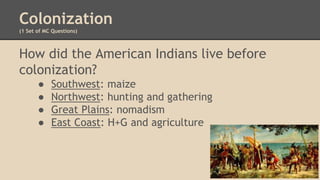
How did the American Indians live before
colonization?
● Southwest: maize
● Northwest: hunting and gathering
● Great Plains: nomadism
● East Coast: H+G and agriculture
Why did the Europeans colonize the New World?
● Resources, such as corn and potatoes
● Power
● To spread Christianity
What did the Spanish and Portuguese explorations cause?
● Smallpox epidemics
● Interracial relations
● Caste system including Mestizos and Zambos
● Introduction of horses and cows
● Encomienda system
Practice MC Question #1
Which of the following had NO influence on 17th-century American identity?
A. British transportation of West African slaves
B. European desire to spread Christianity
C. Interracial relations between Spanish and Indians
D. Nomadic lifestyle of Pre-Columbian inhabitants
E. The new nation’s support of the French Revolution
Practice MC Question #2
How do historians characterize the 17th-century American economy?
A. Cooperation with Indians over limited natural resources
B. High deflation due to numerous smallpox epidemics
C. High isolation from the European economy
D. Plentiful natural resources and exploitation of Indians
E. Reliance on commerce due to limited natural resources
Practice MC Question #3
Why did Europeans immigrate to the New World?
I. To compete with other nations for political power
II. To eradicate the aboriginal peoples
III. To gather additional resources, such as corn and gold
A. I only
B. II only
C. I and II only
D. I and III only
E. I, II, and III
New World Conflicts
(2 Sets of MC Questions)
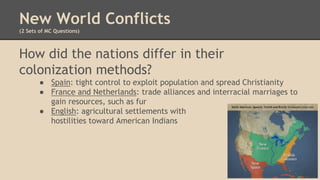
How did the nations differ in their
colonization methods?
● Spain: tight control to exploit population and spread Christianity
● France and Netherlands: trade alliances and interracial marriages to
gain resources, such as fur
● English: agricultural settlements with
hostilities toward American Indians
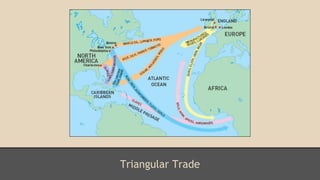
The English began to capture West African
slavesdue to a lack of indentured servants and an inability to enslave the American Indians.
Triangular Trade
How did the colonial regions differ?
● New England: Puritanical, mixed economy of
agriculture and commerce
● Middle: ethnically and religiously diverse, grains
● Chesapeake and North Carolina: tobacco, use of
indentured servants and slaves
● Southern and Caribbean: staple crops like rice and
sugar, heavy use of slave labor
The nations entered conflicts over
land
and perpetuated American Indian aggression by providing
them with guns and alcohol. The Indian aggression
reinforced Great Britain’s negative stereotypes of them.
Great Britain was losing
controlof the colonies, so it briefly passed the Navigation Acts under a mercantilist philosophy.
Practice MC Question #4
Which of the following is NOT an accurate association?
A. American Indians and widespread exploitation
B. Portuguese and trade alliances for fur
C. Puritans and strict New England settlements
D. Spanish and encomienda system
E. West Africans and lack of indentured servants
Practice MC Question #5
What goods in the Triangular Trade were shipped from the Northeast to the Caribbean?
A. Fish, livestock, flour, lumber
B. Rum, iron, gunpowder, cloth, tools
C. Slaves, sugar, molasses
D. Whale oil, lumber, furs
E. None of the above
Practice MC Question #6
Choose the piece of evidence that best supports this statement:
“The rapid introduction of hundreds of thousands of European settlers, along with the plants
and livestock they brought with them, led to an inevitable alteration of the physical landscape
of the North American continent.”
A. Grain cultivation in the Middle Colonies
B. Manufactured goods from London and Bristol
C. Rice and sugar cultivation in New England
D. Use of slave labor in Chesapeake Colonies
E. All of the above
Practice MC Question #7
What British action most profoundly influenced Indian conflicts?
A. Exploitation of West African slaves
B. Lack of an exchange like the Spanish encomienda system
C. Puritanical agricultural settlements
D. Suppliance of guns and alcohol
E. Trade alliances and interracial marriages
American Revolution
(2 Sets of MC Questions)
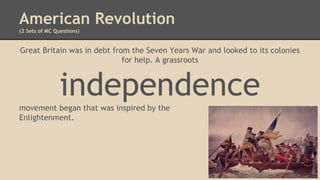
Great Britain was in debt from the Seven Years War and looked to its colonies
for help. A grassroots
independencemovement began that was inspired by the
Enlightenment.
The Enlightenment also inspired
the philosophy of republican motherhood, enabling
womento live as an integral component of
American society.
Why did the colonists win the Revolutionary War?
● European aid, primarily French but also Spanish and
Dutch
● Familiarity with land
● Resilient leadership
● Ideological commitment
Articles of Confederation
Fear of Centralized
Power: placed power in the hands of
the legislative branch; ineffective at controlling
economy and foreign relations
Fear of Excessive Popular Influence:
maintained property qualifications for
voting and citizenship
Constitution
Fear of Disunion: failed to
address slavery
Incapacity to Consider American Indians as
Citizens: failed to address Indian
sphere, numerous seizures of their
lands
The American Revolution was an
inspirationfor rebellions in France, Haiti, and Latin America.
What did the Northwest Ordinance do?
● Set guidelines for admitting new states
● Promoted public education
● Protected private property
● Restricted slavery in the Northwest Territory
Practice MC Question #8
Which of the following accurately summarizes the roots of the American Revolution?
A. Disruption of salutary neglect and an Enlightened conscious
B. Disagreements over the institution of slavery
C. Desire for religious and philosophical freedom
D. Desire for economic freedom inspired by France
E. Mix of American Indians, Europeans, and West Africans
Practice MC Question #9
Which of the following was NOT a characteristic of the American Revolution?
A. Aid from Spain and the Netherlands
B. Involvement of women and minorities
C. Orchestration by Spanish authoritative structures
D. Passion of the everyday colonist
E. Stronger leadership than that of Great Britain
Practice MC Question #10
How did the Northwest Ordinance influence the nation and national identity?
A. Addressed slavery for the first time, though briefly
B. Helped to forge an intelligent society
C. Protected rights seen as distinctly American
D. Unified the states under common legislation
E. All of the above
Practice MC Question #11
Which quote would most likely be found in Revolutionary-era literature?
A. “A lie gets halfway around the world”
B. “Burning with a deadly heat”
C. “But man is a part of nature”
D. “Miserable failures of capitalist economies”
E. “The folly of hereditary right in kings”
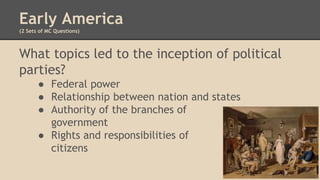
Early America
(2 Sets of MC Questions)
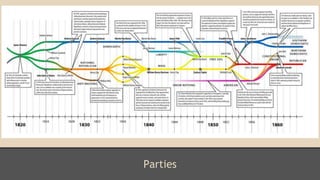
What topics led to the inception of political
parties?
● Federal power
● Relationship between nation and states
● Authority of the branches of
government
● Rights and responsibilities of
citizens
Parties
What social movements were inspired by the Second Great Awakening?
● Utopian communities
● Temperance movement
● Abolitionism
● First-wave feminism
What were some of the technological innovations?
● Textile machinery
● Steam engines
● Interchangeable parts
● Canals
● Railroads
● Telegraph
● Steel plow
● Mechanical reaper
The plethora of technological innovations caused the
workforceto shift from the agricultural sector to factories, particularly women and low-skilled men.
In the South,
cottonwas grown for an international market, and and the Northeast and Midwest became closely linked both
economically and culturally.
What were the key components of the American System, a prominent economic policy inspired by
Alexander Hamilton?
● Tariff
● National bank
● Federal subsidies for public works
How did the market revolution alter American society?
● Widened gap between rich and poor
● Shaped emerging middle and working classes
● Increased separation between home and workplace
What expectations were set for women?
● Be more religious than men
● Be pure
● Submit to their husbands
● Stay at home
The United States was struggling to create a
globalpresence, so it launched several diplomatic, economic, and military initiatives in the Western
Hemisphere and Asia.
What was guaranteed by the Missouri Compromise?
● Missouri was to be admitted as a slave state
● Maine was to be admitted as a free state
● Except for Missouri, slavery was to be banned from
the Louisiana Purchase lands north of latitude
36°30′ N
Practice MC Question #12
Which topic was NOT the subject of fierce debates in early America?
A. Authority of the branches of government
B. Federal power
C. Relationship between nation and states
D. Repayment of debt to Great Britain
E. Rights and responsibilities of citizens
Practice MC Question #13
Which of the following is NOT an accurate association?
A. Abraham Lincoln and nullification
B. Andrew Jackson and the Democrats
C. James Monroe and the “Era of Good Feelings”
D. Henry Clay and the Whigs
E. Stephen Douglas and the Democrats
Practice MC Question #14
Which of the following was NOT a change undergone by America between 1750 and 1850?
A. Attempted development of utopian communities
B. Economic alliance between Northeast and Midwest
C. Invention of numerous technological innovations
D. Rise of international market for Western cotton
E. Shift in workforce from agriculture to factories
Practice MC Question #15
What was one expectation of women in early America?
A. To be pure in both body and mind
B. To be the head of the family
C. To join the agricultural sector
D. To leave religious matters to men
E. To take up livelihoods in politics
Civil War
(2 Sets of MC Questions)
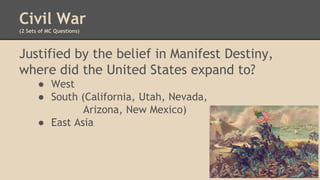
Justified by the belief in Manifest Destiny,
where did the United States expand to?
● West
● South (California, Utah, Nevada,
Arizona, New Mexico)
● East Asia
Sectionalism
North:
● Manufacturing economy
● High immigration rate sparking Nativist
sentiments
● Highly visible campaign against slavery
South:
● Slave-based agriculture
economy
● Low immigration rate
● Belief in states’ rights and
nullification theory
● Racist stereotypes
Why did the North win the Civil War?
● Improved military leadership
● More effective strategies
● Key victories
● Greater resources
● Wartime destruction of the South’s infrastructure
Practice MC Question #16
Which topic is the LEAST pertinent to manifest destiny?
A. Expulsion of American Indians
B. Failed development of utopias
C. Mexican-American War
D. Special virtues of American people
E. Westward expansion
Practice MC Question #17
What was true about the North during the Civil War?
A. Belief in states’ rights and nullification theory
B. Discrimination against blacks exceeding that of the South
C. Discrimination against immigrants
D. Less people than South but more resources
E. Tremendously huge yet obscure abolitionist movement
Multiple Choice Answers
1. E
2. D
3. D
1. B
2. A
3. A
4. D
Multiple Choice Answers
8. A
9. C
10. E
11. E
8. D
9. A
10. D
11. A
8. B
9. C
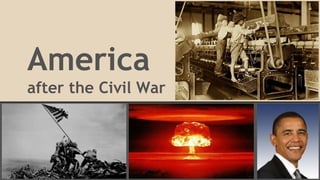
America
after the Civil War
Identity
In the Gilded Age, America saw the fall of the countryside
and the rise of the cities.
Despite widespread prejudice, class and ethnic diversity increased in cities and the workforce.
Most immigrants hoped to acclimate to American society while maintaining their unique cultures; settlement
houses aided in the assimilation process.
Affluent people argued that their wealth was both appropriate and inevitable, but some also understood the
importance of social contribution.
Women and blacks became increasingly dissatisfied with their strict social roles.
During World War I and the Cold War, the communist and
immigrant identities were attacked.
World War II led many Americans to question what their nation’s values were.
As a result of the liberal conscience of the Civil Rights
Movement, activists also began to urge social equality for
women and gays.
Furthermore, American Indians, Latinos, and Asian Americans sought equality and redress of past injustices.
Economy
The Gilded Age was a result of large-scale production,
technological innovations, expanding international
communications networks, and laissez faire.
Government subsidies for transportation and communication systems opened up new markets in North America.
Monopolies began to exploit the growing labor force.
Businesses were consolidated into trusts and holding companies under the philosophy of Social Darwinism.
The Gilded Age was characterized by an unparalleled economic inequality, an increase in child labor, the
emergence of labor unions, and the rise of the Populist party.
The South became increasingly industrialized as the “New South,” but sharecropping and tenant farming
continued to dominate the region.
Farmers formed local organizations to resist corporate control.
Progressive reformers, including journalists, the middle-
class, and women, sought to mollify the industrial issues.
Market instability, most notably the Great Depression, led to increased government regulation of the economy.
In the 1920s, radio, motion pictures, and automobiles led to increased standards of living, greater personal
mobility, and better communications systems.
After World War II, there was an increase in
suburbanization, social mobility, and the economic
influence of the Sun Belt.
After 1980, economic inequality was rampant due to a
decrease in American manufacturing, union
membership, and wage inflation.
Practice Essay Questions
Between 1880 and 1980, there were unprecedented changes in cultural identity. Examine the shift in
identity of TWO of the following groups:
● Women
● Blacks
● Communists
● Immigrants
Contrast the economic policies under the Gilded Age
presidents with those under Franklin Roosevelt.
Explore the role of labor unions in American history.
Migration
During the Gilded Age, immigrants came from Asia,
southern Europe, eastern Europe, and Africa.
Migration to the West encouraged the government to violate treaties with American Indians for additional land.
The Red Scare led to strict quotas on immigrants from
Asia, southern Europe, and eastern Europe.
However, said quotas didn’t apply to nations in the Western Hemisphere, like Mexico, who the United States
depended on for cheap labor.
Some blacks began to travel to the North in an act known as the “Great Migration.”
In 1965, new laws were passed that promoted
immigration to America in a time of prosperity.
In the political, economic, and cultural spheres, the
South and West became increasingly more powerful
due to an influx of Latin and Asian immigrants.
Politics
Radical liberals, union members, and populists called for
a more extensive New Deal, while Congressional
conservatives and Supreme Court justices tried to reduce
its scope.
The New Deal led to the widespread affiliation of blacks with the Democratic party.
During the Cold War, Americans debated the value of
the nuclear arsenal, the “military-industrial complex,”
and the role of the executive branch in foreign policy.
Each branch of the government was instrumental in national desegregation.
Lyndon Johnson’s Great Society was a highly liberal program that sought to end racial discrimination, eradicate
poverty, and attack communism abroad.
In the 1970s, confidence and trust in the government
declined as a result of economic hardships, political
scandals, foreign policy failures, and seeming moral
decay.
Practice Essay Questions
Explore the history of how TWO of the following groups immigrated to the United States:
● Asians
● Southern and Eastern Europeans
● Mexicans
How did the New Deal affect the development of political parties?
Choose the ONE issue that was the most controversial and
explain why it’s the best answer:
● Cold War
● Great Society
● 1990s Immigration
Foreign Relations
Business leaders looked to resources and markets in the
Pacific, Asia, and Latin America.
Manifest destiny resulted from the perception that the
western frontier was “closed,” economic opportunities,
competition with European nations, and racial theories.
The aforementioned principle was used to forge an American presence in Latin America, the Caribbean, the
Philippines, and Asia.
Although the United States did not provide major military support to World War I, the political ramifications
threatened the concept of isolationism.
The Allies won World War II because of political and military cooperation, industrial production, technological
advances, and popular commitment to democratic ideals.
After World War II, the United States emerged as the most powerful nation on Earth.
The Reagan administration brought an end to the Cold
War, even though Reagan originally advocated for
increased arms production.
Environment
The government and corporations disputed the ownership
of natural resources, land and water.
The conservationist and preservationist efforts were initiated.
In the West, Whites, Indians, and Mexican Americans entered battles over land.
In the 1960s, activists fought to protect the environment
against pollution.
Conflicts in the Middle East birthed debates about the
nation’s dependence on fossil fuels.
Culture
The Gilded Age saw numerous cultural conflicts:
● Tradition vs. innovation
● Rural vs. urban
● Christianity vs. science
● Robber barons vs. working class
● Natives vs. immigrants
● Whites vs. blacks
● Idealism vs. disillusionment
Practice Essay Questions
How did American involvement in Latin America change over the 20th Century?
Explain the impact of manifest destiny on American history, as well
as its origin.
How did the United States emerge as an international
superpower?
Lana’s DBQ Tips
● Include all or all but one of the documents in
your DBQ
● Explain one of the following for each
document:
o Point of view
o Intended audience
o Purpose
o Historical context
● Include specific examples not listed in the
documents
● Connect the topic to a larger historical trend
● Complete one of the following:
o Introduce a counterexample
o Account for discrepancies between sources
o Connect the topic to a topic in another historical period
Lana’s FRQ Tips
● Answer the prompt with the aid of specific
examples
● Complete one of the following:
o Introduce a counterexample
o Explore another category not listed in the prompt
o Connect the topic to a topic in another historical period

Apush exam

  • 1.
    Score a 5 onthe APUSH Exam
  • 2.
    Key Concepts Every questionon the exam relates to at least one of these concepts. Identity Economy Migration Politics Foreign Relations Environment Culture
  • 3.
    Colonization (1 Set ofMC Questions) How did the American Indians live before colonization? ● Southwest: maize ● Northwest: hunting and gathering ● Great Plains: nomadism ● East Coast: H+G and agriculture
  • 4.
    Why did theEuropeans colonize the New World? ● Resources, such as corn and potatoes ● Power ● To spread Christianity
  • 5.
    What did theSpanish and Portuguese explorations cause? ● Smallpox epidemics ● Interracial relations ● Caste system including Mestizos and Zambos ● Introduction of horses and cows ● Encomienda system
  • 6.
    Practice MC Question#1 Which of the following had NO influence on 17th-century American identity? A. British transportation of West African slaves B. European desire to spread Christianity C. Interracial relations between Spanish and Indians D. Nomadic lifestyle of Pre-Columbian inhabitants E. The new nation’s support of the French Revolution
  • 7.
    Practice MC Question#2 How do historians characterize the 17th-century American economy? A. Cooperation with Indians over limited natural resources B. High deflation due to numerous smallpox epidemics C. High isolation from the European economy D. Plentiful natural resources and exploitation of Indians E. Reliance on commerce due to limited natural resources
  • 8.
    Practice MC Question#3 Why did Europeans immigrate to the New World? I. To compete with other nations for political power II. To eradicate the aboriginal peoples III. To gather additional resources, such as corn and gold A. I only B. II only C. I and II only D. I and III only E. I, II, and III
  • 9.
    New World Conflicts (2Sets of MC Questions) How did the nations differ in their colonization methods? ● Spain: tight control to exploit population and spread Christianity ● France and Netherlands: trade alliances and interracial marriages to gain resources, such as fur ● English: agricultural settlements with hostilities toward American Indians
  • 10.
    The English beganto capture West African slavesdue to a lack of indentured servants and an inability to enslave the American Indians.
  • 11.
  • 12.
    How did thecolonial regions differ? ● New England: Puritanical, mixed economy of agriculture and commerce ● Middle: ethnically and religiously diverse, grains ● Chesapeake and North Carolina: tobacco, use of indentured servants and slaves ● Southern and Caribbean: staple crops like rice and sugar, heavy use of slave labor
  • 13.
    The nations enteredconflicts over land and perpetuated American Indian aggression by providing them with guns and alcohol. The Indian aggression reinforced Great Britain’s negative stereotypes of them.
  • 14.
    Great Britain waslosing controlof the colonies, so it briefly passed the Navigation Acts under a mercantilist philosophy.
  • 15.
    Practice MC Question#4 Which of the following is NOT an accurate association? A. American Indians and widespread exploitation B. Portuguese and trade alliances for fur C. Puritans and strict New England settlements D. Spanish and encomienda system E. West Africans and lack of indentured servants
  • 16.
    Practice MC Question#5 What goods in the Triangular Trade were shipped from the Northeast to the Caribbean? A. Fish, livestock, flour, lumber B. Rum, iron, gunpowder, cloth, tools C. Slaves, sugar, molasses D. Whale oil, lumber, furs E. None of the above
  • 17.
    Practice MC Question#6 Choose the piece of evidence that best supports this statement: “The rapid introduction of hundreds of thousands of European settlers, along with the plants and livestock they brought with them, led to an inevitable alteration of the physical landscape of the North American continent.” A. Grain cultivation in the Middle Colonies B. Manufactured goods from London and Bristol C. Rice and sugar cultivation in New England D. Use of slave labor in Chesapeake Colonies E. All of the above
  • 18.
    Practice MC Question#7 What British action most profoundly influenced Indian conflicts? A. Exploitation of West African slaves B. Lack of an exchange like the Spanish encomienda system C. Puritanical agricultural settlements D. Suppliance of guns and alcohol E. Trade alliances and interracial marriages
  • 19.
    American Revolution (2 Setsof MC Questions) Great Britain was in debt from the Seven Years War and looked to its colonies for help. A grassroots independencemovement began that was inspired by the Enlightenment.
  • 20.
    The Enlightenment alsoinspired the philosophy of republican motherhood, enabling womento live as an integral component of American society.
  • 21.
    Why did thecolonists win the Revolutionary War? ● European aid, primarily French but also Spanish and Dutch ● Familiarity with land ● Resilient leadership ● Ideological commitment
  • 22.
    Articles of Confederation Fearof Centralized Power: placed power in the hands of the legislative branch; ineffective at controlling economy and foreign relations Fear of Excessive Popular Influence: maintained property qualifications for voting and citizenship
  • 23.
    Constitution Fear of Disunion:failed to address slavery Incapacity to Consider American Indians as Citizens: failed to address Indian sphere, numerous seizures of their lands
  • 24.
    The American Revolutionwas an inspirationfor rebellions in France, Haiti, and Latin America.
  • 25.
    What did theNorthwest Ordinance do? ● Set guidelines for admitting new states ● Promoted public education ● Protected private property ● Restricted slavery in the Northwest Territory
  • 26.
    Practice MC Question#8 Which of the following accurately summarizes the roots of the American Revolution? A. Disruption of salutary neglect and an Enlightened conscious B. Disagreements over the institution of slavery C. Desire for religious and philosophical freedom D. Desire for economic freedom inspired by France E. Mix of American Indians, Europeans, and West Africans
  • 27.
    Practice MC Question#9 Which of the following was NOT a characteristic of the American Revolution? A. Aid from Spain and the Netherlands B. Involvement of women and minorities C. Orchestration by Spanish authoritative structures D. Passion of the everyday colonist E. Stronger leadership than that of Great Britain
  • 28.
    Practice MC Question#10 How did the Northwest Ordinance influence the nation and national identity? A. Addressed slavery for the first time, though briefly B. Helped to forge an intelligent society C. Protected rights seen as distinctly American D. Unified the states under common legislation E. All of the above
  • 29.
    Practice MC Question#11 Which quote would most likely be found in Revolutionary-era literature? A. “A lie gets halfway around the world” B. “Burning with a deadly heat” C. “But man is a part of nature” D. “Miserable failures of capitalist economies” E. “The folly of hereditary right in kings”
  • 30.
    Early America (2 Setsof MC Questions) What topics led to the inception of political parties? ● Federal power ● Relationship between nation and states ● Authority of the branches of government ● Rights and responsibilities of citizens
  • 31.
  • 32.
    What social movementswere inspired by the Second Great Awakening? ● Utopian communities ● Temperance movement ● Abolitionism ● First-wave feminism
  • 33.
    What were someof the technological innovations? ● Textile machinery ● Steam engines ● Interchangeable parts ● Canals ● Railroads ● Telegraph ● Steel plow ● Mechanical reaper
  • 34.
    The plethora oftechnological innovations caused the workforceto shift from the agricultural sector to factories, particularly women and low-skilled men.
  • 35.
    In the South, cottonwasgrown for an international market, and and the Northeast and Midwest became closely linked both economically and culturally.
  • 36.
    What were thekey components of the American System, a prominent economic policy inspired by Alexander Hamilton? ● Tariff ● National bank ● Federal subsidies for public works
  • 37.
    How did themarket revolution alter American society? ● Widened gap between rich and poor ● Shaped emerging middle and working classes ● Increased separation between home and workplace
  • 38.
    What expectations wereset for women? ● Be more religious than men ● Be pure ● Submit to their husbands ● Stay at home
  • 39.
    The United Stateswas struggling to create a globalpresence, so it launched several diplomatic, economic, and military initiatives in the Western Hemisphere and Asia.
  • 40.
    What was guaranteedby the Missouri Compromise? ● Missouri was to be admitted as a slave state ● Maine was to be admitted as a free state ● Except for Missouri, slavery was to be banned from the Louisiana Purchase lands north of latitude 36°30′ N
  • 41.
    Practice MC Question#12 Which topic was NOT the subject of fierce debates in early America? A. Authority of the branches of government B. Federal power C. Relationship between nation and states D. Repayment of debt to Great Britain E. Rights and responsibilities of citizens
  • 42.
    Practice MC Question#13 Which of the following is NOT an accurate association? A. Abraham Lincoln and nullification B. Andrew Jackson and the Democrats C. James Monroe and the “Era of Good Feelings” D. Henry Clay and the Whigs E. Stephen Douglas and the Democrats
  • 43.
    Practice MC Question#14 Which of the following was NOT a change undergone by America between 1750 and 1850? A. Attempted development of utopian communities B. Economic alliance between Northeast and Midwest C. Invention of numerous technological innovations D. Rise of international market for Western cotton E. Shift in workforce from agriculture to factories
  • 44.
    Practice MC Question#15 What was one expectation of women in early America? A. To be pure in both body and mind B. To be the head of the family C. To join the agricultural sector D. To leave religious matters to men E. To take up livelihoods in politics
  • 45.
    Civil War (2 Setsof MC Questions) Justified by the belief in Manifest Destiny, where did the United States expand to? ● West ● South (California, Utah, Nevada, Arizona, New Mexico) ● East Asia
  • 46.
    Sectionalism North: ● Manufacturing economy ●High immigration rate sparking Nativist sentiments ● Highly visible campaign against slavery South: ● Slave-based agriculture economy ● Low immigration rate ● Belief in states’ rights and nullification theory ● Racist stereotypes
  • 47.
    Why did theNorth win the Civil War? ● Improved military leadership ● More effective strategies ● Key victories ● Greater resources ● Wartime destruction of the South’s infrastructure
  • 48.
    Practice MC Question#16 Which topic is the LEAST pertinent to manifest destiny? A. Expulsion of American Indians B. Failed development of utopias C. Mexican-American War D. Special virtues of American people E. Westward expansion
  • 49.
    Practice MC Question#17 What was true about the North during the Civil War? A. Belief in states’ rights and nullification theory B. Discrimination against blacks exceeding that of the South C. Discrimination against immigrants D. Less people than South but more resources E. Tremendously huge yet obscure abolitionist movement
  • 50.
    Multiple Choice Answers 1.E 2. D 3. D 1. B 2. A 3. A 4. D
  • 51.
    Multiple Choice Answers 8.A 9. C 10. E 11. E 8. D 9. A 10. D 11. A 8. B 9. C
  • 52.
  • 53.
    Identity In the GildedAge, America saw the fall of the countryside and the rise of the cities. Despite widespread prejudice, class and ethnic diversity increased in cities and the workforce. Most immigrants hoped to acclimate to American society while maintaining their unique cultures; settlement houses aided in the assimilation process.
  • 54.
    Affluent people arguedthat their wealth was both appropriate and inevitable, but some also understood the importance of social contribution. Women and blacks became increasingly dissatisfied with their strict social roles.
  • 55.
    During World WarI and the Cold War, the communist and immigrant identities were attacked. World War II led many Americans to question what their nation’s values were.
  • 56.
    As a resultof the liberal conscience of the Civil Rights Movement, activists also began to urge social equality for women and gays. Furthermore, American Indians, Latinos, and Asian Americans sought equality and redress of past injustices.
  • 57.
    Economy The Gilded Agewas a result of large-scale production, technological innovations, expanding international communications networks, and laissez faire. Government subsidies for transportation and communication systems opened up new markets in North America. Monopolies began to exploit the growing labor force. Businesses were consolidated into trusts and holding companies under the philosophy of Social Darwinism.
  • 58.
    The Gilded Agewas characterized by an unparalleled economic inequality, an increase in child labor, the emergence of labor unions, and the rise of the Populist party. The South became increasingly industrialized as the “New South,” but sharecropping and tenant farming continued to dominate the region. Farmers formed local organizations to resist corporate control.
  • 59.
    Progressive reformers, includingjournalists, the middle- class, and women, sought to mollify the industrial issues. Market instability, most notably the Great Depression, led to increased government regulation of the economy. In the 1920s, radio, motion pictures, and automobiles led to increased standards of living, greater personal mobility, and better communications systems.
  • 60.
    After World WarII, there was an increase in suburbanization, social mobility, and the economic influence of the Sun Belt.
  • 61.
    After 1980, economicinequality was rampant due to a decrease in American manufacturing, union membership, and wage inflation.
  • 62.
    Practice Essay Questions Between1880 and 1980, there were unprecedented changes in cultural identity. Examine the shift in identity of TWO of the following groups: ● Women ● Blacks ● Communists ● Immigrants Contrast the economic policies under the Gilded Age presidents with those under Franklin Roosevelt. Explore the role of labor unions in American history.
  • 63.
    Migration During the GildedAge, immigrants came from Asia, southern Europe, eastern Europe, and Africa. Migration to the West encouraged the government to violate treaties with American Indians for additional land.
  • 64.
    The Red Scareled to strict quotas on immigrants from Asia, southern Europe, and eastern Europe. However, said quotas didn’t apply to nations in the Western Hemisphere, like Mexico, who the United States depended on for cheap labor. Some blacks began to travel to the North in an act known as the “Great Migration.”
  • 65.
    In 1965, newlaws were passed that promoted immigration to America in a time of prosperity.
  • 66.
    In the political,economic, and cultural spheres, the South and West became increasingly more powerful due to an influx of Latin and Asian immigrants.
  • 67.
    Politics Radical liberals, unionmembers, and populists called for a more extensive New Deal, while Congressional conservatives and Supreme Court justices tried to reduce its scope. The New Deal led to the widespread affiliation of blacks with the Democratic party.
  • 68.
    During the ColdWar, Americans debated the value of the nuclear arsenal, the “military-industrial complex,” and the role of the executive branch in foreign policy. Each branch of the government was instrumental in national desegregation. Lyndon Johnson’s Great Society was a highly liberal program that sought to end racial discrimination, eradicate poverty, and attack communism abroad.
  • 69.
    In the 1970s,confidence and trust in the government declined as a result of economic hardships, political scandals, foreign policy failures, and seeming moral decay.
  • 70.
    Practice Essay Questions Explorethe history of how TWO of the following groups immigrated to the United States: ● Asians ● Southern and Eastern Europeans ● Mexicans How did the New Deal affect the development of political parties? Choose the ONE issue that was the most controversial and explain why it’s the best answer: ● Cold War ● Great Society ● 1990s Immigration
  • 71.
    Foreign Relations Business leaderslooked to resources and markets in the Pacific, Asia, and Latin America.
  • 72.
    Manifest destiny resultedfrom the perception that the western frontier was “closed,” economic opportunities, competition with European nations, and racial theories. The aforementioned principle was used to forge an American presence in Latin America, the Caribbean, the Philippines, and Asia.
  • 73.
    Although the UnitedStates did not provide major military support to World War I, the political ramifications threatened the concept of isolationism. The Allies won World War II because of political and military cooperation, industrial production, technological advances, and popular commitment to democratic ideals. After World War II, the United States emerged as the most powerful nation on Earth.
  • 74.
    The Reagan administrationbrought an end to the Cold War, even though Reagan originally advocated for increased arms production.
  • 75.
    Environment The government andcorporations disputed the ownership of natural resources, land and water. The conservationist and preservationist efforts were initiated. In the West, Whites, Indians, and Mexican Americans entered battles over land.
  • 76.
    In the 1960s,activists fought to protect the environment against pollution.
  • 77.
    Conflicts in theMiddle East birthed debates about the nation’s dependence on fossil fuels.
  • 78.
    Culture The Gilded Agesaw numerous cultural conflicts: ● Tradition vs. innovation ● Rural vs. urban ● Christianity vs. science ● Robber barons vs. working class ● Natives vs. immigrants ● Whites vs. blacks ● Idealism vs. disillusionment
  • 79.
    Practice Essay Questions Howdid American involvement in Latin America change over the 20th Century? Explain the impact of manifest destiny on American history, as well as its origin. How did the United States emerge as an international superpower?
  • 80.
    Lana’s DBQ Tips ●Include all or all but one of the documents in your DBQ ● Explain one of the following for each document: o Point of view o Intended audience o Purpose o Historical context ● Include specific examples not listed in the documents ● Connect the topic to a larger historical trend ● Complete one of the following: o Introduce a counterexample o Account for discrepancies between sources o Connect the topic to a topic in another historical period
  • 81.
    Lana’s FRQ Tips ●Answer the prompt with the aid of specific examples ● Complete one of the following: o Introduce a counterexample o Explore another category not listed in the prompt o Connect the topic to a topic in another historical period