#SELnetworking
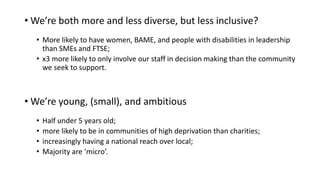
• We’re both more and less diverse, but less inclusive?
• More likely to have women, BAME, and people with disabilities in leadership
than SMEs and FTSE;
• x3 more likely to only involve our staff in decision making than the community
we seek to support.
• We’re young, (small), and ambitious
• Half under 5 years old;
• more likely to be in communities of high deprivation than charities;
• increasingly having a national reach over local;
• Majority are ‘micro’.
• We can be profitable (but at whose cost?)
• Those in areas of deprivation and rural areas most likely to be profitable than
not.
• We’re innovative (but rely on the generosity of others to be so)
• 2/3 doing new things;
• Most will be doing future growth through diversification;
• Biggest barrier to growth is being able to access grant funding.
• But are we presenting a confused picture to the wider
world?
• Some sole traders present themselves as social enterprises;
• 10% of all of us are CICs, but many aren’t sure what type of CIC they are;
• ¼ make ongoing losses;
• Those led by women, BAME, disabled, see lower turnovers than not;
• Turnovers remain largely unchanged over the last 4 years;
• Very little of our trade is with other social enterprises;
• We’re doing less in priority areas of employment, housing, and social care – at
a time when there’s growing and pressing need in these
- For most of us, our main customers are the general public
Starters for 10?
• Although we’ve weathered Covid better that private businesses, older social
enterprises have been harder hit than younger ones – how do we plan in such an
uncertain context?
• We’re recognised as having the potential to not just relieve needs, but create
systemic change to root causes (such as health) – should we? (can we really?)
• Many of us have a mix of paid and volunteer roles – there’s a recognised tension
in that mix as organisations start to grow in size…
• It’s argued that for us to realise our potential we need more support/recognition
from local and public authorities – at a time when their budgets are being
progressively cut…

Selnetworking nov 21

  • 1.
  • 3.
    • We’re bothmore and less diverse, but less inclusive? • More likely to have women, BAME, and people with disabilities in leadership than SMEs and FTSE; • x3 more likely to only involve our staff in decision making than the community we seek to support. • We’re young, (small), and ambitious • Half under 5 years old; • more likely to be in communities of high deprivation than charities; • increasingly having a national reach over local; • Majority are ‘micro’.
  • 4.
    • We canbe profitable (but at whose cost?) • Those in areas of deprivation and rural areas most likely to be profitable than not. • We’re innovative (but rely on the generosity of others to be so) • 2/3 doing new things; • Most will be doing future growth through diversification; • Biggest barrier to growth is being able to access grant funding.
  • 5.
    • But arewe presenting a confused picture to the wider world? • Some sole traders present themselves as social enterprises; • 10% of all of us are CICs, but many aren’t sure what type of CIC they are; • ¼ make ongoing losses; • Those led by women, BAME, disabled, see lower turnovers than not; • Turnovers remain largely unchanged over the last 4 years; • Very little of our trade is with other social enterprises; • We’re doing less in priority areas of employment, housing, and social care – at a time when there’s growing and pressing need in these - For most of us, our main customers are the general public
  • 6.
    Starters for 10? •Although we’ve weathered Covid better that private businesses, older social enterprises have been harder hit than younger ones – how do we plan in such an uncertain context? • We’re recognised as having the potential to not just relieve needs, but create systemic change to root causes (such as health) – should we? (can we really?) • Many of us have a mix of paid and volunteer roles – there’s a recognised tension in that mix as organisations start to grow in size… • It’s argued that for us to realise our potential we need more support/recognition from local and public authorities – at a time when their budgets are being progressively cut…