SELINUX
OUTLINE
• What is SELinux
• History of SELinux
• SELinux Security Models
• SELinux Policy
• SELinux Usage
• SELinux Commands
• Demonstration
• References
WHAT IS SELINUX?
• Security-Enhanced Linux is a Linux kernel security module that provides a mechanism for supporting
access control security policies, including United States Department of Defense –style mandatory access
controls.
• The key concepts underlying SELinux can be traced to several earlier projects by the United States
National Security Agency (NSA).
HISTORY OF SELINUX
• The NSA, the original primary developer of SELinux, released the first version to the open source
development community under the GNU GPL on December 22, 2000.
• The software merged into the mainline Linux kernel 2.6.0-test3, released on 8 August 2003.
• Other significant contributors include Red Hat, Network Associates, Secure Computing Corporation,
Tresys Technology, and Trusted Computer Solutions. Experimental ports of the FLASK/TE
implementation have been made available via the TrustedBSD Project for the FreeBSD and Darwin
operating systems.
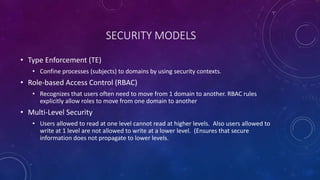
SECURITY MODELS
• Type Enforcement (TE)
• Confine processes (subjects) to domains by using security contexts.
• Role-based Access Control (RBAC)
• Recognizes that users often need to move from 1 domain to another. RBAC rules
explicitly allow roles to move from one domain to another
• Multi-Level Security
• Users allowed to read at one level cannot read at higher levels. Also users allowed to
write at 1 level are not allowed to write at a lower level. (Ensures that secure
information does not propagate to lower levels.
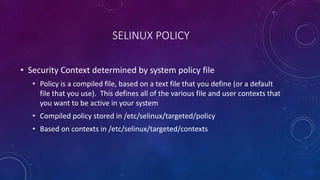
SELINUX POLICY
• Security Context determined by system policy file
• Policy is a compiled file, based on a text file that you define (or a default
file that you use). This defines all of the various file and user contexts that
you want to be active in your system
• Compiled policy stored in /etc/selinux/targeted/policy
• Based on contexts in /etc/selinux/targeted/contexts
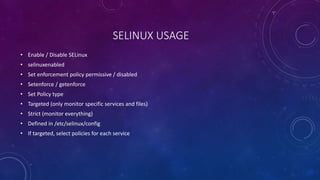
SELINUX USAGE
• Enable / Disable SELinux
• selinuxenabled
• Set enforcement policy permissive / disabled
• Setenforce / getenforce
• Set Policy type
• Targeted (only monitor specific services and files)
• Strict (monitor everything)
• Defined in /etc/selinux/config
• If targeted, select policies for each service
SELINUX COMMANDS
• Global Commands
• selinuxenabled
• getenforce
• setenforce
• sestatus
• fixfiles
• SELinux Files
• /etc/selinux/config
• /selinux/booleans
REFERENCES
• Lawrence, Steve (2016-02-23). "Release 2016-02-23". selinux. SELinux Project. Retrieved 2016-02-24.
• Jump up^ "SELinux Frequently Asked Questions (FAQ) - NSA/CSS". National Security Agency.
Retrieved 2013-02-06.
• Jump up^ Loscocco, Peter; Smalley, Stephen (February 2001). "Integrating Flexible Support for Security
Policies into the Linux Operating System" (PDF).
• Jump up^ "Security-Enhanced Linux - NSA/CSS". National Security Agency. 2009-01-15. Retrieved 2013-
02-06.
• Jump up^ Compare "National Security Agency Shares Security Enhancements to Linux
• https://access.redhat.com/documentation/en-us/red_hat_enterprise.../ch-selinux
• https://selinuxproject.org/
Selinux

Selinux

  • 1.
  • 2.
    OUTLINE • What isSELinux • History of SELinux • SELinux Security Models • SELinux Policy • SELinux Usage • SELinux Commands • Demonstration • References
  • 3.
    WHAT IS SELINUX? •Security-Enhanced Linux is a Linux kernel security module that provides a mechanism for supporting access control security policies, including United States Department of Defense –style mandatory access controls. • The key concepts underlying SELinux can be traced to several earlier projects by the United States National Security Agency (NSA).
  • 4.
    HISTORY OF SELINUX •The NSA, the original primary developer of SELinux, released the first version to the open source development community under the GNU GPL on December 22, 2000. • The software merged into the mainline Linux kernel 2.6.0-test3, released on 8 August 2003. • Other significant contributors include Red Hat, Network Associates, Secure Computing Corporation, Tresys Technology, and Trusted Computer Solutions. Experimental ports of the FLASK/TE implementation have been made available via the TrustedBSD Project for the FreeBSD and Darwin operating systems.
  • 5.
    SECURITY MODELS • TypeEnforcement (TE) • Confine processes (subjects) to domains by using security contexts. • Role-based Access Control (RBAC) • Recognizes that users often need to move from 1 domain to another. RBAC rules explicitly allow roles to move from one domain to another • Multi-Level Security • Users allowed to read at one level cannot read at higher levels. Also users allowed to write at 1 level are not allowed to write at a lower level. (Ensures that secure information does not propagate to lower levels.
  • 6.
    SELINUX POLICY • SecurityContext determined by system policy file • Policy is a compiled file, based on a text file that you define (or a default file that you use). This defines all of the various file and user contexts that you want to be active in your system • Compiled policy stored in /etc/selinux/targeted/policy • Based on contexts in /etc/selinux/targeted/contexts
  • 7.
    SELINUX USAGE • Enable/ Disable SELinux • selinuxenabled • Set enforcement policy permissive / disabled • Setenforce / getenforce • Set Policy type • Targeted (only monitor specific services and files) • Strict (monitor everything) • Defined in /etc/selinux/config • If targeted, select policies for each service
  • 8.
    SELINUX COMMANDS • GlobalCommands • selinuxenabled • getenforce • setenforce • sestatus • fixfiles • SELinux Files • /etc/selinux/config • /selinux/booleans
  • 10.
    REFERENCES • Lawrence, Steve(2016-02-23). "Release 2016-02-23". selinux. SELinux Project. Retrieved 2016-02-24. • Jump up^ "SELinux Frequently Asked Questions (FAQ) - NSA/CSS". National Security Agency. Retrieved 2013-02-06. • Jump up^ Loscocco, Peter; Smalley, Stephen (February 2001). "Integrating Flexible Support for Security Policies into the Linux Operating System" (PDF). • Jump up^ "Security-Enhanced Linux - NSA/CSS". National Security Agency. 2009-01-15. Retrieved 2013- 02-06. • Jump up^ Compare "National Security Agency Shares Security Enhancements to Linux • https://access.redhat.com/documentation/en-us/red_hat_enterprise.../ch-selinux • https://selinuxproject.org/