TQLR
TQLR is alistening strategy that helps students
listen actively instead of just “hearing” the teacher.
The letters stand for:
T –Tune in,
Q – Question
L – Listen,
R – Review
3.
TQLR isa four-step, metacognitive
listening strategy used before, during,
and after listening to a text, lecture, or
explanation. It trains students to:
Prepare their mind (Tune in)
Set a purpose (Question)
Listen with focus (Listen)
Check and organize what they heard
(Review)
Researchers describe it as a simple
listening strategy to improve students’
focused listening and recall.
4.
TQLR STEPS
STEP 1–T =Tune in
Goal
◦ Get ready to listen with full attention and activate
background knowledge.
Teacher does:
◦ Tells students what they will listen to and why.
◦ Removes distractions:“Pens down, eyes front, quiet
please.”
◦ Activates prior knowledge with 1–2 quick questions.
Students do:
◦ Stop side-talk, clear desks, face the speaker.
◦ Think about what they already know about the topic.
5.
TQLR STEPS
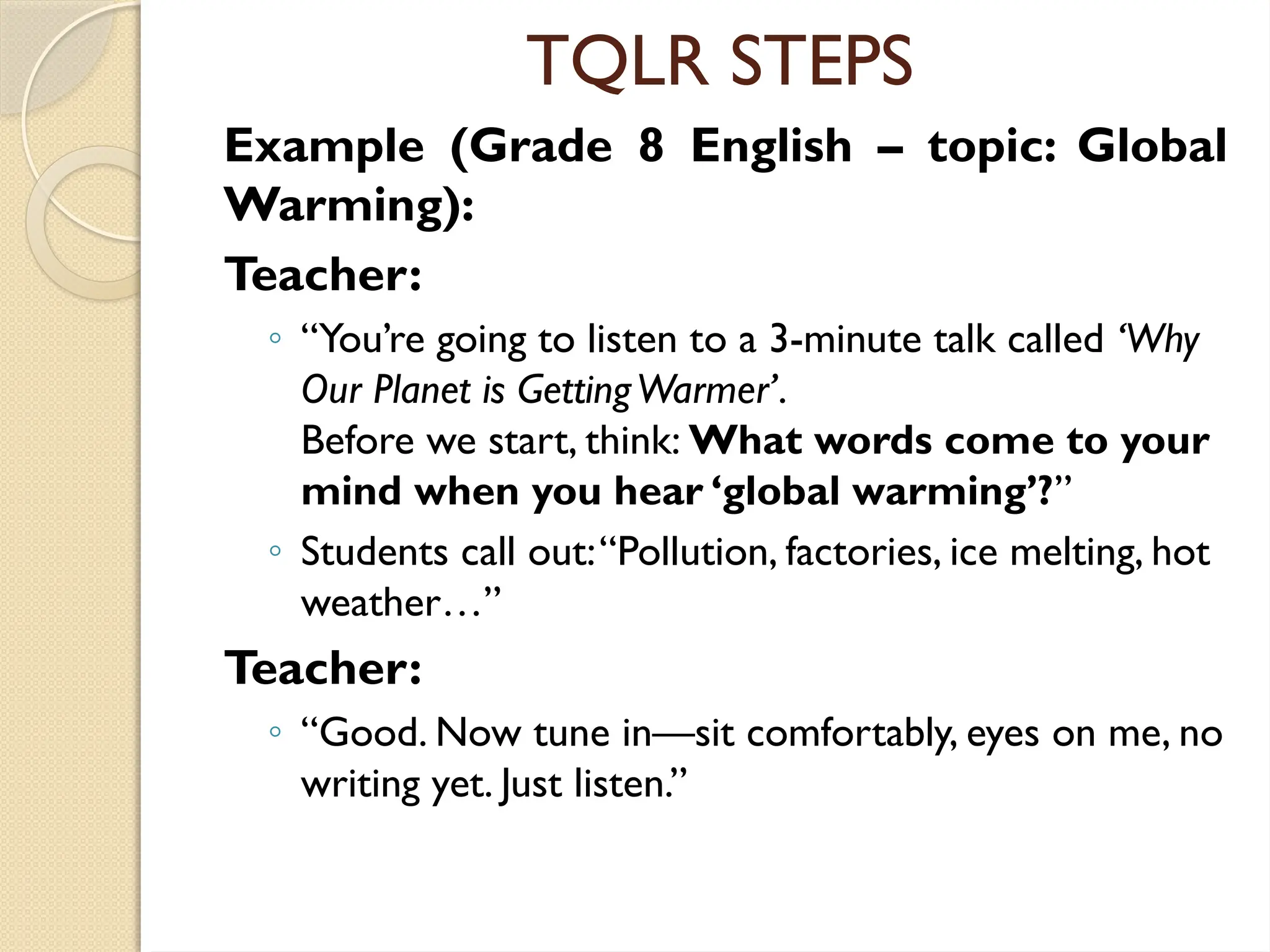
Example (Grade8 English – topic: Global
Warming):
Teacher:
◦ “You’re going to listen to a 3-minute talk called ‘Why
Our Planet is GettingWarmer’.
Before we start, think: What words come to your
mind when you hear ‘global warming’?”
◦ Students call out:“Pollution, factories, ice melting, hot
weather…”
Teacher:
◦ “Good. Now tune in—sit comfortably, eyes on me, no
writing yet. Just listen.”
6.
TQLR STEPS
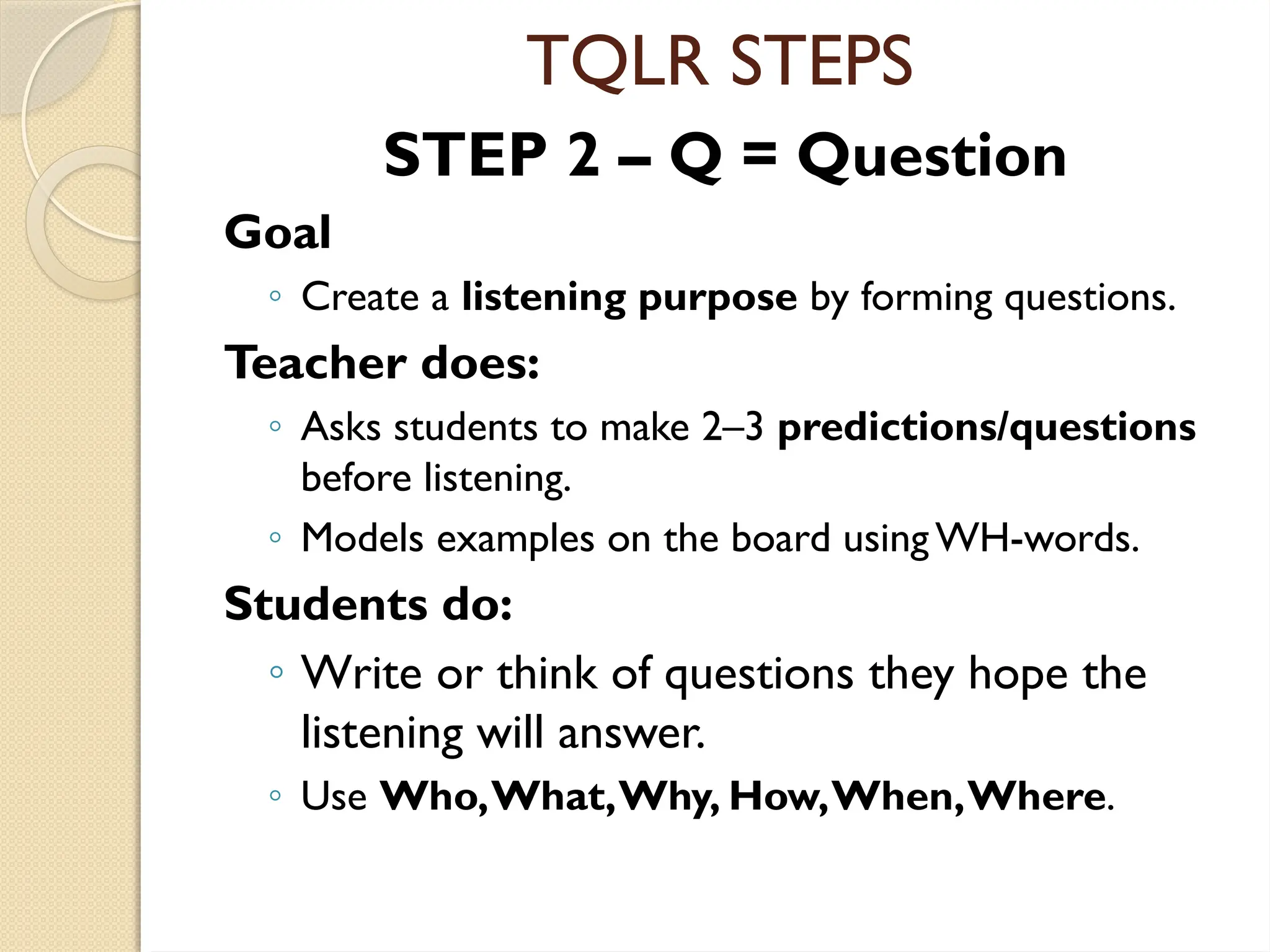
STEP 2– Q = Question
Goal
◦ Create a listening purpose by forming questions.
Teacher does:
◦ Asks students to make 2–3 predictions/questions
before listening.
◦ Models examples on the board using WH-words.
Students do:
◦ Write or think of questions they hope the
listening will answer.
◦ Use Who,What,Why, How,When,Where.
7.
TQLR STEPS
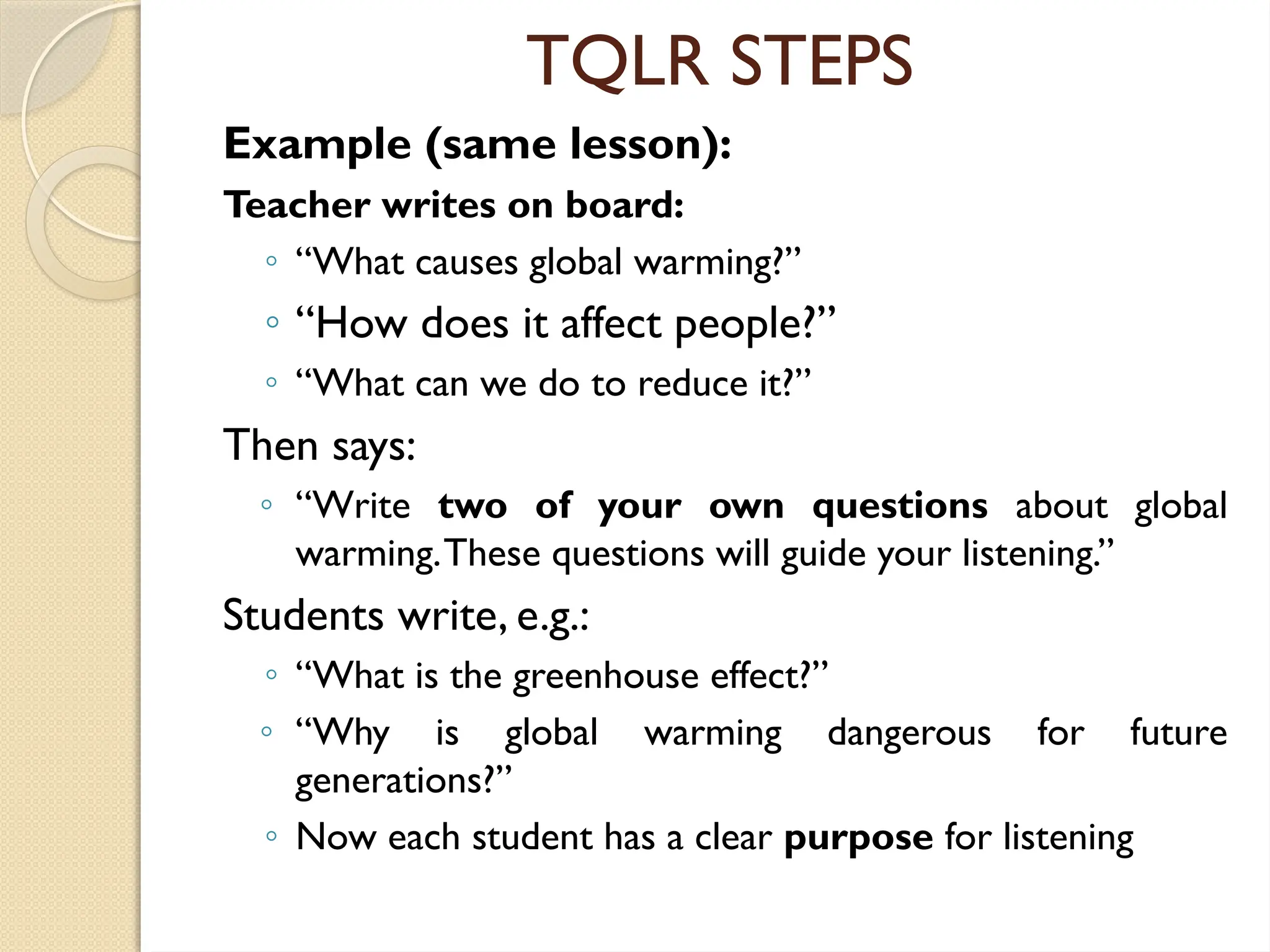
Example (samelesson):
Teacher writes on board:
◦ “What causes global warming?”
◦ “How does it affect people?”
◦ “What can we do to reduce it?”
Then says:
◦ “Write two of your own questions about global
warming.These questions will guide your listening.”
Students write, e.g.:
◦ “What is the greenhouse effect?”
◦ “Why is global warming dangerous for future
generations?”
◦ Now each student has a clear purpose for listening
8.
TQLR STEPS
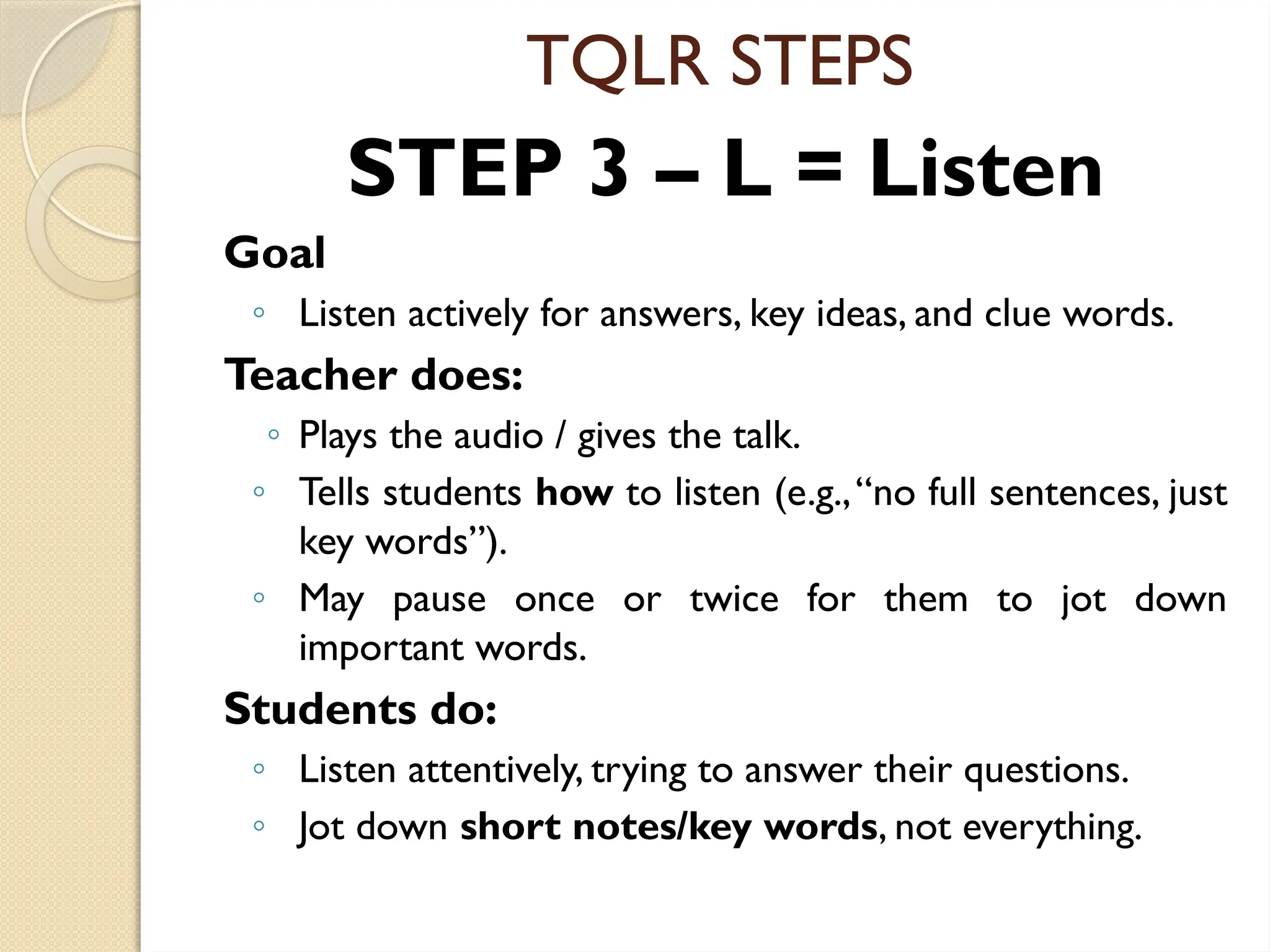
STEP 3– L = Listen
Goal
◦ Listen actively for answers, key ideas, and clue words.
Teacher does:
◦ Plays the audio / gives the talk.
◦ Tells students how to listen (e.g.,“no full sentences, just
key words”).
◦ May pause once or twice for them to jot down
important words.
Students do:
◦ Listen attentively, trying to answer their questions.
◦ Jot down short notes/key words, not everything.
9.
TQLR STEPS
Example (samelesson):
Teacher:
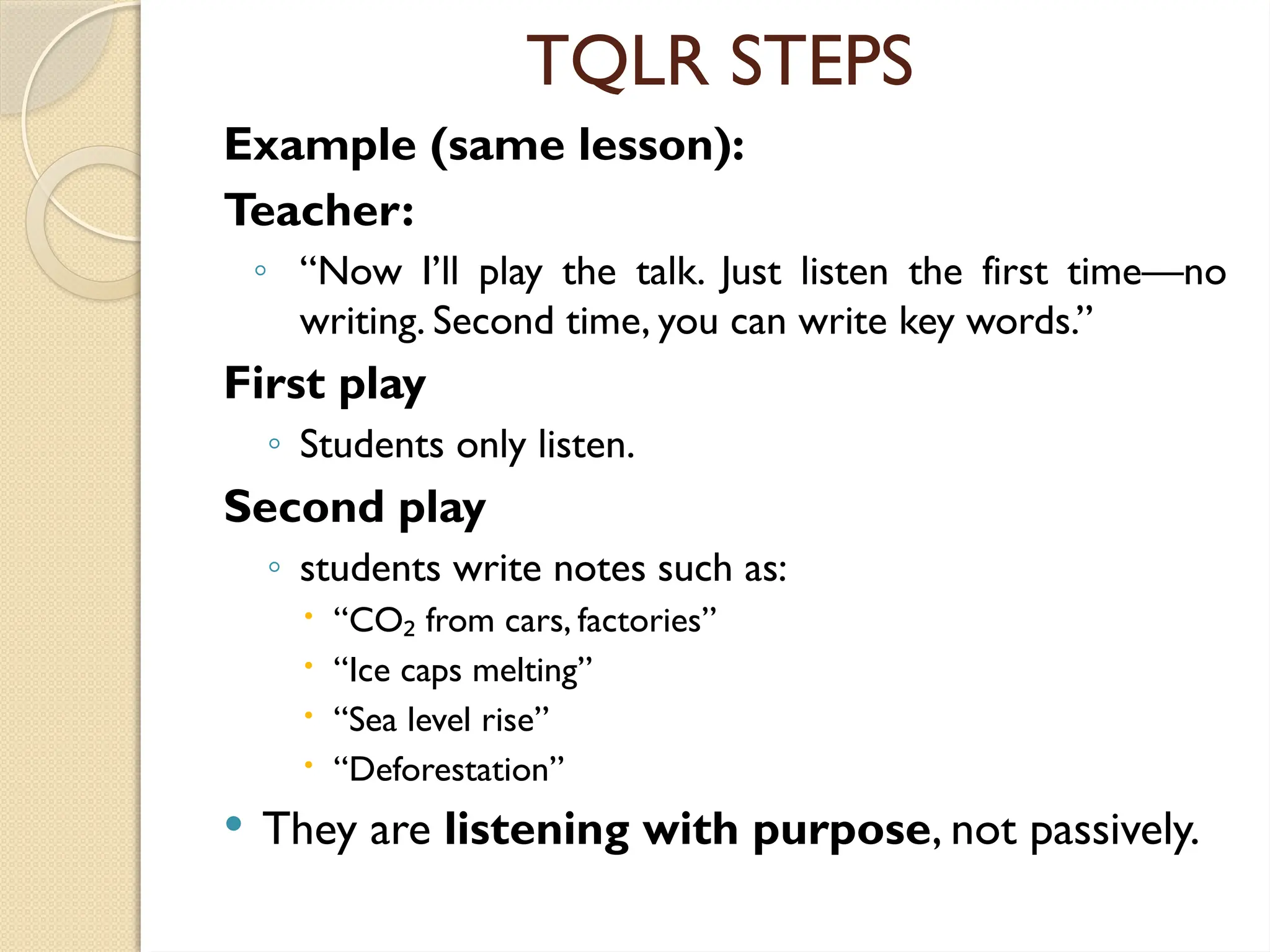
◦ “Now I’ll play the talk. Just listen the first time—no
writing. Second time, you can write key words.”
First play
◦ Students only listen.
Second play
◦ students write notes such as:
“CO from cars, factories”
₂
“Ice caps melting”
“Sea level rise”
“Deforestation”
They are listening with purpose, not passively.
10.
TQLR STEPS
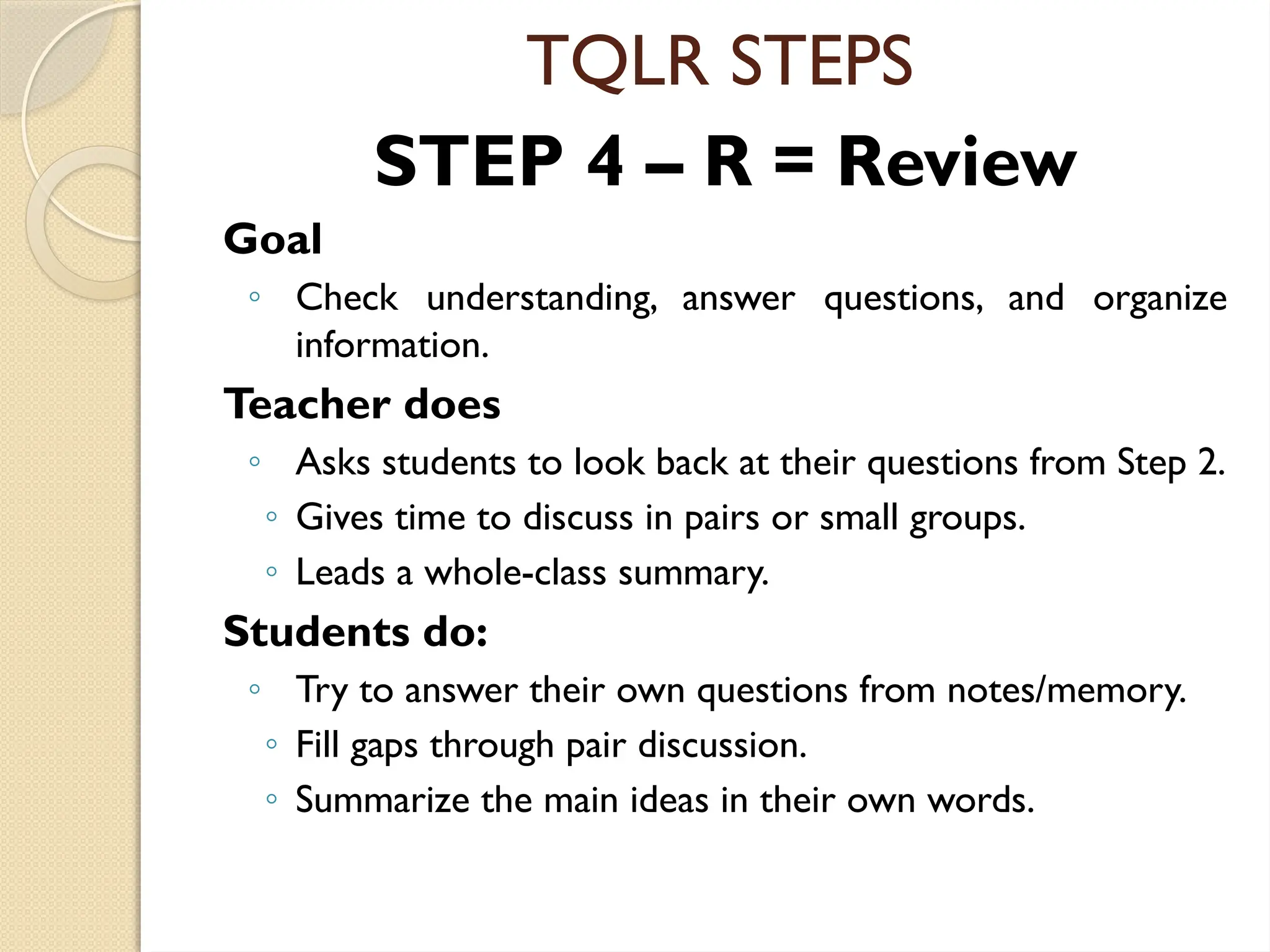
STEP 4– R = Review
Goal
◦ Check understanding, answer questions, and organize
information.
Teacher does
◦ Asks students to look back at their questions from Step 2.
◦ Gives time to discuss in pairs or small groups.
◦ Leads a whole-class summary.
Students do:
◦ Try to answer their own questions from notes/memory.
◦ Fill gaps through pair discussion.
◦ Summarize the main ideas in their own words.
11.
TQLR STEPS
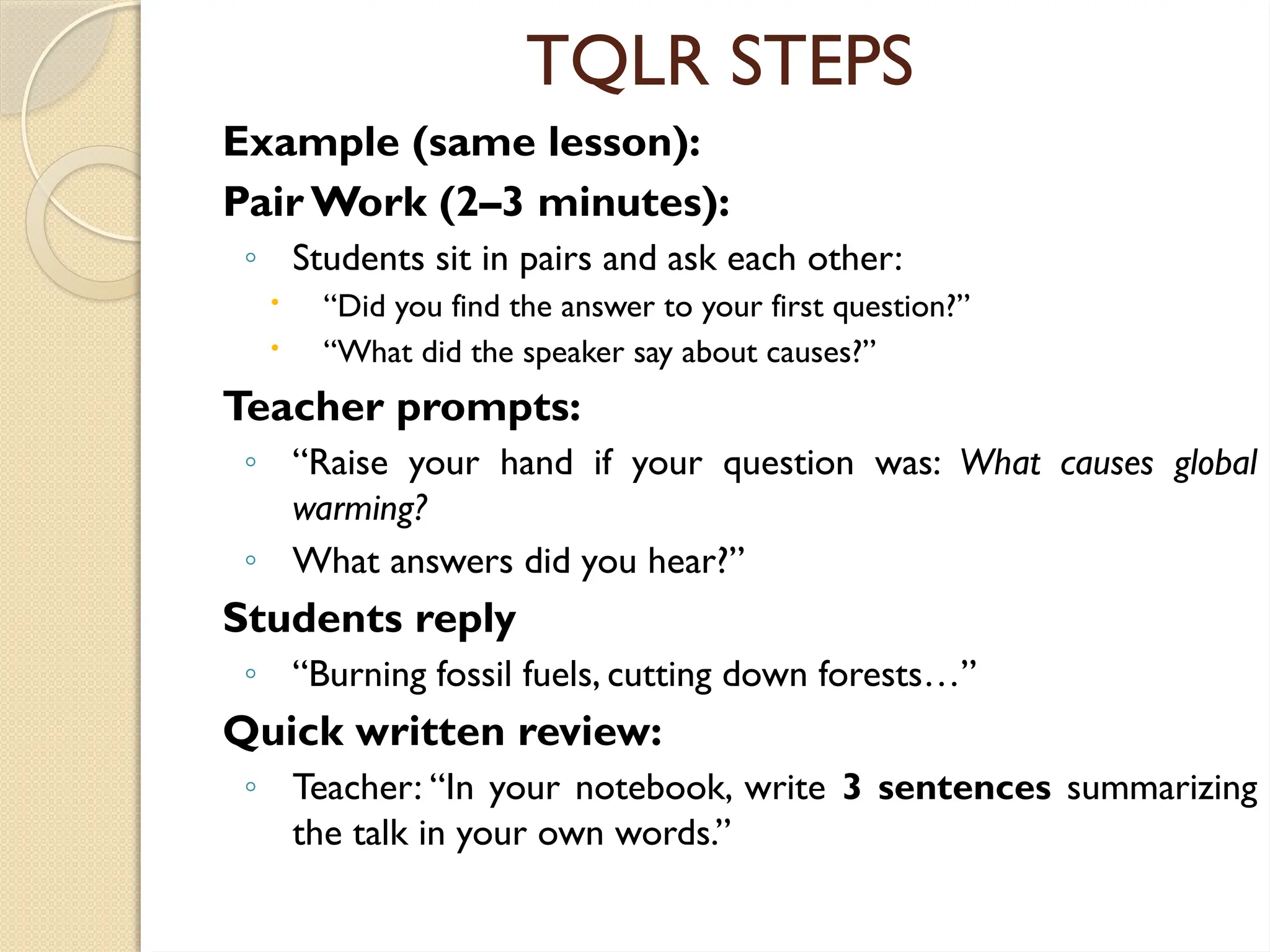
Example (samelesson):
Pair Work (2–3 minutes):
◦ Students sit in pairs and ask each other:
“Did you find the answer to your first question?”
“What did the speaker say about causes?”
Teacher prompts:
◦ “Raise your hand if your question was: What causes global
warming?
◦ What answers did you hear?”
Students reply
◦ “Burning fossil fuels, cutting down forests…”
Quick written review:
◦ Teacher: “In your notebook, write 3 sentences summarizing
the talk in your own words.”