Self-Regulat-
ingCables
Power-Limiting
Cables
MineralInsu-
latedCables
Longline
Heating
RTBTubing
Bundles
TankHeatingSnowandIceControland
Monitoring
Heat-Trace
Panels
Engineered
Products
Steam-Tracing
Systems
TechnicalData
Sheets
Appendixes
This step-by-step design guide provides the tools necessary to design a self-
regulating heat-tracing system for insulated pipes and tubing. For other applications
or for design assistance, contact your Pentair Thermal Management representative
or phone (800) 545‑6258. Also, visit our web site at www.pentairthermal.com.
Contents
Introduction. . . . . . . . . . . . . . . . . . . . . . . . . . . . . . . . . . . . . . . . . . . . . . . . . . . . . . . . . . .  1
Conductive-Polymer Technology. . . . . . . . . . . . . . . . . . . . . . . . . . . . . . . . . . . . . .  1
System Overview. . . . . . . . . . . . . . . . . . . . . . . . . . . . . . . . . . . . . . . . . . . . . . . . . . . . . . .  3
Typical Self-Regulating System. . . . . . . . . . . . . . . . . . . . . . . . . . . . . . . . . . . . . . .  3
Approvals and Certifications . . . . . . . . . . . . . . . . . . . . . . . . . . . . . . . . . . . . . . . . .  3
Thermal Design. . . . . . . . . . . . . . . . . . . . . . . . . . . . . . . . . . . . . . . . . . . . . . . . . . . . . . . .  4
Pipe Heat Loss Calculations. . . . . . . . . . . . . . . . . . . . . . . . . . . . . . . . . . . . . . . . .  4
Heating Cable Selection. . . . . . . . . . . . . . . . . . . . . . . . . . . . . . . . . . . . . . . . . . . . . . . . .  8
Bill of Materials. . . . . . . . . . . . . . . . . . . . . . . . . . . . . . . . . . . . . . . . . . . . . . . . . . . . . . .  20
Determining the Total Length of Heating Cable. . . . . . . . . . . . . . . . . . . . . . . . .  20
Electrical Design. . . . . . . . . . . . . . . . . . . . . . . . . . . . . . . . . . . . . . . . . . . . . . . . . .  23
Connection Kit Selection and Accessories. . . . . . . . . . . . . . . . . . . . . . . . . . . . .  26
Introduction
Pentair Thermal Management invented self-regulating heating cable technology
more than 40 years ago and today has over a billion feet of Raychem brand self-
regulating heating cable installed worldwide.
Self-regulating systems are the preferred choice for most complex pipe-tracing
applications. This is due to their parallel construction, which allows them to be cut to
length and spliced in the field, and their self-regulating output, which provides more
heat where it is needed.
Pentair Thermal Management self-regulating heating cables are certified for
use in hazardous locations and have been tested and approved for unconditional
temperature classifications by worldwide approval agencies.
Conductive-Polymer Technology
Pentair Thermal Management uses innovative conductive-polymer technology in
both monolithic (solid core) and fiber (polymeric fiber wrap) heating cables, as seen
in Figures 1 and 2. The heating element is made of polymers mixed with conductive
carbon black. This special blend of materials creates electrical paths for conducting
current between the parallel bus wires along the entire cable length.
In each heating cable the number of electrical paths between the bus wires changes
in response to temperature fluctuations. As the ambient temperature surrounding
the heating cable decreases, the conductive core or fiber contracts microscopically.
This contraction decreases electrical resistance and creates numerous electrical
paths between the bus wires. Current flows across these paths to warm the core or
fiber.
Pentair Thermal Management
invented self-regulating heating
cable technology more than 40 years
ago and today has over a billion feet
of Raychem brand self-regulating
heating cable installed worldwide.
Self-regulating cables
1 / 32INDUSTRIAL HEAT TRACING SOLUTIONS EN-RaychemSelfRegulating-DG-H56882 08/14
INDUSTRIAL HEAT TRACING SOLUTIONSEN-RaychemSelfRegulating-DG-H56882 08/142 / 32
As the temperature rises, the core or fiber expands microscopically. This expansion
increases electrical resistance, and the number of electrical paths decreases. As a
result,the heating cable automatically begins to reduce its power output.
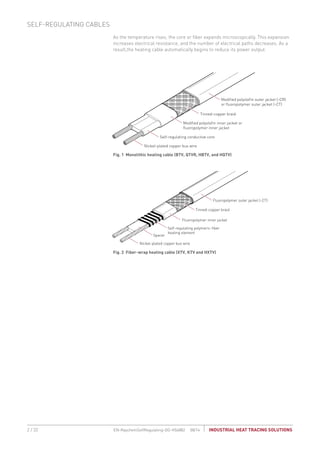
Nickel-plated copper bus wire
Self-regulating conductive core
Modified polyolefin inner jacket or
fluoropolymer inner jacket
Tinned-copper braid
Modified polyolefin outer jacket (-CR)
or fluoropolymer outer jacket (-CT)
Fig. 1 Monolithic heating cable (BTV, QTVR, HBTV, and HQTV)
Fluoropolymer inner jacket
Fluoropolymer outer jacket (-CT)
Spacer
Self-regulating polymeric-fiber
heating element
Nickel-plated copper bus wire
Tinned-copper braid
Fig. 2 Fiber-wrap heating cable (XTV, KTV and HXTV)
Self-regulating cables
Self-Regulat-
ingCables
Power-Limiting
Cables
MineralInsu-
latedCables
Longline
Heating
RTBTubing
Bundles
TankHeatingSnowandIceControland
Monitoring
Heat-Trace
Panels
Engineered
Products
Steam-Tracing
Systems
TechnicalData
Sheets
Appendixes
3 / 32INDUSTRIAL HEAT TRACING SOLUTIONS EN-RaychemSelfRegulating-DG-H56882 08/14
System Overview
Typical Self-Regulating System
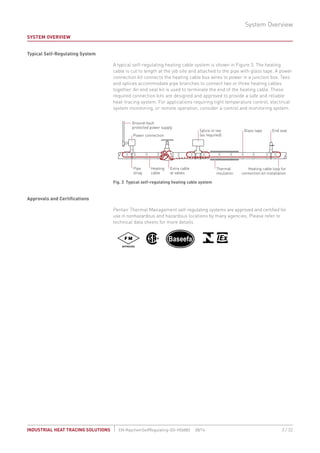
A typical self-regulating heating cable system is shown in Figure 3. The heating
cable is cut to length at the job site and attached to the pipe with glass tape. A power
connection kit connects the heating cable bus wires to power in a junction box. Tees
and splices accommodate pipe branches to connect two or three heating cables
together. An end seal kit is used to terminate the end of the heating cable. These
required connection kits are designed and approved to provide a safe and reliable
heat-tracing system. For applications requiring tight temperature control, electrical
system monitoring, or remote operation, consider a control and monitoring system.
Extra cable
at valves
Thermal
insulation
Heating cable loop for
connection kit installation
Pipe
strap
Heating
cable
Glass tape End sealSplice or tee
(as required)
Ground-fault
protected power supply
Power connection
Fig. 3 Typical self-regulating heating cable system
Approvals and Certifications
Pentair Thermal Management self-regulating systems are approved and certified for
use in nonhazardous and hazardous locations by many agencies. Please refer to
technical data sheets for more details.
System Overview
INDUSTRIAL HEAT TRACING SOLUTIONSEN-RaychemSelfRegulating-DG-H56882 08/144 / 32
Thermal Design
Pipe Heat Loss Calculations
To select the proper heating cable you must first calculate the pipe heat loss, as
outlined in the following four steps:
1	Gather the necessary information.
–	Tm: Maintain temperature
–	Ta: Minimum expected ambient temperature
–	 Pipe or tubing size and material
–	 Thermal insulation type and thickness
2	Calculate the temperature differential between the pipe maintain temperature
and the minimum ambient temperature.
3	Calculate the pipe heat loss.
4	Adjust the heat loss to compensate for specific insulation type.
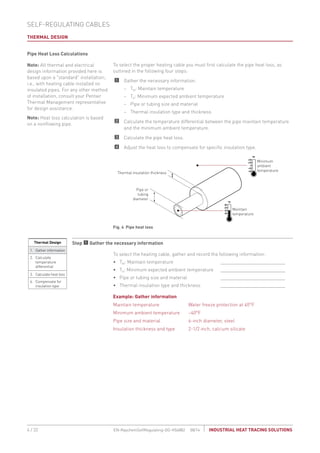
20
40
60
80
−40
−20
0
+20
+40
Maintain
temperature
°F
°F
Minimum
ambient
temperature
Thermal insulation thickness
Pipe or
tubing
diameter
Fig. 4 Pipe heat loss
Thermal Design
1. Gather information
2. Calculate
temperature
differential
3. Calculate heat loss
4. Compensate for
insulation type
Step  Gather the necessary information
To select the heating cable, gather and record the following information:
•	 Tm: Maintain temperature	 	
•	 Ta: Minimum expected ambient temperature	 	
•	 Pipe or tubing size and material	 	
•	 Thermal insulation type and thickness	 	
Example: Gather information
Maintain temperature	 Water freeze protection at 40°F
Minimum ambient temperature	 –40°F
Pipe size and material	 6-inch diameter, steel
Insulation thickness and type	 2-1/2 inch, calcium silicate
Note: All thermal and electrical
design information provided here is
based upon a "standard" installation;
i.e., with heating cable installed on
insulated pipes. For any other method
of installation, consult your Pentair
Thermal Management representative
for design assistance.
Note: Heat loss calculation is based
on a nonflowing pipe.
Self-regulating cables
Self-Regulat-
ingCables
Power-Limiting
Cables
MineralInsu-
latedCables
Longline
Heating
RTBTubing
Bundles
TankHeatingSnowandIceControland
Monitoring
Heat-Trace
Panels
Engineered
Products
Steam-Tracing
Systems
TechnicalData
Sheets
Appendixes
5 / 32INDUSTRIAL HEAT TRACING SOLUTIONS EN-RaychemSelfRegulating-DG-H56882 08/14
Thermal Design
1. Gather information
2. Calculate
temperature
differential
3. Calculate heat loss
4. Compensate for
insulation type
Step  Calculate temperature differential ΔT
To calculate the temperature differential (ΔT), use the formula below:
Formula	 ΔT = Tm – Ta
Example: Calculate temperature differential
Input	Tm = 40°F (from Step 1)
Input	Ta = –40°F (from Step 1)
Calculation	 ΔT = 40°F – (–40°F) = 80°F
ΔT = 80°F
Thermal Design
1. Gather information
2. Calculate
temperature
differential
3. Calculate heat loss
4. Compensate for
insulation type
Step  Calculate the pipe heat loss
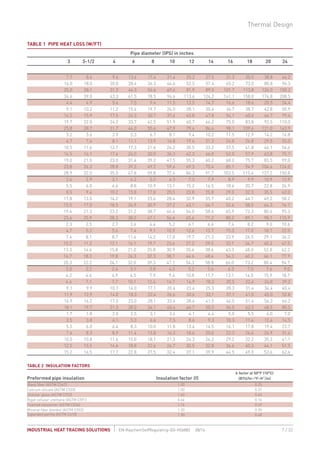
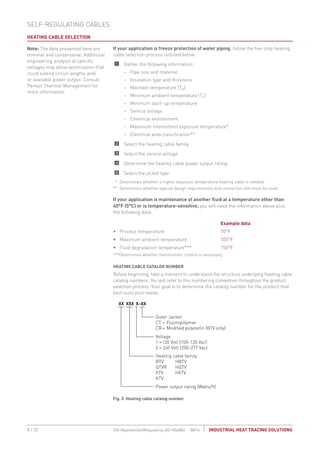
From Table 1 match the pipe size and insulation thickness with the temperature
differential, ΔT, to find the base heat loss of the pipe (Qb).
Example: Calculate pipe heat loss
Input	 Pipe size = 6 inch (from Step 1)
Input	 Insulation thickness = 2-1/2 inch (from Step 1)
Input	 ΔT = 80°F (from Step 2)
Input	 Pipe heat loss = 3.6 W/ft (from Table 1)
From Table 1, Qb must be calculated through interpolation. For this example, 80°F is
3/5 of the difference between the ΔT of 50°F and the ΔT of 100°F:
Qb = 3.6 W/ft + [3/5 x (7.4 – 3.6)] (7.4 is the ΔT of 100°F; 3.6 is the ΔT of 50°F)
Calculation	Qb = 3.6 + 2.3 = 5.9 W/ft
Pipe heat loss	 Qb = 5.9 W/ft @ 40°F
Thermal Design
1. Gather information
2. Calculate
temperature
differential
3. Calculate heat loss
4. Compensate for
insulation type
Step  Compensate for insulation type
Multiply the base heat loss of the pipe (Qb) from Step 3 by the insulation
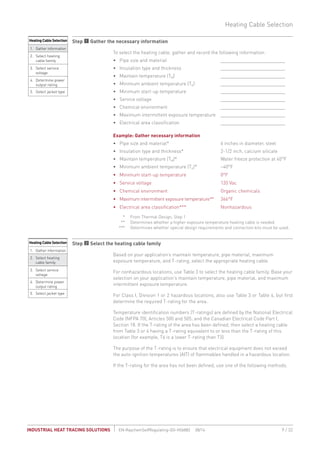
compensation factor (f) from Table 2 to get the total heat loss per foot of pipe (Qt).
Formula	Qt = Qb x f
Example: Insulation type compensation
Input	 Insulation type = calcium silicate (from Step 1)
Input	 f = 1.50 for calcium silicate (from Table 2)
Input	Qb = 5.9 W/ft (from Step 3)
Calculation	Qt = 5.9 W/ft x 1.50 = 8.85 W/ft
Qt = 8.85 W/ft at 40°F
Now proceed to the Heating Cable Selection section, page 8, to determine the
heating cable that will compensate for this heat loss.
Note: Heat loss calculations are based on IEEE Standards.
Thermal Design
INDUSTRIAL HEAT TRACING SOLUTIONSEN-RaychemSelfRegulating-DG-H56882 08/146 / 32
Table 1 Pipe Heat Loss (W/ft)
Pipe diameter (IPS) in inches
1/4 1/2 3/4 1 1-1/4 1-1/2 2 2-1/2
Insulation
thickness
(ΔT) Tubing size (inches)
°F °C 3/4 1 1-1/4 1-1/2 2
0.5" 	50 	28 	1.9 	2.5 	2.9 	3.5 	4.1 	4.6 	5.5 	6.5
	100 	56 	3.9 	5.2 	6.1 	7.2 	8.6 	9.6 	11.5 	13.5
	150 	84 	6.1 	8.1 	9.5 	11.2 	13.4 	14.9 	17.9 	21.1
	200 	111 	8.5 	11.3 	13.2 	15.6 	18.6 	20.7 	24.9 	29.2
1.0" 	50 	28 	1.3 	1.6 	1.9 	2.2 	2.5 	2.8 	3.2 	3.8
	100 	56 	2.7 	3.4 	3.9 	4.5 	5.2 	5.8 	6.8 	7.8
	150 	84 	4.2 	5.3 	6.1 	7.0 	8.2 	9.0 	10.6 	12.2
	200 	111 	5.8 	7.4 	8.4 	9.7 	11.3 	12.4 	14.6 	16.9
	250 	139 	7.6 	9.7 	11.0 	12.7 	14.8 	16.3 	19.1 	22.1
1.5" 	50 	28 	1.1 	1.3 	1.5 	1.7 	1.9 	2.1 	2.4 	2.8
	100 	56 	2.2 	2.8 	3.1 	3.5 	4.0 	4.4 	5.1 	5.8
	150 	84 	3.5 	4.3 	4.8 	5.5 	6.3 	6.9 	8.0 	9.1
	200 	111 	4.8 	5.9 	6.7 	7.6 	8.7 	9.5 	11.0 	12.6
	250 	139 	6.3 	7.8 	8.7 	9.9 	11.4 	12.4 	14.4 	16.5
	300 	167 	7.9 	9.7 	11.0 	12.4 	14.3 	15.6 	18.1 	20.6
	350 	194 	9.6 	11.9 	13.3 	15.1 	17.4 	19.0 	22.0 	25.1
2.0" 	50 	28 	0.9 	1.1 	1.3 	1.4 	1.6 	1.8 	2.0 	2.3
	100 	56 	2.0 	2.4 	2.7 	3.0 	3.4 	3.7 	4.2 	4.8
	150 	84 	3.1 	3.7 	4.2 	4.7 	5.3 	5.8 	6.6 	7.5
	200 	111 	4.3 	5.2 	5.8 	6.5 	7.4 	8.0 	9.2 	10.4
	250 	139 	5.6 	6.8 	7.5 	8.5 	9.6 	10.4 	12.0 	13.5
	300 	167 	7.0 	8.5 	9.4 	10.6 	12.1 	13.1 	15.0 	17.0
	350 	194 	8.5 	10.3 	11.5 	12.9 	14.7 	15.9 	18.2 	20.6
2.5" 	50 	28 	0.9 	1.0 	1.2 	1.3 	1.4 	1.6 	1.8 	2.0
	100 	56 	1.8 	2.2 	2.4 	2.7 	3.0 	3.3 	3.7 	4.2
	150 	84 	2.8 	3.4 	3.7 	4.2 	4.7 	5.1 	5.8 	6.5
	200 	111 	3.9 	4.7 	5.2 	5.8 	6.5 	7.0 	8.0 	9.0
	250 	139 	5.1 	6.1 	6.8 	7.6 	8.5 	9.2 	10.5 	11.7
	300 	167 	6.4 	7.7 	8.5 	9.5 	10.7 	11.5 	13.1 	14.7
	350 	194 	7.8 	9.3 	10.3 	11.5 	13.0 	14.0 	15.9 	17.9
3.0" 	50 	28 	0.8 	1.0 	1.1 	1.2 	1.3 	1.4 	1.6 	1.8
	100 	56 	1.7 	2.0 	2.2 	2.4 	2.7 	2.9 	3.3 	3.7
	150 	84 	2.6 	3.1 	3.4 	3.8 	4.3 	4.6 	5.2 	5.8
	200 	111 	3.6 	4.3 	4.8 	5.3 	5.9 	6.4 	7.2 	8.0
	250 	139 	4.8 	5.7 	6.2 	6.9 	7.8 	8.3 	9.4 	10.5
	300 	167 	6.0 	7.1 	7.8 	8.7 	9.7 	10.4 	11.8 	13.2
	350 	194 	7.3 	8.6 	9.5 	10.5 	11.8 	12.7 	14.3 	16.0
4.0" 	50 	28 	0.7 	0.9 	0.9 	1.0 	1.1 	1.2 	1.4 	1.5
	100 	56 	1.5 	1.8 	2.0 	2.1 	2.4 	2.5 	2.9 	3.2
	150 	84 	2.4 	2.8 	3.0 	3.4 	3.7 	4.0 	4.4 	4.9
	200 	111 	3.3 	3.9 	4.2 	4.6 	5.2 	5.5 	6.2 	6.8
	250 	139 	4.3 	5.1 	5.5 	6.1 	6.7 	7.2 	8.1 	8.9
	300 	167 	5.4 	6.3 	6.9 	7.6 	8.5 	9.0 	10.1 	11.2
	350 	194 	6.6 	7.7 	8.4 	9.3 	10.3 	11.0 	12.3 	13.6
Note: Pipe heat loss (Qb) is shown in watts per foot. Heat loss calculations are based on IEEE Standards with the following provisions:
•	Pipes insulated with glass fiber in accordance with ASTM C547
•	Pipes located outdoors in a 20-mph wind
•	No insulating air space assumed between pipe and insulation
•	No insulating air space assumed between the insulation and outer cladding
•	Includes a 10% safety factor
Self-regulating cables
Self-Regulat-
ingCables
Power-Limiting
Cables
MineralInsu-
latedCables
Longline
Heating
RTBTubing
Bundles
TankHeatingSnowandIceControland
Monitoring
Heat-Trace
Panels
Engineered
Products
Steam-Tracing
Systems
TechnicalData
Sheets
Appendixes
7 / 32INDUSTRIAL HEAT TRACING SOLUTIONS EN-RaychemSelfRegulating-DG-H56882 08/14
Table 1 Pipe Heat Loss (W/ft)
Pipe diameter (IPS) in inches
3 3-1/2 4 6 8 10 12 14 16 18 20 24
	7.7 	8.6 	9.6 	13.6 	17.4 	21.4 	25.2 	27.5 	31.3 	35.0 	38.8 	46.2
	16.0 	18.0 	20.0 	28.4 	36.3 	44.6 	52.5 	57.4 	65.2 	73.0 	80.8 	96.3
	25.0 	28.1 	31.2 	44.3 	56.6 	69.6 	81.9 	89.5 	101.7 	113.8 	126.0 	150.2
	34.6 	39.0 	43.3 	61.5 	78.5 	96.6 	113.6 	124.2 	141.1 	158.0 	174.8 	208.5
	4.4 	4.9 	5.4 	7.5 	9.4 	11.5 	13.5 	14.7 	16.6 	18.6 	20.5 	24.4
	9.1 	10.2 	11.2 	15.6 	19.7 	24.0 	28.1 	30.6 	34.7 	38.7 	42.8 	50.9
	14.2 	15.9 	17.5 	24.3 	30.7 	37.4 	43.8 	47.8 	54.1 	60.4 	66.7 	79.4
	19.7 	22.0 	24.2 	33.7 	42.5 	51.9 	60.7 	66.2 	75.0 	83.8 	92.5 	110.0
	25.8 	28.7 	31.7 	44.0 	55.6 	67.9 	79.4 	86.6 	98.1 	109.6 	121.0 	143.9
	3.2 	3.6 	3.9 	5.3 	6.7 	8.1 	9.4 	10.2 	11.5 	12.9 	14.2 	16.8
	6.7 	7.4 	8.1 	11.1 	13.9 	16.8 	19.6 	21.3 	24.0 	26.8 	29.5 	35.0
	10.5 	11.6 	12.7 	17.3 	21.6 	26.2 	30.5 	33.2 	37.5 	41.8 	46.1 	54.6
	14.5 	16.1 	17.6 	24.0 	30.0 	36.3 	42.3 	46.0 	52.0 	57.9 	63.8 	75.7
	19.0 	21.0 	23.0 	31.4 	39.2 	47.5 	55.3 	60.2 	68.0 	75.7 	83.5 	99.0
	23.8 	26.3 	28.8 	39.3 	49.2 	59.6 	69.3 	75.4 	85.1 	94.9 	104.6 	124.0
	28.9 	32.0 	35.0 	47.8 	59.8 	72.4 	84.3 	91.7 	103.5 	115.4 	127.2 	150.8
	2.6 	2.9 	3.1 	4.2 	5.2 	6.3 	7.3 	7.9 	8.9 	9.9 	10.9 	12.9
	5.5 	6.0 	6.6 	8.8 	10.9 	13.1 	15.2 	16.5 	18.6 	20.7 	22.8 	26.9
	8.5 	9.4 	10.2 	13.8 	17.0 	20.5 	23.8 	25.8 	29.0 	32.3 	35.5 	42.0
	11.8 	13.0 	14.2 	19.1 	23.6 	28.4 	32.9 	35.7 	40.2 	44.7 	49.2 	58.2
	15.5 	17.0 	18.5 	24.9 	30.9 	37.2 	43.1 	46.7 	52.6 	58.5 	64.3 	76.1
	19.4 	21.3 	23.2 	31.2 	38.7 	46.6 	54.0 	58.6 	65.9 	73.3 	80.6 	95.3
	23.6 	25.9 	28.3 	38.0 	47.1 	56.6 	65.6 	71.2 	80.2 	89.1 	98.1 	115.9
	2.3 	2.5 	2.7 	3.6 	4.4 	5.2 	6.1 	6.6 	7.4 	8.2 	9.0 	10.6
	4.7 	5.2 	5.6 	7.4 	9.1 	10.9 	12.6 	13.7 	15.3 	17.0 	18.7 	22.0
	7.4 	8.1 	8.7 	11.6 	14.2 	17.0 	19.7 	21.3 	23.9 	26.5 	29.1 	34.3
	10.2 	11.2 	12.1 	16.1 	19.7 	23.6 	27.2 	29.5 	33.1 	36.7 	40.3 	47.5
	13.3 	14.6 	15.8 	21.0 	25.8 	30.9 	35.6 	38.6 	43.3 	48.0 	52.8 	62.2
	16.7 	18.3 	19.8 	26.3 	32.3 	38.7 	44.6 	48.4 	54.3 	60.2 	66.1 	77.9
	20.3 	22.2 	24.1 	32.0 	39.3 	47.1 	54.3 	58.8 	66.0 	73.2 	80.4 	94.7
	2.0 	2.2 	2.4 	3.1 	3.8 	4.5 	5.2 	5.6 	6.3 	7.0 	7.6 	9.0
	4.2 	4.6 	4.9 	6.5 	7.9 	9.4 	10.8 	11.7 	13.1 	14.5 	15.9 	18.7
	6.6 	7.1 	7.7 	10.1 	12.4 	14.7 	16.9 	18.3 	20.5 	22.6 	24.8 	29.2
	9.1 	9.9 	10.7 	14.0 	17.1 	20.4 	23.4 	25.3 	28.3 	31.4 	34.4 	40.4
	11.9 	12.9 	14.0 	18.3 	22.4 	26.6 	30.6 	33.1 	37.1 	41.0 	45.0 	52.8
	14.9 	16.2 	17.5 	23.0 	28.1 	33.4 	38.4 	41.5 	46.5 	51.4 	56.3 	66.2
	18.1 	19.7 	21.3 	28.0 	34.1 	40.6 	46.7 	50.5 	56.5 	62.5 	68.5 	80.5
	1.7 	1.8 	2.0 	2.5 	3.1 	3.6 	4.1 	4.4 	5.0 	5.5 	6.0 	7.0
	3.5 	3.8 	4.1 	5.3 	6.4 	7.5 	8.6 	9.3 	10.3 	11.4 	12.4 	14.5
	5.5 	6.0 	6.4 	8.3 	10.0 	11.8 	13.4 	14.5 	16.1 	17.8 	19.4 	22.7
	7.6 	8.3 	8.9 	11.4 	13.8 	16.3 	18.6 	20.0 	22.3 	24.6 	26.9 	31.4
	10.0 	10.8 	11.6 	15.0 	18.1 	21.3 	24.3 	26.2 	29.2 	32.2 	35.2 	41.1
	12.5 	13.5 	14.6 	18.8 	22.6 	26.7 	30.5 	32.8 	36.6 	40.3 	44.1 	51.5
	15.2 	16.5 	17.7 	22.8 	27.5 	32.4 	37.1 	39.9 	44.5 	49.0 	53.6 	62.6
Table 2 Insulation Factors
Preformed pipe insulation Insulation factor (f)
k factor at 50°F (10°C)
(BTU/hr–°F–ft2/in)
Glass fiber (ASTM C547) 1.00 0.25
Calcium silicate (ASTM C533) 1.50 0.37
Cellular glass (ASTM C552) 1.60 0.40
Rigid cellular urethane (ASTM C591) 0.64 0.16
Foamed elastomer (ASTM C534) 1.16 0.29
Mineral fiber blanket (ASTM C553) 1.20 0.30
Expanded perlite (ASTM C610) 1.90 0.48
Thermal Design
INDUSTRIAL HEAT TRACING SOLUTIONSEN-RaychemSelfRegulating-DG-H56882 08/148 / 32
Heating Cable Selection
If your application is freeze protection of water piping, follow the five-step heating
cable selection process outlined below.
1	Gather the following information:
–	 Pipe size and material
–	 Insulation type and thickness
–	 Maintain temperature (Tm)
–	 Minimum ambient temperature (Ta)
–	 Minimum start-up temperature
–	 Service voltage
–	 Chemical environment
–	 Maximum intermittent exposure temperature*
–	 Electrical area classification**
2	Select the heating cable family.
3	Select the service voltage.
4	Determine the heating cable power output rating.
5	Select the jacket type.
*	 Determines whether a higher exposure temperature heating cable is needed.
**	 Determines whether special design requirements and connection kits must be used.
If your application is maintenance of another fluid at a temperature other than
40°F (5°C) or is temperature-sensitive, you will need the information above plus
the following data:
	 Example data
•	 Process temperature	 70°F
•	 Maximum ambient temperature	 105°F
•	 Fluid degradation temperature***	 150°F
***Determines whether thermostatic control is necessary.
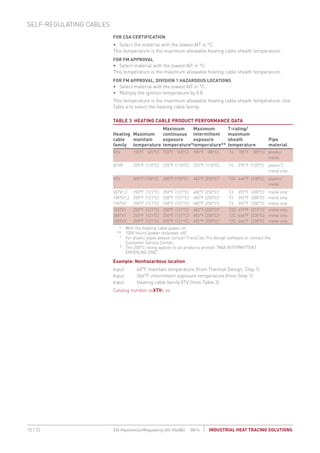
heating cable catalog number
Before beginning, take a moment to understand the structure underlying heating cable
catalog numbers. You will refer to this numbering convention throughout the product
selection process. Your goal is to determine the catalog number for the product that
best suits your needs.
XX XXX X–XX
Outer Jacket
CT = Fluoropolymer
CR= Modified polyolefin (BTV only)
Voltage
1 =120 Volt (100–130 Vac)
2 = 240 Volt (200–277 Vac)
Heating cable family
BTV HBTV
QTVR HQTV
XTV HXTV
KTV
Power output rating (Watts/ft)
Fig. 5 Heating cable catalog number
Note: The data presented here are
nominal and conservative. Additional
engineering analysis at specific
voltages may allow optimization that
could extend circuit lengths and/
or available power output. Consult
Pentair Thermal Management for
more information.
Self-regulating cables
Self-Regulat-
ingCables
Power-Limiting
Cables
MineralInsu-
latedCables
Longline
Heating
RTBTubing
Bundles
TankHeatingSnowandIceControland
Monitoring
Heat-Trace
Panels
Engineered
Products
Steam-Tracing
Systems
TechnicalData
Sheets
Appendixes
9 / 32INDUSTRIAL HEAT TRACING SOLUTIONS EN-RaychemSelfRegulating-DG-H56882 08/14
Heating Cable Selection
1. Gather information
2. Select heating
cable family
3. Select service
voltage
4. Determine power
output rating
5. Select jacket type
Step  Gather the necessary information
To select the heating cable, gather and record the following information:
•	 Pipe size and material	 	
•	 Insulation type and thickness	 	
•	 Maintain temperature (Tm)	 	
•	 Minimum ambient temperature (Ta)	 	
•	 Minimum start-up temperature	 	
•	 Service voltage 	 	
•	 Chemical environment	 	
•	 Maximum intermittent exposure temperature	 	
•	 Electrical area classification	 	
Example: Gather necessary information
•	 Pipe size and material*	 6 inches in diameter, steel
•	 Insulation type and thickness*	 2-1/2 inch, calcium silicate
•	 Maintain temperature (Tm)*	 Water freeze protection at 40°F
•	 Minimum ambient temperature (Ta)*	–40°F
•	 Minimum start-up temperature	 0°F
•	 Service voltage	 120 Vac
•	 Chemical environment	 Organic chemicals
•	 Maximum intermittent exposure temperature**	366°F
•	 Electrical area classification***	 Nonhazardous
	 *	 From Thermal Design, Step 1
	 **	 Determines whether a higher exposure temperature heating cable is needed.
	 ***	 Determines whether special design requirements and connection kits must be used.
Heating Cable Selection
1. Gather information
2. Select heating
cable family
3. Select service
voltage
4. Determine power
output rating
5. Select jacket type
Step  Select the heating cable family
Based on your application’s maintain temperature, pipe material, maximum
exposure temperature, and T-rating, select the appropriate heating cable.
For nonhazardous locations, use Table 3 to select the heating cable family. Base your
selection on your application’s maintain temperature, pipe material, and maximum
intermittent exposure temperature.
For Class I, Division 1 or 2 hazardous locations, also use Table 3 or Table 4, but first
determine the required T-rating for the area.
Temperature identification numbers (T-ratings) are defined by the National Electrical
Code (NFPA 70), Articles 500 and 505; and the Canadian Electrical Code Part I,
Section 18. If the T-rating of the area has been defined, then select a heating cable
from Table 3 or 4 having a T-rating equivalent to or less than the T-rating of this
location (for example, T6 is a lower T-rating than T3).
The purpose of the T-rating is to ensure that electrical equipment does not exceed
the auto-ignition temperatures (AIT) of flammables handled in a hazardous location.
If the T-rating for the area has not been defined, use one of the following methods.
Heating Cable Selection
INDUSTRIAL HEAT TRACING SOLUTIONSEN-RaychemSelfRegulating-DG-H56882 08/1410 / 32
For CSA certification
•	 Select the material with the lowest AIT in °C.
This temperature is the maximum allowable heating cable sheath temperature.
For FM approval
•	 Select material with the lowest AIT in °C.
This temperature is the maximum allowable heating cable sheath temperature.
For FM approval, division 1 hazardous locations
•	 Select material with the lowest AIT in °C.
•	 Multiply the ignition temperature by 0.8.
This temperature is the maximum allowable heating cable sheath temperature. Use
Table 4 to select the heating cable family.
Table 3 Heating Cable Product Performance Data
Heating
cable
family
Maximum
maintain
temperature
Maximum
continuous
exposure
temperature*
Maximum
intermittent
exposure
temperature**
T-rating/
maximum
sheath
temperature
Pipe
material
BTV 150°F	(65°C) 150°F	(65°C) 185°F	(85°C) T6	185°F	(85°C) plastic/
metal
QTVR 225°F	(110°C) 225°F	(110°C) 225°F	(110°C) T4	 275°F (135°C) plastic1/
metal only
KTV 300°F (150°C) 300°F (150°C) 482°F (250°C)2
T2C	446°F	(230°C) plastic/
metal
5XTV1,2
10XTV1,2
15XTV2
250°F	(121°C)
250°F	(121°C)
250°F	(121°C)
250°F	(121°C)
250°F	(121°C)
250°F	(121°C)
482°F (250°C)2
482°F (250°C)2
482°F (250°C)2
T3	 392°F	(200°C)
T3	 392°F	(200°C)
T3	 392°F	(200°C)
metal only
metal only
metal only
15XTV1
20XTV1
20XTV2
250°F	(121°C)
250°F	(121°C)
250°F	(121°C)
250°F	(121°C)
250°F	(121°C)
250°F	(121°C)
482°F (250°C)2
482°F (250°C)2
482°F (250°C)2
T2D	419°F	(215°C)
T2C	446°F	(230°C)
T2C	446°F	(230°C)
metal only
metal only
metal only
	 *	 With the heating cable power on
	 **	 1000 hours (power on/power off)
	 1	 For plastic pipes please consult TraceCalc Pro design software or contact the
Customer Service Center.
2	 The 250°C rating applies to all products printed “MAX INTERMITTENT
EXPOSURE 250C”
Example: Nonhazardous location
Input	 40°F maintain temperature (from Thermal Design, Step 1)
Input	 366°F intermittent exposure temperature (from Step 1)
Input	 Heating cable family XTV (from Table 3)
Catalog number xxXTVx-xx
Self-regulating cables
Self-Regulat-
ingCables
Power-Limiting
Cables
MineralInsu-
latedCables
Longline
Heating
RTBTubing
Bundles
TankHeatingSnowandIceControland
Monitoring
Heat-Trace
Panels
Engineered
Products
Steam-Tracing
Systems
TechnicalData
Sheets
Appendixes
11 / 32INDUSTRIAL HEAT TRACING SOLUTIONS EN-RaychemSelfRegulating-DG-H56882 08/14
Table 4 Heating Cable Product Performance Data
(FM-CID1 Hazardous Locations)
Heating
cable
family
Maximum
maintain
temperature
Maximum
continuous
exposure
temperature*
Maximum
intermittent
exposure
temperature**
T-rating/
maximum
sheath
temperature
Pipe
material
HBTV-CT 150°F	(65°C) 150°F	(65°C) 185°F	(85°C) T6	 185°F (85°C) plastic/
metal
HQTV-CT 225°F	(110°C) 225°F	(110°C) 225°F	(110°C) T4	 275°F (135°C) plastic1/
metal only
5HXTV1,2-CT
10HXTV1,2-CT
15HXTV2-CT
250°F	(121°C)
250°F	(121°C)
250°F	(121°C)
250°F	(121°C)
250°F	(121°C)
250°F	(121°C)
482°F (250°C)2
482°F (250°C)2
482°F (250°C)2
T3	 392°F (200°C)
T3	 392°F (200°C)
T3	 392°F (200°C)
metal only
metal only
metal only
15HXTV1-CT
20HXTV1-CT
20HXTV2-CT
250°F	(121°C)
250°F	(121°C)
250°F	(121°C)
250°F	(121°C)
250°F	(121°C)
250°F	(121°C)
482°F (250°C)2
482°F (250°C)2
482°F (250°C)2
T2D	419°F (215°C)
T2C	446°F (230°C)
T2C	446°F (230°C)
metal only
metal only
metal only
	 *	 With the heating cable power on
	 **	 1000 hours (power on/power off)
	 1	 For plastic pipes please consult TraceCalc Pro design software or contact the
Customer Service Center.
2 The 250°C rating applies to all products printed “MAX INTERMITTENT
EXPOSURE 250C”
Example: CID1 hazardous location
For the same inputs, the heating cable family is HXTV from Table 4 on page 11.
For FM Approved systems in CID1 hazardous locations
Due to the potentially hazardous nature of Division 1 locations, the requirements
below must be followed at all times.
•	 Use only Raychem brand HBTV-CT, HQTV-CT, and HXTV-CT heating cables and
HAK-C-100 connection kits specifically approved by FM.
•	 Complete and send the field information form found in the Approval for Class I,
Division 1 Hazardous Locations in USA form (H56987), available on
www.pentairthermal.com, to the Pentair Thermal Management Customer Ser-
vice Center — phone (800) 545-6258, fax (800) 527-5703 — for design verification.
•	 Be sure the installer completes and returns the Required Installation Record for
Class I, Division 1 Hazardous Locations in USA form (H57426), available on
www.pentairthermal.com, or the one in the back of the installation manual
shipped with the product.
For CSA Certified systems in CID1 hazardous locations
Due to the potentially hazardous nature of Division 1 locations, use only Raychem
brand BTV-CT, QTVR-CT, KTV-CT and XTV-CT heating cables and HAK-C-100
connection kits specifically certified by CSA.
Heating Cable Selection
1. Gather information
2. Select heating
cable family
3. Select service
voltage
4. Determine power
output rating
5. Select jacket type
Step  Select the service voltage
Service voltage options:	 1 = 120 volts (100–130 Vac)
	 2 = 240 volts (200–277 Vac)
Example: Service voltage selection
Input	 XTV heating cable (from Step 2)
Input 	 120 volts (from Step 1)
Voltage option	 1
Catalog number 	 xXTV1-xx
Heating Cable Selection
INDUSTRIAL HEAT TRACING SOLUTIONSEN-RaychemSelfRegulating-DG-H56882 08/1412 / 32
Heating Cable Selection
1. Gather information
2. Select heating
cable family
3. Select service
voltage
4. Determine power
output rating
5. Select jacket type
Step  Determine the heating cable power output rating
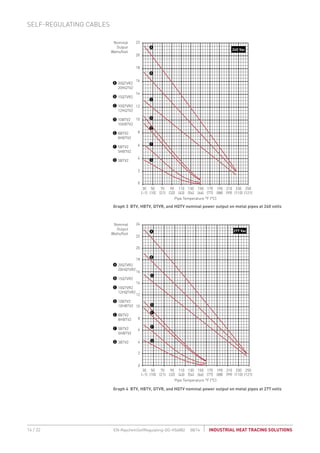
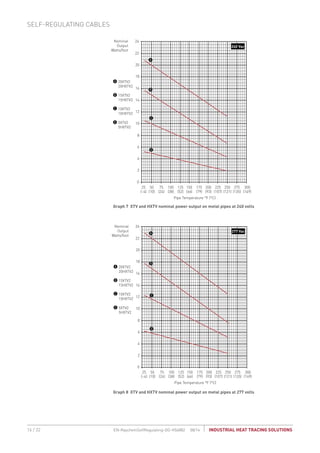
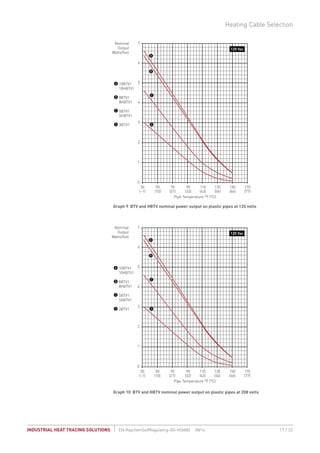
To select the heating cable power output, use Table 5 to determine the appropriate
power output graph based on the heating cable family and voltage already
determined.
Table 5 Heating Cable Power Output Graph Selection
Pipe material Heating cable Voltage Graph number
Metal pipe BTV, QTVR, HBTV,
HQTV
	120
	208
	240
	277
	1
	2
	3
	4
Metal pipe KTV, XTV and HXTV 	120
	208
	240
	277
	5
	6
	7
	8
Plastic pipe* BTV and HBTV 	120
	208
	240
	277
	9
	10
	11
	12
* Graphs assume the use of aluminum tape over the heating cable.
Using the selected graph, locate the heating cable with thermal output greater than
the heat loss (Qt) at the pipe maintenance temperature (Tm).
If the pipe heat loss, Qt, is between the two heating cable power output curves, select
the higher-rated heating cable. If Qt is greater than the power output of the highest-
rated heating cable, you can:
•	 Use two or more heating cables run in parallel.
•	 Spiral the heating cable.
•	 Use thicker insulation to reduce heat loss.
•	 Use insulation material with a lower k factor.
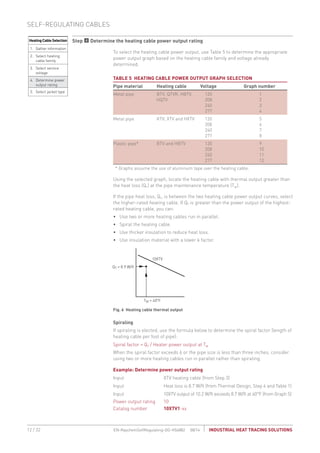
10XTV
TM = 40°F
QT = 8.9 W/ft
Fig. 6 Heating cable thermal output
Spiraling
If spiraling is elected, use the formula below to determine the spiral factor (length of
heating cable per foot of pipe):
Spiral factor = Qt / Heater power output at Tm
When the spiral factor exceeds 6 or the pipe size is less than three inches, consider
using two or more heating cables run in parallel rather than spiraling.
Example: Determine power output rating
Input	 XTV heating cable (from Step 3)
Input	 Heat loss is 8.7 W/ft (from Thermal Design, Step 4 and Table 1)
Input	 10XTV output of 10.2 W/ft exceeds 8.7 W/ft at 40°F (from Graph 5)
Power output rating	 10
Catalog number 	 10XTV1-xx
Self-regulating cables
Self-Regulat-
ingCables
Power-Limiting
Cables
MineralInsu-
latedCables
Longline
Heating
RTBTubing
Bundles
TankHeatingSnowandIceControland
Monitoring
Heat-Trace
Panels
Engineered
Products
Steam-Tracing
Systems
TechnicalData
Sheets
Appendixes
13 / 32INDUSTRIAL HEAT TRACING SOLUTIONS EN-RaychemSelfRegulating-DG-H56882 08/14
30
(–1)
0
2
4
6
8
10
12
14
16
18
20QTVR1
20HQTV1
15QTVR1
10QTVR1
12HQTV1
10BTV1
10HBTV1
8BTV1
8HBTV1
5BTV1
5HBTV1
3BTV1
20
22Nominal
Output
Watts/foot
50
(10)
70
(21)
90
(32)
110
(43)
130
(54)
150
(66)
170
(77)
Pipe Temperature °F (°C)
190
(88)
210
(99)
230
(110)
250
(121)














120 Vac
Graph 1 BTV, HBTV, QTVR, and HQTV nominal power output on metal pipes at 120 volts
0
2
4
6
8
10
12
14
16
18
20QTVR2
20HQTV2
15QTVR2
10QTVR2
12HQTV2
10BTV2
10HBTV2
8BTV2
8HBTV2
5BTV2
5HBTV2
3BTV2
20
22Nominal
Output
Watts/foot














208 Vac
30
(–1)
50
(10)
70
(21)
90
(32)
110
(43)
130
(54)
150
(66)
170
(77)
Pipe Temperature °F (°C)
190
(88)
210
(99)
230
(110)
250
(121)
Graph 2 BTV, HBTV, QTVR, and HQTV nominal power output on metal pipes at 208 volts
Heating Cable Selection
INDUSTRIAL HEAT TRACING SOLUTIONSEN-RaychemSelfRegulating-DG-H56882 08/1414 / 32
0
2
4
6
8
10
12
14
16
18
20QTVR2
20HQTV2
15QTVR2
10QTVR2
12HQTV2
10BTV2
10HBTV2
8BTV2
8HBTV2
5BTV2
5HBTV2
3BTV2
20
22Nominal
Output
Watts/foot














240 Vac
30
(–1)
50
(10)
70
(21)
90
(32)
110
(43)
130
(54)
150
(66)
170
(77)
Pipe Temperature °F (°C)
190
(88)
210
(99)
230
(110)
250
(121)
Graph 3 BTV, HBTV, QTVR, and HQTV nominal power output on metal pipes at 240 volts
0
2
4
6
8
10
12
14
16
18
20QTVR2
20HQTVR2
15QTVR2
10QTVR2
12HQTVR2
10BTV2
10HBTV2
8BTV2
8HBTV2
5BTV2
5HBTV2
3BTV2
20
22
24Nominal
Output
Watts/foot













277 Vac
30
(–1)
50
(10)
70
(21)
90
(32)
110
(43)
130
(54)
150
(66)
170
(77)
Pipe Temperature °F (°C)
190
(88)
210
(99)
230
(110)
250
(121)

Graph 4 BTV, HBTV, QTVR, and HQTV nominal power output on metal pipes at 277 volts
Self-regulating cables
Self-Regulat-
ingCables
Power-Limiting
Cables
MineralInsu-
latedCables
Longline
Heating
RTBTubing
Bundles
TankHeatingSnowandIceControland
Monitoring
Heat-Trace
Panels
Engineered
Products
Steam-Tracing
Systems
TechnicalData
Sheets
Appendixes
15 / 32INDUSTRIAL HEAT TRACING SOLUTIONS EN-RaychemSelfRegulating-DG-H56882 08/14
25
(–4)
0
5
10
15
20
20XTV1
20HXTV1
15XTV1
15HXTV1
10XTV1
10HXTV1
5XTV1
5HXTV1
25Nominal
Output
Watts/foot
50
(10)
75
(24)
100
(38)
125
(52)
150
(66)
175
(79)
200
(93)
225
(107)
250
(121)
275
(135)
300
(149)
Pipe Temperature °F (°C)








120 Vac
Graph 5 XTV and HXTV nominal power output on metal pipes at 120 volts
0
4
6
2
8
10
12
14
16
18
20XTV2
20HXTV2
20KTV-CT
15KTV-CT
15XTV2
15HXTV2
10XTV2
10HXTV2
8KTV-CT
5KTV-CT
5XTV2
5HXTV2
20Nominal
Output
Watts/foot











208 Vac
25
(–4)
50
(10)
75
(24)
100
(38)
125
(52)
150
(66)
175
(79)
200
(93)
225
(107)
250
(121)
275
(135)
300
(149)
Pipe Temperature °F (°C)





Graph 6 XTV and HXTV nominal power output on metal pipes at 208 volts
Heating Cable Selection
INDUSTRIAL HEAT TRACING SOLUTIONSEN-RaychemSelfRegulating-DG-H56882 08/1416 / 32
0
4
2
10
8
6
14
12
20
18
16
24
22
Nominal
Output
Watts/foot
20XTV2
20HXTV2
15XTV2
15HXTV2
10XTV2
10HXTV2
5XTV2
5HXTV2








240 Vac
25
(–4)
50
(10)
75
(24)
100
(38)
125
(52)
150
(66)
175
(79)
200
(93)
225
(107)
250
(121)
275
(135)
300
(149)
Pipe Temperature °F (°C)
Graph 7 XTV and HXTV nominal power output on metal pipes at 240 volts
0
4
2
10
8
6
14
12
20
18
16
24
22
Nominal
Output
Watts/foot
20XTV2
20HXTV2
15XTV2
15HXTV2
10XTV2
10HXTV2
5XTV2
5HXTV2








277 Vac
25
(–4)
50
(10)
75
(24)
100
(38)
125
(52)
150
(66)
175
(79)
200
(93)
225
(107)
250
(121)
275
(135)
300
(149)
Pipe Temperature °F (°C)
Graph 8 XTV and HXTV nominal power output on metal pipes at 277 volts
Self-regulating cables
Self-Regulat-
ingCables
Power-Limiting
Cables
MineralInsu-
latedCables
Longline
Heating
RTBTubing
Bundles
TankHeatingSnowandIceControland
Monitoring
Heat-Trace
Panels
Engineered
Products
Steam-Tracing
Systems
TechnicalData
Sheets
Appendixes
17 / 32INDUSTRIAL HEAT TRACING SOLUTIONS EN-RaychemSelfRegulating-DG-H56882 08/14
30
(–1)
0
1
2
3
4
5
6
7Nominal
Output
Watts/foot
50
(10)
70
(21)
90
(32)
110
(43)
170
(77)
130
(54)
150
(66)
Pipe Temperature °F (°C)

10BTV1
10HBTV1
8BTV1
8HBTV1
5BTV1
5HBTV1
3BTV1




120 Vac




Graph 9 BTV and HBTV nominal power output on plastic pipes at 120 volts
30
(–1)
0
1
2
3
4
5
6
7Nominal
Output
Watts/foot
50
(10)
70
(21)
90
(32)
110
(43)
170
(77)
130
(54)
150
(66)
Pipe Temperature °F (°C)

10BTV1
10HBTV1
8BTV1
8HBTV1
5BTV1
5HBTV1
3BTV1




120 Vac




Graph 10 BTV and HBTV nominal power output on plastic pipes at 208 volts
Heating Cable Selection
INDUSTRIAL HEAT TRACING SOLUTIONSEN-RaychemSelfRegulating-DG-H56882 08/1418 / 32
0
1
2
3
4
5
6
7
8Nominal
Output
Watts/foot
10BTV2
10HBTV2
8BTV2
8HBTV2
5BTV2
5HBTV2
3BTV2








240 Vac
30
(–1)
50
(10)
70
(21)
90
(32)
110
(43)
170
(77)
130
(54)
150
(66)
Pipe Temperature °F (°C)
Graph 11 BTV and HBTV nominal power output on plastic pipes at 240 volts
0
1
2
3
4
5
6
7
8
9Nominal
Output
Watts/foot
10BTV2
10HBTV2
8BTV2
8HBTV2
5BTV2
5HBTV2
3BTV2




277 Vac




30
(–1)
50
(10)
70
(21)
90
(32)
110
(43)
170
(77)
130
(54)
150
(66)
Pipe Temperature °F (°C)
Graph 12 BTV and HBTV nominal power output on plastic pipes at 277 volts
Self-regulating cables
Self-Regulat-
ingCables
Power-Limiting
Cables
MineralInsu-
latedCables
Longline
Heating
RTBTubing
Bundles
TankHeatingSnowandIceControland
Monitoring
Heat-Trace
Panels
Engineered
Products
Steam-Tracing
Systems
TechnicalData
Sheets
Appendixes
19 / 32INDUSTRIAL HEAT TRACING SOLUTIONS EN-RaychemSelfRegulating-DG-H56882 08/14
Heating Cable Selection
1. Gather information
2. Select heating
cable family
3. Select service
voltage
4. Determine power
output rating
5. Select jacket type
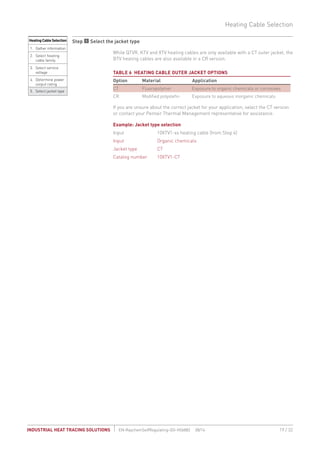
Step  Select the jacket type
While QTVR, KTV and XTV heating cables are only available with a CT outer jacket, the
BTV heating cables are also available in a CR version.
Table 6 Heating Cable Outer Jacket Options
Option Material Application
CT Fluoropolymer Exposure to organic chemicals or corrosives
CR Modified polyolefin Exposure to aqueous inorganic chemicals
If you are unsure about the correct jacket for your application, select the CT version
or contact your Pentair Thermal Management representative for assistance.
Example: Jacket type selection
Input	 10XTV1-xx heating cable (from Step 4)
Input	 Organic chemicals
Jacket type	 CT
Catalog number	 10XTV1-CT
Heating Cable Selection
INDUSTRIAL HEAT TRACING SOLUTIONSEN-RaychemSelfRegulating-DG-H56882 08/1420 / 32
Bill of Materials
Now that you have selected the correct heating cable for your application, this
section helps you to determine:
•	 Total length of heating cable required
•	 Electrical design, including circuit breaker sizing and selection
•	 Quantity and type of connection kits and accessories
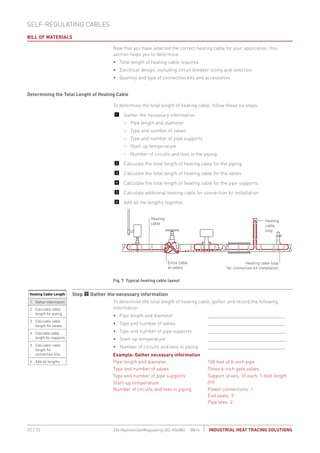
Determining the Total Length of Heating Cable
To determine the total length of heating cable, follow these six steps:
1	Gather the necessary information:
–– Pipe length and diameter
–– Type and number of valves
–– Type and number of pipe supports
–– Start-up temperature
–– Number of circuits and tees in the piping
2	Calculate the total length of heating cable for the piping.
3	Calculate the total length of heating cable for the valves.
4	Calculate the total length of heating cable for the pipe supports.
5	Calculate additional heating cable for connection kit installation.
6	Add all the lengths together.
Heating
cable
Extra cable
at valves
Heating
cable
loop
Heating cable loop
for connection kit installation
Fig. 7 Typical heating cable layout
Heating Cable Length
1. Gather information
6. Add all lengths
2. Calculate cable
length for piping
3. Calculate cable
length for valves
4. Calculate cable
length for supports
5. Calculate cable
length for
connection kits
Step  Gather the necessary information
To determine the total length of heating cable, gather and record the following
information:
•	 Pipe length and diameter	 	
•	 Type and number of valves	 	
•	 Type and number of pipe supports	 	
•	 Start-up temperature	 	
•	 Number of circuits and tees in piping	 	
Example: Gather necessary information
Pipe length and diameter	 100 feet of 6-inch pipe
Type and number of valves	 Three 6-inch gate valves
Type and number of pipe supports	 Support shoes, 10 each, 1-foot length
Start-up temperature	 0°F
Number of circuits and tees in piping	 Power connections: 1
	 End seals: 3
	 Pipe tees: 2
Self-regulating cables
Self-Regulat-
ingCables
Power-Limiting
Cables
MineralInsu-
latedCables
Longline
Heating
RTBTubing
Bundles
TankHeatingSnowandIceControland
Monitoring
Heat-Trace
Panels
Engineered
Products
Steam-Tracing
Systems
TechnicalData
Sheets
Appendixes
21 / 32INDUSTRIAL HEAT TRACING SOLUTIONS EN-RaychemSelfRegulating-DG-H56882 08/14
Heating Cable Length
1. Gather information
6. Add all lengths
2. Calculate cable
length for piping
3. Calculate cable
length for valves
4. Calculate cable
length for supports
5. Calculate cable
length for
connection kits
Step  Calculate the total length of heating cable for the piping
Example: Total length of cable for piping calculation
100 ft of pipe (from Step 1) = 100 ft of cable for single tracing
Heating Cable Length
1. Gather information
6. Add all lengths
2. Calculate cable
length for piping
3. Calculate cable
length for valves
4. Calculate cable
length for supports
5. Calculate cable
length for
connection kits
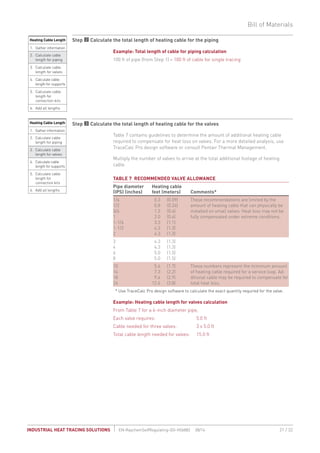
Step  Calculate the total length of heating cable for the valves
Table 7 contains guidelines to determine the amount of additional heating cable
required to compensate for heat loss on valves. For a more detailed analysis, use
TraceCalc Pro design software or consult Pentair Thermal Management.
Multiply the number of valves to arrive at the total additional footage of heating
cable.
Table 7 Recommended Valve Allowance
Pipe diameter
(IPS) (inches)
Heating cable
feet (meters) Comments*
1/4
1/2
3/4
1
1-1/4
1-1/2
2
	0.3	 (0.09)
	0.8	 (0.24)
	1.3	 (0.4)
	2.0	 (0.6)
	3.3	 (1.1)
	4.3	 (1.3)
	4.3	 (1.3)
These recommendations are limited by the
amount of heating cable that can physically be
installed on small valves. Heat loss may not be
fully compensated under extreme conditions.
3
4
6
8
	4.3	 (1.3)
	4.3	 (1.3)
	5.0	 (1.5)
	5.0	 (1.5)
10
14
18
24
	5.6	 (1.7)
	7.3	 (2.2)
	9.4	 (2.9)
	12.6	 (3.8)
These numbers represent the minimum amount
of heating cable required for a service loop. Ad-
ditional cable may be required to compensate for
total heat loss.
* Use TraceCalc Pro design software to calculate the exact quantity required for the valve.
Example: Heating cable length for valves calculation
From Table 7 for a 6-inch diameter pipe,
Each valve requires:	 5.0 ft
Cable needed for three valves: 	 3 x 5.0 ft
Total cable length needed for valves:	 15.0 ft
Bill of Materials
INDUSTRIAL HEAT TRACING SOLUTIONSEN-RaychemSelfRegulating-DG-H56882 08/1422 / 32
Heating Cable Length
1. Gather information
6. Add all lengths
2. Calculate cable
length for piping
3. Calculate cable
length for valves
4. Calculate cable
length for supports
5. Calculate cable
length for
connection kits
Step  Calculate the total length of heating cable for the pipe supports
Support Shoes
For each pipe support shoe, calculate the additional heating cable required as
follows:
Determine the heat loss for one support.
•	 Formula:	 Qsupport = 0.7L x (Tm – Ta), where L = Support length (ft)
(assumes a 0.25-inch steel welded shoe partially shielded from winds)
•	 Multiply that heat loss by the total number of supports.
•	 Add 10 percent to the total heat loss for added safety.
•	 Obtain the heating cable power output per foot from Graph 5.
•	 Divide the total support heat loss by the heating cable power output per foot to
get the number of feet of heating cable needed.
Example: Total length of cable for pipe supports calculation
Input	 10XTV1-CT heating cable (from Cable Selection, Step 5)
Input	 10 one-foot welded steel shoe supports (from Step 1)
Heat loss for one support	 0.7 x 1 x (40–(–40)) = 56 W
Heat loss for all supports	 10 x 56 W = 560 W
Add safety factor	 560 W + 10% = 616 W
Heating cable power output	 10.2 W/ft (from Step 3 of Cable Selection)
Heating cable required	 616 W/10.2 W/ft = 60 ft of heating cable
Heating Cable Length
1. Gather information
6. Add all lengths
2. Calculate cable
length for piping
3. Calculate cable
length for valves
4. Calculate cable
length for supports
5. Calculate cable
length for
connection kits
Step  Calculate additional heating cable for connection kit installation
Estimate the number of power connections, tees, and splices for the system. Allow
an additional three feet for each connection kit.
Example: Include additional cable
Input	 1 power connection, 3 end seals, 2 tees
	 (from Step 1)
Total number of connection kits	 6 (from Step 1)
Cable needed for 6 connection kits 	 6 x 3 ft of additional cable
Total cable length for 6 connection kits 	 18 ft of cable
Heating Cable Length
1. Gather information
6. Add all lengths
2. Calculate cable
length for piping
3. Calculate cable
length for valves
4. Calculate cable
length for supports
5. Calculate cable
length for
connection kits
Step  Add all lengths together
Example: Final addition
Cable for piping	 100 ft (from Step 1)
Cable for valves	 15 ft (from Step 3)
Cable for supports	 60 ft (from Step 4)
Cable for connection kits	 18 ft (from Step 5)
Sum of all lengths	 100 + 15 + 60 + 18 = 193 ft
Total length of heating cable 	 193 ft
Now that you have the total length of heating cable, you can determine the number
of electrical circuits you will need.
Self-regulating cables
Self-Regulat-
ingCables
Power-Limiting
Cables
MineralInsu-
latedCables
Longline
Heating
RTBTubing
Bundles
TankHeatingSnowandIceControland
Monitoring
Heat-Trace
Panels
Engineered
Products
Steam-Tracing
Systems
TechnicalData
Sheets
Appendixes
23 / 32INDUSTRIAL HEAT TRACING SOLUTIONS EN-RaychemSelfRegulating-DG-H56882 08/14
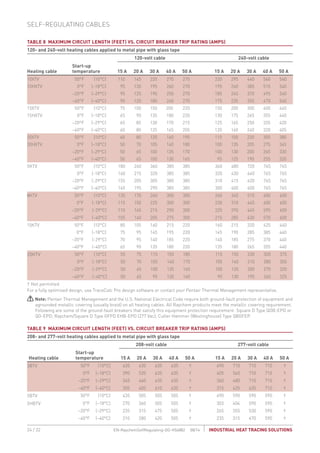
Electrical Design
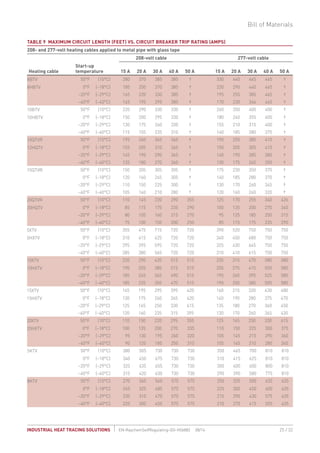
Determining maximum length of heating cable on one circuit breaker
Using Table 8 and Table 9, match the heating cable catalog number at the expected
minimum start-up temperature with the total heating cable length and select a
circuit breaker trip rating. The circuit breaker trip rating should not exceed the
maximum trip rating shown for heating cables of that product family. For example,
the trip rating of a circuit breaker protecting several 10XTV circuits should not
exceed 50 amps. To maximize fault current protection, use the lowest allowable
circuit breaker.
Maximum circuit length per breaker depends on four factors:
1.	 Heating cable family and catalog number
2.	 Minimum start-up temperature
3.	 Service voltage
4.	 Circuit breaker trip rating
Table 8 Maximum Circuit Length (feet) vs. Circuit Breaker Trip Rating (Amps)
120- and 240-volt heating cables applied to metal pipe with glass tape
120-volt cable 240-volt cable
Heating cable
Start-up
temperature 15 A 20 A 30 A 40 A 50 A 15 A 20 A 30 A 40 A 50 A
3BTV 	50°F	 (10°C) 	330 	330 	330 	330 	† 	660 	660 	660 	660 	†
	0°F	 (–18°C) 	200 	265 	330 	330 	† 	395 	530 	660 	660 	†
	–20°F	 (–29°C) 	175 	235 	330 	330 	† 	350 	465 	660 	660 	†
	–40°F	 (–40°C) 	155 	205 	310 	330 	† 	310 	410 	620 	660 	†
5BTV 	50°F	 (10°C) 	230 	270 	270 	270 	† 	460 	540 	540 	540 	†
5HBTV 	0°F	 (–18°C) 	140 	190 	270 	270 	† 	285 	380 	540 	540 	†
	–20°F	 (–29°C) 	125 	165 	250 	270 	† 	250 	330 	500 	540 	†
	–40°F	 (–40°C) 	110 	145 	220 	270 	† 	220 	295 	440 	540 	†
8BTV 	50°F	 (10°C) 	150 	200 	210 	210 	† 	300 	400 	420 	420 	†
8HBTV 	0°F	 (–18°C) 	100 	130 	200 	210 	† 	200 	265 	400 	420 	†
	–20°F	 (–29°C) 	85 	115 	175 	210 	† 	175 	235 	350 	420 	†
	–40°F	 (–40°C) 	80 	105 	155 	210 	† 	155 	210 	315 	420 	†
10BTV 	50°F	 (10°C) 	120 	160 	180 	180 	† 	240 	315 	360 	360 	†
10HBTV 	0°F	 (–18°C) 	80 	110 	160 	180 	† 	160 	215 	325 	360 	†
	–20°F	 (–29°C) 	70 	95 	140 	180 	† 	145 	190 	285 	360 	†
	–40°F	 (–40°C) 	65 	85 	125 	170 	† 	125 	170 	255 	340 	†
10QTVR 	50°F	 (10°C) 	100 	130 	195 	195 	† 	200 	265 	390 	390 	†
12HQTV 	0°F	 (–18°C) 	80 	105 	160 	195 	† 	160 	210 	320 	390 	†
	–20°F	 (–29°C) 	70 	95 	145 	195 	† 	145 	195 	295 	390 	†
	–40°F	 (–40°C) 	65 	90 	135 	180 	† 	135 	180 	275 	365 	†
15QTVR 	50°F	 (10°C) 	75 	100 	150 	200 	220 	160 	210 	320 	340 	†
	0°F	 (–18°C) 	60 	80 	120 	160 	200 	125 	170 	255 	340 	†
	–20°F	 (–29°C) 	55 	70 	110 	145 	185 	115 	155 	235 	315 	†
	–40°F	 (–40°C) 	50 	65 	100 	135 	170 	110 	145 	220 	290 	†
20QTVR 	50°F	 (10°C) 	60 	80 	120 	160 	195 	120 	160 	240 	320 	390
20HQTV 	0°F	 (–18°C) 	45 	60 	95 	125 	160 	95 	125 	190 	255 	320
	–20°F	 (–29°C) 	40 	55 	85 	115 	145 	85 	115 	175 	235 	295
	–40°F	 (–40°C) 	40 	55 	80 	110 	135 	80 	110 	165 	220 	275
5XTV 	50°F	 (10°C) 	180 	240 	360 	385 	385 	360 	480 	720 	765 	765
5HXTV 	0°F	 (–18°C) 	160 	210 	320 	385 	385 	315 	420 	625 	765 	765
	–20°F	 (–29°C) 	150 	200 	305 	385 	385 	295 	395 	595 	765 	765
	–40°F	 (–40°C) 	145 	195 	290 	385 	385 	285 	380 	570 	760 	765
WARNING: Fire hazard
There is a danger of fire from
sustained electrical arcing if the
heating cable is damaged or
improperly installed. To comply
with Pentair Thermal Management
requirements, certifications, and
national electrical codes, and to
protect against the risk of fire,
ground-fault equipment protection
must be used on each heating
cable circuit. Arcing may not be
stopped by conventional circuit
breakers.
Bill of Materials
INDUSTRIAL HEAT TRACING SOLUTIONSEN-RaychemSelfRegulating-DG-H56882 08/1424 / 32
Table 8 Maximum Circuit Length (feet) vs. Circuit Breaker Trip Rating (Amps)
120- and 240-volt heating cables applied to metal pipe with glass tape
120-volt cable 240-volt cable
Heating cable
Start-up
temperature 15 A 20 A 30 A 40 A 50 A 15 A 20 A 30 A 40 A 50 A
10XTV 	50°F	 (10°C) 	110 	145 	220 	270 	270 	220 	295 	440 	540 	540
10HXTV 	0°F	 (–18°C) 	95 	130 	195 	260 	270 	195 	260 	385 	515 	540
	–20°F	 (–29°C) 	95 	125 	190 	250 	270 	185 	245 	370 	495 	540
	–40°F	 (–40°C) 	90 	120 	180 	240 	270 	175 	235 	355 	470 	540
15XTV 	50°F	 (10°C) 	75 	100 	150 200 	220 	150 	200 	300 	400 	445
15HXTV 	0°F	 (–18°C) 	65 	90 	135 	180 	220 	130 	175 	265 	355 	440
	–20°F	 (–29°C) 	65 	85 	130 	170 	215 	125 	165 	250 	335 	420
	–40°F	 (–40°C) 	60 	80 	125 	165 	205 	120 	160 	240 	320 	405
20XTV 	50°F	 (10°C) 	60 	80 	120 	160 	190 	115 	150 	230 	305 	380
20HXTV 	0°F	 (–18°C) 	50 	70 	105 	140 	180 	100 	135 	205 	275 	345
	–20°F	 (–29°C) 	50 	65 	100 	135 	170 	100 	130 	200 	265 	330
	–40°F	 (–40°C) 	50 	65 	100 	130 	165 	95 	125 	190 	255 	320
5KTV 	50°F	 (10°C) 180 240 360 385 385 360 480 720 765 765
	0°F	 (-18°C) 160 215 320 385 385 320 430 640 765 765
	–20°F	 (-29°C) 155 205 305 385 385 310 415 620 765 765
–40°F (–40°C) 145 195 290 385 385 300 400 600 765 765
8KTV 50°F (10°C) 130 170 260 300 300 260 345 515 600 600
0°F (-18°C) 115 150 225 300 300 230 310 465 600 600
–20°F (-29°C) 110 145 215 290 300 225 295 445 595 600
–40°F (–40°C) 105 140 205 275 300 215 285 430 570 600
15KTV 50°F (10°C) 80 105 160 215 220 160 215 320 425 440
0°F (-18°C) 75 95 145 195 220 145 190 285 385 440
–20°F (-29°C) 70 95 140 185 220 140 185 275 370 440
–40°F (–40°C) 65 90 135 180 220 135 180 265 355 440
20KTV 50°F (10°C) 55 75 115 155 185 115 155 230 305 375
0°F (-18°C) 50 70 105 140 175 105 140 210 280 350
–20°F (-29°C) 50 65 100 135 165 100 135 200 270 335
–40°F (–40°C) 50 65 95 130 160 95 130 195 260 325
† Not permitted
For a fully optimized design, use TraceCalc Pro design software or contact your Pentair Thermal Management representative.
Note: Pentair Thermal Management and the U.S. National Electrical Code require both ground-fault protection of equipment and
agrounded metallic covering (usually braid) on all heating cables. All Raychem products meet the metallic covering requirement.
Following are some of the ground-fault breakers that satisfy this equipment protection requirement: Square D Type QOB-EPD or
QO-EPD; Raychem/Square D Type GFPD EHB-EPD (277 Vac); Cutler Hammer (Westinghouse) Type QBGFEP.
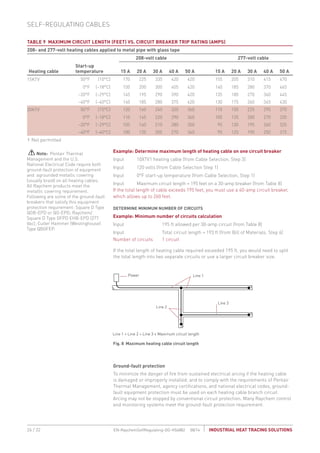
Table 9 Maximum Circuit Length (feet) vs. Circuit Breaker Trip Rating (Amps)
208- and 277-volt heating cables applied to metal pipe with glass tape
208-volt cable 277-volt cable
Heating cable
Start-up
temperature 15 A 20 A 30 A 40 A 50 A 15 A 20 A 30 A 40 A 50 A
3BTV 	50°F	 (10°C) 	635 	635 	635 	635 	† 	690 	710 	710 	710 	†
	 0°F	(–18°C) 	390 	520 	635 	635 	† 	405 	540 	710 	710 	†
	–20°F	 (–29°C) 	345 	460 	635 	635 	† 	360 	480 	710 	710 	†
	–40°F	 (–40°C) 	305 	405 	610 	635 	† 	315 	425 	635 	710 	†
5BTV 	50°F	 (10°C) 	435 	505 	505 	505 	† 	490 	590 	590 	590 	†
5HBTV 	 0°F	(–18°C) 	270 	360 	505 	505 	† 	303 	404 	590 	590 	†
	–20°F	 (–29°C) 	235 	315 	475 	505 	† 	265 	355 	530 	590 	†
	–40°F	 (–40°C) 	210 	280 	420 	505 	† 	235 	315 	470 	590 	†
Self-regulating cables
Self-Regulat-
ingCables
Power-Limiting
Cables
MineralInsu-
latedCables
Longline
Heating
RTBTubing
Bundles
TankHeatingSnowandIceControland
Monitoring
Heat-Trace
Panels
Engineered
Products
Steam-Tracing
Systems
TechnicalData
Sheets
Appendixes
25 / 32INDUSTRIAL HEAT TRACING SOLUTIONS EN-RaychemSelfRegulating-DG-H56882 08/14
Table 9 Maximum Circuit Length (feet) vs. Circuit Breaker Trip Rating (Amps)
208- and 277-volt heating cables applied to metal pipe with glass tape
208-volt cable 277-volt cable
Heating cable
Start-up
temperature 15 A 20 A 30 A 40 A 50 A 15 A 20 A 30 A 40 A 50 A
8BTV 	50°F	 (10°C) 	280 	370 	385 	385 	† 	330 	440 	465 	465 	†
8HBTV 	 0°F	(–18°C) 	185 	250 	370 	385 	† 	220 	290 	440 	465 	†
	–20°F	 (–29°C) 	165 	220 	330 	385 	† 	195 	255 	385 	465 	†
	–40°F	 (–40°C) 	145 	195 	295 	385 	† 	170 	230 	346 	460 	†
10BTV 	50°F	 (10°C) 	220 	290 	330 	330 	† 	260 	350 	400 	400 	†
10HBTV 	 0°F	(–18°C) 	150 	200 	295 	330 	† 	180 	240 	355 	400 	†
	–20°F	 (–29°C) 	130 	175 	260 	330 	† 	155 	210 	315 	400 	†
	–40°F	 (–40°C) 	115 	155 	235 	310 	† 	140 	185 	280 	375 	†
10QTVR 	50°F	 (10°C) 	195 	260 	365 	365 	† 	190 	255 	385 	410 	†
12HQTV 	 0°F	(–18°C) 	155 	205 	310 	365 	† 	150 	205 	305 	410 	†
	–20°F	 (–29°C) 	145 	190 	290 	365 	† 	140 	190 	285 	380 	†
	–40°F	 (–40°C) 	135 	180 	270 	360 	† 	130 	175 	265 	350 	†
15QTVR 	50°F	 (10°C) 	150 	205 	305 	305 	† 	175 	230 	350 	370 	†
	 0°F	(–18°C) 	120 	160 	245 	305 	† 	140 	185 	280 	370 	†
	–20°F	 (–29°C) 	110 	150 	225 	300 	† 	130 	170 	260 	345 	†
	–40°F	 (–40°C) 	105 	140 	210 	280 	† 	120 	160 	240 	320 	†
20QTVR 	50°F	 (10°C) 	110 	145 	220 	290 	355 	125 	170 	255 	340 	426
20HQTV 	 0°F	(–18°C) 	85 	115 	175 	235 	290 	100 	135 	200 	270 	340
	–20°F	 (–29°C) 	80 	105 	160 	215 	270 	95 	125 	185 	250 	315
	–40°F	 (–40°C) 	75 	100 	150 	200 	250 	85 	115 	175 	235 	290
5XTV 	50°F	 (10°C) 	355 	475 	715 	720 	720 	390 	520 	750 	750 	750
5HXTV 	 0°F	(–18°C) 	310 	415 	625 	720 	720 	340 	450 	680 	750 	750
	–20°F	 (–29°C) 	295 	395 	595 	720 	720 	325 	430 	645 	750 	750
	–40°F	 (–40°C) 	285 	380 	565 	720 	720 	310 	410 	615 	750 	750
10XTV 	50°F	 (10°C) 	220 	290 	435 	515 	515 	235 	315 	470 	580 	580
10HXTV 	 0°F	(–18°C) 	190 	255 	385 	515 	515 	205 	275 	415 	550 	580
	–20°F	 (–29°C) 	185 	245 	365 	490 	515 	195 	260 	395 	525 	580
	–40°F	 (–40°C) 	185 	235 	350 	470 	515 	190 	250 	380 	500 	580
15XTV 	50°F	 (10°C) 	145 	195 	295 	395 	420 	160 	215 	320 	430 	480
15HXTV 	 0°F	(–18°C) 	130 	175 	260 	345 	420 	140 	190 	280 	375 	470
	–20°F	 (–29°C) 	125 	165 	250 	330 	415 	135 	180 	270 	360 	450
	–40°F	 (–40°C) 	120 	160 	235 	315 	395 	130 	170 	260 	345 	430
20XTV 	50°F	 (10°C) 	110 	150 	220 	295 	355 	125 	165 	250 	330 	415
20HXTV 	 0°F	(–18°C) 	100 	135 	200 	270 	335 	110 	150 	225 	300 	375
	–20°F	 (–29°C) 	95 	130 	195 	260 	320 	105 	145 	215 	290 	360
	–40°F	 (–40°C) 	90 	125 	185 	250 	310 	105 	140 	210 	280 	345
5KTV 	50°F	 (10°C) 380 505 730 730 730 350 465 700 810 810
	 0°F	(–18°C) 340 450 675 730 730 310 415 625 810 810
	–20°F	 (–29°C) 325 435 655 730 730 300 400 600 800 810
	–40°F	 (–40°C) 315 420 630 730 730 290 390 580 775 810
8KTV 	50°F	 (10°C) 270 360 540 575 575 250 335 500 635 635
	 0°F	(–18°C) 245 325 485 575 575 225 300 450 600 635
	–20°F	 (–29°C) 235 310 470 575 575 215 290 430 575 635
	–40°F	 (–40°C) 225 300 450 575 575 210 275 415 555 635
Bill of Materials
INDUSTRIAL HEAT TRACING SOLUTIONSEN-RaychemSelfRegulating-DG-H56882 08/1426 / 32
Table 9 Maximum Circuit Length (feet) vs. Circuit Breaker Trip Rating (Amps)
208- and 277-volt heating cables applied to metal pipe with glass tape
208-volt cable 277-volt cable
Heating cable
Start-up
temperature 15 A 20 A 30 A 40 A 50 A 15 A 20 A 30 A 40 A 50 A
15KTV 	50°F	 (10°C) 170 225 335 420 420 155 205 310 415 470
	 0°F	(–18°C) 150 200 300 405 420 140 185 280 370 465
	–20°F	 (–29°C) 145 195 290 390 420 135 180 270 360 445
	–40°F	 (–40°C) 140 185 280 375 420 130 175 260 345 430
20KTV 	50°F	 (10°C) 120 160 240 320 360 110 150 225 295 370
	 0°F	(–18°C) 110 145 220 290 360 100 135 200 270 335
	–20°F	 (–29°C) 105 140 210 280 350 95 130 195 260 325
	–40°F	 (–40°C) 100 135 205 270 340 95 125 190 250 315
† Not permitted
Example: Determine maximum length of heating cable on one circuit breaker
Input	 10XTV1 heating cable (from Cable Selection, Step 3)
Input	 120 volts (from Cable Selection Step 1)
Input	 0°F start-up temperature (from Cable Selection, Step 1)
Input	 Maximum circuit length = 195 feet on a 30-amp breaker (from Table 8)
If the total length of cable exceeds 195 feet, you must use a 40-amp circuit breaker,
which allows up to 260 feet.
Determine minimum number of circuits
Example: Minimum number of circuits calculation
Input 	 195 ft allowed per 30-amp circuit (from Table 8)
Input 	 Total circuit length = 193 ft (from Bill of Materials, Step 6)
Number of circuits 	 1 circuit
If the total length of heating cable required exceeded 195 ft, you would need to split
the total length into two separate circuits or use a larger circuit breaker size.
Power Line 1
Line 3
Line 2
Line 1 + Line 2 + Line 3 ≤ Maximum circuit length
Fig. 8 Maximum heating cable circuit length
Ground-fault protection
To minimize the danger of fire from sustained electrical arcing if the heating cable
is damaged or improperly installed, and to comply with the requirements of Pentair
Thermal Management, agency certifications, and national electrical codes, ground-
fault equipment protection must be used on each heating cable branch circuit.
Arcing may not be stopped by conventional circuit protection. Many Raychem control
and monitoring systems meet the ground-fault protection requirement.
Note: Pentair Thermal
Management and the U.S.
National Electrical Code require both
ground-fault protection of equipment
and agrounded metallic covering
(usually braid) on all heating cables.
All Raychem products meet the
metallic covering requirement.
Following are some of the ground-fault
breakers that satisfy this equipment
protection requirement: Square D Type
QOB-EPD or QO-EPD; Raychem/
Square D Type GFPD EHB-EPD (277
Vac); Cutler Hammer (Westinghouse)
Type QBGFEP.
Self-regulating cables
Self-Regulat-
ingCables
Power-Limiting
Cables
MineralInsu-
latedCables
Longline
Heating
RTBTubing
Bundles
TankHeatingSnowandIceControland
Monitoring
Heat-Trace
Panels
Engineered
Products
Steam-Tracing
Systems
TechnicalData
Sheets
Appendixes
27 / 32INDUSTRIAL HEAT TRACING SOLUTIONS EN-RaychemSelfRegulating-DG-H56882 08/14
Connection Kit Selection and Accessories
Overview
Pentair Thermal Management offers a full range of connection kits for power
connections, splices, and end seals on self-regulating cable systems. These
connection kits must be used to ensure proper functioning of the product and
compliance with warranty, code, and approvals requirements.
Different power connection, end seal, splice, and tee kits are required depending on
the area classification. Data sheets can be found on the Pentair Thermal Management
web site, www.pentairthermal.com, or the Technical data sheet section of the
Advanced Industrial Solutions Heat-Tracing Products & Services Catalog (H56550).
Nonhazardous and hazardous location connection kits
Figure 9 shows the connection kits and accessories available for self-regulating
heating systems.





E-150
PKMG-LT
S-150
JS-100-A
JBM-100-A T-100
T-100
JBS-100-L-A
E-100
E-100-L
JBS-100-ECP-A
Nonhazardous locations only
Fig. 9 Self-regulating heating system connection kits and accessories
WARNING: Fire hazard
To prevent fire or shock, Raychem
brand specified connection kits
must be used. Do not substitute
parts or use vinyl electrical tape.
Bill of Materials
INDUSTRIAL HEAT TRACING SOLUTIONSEN-RaychemSelfRegulating-DG-H56882 08/1428 / 32
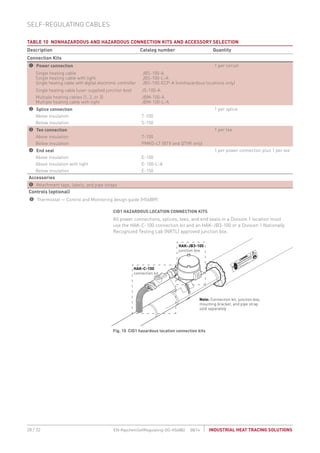
Table 10 Nonhazardous and Hazardous Connection Kits and Accessory Selection
Description Catalog number Quantity
Connection Kits
	 Power connection 1 per circuit
Single heating cable
Single heating cable with light
Single heating cable with digital electronic controller
JBS-100-A
JBS-100-L-A
JBS-100-ECP-A (nonhazardous locations only)
Single heating cable (user-supplied junction box) JS-100-A
Multiple heating cables (1, 2, or 3)
Multiple heating cable with light
JBM-100-A
JBM-100-L-A
	 Splice connection 1 per splice
Above insulation T-100
Below insulation S-150
	 Tee connection 1 per tee
Above insulation T-100
Below insulation PMKG-LT (BTV and QTVR only)
	 End seal 1 per power connection plus 1 per tee
Above insulation E-100
Above insulation with light E-100-L-A
Below insulation E-150
Accessories
	Attachment tape, labels, and pipe straps
Controls (optional)
 	Thermostat — Control and Monitoring design guide (H56889)
Cid1 hazardous location Connection Kits
All power connections, splices, tees, and end seals in a Division 1 location must
use the HAK-C-100 connection kit and an HAK-JB3-100 or a Division 1 Nationally
Recognized Testing Lab (NRTL) approved junction box.
HAK-C-100
connection kit
HAK-JB3-100
junction box
Note: Connection kit, junction box,
mounting bracket, and pipe strap
sold separately
Fig. 10 CID1 hazardous location connection kits
Self-regulating cables
Self-Regulat-
ingCables
Power-Limiting
Cables
MineralInsu-
latedCables
Longline
Heating
RTBTubing
Bundles
TankHeatingSnowandIceControland
Monitoring
Heat-Trace
Panels
Engineered
Products
Steam-Tracing
Systems
TechnicalData
Sheets
Appendixes
29 / 32INDUSTRIAL HEAT TRACING SOLUTIONS EN-RaychemSelfRegulating-DG-H56882 08/14
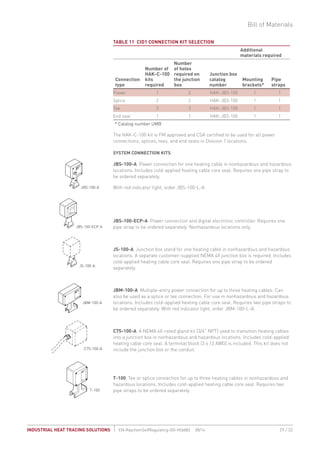
Table 11 CID1 Connection Kit Selection
Additional
materials required
Connection
type
Number of
HAK-C-100
kits
required
Number
of holes
required on
the junction
box
Junction box
catalog
number
Mounting
brackets*
Pipe
straps
Power 1 2 HAK-JB3-100 1 1
Splice 2 2 HAK-JB3-100 1 1
Tee 3 3 HAK-JB3-100 1 1
End seal 1 1 HAK-JB3-100 1 1
* Catalog number UMB
The HAK-C-100 kit is FM approved and CSA certified to be used for all power
connections, splices, tees, and end seals in Division 1 locations.
System Connection Kits
JBS-100-A Power connection for one heating cable in nonhazardous and hazardous
locations. Includes cold-applied heating cable core seal. Requires one pipe strap to
be ordered separately.
With red indicator light, order JBS-100-L-A
JBS-100-ECP-A Power connection and digital electronic controller. Requires one
pipe strap to be ordered separately. Nonhazardous locations only.
JS-100-A Junction box stand for one heating cable in nonhazardous and hazardous
locations. A separate customer-supplied NEMA 4X junction box is required. Includes
cold-applied heating cable core seal. Requires one pipe strap to be ordered
separately.
JBM-100-A Multiple-entry power connection for up to three heating cables. Can
also be used as a splice or tee connection. For use in nonhazardous and hazardous
locations. Includes cold-applied heating cable core seal. Requires two pipe straps to
be ordered separately. With red indicator light, order JBM-100-L-A.
C75-100-A A NEMA 4X-rated gland kit (3/4" NPT) used to transition heating cables
into a junction box in nonhazardous and hazardous locations. Includes cold-applied
heating cable core seal. A terminal block (3 x 12 AWG) is included. This kit does not
include the junction box or the conduit.
T-100 Tee or splice connection for up to three heating cables in nonhazardous and
hazardous locations. Includes cold-applied heating cable core seal. Requires two
pipe straps to be ordered separately.
¨
JBS-100-A
JBS-100-ECP-A
JS-100-A
¨
JBM-100-A
C75-100-A
T-100
Bill of Materials
INDUSTRIAL HEAT TRACING SOLUTIONSEN-RaychemSelfRegulating-DG-H56882 08/1430 / 32
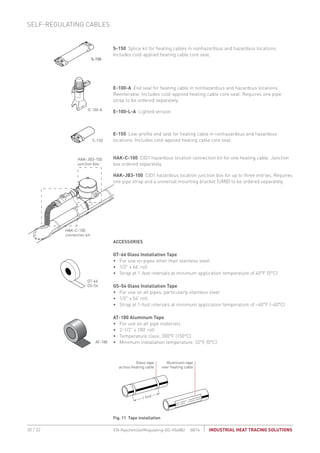
S-150 Splice kit for heating cables in nonhazardous and hazardous locations.
Includes cold-applied heating cable core seal.
E-100-A End seal for heating cable in nonhazardous and hazardous locations.
Reenterable. Includes cold-applied heating cable core seal. Requires one pipe
strap to be ordered separately.
E-100-L-A Lighted version	
E-150 Low-profile end seal for heating cable in nonhazardous and hazardous
locations. Includes cold-applied heating cable core seal.
HAK-C-100 CID1 hazardous location connection kit for one heating cable. Junction
box ordered separately.
HAK-JB3-100 CID1 hazardous location junction box for up to three entries. Requires
one pipe strap and a universal mounting bracket (UMB) to be ordered separately.
Accessories
GT-66 Glass Installation Tape
•	 For use on pipes other than stainless steel
•	 1/2" x 66' roll
•	 Strap at 1-foot intervals at minimum application temperature of 40°F (5°C)
GS-54 Glass Installation Tape
•	 For use on all pipes, particularly stainless steel
•	 1/2" x 54' roll
•	 Strap at 1-foot intervals at minimum application temperature of –40°F (–40°C)
AT-180 Aluminum Tape
•	 For use on all pipe materials
•	 2-1/2" x 180' roll
•	 Temperature class: 300°F (150°C)
•	 Minimum installation temperature: 32°F (0°C)
Glass tape
across heating cable
1 foot
Aluminum tape
over heating cable
Fig. 11 Tape installation
S-150
E-100-A
E-150
HAK-C-100
connection kit
HAK-JB3-100
junction box
GT-66
GS-54
AT-180
Self-regulating cables
Self-Regulat-
ingCables
Power-Limiting
Cables
MineralInsu-
latedCables
Longline
Heating
RTBTubing
Bundles
TankHeatingSnowandIceControland
Monitoring
Heat-Trace
Panels
Engineered
Products
Steam-Tracing
Systems
TechnicalData
Sheets
Appendixes
31 / 32INDUSTRIAL HEAT TRACING SOLUTIONS EN-RaychemSelfRegulating-DG-H56882 08/14
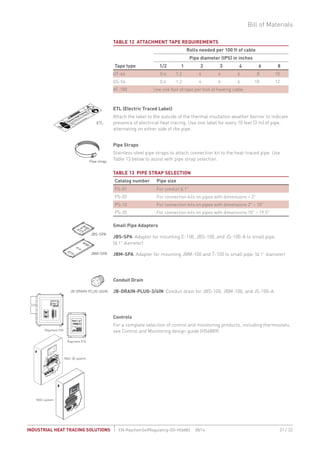
Table 12 Attachment Tape Requirements
Tape type
Rolls needed per 100 ft of cable
Pipe diameter (IPS) in inches
1/2 1 2 3 4 6 8
GT-66 0.6 	1.2 	4 	4 	6 	8 	10
GS-54 0.6 	1.2 	4 	6 	6 	10 	12
AT-180 Use one foot of tape per foot of heating cable
ETL (Electric Traced Label)
Attach the label to the outside of the thermal insulation weather barrier to indicate
presence of electrical heat tracing. Use one label for every 10 feet (3 m) of pipe,
alternating on either side of the pipe.
Pipe Straps
Stainless steel pipe straps to attach connection kit to the heat-traced pipe. Use
Table 13 below to assist with pipe strap selection.
Table 13 Pipe Strap Selection
Catalog number Pipe size
PS-01 For conduit ≤ 1"
PS-03 For connection kits on pipes with dimensions < 2"
PS-10 For connection kits on pipes with dimensions 2" – 10"
PS-20 For connection kits on pipes with dimensions 10" – 19.5"
Small Pipe Adapters
JBS-SPA Adapter for mounting E-100, JBS-100, and JS-100-A to small pipe.
(≤ 1" diameter)
JBM-SPA Adapter for mounting JBM-100 and T-100 to small pipe. (≤ 1" diameter)
Conduit Drain
JB-DRAIN-PLUG-3/4IN Conduit drain for JBS-100, JBM-100, and JS-100-A.
Controls
For a complete selection of control and monitoring products, including thermostats,
see Control and Monitoring design guide (H56889)
ETL
Pipe strap
JBM-SPA
JBS-SPA
JB-DRAIN-PLUG-3/4IN
Raychem 920
Raychem 910
NGC-30 system
NGC system
Bill of Materials
WWW.PENTAIRTHERMAL.COM
32 / 32INDUSTRIAL HEAT TRACING SOLUTIONS EN-RaychemSelfRegulating-DG-H56882 08/14
NORTH AMERICA
Tel:	+1.800.545.6258
Fax:	+1.800.527.5703
Tel:	+1.650.216.1526
Fax:	+1.650.474.7711
thermal.info@pentair.com
Europe, Middle East, Africa
Tel:	+32.16.213.511
Fax:	+32.16.213.603
thermal.info@pentair.com
Asia Pacific
Tel:	+86.21.2412.1688
Fax:	+86.21.5426.2937
cn.thermal.info@pentair.com
Latin America
Tel:	+1.713.868.4800
Fax:	+1.713.868.2333
thermal.info@pentair.com
Pentair, TraceCalc Pro, BTV, QTVR, HBTV, HQTV, XTV, KTV, HXTV, HAK-C-100, JBS-100-ECP-A, JBM-100-A, JS-100-A, JBS-100-L-A, JBS-100-A, S-150,
T-100, PKMG-LT, E-150, E-100-L-A, E-100-A, HAK-JB3-100, C75-100-A are owned by Pentair or its global affiliates. All other trademarks are the
property of their respective owners. Pentair reserves the right to change specifications without prior notice.
© 2001-2014 Pentair.

Self Regulating Heat Trace Guide

  • 1.
    Self-Regulat- ingCables Power-Limiting Cables MineralInsu- latedCables Longline Heating RTBTubing Bundles TankHeatingSnowandIceControland Monitoring Heat-Trace Panels Engineered Products Steam-Tracing Systems TechnicalData Sheets Appendixes This step-by-step designguide provides the tools necessary to design a self- regulating heat-tracing system for insulated pipes and tubing. For other applications or for design assistance, contact your Pentair Thermal Management representative or phone (800) 545‑6258. Also, visit our web site at www.pentairthermal.com. Contents Introduction. . . . . . . . . . . . . . . . . . . . . . . . . . . . . . . . . . . . . . . . . . . . . . . . . . . . . . . . . . . 1 Conductive-Polymer Technology. . . . . . . . . . . . . . . . . . . . . . . . . . . . . . . . . . . . . . 1 System Overview. . . . . . . . . . . . . . . . . . . . . . . . . . . . . . . . . . . . . . . . . . . . . . . . . . . . . . . 3 Typical Self-Regulating System. . . . . . . . . . . . . . . . . . . . . . . . . . . . . . . . . . . . . . . 3 Approvals and Certifications . . . . . . . . . . . . . . . . . . . . . . . . . . . . . . . . . . . . . . . . . 3 Thermal Design. . . . . . . . . . . . . . . . . . . . . . . . . . . . . . . . . . . . . . . . . . . . . . . . . . . . . . . . 4 Pipe Heat Loss Calculations. . . . . . . . . . . . . . . . . . . . . . . . . . . . . . . . . . . . . . . . . 4 Heating Cable Selection. . . . . . . . . . . . . . . . . . . . . . . . . . . . . . . . . . . . . . . . . . . . . . . . . 8 Bill of Materials. . . . . . . . . . . . . . . . . . . . . . . . . . . . . . . . . . . . . . . . . . . . . . . . . . . . . . . 20 Determining the Total Length of Heating Cable. . . . . . . . . . . . . . . . . . . . . . . . . 20 Electrical Design. . . . . . . . . . . . . . . . . . . . . . . . . . . . . . . . . . . . . . . . . . . . . . . . . . 23 Connection Kit Selection and Accessories. . . . . . . . . . . . . . . . . . . . . . . . . . . . . 26 Introduction Pentair Thermal Management invented self-regulating heating cable technology more than 40 years ago and today has over a billion feet of Raychem brand self- regulating heating cable installed worldwide. Self-regulating systems are the preferred choice for most complex pipe-tracing applications. This is due to their parallel construction, which allows them to be cut to length and spliced in the field, and their self-regulating output, which provides more heat where it is needed. Pentair Thermal Management self-regulating heating cables are certified for use in hazardous locations and have been tested and approved for unconditional temperature classifications by worldwide approval agencies. Conductive-Polymer Technology Pentair Thermal Management uses innovative conductive-polymer technology in both monolithic (solid core) and fiber (polymeric fiber wrap) heating cables, as seen in Figures 1 and 2. The heating element is made of polymers mixed with conductive carbon black. This special blend of materials creates electrical paths for conducting current between the parallel bus wires along the entire cable length. In each heating cable the number of electrical paths between the bus wires changes in response to temperature fluctuations. As the ambient temperature surrounding the heating cable decreases, the conductive core or fiber contracts microscopically. This contraction decreases electrical resistance and creates numerous electrical paths between the bus wires. Current flows across these paths to warm the core or fiber. Pentair Thermal Management invented self-regulating heating cable technology more than 40 years ago and today has over a billion feet of Raychem brand self-regulating heating cable installed worldwide. Self-regulating cables 1 / 32INDUSTRIAL HEAT TRACING SOLUTIONS EN-RaychemSelfRegulating-DG-H56882 08/14
  • 2.
    INDUSTRIAL HEAT TRACINGSOLUTIONSEN-RaychemSelfRegulating-DG-H56882 08/142 / 32 As the temperature rises, the core or fiber expands microscopically. This expansion increases electrical resistance, and the number of electrical paths decreases. As a result,the heating cable automatically begins to reduce its power output. Nickel-plated copper bus wire Self-regulating conductive core Modified polyolefin inner jacket or fluoropolymer inner jacket Tinned-copper braid Modified polyolefin outer jacket (-CR) or fluoropolymer outer jacket (-CT) Fig. 1 Monolithic heating cable (BTV, QTVR, HBTV, and HQTV) Fluoropolymer inner jacket Fluoropolymer outer jacket (-CT) Spacer Self-regulating polymeric-fiber heating element Nickel-plated copper bus wire Tinned-copper braid Fig. 2 Fiber-wrap heating cable (XTV, KTV and HXTV) Self-regulating cables
  • 3.
    Self-Regulat- ingCables Power-Limiting Cables MineralInsu- latedCables Longline Heating RTBTubing Bundles TankHeatingSnowandIceControland Monitoring Heat-Trace Panels Engineered Products Steam-Tracing Systems TechnicalData Sheets Appendixes 3 / 32INDUSTRIALHEAT TRACING SOLUTIONS EN-RaychemSelfRegulating-DG-H56882 08/14 System Overview Typical Self-Regulating System A typical self-regulating heating cable system is shown in Figure 3. The heating cable is cut to length at the job site and attached to the pipe with glass tape. A power connection kit connects the heating cable bus wires to power in a junction box. Tees and splices accommodate pipe branches to connect two or three heating cables together. An end seal kit is used to terminate the end of the heating cable. These required connection kits are designed and approved to provide a safe and reliable heat-tracing system. For applications requiring tight temperature control, electrical system monitoring, or remote operation, consider a control and monitoring system. Extra cable at valves Thermal insulation Heating cable loop for connection kit installation Pipe strap Heating cable Glass tape End sealSplice or tee (as required) Ground-fault protected power supply Power connection Fig. 3 Typical self-regulating heating cable system Approvals and Certifications Pentair Thermal Management self-regulating systems are approved and certified for use in nonhazardous and hazardous locations by many agencies. Please refer to technical data sheets for more details. System Overview
  • 4.
    INDUSTRIAL HEAT TRACINGSOLUTIONSEN-RaychemSelfRegulating-DG-H56882 08/144 / 32 Thermal Design Pipe Heat Loss Calculations To select the proper heating cable you must first calculate the pipe heat loss, as outlined in the following four steps: 1 Gather the necessary information. – Tm: Maintain temperature – Ta: Minimum expected ambient temperature – Pipe or tubing size and material – Thermal insulation type and thickness 2 Calculate the temperature differential between the pipe maintain temperature and the minimum ambient temperature. 3 Calculate the pipe heat loss. 4 Adjust the heat loss to compensate for specific insulation type. 20 40 60 80 −40 −20 0 +20 +40 Maintain temperature °F °F Minimum ambient temperature Thermal insulation thickness Pipe or tubing diameter Fig. 4 Pipe heat loss Thermal Design 1. Gather information 2. Calculate temperature differential 3. Calculate heat loss 4. Compensate for insulation type Step  Gather the necessary information To select the heating cable, gather and record the following information: • Tm: Maintain temperature • Ta: Minimum expected ambient temperature • Pipe or tubing size and material • Thermal insulation type and thickness Example: Gather information Maintain temperature Water freeze protection at 40°F Minimum ambient temperature –40°F Pipe size and material 6-inch diameter, steel Insulation thickness and type 2-1/2 inch, calcium silicate Note: All thermal and electrical design information provided here is based upon a "standard" installation; i.e., with heating cable installed on insulated pipes. For any other method of installation, consult your Pentair Thermal Management representative for design assistance. Note: Heat loss calculation is based on a nonflowing pipe. Self-regulating cables
  • 5.
    Self-Regulat- ingCables Power-Limiting Cables MineralInsu- latedCables Longline Heating RTBTubing Bundles TankHeatingSnowandIceControland Monitoring Heat-Trace Panels Engineered Products Steam-Tracing Systems TechnicalData Sheets Appendixes 5 / 32INDUSTRIALHEAT TRACING SOLUTIONS EN-RaychemSelfRegulating-DG-H56882 08/14 Thermal Design 1. Gather information 2. Calculate temperature differential 3. Calculate heat loss 4. Compensate for insulation type Step  Calculate temperature differential ΔT To calculate the temperature differential (ΔT), use the formula below: Formula ΔT = Tm – Ta Example: Calculate temperature differential Input Tm = 40°F (from Step 1) Input Ta = –40°F (from Step 1) Calculation ΔT = 40°F – (–40°F) = 80°F ΔT = 80°F Thermal Design 1. Gather information 2. Calculate temperature differential 3. Calculate heat loss 4. Compensate for insulation type Step  Calculate the pipe heat loss From Table 1 match the pipe size and insulation thickness with the temperature differential, ΔT, to find the base heat loss of the pipe (Qb). Example: Calculate pipe heat loss Input Pipe size = 6 inch (from Step 1) Input Insulation thickness = 2-1/2 inch (from Step 1) Input ΔT = 80°F (from Step 2) Input Pipe heat loss = 3.6 W/ft (from Table 1) From Table 1, Qb must be calculated through interpolation. For this example, 80°F is 3/5 of the difference between the ΔT of 50°F and the ΔT of 100°F: Qb = 3.6 W/ft + [3/5 x (7.4 – 3.6)] (7.4 is the ΔT of 100°F; 3.6 is the ΔT of 50°F) Calculation Qb = 3.6 + 2.3 = 5.9 W/ft Pipe heat loss Qb = 5.9 W/ft @ 40°F Thermal Design 1. Gather information 2. Calculate temperature differential 3. Calculate heat loss 4. Compensate for insulation type Step  Compensate for insulation type Multiply the base heat loss of the pipe (Qb) from Step 3 by the insulation compensation factor (f) from Table 2 to get the total heat loss per foot of pipe (Qt). Formula Qt = Qb x f Example: Insulation type compensation Input Insulation type = calcium silicate (from Step 1) Input f = 1.50 for calcium silicate (from Table 2) Input Qb = 5.9 W/ft (from Step 3) Calculation Qt = 5.9 W/ft x 1.50 = 8.85 W/ft Qt = 8.85 W/ft at 40°F Now proceed to the Heating Cable Selection section, page 8, to determine the heating cable that will compensate for this heat loss. Note: Heat loss calculations are based on IEEE Standards. Thermal Design
  • 6.
    INDUSTRIAL HEAT TRACINGSOLUTIONSEN-RaychemSelfRegulating-DG-H56882 08/146 / 32 Table 1 Pipe Heat Loss (W/ft) Pipe diameter (IPS) in inches 1/4 1/2 3/4 1 1-1/4 1-1/2 2 2-1/2 Insulation thickness (ΔT) Tubing size (inches) °F °C 3/4 1 1-1/4 1-1/2 2 0.5" 50 28 1.9 2.5 2.9 3.5 4.1 4.6 5.5 6.5 100 56 3.9 5.2 6.1 7.2 8.6 9.6 11.5 13.5 150 84 6.1 8.1 9.5 11.2 13.4 14.9 17.9 21.1 200 111 8.5 11.3 13.2 15.6 18.6 20.7 24.9 29.2 1.0" 50 28 1.3 1.6 1.9 2.2 2.5 2.8 3.2 3.8 100 56 2.7 3.4 3.9 4.5 5.2 5.8 6.8 7.8 150 84 4.2 5.3 6.1 7.0 8.2 9.0 10.6 12.2 200 111 5.8 7.4 8.4 9.7 11.3 12.4 14.6 16.9 250 139 7.6 9.7 11.0 12.7 14.8 16.3 19.1 22.1 1.5" 50 28 1.1 1.3 1.5 1.7 1.9 2.1 2.4 2.8 100 56 2.2 2.8 3.1 3.5 4.0 4.4 5.1 5.8 150 84 3.5 4.3 4.8 5.5 6.3 6.9 8.0 9.1 200 111 4.8 5.9 6.7 7.6 8.7 9.5 11.0 12.6 250 139 6.3 7.8 8.7 9.9 11.4 12.4 14.4 16.5 300 167 7.9 9.7 11.0 12.4 14.3 15.6 18.1 20.6 350 194 9.6 11.9 13.3 15.1 17.4 19.0 22.0 25.1 2.0" 50 28 0.9 1.1 1.3 1.4 1.6 1.8 2.0 2.3 100 56 2.0 2.4 2.7 3.0 3.4 3.7 4.2 4.8 150 84 3.1 3.7 4.2 4.7 5.3 5.8 6.6 7.5 200 111 4.3 5.2 5.8 6.5 7.4 8.0 9.2 10.4 250 139 5.6 6.8 7.5 8.5 9.6 10.4 12.0 13.5 300 167 7.0 8.5 9.4 10.6 12.1 13.1 15.0 17.0 350 194 8.5 10.3 11.5 12.9 14.7 15.9 18.2 20.6 2.5" 50 28 0.9 1.0 1.2 1.3 1.4 1.6 1.8 2.0 100 56 1.8 2.2 2.4 2.7 3.0 3.3 3.7 4.2 150 84 2.8 3.4 3.7 4.2 4.7 5.1 5.8 6.5 200 111 3.9 4.7 5.2 5.8 6.5 7.0 8.0 9.0 250 139 5.1 6.1 6.8 7.6 8.5 9.2 10.5 11.7 300 167 6.4 7.7 8.5 9.5 10.7 11.5 13.1 14.7 350 194 7.8 9.3 10.3 11.5 13.0 14.0 15.9 17.9 3.0" 50 28 0.8 1.0 1.1 1.2 1.3 1.4 1.6 1.8 100 56 1.7 2.0 2.2 2.4 2.7 2.9 3.3 3.7 150 84 2.6 3.1 3.4 3.8 4.3 4.6 5.2 5.8 200 111 3.6 4.3 4.8 5.3 5.9 6.4 7.2 8.0 250 139 4.8 5.7 6.2 6.9 7.8 8.3 9.4 10.5 300 167 6.0 7.1 7.8 8.7 9.7 10.4 11.8 13.2 350 194 7.3 8.6 9.5 10.5 11.8 12.7 14.3 16.0 4.0" 50 28 0.7 0.9 0.9 1.0 1.1 1.2 1.4 1.5 100 56 1.5 1.8 2.0 2.1 2.4 2.5 2.9 3.2 150 84 2.4 2.8 3.0 3.4 3.7 4.0 4.4 4.9 200 111 3.3 3.9 4.2 4.6 5.2 5.5 6.2 6.8 250 139 4.3 5.1 5.5 6.1 6.7 7.2 8.1 8.9 300 167 5.4 6.3 6.9 7.6 8.5 9.0 10.1 11.2 350 194 6.6 7.7 8.4 9.3 10.3 11.0 12.3 13.6 Note: Pipe heat loss (Qb) is shown in watts per foot. Heat loss calculations are based on IEEE Standards with the following provisions: • Pipes insulated with glass fiber in accordance with ASTM C547 • Pipes located outdoors in a 20-mph wind • No insulating air space assumed between pipe and insulation • No insulating air space assumed between the insulation and outer cladding • Includes a 10% safety factor Self-regulating cables
  • 7.
    Self-Regulat- ingCables Power-Limiting Cables MineralInsu- latedCables Longline Heating RTBTubing Bundles TankHeatingSnowandIceControland Monitoring Heat-Trace Panels Engineered Products Steam-Tracing Systems TechnicalData Sheets Appendixes 7 / 32INDUSTRIALHEAT TRACING SOLUTIONS EN-RaychemSelfRegulating-DG-H56882 08/14 Table 1 Pipe Heat Loss (W/ft) Pipe diameter (IPS) in inches 3 3-1/2 4 6 8 10 12 14 16 18 20 24 7.7 8.6 9.6 13.6 17.4 21.4 25.2 27.5 31.3 35.0 38.8 46.2 16.0 18.0 20.0 28.4 36.3 44.6 52.5 57.4 65.2 73.0 80.8 96.3 25.0 28.1 31.2 44.3 56.6 69.6 81.9 89.5 101.7 113.8 126.0 150.2 34.6 39.0 43.3 61.5 78.5 96.6 113.6 124.2 141.1 158.0 174.8 208.5 4.4 4.9 5.4 7.5 9.4 11.5 13.5 14.7 16.6 18.6 20.5 24.4 9.1 10.2 11.2 15.6 19.7 24.0 28.1 30.6 34.7 38.7 42.8 50.9 14.2 15.9 17.5 24.3 30.7 37.4 43.8 47.8 54.1 60.4 66.7 79.4 19.7 22.0 24.2 33.7 42.5 51.9 60.7 66.2 75.0 83.8 92.5 110.0 25.8 28.7 31.7 44.0 55.6 67.9 79.4 86.6 98.1 109.6 121.0 143.9 3.2 3.6 3.9 5.3 6.7 8.1 9.4 10.2 11.5 12.9 14.2 16.8 6.7 7.4 8.1 11.1 13.9 16.8 19.6 21.3 24.0 26.8 29.5 35.0 10.5 11.6 12.7 17.3 21.6 26.2 30.5 33.2 37.5 41.8 46.1 54.6 14.5 16.1 17.6 24.0 30.0 36.3 42.3 46.0 52.0 57.9 63.8 75.7 19.0 21.0 23.0 31.4 39.2 47.5 55.3 60.2 68.0 75.7 83.5 99.0 23.8 26.3 28.8 39.3 49.2 59.6 69.3 75.4 85.1 94.9 104.6 124.0 28.9 32.0 35.0 47.8 59.8 72.4 84.3 91.7 103.5 115.4 127.2 150.8 2.6 2.9 3.1 4.2 5.2 6.3 7.3 7.9 8.9 9.9 10.9 12.9 5.5 6.0 6.6 8.8 10.9 13.1 15.2 16.5 18.6 20.7 22.8 26.9 8.5 9.4 10.2 13.8 17.0 20.5 23.8 25.8 29.0 32.3 35.5 42.0 11.8 13.0 14.2 19.1 23.6 28.4 32.9 35.7 40.2 44.7 49.2 58.2 15.5 17.0 18.5 24.9 30.9 37.2 43.1 46.7 52.6 58.5 64.3 76.1 19.4 21.3 23.2 31.2 38.7 46.6 54.0 58.6 65.9 73.3 80.6 95.3 23.6 25.9 28.3 38.0 47.1 56.6 65.6 71.2 80.2 89.1 98.1 115.9 2.3 2.5 2.7 3.6 4.4 5.2 6.1 6.6 7.4 8.2 9.0 10.6 4.7 5.2 5.6 7.4 9.1 10.9 12.6 13.7 15.3 17.0 18.7 22.0 7.4 8.1 8.7 11.6 14.2 17.0 19.7 21.3 23.9 26.5 29.1 34.3 10.2 11.2 12.1 16.1 19.7 23.6 27.2 29.5 33.1 36.7 40.3 47.5 13.3 14.6 15.8 21.0 25.8 30.9 35.6 38.6 43.3 48.0 52.8 62.2 16.7 18.3 19.8 26.3 32.3 38.7 44.6 48.4 54.3 60.2 66.1 77.9 20.3 22.2 24.1 32.0 39.3 47.1 54.3 58.8 66.0 73.2 80.4 94.7 2.0 2.2 2.4 3.1 3.8 4.5 5.2 5.6 6.3 7.0 7.6 9.0 4.2 4.6 4.9 6.5 7.9 9.4 10.8 11.7 13.1 14.5 15.9 18.7 6.6 7.1 7.7 10.1 12.4 14.7 16.9 18.3 20.5 22.6 24.8 29.2 9.1 9.9 10.7 14.0 17.1 20.4 23.4 25.3 28.3 31.4 34.4 40.4 11.9 12.9 14.0 18.3 22.4 26.6 30.6 33.1 37.1 41.0 45.0 52.8 14.9 16.2 17.5 23.0 28.1 33.4 38.4 41.5 46.5 51.4 56.3 66.2 18.1 19.7 21.3 28.0 34.1 40.6 46.7 50.5 56.5 62.5 68.5 80.5 1.7 1.8 2.0 2.5 3.1 3.6 4.1 4.4 5.0 5.5 6.0 7.0 3.5 3.8 4.1 5.3 6.4 7.5 8.6 9.3 10.3 11.4 12.4 14.5 5.5 6.0 6.4 8.3 10.0 11.8 13.4 14.5 16.1 17.8 19.4 22.7 7.6 8.3 8.9 11.4 13.8 16.3 18.6 20.0 22.3 24.6 26.9 31.4 10.0 10.8 11.6 15.0 18.1 21.3 24.3 26.2 29.2 32.2 35.2 41.1 12.5 13.5 14.6 18.8 22.6 26.7 30.5 32.8 36.6 40.3 44.1 51.5 15.2 16.5 17.7 22.8 27.5 32.4 37.1 39.9 44.5 49.0 53.6 62.6 Table 2 Insulation Factors Preformed pipe insulation Insulation factor (f) k factor at 50°F (10°C) (BTU/hr–°F–ft2/in) Glass fiber (ASTM C547) 1.00 0.25 Calcium silicate (ASTM C533) 1.50 0.37 Cellular glass (ASTM C552) 1.60 0.40 Rigid cellular urethane (ASTM C591) 0.64 0.16 Foamed elastomer (ASTM C534) 1.16 0.29 Mineral fiber blanket (ASTM C553) 1.20 0.30 Expanded perlite (ASTM C610) 1.90 0.48 Thermal Design
  • 8.
    INDUSTRIAL HEAT TRACINGSOLUTIONSEN-RaychemSelfRegulating-DG-H56882 08/148 / 32 Heating Cable Selection If your application is freeze protection of water piping, follow the five-step heating cable selection process outlined below. 1 Gather the following information: – Pipe size and material – Insulation type and thickness – Maintain temperature (Tm) – Minimum ambient temperature (Ta) – Minimum start-up temperature – Service voltage – Chemical environment – Maximum intermittent exposure temperature* – Electrical area classification** 2 Select the heating cable family. 3 Select the service voltage. 4 Determine the heating cable power output rating. 5 Select the jacket type. * Determines whether a higher exposure temperature heating cable is needed. ** Determines whether special design requirements and connection kits must be used. If your application is maintenance of another fluid at a temperature other than 40°F (5°C) or is temperature-sensitive, you will need the information above plus the following data: Example data • Process temperature 70°F • Maximum ambient temperature 105°F • Fluid degradation temperature*** 150°F ***Determines whether thermostatic control is necessary. heating cable catalog number Before beginning, take a moment to understand the structure underlying heating cable catalog numbers. You will refer to this numbering convention throughout the product selection process. Your goal is to determine the catalog number for the product that best suits your needs. XX XXX X–XX Outer Jacket CT = Fluoropolymer CR= Modified polyolefin (BTV only) Voltage 1 =120 Volt (100–130 Vac) 2 = 240 Volt (200–277 Vac) Heating cable family BTV HBTV QTVR HQTV XTV HXTV KTV Power output rating (Watts/ft) Fig. 5 Heating cable catalog number Note: The data presented here are nominal and conservative. Additional engineering analysis at specific voltages may allow optimization that could extend circuit lengths and/ or available power output. Consult Pentair Thermal Management for more information. Self-regulating cables
  • 9.
    Self-Regulat- ingCables Power-Limiting Cables MineralInsu- latedCables Longline Heating RTBTubing Bundles TankHeatingSnowandIceControland Monitoring Heat-Trace Panels Engineered Products Steam-Tracing Systems TechnicalData Sheets Appendixes 9 / 32INDUSTRIALHEAT TRACING SOLUTIONS EN-RaychemSelfRegulating-DG-H56882 08/14 Heating Cable Selection 1. Gather information 2. Select heating cable family 3. Select service voltage 4. Determine power output rating 5. Select jacket type Step  Gather the necessary information To select the heating cable, gather and record the following information: • Pipe size and material • Insulation type and thickness • Maintain temperature (Tm) • Minimum ambient temperature (Ta) • Minimum start-up temperature • Service voltage • Chemical environment • Maximum intermittent exposure temperature • Electrical area classification Example: Gather necessary information • Pipe size and material* 6 inches in diameter, steel • Insulation type and thickness* 2-1/2 inch, calcium silicate • Maintain temperature (Tm)* Water freeze protection at 40°F • Minimum ambient temperature (Ta)* –40°F • Minimum start-up temperature 0°F • Service voltage 120 Vac • Chemical environment Organic chemicals • Maximum intermittent exposure temperature** 366°F • Electrical area classification*** Nonhazardous * From Thermal Design, Step 1 ** Determines whether a higher exposure temperature heating cable is needed. *** Determines whether special design requirements and connection kits must be used. Heating Cable Selection 1. Gather information 2. Select heating cable family 3. Select service voltage 4. Determine power output rating 5. Select jacket type Step  Select the heating cable family Based on your application’s maintain temperature, pipe material, maximum exposure temperature, and T-rating, select the appropriate heating cable. For nonhazardous locations, use Table 3 to select the heating cable family. Base your selection on your application’s maintain temperature, pipe material, and maximum intermittent exposure temperature. For Class I, Division 1 or 2 hazardous locations, also use Table 3 or Table 4, but first determine the required T-rating for the area. Temperature identification numbers (T-ratings) are defined by the National Electrical Code (NFPA 70), Articles 500 and 505; and the Canadian Electrical Code Part I, Section 18. If the T-rating of the area has been defined, then select a heating cable from Table 3 or 4 having a T-rating equivalent to or less than the T-rating of this location (for example, T6 is a lower T-rating than T3). The purpose of the T-rating is to ensure that electrical equipment does not exceed the auto-ignition temperatures (AIT) of flammables handled in a hazardous location. If the T-rating for the area has not been defined, use one of the following methods. Heating Cable Selection
  • 10.
    INDUSTRIAL HEAT TRACINGSOLUTIONSEN-RaychemSelfRegulating-DG-H56882 08/1410 / 32 For CSA certification • Select the material with the lowest AIT in °C. This temperature is the maximum allowable heating cable sheath temperature. For FM approval • Select material with the lowest AIT in °C. This temperature is the maximum allowable heating cable sheath temperature. For FM approval, division 1 hazardous locations • Select material with the lowest AIT in °C. • Multiply the ignition temperature by 0.8. This temperature is the maximum allowable heating cable sheath temperature. Use Table 4 to select the heating cable family. Table 3 Heating Cable Product Performance Data Heating cable family Maximum maintain temperature Maximum continuous exposure temperature* Maximum intermittent exposure temperature** T-rating/ maximum sheath temperature Pipe material BTV 150°F (65°C) 150°F (65°C) 185°F (85°C) T6 185°F (85°C) plastic/ metal QTVR 225°F (110°C) 225°F (110°C) 225°F (110°C) T4 275°F (135°C) plastic1/ metal only KTV 300°F (150°C) 300°F (150°C) 482°F (250°C)2 T2C 446°F (230°C) plastic/ metal 5XTV1,2 10XTV1,2 15XTV2 250°F (121°C) 250°F (121°C) 250°F (121°C) 250°F (121°C) 250°F (121°C) 250°F (121°C) 482°F (250°C)2 482°F (250°C)2 482°F (250°C)2 T3 392°F (200°C) T3 392°F (200°C) T3 392°F (200°C) metal only metal only metal only 15XTV1 20XTV1 20XTV2 250°F (121°C) 250°F (121°C) 250°F (121°C) 250°F (121°C) 250°F (121°C) 250°F (121°C) 482°F (250°C)2 482°F (250°C)2 482°F (250°C)2 T2D 419°F (215°C) T2C 446°F (230°C) T2C 446°F (230°C) metal only metal only metal only * With the heating cable power on ** 1000 hours (power on/power off) 1 For plastic pipes please consult TraceCalc Pro design software or contact the Customer Service Center. 2 The 250°C rating applies to all products printed “MAX INTERMITTENT EXPOSURE 250C” Example: Nonhazardous location Input 40°F maintain temperature (from Thermal Design, Step 1) Input 366°F intermittent exposure temperature (from Step 1) Input Heating cable family XTV (from Table 3) Catalog number xxXTVx-xx Self-regulating cables
  • 11.
    Self-Regulat- ingCables Power-Limiting Cables MineralInsu- latedCables Longline Heating RTBTubing Bundles TankHeatingSnowandIceControland Monitoring Heat-Trace Panels Engineered Products Steam-Tracing Systems TechnicalData Sheets Appendixes 11 / 32INDUSTRIALHEAT TRACING SOLUTIONS EN-RaychemSelfRegulating-DG-H56882 08/14 Table 4 Heating Cable Product Performance Data (FM-CID1 Hazardous Locations) Heating cable family Maximum maintain temperature Maximum continuous exposure temperature* Maximum intermittent exposure temperature** T-rating/ maximum sheath temperature Pipe material HBTV-CT 150°F (65°C) 150°F (65°C) 185°F (85°C) T6 185°F (85°C) plastic/ metal HQTV-CT 225°F (110°C) 225°F (110°C) 225°F (110°C) T4 275°F (135°C) plastic1/ metal only 5HXTV1,2-CT 10HXTV1,2-CT 15HXTV2-CT 250°F (121°C) 250°F (121°C) 250°F (121°C) 250°F (121°C) 250°F (121°C) 250°F (121°C) 482°F (250°C)2 482°F (250°C)2 482°F (250°C)2 T3 392°F (200°C) T3 392°F (200°C) T3 392°F (200°C) metal only metal only metal only 15HXTV1-CT 20HXTV1-CT 20HXTV2-CT 250°F (121°C) 250°F (121°C) 250°F (121°C) 250°F (121°C) 250°F (121°C) 250°F (121°C) 482°F (250°C)2 482°F (250°C)2 482°F (250°C)2 T2D 419°F (215°C) T2C 446°F (230°C) T2C 446°F (230°C) metal only metal only metal only * With the heating cable power on ** 1000 hours (power on/power off) 1 For plastic pipes please consult TraceCalc Pro design software or contact the Customer Service Center. 2 The 250°C rating applies to all products printed “MAX INTERMITTENT EXPOSURE 250C” Example: CID1 hazardous location For the same inputs, the heating cable family is HXTV from Table 4 on page 11. For FM Approved systems in CID1 hazardous locations Due to the potentially hazardous nature of Division 1 locations, the requirements below must be followed at all times. • Use only Raychem brand HBTV-CT, HQTV-CT, and HXTV-CT heating cables and HAK-C-100 connection kits specifically approved by FM. • Complete and send the field information form found in the Approval for Class I, Division 1 Hazardous Locations in USA form (H56987), available on www.pentairthermal.com, to the Pentair Thermal Management Customer Ser- vice Center — phone (800) 545-6258, fax (800) 527-5703 — for design verification. • Be sure the installer completes and returns the Required Installation Record for Class I, Division 1 Hazardous Locations in USA form (H57426), available on www.pentairthermal.com, or the one in the back of the installation manual shipped with the product. For CSA Certified systems in CID1 hazardous locations Due to the potentially hazardous nature of Division 1 locations, use only Raychem brand BTV-CT, QTVR-CT, KTV-CT and XTV-CT heating cables and HAK-C-100 connection kits specifically certified by CSA. Heating Cable Selection 1. Gather information 2. Select heating cable family 3. Select service voltage 4. Determine power output rating 5. Select jacket type Step  Select the service voltage Service voltage options: 1 = 120 volts (100–130 Vac) 2 = 240 volts (200–277 Vac) Example: Service voltage selection Input XTV heating cable (from Step 2) Input 120 volts (from Step 1) Voltage option 1 Catalog number xXTV1-xx Heating Cable Selection
  • 12.
    INDUSTRIAL HEAT TRACINGSOLUTIONSEN-RaychemSelfRegulating-DG-H56882 08/1412 / 32 Heating Cable Selection 1. Gather information 2. Select heating cable family 3. Select service voltage 4. Determine power output rating 5. Select jacket type Step  Determine the heating cable power output rating To select the heating cable power output, use Table 5 to determine the appropriate power output graph based on the heating cable family and voltage already determined. Table 5 Heating Cable Power Output Graph Selection Pipe material Heating cable Voltage Graph number Metal pipe BTV, QTVR, HBTV, HQTV 120 208 240 277 1 2 3 4 Metal pipe KTV, XTV and HXTV 120 208 240 277 5 6 7 8 Plastic pipe* BTV and HBTV 120 208 240 277 9 10 11 12 * Graphs assume the use of aluminum tape over the heating cable. Using the selected graph, locate the heating cable with thermal output greater than the heat loss (Qt) at the pipe maintenance temperature (Tm). If the pipe heat loss, Qt, is between the two heating cable power output curves, select the higher-rated heating cable. If Qt is greater than the power output of the highest- rated heating cable, you can: • Use two or more heating cables run in parallel. • Spiral the heating cable. • Use thicker insulation to reduce heat loss. • Use insulation material with a lower k factor. 10XTV TM = 40°F QT = 8.9 W/ft Fig. 6 Heating cable thermal output Spiraling If spiraling is elected, use the formula below to determine the spiral factor (length of heating cable per foot of pipe): Spiral factor = Qt / Heater power output at Tm When the spiral factor exceeds 6 or the pipe size is less than three inches, consider using two or more heating cables run in parallel rather than spiraling. Example: Determine power output rating Input XTV heating cable (from Step 3) Input Heat loss is 8.7 W/ft (from Thermal Design, Step 4 and Table 1) Input 10XTV output of 10.2 W/ft exceeds 8.7 W/ft at 40°F (from Graph 5) Power output rating 10 Catalog number 10XTV1-xx Self-regulating cables
  • 13.
    Self-Regulat- ingCables Power-Limiting Cables MineralInsu- latedCables Longline Heating RTBTubing Bundles TankHeatingSnowandIceControland Monitoring Heat-Trace Panels Engineered Products Steam-Tracing Systems TechnicalData Sheets Appendixes 13 / 32INDUSTRIALHEAT TRACING SOLUTIONS EN-RaychemSelfRegulating-DG-H56882 08/14 30 (–1) 0 2 4 6 8 10 12 14 16 18 20QTVR1 20HQTV1 15QTVR1 10QTVR1 12HQTV1 10BTV1 10HBTV1 8BTV1 8HBTV1 5BTV1 5HBTV1 3BTV1 20 22Nominal Output Watts/foot 50 (10) 70 (21) 90 (32) 110 (43) 130 (54) 150 (66) 170 (77) Pipe Temperature °F (°C) 190 (88) 210 (99) 230 (110) 250 (121)               120 Vac Graph 1 BTV, HBTV, QTVR, and HQTV nominal power output on metal pipes at 120 volts 0 2 4 6 8 10 12 14 16 18 20QTVR2 20HQTV2 15QTVR2 10QTVR2 12HQTV2 10BTV2 10HBTV2 8BTV2 8HBTV2 5BTV2 5HBTV2 3BTV2 20 22Nominal Output Watts/foot               208 Vac 30 (–1) 50 (10) 70 (21) 90 (32) 110 (43) 130 (54) 150 (66) 170 (77) Pipe Temperature °F (°C) 190 (88) 210 (99) 230 (110) 250 (121) Graph 2 BTV, HBTV, QTVR, and HQTV nominal power output on metal pipes at 208 volts Heating Cable Selection
  • 14.
    INDUSTRIAL HEAT TRACINGSOLUTIONSEN-RaychemSelfRegulating-DG-H56882 08/1414 / 32 0 2 4 6 8 10 12 14 16 18 20QTVR2 20HQTV2 15QTVR2 10QTVR2 12HQTV2 10BTV2 10HBTV2 8BTV2 8HBTV2 5BTV2 5HBTV2 3BTV2 20 22Nominal Output Watts/foot               240 Vac 30 (–1) 50 (10) 70 (21) 90 (32) 110 (43) 130 (54) 150 (66) 170 (77) Pipe Temperature °F (°C) 190 (88) 210 (99) 230 (110) 250 (121) Graph 3 BTV, HBTV, QTVR, and HQTV nominal power output on metal pipes at 240 volts 0 2 4 6 8 10 12 14 16 18 20QTVR2 20HQTVR2 15QTVR2 10QTVR2 12HQTVR2 10BTV2 10HBTV2 8BTV2 8HBTV2 5BTV2 5HBTV2 3BTV2 20 22 24Nominal Output Watts/foot              277 Vac 30 (–1) 50 (10) 70 (21) 90 (32) 110 (43) 130 (54) 150 (66) 170 (77) Pipe Temperature °F (°C) 190 (88) 210 (99) 230 (110) 250 (121)  Graph 4 BTV, HBTV, QTVR, and HQTV nominal power output on metal pipes at 277 volts Self-regulating cables
  • 15.
    Self-Regulat- ingCables Power-Limiting Cables MineralInsu- latedCables Longline Heating RTBTubing Bundles TankHeatingSnowandIceControland Monitoring Heat-Trace Panels Engineered Products Steam-Tracing Systems TechnicalData Sheets Appendixes 15 / 32INDUSTRIALHEAT TRACING SOLUTIONS EN-RaychemSelfRegulating-DG-H56882 08/14 25 (–4) 0 5 10 15 20 20XTV1 20HXTV1 15XTV1 15HXTV1 10XTV1 10HXTV1 5XTV1 5HXTV1 25Nominal Output Watts/foot 50 (10) 75 (24) 100 (38) 125 (52) 150 (66) 175 (79) 200 (93) 225 (107) 250 (121) 275 (135) 300 (149) Pipe Temperature °F (°C)         120 Vac Graph 5 XTV and HXTV nominal power output on metal pipes at 120 volts 0 4 6 2 8 10 12 14 16 18 20XTV2 20HXTV2 20KTV-CT 15KTV-CT 15XTV2 15HXTV2 10XTV2 10HXTV2 8KTV-CT 5KTV-CT 5XTV2 5HXTV2 20Nominal Output Watts/foot            208 Vac 25 (–4) 50 (10) 75 (24) 100 (38) 125 (52) 150 (66) 175 (79) 200 (93) 225 (107) 250 (121) 275 (135) 300 (149) Pipe Temperature °F (°C)      Graph 6 XTV and HXTV nominal power output on metal pipes at 208 volts Heating Cable Selection
  • 16.
    INDUSTRIAL HEAT TRACINGSOLUTIONSEN-RaychemSelfRegulating-DG-H56882 08/1416 / 32 0 4 2 10 8 6 14 12 20 18 16 24 22 Nominal Output Watts/foot 20XTV2 20HXTV2 15XTV2 15HXTV2 10XTV2 10HXTV2 5XTV2 5HXTV2         240 Vac 25 (–4) 50 (10) 75 (24) 100 (38) 125 (52) 150 (66) 175 (79) 200 (93) 225 (107) 250 (121) 275 (135) 300 (149) Pipe Temperature °F (°C) Graph 7 XTV and HXTV nominal power output on metal pipes at 240 volts 0 4 2 10 8 6 14 12 20 18 16 24 22 Nominal Output Watts/foot 20XTV2 20HXTV2 15XTV2 15HXTV2 10XTV2 10HXTV2 5XTV2 5HXTV2         277 Vac 25 (–4) 50 (10) 75 (24) 100 (38) 125 (52) 150 (66) 175 (79) 200 (93) 225 (107) 250 (121) 275 (135) 300 (149) Pipe Temperature °F (°C) Graph 8 XTV and HXTV nominal power output on metal pipes at 277 volts Self-regulating cables
  • 17.
    Self-Regulat- ingCables Power-Limiting Cables MineralInsu- latedCables Longline Heating RTBTubing Bundles TankHeatingSnowandIceControland Monitoring Heat-Trace Panels Engineered Products Steam-Tracing Systems TechnicalData Sheets Appendixes 17 / 32INDUSTRIALHEAT TRACING SOLUTIONS EN-RaychemSelfRegulating-DG-H56882 08/14 30 (–1) 0 1 2 3 4 5 6 7Nominal Output Watts/foot 50 (10) 70 (21) 90 (32) 110 (43) 170 (77) 130 (54) 150 (66) Pipe Temperature °F (°C)  10BTV1 10HBTV1 8BTV1 8HBTV1 5BTV1 5HBTV1 3BTV1     120 Vac     Graph 9 BTV and HBTV nominal power output on plastic pipes at 120 volts 30 (–1) 0 1 2 3 4 5 6 7Nominal Output Watts/foot 50 (10) 70 (21) 90 (32) 110 (43) 170 (77) 130 (54) 150 (66) Pipe Temperature °F (°C)  10BTV1 10HBTV1 8BTV1 8HBTV1 5BTV1 5HBTV1 3BTV1     120 Vac     Graph 10 BTV and HBTV nominal power output on plastic pipes at 208 volts Heating Cable Selection
  • 18.
    INDUSTRIAL HEAT TRACINGSOLUTIONSEN-RaychemSelfRegulating-DG-H56882 08/1418 / 32 0 1 2 3 4 5 6 7 8Nominal Output Watts/foot 10BTV2 10HBTV2 8BTV2 8HBTV2 5BTV2 5HBTV2 3BTV2         240 Vac 30 (–1) 50 (10) 70 (21) 90 (32) 110 (43) 170 (77) 130 (54) 150 (66) Pipe Temperature °F (°C) Graph 11 BTV and HBTV nominal power output on plastic pipes at 240 volts 0 1 2 3 4 5 6 7 8 9Nominal Output Watts/foot 10BTV2 10HBTV2 8BTV2 8HBTV2 5BTV2 5HBTV2 3BTV2     277 Vac     30 (–1) 50 (10) 70 (21) 90 (32) 110 (43) 170 (77) 130 (54) 150 (66) Pipe Temperature °F (°C) Graph 12 BTV and HBTV nominal power output on plastic pipes at 277 volts Self-regulating cables
  • 19.
    Self-Regulat- ingCables Power-Limiting Cables MineralInsu- latedCables Longline Heating RTBTubing Bundles TankHeatingSnowandIceControland Monitoring Heat-Trace Panels Engineered Products Steam-Tracing Systems TechnicalData Sheets Appendixes 19 / 32INDUSTRIALHEAT TRACING SOLUTIONS EN-RaychemSelfRegulating-DG-H56882 08/14 Heating Cable Selection 1. Gather information 2. Select heating cable family 3. Select service voltage 4. Determine power output rating 5. Select jacket type Step  Select the jacket type While QTVR, KTV and XTV heating cables are only available with a CT outer jacket, the BTV heating cables are also available in a CR version. Table 6 Heating Cable Outer Jacket Options Option Material Application CT Fluoropolymer Exposure to organic chemicals or corrosives CR Modified polyolefin Exposure to aqueous inorganic chemicals If you are unsure about the correct jacket for your application, select the CT version or contact your Pentair Thermal Management representative for assistance. Example: Jacket type selection Input 10XTV1-xx heating cable (from Step 4) Input Organic chemicals Jacket type CT Catalog number 10XTV1-CT Heating Cable Selection
  • 20.
    INDUSTRIAL HEAT TRACINGSOLUTIONSEN-RaychemSelfRegulating-DG-H56882 08/1420 / 32 Bill of Materials Now that you have selected the correct heating cable for your application, this section helps you to determine: • Total length of heating cable required • Electrical design, including circuit breaker sizing and selection • Quantity and type of connection kits and accessories Determining the Total Length of Heating Cable To determine the total length of heating cable, follow these six steps: 1 Gather the necessary information: –– Pipe length and diameter –– Type and number of valves –– Type and number of pipe supports –– Start-up temperature –– Number of circuits and tees in the piping 2 Calculate the total length of heating cable for the piping. 3 Calculate the total length of heating cable for the valves. 4 Calculate the total length of heating cable for the pipe supports. 5 Calculate additional heating cable for connection kit installation. 6 Add all the lengths together. Heating cable Extra cable at valves Heating cable loop Heating cable loop for connection kit installation Fig. 7 Typical heating cable layout Heating Cable Length 1. Gather information 6. Add all lengths 2. Calculate cable length for piping 3. Calculate cable length for valves 4. Calculate cable length for supports 5. Calculate cable length for connection kits Step  Gather the necessary information To determine the total length of heating cable, gather and record the following information: • Pipe length and diameter • Type and number of valves • Type and number of pipe supports • Start-up temperature • Number of circuits and tees in piping Example: Gather necessary information Pipe length and diameter 100 feet of 6-inch pipe Type and number of valves Three 6-inch gate valves Type and number of pipe supports Support shoes, 10 each, 1-foot length Start-up temperature 0°F Number of circuits and tees in piping Power connections: 1 End seals: 3 Pipe tees: 2 Self-regulating cables
  • 21.
    Self-Regulat- ingCables Power-Limiting Cables MineralInsu- latedCables Longline Heating RTBTubing Bundles TankHeatingSnowandIceControland Monitoring Heat-Trace Panels Engineered Products Steam-Tracing Systems TechnicalData Sheets Appendixes 21 / 32INDUSTRIALHEAT TRACING SOLUTIONS EN-RaychemSelfRegulating-DG-H56882 08/14 Heating Cable Length 1. Gather information 6. Add all lengths 2. Calculate cable length for piping 3. Calculate cable length for valves 4. Calculate cable length for supports 5. Calculate cable length for connection kits Step  Calculate the total length of heating cable for the piping Example: Total length of cable for piping calculation 100 ft of pipe (from Step 1) = 100 ft of cable for single tracing Heating Cable Length 1. Gather information 6. Add all lengths 2. Calculate cable length for piping 3. Calculate cable length for valves 4. Calculate cable length for supports 5. Calculate cable length for connection kits Step  Calculate the total length of heating cable for the valves Table 7 contains guidelines to determine the amount of additional heating cable required to compensate for heat loss on valves. For a more detailed analysis, use TraceCalc Pro design software or consult Pentair Thermal Management. Multiply the number of valves to arrive at the total additional footage of heating cable. Table 7 Recommended Valve Allowance Pipe diameter (IPS) (inches) Heating cable feet (meters) Comments* 1/4 1/2 3/4 1 1-1/4 1-1/2 2 0.3 (0.09) 0.8 (0.24) 1.3 (0.4) 2.0 (0.6) 3.3 (1.1) 4.3 (1.3) 4.3 (1.3) These recommendations are limited by the amount of heating cable that can physically be installed on small valves. Heat loss may not be fully compensated under extreme conditions. 3 4 6 8 4.3 (1.3) 4.3 (1.3) 5.0 (1.5) 5.0 (1.5) 10 14 18 24 5.6 (1.7) 7.3 (2.2) 9.4 (2.9) 12.6 (3.8) These numbers represent the minimum amount of heating cable required for a service loop. Ad- ditional cable may be required to compensate for total heat loss. * Use TraceCalc Pro design software to calculate the exact quantity required for the valve. Example: Heating cable length for valves calculation From Table 7 for a 6-inch diameter pipe, Each valve requires: 5.0 ft Cable needed for three valves: 3 x 5.0 ft Total cable length needed for valves: 15.0 ft Bill of Materials
  • 22.
    INDUSTRIAL HEAT TRACINGSOLUTIONSEN-RaychemSelfRegulating-DG-H56882 08/1422 / 32 Heating Cable Length 1. Gather information 6. Add all lengths 2. Calculate cable length for piping 3. Calculate cable length for valves 4. Calculate cable length for supports 5. Calculate cable length for connection kits Step  Calculate the total length of heating cable for the pipe supports Support Shoes For each pipe support shoe, calculate the additional heating cable required as follows: Determine the heat loss for one support. • Formula: Qsupport = 0.7L x (Tm – Ta), where L = Support length (ft) (assumes a 0.25-inch steel welded shoe partially shielded from winds) • Multiply that heat loss by the total number of supports. • Add 10 percent to the total heat loss for added safety. • Obtain the heating cable power output per foot from Graph 5. • Divide the total support heat loss by the heating cable power output per foot to get the number of feet of heating cable needed. Example: Total length of cable for pipe supports calculation Input 10XTV1-CT heating cable (from Cable Selection, Step 5) Input 10 one-foot welded steel shoe supports (from Step 1) Heat loss for one support 0.7 x 1 x (40–(–40)) = 56 W Heat loss for all supports 10 x 56 W = 560 W Add safety factor 560 W + 10% = 616 W Heating cable power output 10.2 W/ft (from Step 3 of Cable Selection) Heating cable required 616 W/10.2 W/ft = 60 ft of heating cable Heating Cable Length 1. Gather information 6. Add all lengths 2. Calculate cable length for piping 3. Calculate cable length for valves 4. Calculate cable length for supports 5. Calculate cable length for connection kits Step  Calculate additional heating cable for connection kit installation Estimate the number of power connections, tees, and splices for the system. Allow an additional three feet for each connection kit. Example: Include additional cable Input 1 power connection, 3 end seals, 2 tees (from Step 1) Total number of connection kits 6 (from Step 1) Cable needed for 6 connection kits 6 x 3 ft of additional cable Total cable length for 6 connection kits 18 ft of cable Heating Cable Length 1. Gather information 6. Add all lengths 2. Calculate cable length for piping 3. Calculate cable length for valves 4. Calculate cable length for supports 5. Calculate cable length for connection kits Step  Add all lengths together Example: Final addition Cable for piping 100 ft (from Step 1) Cable for valves 15 ft (from Step 3) Cable for supports 60 ft (from Step 4) Cable for connection kits 18 ft (from Step 5) Sum of all lengths 100 + 15 + 60 + 18 = 193 ft Total length of heating cable 193 ft Now that you have the total length of heating cable, you can determine the number of electrical circuits you will need. Self-regulating cables
  • 23.
    Self-Regulat- ingCables Power-Limiting Cables MineralInsu- latedCables Longline Heating RTBTubing Bundles TankHeatingSnowandIceControland Monitoring Heat-Trace Panels Engineered Products Steam-Tracing Systems TechnicalData Sheets Appendixes 23 / 32INDUSTRIALHEAT TRACING SOLUTIONS EN-RaychemSelfRegulating-DG-H56882 08/14 Electrical Design Determining maximum length of heating cable on one circuit breaker Using Table 8 and Table 9, match the heating cable catalog number at the expected minimum start-up temperature with the total heating cable length and select a circuit breaker trip rating. The circuit breaker trip rating should not exceed the maximum trip rating shown for heating cables of that product family. For example, the trip rating of a circuit breaker protecting several 10XTV circuits should not exceed 50 amps. To maximize fault current protection, use the lowest allowable circuit breaker. Maximum circuit length per breaker depends on four factors: 1. Heating cable family and catalog number 2. Minimum start-up temperature 3. Service voltage 4. Circuit breaker trip rating Table 8 Maximum Circuit Length (feet) vs. Circuit Breaker Trip Rating (Amps) 120- and 240-volt heating cables applied to metal pipe with glass tape 120-volt cable 240-volt cable Heating cable Start-up temperature 15 A 20 A 30 A 40 A 50 A 15 A 20 A 30 A 40 A 50 A 3BTV 50°F (10°C) 330 330 330 330 † 660 660 660 660 † 0°F (–18°C) 200 265 330 330 † 395 530 660 660 † –20°F (–29°C) 175 235 330 330 † 350 465 660 660 † –40°F (–40°C) 155 205 310 330 † 310 410 620 660 † 5BTV 50°F (10°C) 230 270 270 270 † 460 540 540 540 † 5HBTV 0°F (–18°C) 140 190 270 270 † 285 380 540 540 † –20°F (–29°C) 125 165 250 270 † 250 330 500 540 † –40°F (–40°C) 110 145 220 270 † 220 295 440 540 † 8BTV 50°F (10°C) 150 200 210 210 † 300 400 420 420 † 8HBTV 0°F (–18°C) 100 130 200 210 † 200 265 400 420 † –20°F (–29°C) 85 115 175 210 † 175 235 350 420 † –40°F (–40°C) 80 105 155 210 † 155 210 315 420 † 10BTV 50°F (10°C) 120 160 180 180 † 240 315 360 360 † 10HBTV 0°F (–18°C) 80 110 160 180 † 160 215 325 360 † –20°F (–29°C) 70 95 140 180 † 145 190 285 360 † –40°F (–40°C) 65 85 125 170 † 125 170 255 340 † 10QTVR 50°F (10°C) 100 130 195 195 † 200 265 390 390 † 12HQTV 0°F (–18°C) 80 105 160 195 † 160 210 320 390 † –20°F (–29°C) 70 95 145 195 † 145 195 295 390 † –40°F (–40°C) 65 90 135 180 † 135 180 275 365 † 15QTVR 50°F (10°C) 75 100 150 200 220 160 210 320 340 † 0°F (–18°C) 60 80 120 160 200 125 170 255 340 † –20°F (–29°C) 55 70 110 145 185 115 155 235 315 † –40°F (–40°C) 50 65 100 135 170 110 145 220 290 † 20QTVR 50°F (10°C) 60 80 120 160 195 120 160 240 320 390 20HQTV 0°F (–18°C) 45 60 95 125 160 95 125 190 255 320 –20°F (–29°C) 40 55 85 115 145 85 115 175 235 295 –40°F (–40°C) 40 55 80 110 135 80 110 165 220 275 5XTV 50°F (10°C) 180 240 360 385 385 360 480 720 765 765 5HXTV 0°F (–18°C) 160 210 320 385 385 315 420 625 765 765 –20°F (–29°C) 150 200 305 385 385 295 395 595 765 765 –40°F (–40°C) 145 195 290 385 385 285 380 570 760 765 WARNING: Fire hazard There is a danger of fire from sustained electrical arcing if the heating cable is damaged or improperly installed. To comply with Pentair Thermal Management requirements, certifications, and national electrical codes, and to protect against the risk of fire, ground-fault equipment protection must be used on each heating cable circuit. Arcing may not be stopped by conventional circuit breakers. Bill of Materials
  • 24.
    INDUSTRIAL HEAT TRACINGSOLUTIONSEN-RaychemSelfRegulating-DG-H56882 08/1424 / 32 Table 8 Maximum Circuit Length (feet) vs. Circuit Breaker Trip Rating (Amps) 120- and 240-volt heating cables applied to metal pipe with glass tape 120-volt cable 240-volt cable Heating cable Start-up temperature 15 A 20 A 30 A 40 A 50 A 15 A 20 A 30 A 40 A 50 A 10XTV 50°F (10°C) 110 145 220 270 270 220 295 440 540 540 10HXTV 0°F (–18°C) 95 130 195 260 270 195 260 385 515 540 –20°F (–29°C) 95 125 190 250 270 185 245 370 495 540 –40°F (–40°C) 90 120 180 240 270 175 235 355 470 540 15XTV 50°F (10°C) 75 100 150 200 220 150 200 300 400 445 15HXTV 0°F (–18°C) 65 90 135 180 220 130 175 265 355 440 –20°F (–29°C) 65 85 130 170 215 125 165 250 335 420 –40°F (–40°C) 60 80 125 165 205 120 160 240 320 405 20XTV 50°F (10°C) 60 80 120 160 190 115 150 230 305 380 20HXTV 0°F (–18°C) 50 70 105 140 180 100 135 205 275 345 –20°F (–29°C) 50 65 100 135 170 100 130 200 265 330 –40°F (–40°C) 50 65 100 130 165 95 125 190 255 320 5KTV 50°F (10°C) 180 240 360 385 385 360 480 720 765 765 0°F (-18°C) 160 215 320 385 385 320 430 640 765 765 –20°F (-29°C) 155 205 305 385 385 310 415 620 765 765 –40°F (–40°C) 145 195 290 385 385 300 400 600 765 765 8KTV 50°F (10°C) 130 170 260 300 300 260 345 515 600 600 0°F (-18°C) 115 150 225 300 300 230 310 465 600 600 –20°F (-29°C) 110 145 215 290 300 225 295 445 595 600 –40°F (–40°C) 105 140 205 275 300 215 285 430 570 600 15KTV 50°F (10°C) 80 105 160 215 220 160 215 320 425 440 0°F (-18°C) 75 95 145 195 220 145 190 285 385 440 –20°F (-29°C) 70 95 140 185 220 140 185 275 370 440 –40°F (–40°C) 65 90 135 180 220 135 180 265 355 440 20KTV 50°F (10°C) 55 75 115 155 185 115 155 230 305 375 0°F (-18°C) 50 70 105 140 175 105 140 210 280 350 –20°F (-29°C) 50 65 100 135 165 100 135 200 270 335 –40°F (–40°C) 50 65 95 130 160 95 130 195 260 325 † Not permitted For a fully optimized design, use TraceCalc Pro design software or contact your Pentair Thermal Management representative. Note: Pentair Thermal Management and the U.S. National Electrical Code require both ground-fault protection of equipment and agrounded metallic covering (usually braid) on all heating cables. All Raychem products meet the metallic covering requirement. Following are some of the ground-fault breakers that satisfy this equipment protection requirement: Square D Type QOB-EPD or QO-EPD; Raychem/Square D Type GFPD EHB-EPD (277 Vac); Cutler Hammer (Westinghouse) Type QBGFEP. Table 9 Maximum Circuit Length (feet) vs. Circuit Breaker Trip Rating (Amps) 208- and 277-volt heating cables applied to metal pipe with glass tape 208-volt cable 277-volt cable Heating cable Start-up temperature 15 A 20 A 30 A 40 A 50 A 15 A 20 A 30 A 40 A 50 A 3BTV 50°F (10°C) 635 635 635 635 † 690 710 710 710 † 0°F (–18°C) 390 520 635 635 † 405 540 710 710 † –20°F (–29°C) 345 460 635 635 † 360 480 710 710 † –40°F (–40°C) 305 405 610 635 † 315 425 635 710 † 5BTV 50°F (10°C) 435 505 505 505 † 490 590 590 590 † 5HBTV 0°F (–18°C) 270 360 505 505 † 303 404 590 590 † –20°F (–29°C) 235 315 475 505 † 265 355 530 590 † –40°F (–40°C) 210 280 420 505 † 235 315 470 590 † Self-regulating cables
  • 25.
    Self-Regulat- ingCables Power-Limiting Cables MineralInsu- latedCables Longline Heating RTBTubing Bundles TankHeatingSnowandIceControland Monitoring Heat-Trace Panels Engineered Products Steam-Tracing Systems TechnicalData Sheets Appendixes 25 / 32INDUSTRIALHEAT TRACING SOLUTIONS EN-RaychemSelfRegulating-DG-H56882 08/14 Table 9 Maximum Circuit Length (feet) vs. Circuit Breaker Trip Rating (Amps) 208- and 277-volt heating cables applied to metal pipe with glass tape 208-volt cable 277-volt cable Heating cable Start-up temperature 15 A 20 A 30 A 40 A 50 A 15 A 20 A 30 A 40 A 50 A 8BTV 50°F (10°C) 280 370 385 385 † 330 440 465 465 † 8HBTV 0°F (–18°C) 185 250 370 385 † 220 290 440 465 † –20°F (–29°C) 165 220 330 385 † 195 255 385 465 † –40°F (–40°C) 145 195 295 385 † 170 230 346 460 † 10BTV 50°F (10°C) 220 290 330 330 † 260 350 400 400 † 10HBTV 0°F (–18°C) 150 200 295 330 † 180 240 355 400 † –20°F (–29°C) 130 175 260 330 † 155 210 315 400 † –40°F (–40°C) 115 155 235 310 † 140 185 280 375 † 10QTVR 50°F (10°C) 195 260 365 365 † 190 255 385 410 † 12HQTV 0°F (–18°C) 155 205 310 365 † 150 205 305 410 † –20°F (–29°C) 145 190 290 365 † 140 190 285 380 † –40°F (–40°C) 135 180 270 360 † 130 175 265 350 † 15QTVR 50°F (10°C) 150 205 305 305 † 175 230 350 370 † 0°F (–18°C) 120 160 245 305 † 140 185 280 370 † –20°F (–29°C) 110 150 225 300 † 130 170 260 345 † –40°F (–40°C) 105 140 210 280 † 120 160 240 320 † 20QTVR 50°F (10°C) 110 145 220 290 355 125 170 255 340 426 20HQTV 0°F (–18°C) 85 115 175 235 290 100 135 200 270 340 –20°F (–29°C) 80 105 160 215 270 95 125 185 250 315 –40°F (–40°C) 75 100 150 200 250 85 115 175 235 290 5XTV 50°F (10°C) 355 475 715 720 720 390 520 750 750 750 5HXTV 0°F (–18°C) 310 415 625 720 720 340 450 680 750 750 –20°F (–29°C) 295 395 595 720 720 325 430 645 750 750 –40°F (–40°C) 285 380 565 720 720 310 410 615 750 750 10XTV 50°F (10°C) 220 290 435 515 515 235 315 470 580 580 10HXTV 0°F (–18°C) 190 255 385 515 515 205 275 415 550 580 –20°F (–29°C) 185 245 365 490 515 195 260 395 525 580 –40°F (–40°C) 185 235 350 470 515 190 250 380 500 580 15XTV 50°F (10°C) 145 195 295 395 420 160 215 320 430 480 15HXTV 0°F (–18°C) 130 175 260 345 420 140 190 280 375 470 –20°F (–29°C) 125 165 250 330 415 135 180 270 360 450 –40°F (–40°C) 120 160 235 315 395 130 170 260 345 430 20XTV 50°F (10°C) 110 150 220 295 355 125 165 250 330 415 20HXTV 0°F (–18°C) 100 135 200 270 335 110 150 225 300 375 –20°F (–29°C) 95 130 195 260 320 105 145 215 290 360 –40°F (–40°C) 90 125 185 250 310 105 140 210 280 345 5KTV 50°F (10°C) 380 505 730 730 730 350 465 700 810 810 0°F (–18°C) 340 450 675 730 730 310 415 625 810 810 –20°F (–29°C) 325 435 655 730 730 300 400 600 800 810 –40°F (–40°C) 315 420 630 730 730 290 390 580 775 810 8KTV 50°F (10°C) 270 360 540 575 575 250 335 500 635 635 0°F (–18°C) 245 325 485 575 575 225 300 450 600 635 –20°F (–29°C) 235 310 470 575 575 215 290 430 575 635 –40°F (–40°C) 225 300 450 575 575 210 275 415 555 635 Bill of Materials
  • 26.
    INDUSTRIAL HEAT TRACINGSOLUTIONSEN-RaychemSelfRegulating-DG-H56882 08/1426 / 32 Table 9 Maximum Circuit Length (feet) vs. Circuit Breaker Trip Rating (Amps) 208- and 277-volt heating cables applied to metal pipe with glass tape 208-volt cable 277-volt cable Heating cable Start-up temperature 15 A 20 A 30 A 40 A 50 A 15 A 20 A 30 A 40 A 50 A 15KTV 50°F (10°C) 170 225 335 420 420 155 205 310 415 470 0°F (–18°C) 150 200 300 405 420 140 185 280 370 465 –20°F (–29°C) 145 195 290 390 420 135 180 270 360 445 –40°F (–40°C) 140 185 280 375 420 130 175 260 345 430 20KTV 50°F (10°C) 120 160 240 320 360 110 150 225 295 370 0°F (–18°C) 110 145 220 290 360 100 135 200 270 335 –20°F (–29°C) 105 140 210 280 350 95 130 195 260 325 –40°F (–40°C) 100 135 205 270 340 95 125 190 250 315 † Not permitted Example: Determine maximum length of heating cable on one circuit breaker Input 10XTV1 heating cable (from Cable Selection, Step 3) Input 120 volts (from Cable Selection Step 1) Input 0°F start-up temperature (from Cable Selection, Step 1) Input Maximum circuit length = 195 feet on a 30-amp breaker (from Table 8) If the total length of cable exceeds 195 feet, you must use a 40-amp circuit breaker, which allows up to 260 feet. Determine minimum number of circuits Example: Minimum number of circuits calculation Input 195 ft allowed per 30-amp circuit (from Table 8) Input Total circuit length = 193 ft (from Bill of Materials, Step 6) Number of circuits 1 circuit If the total length of heating cable required exceeded 195 ft, you would need to split the total length into two separate circuits or use a larger circuit breaker size. Power Line 1 Line 3 Line 2 Line 1 + Line 2 + Line 3 ≤ Maximum circuit length Fig. 8 Maximum heating cable circuit length Ground-fault protection To minimize the danger of fire from sustained electrical arcing if the heating cable is damaged or improperly installed, and to comply with the requirements of Pentair Thermal Management, agency certifications, and national electrical codes, ground- fault equipment protection must be used on each heating cable branch circuit. Arcing may not be stopped by conventional circuit protection. Many Raychem control and monitoring systems meet the ground-fault protection requirement. Note: Pentair Thermal Management and the U.S. National Electrical Code require both ground-fault protection of equipment and agrounded metallic covering (usually braid) on all heating cables. All Raychem products meet the metallic covering requirement. Following are some of the ground-fault breakers that satisfy this equipment protection requirement: Square D Type QOB-EPD or QO-EPD; Raychem/ Square D Type GFPD EHB-EPD (277 Vac); Cutler Hammer (Westinghouse) Type QBGFEP. Self-regulating cables
  • 27.
    Self-Regulat- ingCables Power-Limiting Cables MineralInsu- latedCables Longline Heating RTBTubing Bundles TankHeatingSnowandIceControland Monitoring Heat-Trace Panels Engineered Products Steam-Tracing Systems TechnicalData Sheets Appendixes 27 / 32INDUSTRIALHEAT TRACING SOLUTIONS EN-RaychemSelfRegulating-DG-H56882 08/14 Connection Kit Selection and Accessories Overview Pentair Thermal Management offers a full range of connection kits for power connections, splices, and end seals on self-regulating cable systems. These connection kits must be used to ensure proper functioning of the product and compliance with warranty, code, and approvals requirements. Different power connection, end seal, splice, and tee kits are required depending on the area classification. Data sheets can be found on the Pentair Thermal Management web site, www.pentairthermal.com, or the Technical data sheet section of the Advanced Industrial Solutions Heat-Tracing Products & Services Catalog (H56550). Nonhazardous and hazardous location connection kits Figure 9 shows the connection kits and accessories available for self-regulating heating systems.      E-150 PKMG-LT S-150 JS-100-A JBM-100-A T-100 T-100 JBS-100-L-A E-100 E-100-L JBS-100-ECP-A Nonhazardous locations only Fig. 9 Self-regulating heating system connection kits and accessories WARNING: Fire hazard To prevent fire or shock, Raychem brand specified connection kits must be used. Do not substitute parts or use vinyl electrical tape. Bill of Materials
  • 28.
    INDUSTRIAL HEAT TRACINGSOLUTIONSEN-RaychemSelfRegulating-DG-H56882 08/1428 / 32 Table 10 Nonhazardous and Hazardous Connection Kits and Accessory Selection Description Catalog number Quantity Connection Kits  Power connection 1 per circuit Single heating cable Single heating cable with light Single heating cable with digital electronic controller JBS-100-A JBS-100-L-A JBS-100-ECP-A (nonhazardous locations only) Single heating cable (user-supplied junction box) JS-100-A Multiple heating cables (1, 2, or 3) Multiple heating cable with light JBM-100-A JBM-100-L-A  Splice connection 1 per splice Above insulation T-100 Below insulation S-150  Tee connection 1 per tee Above insulation T-100 Below insulation PMKG-LT (BTV and QTVR only)  End seal 1 per power connection plus 1 per tee Above insulation E-100 Above insulation with light E-100-L-A Below insulation E-150 Accessories  Attachment tape, labels, and pipe straps Controls (optional)  Thermostat — Control and Monitoring design guide (H56889) Cid1 hazardous location Connection Kits All power connections, splices, tees, and end seals in a Division 1 location must use the HAK-C-100 connection kit and an HAK-JB3-100 or a Division 1 Nationally Recognized Testing Lab (NRTL) approved junction box. HAK-C-100 connection kit HAK-JB3-100 junction box Note: Connection kit, junction box, mounting bracket, and pipe strap sold separately Fig. 10 CID1 hazardous location connection kits Self-regulating cables
  • 29.
    Self-Regulat- ingCables Power-Limiting Cables MineralInsu- latedCables Longline Heating RTBTubing Bundles TankHeatingSnowandIceControland Monitoring Heat-Trace Panels Engineered Products Steam-Tracing Systems TechnicalData Sheets Appendixes 29 / 32INDUSTRIALHEAT TRACING SOLUTIONS EN-RaychemSelfRegulating-DG-H56882 08/14 Table 11 CID1 Connection Kit Selection Additional materials required Connection type Number of HAK-C-100 kits required Number of holes required on the junction box Junction box catalog number Mounting brackets* Pipe straps Power 1 2 HAK-JB3-100 1 1 Splice 2 2 HAK-JB3-100 1 1 Tee 3 3 HAK-JB3-100 1 1 End seal 1 1 HAK-JB3-100 1 1 * Catalog number UMB The HAK-C-100 kit is FM approved and CSA certified to be used for all power connections, splices, tees, and end seals in Division 1 locations. System Connection Kits JBS-100-A Power connection for one heating cable in nonhazardous and hazardous locations. Includes cold-applied heating cable core seal. Requires one pipe strap to be ordered separately. With red indicator light, order JBS-100-L-A JBS-100-ECP-A Power connection and digital electronic controller. Requires one pipe strap to be ordered separately. Nonhazardous locations only. JS-100-A Junction box stand for one heating cable in nonhazardous and hazardous locations. A separate customer-supplied NEMA 4X junction box is required. Includes cold-applied heating cable core seal. Requires one pipe strap to be ordered separately. JBM-100-A Multiple-entry power connection for up to three heating cables. Can also be used as a splice or tee connection. For use in nonhazardous and hazardous locations. Includes cold-applied heating cable core seal. Requires two pipe straps to be ordered separately. With red indicator light, order JBM-100-L-A. C75-100-A A NEMA 4X-rated gland kit (3/4" NPT) used to transition heating cables into a junction box in nonhazardous and hazardous locations. Includes cold-applied heating cable core seal. A terminal block (3 x 12 AWG) is included. This kit does not include the junction box or the conduit. T-100 Tee or splice connection for up to three heating cables in nonhazardous and hazardous locations. Includes cold-applied heating cable core seal. Requires two pipe straps to be ordered separately. ¨ JBS-100-A JBS-100-ECP-A JS-100-A ¨ JBM-100-A C75-100-A T-100 Bill of Materials
  • 30.
    INDUSTRIAL HEAT TRACINGSOLUTIONSEN-RaychemSelfRegulating-DG-H56882 08/1430 / 32 S-150 Splice kit for heating cables in nonhazardous and hazardous locations. Includes cold-applied heating cable core seal. E-100-A End seal for heating cable in nonhazardous and hazardous locations. Reenterable. Includes cold-applied heating cable core seal. Requires one pipe strap to be ordered separately. E-100-L-A Lighted version E-150 Low-profile end seal for heating cable in nonhazardous and hazardous locations. Includes cold-applied heating cable core seal. HAK-C-100 CID1 hazardous location connection kit for one heating cable. Junction box ordered separately. HAK-JB3-100 CID1 hazardous location junction box for up to three entries. Requires one pipe strap and a universal mounting bracket (UMB) to be ordered separately. Accessories GT-66 Glass Installation Tape • For use on pipes other than stainless steel • 1/2" x 66' roll • Strap at 1-foot intervals at minimum application temperature of 40°F (5°C) GS-54 Glass Installation Tape • For use on all pipes, particularly stainless steel • 1/2" x 54' roll • Strap at 1-foot intervals at minimum application temperature of –40°F (–40°C) AT-180 Aluminum Tape • For use on all pipe materials • 2-1/2" x 180' roll • Temperature class: 300°F (150°C) • Minimum installation temperature: 32°F (0°C) Glass tape across heating cable 1 foot Aluminum tape over heating cable Fig. 11 Tape installation S-150 E-100-A E-150 HAK-C-100 connection kit HAK-JB3-100 junction box GT-66 GS-54 AT-180 Self-regulating cables
  • 31.
    Self-Regulat- ingCables Power-Limiting Cables MineralInsu- latedCables Longline Heating RTBTubing Bundles TankHeatingSnowandIceControland Monitoring Heat-Trace Panels Engineered Products Steam-Tracing Systems TechnicalData Sheets Appendixes 31 / 32INDUSTRIALHEAT TRACING SOLUTIONS EN-RaychemSelfRegulating-DG-H56882 08/14 Table 12 Attachment Tape Requirements Tape type Rolls needed per 100 ft of cable Pipe diameter (IPS) in inches 1/2 1 2 3 4 6 8 GT-66 0.6 1.2 4 4 6 8 10 GS-54 0.6 1.2 4 6 6 10 12 AT-180 Use one foot of tape per foot of heating cable ETL (Electric Traced Label) Attach the label to the outside of the thermal insulation weather barrier to indicate presence of electrical heat tracing. Use one label for every 10 feet (3 m) of pipe, alternating on either side of the pipe. Pipe Straps Stainless steel pipe straps to attach connection kit to the heat-traced pipe. Use Table 13 below to assist with pipe strap selection. Table 13 Pipe Strap Selection Catalog number Pipe size PS-01 For conduit ≤ 1" PS-03 For connection kits on pipes with dimensions < 2" PS-10 For connection kits on pipes with dimensions 2" – 10" PS-20 For connection kits on pipes with dimensions 10" – 19.5" Small Pipe Adapters JBS-SPA Adapter for mounting E-100, JBS-100, and JS-100-A to small pipe. (≤ 1" diameter) JBM-SPA Adapter for mounting JBM-100 and T-100 to small pipe. (≤ 1" diameter) Conduit Drain JB-DRAIN-PLUG-3/4IN Conduit drain for JBS-100, JBM-100, and JS-100-A. Controls For a complete selection of control and monitoring products, including thermostats, see Control and Monitoring design guide (H56889) ETL Pipe strap JBM-SPA JBS-SPA JB-DRAIN-PLUG-3/4IN Raychem 920 Raychem 910 NGC-30 system NGC system Bill of Materials
  • 32.
    WWW.PENTAIRTHERMAL.COM 32 / 32INDUSTRIALHEAT TRACING SOLUTIONS EN-RaychemSelfRegulating-DG-H56882 08/14 NORTH AMERICA Tel: +1.800.545.6258 Fax: +1.800.527.5703 Tel: +1.650.216.1526 Fax: +1.650.474.7711 thermal.info@pentair.com Europe, Middle East, Africa Tel: +32.16.213.511 Fax: +32.16.213.603 thermal.info@pentair.com Asia Pacific Tel: +86.21.2412.1688 Fax: +86.21.5426.2937 cn.thermal.info@pentair.com Latin America Tel: +1.713.868.4800 Fax: +1.713.868.2333 thermal.info@pentair.com Pentair, TraceCalc Pro, BTV, QTVR, HBTV, HQTV, XTV, KTV, HXTV, HAK-C-100, JBS-100-ECP-A, JBM-100-A, JS-100-A, JBS-100-L-A, JBS-100-A, S-150, T-100, PKMG-LT, E-150, E-100-L-A, E-100-A, HAK-JB3-100, C75-100-A are owned by Pentair or its global affiliates. All other trademarks are the property of their respective owners. Pentair reserves the right to change specifications without prior notice. © 2001-2014 Pentair.