Visions of Post-Secondary
        Education
• Julie Smith
Transition Specialist
COLLEGE
Life Long
                       Learning            Alternative
   Work                                       Post-
                                           Secondary


2 year                POST HIGH              Technical
College                SCHOOL                 School


          4 Year
          College                     Community
                                       College

                    Apprenticeships
   What kind of skills do you need in order to
    be successful in college?
    ◦ Strong self motivation in college prep courses
    ◦ A full scale I.Q. in the average range of
      intelligence
    ◦ Solid ability to understand verbal concepts and
      symbols and to communicate ideas and thoughts
      both orally and in writing
    ◦ Understanding of your learning style, including
      an awareness of your academic strengths and
      weaknesses
    ◦ Ability to function independently in the academic
      environment
   IDEA                         ADA
    ◦ Schools’                    ◦ Individual
      responsibility                Responsibility
    ◦ LRE, quality and free       ◦ Focus on
                                    accommodations
    ◦ Individualized              ◦ Focus on
      Planning and related          nondiscrimination
      services                      and undue hardship
    ◦ Applies until student       ◦ No link between
      graduates of reaches          federal funds and
      age of 22                     compliance with the
    ◦ Transition services           law
   No IEP
   No IDEA, working under ADA and 504
    regulations
   Pay for services
   Students must self identify
   Understand the disability and needs
   Understand the student’s strengths and how
    he/she learns best
   What strategies are beneficial
   Practice becoming a self advocate
   Know your rights!
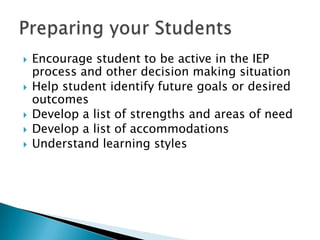
   Encourage student to be active in the IEP
    process and other decision making situation
   Help student identify future goals or desired
    outcomes
   Develop a list of strengths and areas of need
   Develop a list of accommodations
   Understand learning styles
   For students with disabilities, decision
    making is complicated by limited choices and
    the tendency for others to tell the student
    what to do.
   Should you disclose? How?
    ◦ Personal Statement
      accommodations student has used
      what made the student successful
      examples from CHOICES booklet
   Be careful to not “over-disclose”
   Talk with your counselor and/or Transition
    Counselor to discuss how and what to
    disclose
   At most schools you need to meet the
    admissions requirements to be accepted.
    After you are accepted you work through the
    disability support centers to gain
    accommodations.
   In order to get accommodations, you need to
    provide the school or program with
    documentation of the disability
    ◦ Sign off on consent to disclose
    ◦ Ask Case Manager/Transition Coordinator to send
      the documents directly to the school
    ◦ Private testing?
    ◦ Remember that students files are held by the the
      district for 5 years after graduation
   Case Management Model – Schools work on
    an individual basis with students to insure
    success.
   Services Model – School provides appropriate
    accommodations for students based on their
    needs.
   Decisions regarding the exact
    accommodations are made on an individual
    basis.
   College selects the services
   Colleges are not required to provide
    aides, services or devices for personal use or
    study
   Requirements for graduation are the same as
    general population.
   UW – Oshkosh (Project Success)
   UW- Whitewater (Project Assist)
   Southern Illinois University (Achieve
    Program)
   Lynn (Comprehensive Support Program)
   Loras (Learning Disabilities Program)
   University of Arizona (SALT Program)
   U of Indianapolis (BUILD)
   Vincennes University (STEP)
   Lincoln College
   Landmark – specifically for students with LD
    or ADHD

   Beacon – specifically for students with LD
   University   of Wisconsin - Whitewater
   University   of Illinois
   University   of Wisconsin – Madison
   Purdue
   University   of Arizona
   College of Lake County, Harper, Oakton
   Offer a variety of programs both technical
    and academic
   All schools have offices for students with
    disability
   Remedial classes are sometimes necessary

   Some students will not be eligible for CC
    coursework
   Vincennes (STEP Program)
   Lincoln (ADHD) also good for LD
   Ferris State (some two year programs)
   Kirkwood
Some programs focus on basic skills review and
  reinforcement of independent life skills.
 usually have their own contained facility or
  separate facilities on traditional campuses.
 strong vocational component.

 An experiential approach to skill building and
  vocational planning leads to non-degree status
  upon graduation from the program.
 These programs are designed to accommodate
  students whose options may not include traditional
  college
   PACE Program (National Louis)
   ELSA (Elmhurst College)
   Career Foundations (Harper College)
   Personal Success Program (College of Lake
    County)
   Chapel Haven; Westville, Conn.
   Lesley College- Threshold Program;
    Cambridge, MA
   Life Development Institute; Phoenix, AZ
   Minnesota Life College; Richfield, MN
   New York Institute of Technology - VIP Program;
   Riverview School - GROW Program; East
    Sandwich, MA
   Univ. of Alabama - Birmingham; Horizon Program.
   Supported School to Work Transition
    Program, Lewis and Clark Community
    College., Godfrey, Il
   Reach Program, University of Iowa
   A good choice for students with special
    needs?
    ◦ More “hands on” programs
    ◦ Requirements vary but most require subject based
      tests to assess potential for success in the chosen
      program
    ◦ Most schools require a similar work ethic and
      academic component as college
    ◦ Many do not offer anything more than mandated
      accommodations
   Community College Certificate Programs

   Certificate programs are also available
    through vocational programs that are not
    taught in a community college, such as
    through adult education programs or
    specialized vocational schools. In addition,
    some high schools offer vocational classes to
    adults.
   Environmental Technical Institute (ETI)
   Universal Technical Institute (UTI)
   Full Sail
   Flash Point Academy
   Aveda Institute
   Pivot Point Academy
   Cooking and Hospitality Institute of Chicago
    (CHIC)
   ORT Institute
   Usually held on campus and give students a
    “feel” for what college is like
   Both academic and social components
   Not always limited to graduating seniors or
    students who have been accepted to the
    college
   College Living Experience (CLE) -The CLE Summer Program
    Denver, CO
   Colorado Mountain College (CMC) Summer College-Prep
    Program Alpine ADVANTAGE Steamboat Springs, CO
   George Washington University - The GW Summer Scholars
    Washington D.C.
   St. Ambrose University - Davenport, IA
   Curry College -The Learning Academy Milton, MA
   Landmark School -Preparatory Summer Program Prides
  Crossing, MA, South Putney, VT
 Southern Illinois University -Carbondale, IL

Other programs can be found in Naviance
   Keep the students interest in mind
   Do not set the student up for failure
   Apply to a range of programs
   Research
   Campus/Site visits
   Know how student learns and operates
   Help the student to make smart decisions
    regarding college
   CHOICES Fair
    www.postsecondarychoices.org
   OPTIONS Fair
   Transition Coordinator
   Naviance/CareerCruising
   College and Career Center
   College Visits/Internet Exploration
   Heath Center http://www.heath.gwu.edu
   Glenbrook Transition Website
    www.glenbrooktransition.org
Serving Students with Learning Differences and Disabilities

Serving Students with Learning Differences and Disabilities

  • 1.
    Visions of Post-Secondary Education • Julie Smith Transition Specialist
  • 2.
  • 3.
    Life Long Learning Alternative Work Post- Secondary 2 year POST HIGH Technical College SCHOOL School 4 Year College Community College Apprenticeships
  • 6.
    What kind of skills do you need in order to be successful in college? ◦ Strong self motivation in college prep courses ◦ A full scale I.Q. in the average range of intelligence ◦ Solid ability to understand verbal concepts and symbols and to communicate ideas and thoughts both orally and in writing ◦ Understanding of your learning style, including an awareness of your academic strengths and weaknesses ◦ Ability to function independently in the academic environment
  • 7.
    IDEA  ADA ◦ Schools’ ◦ Individual responsibility Responsibility ◦ LRE, quality and free ◦ Focus on accommodations ◦ Individualized ◦ Focus on Planning and related nondiscrimination services and undue hardship ◦ Applies until student ◦ No link between graduates of reaches federal funds and age of 22 compliance with the ◦ Transition services law
  • 8.
    No IEP  No IDEA, working under ADA and 504 regulations  Pay for services  Students must self identify
  • 9.
    Understand the disability and needs  Understand the student’s strengths and how he/she learns best  What strategies are beneficial  Practice becoming a self advocate  Know your rights!
  • 10.
    Encourage student to be active in the IEP process and other decision making situation  Help student identify future goals or desired outcomes  Develop a list of strengths and areas of need  Develop a list of accommodations  Understand learning styles
  • 11.
    For students with disabilities, decision making is complicated by limited choices and the tendency for others to tell the student what to do.
  • 12.
    Should you disclose? How? ◦ Personal Statement  accommodations student has used  what made the student successful  examples from CHOICES booklet  Be careful to not “over-disclose”  Talk with your counselor and/or Transition Counselor to discuss how and what to disclose
  • 13.
    At most schools you need to meet the admissions requirements to be accepted. After you are accepted you work through the disability support centers to gain accommodations.
  • 14.
    In order to get accommodations, you need to provide the school or program with documentation of the disability ◦ Sign off on consent to disclose ◦ Ask Case Manager/Transition Coordinator to send the documents directly to the school ◦ Private testing? ◦ Remember that students files are held by the the district for 5 years after graduation
  • 16.
    Case Management Model – Schools work on an individual basis with students to insure success.  Services Model – School provides appropriate accommodations for students based on their needs.
  • 17.
    Decisions regarding the exact accommodations are made on an individual basis.  College selects the services  Colleges are not required to provide aides, services or devices for personal use or study  Requirements for graduation are the same as general population.
  • 18.
    UW – Oshkosh (Project Success)  UW- Whitewater (Project Assist)  Southern Illinois University (Achieve Program)  Lynn (Comprehensive Support Program)  Loras (Learning Disabilities Program)  University of Arizona (SALT Program)  U of Indianapolis (BUILD)  Vincennes University (STEP)  Lincoln College
  • 19.
    Landmark – specifically for students with LD or ADHD  Beacon – specifically for students with LD
  • 20.
    University of Wisconsin - Whitewater  University of Illinois  University of Wisconsin – Madison  Purdue  University of Arizona
  • 22.
    College of Lake County, Harper, Oakton  Offer a variety of programs both technical and academic  All schools have offices for students with disability  Remedial classes are sometimes necessary  Some students will not be eligible for CC coursework
  • 23.
    Vincennes (STEP Program)  Lincoln (ADHD) also good for LD  Ferris State (some two year programs)  Kirkwood
  • 25.
    Some programs focuson basic skills review and reinforcement of independent life skills.  usually have their own contained facility or separate facilities on traditional campuses.  strong vocational component.  An experiential approach to skill building and vocational planning leads to non-degree status upon graduation from the program.  These programs are designed to accommodate students whose options may not include traditional college
  • 26.
    PACE Program (National Louis)  ELSA (Elmhurst College)  Career Foundations (Harper College)  Personal Success Program (College of Lake County)
  • 27.
    Chapel Haven; Westville, Conn.  Lesley College- Threshold Program; Cambridge, MA  Life Development Institute; Phoenix, AZ  Minnesota Life College; Richfield, MN  New York Institute of Technology - VIP Program;  Riverview School - GROW Program; East Sandwich, MA  Univ. of Alabama - Birmingham; Horizon Program.  Supported School to Work Transition Program, Lewis and Clark Community College., Godfrey, Il  Reach Program, University of Iowa
  • 28.
    A good choice for students with special needs? ◦ More “hands on” programs ◦ Requirements vary but most require subject based tests to assess potential for success in the chosen program ◦ Most schools require a similar work ethic and academic component as college ◦ Many do not offer anything more than mandated accommodations
  • 29.
    Community College Certificate Programs  Certificate programs are also available through vocational programs that are not taught in a community college, such as through adult education programs or specialized vocational schools. In addition, some high schools offer vocational classes to adults.
  • 30.
    Environmental Technical Institute (ETI)  Universal Technical Institute (UTI)  Full Sail  Flash Point Academy  Aveda Institute  Pivot Point Academy  Cooking and Hospitality Institute of Chicago (CHIC)  ORT Institute
  • 32.
    Usually held on campus and give students a “feel” for what college is like  Both academic and social components  Not always limited to graduating seniors or students who have been accepted to the college
  • 33.
    College Living Experience (CLE) -The CLE Summer Program Denver, CO  Colorado Mountain College (CMC) Summer College-Prep Program Alpine ADVANTAGE Steamboat Springs, CO  George Washington University - The GW Summer Scholars Washington D.C.  St. Ambrose University - Davenport, IA  Curry College -The Learning Academy Milton, MA  Landmark School -Preparatory Summer Program Prides Crossing, MA, South Putney, VT  Southern Illinois University -Carbondale, IL Other programs can be found in Naviance
  • 35.
    Keep the students interest in mind  Do not set the student up for failure  Apply to a range of programs  Research  Campus/Site visits  Know how student learns and operates  Help the student to make smart decisions regarding college
  • 36.
    CHOICES Fair www.postsecondarychoices.org  OPTIONS Fair  Transition Coordinator  Naviance/CareerCruising  College and Career Center  College Visits/Internet Exploration  Heath Center http://www.heath.gwu.edu  Glenbrook Transition Website www.glenbrooktransition.org