Group : 2
The idea of selection sort is rather 
simple: we repeatedly find the next 
largest (or smallest) element in the 
array and move it to its final position 
in the sorted array. Assume that we 
wish to sort the array in increasing 
order, i.e. the smallest element at the 
beginning of the array and the largest 
element at the end.
We begin by selecting the largest element 
and moving it to the highest index position. 
We can do this by swapping the element at 
the highest index and the largest element. 
We then reduce the effective size of the array 
by one element and repeat the process on 
the smaller (sub)array. The process stops 
when the effective size of the array 
becomes 1 (an array of 1 element is already 
sorted).
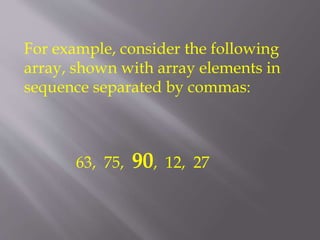
For example, consider the following 
array, shown with array elements in 
sequence separated by commas: 
63, 75, 90, 12, 27
The leftmost element is at index zero, and the 
rightmost element is at the highest array index, in 
our case, 4 (the effective size of our array is 5). 
The largest element in this effective array (index 
0-4) is at index 2. We have shown the largest 
element and the one at the highest index in bold. 
We then swap the element at index 2 with that at 
index 4. The result is: 
60, 75, 27, 12, 90
We reduce the effective size of the array to 
4, making the highest index in the effective 
array now 3. The largest element in this 
effective array(index 0-3) is at index 1, so 
we swap elements at index 1 and 3 
(inbold): 
63, 12, 27, 75, 90
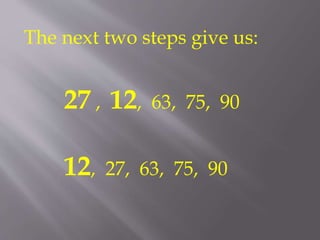
The next two steps give us: 
27 , 12, 63, 75, 90 
12, 27, 63, 75, 90

Selection sort

  • 1.
  • 2.
    The idea ofselection sort is rather simple: we repeatedly find the next largest (or smallest) element in the array and move it to its final position in the sorted array. Assume that we wish to sort the array in increasing order, i.e. the smallest element at the beginning of the array and the largest element at the end.
  • 3.
    We begin byselecting the largest element and moving it to the highest index position. We can do this by swapping the element at the highest index and the largest element. We then reduce the effective size of the array by one element and repeat the process on the smaller (sub)array. The process stops when the effective size of the array becomes 1 (an array of 1 element is already sorted).
  • 4.
    For example, considerthe following array, shown with array elements in sequence separated by commas: 63, 75, 90, 12, 27
  • 5.
    The leftmost elementis at index zero, and the rightmost element is at the highest array index, in our case, 4 (the effective size of our array is 5). The largest element in this effective array (index 0-4) is at index 2. We have shown the largest element and the one at the highest index in bold. We then swap the element at index 2 with that at index 4. The result is: 60, 75, 27, 12, 90
  • 6.
    We reduce theeffective size of the array to 4, making the highest index in the effective array now 3. The largest element in this effective array(index 0-3) is at index 1, so we swap elements at index 1 and 3 (inbold): 63, 12, 27, 75, 90
  • 7.
    The next twosteps give us: 27 , 12, 63, 75, 90 12, 27, 63, 75, 90