Searching and Sorting
4
•Searching refers to finding whether a data item is present in the set of items or not
• Sorting refers to the arrangement of data in a particular order. That is, arranging
items in a particular way
• Sorting and searching have many applications in the area of computers
5.
Searching Algorithms
5
• Thetime required to search depends on the following factors:
– Whether the data is arranged in a particular order or not
– The location of the data to be searched
– The total number of searches to be done
• When the data is arranged in a particular order then, the time taken to search for
the item is less.
• Searching algorithms
– Linear Search
– Binary Search
Sorting
7
• Arranging thedata elements in a particular sequence – in the ascending
order (increasing order) or in the descending order (decreasing order)
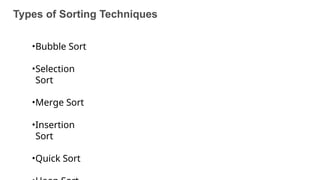
• Sorting Algorithms:
– Selection Sort
– Insertion Sort
– Bubble Sort
8.
Sorting
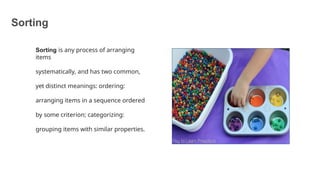
Sorting is anyprocess of arranging
items
systematically, and has two common,
yet distinct meanings: ordering:
arranging items in a sequence ordered
by some criterion; categorizing:
grouping items with similar properties.
8
9.
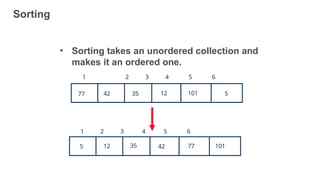
Sorting
77 42 3512 101 5
1 2 3 4 5 6
5 12 35 42 77 101
• Sorting takes an unordered collection and
makes it an ordered one.
1 2 3 4 5 6
9
10.
Complexity of sortingAlgorithm
10
The complexity of sorting algorithm calculates the running time of a function in which 'n'
number of items are to be sorted. The choice for which sorting method is suitable for a
problem depends on several dependency configurations for different problems. The most
noteworthy of these considerations are:
The length of time spent by the programmer in programming a specific sorting
program Amount of machine time necessary for running the program
The amount of memory necessary for running the program
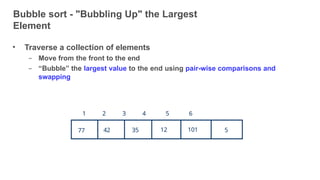
Bubble sort -"Bubbling Up" the Largest
Element
13
• Traverse a collection of elements
– Move from the front to the end
– “Bubble” the largest value to the end using pair-wise comparisons and
swapping
77 42 35 12 101 5
1 2 3 4 5 6
14.
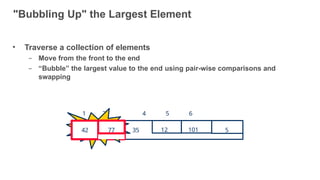
"Bubbling Up" theLargest Element
• Traverse a collection of elements
– Move from the front to the end
– “Bubble” the largest value to the end using pair-wise comparisons and
swapping
5
12
35 101
1 2
3
4 5 6
77 Swap42
42 77
14
15.
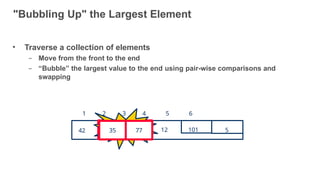
"Bubbling Up" theLargest Element
• Traverse a collection of elements
– Move from the front to the end
– “Bubble” the largest value to the end using pair-wise comparisons and
swapping
5
12
42 101
1 2 3 4 5 6
77 Swap35
35 77
15
16.
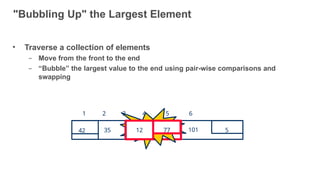
"Bubbling Up" theLargest Element
• Traverse a collection of elements
– Move from the front to the end
– “Bubble” the largest value to the end using pair-wise comparisons and
swapping
5
35
42 101
1 2 3 4 5 6
77 Swap
12
12
16
77
17.
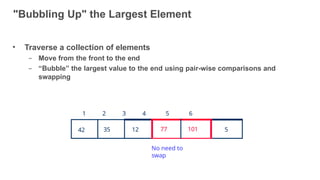
"Bubbling Up" theLargest Element
17
• Traverse a collection of elements
– Move from the front to the end
– “Bubble” the largest value to the end using pair-wise comparisons and
swapping
42 35 12 77 101 5
1 2 3 4 5 6
No need to
swap
18.
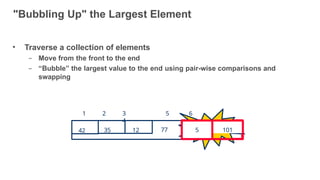
"Bubbling Up" theLargest Element
• Traverse a collection of elements
– Move from the front to the end
– “Bubble” the largest value to the end using pair-wise comparisons and
swapping
77
12
35
42
1 2 3
4
5 6
101 Sw
ap 5
5 101
18
19.
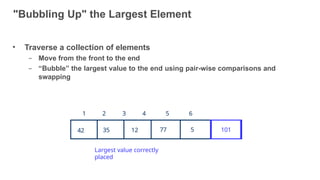
"Bubbling Up" theLargest Element
Largest value correctly
placed
19
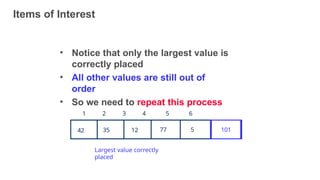
• Traverse a collection of elements
– Move from the front to the end
– “Bubble” the largest value to the end using pair-wise comparisons and
swapping
1 2 3 4 5 6
42 35 12 77 5 101
20.
Items of Interest
Largestvalue correctly
placed
20
• Notice that only the largest value is
correctly placed
• All other values are still out of
order
• So we need to repeat this process
1 2 3 4 5 6
42 35 12 77 5 101
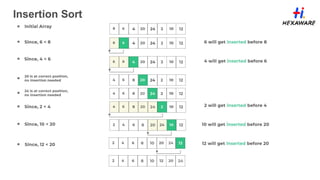
Insertion Sort
22
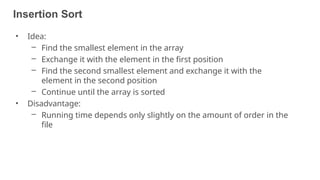
• Idea:
–Find the smallest element in the array
– Exchange it with the element in the first position
– Find the second smallest element and exchange it with the
element in the second position
– Continue until the array is sorted
• Disadvantage:
– Running time depends only slightly on the amount of order in the
file
23.
Insertion Sort
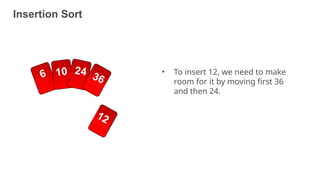
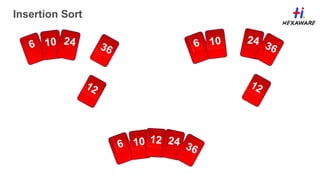
• Toinsert 12, we need to make
room for it by moving first 36
and then 24.
23
76
27
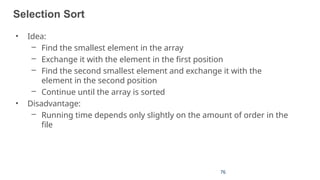
Selection Sort
• Idea:
–Find the smallest element in the array
– Exchange it with the element in the first position
– Find the second smallest element and exchange it with the
element in the second position
– Continue until the array is sorted
• Disadvantage:
– Running time depends only slightly on the amount of order in the
file
28.
• Example: weare
given an array of six
integers that we want
to sort from smallest
to largest
70
60
50
40
30
20
10
0
[1] [2] [3] [4] [5] [6]
28
[0] [1] [2] [3] [4] [5]
Selection Sort
• Part ofthe array is
now
sorted.
70
60
50
40
30
20
10
0
[1] [2] [3] [4] [5] [6]
Sorted side Unsorted side
[0] [1]
32
[2] [3] [4] [5]
Selection Sort
33.
70
60
50
40
30
20
10
0
[1] [[22]] [[33]][[44]] [[55]] [6]
• Find the smallest
element in the
unsorted side.
Sorted side Unsorted side
[0] [1]
33
[2] [3] [4] [5]
Selection Sort
34.
83
70
60
50
40
30
20
10
0
[1] [2] [3][4] [5] [6]
• Swap with the front
of the unsorted
side.
Sorted side Unsorted side
[0] [1] [2] [3] [4] [5]
Selection Sort
35.
84
70
60
50
40
30
20
10
0
[1] [2] [3][4] [5] [6]
• We have increased the
size of the sorted side
by one element.
Sorted side Unsorted side
[0] [1] [2] [3] [4] [5]
Selection Sort
36.
85
70
60
50
40
30
20
10
0
[1] [2] [3][4] [5] [6]
• The
process
continues...
Sorted side Unsorted side
Smallest
from
unsorted
[0] [1] [2] [3] [4] [5]
Selection Sort
37.
70
60
50
40
30
20
10
0
[1] [2] [3][4] [5] [6]
• The process
continues...
Sorted side Unsorted side
[0] [1] [2] [3] [4] [5]
Selection Sort
37
38.
70
60
50
40
30
20
10
0
[1] [2] [3][4] [5] [6]
• The process
continues...
Sorted side Unsorted side
Sorted side
is bigger
[0] [1] [2] [3] [4] [5]
Selection Sort
38
39.
70
60
50
40
30
20
10
0
• The processkeeps
adding one more
number to the
sorted side.
• The sorted side has
the smallest numbers,
arranged from small
to large.
Sorted side Unsorted side
[0] [1] [2] [3] [4] [5]
Selection Sort
[1] [2] [3] [4] [5]
[6][5] [6]
88
40.
70
60
50
40
30
20
10
0
[1] [2] [3][4] [5] [6]
• We can stop when
the unsorted side has
just one number,
since that number
must be the largest
number.
[0] [1] [2] [3] [4] [5]
Sorted side Unsorted side
Selection Sort
40
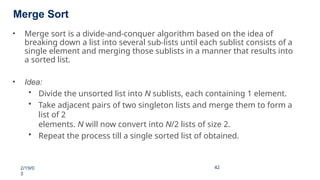
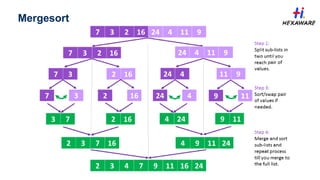
Merge Sort
2/19/0
3
42
42
• Mergesort is a divide-and-conquer algorithm based on the idea of
breaking down a list into several sub-lists until each sublist consists of a
single element and merging those sublists in a manner that results into
a sorted list.
• Idea:
• Divide the unsorted list into N sublists, each containing 1 element.
• Take adjacent pairs of two singleton lists and merge them to form a
list of 2
elements. N will now convert into N/2 lists of size 2.
• Repeat the process till a single sorted list of obtained.
43.
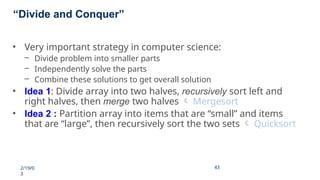
“Divide and Conquer”
2/19/0
3
43
43
•Very important strategy in computer science:
– Divide problem into smaller parts
– Independently solve the parts
– Combine these solutions to get overall solution
• Idea 1: Divide array into two halves, recursively sort left and
right halves, then merge two halves Mergesort
• Idea 2 : Partition array into items that are “small” and items
that are “large”, then recursively sort the two sets Quicksort
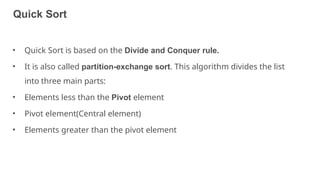
Quick Sort
46
• QuickSort is based on the Divide and Conquer rule.
• It is also called partition-exchange sort. This algorithm divides the list
into three main parts:
• Elements less than the Pivot element
• Pivot element(Central element)
• Elements greater than the pivot element
47.
Quick Sort
47
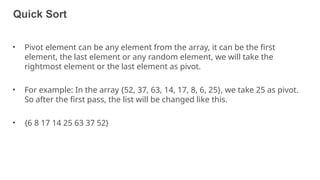
• Pivotelement can be any element from the array, it can be the first
element, the last element or any random element, we will take the
rightmost element or the last element as pivot.
• For example: In the array {52, 37, 63, 14, 17, 8, 6, 25}, we take 25 as pivot.
So after the first pass, the list will be changed like this.
• {6 8 17 14 25 63 37 52}
48.
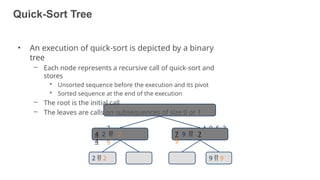
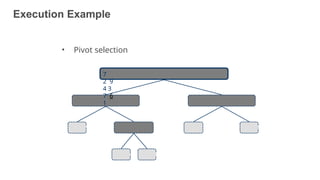
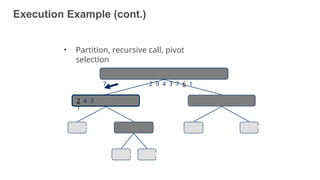
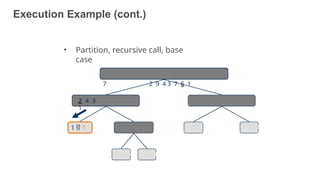
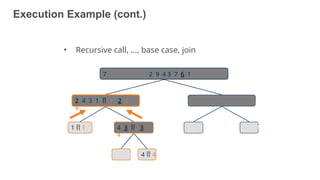
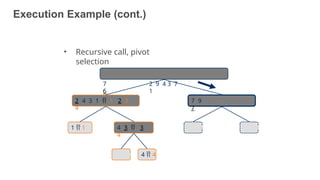
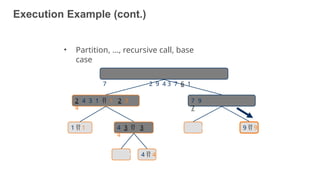
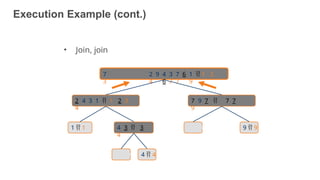
Quick-Sort Tree
• Anexecution of quick-sort is depicted by a binary
tree
– Each node represents a recursive call of quick-sort and
stores
• Unsorted sequence before the execution and its pivot
• Sorted sequence at the end of the execution
– The root is the initial call
– The leaves are calls on subsequences of size 0 or 1
7 4 9 6 2
2 4 6 7
9
4 2 2
4
7 9 7
9
2 2 9 9
48






![• Example: we are
given an array of six
integers that we want
to sort from smallest
to largest
70
60
50
40
30
20
10
0
[1] [2] [3] [4] [5] [6]
28
[0] [1] [2] [3] [4] [5]
Selection Sort](https://image.slidesharecdn.com/2-250507085904-048999ff/85/2-Problem-Solving-Techniques-and-Data-Structures-pptx-28-320.jpg)
![70
60
50
40
30
20
10
0
• Start by finding
the
smallest entry.
29
[1] [2] [3] [4] [5] [6]
[0] [1] [2] [3] [4] [5]
Selection Sort](https://image.slidesharecdn.com/2-250507085904-048999ff/85/2-Problem-Solving-Techniques-and-Data-Structures-pptx-29-320.jpg)
![79
70
60
50
40
30
20
10
0
• Swap the smallest
entry
with the first entry.
[1] [2] [3] [4] [5] [6]
[0] [1] [2] [3] [4] [5]
Selection Sort](https://image.slidesharecdn.com/2-250507085904-048999ff/85/2-Problem-Solving-Techniques-and-Data-Structures-pptx-30-320.jpg)
![80
• Swap the smallest
entry with the first
entry.
70
60
50
40
30
20
10
0
[1] [2] [3] [4] [5] [6]
[0] [1] [2] [3] [4] [5]
Selection Sort](https://image.slidesharecdn.com/2-250507085904-048999ff/85/2-Problem-Solving-Techniques-and-Data-Structures-pptx-31-320.jpg)
![• Part of the array is
now
sorted.
70
60
50
40
30
20
10
0
[1] [2] [3] [4] [5] [6]
Sorted side Unsorted side
[0] [1]
32
[2] [3] [4] [5]
Selection Sort](https://image.slidesharecdn.com/2-250507085904-048999ff/85/2-Problem-Solving-Techniques-and-Data-Structures-pptx-32-320.jpg)
![70
60
50
40
30
20
10
0
[1] [[22]] [[33]] [[44]] [[55]] [6]
• Find the smallest
element in the
unsorted side.
Sorted side Unsorted side
[0] [1]
33
[2] [3] [4] [5]
Selection Sort](https://image.slidesharecdn.com/2-250507085904-048999ff/85/2-Problem-Solving-Techniques-and-Data-Structures-pptx-33-320.jpg)
![83
70
60
50
40
30
20
10
0
[1] [2] [3] [4] [5] [6]
• Swap with the front
of the unsorted
side.
Sorted side Unsorted side
[0] [1] [2] [3] [4] [5]
Selection Sort](https://image.slidesharecdn.com/2-250507085904-048999ff/85/2-Problem-Solving-Techniques-and-Data-Structures-pptx-34-320.jpg)
![84
70
60
50
40
30
20
10
0
[1] [2] [3] [4] [5] [6]
• We have increased the
size of the sorted side
by one element.
Sorted side Unsorted side
[0] [1] [2] [3] [4] [5]
Selection Sort](https://image.slidesharecdn.com/2-250507085904-048999ff/85/2-Problem-Solving-Techniques-and-Data-Structures-pptx-35-320.jpg)
![85
70
60
50
40
30
20
10
0
[1] [2] [3] [4] [5] [6]
• The
process
continues...
Sorted side Unsorted side
Smallest
from
unsorted
[0] [1] [2] [3] [4] [5]
Selection Sort](https://image.slidesharecdn.com/2-250507085904-048999ff/85/2-Problem-Solving-Techniques-and-Data-Structures-pptx-36-320.jpg)
![70
60
50
40
30
20
10
0
[1] [2] [3] [4] [5] [6]
• The process
continues...
Sorted side Unsorted side
[0] [1] [2] [3] [4] [5]
Selection Sort
37](https://image.slidesharecdn.com/2-250507085904-048999ff/85/2-Problem-Solving-Techniques-and-Data-Structures-pptx-37-320.jpg)
![70
60
50
40
30
20
10
0
[1] [2] [3] [4] [5] [6]
• The process
continues...
Sorted side Unsorted side
Sorted side
is bigger
[0] [1] [2] [3] [4] [5]
Selection Sort
38](https://image.slidesharecdn.com/2-250507085904-048999ff/85/2-Problem-Solving-Techniques-and-Data-Structures-pptx-38-320.jpg)
![70
60
50
40
30
20
10
0
• The process keeps
adding one more
number to the
sorted side.
• The sorted side has
the smallest numbers,
arranged from small
to large.
Sorted side Unsorted side
[0] [1] [2] [3] [4] [5]
Selection Sort
[1] [2] [3] [4] [5]
[6][5] [6]
88](https://image.slidesharecdn.com/2-250507085904-048999ff/85/2-Problem-Solving-Techniques-and-Data-Structures-pptx-39-320.jpg)
![70
60
50
40
30
20
10
0
[1] [2] [3] [4] [5] [6]
• We can stop when
the unsorted side has
just one number,
since that number
must be the largest
number.
[0] [1] [2] [3] [4] [5]
Sorted side Unsorted side
Selection Sort
40](https://image.slidesharecdn.com/2-250507085904-048999ff/85/2-Problem-Solving-Techniques-and-Data-Structures-pptx-40-320.jpg)




![UNIT V Searching Sorting Hashing Techniques [Autosaved].pptx](https://cdn.slidesharecdn.com/ss_thumbnails/unitvsearchingsortinghashingtechniquesautosaved-241014040608-74caa0f6-thumbnail.jpg?width=640&height=640&fit=bounds)
![UNIT V Searching Sorting Hashing Techniques [Autosaved].pptx](https://cdn.slidesharecdn.com/ss_thumbnails/unitvsearchingsortinghashingtechniquesautosaved-241126054304-95a69c51-thumbnail.jpg?width=640&height=640&fit=bounds)


